

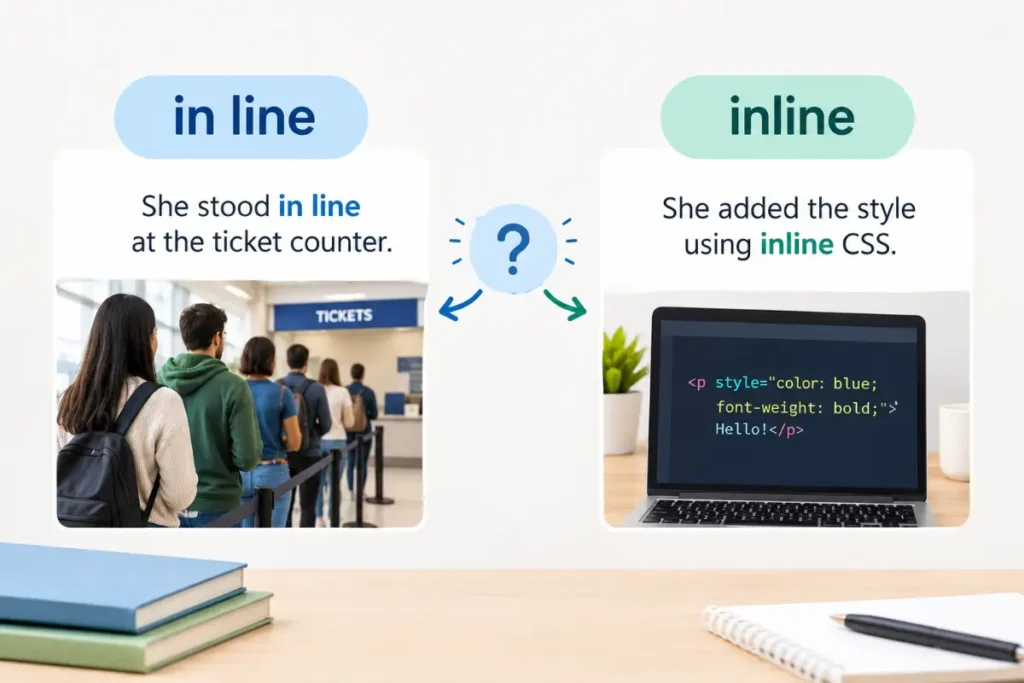
The difference between in line or inline comes down to meaning and context. Both forms are correct in American English, but they don’t mean the same thing in every sentence.
Use “in line” when you mean standing in a queue or following a rule or plan. Use “inline” when you mean something arranged within a line or something built into a larger system. For example, you might stand in line at a store, but you might use inline images in a document.
The confusion comes from the fact that these forms look almost identical. The space between the words may seem minor, yet it can change how readers understand a sentence.
In this guide, you’ll learn how to use each form, spot common mistakes, and choose the right spelling in everyday writing, emails, technical documents, and professional communication.
Quick Definition
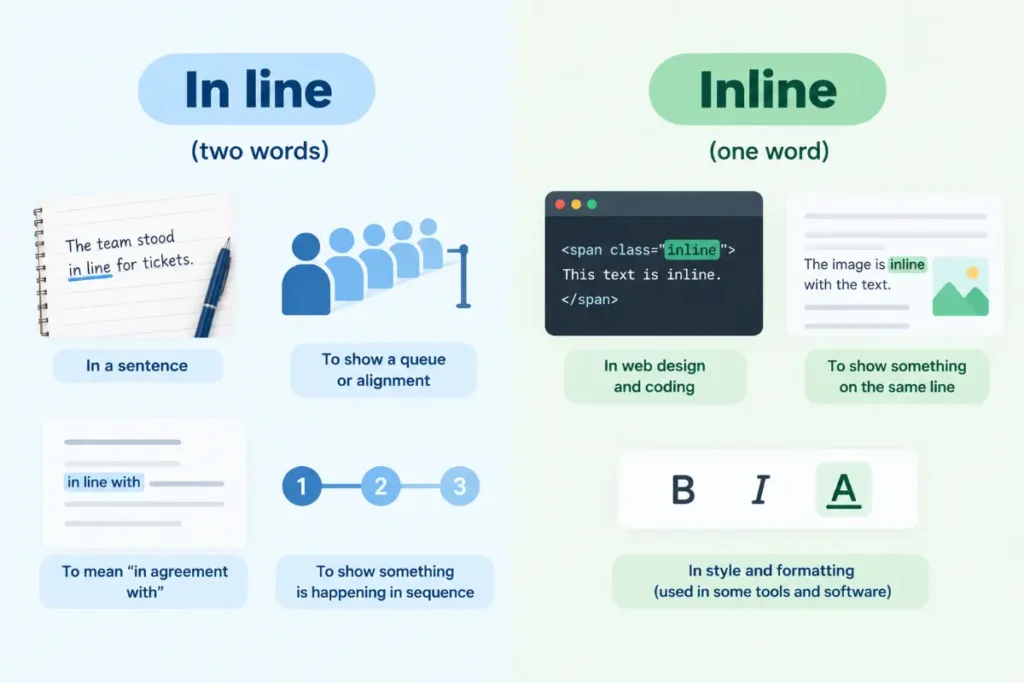
In line is a two word phrase that often means waiting in a queue, being aligned with something, or following an expected rule or plan.
Inline is one word that usually describes something placed within a line of text, built into a larger item, or arranged as part of a continuous sequence.
Direct Answer
Both spellings are correct, but they serve different purposes. Write in line when referring to a queue, alignment, or agreement with a plan. Write inline when describing something integrated into a larger structure or placed within a line of content.
In Line vs Inline at a Glance
| Word or Phrase | Meaning | Example Sentence | When to Use It |
|---|---|---|---|
| In line | Waiting in a queue | We stood in line for coffee. | Queues and waiting. |
| In line | Following a rule or plan | The changes are in line with our goals. | Agreement or consistency. |
| In line | Positioned along the same line | The chairs are in line with the windows. | Physical alignment. |
| Inline | Placed within a line of text or content | The editor added an inline comment. | Writing and editing. |
| Inline | Built into a larger system | The website has an inline search box. | Software and design. |
| Inline | Arranged in a continuous sequence | The inline skates have four wheels in a row. | Equipment and technical uses. |
The easiest way to remember the difference is to look at the job the words perform. The two word phrase often describes a position or relationship. The one word form usually acts as an adjective that describes how something is placed or designed.
When to Use In Line
The phrase in line has several common meanings. It can describe people waiting, objects arranged in a row, or actions that match a rule or expectation.
The words around the phrase usually make the intended meaning clear. Here are the main uses and how they work in everyday American English.
Use In Line When People Are Waiting
One of the most common uses refers to people waiting for their turn. In American English, people often say they are standing in line at a store, bank, restaurant, or ticket counter.
For example.
- We stood in line for twenty minutes to buy concert tickets.
- There’s a long line at the grocery store.
- Please get in line behind the other customers.
- I waited in line to order my lunch.
- The children lined up in front of the school.
In each example, people wait for their turn. The phrase uses two separate words because it describes a person’s position in a queue.
You can also use it with verbs such as stand, wait, get, and stay.
For instance, a parent might tell a child, “Stay in line until your teacher calls your name.” A store worker might ask customers to “get in line at the register.”
These sentences describe a physical queue. They don’t refer to text formatting or a feature built into a computer program.
Use In Line When Something Matches a Rule or Plan
The phrase also means that something agrees with a rule, goal, expectation, or set of instructions.
Consider these examples.
- Your proposal is in line with our company’s goals.
- The new policy is in line with state law.
- Her actions were in line with the team’s expectations.
- The final report is in line with the original plan.
- Our spending needs to stay in line with the budget.
Here, the phrase doesn’t describe people waiting. Instead, it shows that something matches a standard or follows an accepted direction.
This meaning appears often in business writing, school assignments, news reports, and everyday conversations.
Suppose your manager asks you to review a marketing plan. You might say, “The plan is in line with our budget.” This tells your manager that the proposed work fits the available funds.
Likewise, a teacher might say that a student’s answer is in line with the lesson. The answer fits what the student learned.
A useful clue is the word that follows the phrase. Words such as goals, rules, standards, expectations, and policies often point to this meaning.
Use In Line When Objects Are Aligned
You can also use the phrase to describe objects positioned along a straight or shared line.
For example.
- The desks are in line with the windows.
- Make sure the picture is in line with the top shelf.
- The runners stood in line at the starting mark.
- The fence is in line with the edge of the garden.
- Keep the labels in line with the boxes below them.
In these sentences, the phrase describes position. It tells the reader how one object relates to another.
However, the exact wording can depend on what you mean. If several objects form a row, you can say they are in a line. If one object matches the position of another, in line with may be a better fit.
For example, “The chairs are in a line” describes the chairs forming a row. “The chairs are in line with the windows” describes their position relative to the windows.
Both sentences are correct, but they give the reader different information.
Use In Line When Describing Expected Behavior
The phrase can also refer to behavior that follows accepted rules or standards.
For example.
- The employee’s conduct was in line with company policy.
- The decision was in line with what the board expected.
- Her response was in line with the school’s guidelines.
- The team’s actions stayed in line with the coach’s instructions.
This meaning is closely related to agreement and consistency. Something is in line when it fits the standard used to judge it.
You might hear this expression in a workplace discussion. A supervisor could say, “Please keep your work in line with the project’s requirements.” The supervisor wants the work to meet the agreed standards.
In everyday speech, you can often replace the phrase with consistent with, in agreement with, or in keeping with. The best replacement depends on the sentence.
For example, “The decision is in line with our values” could become “The decision is consistent with our values.” Both versions express a similar idea.
Common Expressions That Use In Line
Several everyday expressions use the two word form. Learning these phrases can help you recognize the correct spelling without stopping to think about it.
| Expression | Meaning | Example |
|---|---|---|
| Stand in line | Wait for a turn | We stood in line for ice cream. |
| Get in line | Join a queue | Get in line near the entrance. |
| Wait in line | Remain in a queue | I had to wait in line for an hour. |
| In line with | Consistent with something | The changes are in line with our plan. |
| Keep in line | Maintain order or control | The teacher worked to keep the class in line. |
| Fall in line | Follow instructions or join a group | The team agreed to fall in line with the new rules. |
| Next in line | The next person or thing due for a turn | You’re next in line for service. |
Some expressions have figurative meanings. For instance, fall in line can mean accepting instructions or following the behavior of a group. It doesn’t always describe people physically joining a queue.
Similarly, keep someone in line can mean making sure a person follows rules. Context tells you which meaning applies.
When to Use Inline
The one word form usually describes something placed inside a larger structure or designed as part of a connected sequence. It’s common in writing, web design, software, engineering, and sports equipment.
Although the specific meaning changes across fields, the spelling remains one word when it functions as the established term.
Use Inline When Referring to Text and Editing
In writing and editing, the term often describes material placed directly within the main text rather than in a separate location.
For example.
- The editor left an inline comment beside the sentence.
- Please add an inline citation to support this claim.
- The teacher made inline corrections to the essay.
- The article includes inline links to related resources.
- The writer inserted an inline note for the reviewer.
In each sentence, the item appears within the content itself. The reader doesn’t need to look in a separate document or section to find it.
Imagine reviewing a draft with a colleague. Your colleague highlights a sentence and adds a comment directly beside it. That comment is an inline comment because it appears within the document at the relevant spot.
An endnote works differently. It appears in a separate section, often near the end of a document. A footnote appears at the bottom of a page. An inline note appears within the main content or directly alongside it.
These terms describe different ways to place supporting information. Choosing the right one helps readers understand how a document is organized.
Use Inline When Referring to Websites
Web designers often use the term to describe elements that appear within a webpage or a specific section of content.
Examples include inline images, inline links, inline forms, and inline error messages.
Consider these sentences.
- The article contains an inline image.
- Add an inline link to the product page.
- The website displays inline error messages when a form has missing information.
- The developer placed an inline search field near the page heading.
- The editor used inline formatting to emphasize a key phrase.
An inline image appears within the content instead of sitting in a separate gallery. An inline link forms part of a sentence or paragraph. An inline error message appears near the field or control that needs attention.
For example, a registration form might show “Enter a valid email address” right below the email field. That message is inline because it appears in the form where the problem occurs.
The term helps distinguish an element’s placement from other ways to display it. A popup may appear over the page. A sidebar may sit beside the main content. An inline element appears within the relevant content or layout.
The exact technical behavior depends on the website or application, but the spelling is still one word.
Use Inline in Software and Programming
In software, inline can describe code, data, or functions placed directly in a particular part of a program instead of being handled separately.
The meaning depends on the programming language and the feature involved. Still, the central idea is often direct placement within a larger structure.
For example.
- The developer added an inline comment to explain the code.
- The tool supports inline editing of table cells.
- The application displays inline validation messages.
- The programmer used an inline function for a small operation.
- The editor lets users change text without opening another screen.
An inline comment appears within the source code and explains a nearby instruction. Inline editing lets a user change content directly where it appears. Inline validation displays feedback near the field or input that needs attention.
The phrase also appears in programming discussions about inline functions. Depending on the language, an inline function may suggest that the compiler can substitute a function’s code at the point of use. The exact behavior depends on the language and compiler, so the word doesn’t always guarantee that substitution will happen.
You don’t need to know how programming works to remember the spelling. When the word describes a built in feature or something placed within code or an interface, the one word form is generally the standard choice.
Use Inline When Talking About Formatting
The word also appears in word processing, publishing, and graphic design.
Inline formatting applies to content within a line or block of text. It can affect how words, symbols, or other elements appear without moving them into a separate section.
Examples include.
- The editor applied inline styling to the selected words.
- The document uses inline code to show short commands.
- The writer added an inline reference after the claim.
- The page displays inline icons beside the menu labels.
- The software supports inline changes to text color.
The term is useful because it describes where the formatting or element appears. It doesn’t automatically tell you which font, color, size, or layout to use.
For example, inline code may appear in a different font from the surrounding sentence. An inline icon may sit beside a label. An inline reference may appear immediately after a statement.
The defining feature is its place within the surrounding content.
Use Inline When Referring to Inline Skates
In sports and recreation, inline is part of the name inline skates. These skates have wheels arranged in a single row rather than in two parallel pairs.
For example.
- She bought a pair of inline skates for the summer.
- Inline skating is a fun way to exercise outdoors.
- He wears protective gear when using his inline skates.
- The park has a smooth path for inline skating.
The word describes the wheel arrangement. It doesn’t mean the skates are waiting in a queue or following a rule.
This example is especially useful because it shows how a single word can become part of an established name. You wouldn’t normally write in line skates when referring to this type of sporting equipment.
Use Inline in Engineering and Technical Fields
In technical writing, inline often describes a part or device installed directly within a larger system.
For example, an inline filter may sit within a pipe or fluid system. An inline switch may be built into a cable. An inline sensor may measure conditions within a process.
Consider these sentences.
- The technician installed an inline filter in the water system.
- The cable has an inline switch.
- The engineer checked the inline sensor.
- The system uses an inline pump to move fluid through the pipe.
The term suggests that the component forms part of the system’s path or arrangement. The exact design depends on the device.
You may see the word in product manuals, repair guides, equipment descriptions, and technical specifications. In these settings, writing it as one word helps match common industry usage.
However, technical terms can have precise meanings that vary by field. If you’re editing a manual or product page, follow the spelling used in the relevant standard or manufacturer’s documentation.
Why the Two Spellings Get Confused
The main reason people mix up these forms is that they sound the same when spoken. You can’t hear the space between two words, so you have to rely on meaning and context.
Both forms can also appear in professional writing. One may describe a position or relationship, while the other describes an object, feature, or arrangement.
They Sound the Same
When someone says “in line,” the listener hears the same basic sounds as the word “inline.” This makes the difference hard to notice in conversation.
For example, imagine hearing these two sentences.
- The customers are in line.
- The website offers inline editing.
The first sentence describes customers waiting for their turn. The second describes a feature that lets people edit content directly in a website or application.
The meanings are different even though the forms sound alike. This is why spelling depends on what you want to say rather than how the words sound.
Both Forms Appear in Professional Writing
You may encounter both spellings in an office, school, or technical setting. This can make the distinction seem more complicated than it really is.
Consider these examples.
- The proposal is in line with our budget.
- The report includes inline comments.
Both sentences are correct. The first uses a two word phrase to express agreement with a budget. The second uses a single word to describe comments placed within a report.
The surrounding words provide a useful clue. If you’re talking about matching a plan or following a standard, the two word form often fits. If you’re describing an element placed inside content or built into a system, the one word form is usually appropriate.
Some Meanings Overlap in Everyday Use
The two forms can both relate to arrangement or position. That shared idea can cause confusion, especially when people use them without thinking about the exact meaning.
For example, inline may describe elements arranged along a line. The phrase in line can also describe objects that share a straight alignment.
However, the forms aren’t freely interchangeable. An established term such as inline skates uses one word. The expression in line with company policy uses two.
The safest approach is to learn common expressions as complete phrases. Once you recognize them, you won’t need to guess at the spelling every time.
Common Mistakes to Avoid
Knowing the basic rule is helpful, but real sentences can still be tricky. These examples show mistakes writers often make and how to fix them.
Writing In Line Skates Instead of Inline Skates
Incorrect: She bought new in line skates.
Correct: She bought new inline skates.
Inline skates is the standard name for skates with wheels arranged in a single row. The word functions as part of the equipment’s name, so it stays together.
The same rule applies when discussing the sport. Write inline skating rather than in line skating when referring to the activity involving inline skates.
Writing Inline With Company Policy
Less suitable: The decision is inline with company policy.
Preferred: The decision is in line with company policy.
In standard American English, the usual expression for agreement with a policy is in line with. The phrase uses two words because it describes how the decision relates to a standard.
The same pattern applies to goals, expectations, rules, and plans.
- Her work is in line with the team’s goals.
- The proposal is in line with our budget.
- The changes are in line with federal guidelines.
Although you may see inline with in informal writing, technical material, or specialized contexts, don’t use it as a replacement for the established expression without a good reason.
Confusing In Line With In a Line
These expressions are related, but they don’t always communicate the same idea.
Consider these sentences.
- The students stood in a line.
- The students stood in line for lunch.
The first sentence describes the students’ arrangement. The second usually means the students were waiting for lunch.
You can use in a line when you want to emphasize a row or formation. Use in line when you mean waiting for a turn or when the surrounding phrase calls for that expression.
For example, “The chairs are in a line beside the wall” describes their arrangement. “We waited in line beside the wall” describes people waiting.
Using Inline for Every Kind of Alignment
The word inline doesn’t automatically replace every phrase that describes something arranged in a row.
For example, you might write, “The desks are in line with the windows.” That sentence describes how the desks align with the windows.
In a software manual, however, you might write, “The application supports inline editing.” That describes a feature built into the interface.
The subject matters. Use the word that fits the established meaning rather than choosing the one that looks shorter.
Assuming One Form Is Always More Formal
Neither spelling is automatically more professional than the other. Both are standard when used in the right context.
A business email can correctly say, “The proposal is in line with our goals.” A technical report can correctly describe an inline sensor.
Professional writing depends on accuracy, clarity, and consistent usage. Choosing the shorter spelling simply because it looks modern won’t improve a sentence if the meaning calls for two words.
How to Remember the Difference
A simple memory trick can help you choose the correct form quickly. Focus on the meaning instead of the sound.
Think About a Queue or a Connection
Use in line when you think about people waiting, something following a standard, or one object aligning with another.
For example.
- I’m in line at the coffee shop.
- The plan is in line with our goals.
- The shelf is in line with the top of the cabinet.
Use inline when you think about something placed inside content or integrated into a system.
For example.
- The document has an inline note.
- The website supports inline editing.
- The device contains an inline switch.
You can remember the difference this way. The two word phrase often tells you where something stands or how it relates to a standard. The single word often tells you how something is built, placed, or displayed.
This isn’t a rule that covers every technical use, but it works well for common writing situations.
Learn Common Phrases as Whole Units
Some expressions are easier to remember as complete phrases instead of separate words.
Keep these examples in mind.
| Correct Expression | Why It Works |
|---|---|
| Stand in line | Describes waiting for a turn. |
| In line with the rules | Describes agreement with a standard. |
| Inline comment | Describes a comment placed within content. |
| Inline editing | Describes editing content in place. |
| Inline skates | Names a type of skate. |
| Inline filter | Describes a component installed within a system. |
When you learn the full expression, the spelling becomes easier to recall. You won’t need to rebuild the phrase from scratch every time you write it.
Check the Meaning Before You Check the Spelling
If you’re unsure, pause and ask what the sentence is trying to express.
Does it describe people waiting? Does it mean something follows a rule? Does it refer to a feature built into a document, website, or device?
For instance, consider the sentence, “The comments appear ___ the article.”
If the comments appear within the article itself, inline is the natural choice. Now consider, “The decision is ___ with our values.” The established expression is in line with.
The meaning points you toward the correct spelling.
In Line or Inline in Different Writing Situations
The best choice can become clearer when you look at how each form appears in common types of writing.
In Emails and Business Documents
Use in line with when explaining that a decision, proposal, or action follows a plan or standard.
Examples include.
- The updated schedule is in line with the client’s request.
- Our spending remains in line with the approved budget.
- The revised policy is in line with company guidelines.
- Her performance is in line with the team’s expectations.
Use inline when describing content placed directly inside an email or document.
For example, an email editor might support inline images or inline comments. A reviewer might add inline suggestions to a shared document.
These uses serve different purposes. One describes agreement with a standard. The other describes where content appears.
In School and Academic Writing
Students often encounter both forms in essays, reports, and online learning tools.
For example, a student might write, “My argument is in line with the evidence.” This means the argument agrees with the information presented.
A teacher might add an inline comment to point out a grammar error. The comment appears beside the sentence that needs attention.
Academic writing also uses inline citations in some citation styles and formats. These citations appear within the main text rather than only in a list of references.
For example, a paper might include a brief author and date reference within a sentence. The exact format depends on the required style guide.
If your instructor requests inline citations, follow the rules for the assigned citation style. Don’t assume that every type of citation belongs in the same place.
In Web Content and SEO Writing
Writers and editors may use inline links, images, references, or notes within an article.
An inline link appears as part of the text and takes readers to another page. An inline image appears within the article’s content. An inline reference provides a source or supporting detail near the claim it relates to.
For example.
- Add an inline link to the official product page.
- Place an inline image after the first section.
- Use an inline citation to support the statistic.
- Add an inline note to explain an unfamiliar term.
The phrase in line with also appears in SEO and content planning when writers discuss matching a page to a searcher’s needs or following editorial guidelines.
For example, “The article is in line with our content standards” means the article meets those standards.
Don’t confuse this expression with inline formatting. One describes agreement with a standard. The other describes the placement of content.
In Technical Instructions
Technical documents often contain terms such as inline filter, inline switch, inline code, and inline sensor.
These terms can describe specific parts or features. The one word spelling is common because inline acts as a modifier that tells readers how the component fits into a larger system.
For example.
- Check the inline filter for blockages.
- Use the inline switch to turn off the device.
- Copy the inline code into the editor.
- Inspect the inline sensor before restarting the system.
Technical writing should follow the terminology used by the product maker or the relevant industry. If a manual uses a specific established term, keep that wording consistent throughout the document.
In Everyday Conversation
In casual speech, people usually understand the meaning from context. The distinction matters most when you write the words down.
For example.
- We’re in line for movie tickets.
- The new rule is in line with what we expected.
- I added an inline photo to the message.
- The app lets me make inline changes.
These sentences sound natural in American English. Each uses the spelling that fits its meaning.
When speaking, you don’t need to worry about a visible space. When writing, choosing the correct form helps your reader understand the sentence without stopping to interpret it.
Related Terms That Can Cause Confusion
The difference between the two spellings becomes easier to understand when you compare them with similar expressions.
In Line vs In a Row
Both expressions can describe objects arranged next to one another, but they place different emphasis on the arrangement.
- The books are in a row on the shelf.
- The chairs are in line with the windows.
- The students stood in a row for the photograph.
- The customers waited in line for their turn.
In a row usually describes an arrangement of items or people. In line can describe alignment, but it also commonly refers to waiting.
For example, “The books are in a row” tells you how the books are arranged. “The books are in line with the edge of the desk” tells you how their position matches another object.
Choose the phrase that communicates the relationship you want to describe.
Inline vs Embedded
The words inline and embedded sometimes describe similar ideas, especially in digital content. However, they don’t always mean the same thing.
Inline usually emphasizes placement within a line, document, interface, or system. Embedded often means that something is built into or included within another item.
For example, an inline image appears within the flow of an article. An embedded video may appear inside a webpage instead of opening on a separate page.
The terms can overlap in some settings. Still, don’t treat them as exact synonyms. Use the word that best describes the feature you’re discussing.
Inline vs In Line With
This is one of the most useful distinctions to remember.
Use inline to describe something placed within content or integrated into a system.
Use in line with to describe something that agrees with a rule, plan, standard, or expectation.
Compare these sentences.
- The editor added an inline comment.
- The editor’s changes are in line with our style guide.
The first sentence describes the placement of a comment. The second describes how the changes match the guide.
The words after the phrase often reveal the intended meaning. When you see with followed by a word such as policy, plan, goals, or expectations, the two word expression is usually the right choice.
FAQs
Is In Line One Word or Two Words?
In line is two words when it refers to waiting, alignment, or agreement with a standard. Inline is one word when it describes something placed within content or integrated into a system. The correct spelling depends on the meaning of your sentence.
Is Inline Correct in American English?
Yes. Inline is a standard spelling in American English. You’ll see it in terms such as inline editing, inline comments, inline images, and inline skates.
Should I Write In Line With or Inline With?
Use in line with when you mean consistent with or in agreement with something. For example, “The decision is in line with our policy.” This is the standard expression for describing agreement with a rule or expectation.
Is It In Line or Inline When Waiting for Someone?
Use in line when talking about waiting for a turn. For example, “I’m in line to buy tickets.” The same spelling applies when you tell someone to get in line or wait in line.
What Does Inline Mean in Writing?
In writing, inline usually describes content placed within the main text. An inline comment appears beside the relevant text, while an inline citation appears within the text to support a statement. The exact use depends on the document and its style rules.
Is Inline Hyphenated?
No. The standard spelling is inline, written as one word without a hyphen. However, a specialized term or a particular style guide may have its own requirements, so follow the accepted spelling for the context you’re writing about.
What Is an Example of In Line With?
A common example is “The new schedule is in line with our original plan.” This means the schedule matches or agrees with the plan. You can use the same expression with goals, rules, policies, standards, and expectations.
How Can I Remember the Difference Between In Line and Inline?
Think about meaning first. Use in line for waiting, alignment, or agreement with a standard. Use inline for something placed within content or built into a larger system.
Conclusion
The choice between in line or inline depends on what you mean. Both forms are correct in American English, but they aren’t interchangeable in every sentence.
Use in line when describing people waiting for a turn, objects aligned with something, or actions that match a plan or standard. Use inline when describing something placed within text, built into a website, or integrated into a larger system.
If you get stuck, look at the words around the phrase. Expressions such as in line with company policy take two words. Terms such as inline comments, inline editing, and inline skates use one.
Remember the meaning, and the spelling becomes much easier to choose. A quick check before you publish can help you keep your writing clear and correct.

Sienna Watson is a veteran copywriter and communications coach who has helped startup founders, marketers, and professionals polish their writing for over a decade. Realizing that most people don’t need a degree in linguistics—just clear, impactful communication—Sienna focuses on practical grammar, business writing etiquette, and eliminating wordiness. She advocates for plain language, strong verbs, and persuasive prose that gets results.