
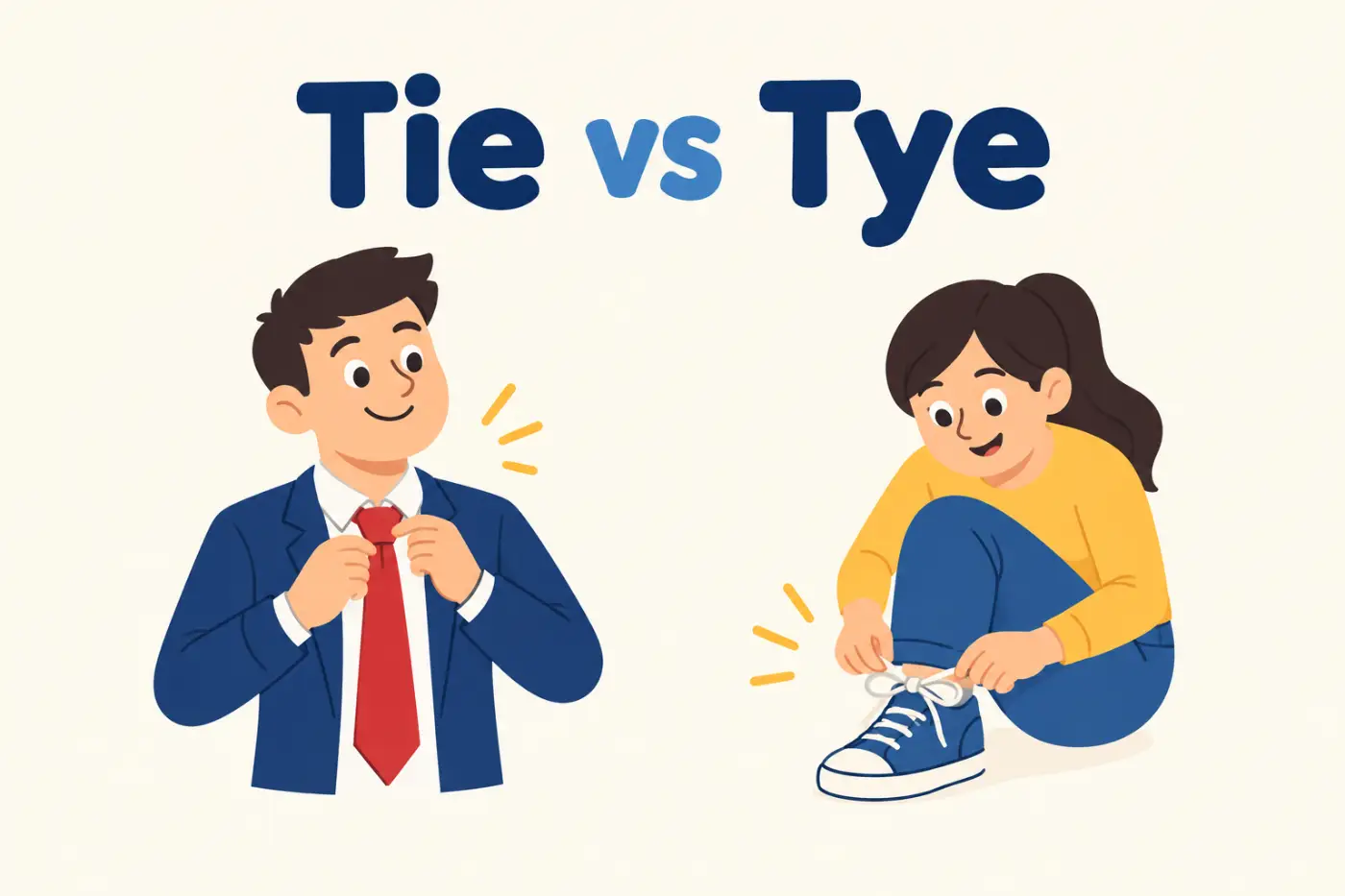
If you’re unsure about tie vs tye you’re probably wondering which spelling belongs in your sentence. The answer is simple. Tie is the standard English spelling. Tye is not normally used as the spelling of the common word for fastening something or connecting two things.
The word tie has several meanings. You can tie your shoes. You can tie two pieces of string together. You can wear a tie with a dress shirt. You can also tie with another person in a game when both sides finish with the same score. Because one word has so many uses it shows up often in everyday writing.
The spelling mistake usually comes from the sound of the word. Tie and tye would sound the same if someone pronounced both forms. That can make the spelling easy to guess incorrectly. Once you know the correct form and a few related words you won’t need to second guess it.
This guide explains the correct spelling and the different meanings of tie. You’ll also see common examples. We’ll look at phrases people often use with the word and explain why tye sometimes appears in names or older sources even though it isn’t the standard spelling of the common English word.
Quick Definition
Tie is the standard spelling of the English word used for fastening things together or connecting them. It can also mean a piece of clothing worn around the neck or an equal result in a contest. Tye is not the standard spelling for these common meanings.
Direct Answer
Tie is the correct spelling for the common English word. Use tie for the verb and noun in ordinary writing.
Comparison Table
| Word | Meaning | Example Sentence | When To Use It |
|---|---|---|---|
| Tie | To fasten or connect something or to have an equal result. | Please tie your shoes before you leave. | Use it in standard English writing. |
| Tie | A narrow piece of clothing worn around the neck. | He wore a blue tie to the wedding. | Use it when talking about neckwear. |
| Tye | Not the standard spelling of the common word. | This spelling is incorrect in ordinary usage. | Avoid it unless it is part of a proper name or specific term. |
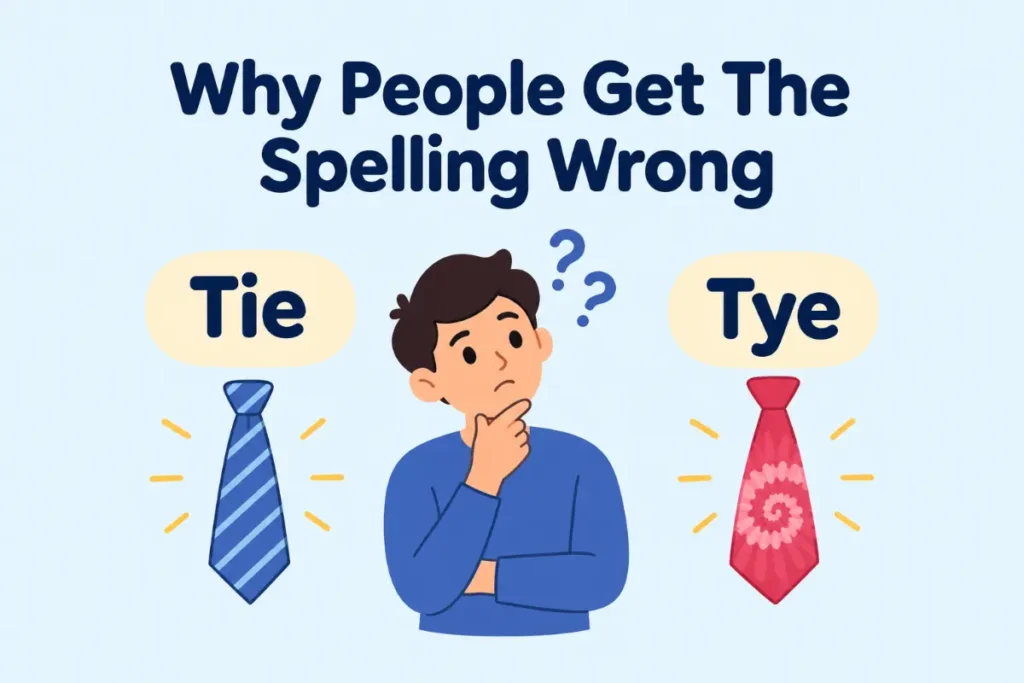
Why People Get The Spelling Wrong
The main reason people make this mistake is pronunciation. English has many words whose spelling cannot be predicted perfectly from the way they sound. When you hear the word tie you may naturally think that it could be written with a y.
That guess makes sense if you are sounding the word out. English uses the letter y in many words where it represents a long vowel sound. Words such as my and cry are familiar examples. Still tie follows a different spelling pattern.
The correct form uses the letters ie. The same pattern appears in several familiar words. Die uses the same vowel combination. So does lie and pie. Seeing these words together can help you remember the spelling.
There is another reason the wrong form can look familiar. Tye does appear in some proper names and specialized terms. A person may see it as a surname or part of a place name and assume it is another accepted spelling of the everyday word. In standard writing that assumption would be incorrect.
When you mean the action of fastening something the piece of clothing or an equal result in a contest use tie.
The Correct Spelling Of Tie
The word is spelled with t followed by i and e.
The correct form is:
Tie
The incorrect form for ordinary use is:
Tye
There is no spelling rule that changes tie into tye based on its meaning. The same spelling works across its common uses.
For example you might write:
- Tie the bag before you put it in the trash.
- I need to buy a new tie for work.
- The two teams ended in a tie.
- Tie the ribbon around the box.
- She learned how to tie a knot.
The meaning changes from sentence to sentence but the spelling stays the same.
What Does Tie Mean As A Verb
As a verb tie means to fasten something with a knot or another method. It can also mean to connect or secure two things.
When you tie your shoes you use the laces to hold the shoes securely on your feet. When you tie a package you use string or ribbon to keep it closed.
Here are some natural examples.
- Please tie your shoes before the race starts.
- I tied the bag tightly so nothing would fall out.
- She tied a ribbon around the gift.
- He tied the rope to the fence.
- Tie these two pieces of string together.
The word can also describe connecting ideas or things in a less physical way.
For example you might say that a person’s success is tied to their hard work. In that sentence no rope or string is involved. The word means closely connected.
- Her confidence is tied to her preparation.
- The company’s growth is tied to customer demand.
- Good sleep is closely tied to healthy habits.
This broader meaning is common in everyday English. It describes a strong connection between two things.
What Does Tie Mean As A Noun
Tie can also be a noun. One common meaning is a piece of clothing worn around the neck with a dress shirt.
For example:
- He wore a red tie to the interview.
- My brother bought a new tie for his graduation.
- That tie goes well with your shirt.
- I forgot to pack my tie for the wedding.
Tie can also mean an equal result in a competition. If two teams or players finish with the same score the game can end in a tie.
For example:
- The game ended in a tie.
- The teams are tied at two goals each.
- Neither player could take the lead so the match ended in a tie.
This meaning is especially common in sports.
The noun can also refer to something that connects people or things. Family ties are connections between family members. Social ties are connections between people in a community.
For example:
- She has strong family ties to the area.
- Their friendship created a lasting tie between the two families.
So although tie looks like a simple word it has a surprisingly wide range of uses.
Tie In Everyday Writing
You’ll see tie in many ordinary situations. It can describe clothing food packaging sports relationships crafts and physical tasks.
Consider a morning routine. You might tie your shoes before leaving home. Someone going to an office might put on a tie. Later that day two coworkers might finish a game with a tie.
The word works naturally in all three situations.
- I tied my shoes before walking to the store.
- He wore a tie to the office.
- Our team finished the season with one tie.
This flexibility is one reason learning the correct spelling matters. A single spelling mistake can appear in many different types of writing.
Common Phrases With Tie
Learning common phrases can make spelling easier. Instead of memorizing the word by itself you begin to recognize it as part of familiar expressions.
Tie Your Shoes
This is one of the first phrases many children learn.
- I taught my son how to tie his shoes.
- Make sure you tie your shoes before running.
Tie The Knot
To tie the knot is an informal expression meaning to get married.
- They plan to tie the knot next summer.
- My cousin tied the knot last weekend.
The phrase uses tie because it comes from the idea of tying a knot. It is often used in friendly conversation and informal writing.
Tie Together
This phrase means to connect two or more things.
- The final chapter ties the whole story together.
- These colors tie the room together.
The second example uses tie in a figurative sense. The colors do not literally connect. Instead they make the different parts of the room feel connected.
Tie Up
Tie up can have several meanings. It can mean to secure something with a knot. It can also mean to finish or deal with something.
- Tie up the package before sending it.
- I need to tie up a few loose ends before I leave.
The second example is an idiom. Loose ends are unfinished tasks or details. The phrase means to finish those remaining tasks.
Tie In
Tie in means to connect one thing with another.
- This example ties in with the main idea.
- The new lesson ties in with what we learned yesterday.
This phrase is common in school writing business writing and everyday speech.
Tie In Sports
Sports provide another common use of tie. A tie happens when competitors finish with the same score or result.
For example a soccer match might finish with both teams scoring two goals. If the competition allows an equal result the match may be recorded as a tie.
You might read:
- The game ended in a 2 to 2 tie.
- The teams played to a tie.
- The match was tied after regulation time.
The verb form is also common.
- The teams are tied at three points each.
- The score was tied with only two minutes left.
Notice the difference between these sentences. Tied describes the state of the score. Tie can name the result.
This distinction is useful when writing about sports because both forms appear frequently.
Tie As A Clothing Word
Tie is also the standard word for the narrow piece of clothing worn around the neck. It is often worn with a dress shirt and a suit.
You may hear people talk about a necktie when they want to be very specific. Necktie and tie usually refer to the same item.
For example:
- He chose a simple black tie.
- She helped him choose a tie for the interview.
- The dress code requires a shirt and tie.
- His tie matched his jacket.
The spelling does not change in any of these examples.
Tie As A Connection
Another useful meaning of tie is a connection between people places or ideas.
Family ties describe connections among relatives. A person’s ties to a city can describe their personal or professional connection to that place.
For example:
- She has strong family ties in Texas.
- He has close ties to the local community.
- The school has ties with several nearby colleges.
This meaning can also appear in discussions about history culture and relationships.
A tie does not always mean a physical connection. It can describe something that links people or ideas together.
Tie And Tied
A common question involves the difference between tie and tied. The base form is tie. The past tense and past participle are tied.
The spelling changes because the word ends in ie.
For example:
- I tie my shoes every morning.
- Yesterday I tied my shoes before leaving.
- She ties her hair back when she works.
- She tied her hair back before the workout.
The same pattern appears in other words that end in ie.
Lie becomes lied when it means to tell an untruth. Die becomes died. Untie becomes untied.
Learning this pattern can help you avoid another common spelling mistake. You should not write tye as the base form simply because tied contains a different letter pattern.
Tie And Ties
The plural form is ties.
You add s to tie rather than changing the spelling.
For example:
- He owns several ties.
- Strong family ties can last for generations.
- The two countries have close economic ties.
The same spelling works for the clothing item and the idea of a connection.
Tie And Tying
The present participle and gerund form is tying. This is where the spelling changes in a way that can confuse people.
When you add ing to tie you remove the final e and add ing. The result is tying.
For example:
- She is tying her shoes.
- He spent ten minutes tying the rope.
- I am tying the package now.
The word is not tieing. That spelling is incorrect.
This change follows a familiar English spelling pattern. Many verbs that end in a silent e drop that e before adding ing.
Write:
- Tie.
- Tied.
- Ties.
- Tying.
Seeing the complete word family together makes the pattern easier to remember.
Tie And Untie
The opposite of tie is untie. To untie something means to loosen or remove a knot.
For example:
- Please untie the package carefully.
- I couldn’t untie the knot.
- She untied her shoes after the race.
The word still contains tie. Adding un changes the meaning but not the spelling of the base word.
This is useful because it gives you another way to recognize the correct form. If you know that untie is spelled with ie you can connect it to tie.
Tie And Retie
Retie means to tie something again.
For example:
- I had to retie my shoe.
- She retied the ribbon after it came loose.
- He stopped to retie the rope.
Again the spelling keeps the original form. The word is built from re plus tie.
These related words give you more exposure to the correct spelling without needing to memorize a separate rule every time.
Common Mistakes With Tie
The most common error is replacing ie with ye and writing tye. That mistake usually happens because the spelling does not seem obvious from pronunciation.
Another mistake appears when people write tieing instead of tying. The correct form removes the final e before adding ing.
Some writers also confuse tie with words that have completely different meanings but similar sounds. Context can help you choose the right word when several terms sound alike.
Good spelling comes from both memory and practice. The more often you see the correct form the less likely you are to make the mistake.
How To Remember The Spelling
A simple memory trick is to connect tie with the word pie. Both end in ie and both have the same long i sound.
Think of this small group:
- Tie.
- Pie.
- Lie.
- Die.
They all use ie at the end.
You can also remember the phrase tie your tie. The first tie means the action of fastening something. The second tie means the item of clothing. The spelling stays the same.
For example:
- Tie your tie before you leave.
It may sound a little repetitive but that repetition makes the spelling easy to remember.
Another useful trick is to think of the related forms together:
Tie. Tied. Ties. Tying. Untie. Retie.
Once you see the word family you can spot the correct spelling more quickly.
When Tye Can Appear
Tye can appear in English text but that does not make it the standard spelling of the common word.
It may occur as a personal name or surname. It can also appear in the names of businesses places products or other specific entities. Proper names can have unusual spellings because names belong to the people or organizations that use them.
For example someone named Tye may introduce themselves using that spelling. You should preserve the spelling of their name when writing about them.
The same principle applies to a business or organization with Tye in its official name. Do not change a proper name simply because it looks unusual.
This is different from using tye when you mean the everyday verb or noun. If you are writing about tying your shoes or wearing a necktie the standard spelling is tie.
Is Tye Ever A Word
Tye can be found in dictionaries and historical sources as a term in specific contexts. It has also appeared in older English usage and in names. That does not mean it can replace the common word tie in modern standard American English.
This distinction matters because people sometimes find an unusual spelling online and assume it is an alternative form. Search results can contain names old texts regional terms and specialized vocabulary. A word appearing somewhere on the internet does not automatically make it a standard alternative spelling.
For normal writing use tie when you mean to fasten something wear neckwear or describe an equal result.
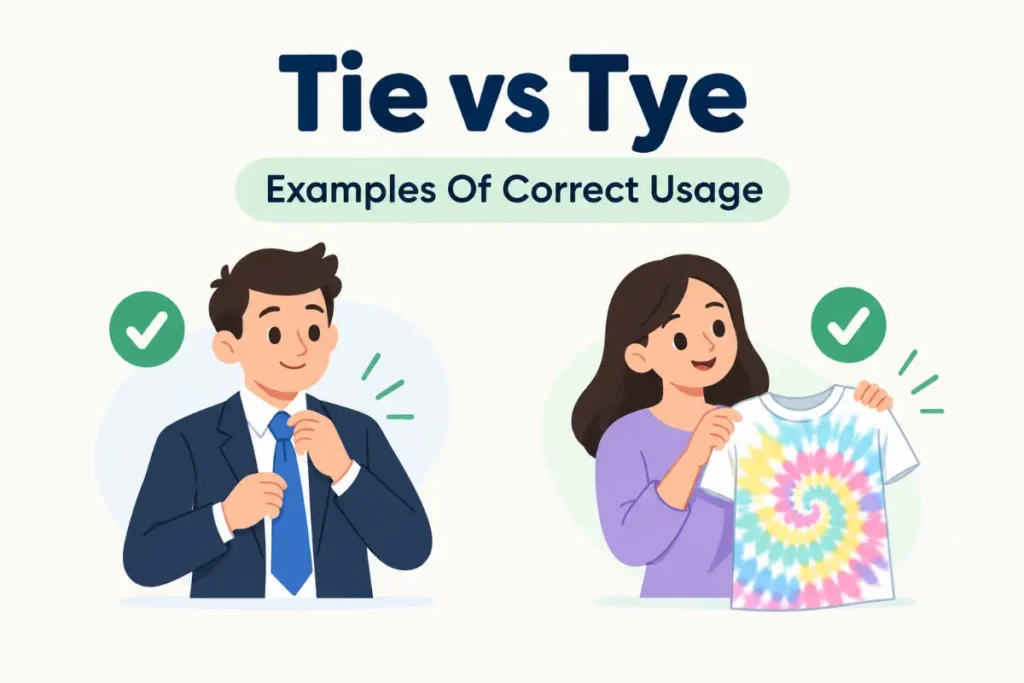
Examples Of Correct Usage
The best way to understand a word is to see how people actually use it. These examples cover several common meanings.
Fastening Something
- Tie the box with a piece of string.
- Please tie the bag before you carry it outside.
- She tied the rope around the post.
- He tied the two ends together.
Clothing
- I need a new tie for the ceremony.
- His blue tie matched his shirt.
- She bought her husband a silk tie.
- You don’t need to wear a tie to this event.
Sports
- The game ended in a tie.
- The teams are tied at one point each.
- They played to a tie.
- The score was tied near the end of the game.
Connections
- She has strong family ties.
- The two groups have close ties.
- His work is closely tied to education.
- The new idea ties into the earlier discussion.
Each example uses the standard spelling. The meaning changes based on context but the spelling remains tie.
Examples Of Incorrect Usage
The following sentences show the common mistake.
- Please tye your shoes.
- He bought a new tye.
- The game ended in a tye.
- She tried to tye the package.
- I need to tye these strings together.
Each sentence should use tie instead.
The corrected versions are:
- Please tie your shoes.
- He bought a new tie.
- The game ended in a tie.
- She tried to tie the package.
- I need to tie these strings together.
Seeing the two forms side by side makes the difference clear. Only one belongs in ordinary modern English.
Why Spell Check May Not Teach You The Rule
Spell check can identify an incorrect spelling but it does not always explain why the mistake happened. You might fix the word and move on without remembering the correct pattern.
That is why learning the word family can be more useful than relying only on automatic correction. If you know tie then tied ties tying untie and retie become easier to recognize.
Reading also helps. Every time you see the correct spelling in a sentence your brain gets another example of how the word looks. Over time the correct version becomes familiar enough that the wrong one looks strange.
A quick proofreading habit can help too. If you’re writing an important email essay application or report take a moment to check words you often misspell. Small checks can prevent simple errors from distracting readers from your main point.
How To Use Tie In A Sentence
The easiest approach is to think about the meaning first.
If you mean fasten something use tie.
- Tie the ribbon around the box.
If you mean clothing use tie.
- He wore a black tie.
If you mean an equal result use tie.
- The game ended in a tie.
If you mean a connection use tie or ties depending on the sentence.
- Their families have strong ties.
The spelling does not need to change for these meanings.
A Simple Spelling Rule To Remember
There is no need to create a complicated rule for this word. Remember that the common word is spelled tie with ie at the end.
Connect it with familiar words such as pie lie and die. Then remember that the related form with ing becomes tying rather than tieing.
You can also keep this small group in mind:
Tie. Tied. Ties. Tying.
Once these forms become familiar you will be much less likely to write the wrong version.
FAQs
Is tie or tye the correct spelling?
The correct spelling is tie. Tye is not the standard spelling of the common English word used for fastening something clothing or an equal result.
Why is tye incorrect?
Tye does not follow the standard spelling used for the common word. The correct form has ie at the end.
Is tye ever used in English?
Yes. Tye can appear as a personal name surname business name or in certain historical or specialized contexts. It should not replace tie in ordinary modern English.
How do you spell the clothing item?
The clothing item is spelled tie. For example you can say that someone wore a blue tie with a white shirt.
How do you spell the past tense of tie?
The past tense is tied. For example you can write that she tied her shoes before leaving.
Is tying or tieing correct?
Tying is correct. The final e in tie is removed before ing is added.
What is the opposite of tie?
The common opposite is untie when you mean to loosen or remove a knot. For example you can untie a rope or untie your shoes.
What does tie mean in sports?
A tie is an equal result in a competition. It happens when two players or teams finish with the same score and the rules allow the game to end without a winner.
Conclusion
If you were searching for tie vs tye because the spelling looked uncertain you can use a simple rule. Write tie when you mean to fasten something when you mean the clothing item or when you describe an equal result.
The word also appears in many related forms. You write tied for the past tense. You write ties for the plural or third person singular form. When you add ing you write tying rather than tieing.
Tye can still appear in names and specific terms. That does not make it the standard spelling of the everyday word. If you are writing a normal sentence about shoes a rope a shirt or a sports score choose tie.
When in doubt remember the small word family tie pie lie and die. They all use ie at the end. That quick connection can help you get the spelling right without stopping to think about it every time.

Dr. Elena Vance holds a Ph.D. in Linguistics from Columbia University and has spent over 15 years analyzing the evolution of the English language. A former university professor turned full-time writer and editor, Elena specializes in breaking down high-level grammatical concepts, punctuation nuances, and style guides (APA, Chicago, MLA) into clear, actionable advice. When she isn’t hunting down dangling modifiers, she can be found collecting vintage dictionaries and reading classic literature.