
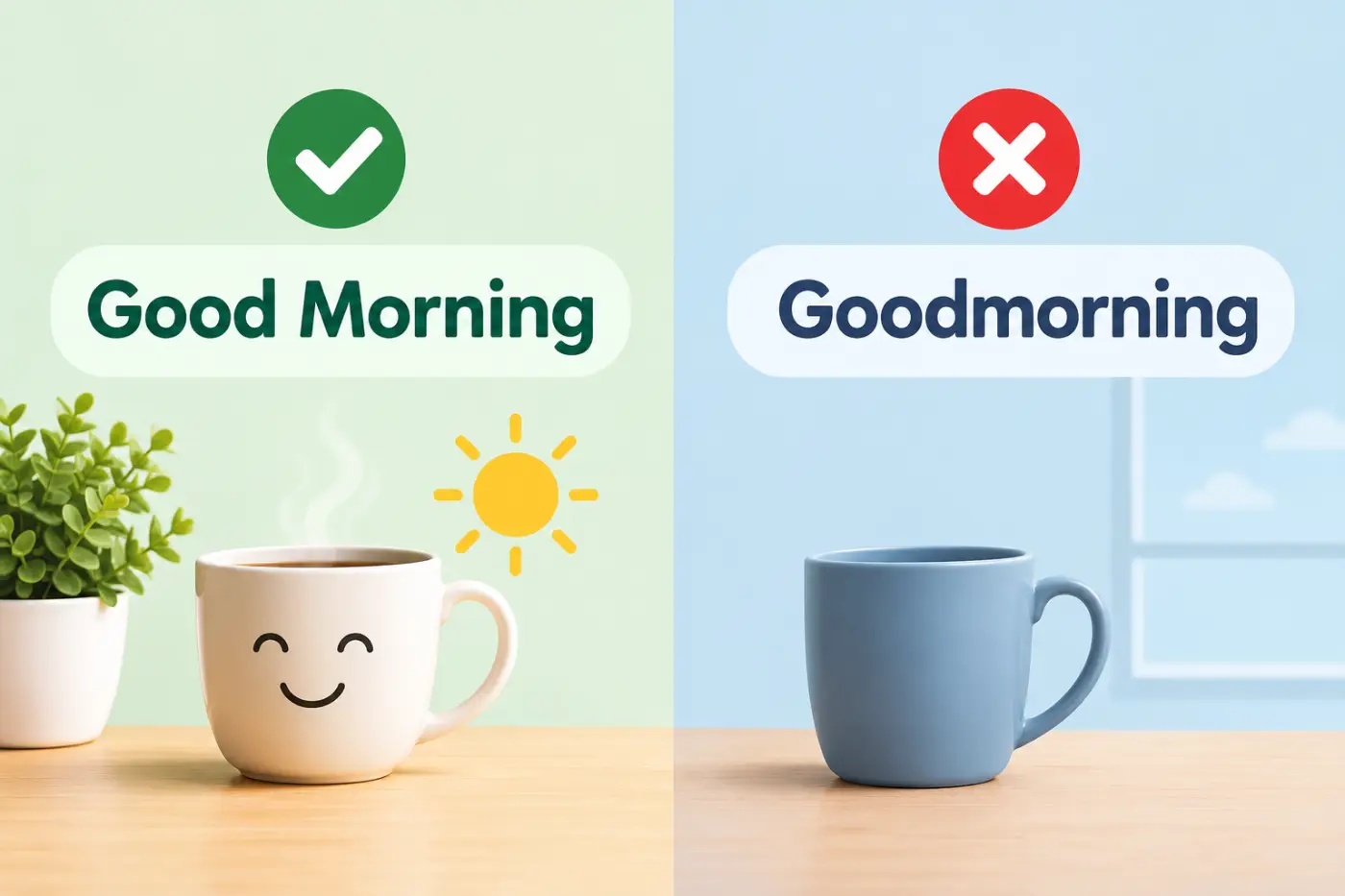
If you’ve ever wondered if good morning or goodmorning is the correct spelling, the answer is simple. The correct form is good morning, written as two separate words.
Use good morning to greet someone at the start of the day. You can say it to a friend, a coworker, a teacher, or a stranger. The phrase works in casual conversations and formal settings.
The confusion comes from the way we use other greetings. We write goodbye as one word, but we write good morning as two. Both expressions are correct in their own forms. They simply follow different spelling patterns.
In this guide, you’ll learn why the two word form is correct, how to use it in sentences, and when to capitalize it. You’ll also find examples for texts, emails, social media posts, and everyday conversations. By the end, you’ll know how to write this common greeting with confidence.
Quick Definition
Good morning is a greeting that people use when they meet or speak to someone in the morning. It consists of two words, good and morning, and it is the standard spelling in American English.
Direct Answer
Good morning is correct. Write it as two words, not as one word. For example, you can write, “Good morning, Sarah. I hope you have a great day.”
Good Morning vs Goodmorning
The main difference between these forms is spelling. The standard English greeting uses two words. Writing it as one word is a spelling mistake in ordinary English writing.
| Word or Phrase | Meaning | Example Sentence | When to Use It |
|---|---|---|---|
| Good morning | A greeting used in the morning | Good morning, everyone. | In conversations, emails, texts, and cards. |
| Goodmorning | A nonstandard spelling of the greeting | Goodmorning, everyone. | Avoid it in standard English writing. |
The phrase has a clear purpose. It lets someone know that you’re greeting them at the start of the day. You don’t need to join the words to make the greeting sound friendly or natural.
Why Good Morning Is Two Words
The phrase consists of two words that work together.
Good describes something pleasant or positive. Morning refers to the early part of the day. When you put them together, they form a friendly greeting.
You can see the same pattern in other expressions. We write good evening and good afternoon as two words, too. These greetings follow the same basic pattern.
For example:
- Good morning, Mom.
- Good afternoon, Mr. Davis.
- Good evening, everyone.
Each greeting contains two separate words. The space between them is part of the standard spelling.
English has many expressions that look like they could form one word but remain separate. The fact that people say the words quickly doesn’t change their spelling.
Why People Write Goodmorning
There are several reasons people combine the words. Most of them come from everyday habits rather than a real spelling rule.
People type quickly. When you’re sending a quick message, you might forget the space between two words. This happens with many common phrases, especially on phones.
The words sound connected. In natural speech, people often say the greeting without a clear pause between good and morning. That can make the expression feel like one word, even though it isn’t.
Other greetings use one word. English has expressions such as goodbye and hello. People may assume that all greetings follow the same spelling pattern. They don’t.
Social media encourages informal spelling. Users sometimes combine words in captions, usernames, hashtags, or creative designs. That doesn’t make the joined form standard English.
Autocorrect may miss the mistake. A phone or computer might not flag every spelling error. Some tools focus on speed and readability instead of checking each phrase carefully.
These habits explain the confusion. Still, the standard form remains good morning. If you’re writing for school, work, a website, or a professional email, keep the two words separate.
How to Use Good Morning in a Sentence
The greeting is easy to use once you know the spelling. You can say it when you arrive somewhere, start a conversation, send a message, or welcome a group.
Use It to Greet One Person
When you meet someone in the morning, you can use the greeting on its own or add the person’s name.
Examples:
- Good morning, Alex.
- Good morning, Mom. Did you sleep well?
- Good morning, Mr. Wilson.
- Good morning, Sarah. How was your weekend?
- Good morning, Doctor. I’m here for my appointment.
Adding a name makes the greeting feel personal. A comma usually separates the greeting from the name when you address someone directly.
You can also follow the greeting with a question or a kind remark.
For example, “Good morning, Jake. Are you ready for the meeting?”
This sounds natural because it starts with a friendly greeting before moving to the main point.
Use It to Greet a Group
You can use the same phrase when speaking to several people at once. It works well in classrooms, offices, meetings, and public events.
Examples:
- Good morning, everyone.
- Good morning, class.
- Good morning, team. Let’s get started.
- Good morning, guests. Thank you for joining us.
The greeting stays the same even when you speak to a large group. You only change the words that follow it.
For a workplace meeting, you might say, “Good morning, team. We have three things to discuss today.”
For a classroom, a teacher might say, “Good morning, students. Please take your seats.”
Both examples use the same standard spelling. The setting affects your tone, not the number of words in the greeting.
Use It in Text Messages
Text messages often sound more relaxed than formal letters. You can keep your greeting short or add a little warmth.
Examples:
- Good morning! Hope you slept well.
- Good morning, bestie. Have an amazing day.
- Good morning, Dad. I’ll call you later.
- Good morning! Don’t forget your lunch.
- Good morning, everyone. Who’s ready for the trip?
You don’t need a long message to make someone feel appreciated. A simple greeting can be enough.
If you’re texting a close friend, you can use an exclamation point to show excitement. If you’re sending a message to a coworker, a period may feel more professional.
The important point is that the spelling doesn’t change with the tone. Even in a casual text, write the greeting as two words.
Use It in Emails
A morning greeting can also make an email feel polite and approachable. It works in professional messages, school emails, and personal correspondence.
Examples:
- Good morning, Ms. Carter. I’m writing to confirm our appointment.
- Good morning, team. The updated report is ready for review.
- Good morning, Professor Lee. Thank you for your feedback.
- Good morning, everyone. Please find the meeting notes below.
For a formal email, pair the greeting with the recipient’s name or title. Then move directly to your reason for writing.
You don’t need to use an elaborate opening. A clear greeting followed by a useful first sentence is often the best choice.
For example:
“Good morning, Mr. Adams. I’m writing to ask about the schedule for next week’s training.”
This opening is polite and direct. It also makes your purpose clear without wasting the reader’s time.
Should You Capitalize Good Morning
Capitalization depends on where the greeting appears. The words themselves stay separate, but the first letter may change based on the sentence or heading.
At the Beginning of a Sentence
Capitalize the first word when the greeting starts a sentence.
Correct examples:
- Good morning, everyone.
- Good morning, Mom.
- Good morning. How are you today?
- Good morning, team. The meeting starts in ten minutes.
The word good begins the sentence, so its first letter is capitalized. The word morning stays lowercase unless another capitalization rule applies.
In the Middle of a Sentence
When the phrase appears in the middle of a sentence, lowercase is usually correct.
Examples:
- I said good morning to my neighbor.
- She wished us good morning before class.
- He always says good morning when he arrives.
- We exchanged good morning greetings in the hallway.
The phrase doesn’t need capital letters just because it is a greeting. Follow the normal rules for sentence capitalization.
In an Email Subject Line
Email subject lines often use title case or sentence case, depending on the writer’s style.
Examples:
- Good Morning About Tomorrow’s Meeting
- Good morning about tomorrow’s meeting
Both styles can appear in email subject lines, but the choice depends on the style guide or workplace preference. In title case, the main words usually begin with capital letters. In sentence case, only the first word and proper nouns are capitalized.
For a simple greeting in an email body, write “Good morning, Taylor.” This is the standard choice.
In Titles and Headings
Headings may use title case or sentence case. In title case, the words Good and Morning are usually capitalized. In sentence case, only Good begins with a capital letter when it starts the heading.
Examples:
- Good Morning Messages for Friends
- Good morning messages for friends
Both heading styles are used in American English. Pick one style and use it consistently throughout the page or document.
In Text Messages and Social Media Posts
Capitalization in casual messages is flexible, but standard capitalization makes your writing easier to read.
You might see someone write “good morning everyone” in a quick message. Readers will usually understand it, but “Good morning, everyone!” is more polished.
For a professional post or public announcement, use standard capitalization and punctuation. This helps your writing look clear and thoughtful.
When to Say Good Morning
The greeting usually fits the early part of the day. However, English doesn’t have one strict clock time that everyone must follow.
Your location, daily routine, and the situation can all affect when you use it.
Is Good Morning Only for Early Hours
People commonly use the greeting from the time they wake up until around noon. This is a useful everyday guideline, not a fixed rule.
For example, you might say good morning to a coworker at 8 a.m. You might also greet a neighbor at 11:45 a.m. Both uses sound natural.
After noon, people generally switch to good afternoon. In the evening, they use good evening.
Here are a few examples.
- 7:30 a.m. Good morning, everyone.
- 10 a.m. Good morning, Mr. Brown.
- 11:50 a.m. Good morning. It’s nice to see you.
- 1 p.m. Good afternoon, everyone.
- 6 p.m. Good evening, guests.
These times are only examples. People may use a morning greeting a little later if they meet someone for the first time that day.
Can You Say Good Morning After Waking Up Late
Yes. You can use the greeting after waking up late, especially when you’re starting a conversation with someone.
Imagine you wake up at 10:30 a.m. and send your friend a text. Writing “Good morning! I hope you have a great day” still makes sense.
The greeting relates to the time of day, not just the moment you wake up. You don’t need to switch to good afternoon simply because you slept late.
However, if it’s already late in the afternoon, good afternoon will usually sound more natural.
Can You Say Good Morning More Than Once
Yes. You can greet different people throughout the morning.
For example, you might greet your family at home, your neighbor on the way to work, and your coworkers when you arrive at the office. Each greeting starts a new interaction.
You can also repeat the greeting if you meet someone again after a long gap. The phrase doesn’t have a one time use limit.
Still, you don’t need to repeat it every time you speak to the same person. After the first greeting, you can continue with a question or move straight to the conversation.
Good Morning vs Good Afternoon vs Good Evening
These three greetings share a similar structure, but they refer to different parts of the day. Knowing the difference helps you choose the right phrase.
| Greeting | Usual Time | Example |
|---|---|---|
| Good morning | Early day until around noon | Good morning, Lisa. |
| Good afternoon | Around noon through the later part of the day | Good afternoon, everyone. |
| Good evening | Early evening and later | Good evening, Mr. Davis. |
The boundaries aren’t exact. People may change greetings based on local habits, work schedules, or the time they meet someone.
Why Good Evening Is Different From Good Night
People often confuse good evening with good night. Both refer to the later part of the day, but they serve different purposes.
Use good evening when greeting someone or starting a conversation.
For example, “Good evening, everyone. Thank you for coming.”
Use good night when saying goodbye for the night or wishing someone a restful sleep.
For example, “Good night, Mom. I’ll see you tomorrow.”
This distinction is useful because the two expressions aren’t interchangeable in every situation. You generally greet someone with good evening, not good night.
Do Morning Greetings Change in American English
The spelling stays the same in American English. People write good morning as two words, just as they do in standard British English.
Some differences may appear in tone and daily habits. For example, one person might prefer a cheerful greeting, while another might simply say hello.
In the United States, good morning is common at work, in schools, in stores, and during public events. It can sound friendly without being overly personal.
You can use it in almost any setting. Just adjust your tone to fit the person and the situation.
Common Mistakes to Avoid
A small spelling or punctuation mistake can make a simple greeting look less polished. These are the errors worth watching for.
Writing Goodmorning as One Word
This is the main mistake people make when searching for the correct spelling.
Incorrect: Goodmorning, Sarah.
Correct: Good morning, Sarah.
The greeting contains two words. Keep the space between them in emails, essays, captions, and other standard writing.
If you’re checking goodmorning or good morning for a school assignment or professional document, choose the two word form.
Forgetting the Comma Before a Name
When you speak directly to someone, place a comma between the greeting and the person’s name.
Correct examples:
- Good morning, Emily.
- Good morning, Mr. Clark.
- Good morning, everyone.
The comma marks the name as the person you’re addressing. Without it, the sentence may still be understood, but the punctuation isn’t as clear.
You don’t need a comma in every sentence containing the phrase. For example, “I said good morning to Emily” doesn’t need one after morning.
Capitalizing Every Letter
Writing the greeting as “GOOD MORNING” can work when you want to show excitement or make a large sign. However, all capital letters may look like shouting in a regular message.
For most writing, use normal capitalization.
Correct: Good morning, everyone.
Less suitable for an ordinary email: GOOD MORNING EVERYONE.
Save all caps for cases where the design or intended emphasis calls for it.
Adding Unnecessary Punctuation
A greeting doesn’t need several punctuation marks to sound friendly.
For example, “Good morning!!!” may look too excited in a professional email. One exclamation point is usually enough when you want a cheerful tone.
You can use a period for a calm, neutral greeting.
- Good morning, Alex.
- Good morning, Alex!
- Good morning, Alex. How are you?
Choose punctuation that matches the tone you want.
Using the Wrong Greeting for the Situation
A morning greeting may sound out of place late at night. Similarly, good night may sound odd when you’re arriving at an evening event.
Think about what you’re doing. If you’re starting an evening conversation, use good evening. If you’re leaving for the night, use good night.
The right phrase makes your meaning clear and helps the interaction feel natural.
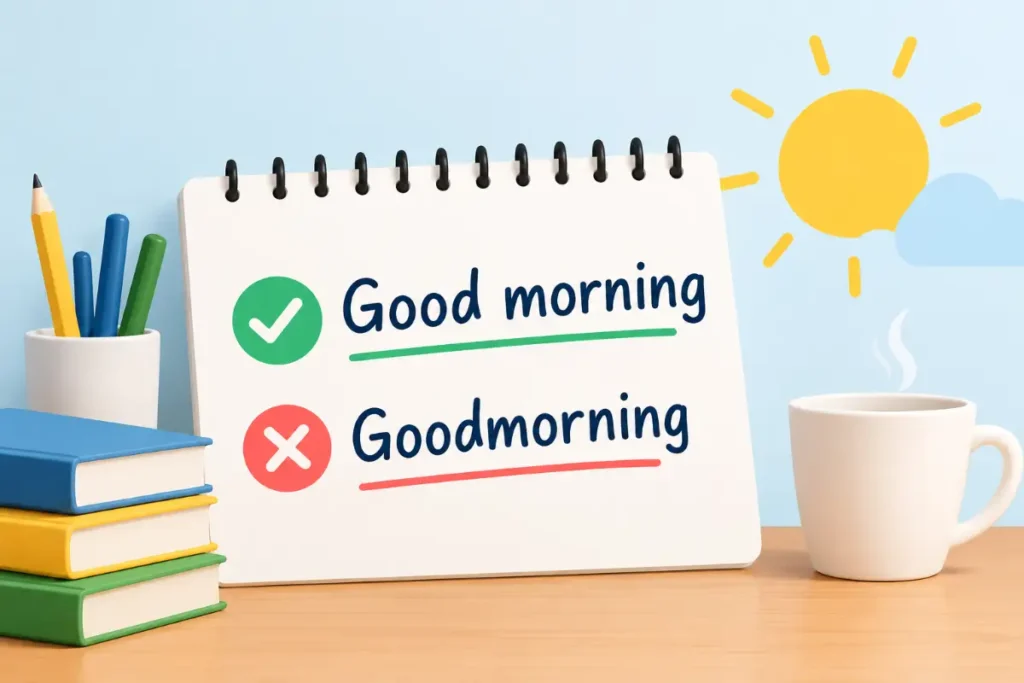
Easy Ways to Remember the Correct Spelling
You don’t need to memorize a long grammar rule to remember this greeting. A few simple tricks can help you get it right every time.
Think of Good Morning as Two Separate Ideas
The word good describes something positive. The word morning names a part of the day.
Keeping these meanings in mind can help you remember the space. You’re combining two words to form a greeting, not creating a single new word.
The same idea applies to good afternoon and good evening. All three expressions contain two words.
Compare It With Other Greetings
Think about these common phrases.
- Good morning.
- Good afternoon.
- Good evening.
Each one uses two words. When you remember the pattern, you’re less likely to join the greeting accidentally.
Don’t assume that every greeting follows this pattern. Goodbye is written as one word, so English spelling still requires you to learn common expressions individually.
Read Your Message Before Sending It
A quick review can catch missing spaces and other small errors.
If you type a greeting quickly, check that the two words remain separate. You can also use a spell checker, but don’t depend on it to catch every mistake.
For work emails and important documents, read the entire opening sentence before sending it. A few seconds of proofreading can make your message look more professional.
FAQs
Is Goodmorning One Word or Two?
The standard spelling is good morning, written as two words. The joined form is nonstandard and should be avoided in ordinary English writing. Use the two word form in emails, messages, schoolwork, and professional documents.
Why Is Good Morning Written as Two Words?
The phrase combines the adjective good with the noun morning to form a greeting. English commonly keeps these words separate in this expression. The fact that people pronounce them together doesn’t change the spelling.
Is Good Morning One Word in American English?
No. American English uses two words for this greeting. Write good morning in school assignments, workplace messages, articles, and everyday conversations.
Should Good Morning Be Capitalized?
Capitalize Good when the greeting starts a sentence. Write morning in lowercase unless a title style or another specific rule calls for a capital letter. In the middle of a sentence, both words are usually lowercase.
Can I Write Good Morning in a Text Message?
Yes. The greeting works well in text messages and online chats. You can keep it simple or add a personal message, such as “Good morning! Hope you have a wonderful day.” The spelling stays the same in casual and formal writing.
Is Good Morning Formal or Informal?
It works in both formal and informal settings. You can use it with friends, family members, teachers, coworkers, clients, and strangers. The words you add and your tone determine how formal the greeting feels.
Is Good Morning Correct After 12 PM?
People generally switch to good afternoon around noon. Still, everyday conversations don’t follow a strict clock rule, and some people may use a morning greeting a little later. When the afternoon is clearly underway, good afternoon is the more natural choice.
What Is the Difference Between Good Morning and Good Day?
Good morning refers to the morning and is a common greeting in the United States. Good day is a broader greeting that can refer to the day in general, though it is less common in everyday American conversation. The best choice depends on the situation and local habits.
Conclusion
The correct spelling is good morning, written as two separate words. The joined form goodmorning is not standard English. Use the two word version in everyday conversations, texts, emails, school assignments, and professional writing.
Remember that the phrase is a greeting for the morning. You can use it with one person or a group, and you can make it sound casual or formal by changing the words around it. Capitalize the first word at the beginning of a sentence and use normal punctuation.
If you came here looking for the answer to goodmorning or good morning, you can now remember the rule without second guessing yourself. Keep the space between the words, and you’re all set.
The simplest way to get it right is to remember how you write good afternoon and good evening. The same two word pattern applies to good morning.

Dr. Elena Vance holds a Ph.D. in Linguistics from Columbia University and has spent over 15 years analyzing the evolution of the English language. A former university professor turned full-time writer and editor, Elena specializes in breaking down high-level grammatical concepts, punctuation nuances, and style guides (APA, Chicago, MLA) into clear, actionable advice. When she isn’t hunting down dangling modifiers, she can be found collecting vintage dictionaries and reading classic literature.