
The terms half day and half-day look almost the same, but the correct choice depends on how you use them in a sentence. Both forms refer to a period that lasts for about half a day. However, one usually works as a noun phrase, while the hyphenated form often acts as an adjective before another noun.
This small spelling difference can be confusing when writing about work schedules, school hours, vacations, or time off. The good news is that the rule is easy to learn once you see a few examples.
In this guide, you’ll learn when to write half day and when to use half-day. You’ll also find simple examples and practical tips to help you choose the right form in everyday American English.
Quick Definition
A half day is a period that lasts for about half of a full day. People often use the phrase to describe a shortened workday, school session, or activity.
Half day is generally written as two words when it acts as a noun. Half day can also appear with a hyphen as half day related wording before another noun, though half day and half day off are commonly written as open phrases in US English. The best choice depends on the sentence and the style guide you follow.
Direct Answer
In American English, write half day as two words when it functions as a noun, as in “I worked a half day.” Use half-day when it directly describes another noun and your chosen style guide calls for a hyphen, as in “a half-day shift.” The open form is also common in some compound phrases, so follow your publication or workplace style guide for consistency.
Half Day and Half Day Compared
The difference between the two spellings comes down to grammar. Both forms refer to a period that lasts about half a day. However, they can serve different roles in a sentence.
| Word or Phrase | Meaning | Example Sentence | When to Use It |
|---|---|---|---|
| Half day | A period lasting about half a day | I worked a half day on Friday. | When the phrase acts as a noun. |
| Half day off | Time away from work or school for part of a day | I took a half day off for my appointment. | When describing a short absence. |
| Half day schedule | A schedule that covers only part of a day | The school follows a half day schedule. | When using the open form as a modifier. |
| Half day session | A session lasting part of a day | The training includes a half day session. | When the phrase describes a session. |
| Half day shift | A work shift lasting about half a normal day | She requested a half day shift. | When describing a shortened shift. |
| Half day program | A program that runs for part of the day | My son attends a half day program. | When describing a shorter program. |
The table shows common ways people use the phrase. Some writers add a hyphen before a noun to make the words work together as one modifier. Others keep the words open. For polished American English, check your house style and apply it consistently.
The key is to identify the job the phrase does in the sentence. A noun names a person place thing or idea. A modifier gives more information about another word. That distinction helps explain many spelling choices in English.
When to Write Half Day as Two Words
Use the open form when the phrase functions as a noun. In this role it names a period of time that covers roughly half of a normal day.
American English commonly uses this spelling in everyday speech and writing. You’ll see it in workplace messages school notices appointment details and conversations about schedules.
Use It When Talking About Work
A half day at work usually means working for about half of the normal workday. The exact hours depend on the employer and the schedule.
Here are some natural examples.
- I worked a half day on Monday.
- My manager approved a half day for my doctor’s appointment.
- We only need a half day to finish the report.
- He took a half day before the holiday weekend.
- The office will close after a half day on Christmas Eve.
In each example the phrase names a period of time. It does not directly modify a noun that follows it as part of a compound description.
You can also use the phrase when discussing attendance or leave.
- “I need to request a half day next Thursday.”
- “The new policy allows employees to take a half day for personal matters.”
These sentences sound natural in American English. They also make the intended meaning clear without adding extra words.
Use It When Talking About School
Schools often have shortened schedules for staff training holidays special events or severe weather. Parents and teachers may describe these schedules using the open form.
For example.
- The students have a half day on Friday.
- We have a half day before winter break.
- My daughter will attend school for a half day.
- The district announced a half day for all elementary schools.
- The children will leave after a half day of classes.
The phrase works as a noun in these sentences. It identifies the length of the school day or the period students attend classes.
A school may also use terms such as early dismissal or shortened school day. These expressions can be clearer when the school wants to explain exactly what will happen.
For instance “School will dismiss students at noon on Friday” gives parents a specific time. The phrase “half day” tells them the general length of the session but may not explain the exact dismissal time.
Use It in Everyday Conversations
You don’t need formal language to discuss a shortened day. The open form works well in casual conversations too.
Consider these examples.
- We spent a half day at the museum.
- A half day should be enough to clean the garage.
- I only have a half day free this weekend.
- The trip takes a half day by car.
- We finished the project in half a day.
Notice the final example. Half a day is another common construction. It uses the article a between half and day. The meaning is similar but the grammar differs slightly.
You can say “We spent a half day at the museum” or “We spent half a day at the museum.” Both can work. The second version often sounds more natural because it treats the time as a simple amount rather than a named block of time.
When to Write Half Day With a Hyphen
The hyphenated form can help when the phrase works as a compound modifier before a noun. A compound modifier is a group of words that work together to describe another word.
For example “a half day shift” can be written as “a half day shift” in styles that leave the words open. Other editors prefer “a half day shift” only when the wording is clear without a hyphen and use “a half day shift” consistently throughout their material. In styles that hyphenate compound modifiers the form is “a half day shift” with the hyphen joining the words.
The important point is that hyphenation rules vary across style guides. The hyphen is not always required simply because the phrase appears before a noun.
Use a Hyphen to Clarify a Compound Modifier
A hyphen can show that two words work together to describe the noun that follows. It helps readers process the phrase as a single unit.
Examples include the following.
- The company introduced a half day policy.
- She signed up for a half day workshop.
- We need a half day training session.
- He accepted a half day assignment.
- The center offers a half day program.
In a style guide that hyphenates these modifiers the phrases become half day policy, half day workshop, half day training session, half day assignment, and half day program with a hyphen between half and day.
The hyphen can improve clarity. Still it is not a universal rule for every use of the phrase. Some major style guides treat common time expressions differently from other compound modifiers. That’s why you may see both open and hyphenated forms in published material.
Follow the Style Guide You Use
If you’re writing for a company website school district newspaper or grammar website follow its style guide. The guide may recommend hyphens in compound modifiers or leave familiar phrases open.
Consistency matters more than switching between forms without a reason. If you use “half day program” in one section and “half day program” in another you should follow the same spelling policy throughout the article. If your style requires the hyphen use it in both places.
For general writing in the United States the safest approach is to use half day as a noun and consult your preferred style guide for the compound modifier. Don’t assume the hyphenated version is always right simply because the words come before another noun.
The Difference Between Half Day and Half a Day
This is another common source of confusion. Both phrases refer to about half of a day but they do not fit into every sentence in the same way.
Half day usually names a block of time. Half a day describes an amount of time. The second form includes the article a.
Compare these examples.
| Phrase | Example | Main Use |
|---|---|---|
| Half day | I requested a half day at work. | Names a shortened work period. |
| Half a day | I spent half a day at work. | Describes how much time was spent. |
| Half day off | I need a half day off. | Refers to time away from work. |
| Half a day off | I took half a day off. | Describes the amount of leave taken. |
Both forms can be correct. The surrounding sentence determines which one sounds natural.
When Half a Day Sounds Better
Use half a day when talking about how long an activity takes or how much time you spend doing something.
For example.
- “I spent half a day painting the kitchen.”
- “The repair should take half a day.”
- “We waited for half a day before the roads reopened.”
These sentences describe duration. They focus on the amount of time involved rather than naming a work or school arrangement.
When Half Day Sounds Better
Use half day when naming a type of schedule or period.
For example.
- “My employer approved a half day.”
- “The school has a half day tomorrow.”
- “She requested a half day off.”
In these examples the phrase refers to a shortened period that people recognize as part of a schedule or leave arrangement.
The difference is subtle. Native English speakers often choose between these forms based on the way the sentence flows. You can improve your writing by reading the whole sentence aloud and checking which construction expresses your meaning most clearly.
Common Mistakes to Avoid
The spelling can feel confusing because English uses hyphens in some compound phrases but leaves other familiar expressions open. The best way to avoid errors is to focus on the meaning and grammar of the full sentence.
Adding a Hyphen Every Time
A common mistake is to assume that the phrase always needs a hyphen. That isn’t a safe rule.
For example.
- Correct in common US usage: I worked a half day.
- Also seen in some styles: I worked a half day.
- Common alternative: I worked half a day.
The first example uses the open noun form. The third uses a different construction that describes duration.
A hyphen can be useful when the words work together as a modifier. However it isn’t automatically required in every phrase about a shortened day.
Leaving Out the Article When You Need It
Another mistake is to remove a from a sentence that needs it.
For example.
Incorrect: The project took half day to complete.
Better: The project took half a day to complete.
The improved sentence describes the amount of time the project required. In standard American English you generally need a in this construction.
Compare it with this sentence.
“The manager approved a half day for the team.”
Here the phrase names a shortened work period. It does not need another article between half and day because the article a already appears before the entire phrase.
Mixing Different Styles in the Same Article
Writers sometimes use different spellings for the same purpose. That can make an article look poorly edited even when the meaning remains clear.
Imagine a company handbook that uses “half day leave” in one paragraph and “half day leave” in another. Readers may wonder if the two forms mean different things.
Choose a consistent style for compound modifiers. Apply it to headings examples tables and body text. If your organization has an editing guide use that guide as the final authority.
Confusing Half Day With a Full Morning or Afternoon
A half day does not always mean exactly four hours. It usually refers to roughly half of a normal working or school day.
For one employee a half day might run from 8 a.m. until noon. Another workplace might count noon until 5 p.m. as a half day because lunch breaks and scheduled hours differ.
For this reason a specific time is often better than a general phrase when people need to plan around the schedule.
Instead of writing “The office has a half day on Friday” you could write “The office closes at noon on Friday.”
The second sentence gives readers the information they need without asking them to guess the closing time.
How to Choose the Right Form
You can make the decision in a few simple steps. First identify the meaning you want. Then check the phrase’s role in the sentence. Finally apply the spelling rules used by your preferred style guide.
Step One. Decide What You Mean
Are you talking about a shortened period at work or school. Or are you describing how long an activity takes.
If you’re naming a scheduled work period you might write “I have a half day tomorrow.”
If you’re describing duration you might write “The trip will take half a day.”
Both sentences are clear. They simply use different grammatical constructions.
Step Two. Look at the Words Around the Phrase
Check the word that comes before the phrase and the word that follows it.
Consider these examples.
- She requested a half day off.
- She spent half a day preparing.
- The school announced a half day.
- The event lasted half a day.
The article a appears in different places because each sentence uses a different construction. Pay attention to the whole phrase rather than treating the spelling as a stand alone choice.
Step Three. Check Your Style Guide
If the phrase appears before another noun and acts as a compound modifier your style guide may call for a hyphen. Some styles keep common expressions open when their meaning is already clear.
This is where the question of half-day or half day becomes a matter of editorial style as well as grammar. A good editor checks the guide used by the publication instead of relying on a rule that may not apply to every phrase.
If you’re writing a personal email or a casual message you don’t need to overthink the issue. Choose a clear construction and keep the spelling consistent.
Examples of Half Day in Real Life
Real examples make the distinction easier to remember. The following sentences show how people use these expressions in common situations.
At Work
“I’ll be working a half day on Tuesday.”
This sentence tells coworkers that you’ll work for only part of your usual day.
“Could I take half a day off next week.”
This asks to use part of a workday as leave. In formal writing add a question mark at the end.
“Our team finished the project in half a day.”
This describes the amount of time needed to complete the task.
“The office will run on a half day schedule before the holiday.”
This describes a shortened schedule. A style guide that hyphenates compound modifiers may use a hyphen in half day schedule.
At School
“The children have a half day on Wednesday.”
This tells parents that the school day will be shorter than usual.
“The teacher planned a half day of activities.”
This refers to the length of the planned activities.
“Classes will end at 11:30 a.m. for the half day.”
This gives the specific dismissal time and refers to the shortened school day.
“The school offers a half day preschool program.”
This describes a program that runs for only part of a normal day. Some editors may hyphenate the modifier before preschool program.
During Travel and Events
“We spent half a day exploring the city.”
This describes how long the visit lasted.
“The tour is a half day long.”
This names the tour as a shortened experience. A smoother alternative is “The tour lasts half a day.”
“Our group booked a half day tour of the coast.”
This describes the length of the tour. Depending on the style guide the modifier may appear with a hyphen.
“The festival includes a half day of live music.”
This refers to the time set aside for the music program.
In Emails and Messages
“Hi Alex. I’ll need a half day off on Thursday for an appointment.”
This is a clear and polite way to request time away from work.
“Please note that Friday will be a half day for all staff.”
This works well in an internal announcement.
“The workshop takes half a day so please plan your travel accordingly.”
This tells attendees how much time to set aside.
When writing a work message remember that the reader needs more than correct spelling. They also need clear information about the date the hours and any action they should take.
A Simple Way to Remember the Rule
The easiest memory trick is to focus on the phrase’s job.
If it names a shortened period of time use the open noun form in ordinary US writing. For example “I have a half day off.”
If it describes how long something takes use half a day. For example “The job will take half a day.”
If the phrase describes another noun check your style guide to see if it calls for a hyphen. For example a publication may prefer a hyphen in half day shift when the phrase works as a compound modifier.
You don’t need to memorize dozens of examples. Learn the basic patterns and apply them to new sentences.
A useful test is to replace the phrase with part of a day. If the sentence still makes sense you are probably talking about the amount of time. If you’re naming a scheduled block of work or school the noun form may fit better.
For example “I worked part of a day” describes duration. “I requested a half day” names a period of leave.
The test isn’t a strict grammar rule but it can help you spot the difference.
Related Expressions You Should Know
The phrase appears in several common expressions. Learning these variations can help you write more clearly and avoid awkward sentences.
Half Day Off
A half day off means taking part of a day away from work or school. People often use this phrase when requesting leave for an appointment family matter or personal errand.
Examples.
- I need a half day off to visit the dentist.
- She took a half day off before her flight.
- My supervisor approved a half day off next Friday.
You can also say “I need to take half a day off.” Both constructions are natural. The first names a type of leave while the second emphasizes the amount of time you plan to take.
Half Day at Work
A half day at work usually means working for about half of your regular shift. It doesn’t always refer to the same number of hours because employers set different schedules.
Examples.
- I only have a half day at work tomorrow.
- He finished his tasks during a half day at work.
- We usually work a half day before major holidays.
If the exact hours matter mention them directly. For instance “I’ll work from 8 a.m. until noon” is clearer than simply saying “I’ll work a half day.”
Half Day at School
A half day at school means students attend classes for a shorter period than usual. Schools may schedule these days for teacher training holidays exams or special events.
Examples.
- The children have a half day at school today.
- A half day at school gives teachers time for training.
- Parents should arrange pickup after the half day ends.
Schools sometimes use early dismissal instead. This phrase focuses on the fact that students leave earlier than usual rather than on the total length of the school day.
Half Day Versus Half Shift
These expressions are related but not identical.
A half day refers to roughly half of a day. A half shift refers to roughly half of a scheduled work shift.
For someone who normally works an eight hour shift the two might mean the same amount of time. For someone who works a twelve hour shift a half shift could last six hours. A half day could mean something different depending on the workplace’s rules.
Use the phrase that matches the schedule you’re describing. This is especially helpful in employee handbooks and leave requests.
Half Day Versus Half a Day
These phrases can sometimes replace each other but the sentence may need a small change.
“I took a half day off” is a natural way to describe a block of leave.
“I took half a day off” is also correct and focuses on the amount of time taken.
The difference is small in everyday conversation. In formal writing choose the version that sounds clearest and use it consistently.
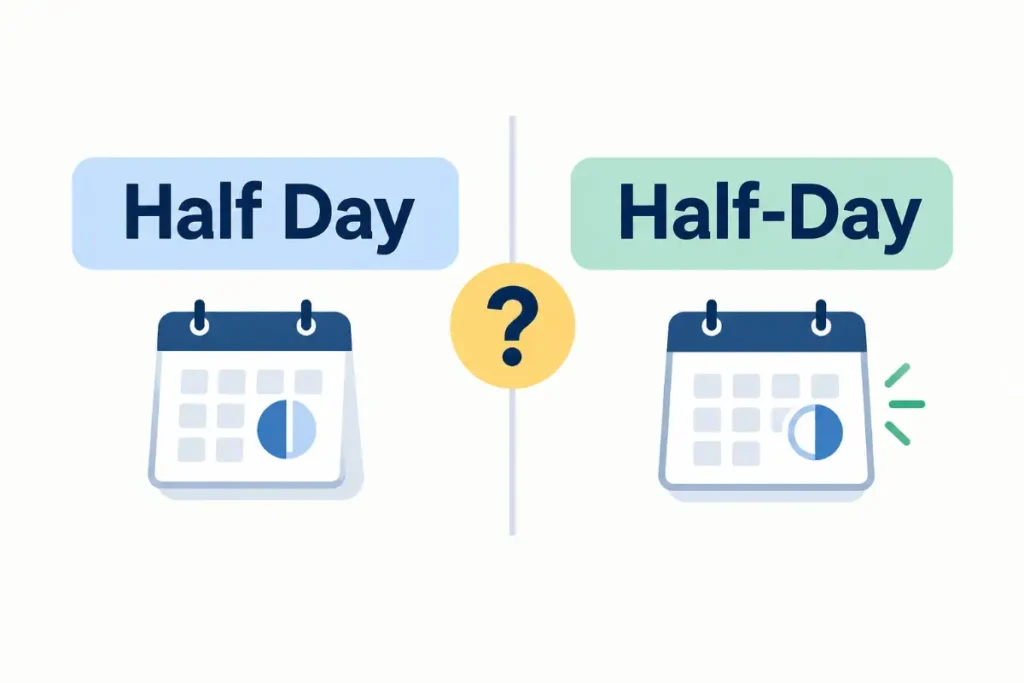
Why the Hyphen Causes Confusion
English spelling rules can seem inconsistent. Some compound modifiers take hyphens while others do not. Familiar expressions may also remain open even when they appear before a noun.
A hyphen joins words so readers can understand them as a unit. For example a well known writer is often written as a well known writer in casual text but many formal style guides use a well known writer with a hyphen joining well and known. The same broad idea applies to many compound modifiers but each expression has its own conventions.
Time expressions add another layer of complexity. Words such as half, full, long, and short appear in many common phrases. Some are hyphenated in one position but open in another.
For example a full time job is commonly written as a full time job with a hyphen in edited American English. Yet I work full time is often written without one because the phrase follows the verb.
The spelling of half day can vary by style guide too. That doesn’t mean every form is equally preferred in every context. It means writers should distinguish between a basic grammar pattern and a house style rule.
For a grammar article the most useful advice is to explain the common noun form first then discuss hyphenation for compound modifiers. Readers can use that distinction without memorizing a long list of exceptions.
When you edit your own writing ask three questions.
- Does the phrase name a period of time.
- Does it describe another noun.
- Does my style guide require a hyphen in this construction.
Those questions usually point you toward a clear and consistent choice.
FAQs
Is half day one word or two words?
In American English half day is usually written as two words when it acts as a noun. For example “We have a half day on Friday.” The one word form halfday is not standard for this meaning.
Is half day hyphenated in American English?
The phrase is often written as two words when it acts as a noun. Some style guides use a hyphen when the phrase modifies another noun. Check your publication’s rules and use the same form throughout your writing.
Should I write half day off or half a day off?
Both forms are correct. You can write “I need a half day off” or “I need half a day off.” The first treats the leave as a scheduled block of time while the second emphasizes the amount of time you need.
Is half day or half day the correct spelling before a noun?
The answer depends on the style guide and the sentence. Some editors hyphenate compound modifiers before a noun while others leave familiar phrases open. For a polished article follow one consistent style instead of changing the spelling at random.
Is half day the same as half a day?
The meanings are closely related but the grammar differs. Half day often names a scheduled period while half a day usually describes an amount of time. For example “I requested a half day” and “The task took half a day” use the phrases in different ways.
Does a half day mean four hours.
Not always. A half day usually means about half of a normal workday or school day. The actual hours depend on the schedule and the organization’s policy.
Which form should I use in a work email?
Use clear wording that matches your workplace’s style. “I’d like to request a half day off on Thursday” is a natural option. If your manager needs to plan coverage include the hours you expect to be away.
How can I remember the difference between half day and half a day?
Think about the role of the phrase in your sentence. Use half day to name a scheduled period and half a day to describe how long something takes. When the phrase modifies another noun check your style guide for its hyphenation rule.
Conclusion
The choice between half-day or half day can feel tricky because English uses hyphens in some compound phrases but not in every expression about time. The open form is common when you use the phrase as a noun. A hyphen may be appropriate when it works as a compound modifier before another noun.
Remember the difference between half day and half a day. The first often names a shortened period of work or school. The second usually describes how long an activity takes.
When writing for a US audience keep your wording simple and clear. Use the form that fits your sentence and follow your preferred style guide for compound modifiers.
If you’re unsure about half-day or half day in a work email or article use a sentence that makes the meaning clear. For example “I need Friday morning off” tells the reader more than “I need a half day.” Clear writing always helps your reader understand what you mean.

Sienna Watson is a veteran copywriter and communications coach who has helped startup founders, marketers, and professionals polish their writing for over a decade. Realizing that most people don’t need a degree in linguistics—just clear, impactful communication—Sienna focuses on practical grammar, business writing etiquette, and eliminating wordiness. She advocates for plain language, strong verbs, and persuasive prose that gets results.