

The correct spelling is success. The spelling sucess is incorrect in standard American English. If you want to describe achieving a goal or getting a good result, always write success with two c’s and two s’s.
This spelling can be tricky because the word has a double c followed by a double s. It’s easy to leave out one letter when writing quickly. However, a simple memory trick can help you spell it correctly every time.
In this guide, you’ll learn the difference between the correct and incorrect spellings, how to remember the word, and how to use it in everyday sentences. You’ll also see common mistakes, related words, and answers to frequently asked questions.
Quick Definition
Success is the achievement of a goal or the result of doing something well. It can describe a personal achievement, a business result, a good exam score, or a project that meets its goals. The word can also describe a person or thing that achieves a favorable result.
Direct Answer
Success is the correct spelling. Sucess is a misspelling because it leaves out one of the two c’s in the word.
Success vs Sucess
| Word | Meaning | Example Sentence | When to Use It |
|---|---|---|---|
| Success | The achievement of a goal or a favorable result. | Her hard work led to success. | Use this spelling in all standard writing. |
| Sucess | An incorrect spelling of success. | The report contained the misspelling sucess. | Use it only when discussing the spelling error itself. |

Why Success Is the Correct Spelling
English spelling can be confusing because many words contain repeated letters. Success is one of them. The word has two c’s in the middle and two s’s at the end. Leaving out any of these letters changes the spelling.
The correct form is not based on personal preference. Standard American English uses success in school assignments, business reports, emails, books, websites, and everyday messages.
For example, you might write:
- The team celebrated its success after months of practice.
- Her success came from patience and hard work.
- The new store became a huge success in its first year.
- Passing the final exam was a major success for him.
Each sentence uses the same spelling. The meaning changes with the context, but the word itself stays the same.
The Letter Pattern in Success
The easiest way to understand the spelling is to look at each letter.
SUCCESS
Seven letters are not enough. Success has eight letters.
The word follows this letter pattern.
- S comes first.
- U comes second.
- CC appears in the middle.
- E comes after the double c.
- SS finishes the word.
Count the letters from left to right. You should get eight in total.
The repeated letters are the part worth remembering. Many people know the word well but still make a typing mistake because they write it from memory without checking the spelling.
Why Sucess Looks Convincing
The incorrect spelling may look reasonable at first glance. That’s because the word remains easy to recognize even after one c disappears.
English has plenty of words with a single c. Readers may understand what you mean when you write the wrong form, but that doesn’t make it correct.
Think of it like writing a familiar person’s name with one letter missing. People may still know who you mean, yet the spelling remains wrong.
The same rule applies here. A reader can often understand sucess from the sentence around it. However, a spelling checker or a careful editor may flag the error.
For formal writing, schoolwork, job applications, and published articles, use the standard spelling every time.
How to Remember the Spelling of Success
A simple memory trick can make this word much easier to spell. Instead of trying to memorize all eight letters at once, break the word into smaller parts.
Remember the Double C and Double S
The most useful trick is to remember that success contains two pairs of repeated consonants.
You can picture the word as three parts.
SU + CC + ESS
This is a memory aid rather than a formal division of the word. It helps you focus on the letters people most often leave out.
When you write the word, ask yourself two quick questions.
- Did I write two c’s in the middle.
- Did I finish with two s’s.
If both answers are yes, you’ve likely written the word correctly.
Try this method in a short sentence.
- Incorrect: Her sucess surprised everyone.
- Correct: Her success surprised everyone.
The meaning stays the same. Only the spelling changes.
Use a Simple Sentence to Lock It In
Memory tricks work best when you use them in real sentences. Try repeating this sentence a few times.
Success starts with two c’s and ends with two s’s.
This short reminder points directly to the two letter pairs that matter most. You don’t need to memorize a long spelling rule or learn a technical term.
You can also write the word five times while saying each letter aloud. Then cover it and write it from memory. Check your answer afterward.
If you miss a letter, don’t just copy the word again. Look at the exact part you missed. That small step helps you notice your own spelling pattern and correct it.
Connect the Word to Its Meaning
Another useful trick is to link the spelling to something familiar.
Imagine working toward a goal. You study for an exam, practice a skill, or finish a difficult project. When your effort leads to a good result, you achieve success.
Picture the word beside that result. Each time you think of the achievement, remember its spelling.
This approach connects the word to an idea instead of treating it as a random group of letters. It can make the spelling easier to recall when you’re writing quickly.
Practice With Short Writing Exercises
You don’t need a long lesson to improve your spelling. A few minutes of focused practice can help.
Complete these sentences by filling in the missing letters.
- Hard work can lead to succe__.
- The event was a great succe__.
- Her succe__ inspired the whole class.
- The company celebrated its succe__.
The correct answer in each sentence is ss. The completed word is success.
For another exercise, write three sentences of your own. Use the word once to describe a person, once to describe an event, and once to describe a goal.
For example, you could describe a successful student, a successful concert, and a successful business launch. This gives you practice with different meanings while reinforcing the same spelling.
What Success Means in Everyday English
Success is more than a spelling word. It’s a common noun that people use to talk about achievements, good results, and progress toward a goal.
The exact meaning depends on the situation. A student may measure success through learning and grades. A business owner may measure it through customer satisfaction and steady growth. An athlete may define it as improving performance or winning a competition.
The word doesn’t always mean becoming rich, famous, or the best at something. Sometimes success means making progress, solving a problem, or completing a task that once seemed difficult.
Success as the Achievement of a Goal
The most common meaning of success is reaching a goal.
Consider these examples.
- Maya studied every evening and passed her nursing exam. She considered passing a success.
- The team practiced for weeks and won its first game. The win felt like a success.
- I finally learned how to drive on the highway. That was a personal success.
- The students finished their science project before the deadline. Their teacher praised their success.
In each sentence, someone works toward a goal and achieves a desired result.
The goal doesn’t have to be large. Learning a new word, keeping a promise, or finishing a book can count as a personal success.
Success as a Good Result
Success can also describe an event, plan, or activity that turns out well.
For example, a school fundraiser may raise enough money to support a local program. A family gathering may bring relatives together after years apart. A new recipe may turn out better than expected.
You could describe each event as a success.
Here are a few natural examples.
- The charity event was a success because it raised enough money.
- Our first camping trip was a success despite the rain.
- The meeting was a success because everyone agreed on the next steps.
- Her birthday party was a success, and all her friends had fun.
Notice that the word describes the outcome. It doesn’t explain every detail that made the event work.
Success as a Person or Thing That Does Well
People also use success to describe someone or something that has become popular or achieved strong results.
For example, a musician may release an album that reaches a wide audience. A small restaurant may become popular because of its food and service. A book may attract many readers and receive positive reviews.
You might say that the album, restaurant, or book is a success.
This use is common in everyday speech and news writing.
- The children’s book became a huge success.
- Her online store was an instant success.
- The movie was a commercial success.
- Their new product has been a success with customers.
In these sentences, success describes the overall result rather than a single achievement.
How to Use Success in a Sentence
Knowing the correct spelling is only the first step. You also need to know how the word fits into a sentence.
Success is usually a noun. It can act as the subject of a sentence, follow a linking verb, or appear after words such as achieve, find, and measure.
Use Success as the Subject
The subject tells readers what a sentence is about.
When success acts as the subject, the sentence often explains what it requires or how it happens.
Examples include the following.
- Success takes time and effort.
- Success often begins with a clear goal.
- Success depends on preparation and practice.
- Success doesn’t happen overnight.
- Success can come from learning from mistakes.
These sentences discuss success as a general idea. The word doesn’t need an article when you use it in this broad sense.
For example, Success takes time sounds natural. You wouldn’t normally write A success takes time when talking about achievement in general.
Use Success With an Article
You can also use success with the article a when you mean a particular achievement or a successful event.
Compare these sentences.
- Her success gave the team hope.
- Her first book was a success.
- The concert was a great success.
- Their plan turned out to be a success.
In the first sentence, success refers to achievement in a general sense. In the other sentences, a success describes a particular result or event.
This difference is useful when you’re choosing the right wording. Both forms are correct, but they don’t always mean exactly the same thing.
Use Common Phrases With Success
Certain phrases appear often in everyday English. Learning them can help you write more naturally.
| Phrase | Meaning | Example |
|---|---|---|
| Achieve success | Reach a goal or get a good result. | She worked hard to achieve success. |
| A great success | An event or effort that turns out very well. | The school play was a great success. |
| Measure success | Decide how well something has worked. | We measure success by customer feedback. |
| Wish someone success | Hope that someone does well. | I wish you success in your new job. |
| Success story | An account of a person or project that achieved good results. | His small business became a local success story. |
| Key to success | Something that helps a person reach a goal. | Practice is the key to success. |
| Path to success | The steps or journey toward an achievement. | She found her own path to success. |
You can use these expressions in conversations, essays, emails, and professional writing. They are familiar to most American readers.
However, avoid repeating the same phrase in every paragraph. Choose the expression that best fits your meaning.
Common Spelling Mistakes With Success
Even people with strong writing skills sometimes misspell familiar words. The problem often comes from typing too quickly or remembering how a word sounds instead of how it looks.
The spelling success is worth checking because the word appears in many types of writing. A small error in a school essay or professional email can distract readers from your message.
Leaving Out One C
This is the main mistake behind the spelling question success or sucess.
The incorrect version has one c in the middle. The correct version has two.
- Incorrect: The project was a big sucess.
- Correct: The project was a big success.
The fix is simple. Look for the two c’s before the e. If you see only one, correct the word.
Using One S at the End
Another mistake is writing succes instead of success. This version has the correct double c but only one s at the end.
- Incorrect: Her succes motivated the other students.
- Correct: Her success motivated the other students.
The word needs two s’s at the end. Check the final letters as carefully as the middle letters.
Mixing Up the Letters
Some writers remember that success contains repeated letters but place them incorrectly. They may add an extra letter in the wrong place or change the order.
For example, sucesss has too many s’s and still lacks the correct letter pattern. It isn’t a standard spelling.
When in doubt, return to the full word.
S U C C E S S
Reading the word slowly from left to right is often enough to catch a mistake.
Trusting Spell Check Too Much
Spell check can catch many spelling errors, but it shouldn’t be your only line of defense. Different writing tools have different settings, and some may miss errors in certain contexts.
A spell checker may flag a misspelled word, suggest a correction, or overlook an error. It may also accept unusual words that appear in names or specialized writing.
For important documents, proofread the text yourself. Read the sentence aloud and check the spelling of key words before you send or publish it.
Confusing Spelling With Grammar
Spelling and grammar are related, but they are not the same.
Spelling concerns the letters used to write a word. Grammar concerns how words work together in a sentence.
For example, this sentence has the correct spelling but awkward grammar.
- Incorrect grammar: She achieve success last year.
- Correct grammar: She achieved success last year.
The noun success is spelled correctly in both sentences. The problem is the verb. The past tense of achieve is achieved.
Likewise, you can write a grammatically sound sentence with a spelling mistake.
- Incorrect spelling: She achieved sucess last year.
- Correct spelling: She achieved success last year.
Checking both spelling and grammar helps you produce clearer writing.
Related Words and Their Correct Spellings
Learning related words can help you build a stronger vocabulary. Many words share the same root or appear in similar contexts, but each has its own spelling and meaning.
Successful
Successful is an adjective. It describes a person, plan, event, or effort that achieves a good result.
Examples.
- She is a successful writer.
- The team had a successful season.
- Their fundraising campaign was successful.
- He made a successful career change.
The spelling follows the pattern of success, with the ending ful added. Notice that successful has two c’s and two s’s before the ending, with another l at the end.
A common error is writing sucessful. That form is incorrect because it carries the original spelling mistake into the longer word.
Successfully
Successfully is an adverb. It explains how someone completes an action or achieves a result.
Examples.
- The technician successfully repaired the computer.
- She successfully completed the training course.
- The company successfully launched its new service.
- We successfully finished the project on time.
The word describes the action rather than simply naming the achievement.
To spell it correctly, start with successful and add ly. Keep the double c and the double s in the base word.
Unsuccessful
Unsuccessful is the opposite of successful. It describes an attempt that doesn’t achieve its intended result.
Examples.
- Their first attempt was unsuccessful.
- The search for the missing key proved unsuccessful.
- He made several unsuccessful attempts to fix the printer.
The prefix un gives the word a negative meaning. The rest of the spelling stays the same.
Don’t write unsucessful. The word still needs two c’s.
Also remember that an unsuccessful attempt doesn’t always mean a person has failed in every sense. It may simply mean that one particular plan didn’t work.
Successor
A successor is a person who takes over a position, role, or job from someone else.
Examples.
- The company announced her successor.
- The coach helped prepare his successor.
- The president introduced the person chosen as his successor.
Although successor looks similar to success, it has a different meaning. The two words share a historical connection, but they aren’t interchangeable.
A person can achieve success without becoming anyone’s successor. Likewise, a successor can take over a position without having achieved a major personal goal.
Succeed
Succeed is a verb. It means to achieve a goal or get a desired result. It can also mean to take someone’s place in a position.
Examples.
- I hope you succeed in your new role.
- She worked hard to succeed in school.
- The new manager will succeed the retiring director.
The spelling changes when you move from the noun to the verb. Success ends in ss, while succeed ends in d.
That difference is easy to overlook if you focus only on how the words are related. Learn each form in a sentence so you can remember both its spelling and its meaning.
A Quick Comparison of Related Words
| Word | Part of Speech | Meaning | Example |
|---|---|---|---|
| Success | Noun | Achievement or a good result. | The event was a success. |
| Successful | Adjective | Achieving a desired result. | She had a successful career. |
| Successfully | Adverb | In a way that achieves a result. | He successfully passed the test. |
| Unsuccessful | Adjective | Not achieving the intended result. | Their first attempt was unsuccessful. |
| Succeed | Verb | To achieve a goal. | You can succeed with practice. |
| Successor | Noun | Someone who takes another person’s position. | They selected a successor. |
These related forms help you express ideas with more variety. They also give you more chances to practice the correct spelling of success.
Why Correct Spelling Matters
A spelling mistake doesn’t always stop readers from understanding a sentence. Still, correct spelling makes writing easier to read and helps you present your ideas clearly.
The word success often appears in places where people want to make a strong impression. You might use it in a job application, a business proposal, a school assignment, or a social media post.
Getting the spelling right helps your writing look polished.
In School and College
Students use success in essays, reports, presentations, and exams. Correct spelling shows that they have reviewed their work and paid attention to detail.
Consider this example.
Incorrect: The sucess of the experiment depended on careful planning.
Correct: The success of the experiment depended on careful planning.
The second sentence is ready for a school report. It states the idea clearly without distracting the reader with a spelling error.
If you are preparing for an exam, practice common words in short sentences. This method helps you recognize the right spelling instead of relying on guesswork.
At Work
Professional writing often includes words such as success, successful, and successfully. These words can describe goals, results, projects, and business performance.
For example, a manager might write, “The success of this project depended on clear communication.”
A sales representative might write, “We successfully completed the order before the deadline.”
Correct spelling supports the professional tone of both sentences. It also helps readers focus on the message instead of noticing an avoidable mistake.
In Online Content
Website articles, product descriptions, and social media posts need clear spelling too. A spelling error can make useful information look less carefully prepared.
For website owners, proofreading also helps protect the quality of published content. Readers should be able to find a direct answer without stumbling over avoidable errors.
If you publish an article about success or sucess, use the correct form in the title, introduction, and body text. You can discuss the misspelling when explaining the difference, but don’t repeat it unnecessarily.
The aim is to answer the reader’s question naturally. Repeating a keyword too often can make an article sound awkward and less useful.
Is Success a Noun or an Adjective
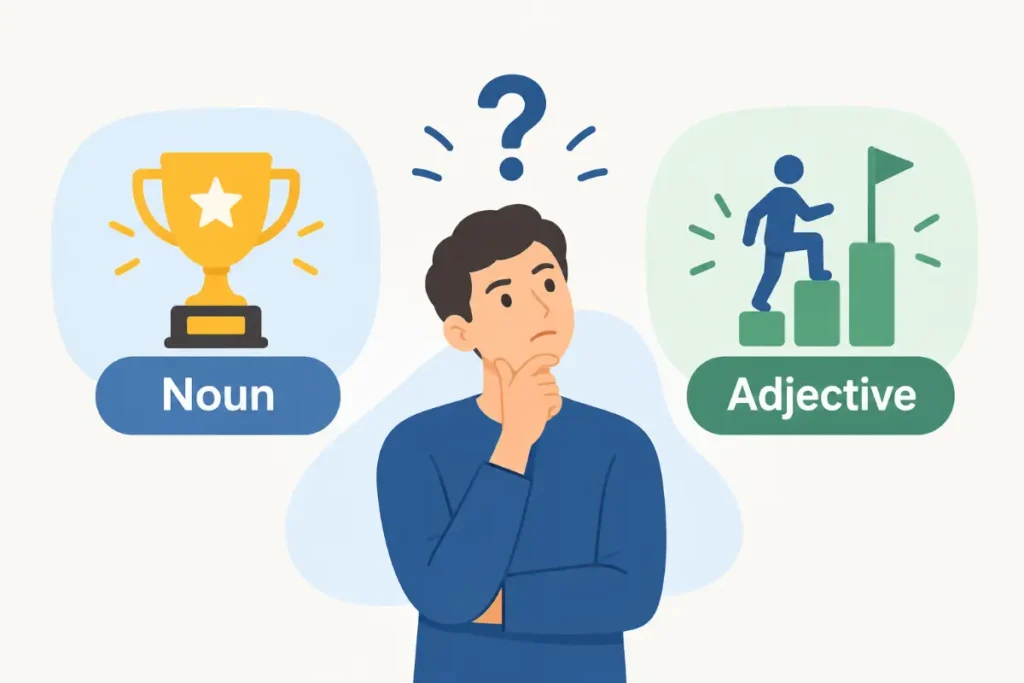
Success is a noun. It names an achievement, a favorable result, or the state of reaching a goal.
Successful is the adjective form. It describes a person or thing that achieves a good result.
Compare these examples.
- Her success impressed the judges.
- She is a successful athlete.
In the first sentence, success names the achievement. In the second, successful describes the athlete.
Successfully is the adverb form. It describes how an action was completed.
– She successfully completed the race.
These forms have related meanings, but they serve different roles in a sentence. Choosing the correct form makes your writing more natural and grammatically sound.
When to Use Success
Use success when you want to name the result or achievement.
Examples.
- Success requires patience.
- Their success surprised the competition.
- The event was a success.
- We celebrated the success of the new program.
When to Use Successful
Use successful when you want to describe a person, event, or action.
Examples.
- She is a successful teacher.
- It was a successful launch.
- They ran a successful campaign.
When to Use Successfully
Use successfully when you want to describe how an action was completed.
Examples.
- The team successfully reached its goal.
- He successfully repaired the broken chair.
- We successfully completed the application.
A simple way to remember the difference is to ask what job the word performs. If it names an achievement, use success. If it describes how an action happened, successfully may be the right choice.
FAQs
What Is the Correct Spelling of Success or Sucess?
Success is the correct spelling in standard American English. It has two c’s in the middle and two s’s at the end. Sucess is a misspelling and should be corrected to success in ordinary writing.
Why Does Success Have Two C’s?
The standard spelling of success includes two c’s before the letter e. English spelling doesn’t always follow a simple sound based rule, so it’s helpful to learn the full word. Remembering the pattern CC followed by SS can help you avoid the most common mistake.
How Do You Spell Success Correctly?
Spell it S U C C E S S. The word has eight letters in total. You can remember it by splitting it into three parts for practice: SU, CC, and ESS.
Is Sucess Ever Correct?
No. Sucess isn’t a standard English spelling of the noun meaning achievement or a good result. Use success in schoolwork, business writing, personal messages, and published content.
What Is the Difference Between Success and Successful?
Success is a noun that names an achievement or a favorable result. Successful is an adjective that describes someone or something that achieves a desired result. For example, “The event was a success” and “The event was successful” are both correct.
What Is the Plural of Success?
The plural form is successes. Add es to the end of success to make the plural. For example, “Her successes inspired the team” refers to several achievements.
What Is the Verb Form of Success?
The related verb is succeed. It means to achieve a goal or get a desired result. For example, “With regular practice, you can succeed” uses the verb correctly.
How Can I Stop Misspelling Success?
Focus on the two c’s in the middle and the two s’s at the end. Write the word in short sentences and check it after each attempt. If you often type it incorrectly, add the correct spelling to your personal word list or use a spelling checker as a final review.
Conclusion
The correct spelling is success, not sucess. The word has eight letters, including two c’s in the middle and two s’s at the end. This spelling stays the same in standard American English.
Remember the pattern CC followed by SS. When you write the word, take a moment to check both pairs of letters. This small habit can help you avoid spelling mistakes in emails, essays, reports, and online articles.
Also, learn the related words success, successful, successfully, and succeed. Each has a different role in a sentence, but learning them together can make your spelling and writing stronger.
The next time you wonder about success or sucess, remember this simple rule. Success has two c’s and two s’s. Check the letters, write the word correctly, and move on with confidence.

Sienna Watson is a veteran copywriter and communications coach who has helped startup founders, marketers, and professionals polish their writing for over a decade. Realizing that most people don’t need a degree in linguistics—just clear, impactful communication—Sienna focuses on practical grammar, business writing etiquette, and eliminating wordiness. She advocates for plain language, strong verbs, and persuasive prose that gets results.