
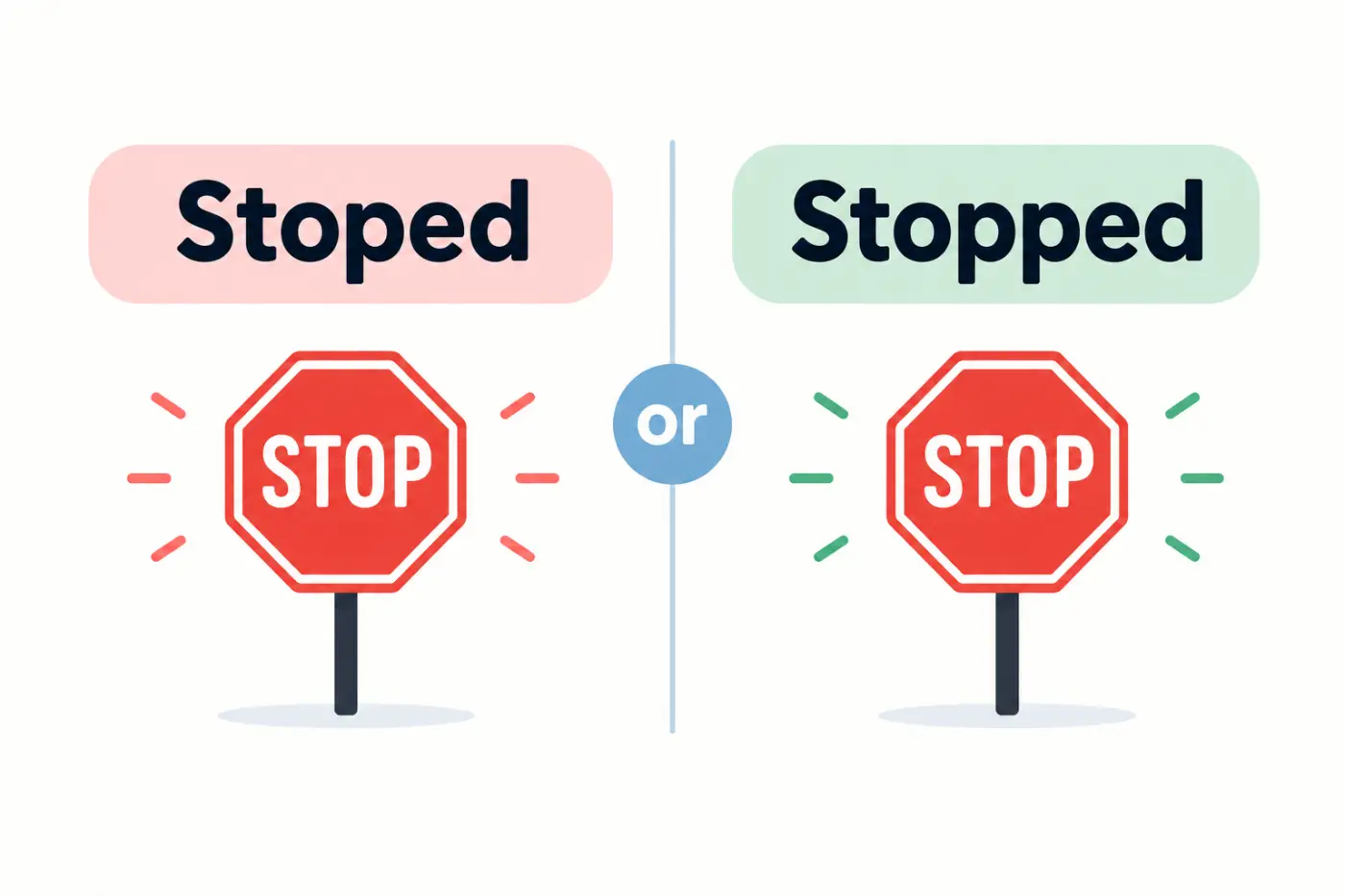
The correct spelling is stopped with two p’s. The spelling stoped is incorrect in standard American English. When you turn the verb stop into the past tense or add the ending ing, you need to double the final consonant before adding the ending that begins with a vowel.
For example, you should write, “She stopped the car at the red light.” You should also write, “He is stopping at the store on his way home.”
The confusion makes sense because many English verbs form their past tense by adding ed without changing the original word. For example, walk becomes walked and clean becomes cleaned. However, stop follows a spelling rule that requires an extra p.
This guide explains why the correct spelling uses two p’s, how to form the past tense, and how to use the word in everyday sentences. You’ll also learn the difference between stopped, stopping, and stop, along with common mistakes and simple ways to remember the rule.
Quick Definition
Stopped is the past tense and past participle of the verb stop. It means that someone or something ended an action, movement, or process. For example, “The bus stopped outside my house.”
Direct Answer
Stopped is the correct spelling. The word stoped is a misspelling because the final p in stop must be doubled before adding ed.
Stoped vs Stopped Spelling Comparison
| Word or phrase | Meaning | Example sentence | When to use it |
|---|---|---|---|
| Stopped | Past tense or past participle of stop | The rain stopped at noon. | Use it when an action or movement has ended. |
| Stoped | Incorrect spelling in standard English | The rain stoped at noon. | Avoid this spelling in writing. |
| Stop | The base form of the verb | Please stop talking. | Use it for the present tense, commands, and after certain helping verbs. |
| Stopping | The present participle or gerund of stop | She is stopping for lunch. | Use it for an ongoing action or when the verb acts as a noun. |
Why Stopped Has Two P’s
The spelling rule for stopped is simple once you understand how short verbs work. When a verb ends with a consonant and follows a certain vowel pattern, you often double the final consonant before adding an ending such as ed or ing.
The verb stop follows this rule because it has one syllable, ends in a consonant, and has a short vowel sound before that consonant.
Look at the word closely.
- The first letter is s.
- The vowel is o.
- The final consonant is p.
The vowel o has a short sound in stop. When you add ed, you double the final p first. This gives you stopped rather than stoped.
The Basic Spelling Rule
For many short verbs that end in a single consonant after a single short vowel, double the final consonant before adding ed or ing.
Here are a few common examples.
| Base verb | Past tense | Form ending in ing |
|---|---|---|
| Stop | Stopped | Stopping |
| Plan | Planned | Planning |
| Shop | Shopped | Shopping |
| Drop | Dropped | Dropping |
| Clip | Clipped | Clipping |
| Grab | Grabbed | Grabbing |
| Hug | Hugged | Hugging |
| Tap | Tapped | Tapping |
Notice the pattern. Each base verb has one syllable and ends with a single consonant after a short vowel. The final consonant doubles before the new ending.
This rule helps preserve the short vowel sound in the original word. It also keeps the spelling consistent across different forms of the verb.
Why You Cannot Simply Add ED
Many English verbs form the past tense by adding ed directly to the base form. For example, jump becomes jumped and help becomes helped.
The word stop works differently because of its spelling pattern. You must double the final p before adding the ending.
The correct change is:
Stop + ed = Stopped.
The incorrect change is:
Stop + ed = Stoped.
The second version leaves out the extra p. Standard English spelling requires both p’s.
Does the Extra P Change the Meaning
No. The extra p does not create a different meaning. It is part of the correct spelling of the past tense.
For example, these sentences express the same idea, but only the first has correct spelling.
- Correct. The driver stopped near the school.
- Incorrect. The driver stoped near the school.
Both sentences attempt to say that the driver brought the vehicle to a halt. However, only stopped follows standard spelling rules.
How to Use Stopped in a Sentence
The word stopped appears in everyday conversations, emails, school assignments, news reports, and workplace messages. It can describe a person ending an action, a vehicle coming to a halt, or an activity that no longer continues.
The meaning depends on the sentence, but the spelling stays the same.
When an Action Ends
Use stopped when someone ends an activity or chooses not to continue doing something.
Examples.
- I stopped eating when I felt full.
- She stopped working at six in the evening.
- They stopped talking when the teacher entered the room.
- My brother stopped playing video games to finish his homework.
- We stopped watching the movie because it was too long.
- He stopped calling after he moved to another city.
- The children stopped laughing when the principal arrived.
- I stopped checking my phone during dinner.
In each sentence, the action began before it ended. The past tense tells readers that the action stopped at some point in the past.
You can also use the word to describe a habit that someone gave up.
For example, “She stopped drinking soda last year.” This sentence tells us that she no longer drinks soda as a habit.
When a Person or Vehicle Comes to a Halt
You can use stopped to describe movement that ends. This often happens when you talk about cars, buses, trains, people, or other moving things.
Examples.
- The bus stopped in front of the library.
- I stopped at the corner to check the street name.
- The taxi stopped outside the hotel.
- The train stopped between two stations.
- The cyclist stopped to fix a flat tire.
- We stopped near the lake to take pictures.
- The elevator stopped on the third floor.
- The truck stopped before reaching the bridge.
In these examples, the word describes a change from movement to stillness. It doesn’t always mean that the movement ended permanently. A bus can stop to pick up passengers and then start moving again.
When Something No Longer Happens
The verb can also describe events, sounds, weather, and processes that come to an end.
Examples.
- The rain stopped before lunchtime.
- The music stopped without warning.
- The noise stopped after the machine was turned off.
- The power stopped working during the storm.
- The meeting stopped for a short break.
- The leak stopped after the plumber repaired the pipe.
- The argument stopped when both sides agreed to listen.
- The alarm stopped after I entered the code.
Some of these sentences describe a temporary pause. Others describe an action that has ended completely. The surrounding details tell readers which meaning applies.
When Someone Prevents an Action
Stopped can also mean that a person or event prevented something from happening.
Examples.
- The police stopped the driver from entering the closed road.
- A sudden storm stopped the game.
- The security guard stopped an unknown visitor at the entrance.
- The doctor stopped the treatment because of an unexpected reaction.
- A broken pipe stopped water from reaching the kitchen.
- Her quick response stopped the argument from getting worse.
This use often appears with words such as from. For example, “The warning stopped us from making a costly mistake.”
The sentence means the warning prevented the mistake. It does not mean that the warning itself physically came to a halt.
The Difference Between Stop Stopped and Stopping
These three forms belong to the same verb, but they serve different purposes. Knowing when to use each one will help you write clear and natural sentences.
Stop
Stop is the base form of the verb. Use it for commands, after certain helping verbs, and in the present tense with subjects such as I, you, we, and they.
Examples.
- Please stop making that noise.
- I stop at this store every Friday.
- They stop for lunch around noon.
- We need to stop before the road gets icy.
- You should stop worrying about every small mistake.
The word also appears after to when you explain a purpose. For example, “I went to the store to stop for gas.” In this sentence, to stop explains what the speaker planned to do.
Stopped
Stopped is the simple past tense. Use it to describe an action that happened in the past.
Examples.
- I stopped at the pharmacy yesterday.
- She stopped answering my messages last week.
- The dog stopped barking when its owner returned.
- We stopped for lunch on our way home.
- The company stopped selling that product last year.
The word can also serve as a past participle. This form appears with helping verbs such as has, have, had, and was.
Examples.
- I have stopped drinking coffee at night.
- She had stopped working before the storm began.
- They have stopped using plastic bags.
- The machine was stopped by an employee.
The form remains stopped in each sentence. The helping verb changes the tense or grammatical structure.
Stopping
Stopping is the form you use in continuous verb tenses and in many sentences where an action acts like a noun.
Examples.
- I am stopping at the grocery store.
- She was stopping to rest every few miles.
- They are stopping the project until they receive approval.
- Stopping at every store made the trip longer.
- He considered stopping his membership.
The spelling rule is the same as the past tense rule. You double the p before adding ing.
Remember this pattern.
- Stop.
- Stopped.
- Stopping.
The base form has one p. The two forms with added endings have two p’s.
A Quick Comparison in Context
Consider how the verb changes in these sentences.
| Sentence | Verb form | Reason |
|---|---|---|
| I stop here every morning. | Stop | A regular action in the present. |
| I stopped here yesterday. | Stopped | An action completed in the past. |
| I am stopping here now. | Stopping | An action happening around the present time. |
| I have stopped here before. | Stopped | A past action connected to the present. |
| Please stop here. | Stop | A command. |
The spelling becomes easier when you pay attention to the time and purpose of the sentence.
Common Mistakes With Stopped
The missing p is the main spelling mistake, but a few other errors can appear when people use this verb. Learning to spot them will help you avoid mistakes in schoolwork, professional writing, and everyday messages.
Writing Stoped Instead of Stopped
This is the most common error related to the target phrase. It happens when someone adds ed without doubling the final consonant.
Incorrect. “The rain stoped before we left.”
Correct. “The rain stopped before we left.”
To fix this mistake, remember that stop follows the consonant doubling rule. Add another p before adding ed.
Writing Stoping Instead of Stopping
The same rule applies to the ing form.
Incorrect. “The car is stoping at the next light.”
Correct. “The car is stopping at the next light.”
Both stopped and stopping need two p’s. The base form keeps just one.
Using Stopped With the Wrong Helping Verb
Sometimes the spelling is correct, but the sentence still has a grammar problem.
For example, “She did stopped talking” is incorrect in standard English. After did, use the base form of the verb.
The correct sentence is “She did stop talking.”
Here are more examples.
- Incorrect. He did stopped the car.
- Correct. He did stop the car.
- Incorrect. They will stopped the game.
- Correct. They will stop the game.
- Incorrect. I can stopped anytime.
- Correct. I can stop anytime.
The rule is simple. Helping verbs such as did, will, and can are followed by the base form in these sentence patterns.
Confusing the Past Tense With the Past Participle
The spelling of the simple past and past participle is identical for stop. Both forms use stopped.
However, they appear in different grammatical structures.
Simple past. “She stopped the car.”
Present perfect. “She has stopped the car.”
Past perfect. “She had stopped the car.”
Passive voice. “The car was stopped by the guard.”
The spelling does not change, but the helping verb changes how the sentence works.
Forgetting the Extra P in Formal Writing
A small spelling error can make a sentence look less polished. This matters in job applications, school essays, reports, and professional emails.
For example, compare these two sentences.
Incorrect. “The team stoped the process to review the results.”
Correct. “The team stopped the process to review the results.”
A spell checker may catch the first error, but it is still useful to know the rule yourself. You can then correct the mistake even when an editing tool is unavailable.
How to Remember the Correct Spelling
Spelling rules are easier to remember when you connect them to a pattern rather than memorize each word on its own. The word stopped is a good example because it follows a rule you can use with many other verbs.
Use the Double P Trick
Think of the word stop as the starting point. When you add ed or ing, give the final p a partner.
- Stop becomes stopped.
- Stop becomes stopping.
You can picture the extra p as a small bridge between the base word and its ending. Once you remember to double the p, you can form both words correctly.
Try saying the forms aloud as you write them. The spelling pattern becomes more familiar with practice.
Remember the Short Vowel Rule
The vowel sound in stop is short. The word has one vowel letter followed by one final consonant. This is the pattern that triggers consonant doubling in many short verbs.
Compare these words.
| Base word | Correct past tense | Vowel sound |
|---|---|---|
| Stop | Stopped | Short o |
| Plan | Planned | Short a |
| Shop | Shopped | Short o |
| Rub | Rubbed | Short u |
| Slip | Slipped | Short i |
This trick works for many common verbs. Still, English has other spelling patterns, so don’t assume every verb ending in a consonant follows the same rule.
Use a Simple Sentence Test
When you are unsure about the spelling, put the word into a sentence about something that already happened.
For example, think of the sentence, “I stopped at the store.”
Then compare it with the present tense sentence, “I stop at the store.”
Seeing the two forms together helps you notice the doubled p. You can use this approach with other verbs that follow the same spelling rule.
Practice With Short Exercises
Try filling in the missing word in each sentence. Choose the correct form from the two options.
- The bus stoped or stopped near the school.
- She is stoping or stopping to answer the phone.
- We stoped or stopped for lunch.
- He has stoped or stopped playing the game.
- The rain stoped or stopped before noon.
The correct answers are stopped, stopping, stopped, stopped, and stopped.
Each answer follows the same spelling pattern. The past tense and past participle use two p’s. The form ending in ing also uses two p’s.
When Do You Double the Final Consonant
The rule behind stopped applies to many English verbs, but it helps to understand its limits. This will keep you from doubling consonants in words that don’t need them.
One Syllable and a Short Vowel
A syllable is a single sound unit in a word. The word stop has one syllable. It contains a short vowel sound followed by one final consonant.
When a one syllable verb follows this pattern, you usually double the final consonant before adding ed or ing.
Examples include:
- Clap becomes clapped and clapping.
- Plan becomes planned and planning.
- Drag becomes dragged and dragging.
- Shop becomes shopped and shopping.
- Skip becomes skipped and skipping.
- Spot becomes spotted and spotting.
These examples share the same basic pattern as stop. The final consonant doubles to keep the spelling consistent with the short vowel sound.
Verbs That End With Two Consonants
You usually don’t double the final consonant when the base word already ends with two consonants.
For example, help becomes helped and helping. The word already ends in two consonants, l and p, so you don’t add another p.
Other examples include:
| Base verb | Past tense | Form ending in ing |
|---|---|---|
| Help | Helped | Helping |
| Jump | Jumped | Jumping |
| Lift | Lifted | Lifting |
| Start | Started | Starting |
| Wash | Washed | Washing |
These words don’t follow the same doubling pattern as stop. Learning the difference will help you make better spelling choices.
Verbs That End With Two Vowels
You also generally don’t double the final consonant when a verb ends in a vowel combination followed by a consonant.
For example, boil becomes boiled and boiling. The spelling does not need an extra l.
Other examples include rain, which becomes rained and raining, and need, which becomes needed and needing.
The exact spelling rule can vary with the word and its sound pattern. However, the main idea is to look at the letters immediately before the final consonant.
Longer Verbs Can Follow the Same Rule
The consonant doubling rule also applies to many longer verbs when the stress falls on the final syllable.
For example, admit becomes admitted and admitting. The final syllable receives the stress, so the final t doubles before the ending.
Another example is occur, which becomes occurred and occurring.
However, verbs with other stress patterns may not double the final consonant. For example, visit becomes visited and visiting. The final syllable does not receive the main stress, so the final t stays single.
You don’t need to master every detail at once. Start with common short verbs such as stop, plan, and shop. Once you understand the basic pattern, longer words become easier to handle.
Related Words That Follow the Same Rule
Learning words in groups can help you improve your spelling faster. Many common verbs double their final consonant before adding ed or ing.
Plan and Planned
The verb plan means to decide what you want to do in the future.
Examples.
- We planned a family trip last summer.
- She is planning a birthday party.
- I plan to finish my work tonight.
The final n doubles in planned and planning because the word follows the same short vowel pattern as stop.
Shop and Shopped
The verb shop means to look for or buy goods.
Examples.
- We shopped for groceries after work.
- He is shopping for a new laptop.
- I shop at that store every weekend.
The final p doubles in both forms with added endings. This makes shopped a useful word to compare with stopped.
Drop and Dropped
The verb drop can mean to let something fall or to stop taking part in something.
Examples.
- I dropped my keys on the floor.
- She is dropping off a package.
- He dropped the class before the deadline.
The final p doubles in dropped and dropping. The spelling pattern stays the same even when the meaning changes.
Grab and Grabbed
The verb grab means to take or hold something quickly.
Examples.
- I grabbed my jacket before leaving.
- She is grabbing a quick snack.
- He grabbed the handle to keep his balance.
The final b doubles before ed and ing. Like stop, this verb has one syllable and a short vowel before the final consonant.
Hug and Hugged.
The verb hug means to hold someone close with your arms.
Examples.
- She hugged her friend goodbye.
- The child is hugging his teddy bear.
- I hugged my sister when she arrived.
The final g doubles in hugged and hugging. This is another common word that follows the same spelling pattern.
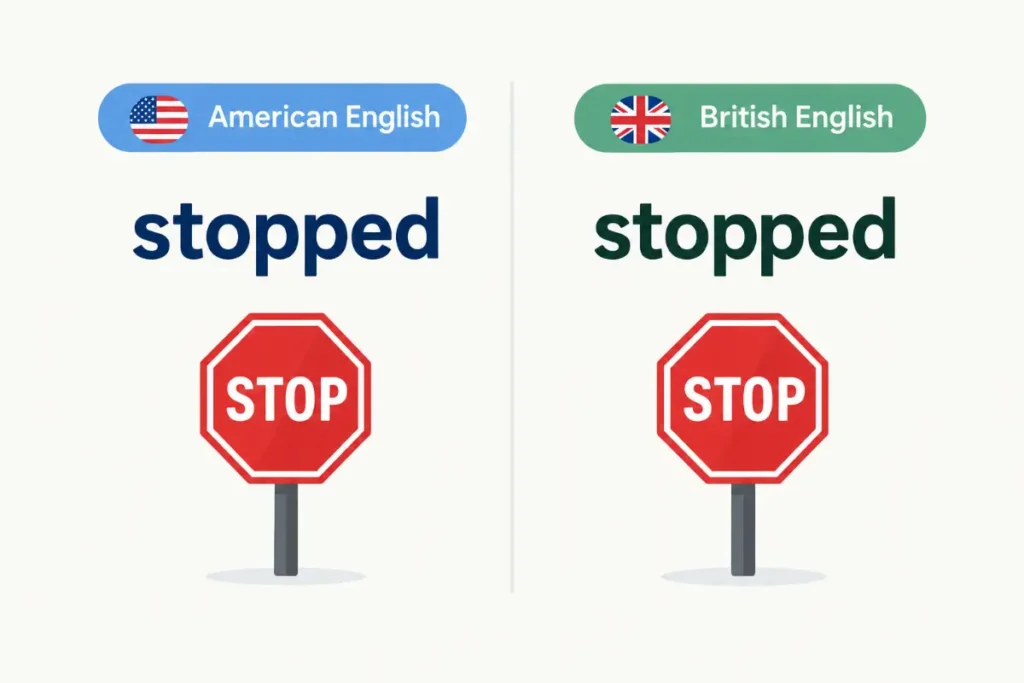
American English and British English
The spelling of stopped is the same in American English and British English. Both use two p’s in the past tense and past participle.
You can write the following sentences for readers in either country.
- The driver stopped near the station.
- The rain stopped in the afternoon.
- She stopped working at five.
- The machine has stopped running.
Some English words have different American and British spellings. For example, Americans often write color, while British writers often use colour. However, stopped is not one of those words.
You don’t need a different spelling for an American audience. Use stopped in school assignments, business emails, articles, and everyday messages.
Is Stoped Ever Correct
In standard modern English, stoped is not the accepted spelling of the past tense of stop. You should avoid it in formal and informal writing.
You might see the spelling in an old text, a typo, a draft, or a learner’s writing. That doesn’t make it correct for ordinary modern English.
If you’re writing an essay, website article, social media post, or work email, use stopped. The same rule applies to stopping.
How Stopped Works in Different Sentence Types
The word stopped can appear in several sentence structures. Understanding these patterns will help you use it correctly in everyday writing.
Simple Past Sentences
Use the simple past when you describe an action that happened and ended in the past.
Examples.
- I stopped by your house yesterday.
- The teacher stopped the lesson to answer a question.
- We stopped at a gas station on the way home.
- My phone stopped working last night.
These sentences describe past events. The word stopped tells the reader that the action took place before the present moment.
You can also include a specific time, such as yesterday, last night, or two hours ago. These details help establish when the action happened.
Present Perfect Sentences
Use the present perfect when a past action connects to the present. Form it with has or have followed by stopped.
Examples.
- I have stopped eating late at night.
- She has stopped attending the weekly meetings.
- They have stopped selling that model.
- We have stopped using the old system.
These sentences often describe a change that still matters now. For example, “I have stopped eating late at night” suggests that the habit has ended and is no longer part of the speaker’s routine.
Past Perfect Sentences
Use the past perfect when one past action happened before another past event. Form it with had followed by stopped.
Examples.
- The rain had stopped before we left home.
- She had stopped working by the time I arrived.
- The bus had stopped before the passengers stood up.
The word had helps show that the stopping happened first. The rest of the sentence provides another point in the past for comparison.
Passive Voice Sentences
In passive voice, the subject receives the action instead of performing it. The word stopped can appear after a form of be.
Examples.
- The car was stopped by a police officer.
- The game was stopped because of heavy rain.
- The machine was stopped before the repair began.
These sentences focus on the car, game, or machine rather than the person who stopped it. The spelling of stopped stays the same.
A Simple Editing Checklist
Before publishing an article or sending an important message, take a moment to check the verb form. A few quick checks can catch most errors.
- Check the base verb. Start with stop.
- Check the ending. Decide if the sentence needs the past tense or the ing form.
- Double the p. Write stopped or stopping when you add those endings.
- Check the helping verb. After did, will, and can, use stop rather than stopped in the usual sentence pattern.
- Read the full sentence. Make sure the verb fits the time and meaning.
- Use a spell checker. Let it help you catch typos, but don’t rely on it to explain the rule.
For example, consider this sentence.
“Yesterday, I did stoped at the store.”
It contains two problems. The spelling is wrong, and the verb form after did is incorrect.
The corrected sentence is “Yesterday, I stopped at the store.” If you want to keep did for emphasis, write “Yesterday, I did stop at the store.”
This shows why spelling and grammar work together. Correct spelling matters, but the verb also needs to fit the sentence.
FAQs
Is stoped or stopped correct?
Stopped is the correct spelling in standard English. It has two p’s because the final consonant in stop doubles before adding ed. Use it when you describe an action that ended in the past.
Why does stopped have two p’s?
The verb stop has one syllable and a short vowel followed by a single final consonant. English spelling rules usually double that consonant before adding ed or ing to verbs with this pattern. That’s why you write stopped and stopping.
Is stoped a real word?
Stoped is not the standard spelling of the past tense of stop. You may see it as a typo or a spelling mistake, but you should use stopped in normal English writing. The same rule applies to formal documents and casual messages.
Is stopping spelled with one p or two?
Stopping is spelled with two p’s. You double the final consonant in stop before adding ing. For example, write, “The bus is stopping near the school.”
What is the past tense of stop?
The past tense of stop is stopped. For example, “I stopped at the store after work.” The past participle is also stopped, as in, “I have stopped at that store before.”
Do Americans and British people spell stopped differently?
No. American English and British English both use stopped with two p’s. The spelling is the same in both varieties of English.
What is the difference between stop and stopped?
Stop is the base form of the verb, while stopped is its past tense and past participle. You might say, “I stop here every day” for a regular action and “I stopped here yesterday” for an action in the past.
How can I remember how to spell stopped?
Remember that stop gains another p before you add ed or ing. The pattern is stop, stopped, and stopping. Practicing these three forms together will help you remember the correct spelling.
Conclusion
The correct spelling is stopped with two p’s. The spelling stoped is incorrect in standard English. Once you learn the rule behind the extra p, you’ll find it easier to spell this word correctly every time.
Remember that stop is the base form. When you add ed to form the past tense or past participle, double the final p first. The same rule applies when you add ing to form stopping.
You can use stopped to describe an action that ended, a vehicle that came to a halt, or something that prevented an event from continuing. The word works in everyday conversations as well as school assignments and professional writing.
The easiest way to remember the rule is to practice the three forms together. Write stop, stopped, and stopping a few times. Before long, the extra p will feel natural, and you won’t have to think twice about the spelling.

Sienna Watson is a veteran copywriter and communications coach who has helped startup founders, marketers, and professionals polish their writing for over a decade. Realizing that most people don’t need a degree in linguistics—just clear, impactful communication—Sienna focuses on practical grammar, business writing etiquette, and eliminating wordiness. She advocates for plain language, strong verbs, and persuasive prose that gets results.