
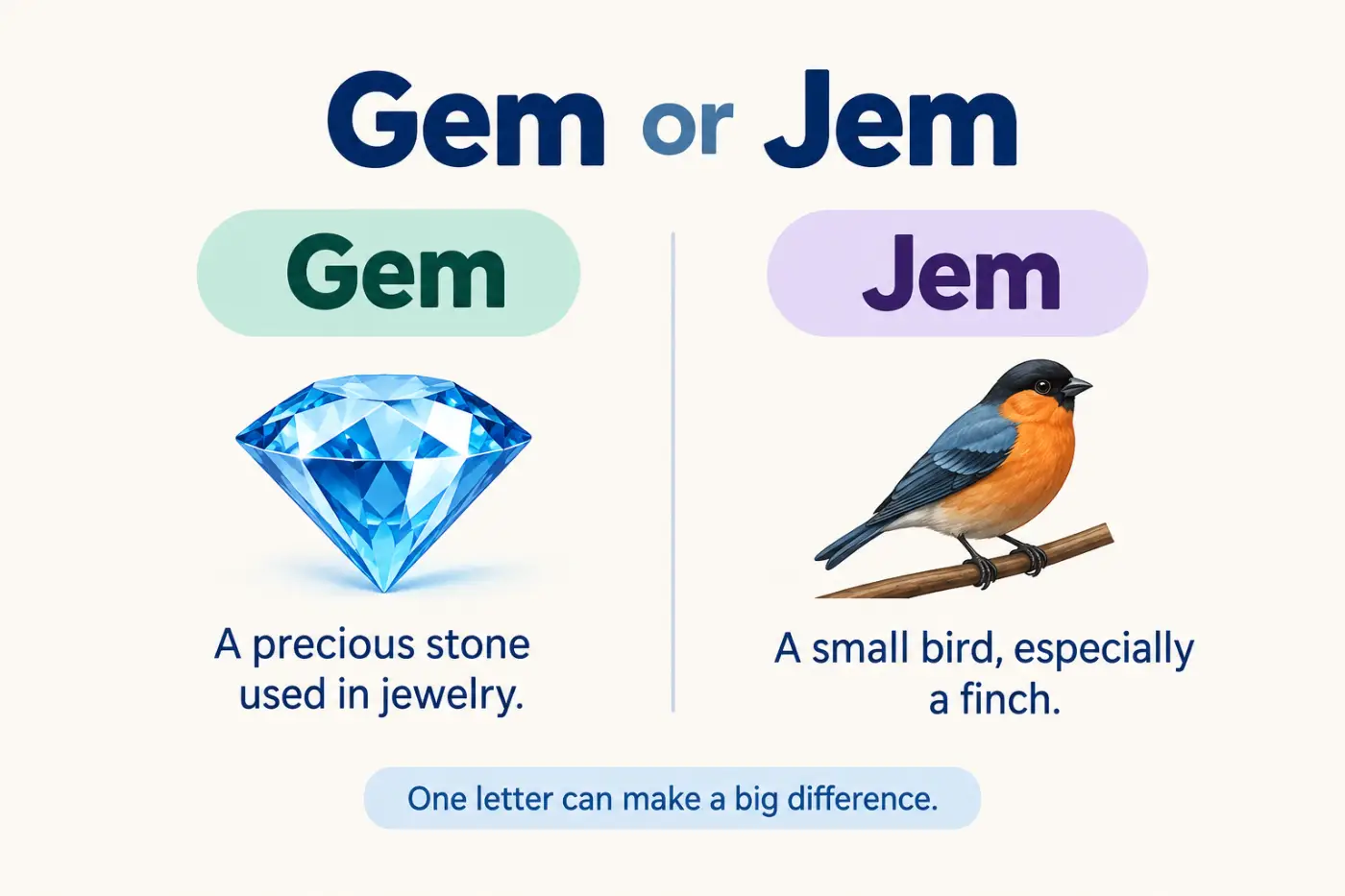
If you’re unsure about gem or jem, the correct spelling is gem. It refers to a precious stone such as a diamond or ruby. It can also describe a person or thing that’s special, valuable, or wonderful.
The word jem is a common spelling mistake. It isn’t the standard English spelling of this word. In American English, you should write gem when talking about a jewel, a treasured person, or something you value.
For example, you might say, “My grandmother gave me a beautiful gem.” You could also say, “That little bookstore is a gem.” In the first sentence, the word refers to a precious stone. In the second, it describes a place that’s worth discovering.
The spelling can be tricky because gem sounds like it starts with the letter J. English has many words where the sound of a letter doesn’t match the spelling people expect. Once you learn the rule behind this word, it becomes much easier to remember.
This guide explains the correct spelling, the meaning of the word, how to use it in everyday sentences, and why people sometimes write the wrong version. You’ll also find practical examples, memory tips, related words, and answers to common spelling questions.
Quick Definition
Gem is the correct spelling of a word that means a precious or semiprecious stone. It can also describe a person, place, or thing that’s especially good or valuable. Jem is not the standard spelling for these meanings.
Direct Answer
Gem is correct. Use it when referring to a precious stone or something special and valuable. Avoid jem in standard English writing.
Gem vs Jem at a Glance
| Word | Meaning | Example Sentence | When to Use It |
|---|---|---|---|
| Gem | A precious stone or something special and valuable. | This necklace has a blue gem. | Use it for jewels, treasured people, and excellent things. |
| Jem | Not a standard spelling of the common word. | The correct spelling is gem. | Use only when Jem is a proper name or an exact title. |
Why Gem Is the Correct Spelling
The correct spelling comes down to a standard English spelling pattern. The word for a precious stone is spelled G E M. It has three letters and one syllable. You pronounce it with a soft G, which sounds like the J in jam or jacket.
That sound can confuse new writers and even fluent English speakers. Many words that start with a soft G sound like they start with J. However, English spelling does not always follow the sound alone. You need to learn the accepted spelling of each word.
The Meaning Behind the Spelling
A gem is a stone that people value for its beauty, rarity, or other special qualities. Diamonds, rubies, sapphires, and emeralds are familiar examples. Jewelers may cut and polish these stones before setting them in rings, necklaces, and other pieces of jewelry.
The word also has a wider meaning. People use it to describe someone or something they admire. A helpful neighbor can be a gem. A small restaurant with excellent food can be a gem. A useful book that teaches you something new can be a gem, too.
In each case, the spelling stays the same. You don’t change the G to J just because the word describes a person or an object instead of a stone.
Why Jem Looks Like a Possible Spelling
The spelling jem may seem reasonable because it matches the way the word sounds. When people hear a word without seeing it written down, they sometimes choose letters based on pronunciation. This is a common part of learning English.
The letter J usually represents the sound you hear at the start of jump, job, and jelly. Since gem begins with a similar sound, someone might assume that J is the right choice.
Still, the standard spelling is based on convention rather than sound alone. You write gem even though its first letter sounds like J. The same kind of spelling challenge appears in words such as giant, gentle, and gym.
What Does Gem Mean
The word gem has several related meanings. Understanding them will help you recognize it in different kinds of writing and use it naturally in your own sentences.
Gem as a Precious Stone
The most direct meaning of a gem is a precious or semiprecious stone. These stones may be valued for their color, shine, rarity, or use in jewelry.
For example, a ruby has a rich red color. An emerald is known for its green color. A sapphire is often blue, though sapphires can appear in other colors as well. A diamond is famous for its sparkle and hardness.
Here are some natural examples.
- She wore a ring with a small green gem.
- The jeweler showed us a rare purple gem.
- His collection includes gems from several countries.
- The necklace features a bright blue gem.
- They found a polished gem at the mineral show.
In these sentences, the word refers to an actual stone. It can appear in everyday conversation, product descriptions, stories, and educational writing.
You may also see gemstone used in place of gem. The two words often refer to the same kind of object. Gemstone is more specific and makes the meaning clear, while gem is shorter and can have a wider meaning.
Gem as a Special Person
People often use gem as a compliment. Calling someone a gem means that person is kind, helpful, thoughtful, talented, or simply wonderful to be around.
Imagine that your coworker stays late to help you finish a difficult task. You might tell a friend, “She’s a real gem.” You’re not saying that your coworker is a stone. You’re saying that she’s valuable to the people around her.
Consider these examples.
- My aunt is a gem because she always makes time for our family.
- Our new teacher is a real gem.
- You’re a gem for helping me move this weekend.
- The nurse who helped my father was an absolute gem.
- He’s a gem of a friend who never lets me down.
This use of the word feels warm and personal. It’s common in casual conversations and friendly messages. It can also appear in a review or a story about someone who made a positive difference.
The expression a gem of a person adds emphasis. It tells readers that the person stands out for good reasons.
Gem as an Excellent Place or Thing
A place or object can also be a gem when it offers something special. People often use the word to describe places that are easy to overlook but worth visiting.
For instance, a family owned cafe with fresh food and friendly service might be called a hidden gem. A quiet beach away from crowded tourist areas could earn the same description. A secondhand store with great finds might also be a gem.
Here are a few examples.
- We found a gem of a restaurant on a quiet street.
- That little library is a gem for local families.
- This used bookstore is a real gem.
- The park behind the museum is a hidden gem.
- Her latest novel is a gem that deserves more attention.
These examples show how flexible the word can be. It works for places, books, services, experiences, and many other things that people appreciate.
What Does Hidden Gem Mean
A hidden gem is a person, place, or thing that is excellent but not widely known. The word hidden suggests that people may overlook it or that it hasn’t received much attention.
A small bakery with amazing bread could be a hidden gem. So could an independent artist whose work deserves a larger audience. The phrase often appears in travel guides, restaurant reviews, book recommendations, and online discussions.
For example, “We discovered a hidden gem in the mountains” suggests that the place was special and perhaps less crowded than popular destinations.
You don’t need to use the phrase only for places. A hidden gem can be a helpful website, an old movie, a little known song, or a person with an unusual talent.
How to Use Gem in Everyday Sentences
Learning the spelling is useful, but knowing how to use the word makes it easier to remember. The best way to learn is to see it in situations that feel familiar.
Examples for School and Work
At school, you might use gem to describe a helpful classmate, a valuable book, or an excellent idea. At work, you might use it to praise a colleague or describe a useful resource.
For example.
- Your notes were a gem during exam week.
- Our new assistant is a gem.
- That training guide is a gem for new employees.
- Her advice turned out to be a real gem.
- The teacher shared a gem of a tip before the test.
These sentences show how the word can make a compliment sound friendly and sincere. It suggests that something has real value without making the statement too formal.
In professional writing, consider your audience. Calling a colleague a gem can work well in a personal message or a friendly team note. A formal report may need a more precise description, such as highly helpful, valuable, or excellent.
Examples for Family and Friends
The word fits naturally into everyday conversations with people you know. It can show gratitude or affection without requiring a long explanation.
Try sentences like these.
- Thanks for picking up my groceries. You’re a gem.
- My brother is a gem when it comes to fixing things.
- She brought dinner when I was sick. What a gem.
- Our neighbors are gems for watching the house while we travel.
- He’s been a gem throughout this whole process.
The expression works because it treats kindness as something precious. It gives a simple compliment a little more warmth.
Examples for Shopping and Reviews
You may see gem in product descriptions and customer reviews. In these cases, it often means that a product or store offers unusually good value or quality.
For example.
- This little shop is a gem for handmade gifts.
- I found a gem of a jacket at the thrift store.
- The restaurant is a gem for anyone who loves fresh pasta.
- This website is a gem for free learning materials.
- That camera turned out to be a hidden gem.
Use the word honestly when writing reviews. If you call a product a gem, explain what makes it stand out. Perhaps it lasts a long time, offers good value, or performs better than expected. A specific reason makes your praise more useful to readers.
Examples in Creative Writing
Writers can use gem to create an image of beauty, value, or rarity. It works in fiction, poetry, personal essays, and descriptive passages.
For instance.
- A tiny gem glimmered beneath the old floorboards.
- Her grandmother’s stories were gems she treasured for years.
- The sun lit the lake like a blue gem.
- Among the dusty papers, he found a gem of a letter.
- His quiet courage was the true gem of the story.
In creative writing, the word can be literal or figurative. A physical stone may help describe a scene, while an idea or memory may represent something precious. The surrounding sentence tells readers which meaning you intend.
Why People Confuse Gem and Jem
Spelling mistakes often happen when a word sounds different from what a person expects to see on the page. This is one reason people write jem instead of gem. The spoken sound points them toward J, even though the accepted spelling starts with G.
The Soft G Sound
English has two common sounds for the letter G. A hard G sounds like the first letter in go, game, and garden. A soft G sounds like the first letter in gentle, giant, and giraffe.
The word gem uses the soft G sound. It sounds like the word begins with J, but its first letter is G.
This pattern appears in many everyday words.
- Gentle. The first letter sounds like J.
- Giant. The first letter sounds like J.
- Ginger. The first letter sounds like J.
- Gym. The first letter sounds like J.
- General. The first letter sounds like J.
- Gem. The first letter sounds like J.
These words show why you can’t always choose a spelling based on sound alone. The letter G can represent different sounds, and the right spelling depends on the word.
The Difference Between Sound and Spelling
English spelling reflects many layers of language history. Some words follow common patterns, while others have spellings that learners need to memorize. Pronunciation can guide you, but it doesn’t always provide the full answer.
For example, phone begins with a sound that many people associate with F, yet its spelling starts with PH. The word know begins with a silent K. In gem, the sound of J comes from the letter G.
This doesn’t mean English has no spelling rules. It means that you need to learn how those rules work and recognize the words that follow them.
When you meet a word that seems confusing, check a reliable dictionary. Reading the word in books, articles, and everyday messages also helps you remember its standard form.
How Reading Helps You Remember
The more often you see a word written correctly, the easier it becomes to recognize. You may not need to stop and think about the spelling of gem after you’ve read it many times.
Try noticing the word in different settings. You might see it in a jewelry catalog, a book review, or a message from a friend. Each time you connect the written form with its meaning, you reinforce the correct spelling.
You can also practice writing short sentences. Instead of repeating the word alone, use it in a few different ways.
For example.
- The gem sparkled in the sunlight.
- My cousin is a gem.
- We found a hidden gem near the coast.
- That book is a gem for new writers.
This small exercise helps you connect the spelling with the word’s different meanings.
Common Mistakes to Avoid
Even a short word can cause confusion. The easiest way to avoid mistakes is to learn the standard spelling and understand the situations in which a different form may appear.
Using Jem in Place of Gem
The most common mistake is writing jem when you mean a precious stone or something special. The spelling may look reasonable, but it isn’t accepted as the standard form for those meanings.
Incorrect: “The jeweler showed us a beautiful jem.”
Correct: “The jeweler showed us a beautiful gem.”
Incorrect: “My best friend is a real jem.”
Correct: “My best friend is a real gem.”
The correction stays the same in both examples. Use G, not J, when writing the ordinary English word.
Assuming Every Word That Sounds Like J Starts With J
English doesn’t use one letter for every sound in a simple, predictable way. Several letters and letter combinations can represent similar sounds.
For instance, giant starts with G, jam starts with J, and phone starts with PH even though it begins with an F sound. These examples show why sound alone can’t settle every spelling question.
When you learn a new word, pay attention to both its pronunciation and its written form. If the spelling seems surprising, make a note of it and practice using it in a sentence.
Treating Every Appearance of Jem as a Spelling Error
There is one useful distinction. Although jem isn’t the standard spelling of the common word for a precious stone, it can appear as a proper name, a character’s name, or part of a title.
Names don’t always follow the spelling rules used for ordinary words. A person may be named Jem, and a writer may choose Jem as the name of a fictional character. In those cases, the spelling may be correct for that specific name.
For example, a sentence such as “Jem is meeting us at the library” could be correct if Jem is someone’s name.
Context matters. If you’re talking about a jewel or a wonderful person, place, or thing, use gem. If you’re writing a person’s actual name, follow the spelling that person uses.
Forgetting the Correct Spelling in Longer Writing
A writer may spell a word correctly in one sentence and incorrectly in another. This can happen during quick typing, editing, or a long writing session.
A simple proofreading check can help. Search your document for jem and review each result. If you intended the common word, change it to gem. If it refers to a name, confirm that the spelling matches the person or character.
Don’t rely on automatic spellcheck alone. Some names may be flagged even when they’re correct, and a spellchecker may not catch every mistake. Read the full sentence to make sure the word fits its meaning.
Easy Ways to Remember the Correct Spelling
A memory trick can make a spelling rule easier to recall. You don’t need a complicated formula. A short phrase or a familiar image may be enough.
Connect Gem With Jewelry
The word gem often appears alongside jewelry. Both words describe things people may wear or give as gifts. You can use this connection to remind yourself that a precious gem begins with G.
Think of a gold ring with a gemstone in the center. Picture the stone catching the light. When you imagine that image, connect it with the spelling G E M.
You can also remember the word gemstone. Since gem forms the first part of gemstone, learning the longer word reinforces the shorter one.
Remember the Phrase A Gem of a Person
Another useful trick is to connect the word with someone you admire. Think of a person who always helps you, listens carefully, or makes your day better.
Say to yourself, “She’s a gem.” The G in gem is the letter you need, even though it sounds like J.
This phrase works because it connects spelling with meaning and emotion. You aren’t memorizing three letters in isolation. You’re linking the word to a real person or a familiar situation.
Practice With Three Short Sentences
Writing a few simple sentences can make the correct spelling stick.
- The gem is blue.
- My uncle is a gem.
- We found a hidden gem.
Each sentence uses the same spelling in a different way. The first refers to a stone. The second describes a person. The third describes something special that people may not know about.
Read the sentences aloud, then write them without looking. Check your work afterward. Repeat the exercise if you need more practice.
Use a Quick Spelling Test
Test yourself by filling in the missing letter.
- The ring has a beautiful _em.
- My teacher is a real _em.
- We discovered a hidden _em.
The correct letter is G in every sentence. If you can complete each example without hesitation, you’re beginning to recognize the pattern.
For extra practice, write your own sentence about a friend, a place, or a piece of jewelry. Using the word in a situation that matters to you can make it easier to remember.
Related Words and Expressions
Learning a few related terms will help you understand how gem works in different settings. These words share similar meanings, but each one has its own use.
Gem and Gemstone
A gem is a precious or semiprecious stone. A gemstone refers more specifically to a stone valued for its beauty or use in jewelry and decoration.
For example, “The ring contains a rare gem” and “The ring contains a rare gemstone” communicate nearly the same idea.
The shorter word also has figurative meanings. You can call a person a gem, but gemstone usually refers to a physical stone. You wouldn’t normally call a helpful neighbor a gemstone.
Gem and Jewel
The words gem and jewel overlap in meaning. Both can refer to a precious stone, and both can suggest something valuable.
However, jewel can also refer to a piece of jewelry or an ornament that contains precious stones. A ring with a diamond may be called a jewel, while the diamond itself is a gem.
For example, “She admired the gem in the center of the jewel” distinguishes the stone from the larger decorative object.
In casual speech, people sometimes use these words in similar ways. The exact meaning depends on the sentence.
Gem and Treasure
A treasure is something highly valued. It may be money, an object, a memory, or a person. A gem can also describe something valuable, but it often suggests beauty, quality, or a special charm.
Consider these examples.
- That old photograph is a family treasure.
- This little cafe is a gem.
- Her letters are treasures I keep in a box.
- His kindness makes him a gem.
A treasure is something you value deeply. A gem is often something that stands out as unusually good or precious.
Gem and Hidden Gem
A hidden gem is something excellent that isn’t widely known. The phrase is especially common in reviews and recommendations.
For example, a small family restaurant may serve wonderful food without attracting much attention. A quiet hiking trail may offer beautiful views without drawing large crowds. People might describe either one as a hidden gem.
The phrase is useful when you want to recommend something that deserves more attention. To make your recommendation convincing, explain what makes the place or item special.
Gem and Genius
The words gem and genius don’t mean the same thing. A genius is a person with exceptional intelligence or someone who shows extraordinary skill. A gem is a precious stone or a person or thing that people value highly.
You might call a brilliant scientist a genius. You might call that scientist a gem if they are also kind, generous, or wonderful to work with.
This distinction matters because a compliment can focus on different qualities. Choose the word that best expresses what you mean.

How Gem Appears in Different Types of Writing
The word fits many writing styles, from casual messages to educational articles. Its meaning stays clear when you give readers enough context.
In Everyday Conversation
People often use gem when thanking someone or giving a compliment. It sounds friendly and sincere without feeling overly formal.
Imagine your friend drives you to the airport early in the morning. You might say, “You’re a gem for doing this.” The phrase shows that you appreciate the favor.
You can also use it to describe something you enjoy. If you discover a great coffee shop, you could tell a friend, “I found a real gem near my office.”
These expressions work well in spoken English because they’re short and easy to understand. They also sound natural in texts, emails to friends, and social media posts.
In Books and Articles
Writers use gem to describe memorable ideas, valuable lessons, or overlooked discoveries. The word can make a description more vivid without adding many extra words.
For example, a book review might say, “This novel is a gem for readers who enjoy family stories.” A travel article might describe a quiet town as “a hidden gem along the coast.”
Still, avoid using the word as a substitute for a clear explanation. If you call a book a gem, tell readers why you recommend it. Mention its engaging story, useful advice, or memorable characters. Specific details help people understand your opinion.
In Business and Professional Messages
You can use the word to praise a helpful colleague or recognize a valuable resource. For example, “Your research notes were a gem during the meeting” expresses appreciation in a relaxed way.
The tone matters. In a friendly team message, the word may sound warm and genuine. In a formal business report, terms such as valuable resource or excellent contribution may fit better.
Choose the expression that suits your audience. Good writing isn’t about using the fanciest word. It’s about choosing the word that communicates your meaning clearly.
When Jem Is Correct
Although gem is the standard spelling for a precious stone and its figurative meanings, you may encounter Jem in other contexts. Recognizing these cases helps you avoid correcting something that isn’t actually a mistake.
Jem as a Person’s Name
Jem can be a given name or nickname. If someone spells their name Jem, use that spelling when referring to them.
For example, “Jem left her notebook in the classroom” is correct if Jem is the person’s name. The word isn’t referring to a stone in this sentence.
Names can have unusual spellings. You shouldn’t change a person’s name to match the spelling of a different word.
Jem as a Fictional Character
Authors sometimes choose names that resemble familiar words. A character named Jem may appear in a novel, a play, or another work of fiction.
One well known example is Jem Finch from Harper Lee’s novel To Kill a Mockingbird. In this case, Jem is the character’s name, so the spelling with J is correct.
This example illustrates the difference between a proper name and an ordinary word. The right spelling depends on what you’re trying to write.
Jem in Titles and Brand Names
A business, product, organization, or creative work may use Jem as part of its official name. In that situation, follow the name as it is presented by its owner or publisher.
For example, a shop might use Jem in its business name for personal or creative reasons. That doesn’t change the standard spelling of the word for a precious stone.
The same principle applies to usernames and screen names. People can choose their own spellings for names, but those choices don’t replace standard dictionary spelling.
FAQs
Is gem or jem correct in American English?
Gem is the correct spelling in American English when you mean a precious stone or something special and valuable. Jem is not the standard spelling for these meanings. Use Jem only when it is the intended spelling of a name or title.
Why is gem spelled with a G?
The word uses a soft G, which sounds like J. English spelling doesn’t always match pronunciation in a simple way. Words such as giant and gentle follow a similar pattern.
What is the plural of gem?
The plural is gems. Add S to the singular word to talk about more than one stone or more than one special person or thing. For example, “The museum displays several rare gems.”
What does gem mean when describing a person?
Calling someone a gem means that person is kind, helpful, thoughtful, or wonderful. It’s a friendly compliment that suggests the person is valuable to others. For example, “My neighbor is a gem for helping us during the storm.”
Is Jem ever a correct spelling?
Yes. Jem can be a person’s name, a fictional character’s name, or part of a title or brand name. However, it isn’t the standard spelling of the ordinary word for a precious stone.
What is the difference between a gem and a gemstone?
Both words can refer to a precious or semiprecious stone. Gemstone is more specific, while gem can also describe a person, place, or thing that stands out for its quality or value.
What does hidden gem mean?
A hidden gem is a person, place, or thing that is excellent but not widely known. The phrase often describes a small restaurant, a quiet travel destination, or an overlooked book. It suggests that something deserves more attention.
How can I remember the correct spelling?
Connect the word with jewelry or the phrase a gem of a person. Both examples use G, even though the first sound resembles J. Practicing a few short sentences can help you remember the spelling.
Conclusion
The correct spelling is gem when you mean a precious stone or something special and valuable. The spelling jem may look reasonable because both letters can lead to a similar sound, but standard English uses G for this word.
Remember that gem has more than one meaning. It can describe a diamond or ruby, a kind and helpful person, or a place that deserves attention. Expressions such as a real gem and hidden gem are common in everyday American English.
The spelling Jem is still correct when it belongs to a person’s name, a fictional character, or an official title. The key is to understand the meaning and use the spelling that fits the context.
If you ever pause over gem or jem, remember the simple rule. A precious stone is a gem, and a wonderful person can be a gem, too. Write it with G, and you’ll get it right.

Dr. Elena Vance holds a Ph.D. in Linguistics from Columbia University and has spent over 15 years analyzing the evolution of the English language. A former university professor turned full-time writer and editor, Elena specializes in breaking down high-level grammatical concepts, punctuation nuances, and style guides (APA, Chicago, MLA) into clear, actionable advice. When she isn’t hunting down dangling modifiers, she can be found collecting vintage dictionaries and reading classic literature.