
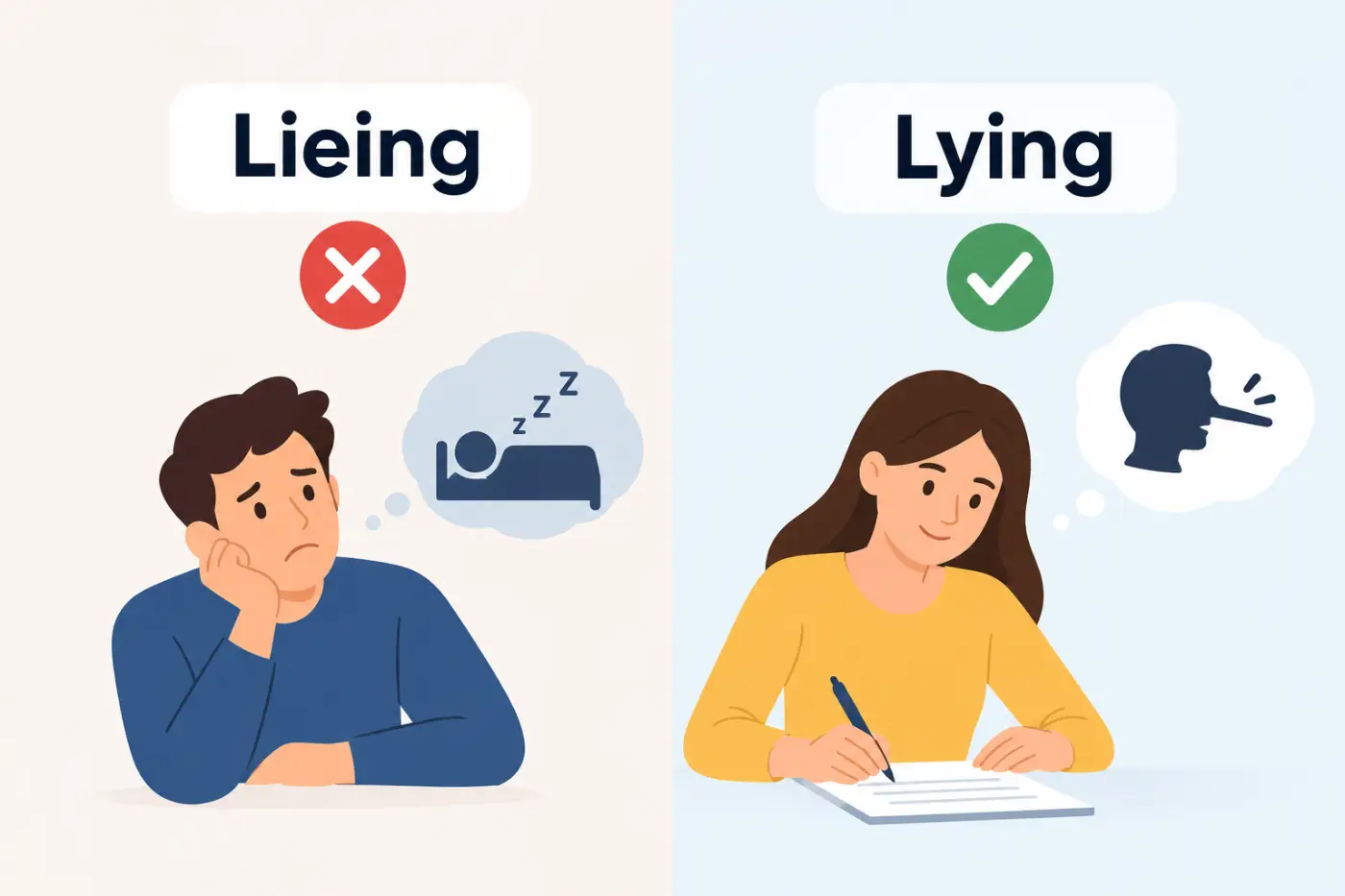
Have you ever stopped while writing and wondered if lieing or lying is the correct spelling? You are not alone. Many English learners and native speakers get stuck on this word because its spelling does not follow the pattern they expect.
The correct spelling is lying. The spelling lieing is incorrect in standard English. You should write lying when you talk about telling a lie or resting your body in a flat position.
The confusion comes from a common spelling rule. Many verbs keep their final letters when we add a suffix. However, verbs that end in a silent e usually drop that e before adding ing. For example, we write making instead of makeing and smiling instead of smileing. The verb lie follows this pattern, so its correct ing form is lying.
In this guide, you will learn why the spelling changes, how to use lying in a sentence, and how to tell the difference between lying, lie, lay, and lain. You will also find common mistakes, simple memory tricks, and examples that make the rule easier to remember.
Quick Definition
Lying is the correct present participle of the verb lie. It can describe telling someone something false or resting in a flat or horizontal position. The spelling lieing is incorrect in standard English.
Direct Answer
The correct spelling is lying, not lieing. Drop the final e from lie and add ing to form lying.
Lying and Lieing Compared
| Word or phrase | Meaning | Example sentence | When to use it |
|---|---|---|---|
| Lying | Telling an untruth or resting in a flat position | He is lying about the missing money. | Use it for both meanings of lie. |
| Lieing | An incorrect spelling | She is lieing on the couch. | Do not use this spelling in standard English. |
| Lie | To tell an untruth or rest in a flat position | I need to lie down. | Use it for the basic form of the verb. |
| Lay | To put something down or the past tense of lie when resting | She laid the book on the table. | Use it for placing something or for the past form of resting. |
| Lain | The past participle of lie when resting | He has lain in bed all morning. | Use it with helping verbs such as has or have. |
| Lied | The past tense and past participle of lie when telling an untruth | She lied about her age. | Use it when someone tells a lie. |
Why Lying Is the Correct Spelling
The spelling becomes easier to understand once you know what happens to verbs that end in a silent e. In English, we often remove the final e before adding ing. This small change helps form the present participle, which appears in sentences that describe an action in progress.
For example, take the verb smile. You write smiling rather than smileing. The same pattern appears in write and writing, bake and baking, and dance and dancing.
The verb lie follows this rule. Remove the final e and add ing. The result is lying.
The Basic Spelling Rule
When a verb ends in a silent e, you usually drop that e before adding ing.
Here are a few examples.
| Base verb | Correct ing form | Incorrect form |
|---|---|---|
| Lie | Lying | Lieing |
| Make | Making | Makeing |
| Write | Writing | Writeing |
| Take | Taking | Takeing |
| Smile | Smiling | Smileing |
| Bake | Baking | Bakeing |
| Drive | Driving | Driveing |
| Hope | Hoping | Hopeing |
Notice how each correct form removes the final e before adding ing. This pattern is common in English spelling, so learning it can help you spell many other words correctly.
There are exceptions to English spelling rules, but you do not need to worry about one here. For the verb lie, the standard form is always lying when you add ing.
Why the Extra E Is Wrong
The spelling lieing keeps the final e and adds ing. That is not the standard spelling pattern for this verb.
You may see lieing in online comments, informal messages, or writing that has not been edited. Seeing it in print does not make it correct. The accepted spelling remains lying.
Think of the final e as a letter that steps aside when ing arrives. You do not need both the e and the ing ending in this word. Once you remove the e, the spelling becomes clear.
A Simple Way to Remember the Rule
Remember the phrase drop the e and add ing.
Start with lie. Remove the final e to get li. Then add ing. The result is lying.
You can use the same trick with other verbs.
- Make becomes making.
- Write becomes writing.
- Take becomes taking.
- Lie becomes lying.
Practice these forms together a few times. Soon, the correct spelling will feel natural instead of confusing.
What Does Lying Mean
The word lying has two common meanings. It can describe someone who is not telling the truth. It can also describe someone or something resting in a flat position.
The spelling stays the same, but the meaning depends on the sentence. Understanding the context helps you identify which meaning the writer intends.
Lying Means Telling an Untruth
When someone knowingly says something false to mislead another person, that person is lying.
For example, a child might say that they finished their homework when they have not started it. You could say, The child is lying about the homework.
Here are more examples.
- He is lying about where he spent the money.
- I think she is lying to protect her friend.
- They were lying when they said they had never met him.
- Stop lying to your parents about your grades.
- The witness was lying about what happened that night.
- She admitted that she had been lying for weeks.
In each sentence, lying describes an act of giving false information.
People also use the word in everyday conversations when they believe someone is being dishonest. However, be careful when using it to describe a real person. Accusing someone of lying is a serious claim because it suggests that the person knows the truth and is deliberately hiding it.
Lying Means Resting in a Flat Position
Lying can also describe a person or object that is in a flat or horizontal position.
For example, if you are tired and resting on your bed, you can say, I am lying on my bed.
This meaning does not involve dishonesty. It simply describes a position or an action.
Consider these examples.
- The dog is lying beside the fireplace.
- She was lying on the grass and watching the clouds.
- My phone is lying on the kitchen counter.
- He is lying on the sofa after a long day.
- The books were lying on the floor.
- I have been lying in bed since early morning.
The word lying works in all these examples because it describes a person or object resting in a flat position.
How Context Changes the Meaning
The sentence around the word usually tells you which meaning applies.
Consider this example.
He is lying to his teacher.
This sentence suggests that he is telling his teacher something false.
Now consider a different sentence.
He is lying on the floor.
This sentence describes his physical position. It does not suggest that he is being dishonest.
The same spelling serves both purposes. You do not need a different word for each meaning. You simply need to understand the other words in the sentence.
How to Use Lying in a Sentence
You can use lying in several common sentence patterns. The right pattern depends on the meaning you want to express.
Use Lying With Am Is or Are
When you describe an action happening now, you can use am, is, or are before lying.
For example, I am lying on the couch means that you are resting on the couch right now.
Here are more examples.
- I am lying about what I saw.
- She is lying on her back.
- He is lying to his friends.
- They are lying in the shade.
- The cat is lying near the window.
These sentences use the present progressive tense. This tense describes an action that is happening now or around the present time.
The structure is simple.
Subject + am, is, or are + lying.
You can use this pattern for both meanings of the verb.
Use Lying With Was or Were
Use was or were before lying when you describe an action that was in progress in the past.
For example, She was lying on the bed describes her position at a time in the past.
The same structure can describe dishonesty.
He was lying when he told us that story.
Here are additional examples.
- I was lying on the grass when it started raining.
- They were lying about their travel plans.
- She was lying in bed when the phone rang.
- We were lying on the beach all afternoon.
- The man was lying about his identity.
In these examples, was and were help place the action in the past. The spelling of lying does not change.
Use Lying With Has Been or Have Been
You can also use lying after has been or have been to describe an action that started in the past and continued for some time.
For example, He has been lying about the problem for days.
This sentence means that his dishonesty began earlier and continued over a period of time.
For the physical meaning, you might say, I have been lying in bed for an hour.
More examples include the following.
- She has been lying to her family for months.
- The dog has been lying under the table.
- They have been lying about their results.
- We have been lying in the sun for too long.
- He has been lying about his experience.
The helping verb changes to match the subject. Use has been with he, she, or it. Use have been with I, you, we, and they.
Use Lying After Certain Verbs
Lying can also follow verbs such as keep, stop, start, and avoid.
For example, You should stop lying to your friends.
In this sentence, lying names the action that should stop.
Here are more examples.
- He kept lying about his mistakes.
- She started lying when she became afraid.
- Avoid lying to people who trust you.
- They continued lying even after the truth came out.
- I hate lying to my family.
After these verbs, the ing form often acts like a noun that names an action. Grammar books call this a gerund when the ing form performs a noun role.
You do not need to memorize the grammar term to use the word correctly. Just remember that lying keeps the same spelling in these patterns.
Lying vs Lie
Lie is the base form of the verb. Lying is the ing form.
You use lie when you talk about the action in a general way or when the sentence requires the base form. You use lying to describe an action in progress or to name the act of telling an untruth.
Compare these sentences.
- I never lie to my family.
- I am lying to my family.
- Please lie down and rest.
- The dog is lying beside me.
The first sentence uses lie to describe a general habit. The second uses lying to describe an action happening now.
The third sentence asks someone to rest in a flat position. The fourth describes the dog’s current position.
Examples That Show the Difference
The difference becomes clearer when you place the words side by side.
| Lie | Lying |
|---|---|
| I do not lie to my friends. | I am lying to my friends. |
| I need to lie down. | I am lying down. |
| Do not lie about your age. | He is lying about his age. |
| The dog may lie here. | The dog is lying here. |
The base form often appears after words such as to, may, can, should, and will.
For example, You should lie down if you feel dizzy.
The ing form appears after a form of be in sentences such as You are lying down.
Do Not Confuse the Two Meanings of Lie
The verb lie has two separate meanings. One means to tell an untruth. The other means to rest in a flat position.
Both meanings use lying in the ing form. However, their past forms differ.
When lie means to tell an untruth, the past tense is lied.
When lie means to rest in a flat position, the past tense is lay.
This difference explains why some sentences use lied while others use lay. The meaning of the verb determines the form you need.
Lying vs Lay
Lying and lay often cause confusion because they belong to the same group of verb forms when lie means to rest in a flat position.
The word lay is the past tense of lie in this meaning. It can also be the present tense of a different verb that means to put or place something somewhere.
The surrounding sentence tells you which meaning applies.
When to Use Lying
Use lying when someone or something is resting in a flat position.
For example, The baby is lying in the crib.
You can also use lying when someone is telling an untruth.
For example, The boy is lying about the broken window.
When to Use Lay
Use lay as the past tense of lie when you describe someone resting in the past.
For example, I lay on the couch yesterday.
In this sentence, the person was resting on the couch. No object was being placed somewhere.
Lay also means to put something down. In this use, it usually takes an object.
For example, She laid the keys on the table.
The keys are the object being placed on the table.
Compare These Examples
- I am lying on the sofa.
- I lay on the sofa yesterday.
- I am laying the blanket on the bed.
- I laid the blanket on the bed yesterday.
The first two sentences describe a person resting. The last two describe a person placing a blanket somewhere.
Pay attention to the object. In the last two examples, the blanket receives the action. That is why laying and laid are correct.
Lying vs Lied
Lying and lied both relate to telling an untruth, but they appear in different verb forms.
Lying is the ing form. Lied is the past tense and past participle of lie when the verb means to tell an untruth.
For example, She is lying to me describes an action happening now.
She lied to me yesterday describes an action that happened in the past.
Examples With Lying
- He is lying about his test score.
- They were lying to avoid trouble.
- I think you are lying to me.
- She has been lying about her plans.
Examples With Lied
- He lied about his test score.
- They lied to avoid trouble.
- I think you lied to me.
- She has lied about her plans.
Notice that the past form is lied, not lay, when the meaning involves dishonesty.
This is a useful rule to remember. If you are talking about someone telling an untruth, use lied for the simple past. If you are talking about someone resting in the past, use lay.
Lying vs Laying
Lying and laying differ in meaning, even though both end in ing.
Lying usually describes someone or something resting in a flat position. It can also mean telling an untruth.
Laying means putting or placing something somewhere. It is the ing form of the verb lay.
When to Use Lying
Use lying when the subject rests in a flat position.
For example, The baby is lying in the crib.
The baby is not placing anything. The sentence simply describes the baby’s position.
You can also use lying to describe dishonesty.
For example, He is lying about his work history.
When to Use Laying
Use laying when someone is putting something down or placing it in a position.
For example, She is laying the blanket on the bed.
The blanket is the thing being placed. That makes laying the correct form.
Here are more examples.
- He is laying the papers on the desk.
- They are laying bricks for a new wall.
- I am laying the clothes on the chair.
- The workers are laying a new floor.
- She is laying the baby in the crib.
In the last example, the person is placing the baby in the crib. That is different from saying the baby is lying in the crib.
An Easy Comparison
Think about the action.
If the subject is resting, use lying.
If the subject is placing something, use laying.
For example, The cat is lying on the blanket means the cat is resting on it.
The child is laying the blanket on the floor means the child is putting the blanket there.
This small difference can change the meaning of a sentence. Once you focus on the action, the right word becomes easier to choose.
Common Mistakes With Lying
Many spelling and grammar mistakes happen because several related words look or sound alike. Learning the difference between them will help you write more clearly.
Writing Lieing Instead of Lying
This is the main spelling mistake covered in this guide.
- Incorrect: He is lieing about his age.
- Correct: He is lying about his age.
The final e in lie disappears before ing is added. Do not keep the e in the finished word.
Using Lay When You Mean Lying
Some people use lay in sentences that describe a person resting right now.
- Incorrect: I am lay on the bed.
- Correct: I am lying on the bed.
The verb am needs the ing form in this sentence. The correct form is lying.
Using Laying Without an Object
People sometimes write laying when they mean resting.
- Incorrect: She is laying on the couch.
- Correct: She is lying on the couch.
In standard grammar, lying is the right choice when someone is resting. Laying normally describes placing something somewhere and usually takes an object.
For example, She is laying her coat on the chair is correct because the coat is being placed on the chair.
Using Lied for Physical Rest
The word lied refers to telling an untruth. It does not describe resting in a flat position.
- Incorrect: He lied on the bed all morning.
- Correct: He lay on the bed all morning.
Use lay as the past tense of lie when the meaning is to rest.
Using Lay When You Mean Lied
The opposite mistake also happens.
- Incorrect: She lay about the missing money.
- Correct: She lied about the missing money.
The sentence describes dishonesty, so lied is the correct past tense.
Adding an Extra E to Other Verbs
The same spelling issue can appear in other words.
- Incorrect: She is makeing dinner.
- Correct: She is making dinner.
- Incorrect: He is writeing a letter.
- Correct: He is writing a letter.
Remember the pattern. When a verb ends in a silent e, you usually remove that letter before adding ing.
How to Remember the Correct Spelling
A good memory trick should be short enough to use when you are writing. You do not need a long grammar lesson every time you face a spelling question.
Use the Drop the E Rule
Think of the base verb lie. Remove the final e, then add ing.
Lie becomes lying.
This is the simplest way to remember the spelling.
You can apply the same idea to make, write, smile, and take. These verbs lose the final e before the ing ending appears.
Connect Lying With Trying
The words lying and trying rhyme. You can use the familiar spelling of trying to help remember lying.
Try writing this short sentence.
I am trying to stop lying.
Both words end in ying. Once you remember that pattern, you may find it easier to spell lying correctly.
Focus on the Meaning
Ask yourself what the sentence describes.
If someone is telling an untruth, use lying.
If someone is resting in a flat position, use lying.
The spelling does not change between these meanings. You only need to check the context to understand the word.
Practice With Short Sentences
Writing a few examples can help the spelling stick.
- The dog is lying on the rug.
- He is lying about his homework.
- I am lying down because I feel tired.
- She is lying to protect her brother.
- The baby is lying in the crib.
Read the sentences aloud and notice how lying works in each one. Repeating correct examples helps build a habit that can prevent future spelling mistakes.

More Examples of Lying in Everyday English
Examples from daily life make grammar rules easier to apply. The following sentences show how the word works in conversations, school assignments, emails, and other common forms of writing.
Examples About Dishonesty
- I know you are lying because I saw what happened.
- He kept lying about the money he borrowed.
- She was lying when she said she had finished the report.
- The child admitted that he had been lying to his parents.
- They are lying about the reason for their absence.
- Stop lying and tell me what happened.
- He was caught lying during the interview.
- I do not like lying to people who trust me.
- She has been lying about her plans for weeks.
- The student was lying about losing the book.
Each sentence uses lying to describe dishonesty or a false statement.
Examples About Resting
- I am lying on my bed and reading a book.
- The cat is lying in the sunshine.
- She was lying on the grass when her friend arrived.
- The dog has been lying near the door all afternoon.
- He is lying on the couch after a long day at work.
- The child lay on the floor and watched the ceiling fan.
- My jacket is lying on the back of the chair.
- We were lying on the beach when the clouds appeared.
- The patient is lying in bed and resting.
- The fallen tree was lying across the road.
These examples show that lying can describe people, animals, and objects. It often appears with words such as on, in, under, beside, and near to show location.
Examples in School and Work
- The student is lying about completing the assignment.
- My notebook is lying on the classroom desk.
- He was lying about his work experience.
- The files are lying in a pile beside the printer.
- She is lying in bed while preparing for her exam.
- The manager accused him of lying about the results.
- The report was lying on the conference table.
- They have been lying about the project’s progress.
These sentences show how the same word can appear in both formal and informal settings. Choose the correct form based on the meaning and tense.
Is Lying Ever Spelled With an Extra E
In standard modern English, the correct spelling is lying. The form lieing is not accepted as the normal spelling of the present participle.
You may come across the incorrect form in social media posts, text messages, or unedited writing. Some people spell it that way because they expect the word to follow the pattern of other verbs that take ing.
However, standard dictionaries and edited English use lying.
The spelling rule is clear. The final e disappears before ing is added. You do not need to keep both letters.
Does Lying Have Different Forms in American English
American English uses lying as the correct spelling. British English also uses lying. There is no regional spelling difference between these two varieties of English for this word.
Some words do have different American and British spellings. For example, Americans usually write color while British writers often use colour. Lying does not follow that pattern.
If you are writing for an American audience, use lying in both formal and informal writing. The same spelling works in school essays, workplace emails, personal messages, and published articles.
Related Words You Should Know
Learning the related forms of lie can prevent mistakes beyond the spelling question itself. The key is to separate the meaning of telling an untruth from the meaning of resting in a flat position.
Lie and Its Forms for Dishonesty
When lie means to tell an untruth, its main forms are lie, lied, and lying.
| Verb form | Example |
|---|---|
| Base form | I never lie to my friends. |
| Present participle | He is lying to his parents. |
| Simple past | She lied about the accident. |
| Past participle | They have lied to us before. |
The past tense and past participle both use lied.
Lie and Its Forms for Resting
When lie means to rest in a flat position, the forms are lie, lay, lain, and lying.
| Verb form | Example |
|---|---|
| Base form | I need to lie down. |
| Present participle | She is lying on the sofa. |
| Simple past | He lay on the grass. |
| Past participle | They have lain in bed all morning. |
These forms can seem unusual because lay serves as the past tense of lie in this meaning. With practice, the pattern becomes easier to recognize.
The Difference Between Lay and Lain
Lay is the simple past form of lie when someone rests. Lain is the past participle.
For example, He lay in bed yesterday uses the simple past.
He has lain in bed all morning uses the past participle with has.
In everyday American English, some speakers may avoid lain because it sounds formal or old fashioned. Still, lain remains a standard form and can be useful in careful writing.
Why These Forms Matter
Choosing the correct verb form helps readers understand when an action happened and what the subject did.
Compare these sentences.
- She is lying on the bed.
- She lay on the bed yesterday.
- She has lain on the bed for hours.
Each sentence describes resting, but each uses a different verb form. The spelling depends on the tense and sentence structure, not simply on the presence of the word lie.
A Quick Guide to Choosing the Right Word
When you are unsure which form to use, start with the meaning. Ask yourself if the sentence describes dishonesty, resting, or placing something somewhere.
- If it describes dishonesty happening now, use lying. For example, He is lying to his coach.
- If it describes resting now, use lying. For example, He is lying on the couch.
- If it describes dishonesty in the past, use lied. For example, He lied to his coach.
- If it describes resting in the past, use lay. For example, He lay on the couch.
- If someone is putting an object somewhere, use laying for an action happening now. For example, He is laying the book on the desk.
- If the sentence describes placing something in the past, use laid. For example, He laid the book on the desk.
This method works because it focuses on meaning before spelling. Once you identify the action and time, the correct form becomes easier to choose.
FAQs
Is Lieing or Lying Correct?
Lying is correct in standard English. Lieing is a misspelling because the final e in lie is dropped before adding ing. Use lying when describing dishonesty or resting in a flat position.
Why Is Lying Spelled Without an E?
English spelling usually drops a silent final e before adding ing. For example, make becomes making and write becomes writing. Lie follows the same pattern and becomes lying.
Is Lying a Real Word?
Yes. Lying is a standard English word and the present participle of lie. It can mean telling an untruth or resting in a flat position.
What Is the Past Tense of Lying?
The past tense depends on the meaning. If lie means telling an untruth, the past tense is lied. If lie means resting in a flat position, the past tense is lay.
Is It Lying Down or Laying Down?
Use lying down when you mean resting your body in a flat position. Use laying down when you mean placing something down. For example, I am lying down describes rest, while I am laying down the book describes placing an object.
What Is the Difference Between Lying and Lied?
Lying is the ing form used for an action in progress or as the name of an action. Lied is the past tense and past participle of lie when it means telling an untruth. You might say He is lying now and He lied yesterday.
Do Americans Spell Lying Differently From British People?
No. Both American and British English use lying. The spelling does not change based on the variety of English.
Can Lying Mean Resting Instead of Being Dishonest?
Yes. Lying can describe a person or object resting in a flat position. In a sentence such as The dog is lying under the table, the word describes the dog’s position rather than dishonesty.
Conclusion
The correct spelling is lying, not lieing. The rule is simple. Drop the final e from lie and add ing. This gives you the right spelling for both common meanings of the word.
Use lying when someone is telling an untruth or resting in a flat position. Use lied for past dishonesty and lay for resting in the past. When someone places an object somewhere, use laying for the action in progress.
If you forget the rule, think of making and writing. Both words lose the final e before ing is added. Lying follows the same pattern.
The next time you pause over the spelling, remember this simple rule. Drop the e and write lying. That one small change will help you avoid a common mistake in emails, schoolwork, and everyday writing.

Sienna Watson is a veteran copywriter and communications coach who has helped startup founders, marketers, and professionals polish their writing for over a decade. Realizing that most people don’t need a degree in linguistics—just clear, impactful communication—Sienna focuses on practical grammar, business writing etiquette, and eliminating wordiness. She advocates for plain language, strong verbs, and persuasive prose that gets results.