

The correct spelling is naive. The spelling nieve is incorrect when you mean someone who lacks experience or trusts people too easily.
The word naive describes a person who may believe others without asking questions or who doesn’t understand how the world works. For example, you might say, “He was naive to believe that stranger would give him free tickets.”
The confusion comes from the way the word sounds. Some people hear the ending as eve and spell it as nieve. However, the standard English spelling is naive.
In this guide, you’ll learn what the word means, how to use it in everyday sentences, how to pronounce it, and how it differs from similar words such as innocent, gullible, and inexperienced. You’ll also find simple tips to help you remember the correct spelling.
Quick Definition
Naive is an adjective that describes someone who lacks experience, knowledge, or good judgment about a situation. It can also describe a person who trusts others too easily. The word may suggest innocence or a lack of awareness, but it can also point to poor judgment.
Direct Answer
Naive is the correct spelling, not nieve. Use naive when describing someone who lacks experience or is too trusting. For example, “She was naive to think that every online offer was genuine.”
Naive vs Nieve at a Glance
| Word | Meaning | Example Sentence | When to Use It |
|---|---|---|---|
| Naive | Lacking experience or judgment | He was naive about online scams. | Use this standard English spelling. |
| Nieve | Not a standard spelling for this meaning | She was nieve about money. | Avoid this spelling in standard English writing. |
The difference is simple. Naive is the spelling you should use in school assignments, emails, articles, and everyday writing. Nieve is usually a spelling mistake when the intended word is naive.

What Does Naive Mean
The word naive describes a person who doesn’t have enough experience or knowledge to understand a situation fully. It often applies to someone who trusts others without thinking about their reasons or intentions.
Imagine a teenager who believes every advertisement on the internet. They may think each company tells the truth and every offer is safe. You could describe that teenager as naive because they haven’t learned how easily online messages can mislead people.
However, the word doesn’t always describe someone who is young or uneducated. An adult can be naive about a topic they’ve never studied or a situation they’ve never faced.
For example, an experienced teacher might be naive about buying a house. A skilled doctor might be naive about investing money. Both people can have strong knowledge in one area and little experience in another.
The Main Meanings of Naive
The word has a few closely related meanings.
Lacking experience. A person may not understand how a situation works because they’ve never dealt with it before.
Example: “I was naive about renting an apartment before moving to the city.”
Too trusting. Someone may believe people without checking their claims or looking for signs of dishonesty.
Example: “He was naive to trust a stranger with his bank details.”
Showing a simple view of the world. A person may expect life to be fair and people to act honestly all the time.
Example: “It was naive to think that hard work alone would guarantee success.”
Lacking practical judgment. Someone may have a good heart but fail to think through the possible results of a choice.
Example: “Buying an expensive car without checking his budget was a naive decision.”
These meanings share one central idea. A naive person may not see the full picture because they lack experience, information, or caution.
Is Naive a Positive or Negative Word
The meaning depends on the situation.
Sometimes naive sounds gentle or positive. It can suggest that a person is innocent, sincere, or free from bad intentions.
For example:
“Her naive belief in kindness made her want to help everyone.”
This sentence presents her trust as a sign of a good heart. Still, it hints that she may not recognize the risks of helping everyone.
In other situations, naive sounds critical.
For example:
“His naive plan ignored the cost of running the business.”
Here, the word suggests that his plan lacked careful thought. It points to a mistake in judgment rather than a good quality.
The tone also depends on the speaker. Calling someone naive can sound insulting if you use it to suggest that they’re foolish or easy to trick. In a kinder conversation, it can simply mean that they haven’t learned enough about a particular subject yet.
If you want to describe someone without sounding harsh, try inexperienced or unfamiliar with the subject. These phrases explain the problem without making a broad judgment about the person.
Why Do People Confuse Naive and Nieve
The spelling confusion makes sense when you hear the word spoken aloud. The ending of naive can sound like a long ee sound, and some speakers pronounce it with two syllables.
The standard spelling is not always obvious from the sound alone. English has many words whose spellings don’t closely match the way people say them. That can make unfamiliar words tricky to write.
The Ending Can Be Misleading
The word naive comes from French. Its spelling reflects its history rather than a simple English sound pattern.
In English, the word is commonly written as naive. You may also see the spelling naïve, which uses two dots above the letter i. Both forms are accepted in standard English.
The incorrect form nieve may look reasonable to someone who hasn’t seen the word in writing. However, it doesn’t follow the standard spelling of naive.
Compare these examples.
- Correct: “She was naive about the risks of sharing personal information.”
- Incorrect: “She was nieve about the risks of sharing personal information.”
- Also correct: “She was naïve about the risks of sharing personal information.”
The meaning stays the same in the first and third examples. The only difference is the spelling style.
English Has Other Words With Tricky Spellings
Naive isn’t the only word that can confuse writers. Some English words have unusual letter patterns or silent letters.
Consider these examples.
- Believe has ie after the letter l.
- Receive has ei after the letter c.
- Friend doesn’t follow a spelling pattern that every learner can easily predict.
- Foreign has a letter combination that may surprise new learners.
- Naive has a spelling that many people need to learn by sight.
These examples show why sounding out a word doesn’t always help. Reading the word often and using it in your own writing can make the correct spelling easier to remember.
Does Nieve Ever Have a Different Meaning
The word nieve can appear as a name or in some other language contexts. However, it isn’t the standard English spelling of the adjective used to describe someone who lacks experience or trusts too easily.
If you’re writing an English sentence about a person who believes something too quickly, use naive.
For example:
“It’s naive to assume that a stranger online has good intentions.”
This sentence uses the standard spelling and clearly expresses the intended meaning.
How to Pronounce Naive
The word naive is commonly pronounced nah EEV or nye EEV, depending on the speaker and dictionary pronunciation. It usually has two syllables, with the stress on the second syllable.
You may hear small differences among English speakers in the United States. These differences don’t change the spelling.
Break the Word Into Two Sounds
One simple way to practice the word is to say it slowly.
First, say the opening sound. Then say the ending sound with more emphasis.
Put the sounds together and repeat the full word: naive.
Listen to the pronunciation in a trusted American English dictionary if you’re unsure how it should sound. Hearing a word spoken by a fluent speaker can help you connect its sound with its spelling.
How to Use the Pronunciation to Remember the Spelling
Pronunciation can help you recognize the word, but it isn’t a reliable way to spell it on its own.
You might hear the final sound and think of a different letter pattern. Instead, connect the sound to the written form.
Write naive on a card or in a note. Read it aloud and use it in a sentence such as “I was naive when I first started my job.”
Repeat this practice a few times over several days. Seeing the same spelling in context can help it stick in your memory.
How to Remember the Correct Spelling
You don’t need a complicated spelling rule to remember naive. A simple memory trick and a little practice are often enough.
Remember the Letters in Naive
Focus on the sequence of letters.
N A I V E
The word begins with nai and ends with ve. Keep the letters in that order rather than changing the ending to eve.
Write the word three times while saying it aloud. Then cover it and try to spell it from memory. Check your answer and repeat the exercise if you make a mistake.
This technique works best when you practice the word in a sentence instead of memorizing a group of letters alone.
Connect the Word With Its Meaning
Choose a sentence that clearly shows what naive means.
For example:
“I’m not naive enough to share my password with a stranger.”
The sentence connects the spelling to the idea of being too trusting. When you remember the meaning, you have a useful clue for recalling the word.
You can also use this short reminder.
Naive means inexperienced or too trusting. Nieve is the spelling to avoid in standard English.
Use the Word in Everyday Writing
The more often you use a word correctly, the more familiar it becomes.
Try writing three original sentences.
- “He was naive about the cost of living alone.”
- “Don’t be naive about offers that promise easy money.”
- “Her naive view of business changed after her first year.”
Each sentence uses the same spelling in a different context. This helps you learn the word rather than simply memorize it.
Turn on Spell Check
Spell check can catch many common typing mistakes. If you type nieve in a document, your software may suggest naive as a correction.
Still, spell check isn’t perfect. It may miss errors that create another valid word, and it may not understand the meaning of your sentence.
Use it as a helpful tool, not as a replacement for learning the spelling. When in doubt, check a trusted dictionary.
How to Use Naive in Everyday Sentences
Knowing the definition is helpful, but seeing the word in real situations makes it easier to use correctly. The word naive often describes a belief, choice, plan, or person who lacks experience or judgment.
Here are examples from everyday life.
Examples About Trust
People often use naive when someone believes another person too quickly.
- “I was naive to believe his story without checking the facts.”
- “She isn’t naive enough to share her password with someone she just met.”
- “He had a naive trust in strangers.”
- “My parents warned me not to be naive about online messages.”
- “It was naive of me to think everyone would keep their promises.”
Each example shows a lack of caution. The person may have good intentions, but they don’t take enough time to consider the risks.
Notice the phrase naive to believe. This structure is useful when you want to explain why a belief or action showed poor judgment.
For example, “It was naive to believe the offer without reading the details.”
You can also say “naive about something” when someone lacks knowledge in a particular area.
For example, “I was naive about the rules of renting a home.”
Examples About Work and Business
A person can be naive at work when they have little experience with office life or business decisions.
- “He was naive to think his first business would make money right away.”
- “She had a naive idea of how much time the project would take.”
- “I was naive about salary negotiations when I got my first job.”
- “The new owner made a naive decision by ignoring customer feedback.”
- “It would be naive to start a company without researching the market.”
These sentences don’t always suggest that someone is unintelligent. They often show that the person has something to learn.
A new business owner may be smart and hardworking. Still, they might underestimate costs because they’ve never run a company before.
In this case, naive describes a gap in experience rather than a lack of intelligence.
Examples About Money
Financial choices are another common place to use the word.
- “It was naive to invest all his savings in one company.”
- “She was naive about the hidden fees on the loan.”
- “Don’t be naive about promises of guaranteed profits.”
- “I had a naive belief that saving money would always be easy.”
- “He made a naive choice by buying something he couldn’t afford.”
These examples show how a person may overlook risks or misunderstand the facts.
The word can also describe a plan that seems too simple to work.
For instance, “Thinking you can pay off a large debt in one week is naive.”
The sentence criticizes the plan rather than the person’s character. This is often a useful way to use the word without sounding needlessly harsh.
Examples About Relationships
People also use naive when talking about friendship and romance.
- “She was naive to think that an apology would fix every problem.”
- “He had a naive belief that love alone could solve their disagreements.”
- “I was naive about how much work a healthy relationship takes.”
- “It may seem naive to trust someone after only one meeting.”
- “His naive view of friendship changed as he grew older.”
These sentences describe expectations that may not match real life. They don’t mean that trust or love is bad. Instead, they suggest that feelings need to go hand in hand with good judgment.
For example, trusting a friend can be a good thing. Ignoring repeated signs of dishonesty may be naive.
Examples About Learning and Experience
Sometimes naive simply means that someone is new to a subject.
- “As a beginner I asked some naive questions.”
- “My first design was naive but full of fresh ideas.”
- “She was naive about how difficult the exam would be.”
- “His early writing showed a naive understanding of history.”
- “I had a naive idea of what it meant to live alone.”
In these examples, the word can describe a stage of learning. People often begin with limited knowledge and gain a better understanding through practice.
A naive question isn’t always a bad question. It may reveal that someone is starting from the basics and needs a clear explanation.
Naive vs Similar Words
Naive has several close synonyms, but they don’t all mean the same thing. Choosing the right word helps you express your point clearly.
Naive vs Gullible
A gullible person is easy to fool because they believe things too readily.
A naive person may also be too trusting, but the word has a wider meaning. It can describe someone who lacks experience or has an unrealistic view of a situation.
Compare these sentences.
- “He was naive about how businesses operate.”
- “He was gullible enough to believe the fake prize message.”
The first sentence focuses on a lack of experience. The second focuses on being easily tricked.
You can use gullible when someone repeatedly falls for lies or scams. Use naive when you want to highlight inexperience or limited judgment.
Naive vs Innocent
Innocent often means free from guilt or wrongdoing. It can also describe someone who has a simple or trusting nature.
Naive usually emphasizes a lack of experience or understanding.
For example:
“She was innocent of any wrongdoing.”
This means she didn’t commit the act in question.
Now compare it with this sentence.
“She was naive to trust the stranger.”
This means she trusted someone without thinking carefully about the possible risk.
The two words can overlap when describing a person’s outlook. However, innocent doesn’t automatically mean inexperienced, and naive doesn’t automatically mean free from guilt.
Naive vs Inexperienced
Inexperienced is a more direct and often more neutral word. It means someone hasn’t had much practice or exposure to a task or situation.
Naive can suggest that the lack of experience has led to poor judgment.
For example:
“He was inexperienced at managing a team.”
This sentence simply says he hasn’t managed a team much before.
“He was naive to think that managing a team would require no planning.”
This sentence goes further. It suggests that his expectations were unrealistic.
If you want to sound fair and professional, inexperienced is often the better choice when you’re only describing someone’s skill level.
Naive vs Simple
The word simple has many meanings. It can describe something easy to understand or a person who doesn’t think in a complex way.
When used to describe a person, simple may sound insulting. Naive is more specific when the issue involves limited experience or too much trust.
For example:
“Her explanation was simple and clear.”
Here, simple is positive because it means easy to understand.
“Her naive view of the problem ignored several risks.”
Here, naive means she didn’t fully understand the situation.
Don’t use these words as if they always mean the same thing. The right choice depends on the idea you want to express.
Naive vs Optimistic
An optimistic person expects good things to happen. A naive person may expect good things because they haven’t considered the facts or possible problems.
Optimism can be sensible. It doesn’t always involve ignoring risks.
For example:
“I’m optimistic that our team can finish the project on time.”
This shows hope and confidence.
“I’m naive to think the team can finish the project without a plan.”
This suggests an unrealistic expectation.
You can be optimistic and still prepare for problems. Naivety appears when hope takes the place of careful thought.
Naive vs Childish
Childish usually describes behavior that seems immature or inappropriate for someone’s age. Naive describes limited experience or poor understanding.
For example:
“His childish reaction made the disagreement worse.”
This sentence criticizes his behavior.
“His naive understanding of the contract led him to miss an important detail.”
This sentence points to a lack of knowledge.
A person can be naive without acting childish. Likewise, an adult can behave childishly despite having plenty of experience.
Common Mistakes to Avoid
The spelling is only one part of using naive correctly. You should also pay attention to its meaning and how it fits into a sentence.
Using Nieve Instead of Naive
This is the main spelling mistake people make with the word.
- Incorrect: “She was nieve about the risks of online shopping.”
- Correct: “She was naive about the risks of online shopping.”
Remember that naive is the standard spelling in English. If you’re writing for school or work, use this form unless you’re reproducing a name or a source that uses another spelling.
Treating Naive as a Noun
Naive is an adjective. It describes a person or thing.
You can write:
- “He is naive.”
- “She made a naive choice.”
- “That was a naive assumption.”
You generally shouldn’t use naive by itself as a noun to mean an inexperienced person. Instead, write “a naive person” or use a noun such as beginner or newcomer when it fits the meaning.
Assuming Naive Always Means Foolish
Naive doesn’t mean unintelligent. It describes a lack of experience or awareness in a particular area.
A brilliant scientist might be naive about personal finance. An experienced manager might be naive about a new technology. Neither person has to lack intelligence.
People learn through experience. Being naive about something can simply mean that you haven’t learned enough about it yet.
Using Naive When You Mean Honest
Honesty and naivety aren’t the same thing.
An honest person tells the truth. A naive person may lack the experience or judgment needed to recognize a risk.
For example, “She was honest about the mistake” says that she told the truth.
“She was naive to believe the false promise” says that she trusted someone without enough reason.
A person can be honest and cautious at the same time.
Calling Every Beginner Naive
Someone who is new to a subject isn’t automatically naive. A beginner may ask questions, study the facts, and make careful decisions.
Use naive when the situation involves a lack of understanding or unrealistic expectations. Use beginner or inexperienced when you only mean that someone is new.
This distinction helps you describe people fairly and accurately.
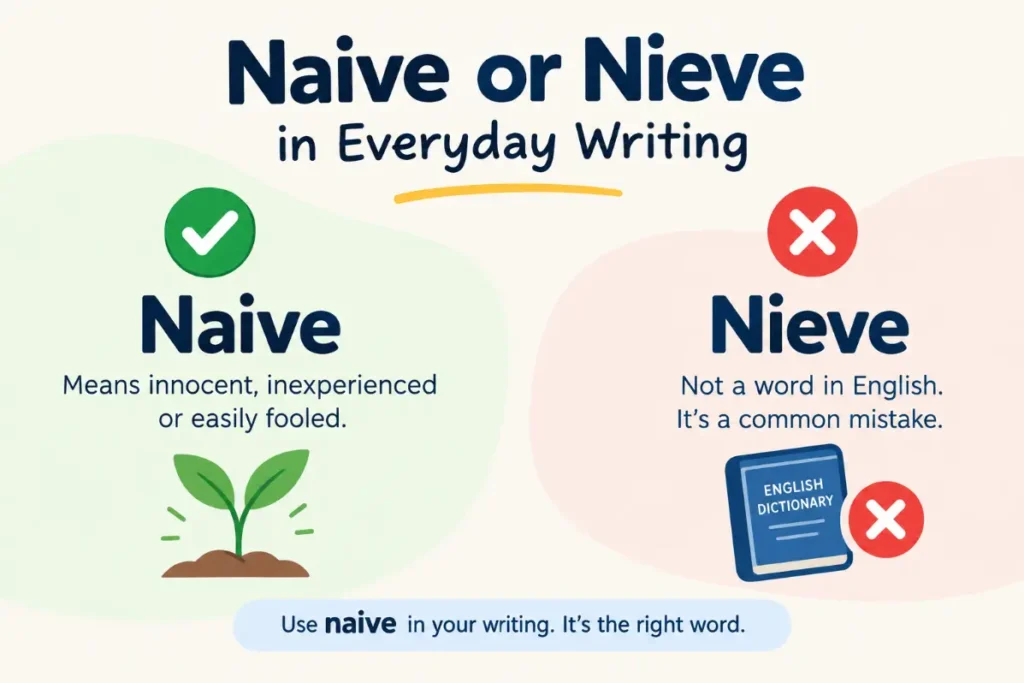
Naive or Nieve in Everyday Writing
When you write about inexperience or misplaced trust, the spelling and sentence structure both matter. The right spelling makes your writing clear, while the right context helps readers understand your meaning.
Examples for School and College
Students may use naive when discussing characters in a book or describing a person’s actions.
- “The main character was naive because he trusted everyone he met.”
- “Her naive assumptions caused her to misunderstand the story.”
- “The student gave a naive answer because he hadn’t studied the topic.”
- “His naive view of history changed after he read more about the subject.”
In school essays, explain why the person shows naivety rather than simply labeling them naive. This adds detail and makes your writing stronger.
For example, instead of writing “The character was naive,” you could write “The character was naive because he believed the stranger without asking for proof.”
The second sentence gives the reader a clear reason for your judgment.
Examples for Emails and Professional Writing
You can use naive in professional writing, but think about your tone before describing a coworker or client.
For example:
“The original plan was naive because it didn’t account for delivery delays.”
This sentence focuses on the plan rather than attacking the person who created it.
You could also write:
“Our first estimate was based on a naive understanding of the costs.”
This wording admits that the team lacked enough information at the time.
In a formal report, you might prefer unrealistic, inexperienced, or based on limited information. These terms can sound more precise and less personal.
Examples for Social Media and Everyday Conversation
In casual conversation, naive can describe a simple mistake or an expectation that turned out to be unrealistic.
- “I was naive to think the move would be easy.”
- “Don’t be naive. Check the offer before paying.”
- “That was a naive thing to believe.”
- “I used to be naive about how much groceries cost.”
- “It’s naive to think every review online is genuine.”
These sentences sound natural because they connect the word to familiar situations. You don’t need complicated language to use it well.
Is Naive Formal or Informal
Naive works in both formal and informal English. You can use it in a casual conversation, a school essay, a news article, or a professional report.
The key is to use it accurately.
- In casual speech, someone might say, “I was naive to believe him.”
- In an academic essay, a writer might say, “The character’s naive assumptions prevent him from understanding the conflict.”
- In a business report, someone might write, “The initial forecast reflected a naive estimate of operating costs.”
All three sentences use the same adjective. The wording changes to fit the situation.
Should You Use Naive in Professional Writing
Yes, but choose your wording carefully when describing another person.
Calling a coworker naive may sound judgmental. If your goal is to explain a problem, describe the specific gap in knowledge or planning.
For example, instead of saying “The new employee was naive,” write “The new employee had limited experience with customer negotiations.”
The second sentence gives useful information without making an unnecessary personal judgment.
When you describe an idea rather than a person, naive can be more direct.
For example, “The proposal was naive because it ignored the cost of maintenance.”
This sentence identifies a clear weakness in the proposal.
FAQs
Is naive or nieve the correct spelling?
Naive is the correct spelling in standard English. Nieve is a misspelling when you mean someone who lacks experience or trusts others too easily. You can also write naïve with two dots above the i.
How do you spell naive in American English?
In American English, the usual spelling is naive. The form naïve is also accepted. Both spellings have the same meaning and pronunciation.
What does naive mean in simple words?
Naive means lacking experience or trusting people too easily. A naive person may believe something without checking the facts or thinking about the risks. For example, believing every online offer is genuine would be naive.
Is naive a bad word?
Naive isn’t always negative. It can describe innocence or a lack of experience without insulting anyone. However, it can sound critical when you use it to suggest that someone has poor judgment or is easy to fool.
What is the difference between naive and gullible?
Naive often describes someone who lacks experience or has an unrealistic view of a situation. Gullible describes someone who is easy to trick because they believe things too readily. A person can be naive without falling for every lie.
Can you use naive in a sentence?
Yes. For example, “I was naive to believe that the offer was free.” The sentence shows that the speaker trusted the offer without considering the possibility of hidden costs. You can also use the word to describe a plan or belief.
Does naive have two dots above the i?
Yes. The spelling naïve includes two dots above the i. This mark is called a diaeresis and shows that the vowel sounds are pronounced separately. The spelling naive without the dots is also correct and common in American English.
What is the opposite of naive?
The opposite depends on the meaning you intend. Experienced, worldly, cautious, and shrewd can all work in different contexts. For example, an experienced shopper may recognize a scam that a naive shopper misses.
Conclusion
The correct spelling is naive, not nieve. Use naive to describe someone who lacks experience, trusts others too easily, or has an unrealistic understanding of a situation. The spelling naïve is also correct.
Remember that naive doesn’t automatically mean foolish or unintelligent. Someone can be knowledgeable in one area and inexperienced in another. The word describes a person’s understanding of a particular situation rather than their overall intelligence.
To remember the spelling, practice writing N A I V E and use it in a sentence. For example, “It was naive to trust the offer without checking the details.”
The next time you wonder about naive or nieve, choose naive. It’s the standard English spelling and the right choice for everyday writing, schoolwork, and professional content.

Dr. Elena Vance holds a Ph.D. in Linguistics from Columbia University and has spent over 15 years analyzing the evolution of the English language. A former university professor turned full-time writer and editor, Elena specializes in breaking down high-level grammatical concepts, punctuation nuances, and style guides (APA, Chicago, MLA) into clear, actionable advice. When she isn’t hunting down dangling modifiers, she can be found collecting vintage dictionaries and reading classic literature.