

Have you ever typed treet when you meant treat? The two spellings look similar, but only one is a standard English word. If you are searching for treet vs treat, the correct choice depends on the meaning you want to express.
Treat is the correct spelling when you mean something enjoyable, such as a piece of candy, a special gift, or a kind action. It can also mean to act toward someone in a certain way or to provide care for an illness. Treet is not a standard English word in modern American English. Most of the time, it is simply a spelling mistake.
The confusion makes sense. Both spellings contain the same letters except for the final vowel sound. English spelling can be tricky because words do not always sound the way they look. A small change can also turn a correct word into a spelling error.
In this guide, you will learn what treat means, how to use it in everyday writing, and why treet is usually incorrect. You will also find simple examples, common mistakes, memory tips, and answers to frequently asked questions.
Quick Definition
Treat is a standard English word that can mean something enjoyable, the way you behave toward someone, or the care given to a person or problem. It can work as both a noun and a verb.
Treet is not a standard English spelling. If you mean a sweet snack, a special experience, or the act of caring for someone, use treat.
Direct Answer
Treat is correct, while treet is generally a misspelling. Use treat for a special pleasure, kind behavior, medical care, or the act of dealing with a person or subject. Do not use treet in ordinary English writing.
Treet vs Treat at a Glance
| Word | Meaning | Example Sentence | When to Use It |
|---|---|---|---|
| Treat | Something enjoyable | Mom bought me a chocolate treat. | When talking about a snack or special pleasure. |
| Treat | To behave toward someone | Please treat everyone with kindness. | When describing how someone acts toward others. |
| Treat | To provide care | The doctor will treat the infection. | When discussing medical care or a problem that needs attention. |
| Treet | Not a standard English word | I bought a treet. | Avoid this spelling in ordinary writing. |
What Treat Means in Everyday English
The word treat has several meanings. The right meaning depends on how you use it in a sentence. You can use it to talk about food, special experiences, relationships, health, or the way you handle a subject.
Understanding these meanings makes the spelling easier to remember. Once you know what the word does in a sentence, you can choose the correct form with confidence.
Treat as a Noun
A noun names a person, place, thing, or idea. When treat works as a noun, it often refers to something enjoyable that someone receives or experiences.
A treat can be a favorite dessert, a small gift, a fun activity, or a pleasant surprise. It is usually something that feels special rather than something you get every day.
For example, consider these sentences.
- I bought myself a chocolate treat after work.
- The children received a special treat for finishing their homework.
- A day at the beach would be a real treat.
- Grandma brought homemade cookies as a treat.
- Watching the sunset from the hill was a treat.
In each sentence, treat describes something pleasant. It does not have to be food. A relaxing afternoon or an exciting trip can also count as a treat.
People often use the word when they want to show that an experience feels rewarding. For example, you might say, “Having the whole house to myself was a treat.” The sentence tells the reader that you enjoyed the experience.
Treat as a Verb
A verb describes an action or state. As a verb, treat can mean to behave toward someone in a certain way, provide care, or deal with a subject.
Look at these examples.
- Treat your neighbors with respect.
- The nurse will treat the patient today.
- We should treat the old furniture carefully.
- The teacher will treat each student fairly.
- The mechanic can treat the metal to prevent rust.
Notice how the meaning changes from sentence to sentence. In the first example, treat refers to respectful behavior. In the last example, it describes a process used to protect a material.
The sentence gives you clues about the meaning. Words such as respect, patient, fairly, and carefully help show how the verb is being used.
Treat as a Special Pleasure
One common use of treat is to describe something that brings pleasure or makes an ordinary day feel special.
For example, a parent might buy ice cream for a child after a long week. A friend might pay for lunch to celebrate good news. Someone who loves books might consider finding a rare novel a real treat.
Here are a few natural examples.
- This fresh apple pie is a treat.
- My favorite band is playing tonight, so the concert will be a treat.
- It was a treat to spend the afternoon with my cousins.
- That little bakery is a treat for anyone who loves fresh bread.
The word can describe both a physical item and an experience. You can enjoy a treat, give someone a treat, or call an event a treat.
This use is common in everyday American English. It is friendly, simple, and easy to understand.
Treat as Care or Medical Help
In health care, treat means to provide care for an illness, injury, or other medical problem.
For example, a doctor may treat a patient for an infection. A dentist may treat a damaged tooth. A physical therapist may treat an injury with guided exercises.
Consider these sentences.
- The doctor will treat the infection with medicine.
- The clinic treats patients with skin conditions.
- The nurse treated the cut and covered it with a bandage.
- Early care can help treat some health problems.
In these examples, treat does not mean a reward or a pleasant surprise. It refers to care intended to improve a person’s condition.
The same meaning can apply outside medicine. You can treat water to make it safer for a particular use, treat wood to protect it from damage, or treat a stain to help remove it.
The key idea is that something receives care or goes through a process.
Treat as a Way to Behave
Another common meaning describes how one person acts toward another.
When you treat someone well, you behave with kindness, respect, fairness, or care. When you treat someone badly, your behavior causes hurt or shows a lack of respect.
For example.
- Always treat others with respect.
- She treats her coworkers fairly.
- He treated his younger brother kindly.
- The manager treated the complaint seriously.
- Please treat the family with care during this difficult time.
This meaning appears often in advice about manners and relationships. It also appears in conversations about fairness at school, work, and home.
You can remember it by asking a simple question. How does one person act toward another person? The answer may describe how that person treats them.
Why Treet Is Usually Incorrect
The spelling treet is not recognized as a standard English word for a sweet snack, a kind action, or medical care. If you write it in a normal sentence, readers will usually assume you made a spelling mistake.
For example, this sentence is incorrect.
“I bought my dog a treet.”
The correct version is.
“I bought my dog a treat.”
The meaning stays the same, but the second sentence uses the accepted spelling.
Why People Make This Spelling Mistake
English has many words that sound alike or share similar letter patterns. This can make spelling difficult, especially when you write quickly or rely on sound alone.
The long E sound in treat may lead some writers to spell the word with two E letters near the end. However, English spelling does not follow one simple rule for every sound.
Think about these words.
- Treat.
- Great.
- Bread.
- Break.
- Seat.
- Head.
These words contain different letter patterns and sounds. Some share the same letters but sound different. Others sound alike but use different spellings.
That is why listening to a word is not always enough. It helps to learn its correct spelling and meaning together.
Is Treet Ever Acceptable
You may come across Treet in a company name, product name, username, fictional story, or other special context. A business or creator can choose a nonstandard spelling for a name.
That does not make treet a standard English word. Proper names can use unusual spellings for branding or creative reasons.
For example, a fictional snack company might call one of its products Treet. In that case, you would copy the official name when referring to that product.
However, if you are writing an ordinary sentence about candy, a reward, or medical care, use treat. A special name does not change the standard spelling of the common word.
How to Use Treat Correctly in Sentences
Knowing the definition is a good start. The next step is learning how the word fits into everyday sentences.
The word treat can appear in different forms depending on the tense and the sentence structure. These forms include treat, treats, treated, and treating.
Treat in the Present Tense
Use treat with subjects such as I, you, we, and they in the simple present tense. Use treats with a singular third person subject such as he, she, or it.
Examples include the following.
- I treat my friends with respect.
- You treat your dog like family.
- We treat every customer fairly.
- They treat the garden soil before planting.
- She treats her patients with care.
- He treats his team members kindly.
The spelling changes when the subject is he, she, or it. You add an S to make treats.
Do not write “She treet her patients with care.” The correct sentence is “She treats her patients with care.”
Treat in the Past Tense
The past tense of treat is treated. Add ED to the base word.
Examples include the following.
- We treated our guests to dinner.
- The doctor treated the injured runner.
- She treated her sister to a movie.
- They treated the old wooden table with oil.
- He treated everyone fairly during the meeting.
The word treated can describe a completed action. It can refer to a pleasant experience, behavior, or care.
Remember that the past tense does not use treeted. The correct spelling is treated.
Treat in the Continuous Form
The form treating often describes an action that is happening now or was happening at a certain time.
For example.
- The doctor is treating the patient.
- She is treating her friends to lunch.
- We are treating the wooden floor to protect it.
- They were treating each guest with kindness.
To form treating, remove the final E from treat and add ING. The result is treating, not treateing.
This spelling pattern appears in many English verbs. For example, make becomes making, and write becomes writing.
Treat in Common Expressions
The word appears in many everyday expressions. Learning these phrases can help you use it naturally.
Treat yourself.
This means doing something enjoyable for your own benefit.
Example. I finished the project, so I treated myself to a nice dinner.
Treat someone to something.
This means paying for or giving someone an enjoyable experience.
Example. My aunt treated us to lunch at her favorite restaurant.
Treat someone with respect.
This means behaving toward someone in a respectful way.
Example. Good leaders treat their employees with respect.
Treat something seriously.
This means giving an issue the attention it deserves.
Example. The school treats safety concerns seriously.
A special treat.
This refers to something enjoyable that feels out of the ordinary.
Example. Fresh strawberries with whipped cream are a special treat in our house.
These phrases are common in speech and writing. Using them correctly can make your English sound more natural.
Real Life Examples of Treat
The best way to understand a word is to see it in situations you recognize. Here are examples from home, school, work, travel, health, and everyday conversations.
Examples About Food and Rewards
- Dad brought home donuts as a treat.
- We saved a slice of cake for our guest.
- The children got a small treat after cleaning their rooms.
- My favorite coffee shop makes a delicious chocolate treat.
- A bowl of fresh fruit can be a simple treat on a hot day.
- The dog sat patiently and waited for his treat.
- She bought herself a sweet treat after a busy morning.
- The ice cream shop gave each child a free treat.
In these sentences, treat refers to something enjoyable. It often suggests a small reward or pleasure.
Examples About Kind Behavior
- Treat people the way you want them to treat you.
- Our coach treats every player fairly.
- She treated the new student with kindness.
- Please treat your classmates with respect.
- The staff treats every visitor politely.
- He treats his grandparents with great care.
- They treated the volunteers like members of the family.
These examples show how the verb describes behavior. The word does not refer to food or gifts in these sentences.
Examples About Health and Care
- The doctor treats children with asthma.
- The nurse treated his injured hand.
- The dentist will treat the damaged tooth.
- The clinic treats minor burns and cuts.
- The veterinarian treated the sick puppy.
- The medicine may help treat the infection.
- The therapist is treating the athlete’s knee injury.
These sentences use treat to describe care. In medical writing, the word often appears beside the name of a condition or injury.
Examples About Work and Problems
- We need to treat this request as a priority.
- The company treats customer complaints seriously.
- The technician treated the metal to prevent rust.
- Please treat this information as private.
- The teacher treated the question as an opportunity to explain the topic.
- The team treated the delay as a chance to review its plans.
Here, treat means to handle or regard something in a particular way. This meaning is useful in professional and everyday communication.
Common Mistakes With Treat
Some spelling errors happen because writers know the sound of a word but forget its letter pattern. Other mistakes happen when writers use the right word in the wrong form.
Mistake One Is Writing Treet
Incorrect. The puppy got a treet after learning a new trick.
Correct. The puppy got a treat after learning a new trick.
The correct spelling has the letters T, R, E, A, and T. Remember the A after the first E.
Mistake Two Is Writing Treated Incorrectly
Incorrect. The doctor treeted the patient.
Correct. The doctor treated the patient.
The past tense uses the base word treat followed by ED. It does not use an extra E before the ending.
Mistake Three Is Using Treats With the Wrong Subject
Incorrect. They treats their guests well.
Correct. They treat their guests well.
In the simple present tense, they takes treat. The form treats usually goes with he, she, or it.
Mistake Four Is Confusing a Treat With a Treatment
A treat can be something enjoyable or an action that provides care. A treatment usually refers to a method of care or the way something is handled.
For example.
- The child received a treat after the game.
- The patient started a new treatment for the condition.
The first sentence refers to a reward. The second refers to care.
The two words are related, but they do not always mean the same thing.
Mistake Five Is Confusing Treat With Trick
People often connect treat with Halloween because children ask for candy while trick or treating. However, trick and treat have different meanings.
A trick can be a prank, a clever action, or something used to fool someone. A treat is a pleasant item or experience.
For example.
- The magician performed a clever trick.
- The child received a chocolate treat.
Knowing the difference helps you avoid mixing up two familiar words.
How to Remember the Correct Spelling
A simple memory trick can help you avoid spelling treat incorrectly.
Remember the Word Eat
The word treat contains the letters EAT in the middle. A treat is often something you eat, such as candy, cookies, or ice cream.
Think of this sentence.
“A treat is something sweet to eat.”
Not every treat is food, but the connection can help you remember the spelling. The letters EAT appear in the correct word.
Connect Treat With Great
The words treat and great share the same final four letters. Both use EAT followed by T.
Try remembering this short phrase.
“A great treat is spelled TREAT.”
The shared letter pattern can help you recall the correct spelling when you are writing quickly.
Picture a Favorite Snack
Imagine your favorite cookie or piece of chocolate. Write the word treat beside it.
The mental image connects the word to a familiar object. This can make the spelling easier to remember later.
You can also practice with a short sentence.
“My favorite treat is chocolate cake.”
Read it aloud and notice the spelling. Repeat the sentence a few times until the word looks familiar.
Check the Meaning Before You Choose
When you are unsure about a spelling, ask yourself what you want to say.
Are you talking about a sweet snack, a kind action, or medical care? If so, treat is the correct standard spelling.
This quick meaning check is useful because spelling and meaning work together. It helps you catch mistakes before you finish a sentence.
Related Words and Common Confusions
Learning related words can help you understand treat more deeply. It also helps you avoid mixing it up with words that look or sound similar.
Treat vs Street
The words treat and street share some letters, but they have different meanings.
A street is a public road in a town or city. A treat is something enjoyable or an action involving care or behavior.
Examples.
- We walked down the street to the bakery.
- We bought a treat at the bakery.
The first sentence describes a place. The second describes something enjoyable.
This pair is especially useful to learn because treet may appear when someone accidentally leaves the first letter S out of street or confuses its spelling with treat.
Treat vs Trick
A trick can mean a prank, a clever method, or an action that fools someone. A treat is usually something pleasant.
Examples.
- The children played a harmless trick on their father.
- Their father gave them a treat afterward.
These words often appear together in the phrase trick or treat, which is linked to Halloween in the United States. That familiar phrase can help you remember the spelling of treat.
Treat vs Treatment
A treat can describe a pleasant reward or the act of providing care. A treatment usually refers to a process, method, or course of care.
Examples.
- The puppy received a treat for good behavior.
- The veterinarian recommended treatment for the puppy’s infection.
The first sentence refers to a reward. The second describes care for a health problem.
Treat vs Reward
A reward is something given because of an achievement, good behavior, or a completed task. A treat can also be a reward, but it may simply be something enjoyable.
Examples.
- The teacher gave the class a reward for completing the project.
- The teacher brought cookies as a treat.
The meanings overlap, but they are not always interchangeable. A reward often recognizes an action or result. A treat can be a simple pleasure without any special achievement.
Treat vs Dessert
A dessert is a sweet food usually served after a meal. A treat can be any enjoyable food or experience.
Examples.
- We had apple pie for dessert.
- We stopped for ice cream as a treat after the game.
Ice cream can be both a dessert and a treat. The difference depends on how you use the word in context.
Treat vs Care For
The phrase care for can mean looking after someone or something. The verb treat can describe the way care is provided.
Examples.
- The nurse cared for the patient overnight.
- The doctor treated the patient’s infection.
These expressions are related, but their meanings differ slightly. Caring for someone can involve many forms of support. Treating an illness usually refers to care aimed at a specific health problem.
How Treat Appears in American English
In American English, treat is common in casual conversation, school assignments, work messages, and health information. Its meaning usually becomes clear from the surrounding words.
Treat in Everyday Conversation
Friends and family often use treat when talking about food or plans.
For example.
“Let me treat you to lunch.”
This means the speaker plans to pay for lunch.
Another example is “I have a little treat for you.” The speaker may be offering candy, a gift, or a surprise.
People also use the word when talking about enjoyable experiences. Someone might say, “The live music was a real treat.” That sentence shows that the person enjoyed the music.
These expressions are natural and easy to understand. They work well in everyday speech.
Treat in School Writing
Students may use treat when writing about behavior, health, or rewards.
For example.
- Students should treat one another with respect.
- The doctor treated the patient after the accident.
- The class received a treat after the school play.
- The author treats the main topic with care.
In school writing, the meaning depends on the subject. The word can describe actions, experiences, or the way an author handles a topic.
Treat in Professional Writing
At work, treat often appears in instructions and explanations.
For example.
- Please treat all customer information as confidential.
- The company treats safety as a top priority.
- The technician will treat the surface before painting it.
- The manager treated each employee fairly.
These sentences show that the word can be useful in formal settings. It is not limited to casual talk about food.
When writing for work, choose the meaning that fits your sentence. If you mean a method of care, use treat or treatment as needed. If you mean behavior, explain how someone acts toward another person.
Treat in Health Information
Medical articles and patient instructions often use treat to describe care for a condition.
For example, a health guide may explain how doctors treat a minor infection. A hospital website may describe treatments for an injury.
Use the verb when you want to describe the action of providing care.
Example. “The doctor will treat the wound and check for signs of infection.”
Use the noun treatment when you mean the method or process of care.
Example. “The patient began treatment last week.”
This difference helps make health information clearer. It also prevents a common error in which writers use a verb when the sentence needs a noun.
Is Treat a Noun or a Verb
The answer is both. Treat can function as a noun or a verb, and the sentence tells you which meaning applies.
When Treat Is a Noun
A noun names a thing or an idea. In the sentence “The cookie was a treat,” the word treat names something enjoyable.
Other examples include the following.
- That concert was a treat.
- The children shared a treat.
- This view is a real treat.
You can often place a or the before the noun when the sentence refers to one treat.
When Treat Is a Verb
A verb describes an action. In the sentence “We treat everyone fairly,” the word treat describes how we behave.
Other examples include the following.
- They treat their dog kindly.
- Doctors treat many different conditions.
- Please treat the package carefully.
A useful way to identify the verb is to look at the subject and ask what action it performs. If the subject treats someone or something in a certain way, the word is functioning as a verb.
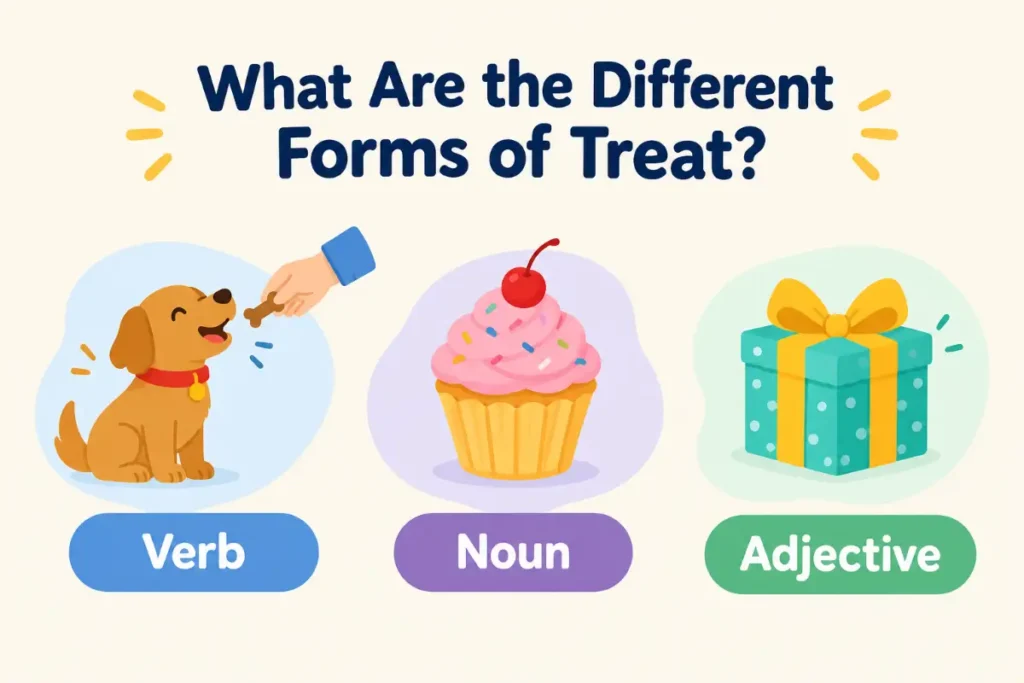
What Are the Different Forms of Treat
The word changes form depending on tense and sentence structure. Learning these forms will help you write correctly.
| Form | Example | Use |
|---|---|---|
| Treat | I treat my friends kindly. | Base form and simple present with I, you, we, or they. |
| Treats | She treats her friends kindly. | Simple present with he, she, or it. |
| Treated | We treated our guests to dinner. | Simple past tense. |
| Treating | He is treating the patient. | Continuous form. |
| Treatment | The treatment helped the patient. | Noun for a method or process of care. |
The base word remains recognizable in each form. The spelling changes to fit the sentence.
Remember that treet is not the correct base form. The correct forms begin with treat, as in treats, treated, and treating.
How to Correct Treet in Your Writing
If you find treet in a draft, first check what the sentence means. In most ordinary sentences, you will need to replace it with treat.
Check the Sentence Meaning
Read the full sentence rather than correcting the word without context.
For example.
- Incorrect. “The dog wants a treet.”
- Correct. “The dog wants a treat.”
The sentence refers to a snack, so treat is the right choice.
Now consider this example.
- Incorrect. “The nurse will treet the injury.”
- Correct. “The nurse will treat the injury.”
Here, the word describes care. The same spelling correction works because treat is the standard verb.
Check the Verb Form
Sometimes the problem is not only the spelling of the base word. You may also need to choose the right verb form.
- Incorrect. “She treet everyone fairly.”
- Correct. “She treats everyone fairly.”
- Incorrect. “They treeted the guests to dinner.”
- Correct. “They treated the guests to dinner.”
Look at the subject and the time of the action. These clues will help you choose the correct form.
Use a Dictionary or Spell Checker
A dictionary can confirm the accepted spelling and meaning. A spell checker can also flag treet in ordinary writing.
However, a spell checker may not catch every mistake. It may miss a wrong word if that word is a valid spelling of something else. That is why reading the sentence for meaning still matters.
If you are writing an article, email, school assignment, or work report, take a moment to review words that look unusual. A quick check can prevent a simple typo from distracting your reader.
Practice the Correct Spelling
Try these short exercises to check your understanding. Choose the spelling that fits each sentence.
Question One
I bought a chocolate _____ after lunch.
Answer. Treat.
The sentence refers to something enjoyable to eat.
Question Two
Please _____ everyone with kindness.
Answer. Treat.
The word describes how you should behave toward people.
Question Three
The doctor _____ the patient yesterday.
Answer. Treated.
The sentence describes a completed action in the past.
Question Four
My dog gets a small _____ after a walk.
Answer. Treat.
The word refers to a reward or snack.
Question Five
She is _____ the injured bird.
Answer. Treating.
The sentence describes an action in progress.
Question Six
The children walked down the _____ to reach the park.
Answer. Street.
This sentence refers to a road. It does not describe a snack or an action involving care.
These examples show why context matters. Treat is the correct spelling for the meanings discussed in this guide, but street is a different word with a different meaning.
FAQs
Is treet a real word?
Treet is not a standard English word in ordinary modern American English. You may see it as a brand name, a username, or a creative spelling. In normal writing, use treat when you mean something enjoyable or the act of providing care.
Is treet vs treat the correct spelling question?
The phrase treet vs treat compares a nonstandard spelling with the standard English word treat. The correct spelling is treat. Use it for a pleasant reward, a special experience, medical care, or the way you behave toward someone.
What does treat mean?
Treat can mean something enjoyable, such as candy or a special experience. As a verb, it can mean to behave toward someone in a certain way or to provide care for an illness or injury. The surrounding sentence tells you which meaning applies.
How do you spell treat in American English?
The correct spelling is T R E A T. It contains five letters. The same base spelling appears in related forms such as treats, treated, and treating.
What is the past tense of treat?
The past tense is treated. For example, you can write, “The doctor treated the patient yesterday.” Add ED to the base word treat to form the regular past tense.
Is treat a noun or a verb?
Treat can be both a noun and a verb. As a noun, it can refer to a snack or an enjoyable experience. As a verb, it can describe behavior, care, or the way someone handles a subject.
What is the difference between treat and treatment?
Treat can describe an action or something enjoyable. Treatment is a noun that often refers to a method or process of care. For example, a doctor treats an infection by providing treatment.
How can I remember the spelling of treat?
Connect treat with the letters EAT in the middle of the word. A treat is often something you eat, such as a cookie or a piece of candy. This simple connection can help you remember the correct spelling.
Conclusion
The main difference in treet vs treat is simple. Treat is the standard English spelling, while treet is generally a spelling mistake. Use treat when you mean something enjoyable, kind behavior, medical care, or the act of handling a person or subject in a certain way.
Remember that treat can be both a noun and a verb. You might receive a treat, give someone a treat, treat a friend kindly, or treat an illness. The meaning changes with the sentence, but the correct base spelling stays the same.
When you are unsure, look at the meaning first. If you are talking about a reward, a pleasant experience, or an action involving care, treat is the word you need. If you mean a public road, use street instead.
A simple way to remember the spelling is to connect treat with eat. Many treats are foods we enjoy, and the letters EAT help you recall the correct spelling. Keep that small trick in mind, and you will be less likely to make this mistake in your next sentence.

Sienna Watson is a veteran copywriter and communications coach who has helped startup founders, marketers, and professionals polish their writing for over a decade. Realizing that most people don’t need a degree in linguistics—just clear, impactful communication—Sienna focuses on practical grammar, business writing etiquette, and eliminating wordiness. She advocates for plain language, strong verbs, and persuasive prose that gets results.