

The difference between sheath vs sheathe comes down to how you use each word. A sheath is a cover that holds or protects something such as a knife or sword. To sheathe means to put that object into its cover.
Both words are correct. They sound almost the same, but they play different roles in a sentence. One is a noun that names an object. The other is a verb that describes an action.
For example, you can carry a knife in a sheath. After using it, you can sheathe the knife by sliding it back into the cover. The words are closely related, so mixing them up is easy.
Once you learn the difference, you’ll know which spelling to use in everyday writing, stories, school assignments, and professional documents. You’ll also learn how to remember the two words, avoid common mistakes, and use them naturally in real sentences.
Quick Definition
A sheath is a protective cover designed to hold an object, often a knife, sword, or blade. Sheathe is a verb that means to place something inside its sheath or cover.
Think of the difference this way. The sheath is the cover. To sheathe is to put something inside it.
Direct Answer
Use sheath when you mean a protective cover. Use sheathe when you mean the act of putting a blade or another object into that cover.
For example, The hunter cleaned his knife and returned it to its sheath. You could also write, The hunter sheathed his knife after cleaning it.
Sheath vs Sheathe at a Glance
| Word | Meaning | Example Sentence | When to Use It |
|---|---|---|---|
| Sheath | A protective cover | The knife stayed in its sheath. | When naming the cover. |
| Sheathe | To put something into a cover | Sheathe the sword before you leave. | When describing the action. |
| Sheathed | Put inside a cover | He kept his sheathed sword at his side. | When describing an object already covered. |
| Sheathing | The act of covering or enclosing something | Sheathing the blade kept it safe. | When describing an ongoing action or process. |
The easiest way to choose the right word is to look at what your sentence needs. If you are talking about an object, use sheath. If you are describing an action, use sheathe.
For example, The soldier removed the sword from its sheath names the cover. In contrast, The soldier began to sheathe the sword describes what the soldier did.

What Does Sheath Mean
A sheath is a cover or case made to hold and protect an object. The word often refers to a knife or sword cover, but it has other uses in everyday English and specialized fields.
Think of a sheath as a protective home for an object. It helps keep the object in place and can protect both the object and the people around it.
Sheath as a Protective Cover
The most familiar use of sheath describes a cover for a blade. A knife sheath may be made of leather, plastic, wood, or another durable material. Some sheaths have a belt loop or clip so the owner can carry the knife safely.
Here are a few natural examples.
- The cook placed the hunting knife in its sheath.
- The leather sheath had a small loop for a belt.
- Maya bought a new sheath to protect her camping knife.
- The sword rested inside a decorated sheath.
- He checked the sheath for damage before storing the knife.
In each sentence, sheath names the cover. It does not describe the act of putting the knife away.
A sheath can also help keep a sharp edge from damaging other items. For example, a knife stored loose in a bag could cut through fabric or injure someone reaching inside. A suitable sheath helps prevent that problem.
The exact design depends on the object. A kitchen knife sheath may look different from a sword sheath or a cover made for a small tool. The purpose stays much the same. It holds and protects the item.
Sheath in Clothing and Biology
The word has uses beyond knives and swords.
In clothing, a sheath dress is a fitted dress that follows the body’s shape. The name suggests a close covering around the body. For example, She wore a simple black sheath dress to the dinner.
In biology, a sheath is a covering or outer layer around a structure in a living thing. Some nerves have protective coverings. Certain plants also have leaf structures called sheaths that wrap around part of a stem.
For example, a biology textbook might describe a protective layer around a nerve as a sheath. A plant guide might explain how a leaf sheath surrounds part of a grass stem.
These meanings share a common idea. A sheath surrounds, holds, or protects something. The object may be a blade, part of the body, or a plant structure.
Sheath in Technology and Everyday Language
You may also see sheath in technical writing. It can describe a protective outer layer around a wire, cable, pipe, or other structure.
For example, The electrician inspected the cable sheath for cracks. Here, the sheath is the outer layer that protects the cable inside.
In another sentence, The pipe had a metal sheath around it. The word still refers to a covering, even though the object is not a weapon or tool.
This broader meaning helps explain why the word appears in different fields. It is not limited to a knife cover. It can name many kinds of protective or surrounding layers.
When you encounter sheath in an unfamiliar context, look at the object being described. If the word refers to a cover or outer layer, the noun is likely the right choice.
What Does Sheathe Mean
Sheathe is a verb. It describes the action of putting something into a sheath or covering it with a protective layer.
The word often appears in writing about swords, knives, and other blades. It can also describe the act of enclosing something in a protective covering.
For example, The guard sheathed his sword before entering the building. The guard performed an action by putting the sword into its cover.
Sheathe as an Action
Use sheathe when you want to explain what someone does with an object.
Consider these examples.
- The soldier sheathed his sword after the battle.
- Please sheathe the knife before placing it in your backpack.
- The fencer sheathed the blade after practice.
- He reached for the sword but chose to sheathe it instead.
- The traveler sheathed his hunting knife before returning to camp.
Each sentence describes an action. The word sheathe tells the reader that someone is putting an object into a cover.
The verb can also appear in instructions. A teacher might tell a student to sheathe a training sword before leaving the practice area. A park guide might remind a camper to place a knife in its cover before packing it.
The key is the action. You are not naming the cover. You are describing what a person does.
Sheathe Can Mean to Cover or Enclose
The verb can have a broader meaning than putting a blade into a case. It can describe covering or enclosing something in a protective layer.
For example, The workers sheathed the cable in a tough outer layer. In this sentence, the workers covered the cable to protect it.
You might also read a sentence such as The builders sheathed the frame with wooden panels. This use describes covering a structure with a material. The exact meaning depends on the subject and the surrounding sentence.
The word also appears in figurative writing. An author might describe a character as sheathing a hand in a glove. The sentence uses the idea of enclosing something inside a covering.
These uses follow the same basic pattern. The verb describes an action that places or encloses something within a protective layer.
How to Use Sheathe in a Sentence
A useful way to practice is to place sheathe after a person or subject that performs the action.
For example, The knight will sheathe his sword. The knight is the subject. The sword is the object. The action is putting the sword into its sheath.
You can also use the word after modal verbs such as can, should, and must.
- You should sheathe the knife before storing it.
- The guard must sheathe the sword before entering.
- She can sheathe the blade with one hand.
- The hunter will sheathe the knife after cleaning it.
The base form stays sheathe after these verbs. You would not write should sheath the knife if you mean the action of putting the knife away in a sentence that requires the verb sheathe.
However, sheath the knife can be correct in a different grammatical pattern. In that case, sheath is being used as a verb. This detail matters because English sometimes lets a noun become a verb without changing its spelling.
The next sections explain that overlap and show how to choose the clearest form.
Why Sheath and Sheathe Are Easy to Confuse
The two words look almost identical. They share the same letters in nearly the same order, and both relate to covering or protecting something. The final e in sheathe is the main spelling clue.
There is also a grammatical difference. Sheath usually names a thing, while sheathe usually describes an action. Once you spot that difference, the choice becomes much easier.
The Final E Makes a Difference
The word sheath ends with th. The word sheathe ends with the. That extra e helps distinguish the verb from the more common noun.
Compare these two sentences.
The knife has a leather sheath.
The camper will sheathe the knife.
The first sentence names a cover. The second describes an action. The final letter helps you recognize the difference, but the meaning and grammar of the sentence confirm the choice.
The words also have different forms when you change the sentence tense. The past tense of sheathe is sheathed. The plural of the noun sheath is sheaths.
For example, you might write, The knife has two sheaths in the storage box. You could also write, The camper sheathed the knife before dinner.
Notice how the endings change. The noun takes an s to form its plural. The verb takes d after its final e to form the past tense.
They Have Different Jobs in a Sentence
A noun names a person, place, thing, or idea. A verb describes an action or state. You do not need to memorize a long grammar rule to understand these words. Just ask what job the word performs.
In The sheath is made of leather, the word names an object. It is a noun.
In Sheathe the blade before you put it away, the word gives an instruction. It is a verb.
Try reading the following examples aloud.
- The sheath is too small for the knife.
- The owner will sheathe the knife after cleaning it.
- The damaged sheath needs repair.
- The guard sheathed the sword before leaving.
The noun appears in the first and third examples. The verb appears in the second and fourth.
You can use this simple test when editing your own writing. If the sentence needs the name of a cover, choose sheath. If it needs the action of putting an object into its cover, choose sheathe.
Context Can Change the Correct Choice
English has words that can serve as more than one part of speech. Sheath is one of them. It can act as a noun or a verb, though the verb use is less common in everyday writing.
For example, The sheath protects the blade uses sheath as a noun. In Sheath the blade before carrying it, the same spelling acts as a verb.
This is why the final e rule is helpful but not enough on its own. You should also consider the sentence’s meaning.
If the sentence reads Sheath the knife, the word is an instruction to cover the knife. The spelling is still correct because sheath can function as a verb meaning to put something into a sheath.
If you write Sheathe the knife, the meaning is nearly the same. The verb sheathe makes the action more explicit and is often the better choice when you want to avoid confusion.
Both forms can be grammatically correct. The difference is a matter of word choice and clarity rather than a simple rule that says sheath can never be a verb.
Is Sheath vs Sheathe Ever a Grammar Question
Yes. The choice can involve both meaning and grammar. Most of the time, you need to decide if you are naming a cover or describing the act of putting something inside it.
The confusion often starts when people learn only one meaning for each word. They learn that a sheath is a knife cover and assume the spelling can never act as a verb. English is more flexible than that.
When Sheath Is a Noun
Use sheath as a noun when it names a cover or outer layer. It can appear as the subject or object of a sentence, or after a preposition.
Examples include the following.
- The sheath needs a new strap.
- She bought a sheath for her pocketknife.
- The blade slipped out of its sheath.
- A crack appeared in the cable sheath.
- The plant’s leaf sheath wrapped around the stem.
In each example, the word refers to a thing or a covering. You can often place the, a, my, or its before it.
For example, the sheath, a sheath, and its sheath all make sense. These phrases show that the word is naming an object.
When Sheath Is a Verb
The word sheath can also be used as a verb. As a verb, it means to put something into a sheath or cover it with a layer.
For example, The guard sheathed his sword is correct. The word sheathed is the past tense of the verb sheath.
You may also see commands such as Sheath your knife before you pack it. Here, sheath is an action word. It tells someone what to do.
This use is established English, so it is not automatically a spelling error. Still, many readers find sheathe easier to recognize as the verb because the extra e separates it visually from the noun.
When Sheathe Is the Better Choice
Use sheathe when you want a clear verb that means to put a blade into its cover or to enclose something in a protective layer.
For instance, The knight sheathed his sword is direct and natural. The reader can quickly understand the action.
In technical writing, you may choose a more specific verb such as cover, enclose, or protect if it explains the process more clearly. In a story about a sword or knife, sheathe is often the most precise choice.
The goal is not to force one spelling into every sentence. The goal is to choose the word that fits the meaning and reads naturally.
Common Examples of Sheath and Sheathe
Examples help make the distinction easier to remember. The sentences below show how the words work in everyday situations, fiction, instructions, and technical writing.
Examples With Sheath
Use these sentences as models when you need a noun.
- The leather sheath protected the knife from scratches.
- My grandfather kept his old sword in a wooden sheath.
- The knife’s sheath was attached to the side of his backpack.
- A loose sheath can make carrying a blade unsafe.
- The tailor designed a sheath dress for the event.
- The cable sheath showed signs of wear.
- The plant’s sheath covered the base of its leaves.
- She placed the knife beside its sheath on the workbench.
- The sword’s decorated sheath matched its handle.
- He replaced the broken sheath before taking the tool outdoors.
In each sentence, sheath names a cover or outer layer. You could replace it with cover or case in some examples, but not all. For example, sheath dress is an established clothing term, so replacing sheath with cover would change the meaning.
Examples With Sheathe
Use these sentences when you need a verb.
- The guard sheathed his sword after the ceremony.
- Please sheathe the blade before you return the tool.
- The knight chose to sheathe his weapon.
- She sheathed the knife and placed it in her bag.
- The soldier sheathed his sword without a word.
- He reached for the blade, then decided to sheathe it.
- The worker sheathed the wire in a protective layer.
- The builder sheathed the frame with wooden panels.
- The character sheathed his sword as the danger passed.
- She carefully sheathed the knife before handing it over.
These examples show the action of covering or enclosing something. The verb can describe an action that happens now, happened in the past, or will happen later.
Examples That Show Both Words
Seeing both words in the same sentence can help you remember the difference.
- She placed the knife in its sheath and stored it safely.
- Before leaving the campsite, he decided to sheathe the knife.
- The sheath was worn, so the owner replaced it before using the knife again.
- The guard removed the sword from its sheath, then sheathed it after the practice session.
- The knife stayed in its sheath until the cook needed it.
- After cleaning the blade, the cook sheathed it and returned it to the drawer.
These sentences connect the noun and the verb. First, you identify the cover. Then, you describe the action of putting the object into it.
A sentence can contain both words without sounding repetitive. Each one has a different job.
Examples in Different Tenses
The verb sheathe changes form based on the tense and sentence structure.
| Form | Example |
|---|---|
| Present | I sheathe the knife after use. |
| Third person present | She sheaths the sword after practice. |
| Past | He sheathed the blade before leaving. |
| Future | They will sheathe their swords soon. |
| Present progressive | She is sheathing the knife now. |
| Present perfect | He has sheathed the sword. |
| Infinitive | He wants to sheathe the blade. |
Pay attention to sheaths in the third person present. It can look like the plural noun sheaths, but the sentence tells you how it functions.
In Sheaths are made from leather, the word names multiple covers. In She sheaths her knife, it describes an action performed by one person.
The form sheathed can also work as an adjective. For example, The sheathed sword hung on the wall. Here, it describes the sword’s condition. The sword is already inside its cover.
Common Mistakes to Avoid
Even experienced writers can mix up these words. The good news is that most mistakes come from a few simple habits. Once you know what to look for, you can catch them quickly.
Using Sheathe When You Mean the Cover
One common mistake is using the verb when the sentence needs a noun.
- Incorrect: The hunter put the knife in its sheathe.
- Correct: The hunter put the knife in its sheath.
The sentence names the cover, so sheath is the right choice. The word after its describes the object that holds the knife.
You can use sheathe in a sentence like this instead. The hunter decided to sheathe the knife before walking back to camp. Here, the word describes the hunter’s action.
Using Sheath When You Mean the Action
Another mistake is choosing the noun spelling when you want the more specific verb sheathe.
For example, He will sheathe his sword before leaving clearly describes an action. The sentence is correct and natural.
You may also see He will sheath his sword before leaving. This version is grammatically acceptable because sheath can work as a verb. However, sheathe is often the clearer choice for readers who expect the noun and verb to have different spellings.
For the clearest writing, use sheath for the cover and sheathe for the action when the context allows both choices.
Writing Sheathes When You Mean Sheathed
The endings can cause another problem.
The plural noun is sheaths or, in some pronunciations and forms, sheathes. The past tense of the verb sheathe is sheathed.
Compare these examples.
- Correct noun: The store sells several leather sheaths.
- Correct verb: The soldier sheathed his sword.
- Incorrect past tense: The soldier sheathes his sword yesterday.
The last sentence uses the present tense form sheathes with a past time marker. The correct sentence is The soldier sheathed his sword yesterday.
Remember that sheaths and sheathes can appear as noun forms, while sheathed is the standard past tense of sheathe.
Confusing Sheath With Other Similar Words
Writers sometimes confuse sheath with sheathe, scabbard, and scathe. These words may look or sound similar, but their meanings differ.
A scabbard is a case made to hold a sword or dagger. It is close in meaning to a sword sheath. A scathe is harm or damage, and the verb scathe means to harm or damage. It does not mean to cover a blade.
For example, The sword rested in its scabbard and The sword rested in its sheath can describe much the same situation. However, The fire scorched and scathed the wooden handle uses a different word with a different meaning.
When two words look alike, focus on what the sentence says. Similar spelling does not always mean similar meaning.
How to Remember the Difference
A quick memory trick can save time when you’re writing. You do not need to recall a long grammar rule every time you use one of these words.
Remember That a Sheath Is a Thing
Think of the phrase a knife sheath. The word names the object that protects the blade.
You can use the same pattern with a sword sheath, a cable sheath, or a plant sheath. In each phrase, the word names a covering.
If you can put a or the before the word and the sentence still makes sense, you may need the noun sheath.
For example, The sheath is damaged makes sense because the word refers to an object. The same is true of A sheath protects the blade.
Remember That Sheathe Is an Action
Think of sheathe the sword. You are telling someone to do something. The verb describes the act of putting the sword into its cover.
You can also connect the word with other action verbs. You draw a sword out of its sheath, then sheathe it when you put it away.
That contrast is especially useful in stories about knights, soldiers, or sword fights. The action of drawing a sword removes it from its cover. The action of sheathing a sword returns it to the cover.
Try remembering this short pair.
- The sheath holds the blade.
- You sheathe the blade.
The first sentence names a thing. The second describes an action.
Use the Sentence Test
If you’re still unsure, rewrite the sentence with a simpler word.
For example, consider He put the knife in its sheathe. Replace the disputed word with cover. The sentence becomes He put the knife in its cover. That tells you the noun is needed, so sheath is correct.
Now consider He decided to sheath the knife. Replace the verb with place inside its cover. The sentence becomes He decided to place the knife inside its cover. The action is clear, so sheathe is also a natural choice.
This test is not a substitute for learning how the words work, but it can help you make a quick decision during proofreading.
Sheath vs Sheathe in American English
Both spellings are standard in American English. The difference is not a regional spelling rule. It comes down to how the words function in the sentence and the meaning you want to express.
American dictionaries recognize sheath as a noun and as a verb. They also recognize sheathe as a verb. In regular writing, the noun sheath and the verb sheathe are the most useful forms to remember.
Which Form Should You Use in Everyday Writing
If you’re writing for a general American audience, use sheath when naming a cover and sheathe when describing the action of putting something into it.
For example, The knife has a leather sheath is clear. So is Please sheathe the knife before storing it.
This approach makes your meaning easy to follow. It also helps readers who are learning English or who may not know that sheath can sometimes function as a verb.
Which Form Works Best in Fiction
In fiction, both forms can work. The best choice depends on the sentence and the style of the writing.
For example, The knight sheathed his sword and stepped into the hall is direct and easy to picture. The verb helps the reader follow the action without stopping to work out the meaning.
You could also write, The knight returned the sword to its sheath. This version places more attention on the cover and the movement of the sword into it.
Neither sentence is better in every situation. Choose the one that fits the action and the rhythm of the passage.
Which Form Works Best in Technical Writing
Technical writing should favor clarity. Use sheath when naming an outer layer or protective cover. Use sheathe when describing the process of placing an object inside a cover or enclosing it in a layer.
For example, Inspect the cable sheath for damage names the part that needs inspection. Sheathe the exposed wire in approved protective material describes an action.
In some technical fields, cover, enclose, insulate, or protect may be more precise than sheathe. Choose the word that best describes the actual task. Clear instructions matter more than using a particular vocabulary word.
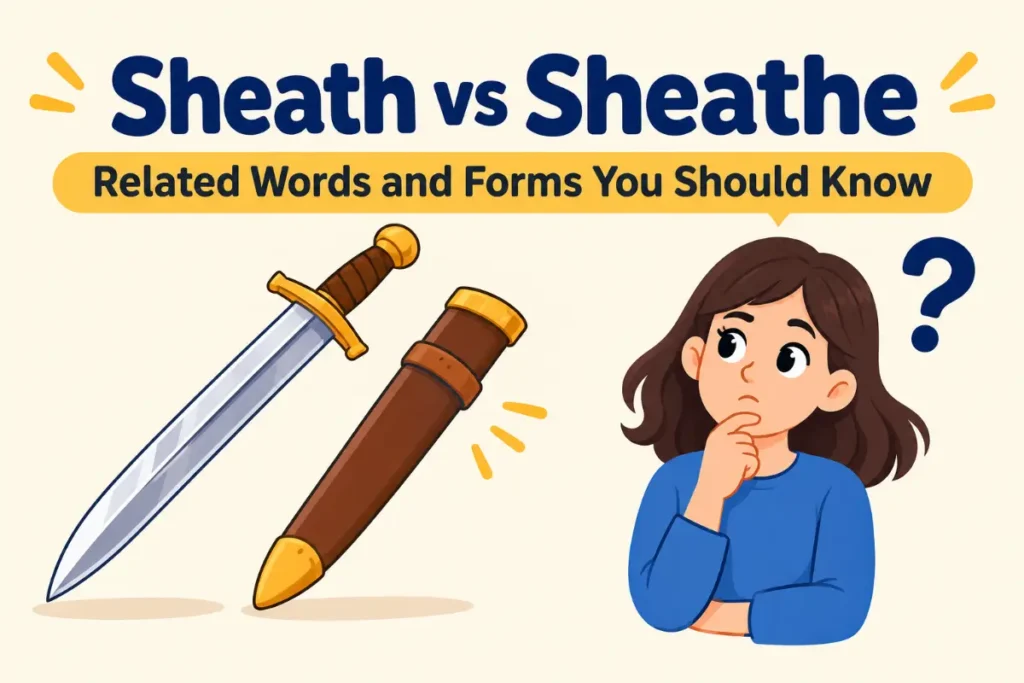
Related Words and Forms You Should Know
Learning the related forms can help you use the words correctly in more complex sentences. You may see these forms in books, instructions, articles, and technical documents.
Sheaths
Sheaths is the plural form of the noun sheath. Use it when talking about two or more covers.
For example, The shop displayed leather sheaths in several sizes. The sentence refers to multiple covers.
You can also write, The plant’s leaf sheaths protect parts of its stems. Here, the plural form describes several plant structures.
Sheathed
Sheathed is the past tense of the verb sheathe. It can also describe something that is already inside a cover.
For example, The guard sheathed his sword before leaving the room. The action happened in the past.
In The sheathed sword rested against the wall, the word describes the sword’s condition. The sword is already inside its cover.
Sheathing
Sheathing can describe the action of putting something into a sheath. It can also refer to the process of covering a surface with a protective layer.
For example, Sheathing the blade took only a moment. The word describes the action.
In construction, sheathing can refer to boards or panels attached to a building frame. The material covers the frame and helps form a surface. This technical use is related to the broader idea of enclosing or covering something.
Scabbard
A scabbard is a case for a sword or dagger. It often refers to a long, rigid or shaped cover designed for a blade.
For example, The antique sword remained in its scabbard. You could also say The antique sword remained in its sheath.
The two terms can overlap, especially when talking about swords. However, sheath has a wider range of uses and can describe protective covers for many kinds of objects.
Knowing these related words helps you describe an object more precisely. It also makes it easier to understand the terms when they appear in different settings.
How to Choose the Right Word While Editing
When proofreading, check the meaning before checking the spelling. Ask yourself if the sentence names a cover or describes an action.
If it names a cover, sheath is usually the right choice. If it describes putting something into a cover, sheathe is usually the clearest choice.
Then check the tense. Use sheathed for a completed action in the past. Use sheathing when describing an ongoing action or a covering process.
For example, The worker sheathed the cable yesterday uses the past tense. The worker is sheathing the cable now describes an action in progress.
These small checks can prevent spelling errors and make your writing easier to understand.
Why the Difference Matters
Choosing the right word helps readers understand the sentence without stopping to guess. The difference may seem small, but a spelling mistake can make an otherwise clear sentence look careless.
This matters in school assignments, professional instructions, product descriptions, and creative writing. If you are describing a knife cover, the noun sheath communicates the object. If you are describing what someone does with a knife, the verb sheathe communicates the action.
Clear word choice also helps search engines and voice assistants identify the topic of your writing. When a definition is direct and an example shows the word in context, readers can find the answer quickly.
The best approach is simple. Learn the main difference, notice the role the word plays in the sentence, and use an example to check your choice.
FAQs
What Is the Main Difference Between Sheath and Sheathe?
A sheath is a cover that holds or protects something. To sheathe means to put something into that cover or enclose it in a protective layer. The first word usually names an object, while the second usually describes an action.
Is Sheath vs Sheathe a Difference in Spelling or Meaning?
The words have different spellings and different common uses. Sheath is most often a noun, while sheathe is a verb. However, sheath can also function as a verb, so the sentence context matters.
Is Sheathe a Real Word?
Yes. Sheathe is a standard English verb. It means to put a blade into its sheath or to cover something with a protective layer. For example, The soldier sheathed his sword before returning to camp.
What Is the Past Tense of Sheathe?
The past tense of sheathe is sheathed. For example, The guard sheathed his sword after the ceremony. Use sheathed to describe an action that has already happened.
What Is the Plural of Sheath?
The usual plural is sheaths. For example, The store sells knife sheaths in different sizes. The form sheathes can also occur as a plural noun, though sheaths is the more common choice in modern everyday writing.
Can Sheath Be Used as a Verb?
Yes. Sheath can be used as a verb meaning to put something into a sheath or cover it. For example, Sheath your knife before packing it. The related verb sheathe is also correct and often makes the intended action clearer.
Is a Sheath the Same as a Scabbard?
The words have similar meanings when they refer to a cover for a blade. A scabbard usually refers to a case made for a sword or dagger, while a sheath can describe a wider range of protective covers. The best word depends on the object and the context.
Conclusion
The difference between sheath vs sheathe is simple once you understand how each word works. A sheath is a protective cover. To sheathe means to put something into that cover or enclose it in a protective layer.
Use sheath when naming the cover. Use sheathe when describing the action. For example, The knife is in its sheath names the object, while Sheathe the knife before storing it gives an instruction.
Remember the related forms too. Sheaths is the usual plural noun, sheathed is the past tense, and sheathing can describe an ongoing action or a covering process.
When you’re unsure, read the sentence and ask what the word needs to do. If you need a name for a cover, choose sheath. If you need a verb for the action, choose sheathe. That simple check will help you get the spelling right.

Dr. Elena Vance holds a Ph.D. in Linguistics from Columbia University and has spent over 15 years analyzing the evolution of the English language. A former university professor turned full-time writer and editor, Elena specializes in breaking down high-level grammatical concepts, punctuation nuances, and style guides (APA, Chicago, MLA) into clear, actionable advice. When she isn’t hunting down dangling modifiers, she can be found collecting vintage dictionaries and reading classic literature.