

Have you ever stopped while writing and wondered if you should use to bad or too bad? These two expressions sound exactly the same when spoken. However, only one is correct when you want to say that something is unfortunate or disappointing.
The correct expression is too bad. It means something is unfortunate or disappointing. For example, you might say, “It’s too bad that we missed the concert.” Here the word too adds meaning to the adjective bad and shows regret about something.
The confusion comes from two small words that sound alike but serve different purposes. To usually shows direction or introduces an action. Too means also or more than needed. A single extra letter changes the meaning of a sentence.
In this guide, you’ll learn the difference between these words and how to use them correctly. We’ll look at everyday examples, common mistakes, simple memory tricks, and related expressions. By the end, you’ll know exactly which spelling to use and why.
Quick Definition
Too bad is the correct expression when you want to describe something unfortunate or disappointing. The word too can also mean excessively when it comes before an adjective. For example, “The coffee is too bad to drink” means the coffee is so unpleasant that drinking it isn’t a good idea.
The phrase to bad isn’t a standard expression with this meaning. However, the words to and bad can appear next to each other in a sentence when they serve separate grammatical roles.
Direct Answer
Too bad is correct when you express disappointment or describe an unfortunate situation. Use to for direction or as part of an infinitive verb. Don’t use to bad as a replacement for the common expression too bad.
To Bad or Too Bad Comparison Table
| Word or Phrase | Meaning | Example Sentence | When to Use It |
|---|---|---|---|
| Too bad | Unfortunate or disappointing | It’s too bad that you can’t come. | When expressing regret or disappointment. |
| Too bad | Excessively unpleasant or poor | The food was too bad to eat. | When describing something as extremely poor or unpleasant. |
| To | Direction or destination | We went to the park. | When showing where someone or something is going. |
| To | Introduces an infinitive verb | I want to learn English. | Before the base form of a verb. |
| To bad | Not a standard expression by itself | The weather changed from good to bad. | When to and bad have separate roles in a sentence. |
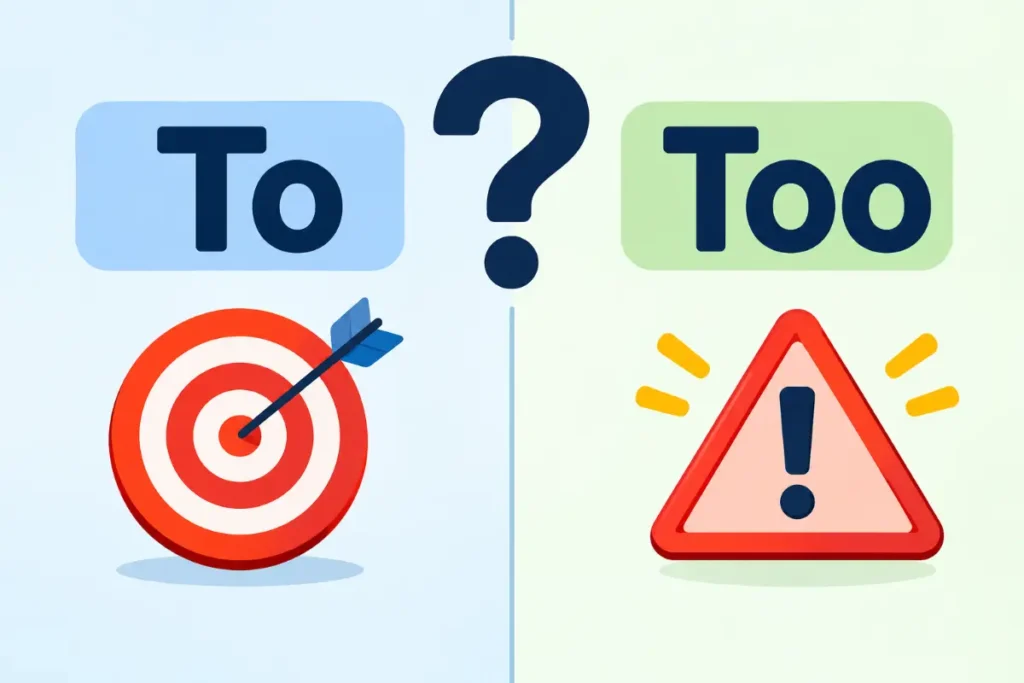
Understanding the Difference Between To and Too
The easiest way to avoid this spelling mistake is to understand what each word does. Although to and too sound alike, they don’t have the same meaning or grammatical function.
Let’s look at each word more closely.
What Does To Mean?
The word to is a preposition or part of an infinitive verb. It often shows movement toward a place or person. It can also connect an action with another verb.
For example:
- We drove to the beach on Saturday.
- She sent an email to her teacher.
- I need to finish my homework.
- He wants to become a doctor.
- They walked to the nearest store.
In these sentences, to doesn’t describe how good or bad something is. Instead, it shows direction or introduces an action.
You can also use it to show a connection between two things.
For example:
- The office is open from Monday to Friday.
- The temperature dropped from warm to cold.
- She counted from one to ten.
- The road leads to the old bridge.
- The children moved from the classroom to the playground.
Notice the sentence “The temperature dropped from warm to cold.” The word to connects two different conditions. It doesn’t mean too or express disappointment.
This distinction matters because the words can sometimes appear beside adjectives without forming a fixed expression.
What Does Too Mean?
The word too is an adverb. It has two main meanings.
First, it can mean also or in addition. Second, it can mean more than necessary or to an excessive degree.
For example:
- I want to come too.
- She likes chocolate too.
- The bag is too heavy.
- This room is too cold.
- The movie was too long.
In the first two examples, too means also. In the remaining examples, it describes something that goes beyond an acceptable or comfortable level.
You can also place too before the adjective bad to describe something unpleasant or disappointing.
For example:
- The weather is too bad for a picnic.
- It’s too bad that the store is closed.
- The service was too bad for the price.
- The traffic was too bad to drive safely.
The meaning depends on the sentence. However, the spelling stays the same.
Why These Words Sound the Same
The words to and too are homophones. Homophones are words that have the same pronunciation but different spellings and meanings.
English has many homophones. Some are easy to mix up because they sound identical in normal conversation.
Here are a few familiar examples:
- To and too.
- There and their.
- Your and you’re.
- Two and too.
- See and sea.
- Right and write.
- Here and hear.
When people speak, listeners usually understand the intended meaning from the rest of the sentence. Writing doesn’t offer the same help. Readers depend on correct spelling and sentence structure to understand the message.
That’s why it’s worth learning the difference instead of relying only on how a word sounds.
Why To Bad or Too Bad Gets Confusing
The confusion usually starts when someone hears the expression in conversation and tries to write it down. Since both words sound the same, it’s easy to choose the shorter spelling without thinking about the meaning.
However, spelling depends on the job a word performs in a sentence. You can’t choose between these words based on sound alone.
The Extra O Changes the Meaning
The second letter O in too isn’t just an extra character. It helps distinguish the word from to.
Compare these sentences:
- It’s too bad that we lost the game.
- We went to the stadium after lunch.
The first sentence expresses disappointment. The second shows the destination.
Now consider these examples:
- The soup is too hot.
- I gave the soup to my brother.
The first sentence describes the temperature as higher than desired. The second shows who received the soup.
Once you understand this difference, choosing the correct spelling becomes much easier.
Fast Speech Can Cause Spelling Mistakes
People often speak quickly and don’t pronounce every word with great care. In everyday American English, to and too commonly have the same short unstressed sound.
For example, someone might say, “I want to go too.” Both words may sound almost identical in a natural conversation.
When you hear a sentence like this, you need to understand the meaning before choosing the spelling.
Ask yourself what the word is doing.
Does it show a destination or introduce an action? Use to. Does it mean also or excessively? Use too.
This small habit can prevent many common writing mistakes.
People Often Remember the Sound Instead of the Rule
Many spelling errors happen because people remember how a phrase sounds rather than how it works.
For instance, someone may hear “That’s too bad” many times and later type the shorter spelling by mistake. The sentence may still look familiar, but the meaning and grammar don’t support that choice.
The same problem occurs with other homophones. Someone might write “your welcome” instead of “you’re welcome” because both versions can sound similar in casual speech.
The solution is simple. Learn the purpose of each word rather than memorizing its sound alone.
When to Use Too Bad in a Sentence
The phrase too bad appears in many everyday conversations. People use it to show sympathy, express disappointment, or describe something as very unpleasant.
The exact meaning depends on the context and the words around it.
To Express Disappointment
One common use of too bad is to express regret about something that didn’t happen as planned.
For example:
- It’s too bad that we missed the train.
- That’s too bad. I know you wanted to attend the wedding.
- It’s too bad that the concert sold out.
- It’s too bad that she couldn’t join us for dinner.
- That’s too bad about your canceled flight.
In these examples, the speaker recognizes an unfortunate situation. The phrase doesn’t always show deep sadness. Sometimes it simply communicates mild disappointment.
Imagine your friend planned to visit a new restaurant. However, the restaurant closed before they arrived. You could say, “That’s too bad. I heard the food was excellent.”
This response shows that you understand their disappointment.
To Show Sympathy
You can also use the expression when someone shares an unpleasant experience.
For example:
- “I lost my favorite jacket.” “That’s too bad.”
- “My phone stopped working this morning.” “Oh, that’s too bad.”
- “We had to cancel our vacation.” “That’s too bad. I hope you can reschedule it.”
- “I didn’t get the job.” “That’s too bad. I’m sure another opportunity will come along.”
The phrase works as a short response that acknowledges someone’s problem.
Still, pay attention to your tone. Saying “Too bad” in a cold or careless way can sound rude. Adding a few kind words makes your response warmer.
For example, instead of saying only “Too bad,” you could say, “That’s too bad. I hope things work out for you.”
The words stay simple, but the message feels more thoughtful.
To Describe an Unfortunate Situation
Sometimes you don’t need to respond to another person’s problem. You can use the phrase to describe a situation that didn’t turn out well.
For example:
- It’s too bad that the park is closed today.
- It’s too bad that the weather ruined our plans.
- It’s too bad that the team lost after playing so well.
- It’s too bad that the shop doesn’t carry that brand.
- It’s too bad that the school canceled the event.
These sentences explain that something is disappointing or unfortunate.
You can also use the expression when discussing missed chances.
For example, “It’s too bad we didn’t take more pictures during the trip.”
The speaker looks back at an experience and wishes something had happened differently.
To Describe Something as Extremely Poor
The phrase can also describe something that falls far below an acceptable level.
For example:
- The food was too bad to finish.
- The movie was too bad to recommend.
- The hotel service was too bad for the price.
- The internet connection was too bad for a video call.
- The writing was too bad to publish.
Here, too means excessively. It describes the degree of the adjective bad.
This use often follows the pattern too + adjective + to + verb.
For example, in “The food was too bad to eat,” the word too modifies bad. The second to introduces the verb eat.
Both words appear in the same sentence, but they perform different jobs.
This pattern is especially useful to understand because it shows why the two spellings aren’t interchangeable.
Common Situations Where Too Bad Fits Naturally
Understanding the definition is helpful. However, seeing the expression in everyday situations makes it easier to use without hesitation.
Here are some common situations where you’ll hear or read it.
When Plans Don’t Work Out
People often use the expression when plans change unexpectedly.
For example:
- It’s too bad that the picnic got canceled because of the rain.
- That’s too bad. We were looking forward to seeing you.
- It’s too bad that the bus arrived late.
- It’s too bad that we couldn’t book a table at our favorite restaurant.
- That’s too bad about your weekend trip.
You can use it for small disappointments or bigger setbacks. The phrase doesn’t explain how serious the problem is. The surrounding conversation provides that information.
When Someone Misses an Opportunity
Missing a good opportunity can leave someone disappointed. This expression is a natural way to acknowledge that feeling.
For example:
- It’s too bad that you missed the scholarship deadline.
- That’s too bad. You would’ve been a great fit for the position.
- It’s too bad that he couldn’t attend the interview.
- It’s too bad that we didn’t buy tickets before they sold out.
- It’s too bad that she missed the chance to study abroad.
These examples show regret about something that has already happened.
You can also use the phrase when talking about a future opportunity that may no longer be available.
For example, “It’s too bad that the store won’t reopen this year.”
When Giving a Casual Response
In everyday American English, people often use short responses to show that they understand someone else’s disappointment.
For example:
Person A: I wanted to see the new movie, but all the tickets were sold out.
Person B: That’s too bad. Maybe you can go next weekend.
Another example:
Person A: My favorite coffee shop is closed today.
Person B: Oh, that’s too bad. There’s another one across the street.
These responses sound natural because they acknowledge the problem without making the conversation overly serious.
When Talking About Poor Quality
You can also use the phrase to describe something that doesn’t meet expectations.
For example:
- The customer service was too bad for such an expensive store.
- The sound quality was too bad to enjoy the recording.
- The weather was too bad for an outdoor wedding.
- The report was too bad to send to the client.
- The road conditions were too bad for safe driving.
In these sentences, the word too emphasizes the degree of the problem.
It tells the reader that something is worse than acceptable for a particular purpose.
Grammar Rules That Help You Choose the Right Word
You don’t need to memorize a long list of grammar terms to understand this difference. A few simple rules can help you make the right choice in almost every sentence.
Rule One Use Too Before an Adjective
Use too before an adjective when you want to show an excessive degree.
An adjective describes a person, place, thing, or situation. Words such as bad, cold, hot, expensive, and difficult are adjectives.
For example:
- The weather is too cold.
- This bag is too expensive.
- The exam was too difficult.
- The coffee is too hot.
- The service was too bad.
In each example, too tells us that something has gone beyond a comfortable or acceptable level.
You can also use this structure with other adjectives.
For example:
- The room is too small for six people.
- The music is too loud for studying.
- The shoes are too tight.
- The water is too dirty to drink.
Remember that too adds the idea of excess. It doesn’t simply describe something.
Rule Two Use Too When You Mean Also
The word too can also mean also or as well.
For example:
- I want to visit New York too.
- My brother enjoys reading too.
- She is coming to the party too.
- We need to buy some groceries too.
- He wants to learn Spanish too.
In these sentences, you can often replace too with also without changing the main meaning.
For example:
“I want to visit New York too.”
“I also want to visit New York.”
Both sentences communicate the same basic idea.
This substitution is a useful spelling check. If also makes sense in the sentence, you probably need too.
Rule Three Use To Before a Base Verb
The word to often comes before the base form of a verb. This structure is called an infinitive.
For example:
- I want to sleep.
- She needs to study.
- We decided to leave.
- He hopes to win.
- They plan to travel.
The verb after to stays in its base form.
For instance, you write “to go” rather than “to goes” in this structure.
More examples include:
- I need to call my mother.
- She wants to improve her writing.
- We hope to visit California.
- He promised to help us.
- They agreed to work together.
This rule is useful because to doesn’t describe the amount or degree of anything in these examples.
Rule Four Use To to Show Direction
Use to when someone or something moves toward a place or person.
For example:
- She went to school early.
- We drove to the airport.
- He walked to the grocery store.
- Send this letter to your manager.
- The children ran to their parents.
The word connects the action with its destination.
You can also use it to describe movement between two points.
For example:
- The train runs from Boston to New York.
- We traveled from the hotel to the beach.
- The temperature changed from mild to cold.
In these cases, to helps show where something starts and where it ends.
Rule Five Use Too Before a To Infinitive Pattern
One especially useful grammar pattern is too + adjective + to + verb.
It describes something that has reached an excessive level and makes an action difficult or impossible.
For example:
- The coffee is too hot to drink.
- The box is too heavy to lift.
- The room is too small to hold everyone.
- The question is too difficult to answer.
- The movie is too boring to finish.
Look closely at the first sentence.
“The coffee is too hot to drink.”
The first too modifies the adjective hot. The second to introduces the verb drink.
The same pattern works with bad.
For example:
- The food is too bad to serve.
- The weather is too bad to travel.
- The recording is too bad to use.
- The damage is too bad to ignore.
Learning this pattern makes it easier to recognize the correct spelling when both words appear close together.
Is Too Bad Always Negative
The expression usually carries a negative meaning. However, the speaker’s tone and the situation can change how it feels.
Sometimes it shows genuine sympathy. At other times, it can sound sarcastic, dismissive, or even playful.
Too Bad as a Kind Response
When someone shares disappointing news, a gentle response can show that you care.
For example:
Friend: I couldn’t get tickets for the game.
You: That’s too bad. I know how much you wanted to go.
The response recognizes the disappointment without making the conversation awkward.
You can make it even warmer by adding a helpful thought.
For example:
“That’s too bad. Maybe we can watch the next game together.”
Too Bad as a Dismissive Response
The same words can sound unfriendly when someone says them without sympathy.
For example:
Person A: I can’t finish the project because my computer stopped working.
Person B: Too bad. The deadline is still today.
Here, the response sounds cold because the speaker doesn’t show much concern.
The words haven’t changed. The tone and context have.
If you want to sound polite, add a few words that show understanding.
For example:
“That’s too bad. Is there anything I can do to help?”
Too Bad as a Sarcastic Comment
People sometimes use the phrase sarcastically when they don’t feel sorry about a situation.
For example:
- You didn’t save me a slice of cake? Too bad for you. I ate the last one.
- He thought he could skip practice and still play in the match. Too bad.
- They ignored the instructions and now have to start again. Too bad.
In these examples, the speaker may be teasing someone or suggesting that the person must accept the result of their actions.
This use is more casual. It’s best suited to conversations with people who understand your sense of humor.
Too Bad in a Playful Conversation
Friends and family sometimes use the phrase to joke about small problems.
For example:
- Person A: You finished all the cookies.
- Person B: Too bad. You should’ve taken some earlier.
This response is playful rather than serious.
However, don’t assume that everyone will understand the joke. In a formal conversation or a sensitive situation, a kinder response is usually a better choice.
Common Mistakes People Make With These Words
Even people who know the basic difference sometimes make mistakes when writing quickly. These errors often happen in emails, text messages, social media posts, and school assignments.
Let’s look at some common examples.
Writing To Bad Instead of Too Bad
This is the main mistake people make when expressing disappointment.
- Incorrect: It’s to bad that you missed the party.
- Correct: It’s too bad that you missed the party.
The corrected sentence uses too because the phrase expresses regret.
Another example:
- Incorrect: That’s to bad about your lost luggage.
- Correct: That’s too bad about your lost luggage.
The word to cannot replace too in these expressions.
Using Too Before a Verb
Another common mistake is using too when the sentence needs to before an infinitive verb.
- Incorrect: I want too visit my grandparents.
- Correct: I want to visit my grandparents.
The word introduces the verb visit. It doesn’t mean also or excessively.
Here are more examples:
- Incorrect: She needs too finish her homework.
- Correct: She needs to finish her homework.
- Incorrect: We decided too leave early.
- Correct: We decided to leave early.
- Incorrect: He hopes too become a teacher.
- Correct: He hopes to become a teacher.
A quick way to check these sentences is to look at the word after the spelling choice. If it introduces an action in its base form, you usually need to.
Using To Instead of Too to Mean Also
Some writers forget the extra O when they want to say also.
- Incorrect: I want to come to.
- Correct: I want to come too.
The first to introduces the verb come. The second word means also.
This example is useful because it shows that both spellings can appear in the same sentence.
Here are a few more corrections:
- Incorrect: My sister wants to join to.
- Correct: My sister wants to join too.
- Incorrect: I enjoyed the movie to.
- Correct: I enjoyed the movie too.
- Incorrect: Please bring your notebook to.
- Correct: Please bring your notebook too.
Confusing Too Bad With Very Bad
The expressions too bad and very bad can sometimes describe similar situations. However, they don’t always communicate the same idea.
Compare these examples:
- The weather is very bad.
- The weather is too bad to go outside.
The first sentence describes poor weather. The second says the weather is so poor that going outside isn’t a good option.
The word too often suggests that something has crossed a limit.
For example:
- The bag is very heavy.
- The bag is too heavy to carry.
The first sentence describes the bag. The second suggests that its weight makes carrying it difficult or impossible.
This difference helps you choose the right expression based on your intended meaning.
Adding Unnecessary Words After Too Bad
Some writers use extra words that make a sentence awkward.
For example:
Awkward: It’s too bad of a thing that we missed the event.
Better: It’s too bad that we missed the event.
Another example:
Awkward: That’s a too bad situation.
Better: That’s a bad situation.
You can also write:
“That’s a very unfortunate situation.”
Keep the sentence simple. The phrase already communicates disappointment without extra wording.
Easy Ways to Remember the Difference
You don’t need complicated grammar rules to remember these spellings. A few simple tricks can help you choose the right word when writing.
Remember That Too Has an Extra O
The easiest trick is to remember that too has an extra O.
Think of the extra O as an extra amount. When something is too hot or too expensive, it has more of something than you want.
For example:
- The coffee is too hot.
- The shoes are too expensive.
- The room is too small.
- The weather is too bad.
The extra O can remind you of an excessive amount.
This trick works well when too means more than necessary. It also helps you remember the correct spelling in common expressions of disappointment.
Replace Too With Also
Another useful trick is to replace too with also.
If the sentence still makes sense, you need too.
For example:
- “I want to come too.”
- “I want to come also.”
The first sentence sounds more natural, but both communicate the same idea.
Try another example:
- “She likes swimming too.”
- “She likes swimming also.”
Again, the meaning stays almost the same.
However, this trick doesn’t work for every use of too. When the word means excessively, try replacing it with more than necessary instead.
For example:
- “The bag is too heavy.”
- “The bag is more than heavy enough.”
The second sentence isn’t a natural replacement in every context, but it helps you recognize the idea of excess.
Connect To With Movement or Action
Think of to as a word that points toward something.
For example:
- Walk to the door.
- Drive to work.
- Give the book to Sarah.
- Learn to cook.
- Try to improve.
In each example, the word connects an action with a destination, person, or another action.
This simple connection makes the spelling easier to remember.
Read the Whole Sentence Before Choosing
Sometimes a single word doesn’t give you enough information. Reading the complete sentence helps you understand the intended meaning.
Compare these examples:
- I want to eat too.
- The food is too spicy to eat.
The first sentence contains two different uses of the words. The first to introduces the verb eat. The final too means also.
In the second sentence, too describes the degree of spiciness. The final to introduces the verb eat.
Both sentences are grammatically correct.
Reading the complete sentence helps you identify the role of each word instead of choosing a spelling based on sound.

Related Expressions That Mean Too Bad
English has several expressions that communicate disappointment or describe an unfortunate situation. Learning these alternatives can make your writing and conversations more natural.
That’s a Shame
People use “That’s a shame” to show sympathy or disappointment about something.
For example:
- You couldn’t attend the wedding? That’s a shame.
- That’s a shame about your broken laptop.
- It’s a shame that the school canceled the trip.
This expression sounds friendly and natural. It’s a good choice when you want to acknowledge someone’s disappointment.
What a Pity
“What a pity” expresses regret about something unfortunate.
For example:
- What a pity that the concert was canceled.
- It’s a pity that we missed the opportunity.
- What a pity that the restaurant closed.
This phrase is common in English. It can sound slightly more formal than “That’s too bad.”
That’s Unfortunate
This expression directly describes a situation as unlucky or disappointing.
For example:
- That’s unfortunate. I hope you find another job soon.
- It’s unfortunate that the road is closed.
- That’s unfortunate news for the entire team.
It’s a useful alternative in professional conversations and formal writing.
What a Bummer
“What a bummer” is an informal American expression. People use it to describe something disappointing or annoying.
For example:
- Your flight got delayed? What a bummer.
- What a bummer that the game was canceled.
- It’s such a bummer that we can’t go to the beach.
This expression works well with friends and family. However, it may sound too casual in a formal email or business conversation.
That’s Too Bad
This is the most direct and familiar expression for acknowledging an unfortunate situation.
For example:
- That’s too bad. I hope you feel better soon.
- It’s too bad that the store is closed.
- That’s too bad about your canceled plans.
You can use it in everyday conversation, text messages, and informal writing.
Examples of To and Too in Everyday Sentences
The best way to remember a grammar rule is to see it in action. The following examples show how both words work in natural sentences.
Pay attention to the meaning rather than just the spelling.
Examples Using Too
- It’s too bad that we couldn’t attend the birthday party.
- The coffee is too hot for me to drink.
- I want to visit the museum too.
- This jacket is too expensive for my budget.
- She was too tired to finish her homework.
- It’s too bad that the weather changed.
- My brother wants to join us too.
- The room is too small for our family.
- The movie was too boring to watch again.
- That’s too bad about your broken phone.
- The road was too dangerous to drive on.
- I enjoyed the concert too.
- The box is too heavy to carry alone.
- It’s too bad that we missed the deadline.
- The music is too loud for the baby.
Examples Using To
- I need to finish my assignment tonight.
- We went to the supermarket after work.
- She gave the keys to her father.
- He wants to learn how to swim.
- They decided to visit their grandparents.
- I sent a message to my best friend.
- The children walked to school together.
- We plan to move to another city.
- She likes to read before bedtime.
- Please give this package to the receptionist.
- I want to improve my English skills.
- He drove to the office early.
- We need to clean the kitchen.
- She hopes to become a doctor.
- The train travels from Chicago to Detroit.
Examples Using Both Words Together
These sentences are especially helpful because they show how the two spellings can work in the same sentence.
- I want to go to the party too.
- She needs to speak to her teacher too.
- It’s too late to change our plans.
- The weather is too bad to go outside.
- He wants to learn to cook Italian food too.
- The suitcase is too heavy to carry to the car.
- We need to talk to the manager too.
- The soup is too hot to serve to the children.
- It’s too bad that you have to leave early.
- I plan to travel to Florida too.
Notice how the meaning changes depending on the word’s position.
In “It’s too late to change our plans,” the first too means excessively. The second to introduces the action change.
In “I want to go to the party too,” both instances of to show an action or destination. The final too means also.
These examples show why understanding the sentence structure matters more than memorizing a single spelling.
FAQs
Is to bad or too bad correct?
Too bad is correct when you want to express disappointment or describe an unfortunate situation. The word too can also mean excessively. The spelling to bad isn’t correct as a standalone expression with this meaning.
What does too bad mean?
Too bad usually means something is unfortunate or disappointing. For example, “It’s too bad that we missed the concert” expresses regret about missing the event. It can also describe something that is excessively poor or unpleasant.
Can I use too bad to express sympathy?
Yes. You can say “That’s too bad” when someone shares disappointing news. For example, if your friend misses an important event, you can use this expression to show that you understand their disappointment.
Is too bad formal or informal?
Too bad works in both casual and neutral conversations. However, it can sound dismissive in some situations. In formal writing, expressions such as “That’s unfortunate” or “It’s disappointing” may sound more appropriate.
Why do people confuse to bad and too bad?
People confuse these spellings because they sound the same in spoken English. However, they have different meanings and grammatical functions. To shows direction or introduces an action while too means also or excessively.
Can too bad mean very bad?
Yes. When too comes before the adjective bad, it can describe something as excessively unpleasant or poor. For example, “The food was too bad to eat” means the food was so unpleasant that eating it wasn’t a good option.
What is the difference between too bad and very bad?
Very bad describes something as extremely unpleasant or poor. Too bad often suggests that something has gone beyond an acceptable level or makes an action difficult or impossible. For example, “The weather is too bad to travel” explains why traveling isn’t practical.
Can I say that’s too bad in a text message?
Yes. That’s a natural and common expression in text messages. You can use it to respond to disappointing news or show sympathy. For a warmer response, add something like “I hope things get better soon.”
Conclusion
The correct spelling is too bad when you want to express disappointment or describe an unfortunate situation. The word too means excessively in this expression and can also mean also in other sentences.
On the other hand, to shows direction or introduces an infinitive verb. You can write “go to school” or “learn to swim” because the word has a different grammatical purpose in these examples.
Remember this simple trick. Use too when you mean also or more than necessary. Use to when you show direction or introduce an action.
The next time you write a sentence and feel unsure, check its meaning before choosing the spelling. This small habit will help you avoid a common English mistake and make your writing clearer.

Sienna Watson is a veteran copywriter and communications coach who has helped startup founders, marketers, and professionals polish their writing for over a decade. Realizing that most people don’t need a degree in linguistics—just clear, impactful communication—Sienna focuses on practical grammar, business writing etiquette, and eliminating wordiness. She advocates for plain language, strong verbs, and persuasive prose that gets results.