
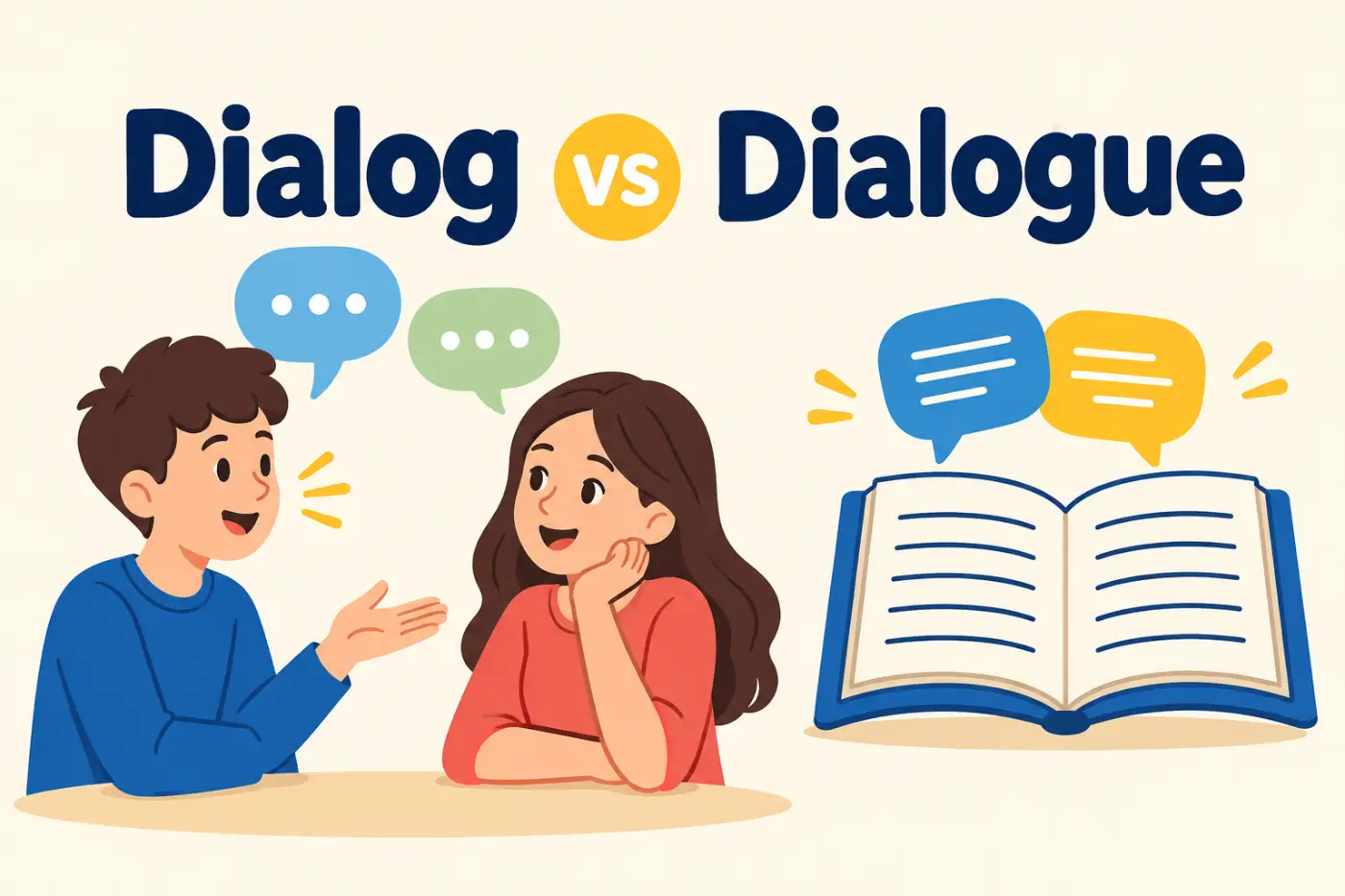
You type the word out, pause, and stare at those last two letters. Should you keep the “-ue” at the end, or chop it off? The choice between dialog vs dialogue trips up writers, students, and software teams every single day. Both spellings show up in major American dictionaries, and your spellchecker might accept both without flagging an error.
That makes the decision feel strangely stressful. Pick the wrong version in a novel, and an editor will mark it up with a red pen. Pick the wrong version in an app interface or coding guide, and a senior developer might raise an eyebrow. Worse yet, mixing both versions in the same piece makes your writing look sloppy.
The good news is that the rule is much simpler than most grammar books make it sound. In modern American English, the two spellings have split into two clear jobs. One handles human conversation, while the other handles computers and software screens.
In this guide, you will learn the exact rule for both spellings, where the split came from, and how major style guides treat each word. We will also walk through real-world sentence examples, regional differences between the US and the UK, common mistakes, and easy memory tricks so you get it right every time.
Quick Definition
Dialogue (with “-ue”) is the standard spelling for a spoken or written conversation between two or more people, such as lines in a book, movie, or serious discussion. Dialog (without “-ue”) is the standard American spelling used in computing and software design to describe a small pop-up window or box on a screen. Both words share the exact same root and pronunciation, but modern usage separates them by context.
Direct Answer
Use dialogue for human conversations, speeches, plays, novels, and diplomatic talks. Use dialog when writing about computer programs, user interfaces, pop-up boxes, and software menus in American English.
Comparison Table
| Word / Phrase | Meaning | Example Sentence | When to Use It |
|---|---|---|---|
| Dialogue | A spoken conversation between people, lines spoken by characters in a story, or an open exchange of ideas. | The movie had snappy dialogue that kept the audience laughing from start to finish. | Fiction, scripts, essays, journalism, speeches, and everyday conversations. |
| Dialog | A small pop-up window or box on a computer screen that asks the user for input or displays an alert. | Click “Save” in the dialog box before you close your browser tab. | Software manuals, app design, coding guides, and tech documentation (US English). |
| Dialogue (Verb) | To take part in an open discussion or conversation to resolve a problem or share views. | Community leaders met to dialogue about local school funding. | Formal discussions, politics, or group talks (though many editors prefer “talk” or “discuss”). |
| Dialog (Tech Variant) | A shortened form used in code tags, file names, and interface labels to save space. | Developers use the HTML <dialog> element to build clean pop-up modals. | Web development, programming languages, and UI component libraries. |

Dialog vs Dialogue: The Core Rule in US English
If you remember only one rule from this entire article, make it this one. Dialogue is for people, and dialog is for computers.
In American English, dialogue remains the default spelling for almost every kind of human communication. Whenever two characters argue in a novel, two politicians debate on television, or two neighbors chat over a fence, that is dialogue. It covers written scripts, stage plays, movie lines, podcast interviews, and peaceful talks between rival nations.
On the other hand, dialog took over the world of personal computers in the 1980s and 1990s. Software engineers and technical writers needed a clean, punchy word for those little boxes that pop up on your monitor to ask, “Are you sure you want to delete this file?” They dropped the silent “-ue” and called it a dialog box, or simply a dialog.
Today, that split is locked into professional American writing. If you write a short story and spell it “dialog,” your copy editor will change it to “dialogue.” If you write a user manual for a software company and spell it “dialogue box,” your technical editor will chop off the “-ue” and turn it into “dialog box.”
Both spellings are pronounced the exact same way: DYE-uh-lawg. You cannot hear the difference when someone says the word out loud. The difference exists purely on the page and on the screen.
Where the Two Spellings Come From
To understand why two spellings exist in the first place, we have to travel back more than two thousand years. Language rarely changes overnight, and this word has been on a long journey across three different languages.
Ancient Greek Roots
The word began in ancient Greece as dialogos. That Greek noun comes from two smaller parts: dia, meaning “across” or “between,” and logos, meaning “word,” “speech,” or “reason.” Put them together, and dialogos literally means “speaking across” or “a back-and-forth exchange of words.”
Notice that the ancient Greek word ended with a hard “g” sound followed by “-os.” There was no “-ue” anywhere near it. The ancient Greeks spelled it cleanly, much like the modern tech version.
The French Detour into English
From Greece, the word traveled into Latin as dialogus. Later, Old French speakers adopted it and reshaped the ending to fit French spelling habits. In French, a bare “g” at the end of a word could sound soft (like the “g” in mirage). To keep the “g” hard, French scribes added “-ue” to the end, creating the spelling dialogue.
When Norman French speakers invaded England in 1066, they brought thousands of French words into Middle English. Dialogue entered English around the 13th century, complete with its French “-ue” tail. For the next six hundred years, nearly everyone who wrote in English used that longer French spelling.
Noah Webster and American Spelling Reform
In the early 1800s, an American lexicographer named Noah Webster set out to simplify American spelling. Webster believed that words should look the way they sound. He hated silent letters left over from French and Latin, and he wanted the newly independent United States to have its own clear, practical spelling rules.
Webster succeeded with dozens of common words. Thanks to him, Americans write color instead of colour, center instead of centre, and defense instead of defence. He also targeted words ending in “-ogue,” arguing that the final “-ue” did zero work in pronunciation.
Webster pushed for shorter spellings like catalog, analog, prolog, and dialog. His dictionary listed these shorter forms, and American newspapers briefly experimented with them during the late 1800s and early 1900s. Major publications like the Chicago Tribune even adopted simplified spellings for several decades.
Why “Dialogue” Held On Until Computers Arrived
Despite Webster’s best efforts, everyday readers and book publishers resisted dropping the “-ue” from dialogue. While catalog caught on because stores printed millions of mail-order catalogs every year, dialogue stayed tied to literature, theater, and academic writing. Novelists and English teachers preferred the classic look of the longer word.
Then came the personal computer revolution. Early computer screens had tiny resolutions, strict memory limits, and narrow menu bars. Every single character counted when engineers wrote code or designed on-screen prompts.
Companies like Microsoft, Apple, and IBM needed short labels for their new graphical user interfaces. When engineers built pop-up windows that asked users for commands, they reached for Webster’s shorter spelling: dialog. It saved two characters of screen space, looked cleaner in code, and quickly became the global standard in software engineering.
When to Use “Dialogue” (With Real-World Examples)
Outside of software screens and programming code, dialogue is almost always the right choice. Let’s look at the main situations where you should keep the “-ue” at the end.
Spoken Conversations in Books, Plays, and Movies
Whenever characters speak out loud in a story, you are writing dialogue. In fiction, dialogue moves the plot forward, reveals what characters want, and shows how people relate to one another. Screenwriters, playwrights, and novelists rely on it to bring scenes to life.
Here are a few natural examples of how writers use the word in creative contexts:
- “Tarantino is famous for writing sharp, realistic dialogue about everyday topics.”
- “Good dialogue should sound like real people talking, not like characters reading from an encyclopedia.”
- “The play opens with ten minutes of silent physical comedy before a single line of dialogue is spoken.”
- “She struggled to format her dialogue properly when two characters interrupted each other.”
Notice how strange the shorter spelling would look in any of those sentences. Writing “Tarantino is famous for writing sharp dialog” looks like a typo to a trained reader.
Discussions Between People, Groups, or Nations
Beyond creative writing, dialogue also means a serious, constructive exchange of ideas. Diplomats, business leaders, teachers, and community groups use the word when they want to solve a problem through peaceful talk rather than conflict.
In this sense, the word carries a sense of openness and mutual respect. Two people having a monologue at each other are just talking past one another. Two people engaging in dialogue are actually listening and responding.
Look at how the word works in news articles, essays, and workplace writing:
- “World leaders called for open dialogue to prevent further trade disputes.”
- “The town hall meeting sparked an honest dialogue between parents and the school board.”
- “Healthy teams encourage constant dialogue between designers and engineers.”
- “The documentary aims to start a national dialogue about clean drinking water.”
In all of these cases, the focus is on human connection and shared understanding. Always keep the “-ue” when describing discussions like these.
Using “Dialogue” as a Verb
For centuries, dialogue worked strictly as a noun. You wrote dialogue, you heard dialogue, or you entered into a dialogue. Over the last few decades, however, business speakers, politicians, and nonprofits began using it as a verb meaning “to talk with someone to reach an agreement.”
For example, you might hear someone say:
- “Our department needs to dialogue with the marketing team before launching the new product.”
- “The two sides agreed to dialogue until they found a fair compromise.”
While you will see this in corporate emails and press releases, many traditional editors dislike using dialogue as a verb. They view it as clunky business jargon. If you want your writing to sound crisp and natural, replace the verb form with simpler words like talk, speak, discuss, or meet.
Instead of writing, “We need to dialogue about the budget,” try writing, “We need to talk about the budget.” Your reader will thank you.
Dialog vs Dialogue in Tech and Software
Step inside the world of software development, web design, or technical writing, and the rules flip completely. Here, dialog (without the “-ue”) is king.
Dialog Boxes, Pop-Ups, and Modal Windows
If you have ever used a Windows PC, a Mac, or a smartphone, you have interacted with thousands of dialogs. In computing, a dialog (often called a dialog box) is a small window that appears on top of the main screen to communicate information or ask you to make a choice.
For example, when you click “Print” in a word processor, a print dialog pops up so you can pick your printer and choose how many copies you want. When your battery drops to 10 percent, your phone displays a low-battery dialog warning you to plug in a charger.
Tech companies standardized the shorter spelling decades ago. Look at how technical documentation uses the word:
- “A confirmation dialog appears when you attempt to permanently delete a folder.”
- “Press the Escape key to dismiss the active dialog without saving your changes.”
- “Screen readers announce the title of a modal dialog as soon as it opens.”
- “Avoid stacking multiple dialogs on top of each other, as it confuses users.”
In web development, the World Wide Web Consortium (W3C) even built the short spelling directly into HTML5. Web developers use the <dialog> tag to create native pop-up windows and interactive alerts on websites. You cannot write <dialogue> in HTML—the browser simply will not recognize it as a valid tag.
User Interface (UI) Design and Microcopy
UX writers and interface designers live by strict character limits. Buttons, tooltips, error messages, and help docs need to be brief, scannable, and clear. Using dialog instead of dialogue saves space and keeps technical terms consistent across codebases and user guides.
Design systems from major tech companies explicitly enforce this rule:
- Google Material Design calls its pop-up components “Dialogs” (such as basic dialogs, full-screen dialogs, and alert dialogs).
- Microsoft Fluent UI uses “Dialog” for overlay windows that require user interaction.
- Apple Human Interface Guidelines historically favored “alerts” and “sheets,” while still using “dialog” when referring to standard system prompts like the Open and Save dialogs.
Because developers name their code files things like ConfirmDialog.js or SettingsDialog.swift, technical writers match that exact spelling in user guides and release notes. Keeping the same spelling in both the code and the documentation prevents confusion across the entire product team.
Video Games and Interactive Scripts: The Gray Area
Video games sit right at the crossroads of storytelling and software engineering, which creates an interesting puzzle for game writers. Which spelling belongs in a video game studio?
Most game studios solve this by splitting the two terms based on who is looking at them:
- The story and voice lines: When writers draft the script that voice actors read in a recording booth, they call it dialogue. A game’s narrative designer writes character dialogue, branching dialogue trees, and ambient NPC (non-player character) dialogue.
- The user interface and menus: When UI programmers build the pop-up boxes that tell players “Controller Disconnected” or “Overwrite Save Slot 1?”, they call those windows dialogs.
So inside the exact same game studio, a narrative script document will talk about “Act II dialogue,” while a UI bug ticket will talk about the “Pause menu dialog.” Each team follows the rule that fits its specific craft.
American English vs. British English Rules
Everything we have covered so far applies to American English. If you write for an audience in the United Kingdom, Australia, New Zealand, or South Africa, the rules look quite different.
British, Australian, and Canadian Usage
In British English, dialogue is the standard spelling for almost everything—including computers. British writers rarely drop the “-ue” at the end of “-ogue” words. In the UK, people browse a catalogue, check an analogue clock, read a prologue, and write dialogue.
When British technical writers describe a pop-up window on a computer screen, many still write dialogue box rather than dialog box. Major British publications, such as The Guardian and the BBC, stick firmly to dialogue across all sections of their websites.
However, American tech companies dominate global software standards. Because programming languages, HTML tags (<dialog>), and developer frameworks like React and Android are built in the United States, British software developers still type dialog when writing code. Outside of raw code, though, British prose strongly favors dialogue.
Canadian English sits right in the middle of the Atlantic on this issue. Canadian writers generally follow British spelling for words like colour and centre, so dialogue is standard in Canadian books, newspapers, and government documents. At the same time, Canadian tech companies follow American tech style and use dialog for software interfaces.
Here is a quick breakdown by region:
- United States: Use dialogue for speech and writing; use dialog for software and computing.
- United Kingdom & Australia: Use dialogue for speech, writing, and general prose; dialog appears mostly inside programming code and American software docs.
- Canada: Use dialogue in general writing and journalism; use dialog in tech and software interfaces.
What Major Style Guides Say
Professional editors do not guess when it comes to tricky spellings. They rely on official style guides to keep publications consistent. Let’s look at what the top American style manuals say about these two words.
The Associated Press (AP) Stylebook
The AP Stylebook is the gold standard for newspapers, magazines, PR teams, and online news sites across the United States. AP style is famous for preferring shorter, cleaner spellings whenever possible. For example, AP uses catalog instead of catalogue.
Yet even the AP Stylebook draws the line here. AP instructs journalists to spell it dialogue in all standard news stories, quotes, and feature articles. The only exception is when writing specifically about computer interfaces, where dialog box is accepted.
The Chicago Manual of Style (CMOS)
Book publishers, universities, and long-form magazines follow The Chicago Manual of Style. Chicago style leans toward traditional, literary spellings. It strongly prefers dialogue for all human speech, literary analysis, and essays.
While Chicago acknowledges that dialog exists as an accepted variant in American dictionaries, it advises editors to stick with dialogue in general prose and reserve dialog strictly for computing contexts.
Microsoft Writing Style Guide and Apple Style Guide
When you switch from publishing guides to tech style guides, the advice flips 180 degrees.
The Microsoft Writing Style Guide explicitly instructs writers to use dialog (or dialog box) when referring to secondary UI windows that require user action. It tells writers never to use the “-ue” spelling when describing Windows components.
Similarly, the Google Developer Documentation Style Guide requires dialog (never dialogue) when documenting user interfaces, modals, and alerts across Android, Chrome, and Google Cloud products.
Common Mistakes Writers Make (And How to Fix Them)
Even when you know the basic rule, it is easy to slip up when you are writing fast. Here are the five most common mistakes people make with these two words, along with quick ways to fix each one.
Mistake 1: Mixing Both Spellings in the Same Document
The single biggest error is switching back and forth between dialog and dialogue within the same article, report, or slide deck. Maybe you started writing in the morning using one spelling, and after lunch, you typed the other spelling without noticing.
How to fix it: Before you hit publish, press Ctrl + F (or Cmd + F on a Mac) and search your document for dialog. Check every single match. Make sure every instance follows the same rule unless you are genuinely talking about both human speech and software pop-ups in the same piece.
Mistake 2: Using “Dialog” in Fiction or School Essays
Some students see “dialog” on their computer screens all day and assume it is the modern, updated spelling for everything. They turn in an English essay analyzing “Shakespeare’s clever dialog” or submit a short story with “realistic dialog.”
Teachers and literary editors almost always mark this as a spelling error. Even though dictionaries list dialog as a variant, academic and creative writing fields expect dialogue.
How to fix it: Whenever you are writing for school, books, blogs, or journalism, keep the “-ue” at the end. Save the short version strictly for tech topics.
Mistake 3: Writing “Dialogue Box” in Tech Docs
On the flip side, writers who come from a journalism or English background often bring their literary habits into tech jobs. They write help articles telling users to “click OK in the dialogue box.”
To a software engineer or experienced UX designer, “dialogue box” looks dated and out of place. It signals that the writer is unfamiliar with standard tech terminology.
How to fix it: Drop the “-ue” whenever you write about software menus, pop-up alerts, or code elements. Write dialog box or alert dialog.
Mistake 4: Confusing “Dialogue” with “Monologue” or “Soliloquy”
Sometimes the mistake is not about spelling—it is about picking the wrong word entirely. People occasionally use dialogue when only one person is speaking.
Remember the Greek prefix dia-, which means “across” or “between.” A dialogue requires at least two participants exchanging ideas. If only one person is talking, you need a different word:
- Monologue: A long speech given by one person, either to other characters in a scene or directly to an audience (like a late-night TV host’s opening monologue).
- Soliloquy: A speech in a play where a character speaks their inner thoughts aloud while alone on stage, unaware that anyone is listening (like Hamlet’s “To be, or not to be” speech).
How to fix it: Count the speakers. Two or more speakers equals dialogue. One speaker talking to others equals monologue. One speaker talking to themselves equals soliloquy.
Mistake 5: Misspelling Derived Forms
What happens when you add endings like -ing, -ed, or -ist to these words? Adding suffixes trips up even experienced editors.
Here is how the endings work in US English:
- Plural noun: Add an “s” to whichever base spelling you are using. Human conversations become dialogues (“The book features witty dialogues”). Software windows become dialogs (“Close all open dialogs”).
- Present participle (-ing): If you use the verb form, dialoguing is the traditional spelling, while dialoging is the shortened American variant. Again, most editors recommend avoiding both and simply writing talking or discussing.
- Past tense (-ed): Dialogued is the standard spelling, with dialoged as a rare variant.
- Person who speaks in a dialogue: A person who takes part in a dialogue is a dialogist (notice that the “-ue” drops before “-ist” in both US and UK English).
Easy Memory Tricks That Stick
You do not need to memorize dictionary entries to keep these two spellings straight. Use any of these three simple memory tricks next time you hesitate at your keyboard.
Trick 1: “UE” Stands for “Uttered Expression”
Look at the last two letters of dialogue: U-E. Connect those two letters to the phrase Uttered Expression.
Human speech is an uttered expression—words spoken out loud by living, breathing people. A computer screen cannot utter anything on its own. So if the words come from a human mouth or pen, keep the U-E for Uttered Expression.
Trick 2: Shorter Word = Smaller Screen
Think about the physical size of a pop-up box on your laptop or phone. A pop-up window is small, cramped, and compact. Every inch of space matters.
Because a pop-up box is compact, it uses the compact spelling: dialog. Human conversations, on the other hand, have plenty of room to breathe, stretch out, and explore big ideas—so they get the longer spelling: dialogue.
Trick 3: Compare It to “Catalog” vs. “Epilogue”
If you still feel unsure, think about how other “-ogue” words behave in everyday American writing. You rarely see a movie poster boast about an “exciting prolog,” and nobody praises the moving “epilog” at the end of a novel. Story words keep their “-ue” tail.
Meanwhile, technical and commercial words like catalog and analog dropped their tails to feel sleek and functional. Dialog belongs right alongside catalog and analog in the practical, technical bucket, while dialogue stays with prologue and epilogue in the storytelling bucket.

Related Word Pairs with “-ogue” and “-og”
The tension between dialog and dialogue is part of a much larger pattern in English spelling. Dozens of English words entered the language from French with an “-ogue” ending, and American English has treated each one differently over the last two hundred years.
Understanding these cousin words will make you a sharper, more confident speller overall. Let’s look at the most common “-ogue” and “-og” pairs and see which spelling wins in US English today.
Catalog vs. Catalogue
Unlike dialogue, the short spelling catalog won a complete victory in the United States. Whether you are talking about a printed clothing catalog, a library card catalog, or cataloging items in a warehouse, catalog is the standard American spelling.
In the UK, Australia, and Canada, catalogue remains the standard spelling. In the US, you will usually only see catalogue in the names of older institutions, art galleries, or fancy museum publications.
Analog vs. Analogue
Both spellings appear in American English, though they often split by context—much like dialog and dialogue.
- Analog (without “-ue”) is the standard spelling in electronics, music, and computing. Think of an analog clock, analog synthesizer, analog signal, or analog stick on a video game controller.
- Analogue (with “-ue”) frequently shows up in science, chemistry, and formal writing when describing something that is similar or comparable to something else (“Scientists created a synthetic analogue of the rare compound”). However, analog is also accepted in that sense in US English.
Prologue vs. Prolog
In books, plays, and movies, prologue is the overwhelming favorite in both American and British English. A prologue is an introductory section that sets the stage before Chapter 1 begins.
Where does prolog show up? You guessed it in computer science! Prolog (short for Programming in Logic) is a famous artificial intelligence programming language created in the 1970s. Outside of that programming language, always write prologue.
Epilogue vs. Epilog
Just like prologue, epilogue keeps its “-ue” in nearly all American and British writing. An epilogue is the concluding section at the end of a book or film that shows what happens to the characters later on. While American dictionaries list epilog as a secondary variant, almost no major publisher uses it.
Monologue vs. Monolog
A monologue is a long speech delivered by a single actor or comedian. Even though Noah Webster tried to push monolog, the shorter version never caught on. Always use monologue in essays, theater reviews, and everyday writing.
Demagogue vs. Demagog
A demagogue is a political leader who seeks support by appealing to popular desires and prejudices rather than using rational argument. In American journalism and history books, demagogue is the standard spelling, though demagog occasionally appears in older newspaper archives.
Synagogue vs. Synagog
A synagogue is a Jewish house of worship and community center. Both American and British English use synagogue almost exclusively. The shortened form synagog is considered outdated and rarely appears in modern print.
Pedagog vs. Pedagogue
A pedagogue is a teacher, especially one who is strict or formal. Like synagogue and demagogue, the longer French spelling pedagogue remains standard across the English-speaking world.
FAQs
Is dialog vs dialogue a US vs UK spelling difference?
Partly, yes. In the United Kingdom, Australia, and Canada, dialogue is used for almost everything, including computer interfaces. In the United States, writers use dialogue for human speech and dialog specifically for computing and software pop-ups.
Is “dialog” ever correct in American English?
Yes, dialog is completely correct in American English when you are writing about computers, software, user interfaces, or programming. Major tech companies like Microsoft, Google, and Apple use dialog (and dialog box) in all their official guides and codebases.
Which spelling should I use in a novel or screenplay?
Always use dialogue when writing fiction, stage plays, movie scripts, or essays about literature. Editors, teachers, and publishers treat the shorter spelling as a mistake in creative and academic writing.
Why does HTML use <dialog> instead of <dialogue>?
Web standards were developed largely in the United States, where dialog was already the standard computing term for pop-up windows. Using the shorter spelling also saves two characters in code and matches the naming conventions used in Windows, Mac, and Android software design.
Can I use “dialogue” as a verb?
You can, as in “Leaders met to dialogue about the issue,” and many dictionaries list it as a valid verb. However, most style guides and editors consider it clunky corporate jargon and recommend using simpler verbs like talk, speak, or discuss instead.
How do you spell the plural of both words?
Simply add an “s” to the end of whichever base word you are using. Human conversations become dialogues, while multiple pop-up windows on a computer screen become dialogs.
Do “dialog” and “dialogue” sound different when spoken?
No, both spellings are pronounced identically: DYE-uh-lawg. The silent “-ue” at the end of dialogue does not change the pronunciation at all.
Conclusion
Once you know the split between dialog vs dialogue, you can pick the right word in seconds. English spelling has plenty of weird traps, but this one actually follows a clean, logical divide. One spelling belongs to human voices, stories, and conversations, while the other belongs to the digital screens we tap and click every day.
Keep dialogue on hand whenever people are talking, debating, or exchanging ideas—whether on the page of a novel, on a theater stage, or around a conference table. Switch to dialog the moment you step into the world of software menus, pop-up alerts, user guides, and HTML tags.
Before you send off your next draft, take five seconds to scan your page for consistency. Match the spelling to your audience, stick to one choice from start to finish, and write with confidence.

Dr. Elena Vance holds a Ph.D. in Linguistics from Columbia University and has spent over 15 years analyzing the evolution of the English language. A former university professor turned full-time writer and editor, Elena specializes in breaking down high-level grammatical concepts, punctuation nuances, and style guides (APA, Chicago, MLA) into clear, actionable advice. When she isn’t hunting down dangling modifiers, she can be found collecting vintage dictionaries and reading classic literature.