
If you’ve ever paused over definately or definitely you’re dealing with one of the most common spelling mistakes in English. The correct spelling is definitely. The spelling definately is incorrect.
The confusion usually comes from the middle of the word. When people say the word aloud they may hear a sound that makes the spelling seem like it should contain a. English pronunciation can be tricky like that. In writing the correct form always uses i in the middle and ends with ly.
Once you know where the word comes from and how to break it into smaller parts the spelling becomes much easier to remember. You’ll also see how to use it naturally in sentences and how it differs from words such as certainly and surely.
Quick Definition
Definitely is an adverb that means certainly or without doubt. You can use it when you feel sure that something is true or that something will happen.
Definately is not a correct English spelling. It is a common misspelling of definitely.
Direct Answer
The correct spelling is definitely. Definately is incorrect and should not be used in standard English writing.
Comparison Table
| Word or spelling | Meaning | Example sentence | When to use it |
|---|---|---|---|
| Definitely | Certainly or without doubt. | I will definitely call you tomorrow. | Use this spelling in all normal English writing. |
| Definately | No standard English meaning. | This spelling is incorrect. | Do not use it. |
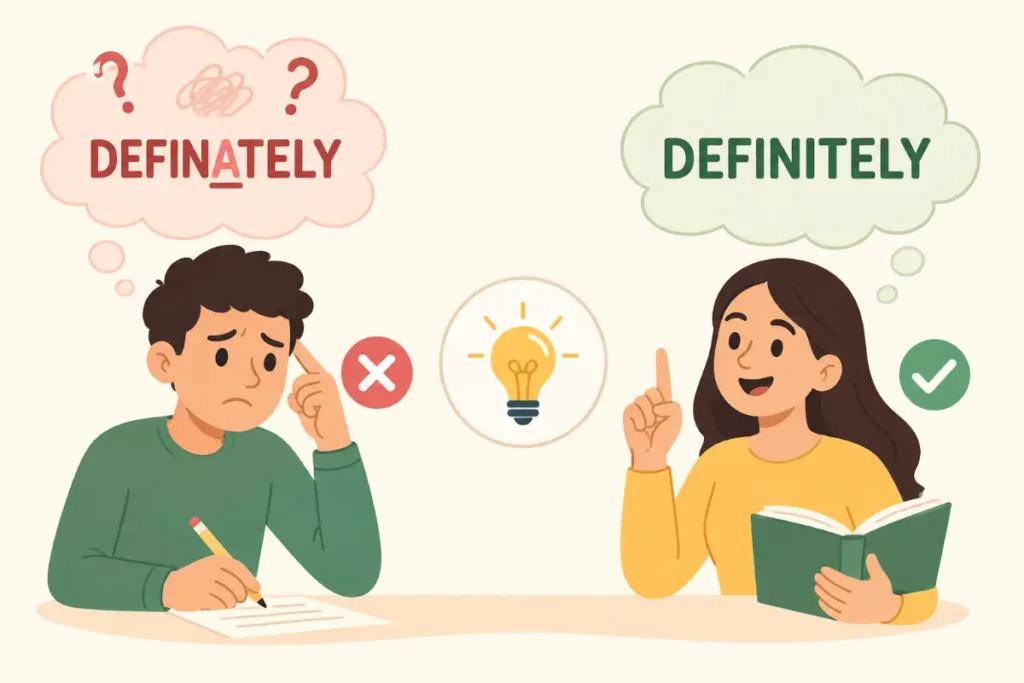
Why People Spell Definitely Wrong
The spelling of definitely causes trouble because the way we pronounce it does not make every letter easy to hear. When you say the word quickly the middle part can sound less clear than it looks on the page.
There is another reason for the mistake. People often connect the word with definite but then add the ending incorrectly. The adjective is definite and the adverb is definitely. The spelling changes slightly when the adverb ending is added.
Think of the word as a small chain.
Definite + ly = definitely.
The final e in definite is dropped before ly is added. That gives you definitely rather than a spelling based on how the word sounds.
This is one of those words that becomes easier once you stop trying to spell it from pronunciation alone. Look at its base word instead.
The Rule Behind Definitely
The best way to understand the spelling is to start with definite. The word definite means clear certain or clearly defined.
For example:
- We need a definite answer before Friday.
- She gave me a definite time for the meeting.
- There is no definite proof that the plan will work.
When you turn definite into an adverb you add ly. The final e is removed.
Definite + ly = definitely.
That gives us the correct spelling.
The important part to remember is the middle of the word. The correct form contains finite.
Definitely.
If you can remember finite inside the word you have a useful spelling clue. The incorrect version often appears because people replace the i with a.
A Simple Memory Trick
One of the easiest ways to remember the spelling is to look for the word finite inside definitely.
You can see it here:
de + finite + ly
The word finite means limited or having an end. It is not the meaning of definitely but it gives you a useful spelling pattern.
When you write the word remember this phrase:
Definitely has finite in it.
That small trick can save you from making the same mistake again.
Another useful method is to connect the word with definite. If you know how to spell definite then adding ly gives you the correct adverb.
- Definite.
- Definitely.
The two words belong together. Learning them as a pair is much easier than trying to memorize the longer word by itself.
What Does Definitely Mean
Definitely means certainly or without doubt. It shows that the speaker feels very sure about something.
For example:
- I definitely want to visit New York someday.
- She will definitely be there tonight.
- That is definitely the right answer.
In each sentence the speaker is expressing strong confidence.
- You can also use definitely to give a strong yes.
- Someone might ask:
- Are you coming to the party?
- You could answer:
- Definitely.
That one word tells the other person that you are certain about your answer.
The word can also strengthen a statement.
- This is definitely worth trying.
- He definitely knows what happened.
- We definitely need more time.
The strength of the word depends on the context. It often sounds more confident than simply saying probably or maybe.
Definitely In Everyday Conversation
People use this word constantly in normal speech. It can show agreement confidence or certainty.
- Imagine a friend asks:
- Do you want to get coffee?
- You might say:
- Definitely.
That sounds friendly and confident. You are not simply saying that coffee sounds possible. You are saying that you are sure you want to go.
- You might also say:
- I definitely need a break.
Here the word adds emphasis. The speaker strongly believes a break is needed.
Another example is:
- She definitely told me about the meeting.
- The speaker is confident that the conversation happened.
Because definitely is common in everyday speech it appears often in texts emails social media posts and casual conversations. That makes correct spelling especially useful.
Definitely In Formal Writing
Definitely works in both casual and formal writing. You can use it in an email to a friend or in a professional document.
For example:
- We definitely need to review the contract before signing it.
- The results definitely support the main point.
- The company will definitely benefit from the change.
Still, use the word with care in formal writing. Definitely expresses strong certainty. If the evidence is weak then a softer word may be more accurate.
For example, saying something will definitely happen makes a strong claim. If you only think it is likely then probably may be a better choice.
Good writing is not only about correct spelling. It is also about choosing words that match what you actually know.
Definitely Compared With Certainly
Definitely and certainly are close in meaning. Both can show strong confidence.
You could say:
- I will definitely help you.
- I will certainly help you.
Both sentences tell the reader that the speaker intends to help.
The difference is mostly one of tone and style. Definitely often sounds more conversational and direct. Certainly can sound a little more formal depending on the sentence.
For everyday American English both words are useful.
Definitely Compared With Surely
Surely can also express confidence but it often carries a different feeling. Consider these sentences:
- She will definitely arrive on time.
- Surely she will arrive on time.
The first sentence is a direct statement of confidence. The second can sound like the speaker expects the listener to agree.
Surely can also express surprise.
- Surely you’re not leaving already.
That sentence does not simply state a fact. It shows that the speaker finds the situation surprising. Definitely is more direct when you simply want to say that you are certain.
Definitely Compared With Probably
Definitely and probably should not be treated as interchangeable.
Definitely means you feel certain.
Probably means you think something is likely but you are not completely sure.
Compare these examples:
- I will definitely finish the project today.
- I will probably finish the project today.
The first sentence gives a strong promise or prediction. The second leaves room for something to change.
This difference matters in professional writing. If you are not completely certain about an event then definitely may make your statement sound stronger than your evidence supports.
Definitely Compared With Really
Really is another common word that sometimes appears in similar sentences. The two words do different jobs.
Really can add emphasis or show that something is true.
- I really like this restaurant.
Definitely shows certainty.
- I definitely want to come back.
You can use both in the same sentence.
- I really like this restaurant and I’ll definitely come back.
Here really strengthens the speaker’s feeling while definitely shows certainty about the future action.
Common Sentences With Definitely
The best way to become comfortable with a word is to see it used naturally. These examples show several common patterns.
Showing Strong Agreement
- I definitely agree with you.
- That is definitely a good idea.
- We should definitely try that restaurant.
In these sentences definitely adds strong agreement.
Showing Certainty
- She definitely knows the answer.
- They definitely saw the accident.
- He definitely remembers your name.
The speaker is confident that the statement is true.
Making A Strong Plan
- I’ll definitely call you later.
- We’re definitely going to the game.
- She’ll definitely join us for dinner.
These examples show confidence about a future action.
Giving A Strong Opinion
- That was definitely the best part of the movie.
- This is definitely the easiest way to do it.
- He is definitely the right person for the job.
The speaker is making a strong judgment.
Common Mistakes With Definitely
Spelling mistakes usually happen in predictable ways. Once you know the common errors you can spot them more easily.
Using A Instead Of I
The most common mistake is writing definately. The middle vowel should be i.
Correct:
- I definitely remember.
Incorrect:
- I definately remember.
The incorrect spelling looks believable because the word’s pronunciation does not make the middle vowel obvious. Still, standard English uses i.
Forgetting The Second I
Some people write forms such as definitly. This happens when they remember the general shape of the word but leave out a letter.
The correct spelling is:
definitely
There is an i after the n and another i before the final ly.
Adding An Extra E
Another mistake is carrying the final e from definite into the longer form.
The adjective is:
definite
The adverb is:
definitely
When ly is added the final e is removed.
Confusing Spelling With Pronunciation
Trying to spell definitely only by listening can lead you in the wrong direction. The spoken word does not clearly reveal every letter.
A better approach is to connect it with the base word definite and remember the spelling pattern.
Is Definitely An Adverb
Yes. Definitely is an adverb.
An adverb can describe or strengthen a verb adjective or another adverb. In this case definitely often tells us how certain someone is about an action or statement.
For example:
- I definitely agree.
The word definitely adds information about the speaker’s level of certainty.
You can also place it in different parts of a sentence.
- I definitely want to go.
- She will definitely call later.
- They definitely made the right choice.
The placement can change slightly depending on the sentence but the basic meaning stays the same.
Where To Put Definitely In A Sentence
There is no single position that works in every sentence. In everyday English the word often appears before the main verb.
For example:
- I definitely like this book.
- She definitely knows the answer.
- They definitely need more time.
When the sentence uses an auxiliary verb such as will or can the word often comes after that helping verb.
- I will definitely call you.
- She can definitely help us.
- They have definitely finished the work.
These patterns sound natural in American English.
You can also use definitely at the beginning of a sentence when you want to make a strong response.
- Definitely, I would recommend it.
In casual conversation you may simply say:
- Definitely.
That works as a complete response when the context is clear.
Can Definitely Start A Sentence
Yes. Definitely can start a sentence.
For example:
- Definitely, you should see that movie.
- Definitely, we need to talk about this.
- Definitely, that was the right decision.
Starting with the word can make the response sound confident and direct. In casual writing the comma after definitely is common when it acts as an introductory word.
You can also avoid the comma by putting the word in a different position.
- You should definitely see that movie.
That version is especially natural in everyday American English.
Definitely And Definite
These words are closely related but they have different grammatical jobs.
Definite is an adjective. It describes a noun.
- We need a definite answer.
- She gave me a definite date.
- There is a definite reason for the change.
Definitely is an adverb. It usually describes the speaker’s certainty about a statement or action.
- I definitely know the answer.
- She definitely wants to come.
- They will definitely arrive soon.
A useful memory trick is simple.
Definite describes. Definitely confirms.
That is not a complete grammar rule but it can help you remember the difference.
Definitely And Definition
Definition is another related word that can cause confusion because it begins with the same letters.
A definition explains what a word or idea means.
For example:
- The dictionary gives a clear definition of the word.
Definite means clear or certain.
- We need a definite answer.
Definitely means certainly.
- I definitely agree.
These words share a common root but they do not have the same meaning. Learning the family together can make each one easier to recognize.
The History Behind The Spelling
You do not need to know the history of a word to spell it correctly. Still, a little background can explain why English spelling sometimes looks less predictable than pronunciation.
Definitely comes from the adjective definite, which traces back through French and Latin. The Latin word definitus is connected with the idea of setting limits or defining something clearly.
That history helps explain the relationship between words such as definite, definitely and definition. They belong to the same word family and carry related ideas of clarity and certainty.
English has borrowed thousands of words from other languages. Many kept spelling patterns that came from their earlier forms. That is one reason modern English can have spellings that do not perfectly match modern pronunciation.
You do not need to memorize any of this to write the word correctly. The useful point is that definitely is built from definite rather than from the way the word sounds.
A Better Way To Memorize The Spelling
If the spelling keeps slipping from your memory try using a visual trick.
Write the word like this:
DEFINITE + LY
Then remove the final e.
You get:
DEFINITELY
Now focus on the middle:
FINITE
That gives you a strong visual anchor.
Another helpful trick is to say the phrase definite ly silently while you type. You are not trying to copy the pronunciation. You are reminding yourself that the longer word comes from definite.
After enough practice you will not need the trick. The correct spelling will simply look right.
A Quick Spelling Practice
Try completing these sentences with the correct form.
- I will ______ call you tomorrow.
- She ______ knows what happened.
- We should ______ check the address.
- He is ______ coming to the party.
- The correct answer in every sentence is definitely.
You can make the exercise harder by writing your own sentences. Try using the word in a statement about your plans your opinions and something you know for certain.
For example:
- I definitely want to learn Spanish.
- That was definitely the funniest part.
- She will definitely remember this day.
Using the word in different situations helps build stronger memory.
When Definitely Is Too Strong
Correct spelling does not automatically make a sentence accurate. You also need to think about the strength of the word.
Definitely means you are certain. If you have only a guess then another word may fit better.
Compare these statements:
- The package will definitely arrive tomorrow.
- The package will probably arrive tomorrow.
- The package might arrive tomorrow.
Each sentence shows a different level of confidence.
The first gives a very strong statement. The second says the event is likely. The third leaves the most room for doubt.
This distinction matters in professional communication. If a customer asks when an order will arrive you should not promise a definite result unless you have good reason to be certain.
Strong words work best when your evidence supports them.
How Definitely Works In Professional Emails
You will often see this word in workplace communication. It can make a response sound confident and positive.
For example:
- I’ll definitely send the updated file this afternoon.
- We should definitely review the numbers before the meeting.
- I definitely agree with your suggestion.
It can also be useful when confirming a plan.
- Yes, I’ll definitely be there at nine.
Still, avoid using strong certainty when you cannot guarantee something. If a project depends on several outside factors you may want to say probably or I expect instead.
Good professional writing should sound confident without making promises you cannot keep.
How Definitely Works In School Writing
Students often use definitely in essays assignments and answers when they want to make a strong point.
For example:
- This event definitely changed the course of the story.
- The evidence definitely supports the main argument.
- The character definitely regrets his decision.
The word can work well but it should support a clear reason. If you say something definitely happened then your writing should explain why you are confident. For example:
The evidence definitely supports the claim because three independent sources report the same result.
That is stronger than simply using definitely without explanation.
Words That Sound Similar But Mean Different Things
English has many words that look or sound similar while serving different purposes. Knowing the differences can improve both spelling and word choice.
Definitely And Defiantly
These two words are especially easy to confuse because they look similar.
Definitely means certainly.
- I will definitely help you.
Defiantly means in a way that shows open resistance or refusal to obey.
- The child defiantly refused to leave the room.
The meanings are completely different. A spelling mistake between these words can change the meaning of a sentence.
Definitely And Definitively
Definitively means in a final or conclusive way.
- The study did not definitively prove the theory.
Definitely means certainly.
- I definitely agree with the study.
The two words are related but they are not interchangeable.
Definitely And Decidedly
Decidedly means clearly or noticeably.
- The weather was decidedly colder today.
Definitely means certainly.
- I definitely prefer the first option.
These words can sometimes appear in similar contexts but they express different ideas.
How To Proofread For This Mistake
A quick proofreading routine can catch this error before you publish or send your writing.
First search for the common incorrect spelling if you are working on a long document. Modern word processors can usually help with this. If you find it then replace it with the correct form.
Next look at the word itself rather than trusting the red underline from your software. Spell check is useful but it should not be your only method.
Finally connect the spelling with definite. Ask yourself if the word contains the same base.
Definite becomes definitely.
That simple check takes only a second.
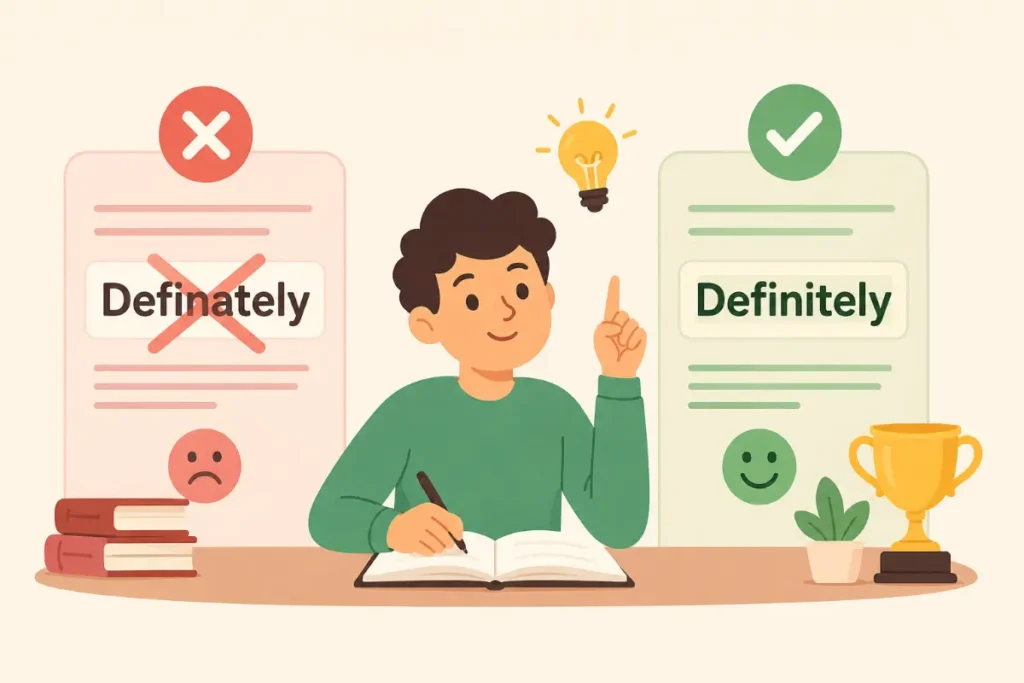
Why Correct Spelling Matters
A single spelling mistake does not make someone a bad writer. Everyone makes errors. Fast typing tiredness and unfamiliar words can all lead to mistakes.
Still, correct spelling makes your writing easier to trust. Readers should be able to focus on your message instead of stopping to wonder if a common word has been spelled correctly.
This matters even more in professional writing. A job application business email report or website article represents your attention to detail. Small errors can distract from otherwise strong work.
The good news is that this particular mistake is easy to fix. Once you remember finite inside the word you have a reliable clue for the correct spelling.
FAQs
Is definately or definitely correct?
The correct spelling is definitely. The form definately is a common spelling mistake and is not accepted as the standard spelling. Remember that the correct word contains finite in the middle.
Why is definitely so hard to spell?
The pronunciation does not clearly show every letter in the word. The middle vowel can sound less clear when people say the word quickly. Connecting it with definite makes the spelling easier to remember.
Is definately a word?
No. Definately is not the standard English spelling of a word. It is a common misspelling of definitely.
What is the easiest way to remember definitely?
Remember the word finite inside definitely. You can also start with definite and add ly after removing the final e.
What does definitely mean?
Definitely means certainly or without doubt. It shows that the speaker feels very sure about a statement or action.
Is definitely formal or informal?
Definitely works in both casual and formal English. You can use it in conversations emails school writing and professional documents. Just make sure the level of certainty matches the facts.
What is the difference between definite and definitely?
Definite is an adjective that describes something as clear or certain. Definitely is an adverb that shows certainty about an action or statement. For example you can have a definite answer and definitely know that answer.
Can definitely be used by itself?
Yes. Definitely can work as a one word answer when the context is clear. If someone asks if you want to join them for dinner you can simply say definitely to show strong agreement.
Conclusion
If you’re choosing between definately or definitely the answer is simple. Definitely is the correct spelling and definately is a misspelling. The correct form contains finite in the middle and ends with ly.
The easiest way to remember it is to start with definite. Remove the final e and add ly. You get definitely. That connection is much more reliable than trying to spell the word from its pronunciation.
Remember that definitely means certainly or without doubt. Use it when you want to show strong confidence in a statement or action. If you are only making a likely guess then probably or possibly may be a better choice.
The next time you stop over the spelling take a quick look at the middle of the word. Finite is hiding inside definitely. Once that pattern sticks in your mind you’ll have a simple way to spell the word correctly every time.

Sienna Watson is a veteran copywriter and communications coach who has helped startup founders, marketers, and professionals polish their writing for over a decade. Realizing that most people don’t need a degree in linguistics—just clear, impactful communication—Sienna focuses on practical grammar, business writing etiquette, and eliminating wordiness. She advocates for plain language, strong verbs, and persuasive prose that gets results.