
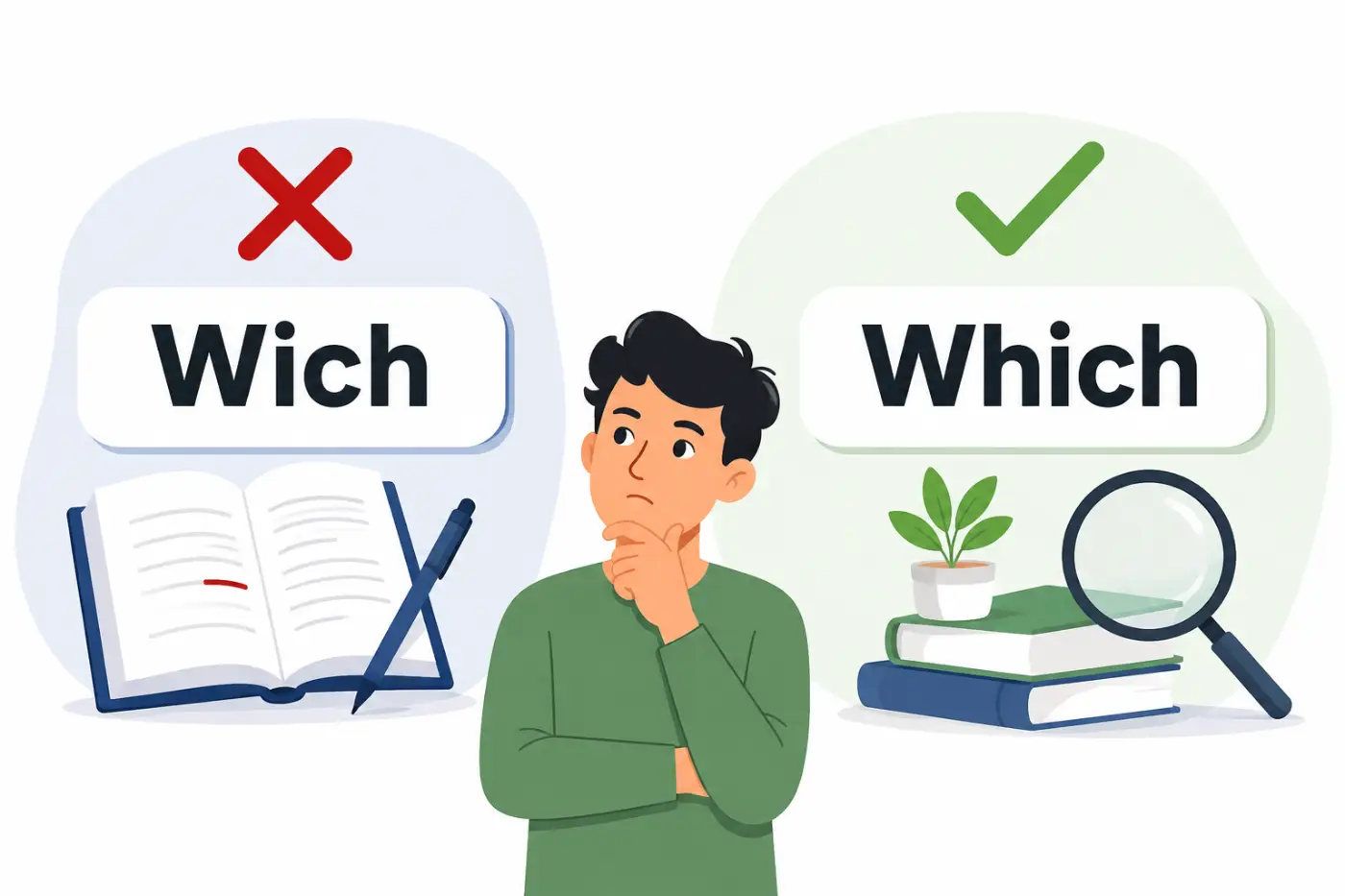
If you’re searching for wich or which the answer is simple. Which is the correct English spelling. Wich is not normally used as a standalone English word.
The confusion comes from pronunciation. In many sentences which sounds like a short word with a soft ending. When people hear it or type quickly they may leave out the letter h. That creates the common misspelling wich.
The correct word is useful far beyond one simple spelling question. Which can help you ask about a choice identify one thing from a group and add extra information to a sentence. Once you understand how it works you can use it naturally in questions and statements.
This guide explains the spelling the meaning the grammar and the common mistakes that cause confusion. You’ll also see simple examples that show exactly how to use the word in everyday American English.
Quick Definition
Which is a pronoun or determiner used when someone is choosing or identifying one or more things from a group. It can also introduce extra information about something already mentioned.
Wich is generally a misspelling of which. In standard English writing you should use which.
Direct Answer
Which is the correct spelling. Wich is normally incorrect when you mean the common English word used for asking about a choice or identifying something.
Comparison Table
| Word or spelling | Meaning | Example sentence | When to use it |
|---|---|---|---|
| Which | Used to ask about a choice or identify something from a group. | Which jacket do you like best. | Use it in questions and many descriptive sentences. |
| Wich | Not normally a standard standalone English word. | I don’t know wich one to choose. | Do not use it as a spelling of which. |
Why People Confuse Which And Wich
The missing h seems like a tiny mistake but it changes the spelling of the entire word. When you’re typing quickly the letters can disappear without you noticing. This happens often because the word is short and familiar.
Pronunciation can also play a role. In many American accents which sounds very close to witch. Some speakers pronounce the beginning with a slight difference while others pronounce the two words almost exactly the same. That means sound alone isn’t a reliable way to remember the spelling.
Think about the word visually instead. The correct form has four letters.
W H I C H
The first h is easy to forget. A useful memory trick is to connect which with another familiar wh question word such as what, when, where, or who. These words all begin with wh.
Once you remember that pattern the spelling becomes much easier to recognize.
What Does Which Mean
Which usually helps you choose or identify something from a limited group. It can refer to people animals objects ideas places or actions depending on the sentence.
For example:
- Which color do you prefer.
- Which restaurant should we try.
- Which book belongs to you.
- Which road leads to the airport.
In each question the speaker has a group of possible answers in mind. The listener needs to identify one of them.
You can think of which as a word that points toward a choice. If someone asks which shirt you want they aren’t asking you to name any shirt in the world. They usually have a few shirts in mind and want you to select one.
That small distinction becomes useful when you compare which with what.
Which And What
Which and what can both appear in questions. They don’t always mean exactly the same thing.
Use which when the choices are limited or known.
- Which movie do you want to watch.
- Which dessert would you like.
- Which bus goes downtown.
Use what when the possible answers are more open.
- What movie do you want to watch.
- What dessert do you like.
- What do you want to eat.
The difference isn’t always strict in casual American English. Speakers sometimes use what even when a smaller group of choices exists. Still, which often gives the listener a clearer sense that the options are limited.
- Imagine that you’re standing in front of two jackets.
- You might ask, Which jacket should I buy.
- If you’re shopping online and haven’t decided on a style at all you might ask, What jacket should I buy.
The first question points to a known set of choices. The second leaves the possibilities much wider.
How Which Works In A Sentence
The word can play different grammar roles. You don’t need to memorize complicated grammar terms to use it correctly. It helps to understand the two most common jobs.
Which Before A Noun
When which comes directly before a noun it helps identify a specific choice.
Examples include:
- Which phone do you use.
- Which class are you taking.
- Which city do you live in.
- Which answer is correct.
Here which tells the reader or listener that a choice or identification is coming next.
You can also use it with plural nouns.
- Which shoes are yours.
- Which books should I pack.
- Which cookies do you want.
The noun can be singular or plural. The basic purpose stays the same.
Which As A Pronoun
Sometimes which stands on its own instead of appearing directly before a noun.
For example:
- I have two options. Which should I choose.
- There are three trains. Which arrives first.
- You can pick either one. Which do you prefer.
In these sentences the noun doesn’t need to be repeated because everyone already knows what the choices are.
That makes the sentence shorter and more natural.
Which In Everyday Questions
You’ll hear and read which constantly in everyday American English. It appears in casual conversations just as often as it appears in formal writing.
A friend might ask:
- Which one do you want.
- Which shoes look better.
- Which route should we take.
- Which day works best for you.
A teacher might ask:
- Which answer did you choose.
- Which chapter are you reading.
- Which example supports your idea.
At work someone might ask:
- Which file should I send.
- Which meeting are you attending.
- Which version do you want me to use.
The word doesn’t sound formal or old fashioned. It’s a normal part of everyday English.
The Spelling Pattern To Remember
The easiest way to remember the spelling is to focus on the beginning.
Which starts with wh.
The same opening appears in several common question words.
- What.
- When.
- Where.
- Who.
- Whose.
- Why.
- Which.
This gives you a simple visual pattern. When you’re about to type the word ask yourself if you’re using one of the common wh question words. If you are asking someone to identify a choice then which needs the wh at the beginning.
Don’t rely only on how the word sounds. English has many words whose spelling isn’t obvious from pronunciation. Seeing the correct form repeatedly is a much stronger memory tool.
Which And Witch
Another source of confusion is witch. These two words can sound the same in many American accents but they have completely different meanings.
Which is used to ask about a choice or identify something.
- Which book should I read.
Witch is a noun that traditionally refers to a person believed to use magic. The word is also common in stories movies and Halloween discussions.
- The story is about a witch who lives in the forest.
The spelling difference is easy to spot once you know it. Which begins with wh while witch begins with w and has it in the middle.
If you hear the word without seeing it you may need context to know which word the speaker means. In writing the spelling makes the meaning clear.
Common Sentences With Which
The fastest way to build confidence is to see the word in natural sentences. These examples cover several common uses.
- Which shirt should I wear to dinner.
- Which answer did you choose.
- Which train leaves first.
- Which laptop belongs to you.
- Which restaurant has the best reviews.
- Which option costs less.
- Which road should we take.
- Which movie did you watch last night.
- Which of these belongs to Sarah.
- Which one would you recommend.
Notice how the word often appears near the beginning of a question. That’s because it introduces the choice the speaker wants the other person to identify.
You can also use it in statements.
- I know which restaurant you mean.
- She showed me which door to use.
- We haven’t decided which hotel to book.
- He explained which documents we needed.
In these sentences which introduces information about a choice or identification. The sentence isn’t necessarily a direct question.
Which In Relative Clauses
Which has another important job in English. It can introduce a relative clause. A relative clause is a part of a sentence that gives more information about something already mentioned.
For example:
- I bought a new laptop which has a larger screen.
- She visited the museum which opened last year.
- We took the highway which runs along the coast.
In these examples which connects the main idea with extra information about a thing. This use is especially common in writing. It can help you add detail without creating another sentence.
For example you could write:
- I bought a new laptop. It has a larger screen.
Or you could combine the ideas.
- I bought a new laptop which has a larger screen.
Both versions can work. The second one connects the information more closely.
The grammar becomes more detailed when you compare which with that. That distinction matters in polished writing and will be covered in the next section.
Which And That
One of the most common grammar questions about which is how it differs from that. Both words can introduce information about a noun, but they don’t always work in the same way.
In American English a useful rule is that that often introduces information that helps identify exactly which person or thing you mean. Which often introduces extra information that isn’t needed to identify the noun.
Consider these two sentences.
- The car that has the red roof belongs to my sister.
- My car which has a red roof is parked outside.
The first sentence uses the information about the red roof to identify the car. There may be several cars nearby, so the extra detail helps narrow things down.
The second sentence already identifies the car as my car. The detail about the red roof simply adds information.
There is an important punctuation difference too. Extra information introduced by which is often set off with commas.
- My laptop which I bought last year is still working.
However, punctuation and style can depend on the exact meaning you want. The safest approach is to ask yourself if the information is needed to identify the noun or simply adds extra detail.
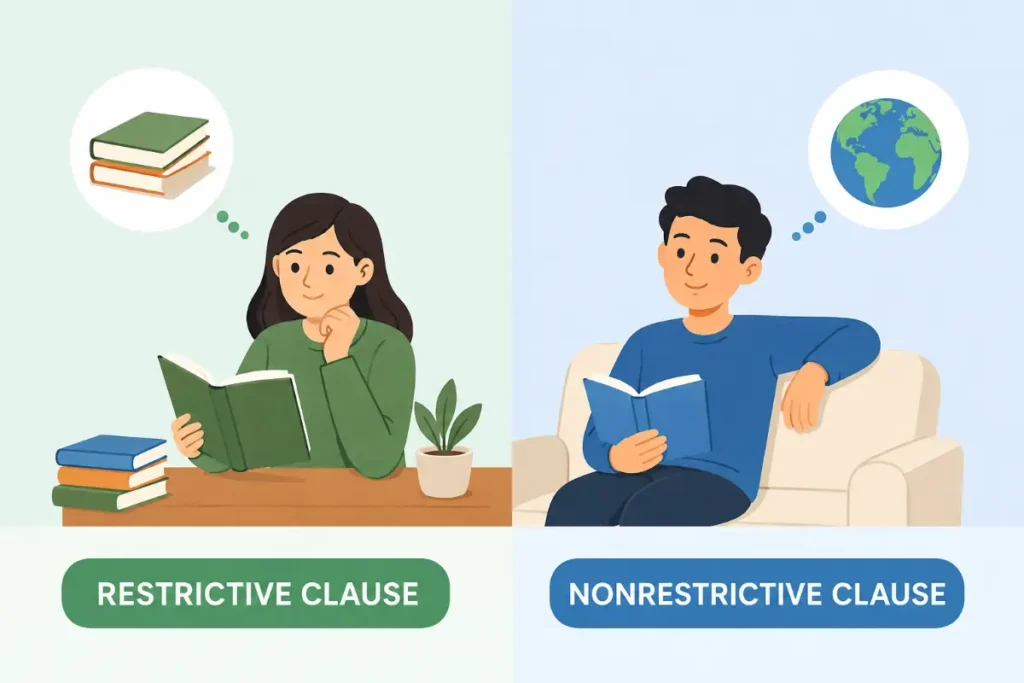
Restrictive And Nonrestrictive Clauses
These grammar terms can sound intimidating but the idea is simple.
A restrictive clause gives information that helps identify the exact thing you’re talking about. It is essential to the meaning.
- The books that are on the table belong to me.
This means only the books on the table belong to me. The phrase that are on the table helps identify the books.
A nonrestrictive clause adds information that isn’t essential to identify the thing.
- My books which are on the table belong to me.
Here my books already tells us what the speaker means. The information about the table adds detail.
In American English many editors prefer that for restrictive clauses and which for nonrestrictive clauses. This approach makes the meaning easier to see at a glance.
There are other style rules and exceptions, but this simple distinction will handle many everyday sentences.
The Role Of Commas With Which
Punctuation can change how a reader understands a sentence. When which introduces extra information, commas often surround the clause.
For example:
- The house which sits on the corner belongs to my aunt.
Depending on the intended meaning and the style being used, this sentence can be read in different ways. A clearer version is often better.
If the information is extra, write:
- My aunt’s house, which sits on the corner, is for sale.
The commas show that the detail about the corner is additional information.
If the information identifies the house, many American editors would use that instead.
- The house that sits on the corner belongs to my aunt.
The difference may seem small, but punctuation gives the reader a useful signal. Good writing isn’t only about choosing the right word. It is also about making your meaning easy to understand.
Which In Formal Writing
This word works perfectly well in formal writing. You can use it in school essays reports professional emails applications and business documents.
For example:
- Please confirm which documents you need.
- The report explains which factors affected the results.
- We need to decide which proposal offers the best solution.
- The study examines several methods which can improve accuracy.
The key is not to avoid the word because it sounds formal. It is a normal and useful English word.
In professional writing clarity matters more than trying to replace simple words with complicated ones. Which often gives you the clearest way to express a choice or add information.
Common Mistakes With Which
The missing h is only one possible problem. Writers also make grammar and punctuation mistakes when using this word.
Leaving Out The H
The most obvious error is writing wich instead of which.
For example:
- Incorrect: Wich color do you prefer.
- Correct: Which color do you prefer.
The fix is simple. Remember that the word starts with wh.
Using Which When You Mean Who
Which usually refers to things and choices. Who normally refers to people.
For example:
- Which employee won the award.
- Who won the award.
The first question focuses on identifying one employee from a group. The second asks for the identity of the person who won.
You can use which with people when you’re choosing from a known group.
- Which doctor should I call.
You wouldn’t normally use which as a general replacement for who.
Confusing Which With What
As discussed earlier, both words can ask about choices. The difference is often the size or limits of the group.
- Which dress do you want.
This suggests that the speaker has a specific set of dresses in mind.
- What do you want to wear.
This leaves the answer more open.
In casual speech the line can be flexible. Native speakers don’t always follow a strict rule. Still, understanding the basic difference helps you choose the word that best matches your meaning.
Forgetting The Comma
When which introduces nonessential information, commas usually help separate that information from the main sentence.
- My car, which is ten years old, still runs well.
Without the commas the sentence can suggest a different relationship between the information and the noun. Good punctuation helps prevent that confusion.
How To Remember The Spelling
A spelling trick works best when it’s simple enough to recall in a hurry.
Remember The WH Family
Think about the common question words.
- What.
- When.
- Where.
- Who.
- Why.
- Which.
They all begin with wh. If you’re asking someone to choose or identify something, that h belongs there.
Think Of The Word In Three Parts
You can mentally divide the spelling into three parts.
WH + I + CH
That gives you the full spelling without making it feel like something you need to memorize letter by letter.
Connect Which And Which One
Another useful trick is to connect the word with the phrase which one.
- Which one do you want.
- Which one should I choose.
- Which one is yours.
Once which one becomes familiar, the spelling of the first word becomes easier to remember.
Write It In Context
Don’t spend five minutes writing the same word by itself. Use it in real sentences instead.
- Which movie should we watch tonight.
- Which shoes fit you better.
- Which answer makes the most sense.
Context gives the word meaning. Meaning makes spelling easier to remember.
Which In Questions About Choices
The word is especially useful when several options are available. It helps narrow the question so the listener knows what kind of answer you want.
Imagine you’re at a coffee shop with a friend. You might ask:
- Which coffee do you want.
If there are several drinks on the menu the question points toward one of them.
At a clothing store you might ask:
- Which jacket looks better.
An airport you might ask:
- Which gate do we need.
At a restaurant you might ask:
- Which dessert should we share.
These examples show why the word is so useful. It turns a broad question into a focused choice.
Which One And Which Ones
Which one is used when you’re choosing a single item from a group.
- Which one is yours.
- Which one should I buy.
- Which one do you prefer.
The noun can be left out because one or ones stands in for it.
Compare these sentences.
- Which shirt do you want.
- Which one do you want.
Both are natural. The first names the thing being chosen. The second relies on context.
This small distinction makes everyday speech smoother. You don’t have to repeat the same noun when everyone already knows what you’re discussing.
Which In Indirect Questions
Not every question with which ends with a question mark. The word can appear inside a larger sentence.
For example:
- I don’t know which bus to take.
- She asked which restaurant we preferred.
- Can you tell me which file I should open.
- He hasn’t decided which college to attend.
These are called indirect questions. The sentence contains a question idea but isn’t written as a direct question.
Compare:
- Which bus should I take.
with:
- I don’t know which bus I should take.
The meaning is closely related but the sentence structure is different.
This form is common in conversation and writing. You’ll see it often in instructions too.
- Select which option you prefer.
- Tell us which plan you want.
- Choose which account you want to use.
Which In Relative Clauses With Prepositions
In more formal writing which can appear after a preposition.
For example:
- The company for which she works is based in Chicago.
- The house in which they lived was built in 1920.
- The issue about which we spoke has been resolved.
These sentences are grammatically correct but they sound formal in everyday American conversation.
Most people would say:
- The company she works for is based in Chicago.
- The house they lived in was built in 1920.
- The issue we spoke about has been resolved.
Both versions can be correct. The second style sounds more natural in ordinary conversation.
This is a good example of why grammar isn’t only about correctness. Good writing also considers the audience and situation.
Which In Everyday American English
You don’t need complicated grammar to use this word well. In ordinary conversation which is usually straightforward.
You might hear:
- Which one do you like.
- Which way should we go.
- Which day works for you.
- Which team are you rooting for.
- Which one is cheaper.
- Which restaurant is open.
- Which train should I catch.
These sentences sound natural because they match common situations. People make choices all day long and which is one of the main words English uses to talk about those choices.
A Quick Practice Test
Try filling in the blank with the correct spelling.
- ___ movie should we watch tonight.
- The answer is which.
- Now try this one.
- I don’t know ___ route is faster.
- Again the answer is which.
- One more.
- ___ shoes belong to you.
- The answer is which.
If you automatically want to add the h now that’s a good sign. The goal isn’t to memorize a long grammar rule. You want the correct spelling to become familiar enough that the wrong version looks strange.
Why Reading Helps Your Spelling
Spelling improves when you repeatedly see words used correctly. Reading gives your brain thousands of small examples without requiring you to study every one.
When you read an article and see which several times your brain starts storing its shape. Later when you type the word the familiar version comes to mind more easily.
This is one reason regular reading can improve writing skills. You aren’t only learning new facts. You’re also seeing sentence patterns spelling patterns punctuation and natural word choices.
If you often make the same spelling mistake try paying extra attention to that word when you read. That small habit can make a noticeable difference.

What To Do When You Are Still Unsure
If the spelling doesn’t come to you immediately don’t guess and move on. Take a second to check the word.
In most writing apps you can use spell check. You can also check a trusted dictionary when accuracy matters.
For everyday writing the most useful habit is simple. Stop for a moment and look at the first two letters. If you’re using the word that asks about a choice or identifies something then you need wh.
That quick check can prevent a surprisingly common mistake.
FAQs
Is wich or which correct?
Which is the correct spelling for the standard English word. Wich is normally a spelling error when you mean the word used to ask about a choice or identify something.
Is wich a real English word?
Wich is not normally used as a standalone word in modern standard English. You may see it inside place names or historical words but that doesn’t make it a replacement for which.
Why is which spelled with an h?
The word belongs to the group of English question words that begin with wh. Its spelling developed over time and the h is part of the standard form used today.
How do you remember the spelling of which?
Remember the common wh question words such as what, when, where, who, why, and which. You can also remember the word as WH + I + CH.
Is which a question word?
Yes. Which is commonly used as a question word when someone wants you to choose or identify something from a group. For example you might ask which seat someone wants.
Can which be used for people?
Yes. You can use which when choosing someone from a known group. For example Which doctor should I call asks the listener to choose a doctor from a particular group.
What is the difference between which and what?
Which often points to a limited group of choices. What usually leaves the possible answers more open. The distinction can be flexible in casual American English.
What is the difference between which and witch?
Which is used to ask about a choice or identify something. Witch is a noun associated with a person believed to practice magic and is also common in stories and folklore.
Conclusion
If you came here wondering about wich or which the answer is clear. Use which when you’re asking someone to choose or identify something. The spelling with the h is the standard form.
The easiest way to remember it is to connect it with other wh question words. What begins with wh. When begins with wh. Where begins with wh. Which follows the same pattern.
You’ll also see which used in indirect questions and relative clauses. It can help you choose between options or add useful information to a sentence. Once you understand these basic uses the word becomes much easier to handle.
When you’re writing and the spelling suddenly slips your mind pause for a second. Think wh. Then write which. That tiny habit can keep this common spelling mistake out of your emails essays messages and other everyday writing.

Dr. Elena Vance holds a Ph.D. in Linguistics from Columbia University and has spent over 15 years analyzing the evolution of the English language. A former university professor turned full-time writer and editor, Elena specializes in breaking down high-level grammatical concepts, punctuation nuances, and style guides (APA, Chicago, MLA) into clear, actionable advice. When she isn’t hunting down dangling modifiers, she can be found collecting vintage dictionaries and reading classic literature.