

If you’re stuck on loose or lose you aren’t alone. These two words look and sound similar enough to cause trouble. The good news is that they have different meanings and different jobs in a sentence.
Lose is a verb. It means to misplace something to no longer have something or to fail to win. Loose is usually an adjective. It means not tight not firmly fixed or not held in place. Once you connect each word with its meaning the difference becomes much easier to remember.
This guide explains the difference in plain English. You’ll see real examples that show how each word works in everyday writing. You’ll also learn a few simple memory tricks common mistakes related words and answers to questions people often ask.
Quick Definition
Lose means to misplace something to stop having something or to fail to win. For example you can lose your keys lose a game or lose interest in something.
Loose means not tight or not firmly attached. For example you can have a loose shirt a loose tooth or a loose screw.
Direct Answer
Use lose when you mean to misplace something stop having something or fail to win. Use loose when you mean something is not tight or is free from restraint.
Comparison Table
| Word | Meaning | Example Sentence | When To Use It |
|---|---|---|---|
| Lose | To misplace something or fail to win. | I don’t want to lose my keys. | Use it for an action or change of state. |
| Loose | Not tight or firmly fixed. | This shirt feels loose. | Use it mainly to describe something. |
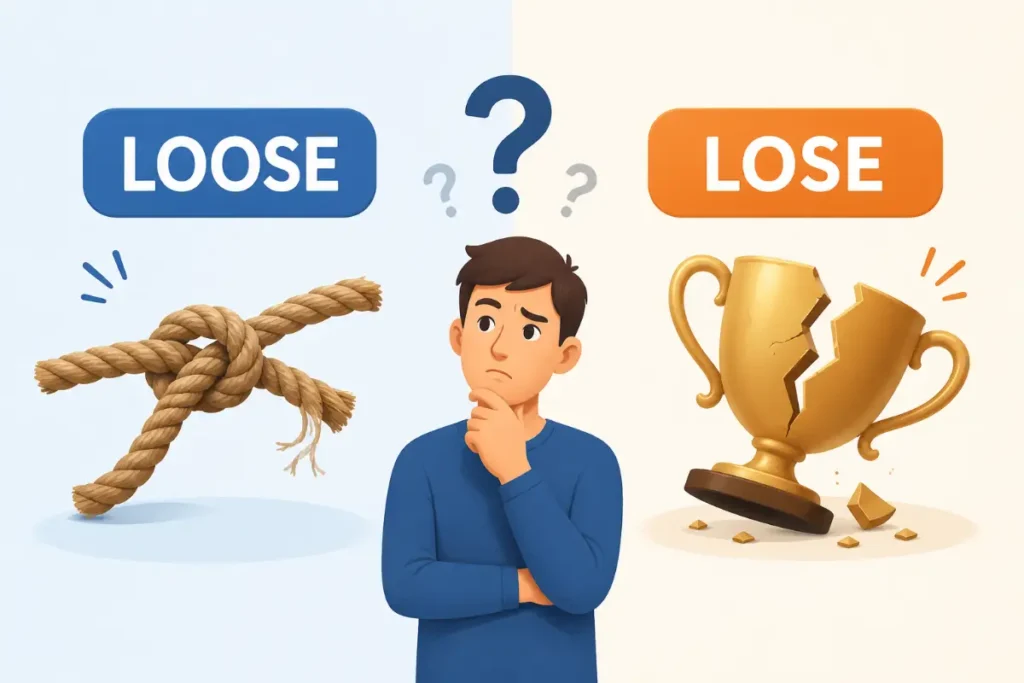
Why These Words Cause So Much Confusion
The main reason is simple. Loose and lose look almost identical when you see them on the page. They also sound similar in some accents. That small extra letter can make a big difference in meaning.
- Think about these two sentences.
- I don’t want to lose my phone.
- My phone case is loose.
The first sentence describes something that could happen to the phone. You might misplace it or no longer have it. The second sentence describes the condition of the case. It isn’t tight enough.
The difference is only one letter but the meanings are completely different.
This kind of spelling problem happens often in English. Words can look almost the same while doing very different jobs. A small change in spelling can turn an action into a description or change the meaning of a sentence altogether.
The best way to handle this pair is not to focus only on the spelling. Start with the meaning. Ask yourself what you are trying to say. If you mean misplace fail or no longer have something then you need lose. If you mean not tight or not firmly attached then you need loose.
That simple habit can save you from the mistake.
What Does Lose Mean
Lose is a verb. It describes an action or a change. The word has several common meanings but they all involve something being gone missing unsuccessful or no longer available.
You can lose a physical object.
- I always lose my keys.
- She lost her wallet at the airport.
- Don’t lose your phone while you’re traveling.
You can also lose something less physical.
- He lost his patience.
- She lost interest in the movie.
- They lost confidence after the mistake.
The word also describes failing to win.
- Our team lost the game.
- I don’t want to lose this match.
- They lost the final by one point.
Another common use describes a person or thing becoming difficult to see or find.
- We lost sight of the boat.
- I lost track of time.
- The runner lost the other competitors in the crowd.
In every example the word describes something happening. That is a useful clue because lose is a verb.
Lose Means Misplace
One of the most common meanings is to misplace something.
- If you put your keys somewhere and can’t find them later you lost your keys.
- If you can’t find your glasses you may have lost your glasses.
- If you can’t remember where you saved a file you may say you lost the file. In this case the word doesn’t always mean the file disappeared forever. It can simply mean you don’t know where it is.
Here are some natural examples.
- I think I lost my keys at the restaurant.
- She keeps losing her sunglasses.
- I don’t want to lose this receipt.
- He lost his passport while traveling.
Notice that the object doesn’t need to be permanently gone. You can lose something for a short time and find it later.
Lose Means Fail To Win
Another very common meaning relates to competition.
If you don’t win a game you lose the game.
- We lost the baseball game.
- She lost the tennis match.
- Our team lost by three points.
This meaning appears in sports but it isn’t limited to sports.
You can lose a competition an election a debate or a contest.
- He lost the election.
- She lost the debate.
- The company lost the contract.
The opposite of lose in this sense is win.
Lose Means Stop Having Something
You can also lose something that isn’t a physical object.
People lose jobs friendships trust confidence patience hope or interest.
- She lost her job last year.
- He lost his confidence after the accident.
- The company lost the customer’s trust.
- I started to lose interest in the book.
This use is common in everyday speech. It shows why the word has a broader meaning than simply misplacing your keys.
Lose Means Become Unaware Of Something
The word can also appear in phrases such as lose track and lose sight.
If you lose track of time you stop paying attention to how much time has passed.
- I lost track of time while reading.
If you lose sight of something you can no longer see it.
- We lost sight of the car in traffic.
These expressions are worth learning as complete phrases. They appear often in natural English.
What Does Loose Mean
Loose is most often an adjective. It describes something that isn’t tight secure or firmly fixed.
Think about a shoelace.
If the shoelace is tied tightly it isn’t loose. If the knot has come undone and the lace hangs freely it is loose.
The same idea applies to clothing.
- These pants are too loose.
- My shirt feels loose around the shoulders.
- The jacket has a loose fit.
The word can also describe physical objects.
- The screw is loose.
- One of the floorboards is loose.
- The handle feels loose.
- The tooth is loose.
In each case the thing isn’t held as firmly as it should be.
Loose Means Not Tight
This is probably the easiest meaning to remember.
Something loose has extra space or movement.
- A loose belt isn’t tight around your waist.
- A loose lid isn’t firmly closed.
- A loose knot can come undone easily.
- A loose tooth can move inside the gum.
The word describes a condition rather than an action.
Loose Means Free
The word can also mean free from something that holds or controls it.
For example a dog may get loose if it escapes from its leash.
- The dog broke free and ran loose through the yard.
A horse can run loose in a field.
You might also hear someone say that a person is on the loose. This means the person is free and hasn’t been captured or stopped.
- The suspect was still on the loose.
This meaning connects naturally to the main idea. Something that is loose isn’t being held tightly.
Loose Can Describe Rules
The word can also describe rules or control that aren’t strict.
For example a school may have loose rules about clothing. That means the rules allow a lot of freedom.
A manager might give loose instructions. This means the instructions aren’t very detailed or strict.
- The project has a loose schedule.
- The group follows a loose set of guidelines.
Here the word doesn’t mean physically loose. It describes something that isn’t strict or tightly controlled.
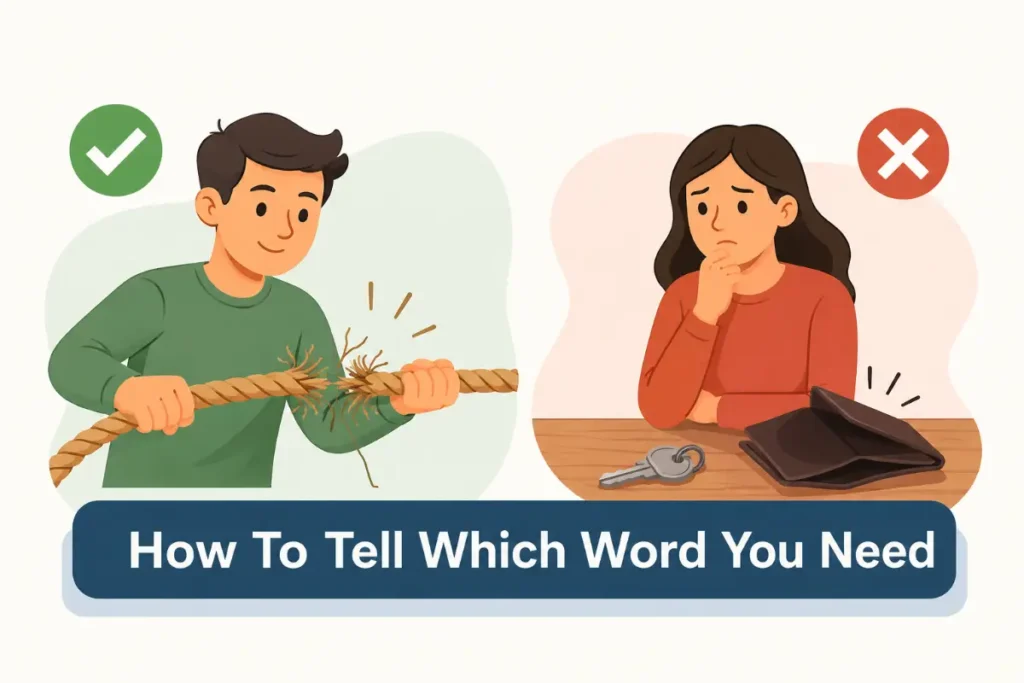
How To Tell Which Word You Need
The fastest way to choose the right word is to ask yourself what the sentence means.
- If the sentence describes an action such as misplacing something failing to win or no longer having something then use lose.
- If the sentence describes something that isn’t tight secure or firmly controlled then use loose.
Try these examples.
- I don’t want to lose my jacket.
- My jacket is loose around the waist.
- The first sentence talks about no longer having the jacket. The second describes how the jacket fits.
- Another pair makes the difference even clearer.
- Don’t lose the screw.
- The screw is loose.
In the first sentence someone might misplace the screw. In the second sentence the screw is still there but it isn’t firmly attached.
This meaning test is more useful than simply trying to remember which spelling has an extra letter.
The Pronunciation Difference
Pronunciation can help you remember the difference.
- Lose usually has a long oo sound. It rhymes closely with words such as choose and news.
- Loose has an even longer sound because the word has two vowel sounds around the double consonant pattern. It sounds like goose and moose.
- The spelling also gives you a useful visual clue.
- Lose has one o after the l.
- Loose has two o letters.
- You can connect the extra o with extra space. Something loose has extra room or movement.
This isn’t a formal spelling rule. It’s simply a memory trick. Still it can work well because it connects the spelling with the meaning.
Common Mistakes With Lose And Loose
These words often appear in the same kinds of mistakes. People may know the meaning they want but type the wrong spelling because the words look so similar.
Here are some common errors.
| Incorrect Use | Correct Use | Why |
|---|---|---|
| Don’t loose your keys. | Don’t lose your keys. | The meaning is misplace. |
| My shoes are lose. | My shoes are loose. | The meaning is not tight. |
| We might loose the game. | We might lose the game. | The meaning is fail to win. |
| The screw is lose. | The screw is loose. | The screw isn’t tight. |
| I don’t want to loose hope. | I don’t want to lose hope. | The meaning is stop having hope. |
The mistake can change the meaning of the sentence or make the sentence grammatically wrong.
For example My shoes are lose doesn’t work because the adjective needed here is loose.
On the other hand Don’t loose your keys is also wrong because the sentence needs the verb lose.
The context gives you the answer.
Why Loose Is Not The Past Tense Of Lose
This is another point that confuses learners.
The past tense of lose is lost.
It isn’t loose.
Here is the pattern.
- Present: I lose my keys.
- Past: I lost my keys.
- Past participle: I have lost my keys.
The word loose is a separate word with its own meaning.
You might say:
- The screw is loose.
- The screw was loose.
- The screw became loose.
You wouldn’t use loose to describe the past form of the verb lose.
Remembering lose → lost makes this distinction much easier.
Lose In Different Verb Forms
Because lose is a verb you may see it in several forms.
The base form is lose.
- I don’t want to lose my wallet.
The third person singular form is loses.
- He often loses his keys.
The past tense is lost.
- She lost her phone yesterday.
The past participle is also lost.
- I have lost my ticket.
The present participle is losing.
- We are losing time.
Notice something important. The spelling changes in losing. The final e disappears before ing.
That gives you another useful word to recognize.
Loose In Different Forms
Loose can also change form when you use it as a verb.
As an adjective it means not tight.
- The bolt is loose.
As a verb it can mean to release or set free.
- The rider loosed the horse from its restraint.
This verb use is much less common in everyday American English. Most people are far more likely to use release or set free.
The related noun looseness means a state of being loose.
The verb loosen means to make something less tight.
- Loosen the knot.
- He loosened his tie.
- The screws began to loosen.
These related words can help you see how the spelling family works.
Memory Tricks That Actually Help
You don’t need a complicated rhyme to remember these words. A simple mental picture can be enough.
Think Of Lose As Something Gone
Picture your keys disappearing.
- You can’t find them.
- You lose them.
Now picture a shirt that hangs too far from your body.
- It isn’t tight.
- It is loose.
That visual contrast makes the difference easy to recall.
Remember The Extra O
Loose has an extra o.
You can think of the extra letter as extra space.
Loose means there is often extra space or movement.
Again this isn’t a grammar rule. It’s simply a quick memory aid.
Connect Lose With Lost
This is one of the strongest tricks.
If you know that the past tense is lost then you can remember that the present verb is lose.
- Lose.
- Lost.
- Losing.
That gives you a complete little word family to work with.
Examples You Can Use In Everyday Writing
The best way to learn the difference is to see it in situations you already understand.
Talking About Your Belongings
- I don’t want to lose my wallet.
- She lost her keys again.
- Don’t lose your boarding pass.
- He was afraid he would lose his phone.
These sentences all describe something being misplaced or no longer available.
Now compare them with examples using loose.
- The button on my shirt is loose.
- My shoelaces are loose.
- The lid is loose.
- This handle feels loose.
These sentences describe physical conditions.
Talking About Sports
- Our team could lose tonight.
- They lost the championship game.
- Nobody wants to lose the final.
- The team was losing by halftime.
You wouldn’t use loose in these sentences because the meaning is about failing to win.
Talking About Clothing
- These jeans are too loose.
- The shirt feels loose around my shoulders.
- This belt is loose.
- The jacket has a loose fit.
Here the meaning is about fit. The clothing isn’t tight.
Talking About Feelings
- I don’t want to lose hope.
- She lost confidence after the mistake.
- He began to lose interest in the project.
- They were afraid of losing trust.
These examples use the verb because something is disappearing or being reduced.
Related Words That Are Easy To Mix Up
English has several word pairs that cause the same kind of confusion. Learning them can improve your spelling beyond this one pair.
Then And Than
Then usually relates to time or sequence.
- We ate dinner and then watched a movie.
Than is used for comparisons.
- She is taller than her brother.
The words look similar but they have different jobs.
Affect And Effect
Affect is commonly used as a verb meaning to influence.
- Lack of sleep can affect your mood.
Effect is commonly used as a noun meaning a result.
- Lack of sleep can have a serious effect on your mood.
These words have more complicated uses than lose and loose. Still the same principle applies. Focus on meaning and sentence function.
Their And There
Their shows ownership.
- Their house is across the street.
There points to a place or introduces something.
- The books are over there.
- There are three apples on the table.
Again a small spelling difference changes the meaning.
Your And You’re
Your shows ownership.
- Is this your bag?
You’re is short for you are.
- You’re early today.
Checking the meaning before choosing the spelling is a powerful habit.
How To Use Lose Correctly In Formal Writing
The verb lose is completely normal in formal writing. You don’t need a more complicated word.
You can use it in reports essays emails applications and professional documents.
For example:
- The company could lose several customers if the issue continues.
- Students may lose points for missing important details.
- The team could lose valuable time if the system fails.
The key is to use the word according to its meaning.
There is no reason to replace lose with a longer word just to sound formal. Clear writing usually works better.
How To Use Loose Correctly In Formal Writing
Loose is also perfectly acceptable in formal writing when its meaning fits.
You might use it to describe clothing materials objects rules or connections.
- The cable connection is loose.
- The fabric has a loose weave.
- The policy provides loose guidelines.
- The fitting became loose over time.
In technical writing the exact meaning can matter. If a part isn’t firmly attached then loose tells the reader something specific about its condition.
When To Use Lose In A Sentence
Use lose when the subject performs an action involving something being gone missing or unsuccessful.
A quick test is to replace the word with misplace or fail to win.
If the replacement makes sense then lose is probably the right choice.
For example:
I don’t want to lose my keys.
Replace it with:
I don’t want to misplace my keys.
The meaning still works.
Now try:
Our team could lose the game.
Replace it with:
Our team could fail to win the game.
Again the meaning works.
This test can be useful when you’re unsure.
When To Use Loose In A Sentence
Use loose when you’re describing something that isn’t tight secure or firmly controlled.
A useful test is to replace it with not tight.
For example:
My shoes are loose.
Try:
My shoes are not tight.
The basic meaning stays the same.
Another example is:
The screw is loose.
Try:
The screw is not tight.
That also works.
This quick substitution test can help you make the right choice without thinking about complicated grammar rules.
A Simple Way To Remember The Difference
Imagine two pictures.
- In the first picture your keys are missing. You search the table. You check your pockets. You look under the sofa.
- You lose your keys.
- In the second picture a screw is sticking out of a chair. You touch it and it moves.
- The screw is loose.
- The first word describes something that is gone or missing. The second describes something that isn’t secure.
That contrast is worth remembering because it covers the most common uses of both words.
Why Context Matters More Than Spelling
When people ask which spelling is correct they often focus too much on the letters. The better question is what the sentence means.
Consider this sentence.
I don’t want to ___ my job.
The meaning is clear. You aren’t talking about a job that isn’t tight. You mean you don’t want to stop having your job.
So the correct verb is lose.
Now consider:
The handle is ___.
Here you are describing the handle. You mean it isn’t firmly attached.
So the correct adjective is loose.
The sentence gives you the answer before the spelling does.
This is a useful approach for many confusing English words. Start with meaning. Then choose the word that carries that meaning.
Common Phrases With Lose
Some expressions with lose are so common that you should learn them as complete phrases.
Lose Weight
This means to become lighter by reducing body weight.
- She wants to lose weight through healthy habits.
Lose Time
This means to waste or no longer have available time.
- We can’t afford to lose time.
Lose Money
This means to experience a financial loss.
- The company could lose money on the deal.
Lose Sleep
This means to sleep less because something is worrying you.
- Don’t lose sleep over one small mistake.
Lose Your Temper
This means to become very angry.
- He lost his temper during the argument.
Lose Your Mind
This is an informal expression that can mean becoming extremely upset or acting in a way that seems unreasonable.
- I thought I was going to lose my mind waiting for the computer to restart.
These expressions all use the same spelling because they involve the idea of something being lost or going away.
Common Phrases With Loose
Loose also appears in several useful expressions.
Loose Change
This change means small coins that you carry in your pocket or keep somewhere nearby.
- I found some loose change in the car.
On The Loose
This means free and not captured or controlled.
- The escaped dog was still on the loose.
Loose Ends
A loose end is an unfinished part of a task or situation.
- I need to tie up a few loose ends before I leave.
These phrases are common in American English and are useful to recognize in everyday reading.

A Quick Practice Test
Try choosing the correct word before reading the answers.
- I don’t want to ___ my wallet.
- These pants are too ___.
- Our team might ___ the game.
- The door handle is ___.
- She doesn’t want to ___ her job.
- My shoelaces are ___.
- Don’t ___ your passport.
- The screw became ___.
The answers are:
- Lose.
- Loose.
- Lose.
- Loose.
- Lose.
- Loose.
- Lose.
- Loose.
If you got them all right then you have the main difference down.
FAQs
Is loose or lose correct?
Both words are correct but they have different meanings. Lose is a verb that means to misplace something or fail to win. Loose usually describes something that isn’t tight or firmly attached.
How can I remember the difference between loose and lose?
Think of lose as something going away. You can lose your keys your job your patience or a game. Think of loose as something having extra space or movement such as loose clothing a loose screw or a loose tooth.
Is loose the past tense of lose?
No. The past tense of lose is lost. Loose is a separate word and usually works as an adjective.
Why do people confuse these two words?
They look almost the same and they sound similar in some accents. The extra o in loose can be easy to overlook when you’re typing quickly. Focusing on meaning makes the distinction much easier.
Do lose and loose sound the same?
No. They have different pronunciations. Lose has a long oo sound and loose has a similar vowel sound but ends with an s sound that is pronounced differently.
Is loose an adjective?
Yes. Loose is most often an adjective. It describes something that isn’t tight secure or firmly fixed.
Is lose a verb?
Yes. Lose is a verb. It can mean to misplace something stop having something fail to win or no longer experience something.
What is the easiest way to know which word to use?
Ask yourself what you’re trying to say. If you mean misplace fail or stop having something use lose. If you mean not tight or not firmly attached use loose.
Conclusion
The difference between loose or lose becomes simple once you connect each word to its meaning. Lose describes an action such as misplacing something failing to win or no longer having something. Loose describes something that isn’t tight secure or firmly fixed.
A useful memory trick is to give the extra o in loose a little extra space. You can picture a loose shirt hanging away from the body or a loose screw moving in its hole. For lose think about something disappearing from your possession or a team failing to win.
The two words may look almost identical but they do very different jobs. If you’re writing a sentence and you aren’t sure which one belongs there pause and ask what the sentence means. That small check will usually give you the answer.
Keep lose connected with things that go missing or aren’t won. Keep loose connected with things that aren’t tight or firmly held. Once that distinction becomes familiar you’ll stop having to guess.

Dr. Elena Vance holds a Ph.D. in Linguistics from Columbia University and has spent over 15 years analyzing the evolution of the English language. A former university professor turned full-time writer and editor, Elena specializes in breaking down high-level grammatical concepts, punctuation nuances, and style guides (APA, Chicago, MLA) into clear, actionable advice. When she isn’t hunting down dangling modifiers, she can be found collecting vintage dictionaries and reading classic literature.