
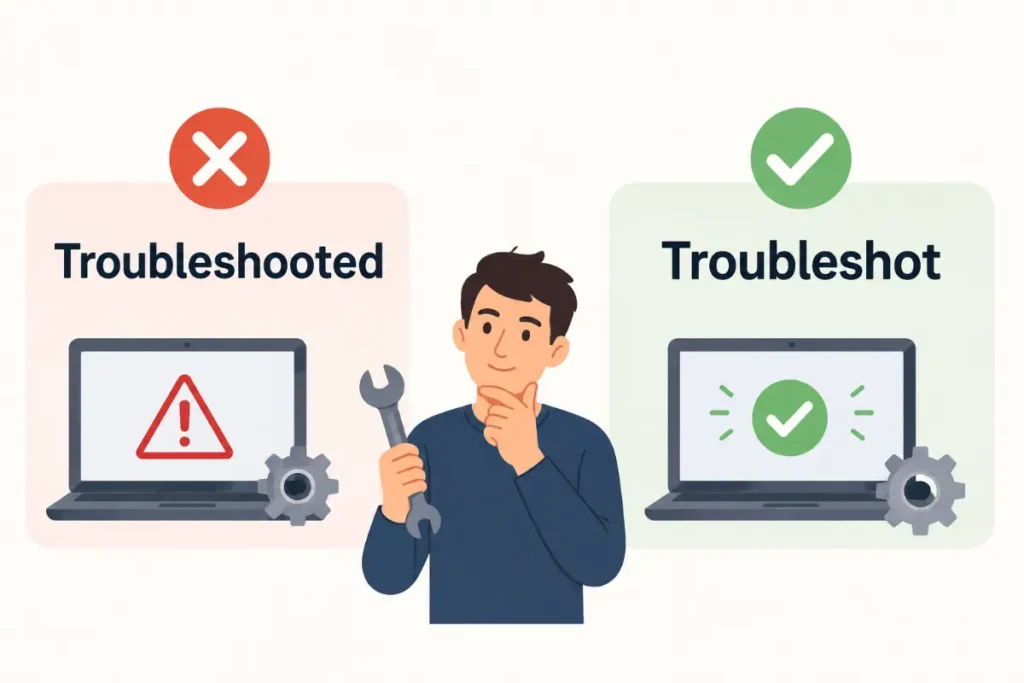
If you’re unsure about troubleshooted or troubleshot you’re dealing with a common problem in English. The verb troubleshoot has an unusual past tense because it doesn’t simply take the usual ed ending. The correct past form is troubleshot.
So you’d write I troubleshot the computer yesterday rather than I troubleshooted the computer yesterday. The same form works for technical problems at work as well as everyday situations where you find and fix the cause of a problem.
The confusion makes sense because many English verbs form their past tense by adding ed. You walk and walked. You clean and cleaned. You test and tested. So when people see troubleshoot they may naturally expect troubleshooted. English has other plans for this verb.
This guide explains why troubleshot is correct how the verb works in different tenses and how to use it naturally. You’ll also see examples from technology work customer support and everyday speech so you can choose the right form without second guessing yourself.
Quick Definition
Troubleshoot means to find the cause of a problem and work out how to fix it. Troubleshot is the simple past and past participle form of the verb. Troubleshooted is generally not the standard past form in modern English.
Direct Answer
The correct past tense of troubleshoot is troubleshot. Use troubleshot for a completed action in the past and troubleshooting for the ongoing process of finding and fixing a problem.
Comparison Table
| Word or Phrase | Meaning | Example Sentence | When to Use It |
|---|---|---|---|
| Troubleshoot | Find and fix the cause of a problem. | I need to troubleshoot the printer. | Present tense or after words such as to and can. |
| Troubleshot | Found and fixed the cause of a problem in the past. | I troubleshot the printer yesterday. | Simple past and past participle. |
| Troubleshooting | The process of finding and fixing a problem. | She is troubleshooting the network. | Ongoing action or as a noun. |
| Troubleshoots | Finds and fixes problems. | He troubleshoots software issues. | Present tense with he she or it. |
| Troubleshooted | A nonstandard form that appears in some writing. | Avoid this form in careful standard English. | Do not use it as the normal past form. |
Why Troubleshot Is The Correct Past Form
The key is the word shoot.
Troubleshoot is made from trouble and shoot. The word shoot has an irregular past tense. Its past form is shot rather than shooted. Because troubleshoot keeps the form of shoot inside it the past tense follows the same pattern.
Think of the family like this.
Shoot → shot
Troubleshoot → troubleshot
That pattern makes the spelling much easier to understand. You don’t need to invent a new past form by adding ed. The second part of the compound verb already has an established irregular form.
For example you would say I shot the ball yesterday. You would not normally say I shooted the ball yesterday. In the same way you say I troubleshot the issue yesterday rather than I troubleshooted the issue yesterday.
This is one of those places where English rewards you for learning the whole word family. Once you connect troubleshoot with shoot the past form becomes much easier to remember.
What Troubleshoot Means
To troubleshoot means to investigate a problem in a planned way so you can find its cause and correct it. The word is strongly associated with technology but its meaning is broader than computers and machines.
For example a technician might troubleshoot a printer that refuses to print. A software developer might troubleshoot an error in an application. A customer service worker might troubleshoot a problem with an account.
You can also use the word for less technical problems. Someone might troubleshoot a scheduling issue at work by checking what caused the delay and finding a better process.
The main idea stays the same. There is a problem and you are trying to identify what is causing it so you can fix it.
That is different from simply fixing something by chance. Troubleshooting usually involves checking possible causes one at a time. You look at the evidence. You test a possible solution. Then you see if the problem disappears.
Troubleshoot In The Present Tense
Use troubleshoot when you are talking about an action happening now or something that generally happens.
For example:
- I need to troubleshoot this printer.
- We troubleshoot network problems for our customers.
- Can you troubleshoot the connection?
- Our technicians troubleshoot software issues every day.
The base form also appears after modal verbs such as can, will, should, and must.
You would say:
- I can troubleshoot the problem.
- We should troubleshoot the system first.
- She will troubleshoot the issue tomorrow.
- You must troubleshoot the connection before replacing the device.
Notice that the verb stays in its base form after these words. You would not write can troubleshot or should troubleshot.
Troubleshot In The Past Tense
Use troubleshot when the troubleshooting happened in the past and is finished.
For example:
- I troubleshot the printer yesterday.
- She troubleshot the network problem before lunch.
- We troubleshot the software issue last night.
- The technician troubleshot the connection and found the cause.
- He troubleshot several problems during the installation.
The word can describe one completed action or several completed actions.
For instance a manager might say that an employee troubleshot three customer issues during the morning. The action happened in the past so troubleshot is the natural choice.
You can also use the word with time expressions such as yesterday, last week, earlier, this morning, and two hours ago when the context clearly places the action in the past.
Troubleshooting As An Ongoing Action
Another form you will see often is troubleshooting. This is the present participle of the verb and it describes an action that is in progress.
For example:
- I’m troubleshooting the printer right now.
- She is troubleshooting a problem with the website.
- They are troubleshooting the network.
- We spent the afternoon troubleshooting the software.
The ing form can also work as a noun. For example:
- Troubleshooting takes patience.
- Basic troubleshooting can solve many common problems.
- The guide includes troubleshooting steps for common errors.
This form is especially common in technical writing. You may see headings such as Printer Troubleshooting or Network Troubleshooting in help guides and support documents.
The Difference Between Troubleshoot And Troubleshot
The difference is mainly about time.
Troubleshoot refers to the base form. It can describe a general action or an action that happens now or in the future depending on the sentence.
Troubleshot refers to a completed action in the past or works as the past participle after certain helping verbs. Compare these sentences.
- I troubleshoot computer problems at work.
- I troubleshot a computer problem yesterday.
The first sentence describes a regular activity. The second tells us about a completed event. Now compare these.
- We need to troubleshoot the server.
- We troubleshot the server last night.
The first sentence refers to an action that still needs to happen. The second says the action already happened. This simple time difference will help you choose the right form in most everyday situations.
Why Troubleshooted Sounds Natural To Some People
The form troubleshooted sounds logical if you apply the most common English past tense pattern. Many verbs simply add ed. For example:
- Test becomes tested.
- Check becomes checked.
- Repair becomes repaired.
- Fix becomes fixed.
- Call becomes called.
Because troubleshoot is a regular looking compound verb people may assume it works the same way.
But compound words do not always behave as if they were completely new words. Troubleshoot contains the verb shoot, and that verb already has an irregular past form.
English has many examples of this kind of pattern. When a compound verb is built from a verb with an irregular past form the compound can keep that irregular pattern. That is why shoot becomes shot and troubleshoot becomes troubleshot.
Once you understand that connection the spelling stops looking random.

How The Verb Fits Into Real Work Situations
The word is especially useful in professional settings because many jobs involve finding the source of problems.
A technical support worker might say:
- I troubleshot the customer’s login problem and found that the account was locked.
A network administrator might say:
- We troubleshot the connection and discovered a damaged cable.
A software developer might write:
- I troubleshot the error and found a problem in the database query.
A manager might explain:
- She troubleshot the scheduling issue before it affected the rest of the team.
In each sentence the person did more than notice a problem. They investigated it and worked toward a solution. That distinction matters because troubleshoot is not simply another word for fix.
If you fix a problem you solve it. If you troubleshoot a problem you investigate the cause and test ways to solve it. Sometimes troubleshooting leads directly to a fix. Other times it helps you discover what needs to happen next.
Troubleshoot And Fix Are Not Exactly The Same
These two words often appear together but they describe different parts of the process. Imagine your laptop will not connect to the internet.
You might first troubleshoot the problem. You check the Wi Fi connection. Then you restart the router. Next you test another device. You might discover that the problem comes from the router.
Once you know the cause you can fix the problem by restarting or replacing the router. So troubleshooting is often the investigation that comes before or during the repair.
You could say:
- I troubleshot the internet problem and fixed the connection.
That sentence sounds natural because the two verbs describe different actions. The first tells us that you investigated the problem. The second tells us that you solved it.
This distinction is useful in workplace writing because it gives readers more information about what you actually did.
Troubleshoot And Diagnose Are Also Different
Diagnose means identifying what is causing a problem. Troubleshoot often involves diagnosis but usually goes a step further by testing possible solutions.
For example a doctor may diagnose an illness. A computer technician may diagnose a software error. A mechanic may diagnose a problem with an engine.
In technical work you might troubleshoot a device by checking several possible causes until you identify the fault. That means the two words can overlap but they are not perfect substitutes.
Consider this example.
- The technician diagnosed the problem as a faulty power supply.
- The technician troubleshot the computer and discovered the faulty power supply.
The first sentence focuses on the identified cause. The second focuses on the process used to find it. Using the right word can make your writing more precise without making it complicated.
How To Use Troubleshot Correctly
Once you understand that troubleshot is the past form of troubleshoot the next step is using it naturally in sentences. The word works like other past tense verbs. It tells the reader that the investigation happened before now and is complete or viewed as a completed event.
For example you might say that you troubleshot a printer yesterday or that your team troubleshot a network problem last week. The sentence can include the object of the action such as the printer the software or the connection.
You can also use troubleshot without naming the exact problem when the context already makes it clear.
- I troubleshot the issue before the meeting.
- She troubleshot the problem and found a simple solution.
- We troubleshot several errors during the test.
- The technician troubleshot the system for two hours.
The important point is that the action belongs in the past. If you are talking about something you still need to investigate then use troubleshoot instead.
Examples In Different Situations
The best way to get comfortable with an irregular verb is to see how people use it in real situations. The following examples show how the past form works in common settings.
Computer Problems
Technology is probably the area where you will see this verb most often. Computers can have problems with software hardware internet access accounts and settings.
- I troubleshot my laptop after it stopped connecting to Wi Fi.
- She troubleshot the software error before sending the update.
- Our technician troubleshot the computer and found a damaged cable.
- We troubleshot the application after several users reported the same error.
Each sentence describes an investigation that already happened. That is why troubleshot fits naturally.
Internet And Network Problems
Network issues can have many possible causes. A connection might fail because of a router a cable a server a setting or an internet service problem.
- The IT team troubleshot the network after the connection dropped.
- I troubleshot the Wi Fi problem and discovered that the router needed to be restarted.
- He troubleshot the connection but could not find the source of the outage.
- We troubleshot the office network for most of the morning.
Notice that troubleshooting does not always mean you solved the problem. You can investigate an issue and still need more information before you can fix it.
Workplace Problems
The word isn’t limited to computers. You can use it when someone investigates a process or system that isn’t working properly.
- She troubleshot the scheduling problem before it caused delays.
- We troubleshot the delivery process and found where orders were getting stuck.
- The manager troubleshot the reporting system after several errors appeared.
- He troubleshot the workflow and suggested a simpler process.
This broader use is common in professional English. The basic meaning stays the same. You identify a problem and work through possible causes.
Customer Support
Customer support teams often troubleshoot problems for users. They may ask questions test settings check account information or guide someone through possible solutions.
- I troubleshot the customer’s login issue during the call.
- The support team troubleshot the payment problem and found an account setting that caused it.
- She troubleshot the connection with the customer and restored the service.
- We troubleshot several complaints before the end of the shift.
In this setting the word can show that you did more than simply respond to a complaint. You investigated the cause and worked toward a solution.
Common Mistakes With The Past Tense
The most common mistake is adding ed to the end of troubleshoot. That produces troubleshooted. It may look logical but it is not the standard past form used in careful English.
Another mistake is using troubleshot when the sentence needs the base form. For example:
- Incorrect: I will troubleshot the problem tomorrow.
- Correct: I will troubleshoot the problem tomorrow.
After will you need the base form. The same rule applies after other modal verbs.
- I can troubleshoot the issue.
- We should troubleshoot the system.
- She must troubleshoot the connection.
- They might troubleshoot the software later.
Do not change the verb into its past form after these words.
The opposite mistake can happen when someone talks about a completed action.
- Incorrect: I troubleshoot the problem yesterday.
- Correct: I troubleshot the problem yesterday.
The word yesterday tells you that the action happened in the past. That makes troubleshot the natural choice.
Troubleshot Or Troubleshooted
The question of troubleshooted or troubleshot comes down to standard verb usage. Troubleshot is the established past tense and past participle form of troubleshoot.
You may occasionally see troubleshooted in informal writing or online posts. People can create regular forms for irregular verbs because they sound familiar. That does not make the form standard.
Think about the verb shoot again. Its past form is shot.
You would say:
- I shot the ball yesterday.
You would not normally say:
- I shooted the ball yesterday.
The same pattern carries into troubleshoot.
- I troubleshot the problem yesterday.
That connection is the easiest rule to remember.
The Three Main Forms
A useful way to learn this verb is to memorize its three main forms together.
Troubleshoot → troubleshot → troubleshot
The first form is the base form. The second and third forms are the same.
This pattern is similar to several other irregular verbs.
- Shoot → shot → shot.
- Buy → bought → bought.
- Teach → taught → taught.
- Think → thought → thought.
- Catch → caught → caught.
Learning the complete set helps you avoid trying to build the past tense from scratch.
For troubleshoot the pattern is especially simple because the past tense and past participle are identical.
Base Form
Use troubleshoot for the basic form.
- I troubleshoot software problems.
- We need to troubleshoot the printer.
- Can you troubleshoot this issue?
Past Form
Use troubleshot for a completed past action.
- I troubleshot the printer yesterday.
- She troubleshot the network problem last night.
- They troubleshot the issue before the meeting.
Past Participle
The same form troubleshot can work after helping verbs such as have has and had.
- I have troubleshot similar problems before.
- She has troubleshot several network issues this week.
- We had troubleshot the system before the technician arrived.
This is an important distinction. Troubleshot is not only a simple past form. It also works as the past participle.
When To Use Have Troubleshot
The phrase have troubleshot describes an action that happened before now and has a connection to the present. It can also describe experience without giving one specific past time.
For example:
- I have troubleshot this type of error before.
- She has troubleshot hundreds of customer issues.
- We have troubleshot similar network problems in the past.
You are not simply saying that something happened yesterday. You are talking about experience or a past action that matters to the current situation.
Compare these sentences.
- I troubleshot the issue yesterday.
- I have troubleshot this issue before.
The first sentence points to a specific past event. The second focuses on experience.
That difference is small but useful. It helps you choose the tense that best matches what you want to tell the reader.
When To Use Had Troubleshot
Use had troubleshot when one past troubleshooting action happened before another past event.
For example:
- We had troubleshot the printer before the technician arrived.
- She had troubleshot the network problem before the manager called.
- I had troubleshot the software before the team started testing it.
There are two past events in each sentence. The past perfect form shows which one happened first. First the person investigated the problem. Later another event happened.
This tense is useful in detailed reports and stories because it makes the order of events clear.
Troubleshooting As A Noun
Troubleshooting can also act as a noun. In this use it refers to the process of finding and solving problems.
You will often see the word in help articles manuals software guides and customer support pages. For example:
- The manual includes a troubleshooting guide.
- Basic troubleshooting can solve many printer problems.
- Our support page has troubleshooting steps for common errors.
- The technician specializes in hardware troubleshooting.
This form is especially useful when you are talking about a general method rather than one specific action.
A troubleshooting guide is a set of instructions that helps someone identify and solve common problems. It might tell you to restart a device check a cable update software or test another connection.
A Simple Troubleshooting Process
The word has a practical meaning beyond grammar. Troubleshooting usually follows a logical process. You start with the problem then work through possible causes.
Identify The Problem
First describe exactly what is wrong.
Instead of saying the computer doesn’t work you might say the computer turns on but cannot connect to the internet.
A clear description gives you a better starting point.
Check The Simple Causes
Next check the things that are easiest to verify.
For a network problem you might check the Wi Fi setting the router and the cable. For a printer problem you might check the power supply paper and the connection. Simple checks can save a lot of time.
Test One Change At A Time
If you change five things at once you may not know which change solved the problem. Testing one possible cause at a time gives you clearer information. For example you might restart the router first. If that does not work you can move to the next possible cause.
Find The Root Cause
The goal is not always to make the problem disappear for a few minutes. Good troubleshooting tries to find the underlying cause.
If a computer keeps losing its internet connection you want to know why. Simply reconnecting it every ten minutes may hide the real problem.
Confirm The Fix
- After making a change test the system again. Make sure the problem is actually gone.
- This final step matters because a temporary improvement is not always a real solution.
- The process can be simple or highly technical. The word troubleshoot covers both situations.
Why The Word Is Common In Technology
The term became strongly linked with technical work because machines and systems often have problems with several possible causes. A technician needs a clear process for finding the source of the issue.
Computers are a good example. If a program stops working there could be many reasons. The problem might come from the software settings the operating system the network a file or the hardware.
A technician cannot simply guess. They need to test possible causes.
That is exactly what troubleshooting means.
Over time the word became common outside technology too. People now use it for business processes customer service workflows equipment and other systems that can develop problems.
So you do not need to work in IT to use the word correctly.
Troubleshot In Professional Writing
If you are writing a resume performance review report or work email troubleshot can be useful when you want to describe problem solving experience.
For example:
- Troubleshot software errors and reduced support delays.
- Troubleshot customer account issues and restored access.
- Troubleshot network problems across multiple office locations.
- Troubleshot equipment failures during production testing.
These sentences show an active skill. They tell the reader that you investigated problems instead of simply reporting them.
On a resume you may also see the base form used in a job description.
- Troubleshoot hardware and software issues.
- Troubleshoot customer account problems.
- Troubleshoot network connectivity issues.
The correct form depends on the sentence. A job description often uses the base form because it describes a responsibility. A resume bullet about something you already did can use troubleshot.
Troubleshoot Or Solve
These verbs are related but they are not identical. Solve means to find the answer or fix the problem.
Troubleshoot focuses on the process of investigating the problem and identifying its cause. For example:
- I solved the printer problem.
This tells us the problem was fixed.
- I troubleshot the printer problem.
This tells us that you investigated it. It does not necessarily tell us that you solved it.
You can combine the ideas.
- I troubleshot the printer and solved the problem.
That sentence gives the reader the full picture. You investigated the issue and then fixed it.
More Examples Of Troubleshot In Real Writing
The best way to make an irregular verb feel natural is to see it in different kinds of sentences. Troubleshot can describe a quick fix attempt or a long investigation. The key is that the action happened in the past.
Consider these examples.
- I troubleshot the printer before leaving the office.
- The technician troubleshot the machine for several hours.
- We troubleshot the connection but could not find the source of the problem.
- She troubleshot the software after several users reported errors.
- They troubleshot the payment system before the store opened.
- He troubleshot the account issue and restored the customer’s access.
These sentences show that the verb can work with many kinds of problems. It doesn’t have to describe a computer issue. The object can be a device a system a process or even a service.
You can also add details about how the problem was investigated.
- I troubleshot the printer by checking the network connection and driver.
- She troubleshot the login issue by testing the account settings.
- We troubleshot the error by reviewing the application logs.
- The technician troubleshot the machine by testing each component.
This kind of sentence is especially useful in professional writing because it tells the reader what you actually did.
How Context Helps You Choose The Right Form
Sometimes you don’t need to memorize a complicated grammar rule. The surrounding words can tell you which verb form you need. Look for words that point to the past. Words such as yesterday last night last week earlier before and ago often signal a completed past action. For example:
- I troubleshot the issue yesterday.
- We troubleshot the network last night.
- She troubleshot the printer two hours ago.
In each sentence the time is clearly in the past. That makes the past form the natural choice.
Other words point toward the base form.
- I need to troubleshoot the issue.
- We will troubleshoot the problem tomorrow.
- You can troubleshoot the connection yourself.
- They should troubleshoot the system first.
The words to will can and should are useful clues. They normally take the base form after them.
Then there are helping verbs that call for the past participle.
- I have troubleshot this problem before.
- She has troubleshot similar issues.
- We had troubleshot the system before the update.
Once you learn these patterns you won’t need to stop and think about the spelling every time.
A Quick Tense Guide
A simple tense guide can make the whole verb family easier to understand.
| Form | Use | Example |
|---|---|---|
| Troubleshoot | Base form | I need to troubleshoot the problem. |
| Troubleshoots | Present form with he she or it | She troubleshoots network issues. |
| Troubleshot | Simple past | I troubleshot the problem yesterday. |
| Troubleshot | Past participle | I have troubleshot similar issues. |
| Troubleshooting | Present participle | I am troubleshooting the problem. |
The form changes based on the grammar around it. The past tense and past participle are both troubleshot.
That is the part most people need to remember.
The Difference Between Troubleshot And Troubleshooting
These forms can look similar because they describe the same general activity. The difference is the time or function of the action.
Troubleshot describes a completed action or works as a past participle.
Troubleshooting describes an action in progress or the general process of finding problems.
Compare these examples.
- I troubleshot the computer yesterday.
- I am troubleshooting the computer now.
The first sentence tells us the work happened in the past. The second tells us the work is happening now.
You can also use troubleshooting as a noun.
- Troubleshooting can take time.
- The manual has a troubleshooting section.
- Basic troubleshooting solved the problem.
This distinction becomes easier once you focus on the meaning instead of only looking at the spelling.
The Difference Between Troubleshot And Fixed
These words are sometimes treated as if they mean the same thing. They don’t.
Troubleshot tells us that someone investigated a problem. Fixed tells us that someone solved it.
Imagine your phone won’t charge. You might troubleshoot the problem by trying another cable checking the charging port and testing another outlet. If you discover that the cable is damaged and replace it you have fixed the problem.
You could then say:
- I troubleshot the charging problem and fixed it by replacing the cable.
That sentence is more precise than simply saying I fixed the phone. It shows both the investigation and the solution.
This difference can matter at work. If you’re describing your role in a project you may want to show that you can find the cause of problems instead of simply following a repair instruction.
The Difference Between Troubleshooting And Testing
Testing and troubleshooting can happen together but they serve different purposes.
Testing means checking how something works or checking a particular condition. Troubleshooting uses tests as part of a larger effort to find the cause of a problem.
For example a software tester may run a test to see if an application works correctly. If the test fails a developer may troubleshoot the failure to find out why it happened.
You could say:
- The tester found the error during testing.
- The developer troubleshot the error afterward.
The first action discovered the problem. The second investigated its cause.
This distinction helps explain why troubleshooting often involves several smaller actions. You may check settings test connections restart equipment read error messages and compare results before you know what caused the issue.
Is Troubleshooted Ever Used
You may come across troubleshooted in online writing. Some speakers and writers use it because many English verbs form their past tense by adding ed.
However troubleshot is the standard form and the better choice for careful writing. Use it in school assignments professional documents resumes reports emails and published content.
The fact that people use a form does not automatically make it the preferred standard form. English has many informal forms that appear in speech or online writing but are not the best choice in edited prose.
If you want your writing to sound polished and natural keep the pattern simple.
Troubleshoot → troubleshot → troubleshot.
That gives you the standard forms without any guesswork.
A Useful Memory Trick
One of the easiest ways to remember the past form is to remove trouble mentally.
You are left with shoot.
Now remember:
Shoot → shot.
Put trouble back in front.
Troubleshoot → troubleshot.
This trick works because the irregular part of the word stays the same. You don’t have to memorize an unrelated spelling. You only need to remember the past form of shoot. You can even picture the two verbs as a pair.
- I shoot.
- I shot.
- I troubleshoot.
- I troubleshot.
Once that connection becomes familiar the wrong form will start to look strange.
A Second Memory Trick
Think of troubleshot as two parts.
Trouble + shot.
The word shot is already familiar. You know it is the past form of shoot. For example:
- I shoot the ball.
- I shot the ball.
- I troubleshoot the problem.
- I troubleshot the problem.
The repeated pattern makes the spelling easier to recall. This trick is especially useful if you often write quickly and don’t have time to think through a grammar explanation.
Common Sentence Errors
Let’s look at a few mistakes that appear often.
Using Troubleshooted For A Past Action
Incorrect:
- I troubleshooted the printer yesterday.
Better:
- I troubleshot the printer yesterday.
The time word yesterday tells us the action happened in the past. Use the established past form.
Using Troubleshot After Will
Incorrect:
- I will troubleshot the issue tomorrow.
Better:
- I will troubleshoot the issue tomorrow.
After will use the base form. The same principle applies to other modal verbs.
Using Troubleshot After To
Incorrect:
- We need to troubleshot the network.
Better:
- We need to troubleshoot the network.
The word to is followed by the base form in this kind of sentence.
Using Troubleshoot For A Completed Action
Incorrect:
- She troubleshoot the problem last night.
Better:
- She troubleshot the problem last night.
The action has already happened. The simple past form is needed.
Mixing Up Troubleshot And Troubleshooting
Incorrect:
- I am troubleshot the printer.
Better:
- I am troubleshooting the printer.
After am in this sentence you need the ing form because the action is happening now.
How To Use The Word In A Resume
Troubleshot can be a strong word on a resume because it shows active problem solving. Instead of saying that you helped with problems you can explain that you investigated and resolved specific issues.
For example:
- Troubleshot software errors for customers and restored service.
- Troubleshot network issues across multiple office locations.
- Troubleshot hardware problems and reduced equipment downtime.
- Troubleshot account access issues for customers.
- Troubleshot application errors during product testing.
These statements work best when they include a clear result. If you can show what happened after your troubleshooting you give the reader stronger evidence of your skills.
For example:
- Troubleshot network problems and restored service for multiple users.
That sentence tells us both what you did and what happened because of your work.
How To Use The Verb In An Email
Professional emails often need a simple description of a problem and the steps taken to solve it. The past form can help you explain what has already been done.
For example:
- I troubleshot the connection this morning and found that the router was offline.
Or:
- I troubleshot the issue and confirmed that the problem was caused by an incorrect setting.
You can also use the base form when asking someone to investigate a problem.
- Could you troubleshoot the connection when you have a chance.
- Please troubleshoot the issue and let me know what you find.
The form changes because the purpose of the sentence changes. One describes completed work. The other asks for an action.
Troubleshoot In Everyday English
You don’t need to use this verb only for formal technical situations. People use it in everyday speech when they want to describe a methodical attempt to solve a problem.
For example:
- I had to troubleshoot my coffee maker this morning.
- We spent an hour troubleshooting the new TV.
- She knows how to troubleshoot basic car problems.
- Dad troubleshoots everything before calling a repair service.
The word can sound a little more technical than figure out or fix. Still it works well when you want to emphasize the process of finding the cause. In casual conversation you might say I figured out what was wrong. In a work report you might say I troubleshot the issue and identified the cause.
Both can describe the same general event but they create a different level of detail.
When Troubleshot Is The Better Choice
Use troubleshot when you want to make three things clear.
First the problem existed in the past. Second someone investigated it. Third you are describing that investigation as a completed event or past experience. For example:
- I troubleshot the issue before the customer arrived.
The sentence gives us a clear picture. There was a problem. You investigated it. The investigation happened before the customer arrived. You don’t need to use a complicated sentence to communicate that idea. The verb itself carries useful information.
When A Different Verb Is Better
Sometimes troubleshoot isn’t the best word. If you simply repaired something you can say fixed. If you found the cause you can say identified the cause or diagnosed. If you checked something for errors you can say tested or checked.
For example:
- I fixed the broken cable.
This is clearer than I troubleshot the broken cable if you already knew the cable was the problem.
Likewise:
- I diagnosed the issue as a faulty battery.
This may be better than I troubleshot the issue when your main point is the diagnosis.
Strong writing uses the most precise verb available. Troubleshot is useful because it describes investigation and problem solving but it should not replace every other word for fixing a problem.
A Simple Rule To Remember
If you’re still stuck on troubleshooted or troubleshot remember one small connection.
- The verb contains shoot.
- The past form of shoot is shot.
- So the past form of troubleshoot is troubleshot.
You can use the same pattern in every tense.
- I troubleshoot problems.
- I troubleshot a problem yesterday.
- I have troubleshot similar problems before.
- I am troubleshooting a problem now.
- I will troubleshoot another problem tomorrow.
Once you see the pattern the verb becomes much easier to use. You don’t need to rely on the ed rule because this verb belongs to the irregular family connected to shoot.
FAQs
Is troubleshot or troubleshooted correct?
Troubleshot is the standard past tense and past participle of troubleshoot. The form troubleshooted is sometimes seen in informal writing but it isn’t the standard form you should use in careful English.
Why is the past tense of troubleshoot troubleshot?
The answer comes from the word shoot. The past tense of shoot is shot, and troubleshoot keeps that irregular pattern. So the forms are troubleshoot, troubleshot, and troubleshot.
Is troubleshot a real word?
Yes. Troubleshot is a standard English word. It can work as the simple past form and as the past participle of troubleshoot.
Can I say I troubleshooted a problem?
It’s best to avoid that form in standard written English. Use I troubleshot the problem instead. This is the established form used in edited and professional writing.
What is the past tense of troubleshoot?
The past tense is troubleshot. For example, you can say I troubleshot the printer yesterday or She troubleshot the network problem last night.
What is the past participle of troubleshoot?
The past participle is also troubleshot. You can use it with helping verbs such as have, has, and had. For example, We have troubleshot similar problems before.
What is the difference between troubleshoot and troubleshooting?
Troubleshoot is the base form of the verb. Troubleshooting describes an action in progress or the process of finding and fixing a problem. You can say I need to troubleshoot the printer or I am troubleshooting the printer.
Can troubleshoot be used outside technology?
Yes. The word is strongly connected with computers and technical support but its meaning is broader. You can troubleshoot a business process, scheduling problem, equipment issue, or customer service problem whenever you are investigating possible causes and working toward a solution.
Conclusion
If you’ve been stuck on troubleshooted or troubleshot the answer is simple. Use troubleshot when you need the past tense or past participle of troubleshoot. The extra ed isn’t needed because the verb follows the irregular pattern of shoot.
The easiest memory trick is to connect the two words. Shoot becomes shot. Add trouble to the front and you get troubleshoot becoming troubleshot. That small connection is much easier to remember than trying to memorize a separate spelling rule.
Keep the main forms together in your mind: troubleshoot, troubleshot, troubleshot, and troubleshooting. Use the base form for actions in general and after words such as will, can, and to. Use troubleshot for completed past actions and after have, has, or had. Use troubleshooting for an action that is happening or for the general process.
The next time you need to describe a problem you investigated yesterday don’t add ed automatically. Think of shoot and shot for a second. Then write troubleshot with confidence.

Sienna Watson is a veteran copywriter and communications coach who has helped startup founders, marketers, and professionals polish their writing for over a decade. Realizing that most people don’t need a degree in linguistics—just clear, impactful communication—Sienna focuses on practical grammar, business writing etiquette, and eliminating wordiness. She advocates for plain language, strong verbs, and persuasive prose that gets results.