
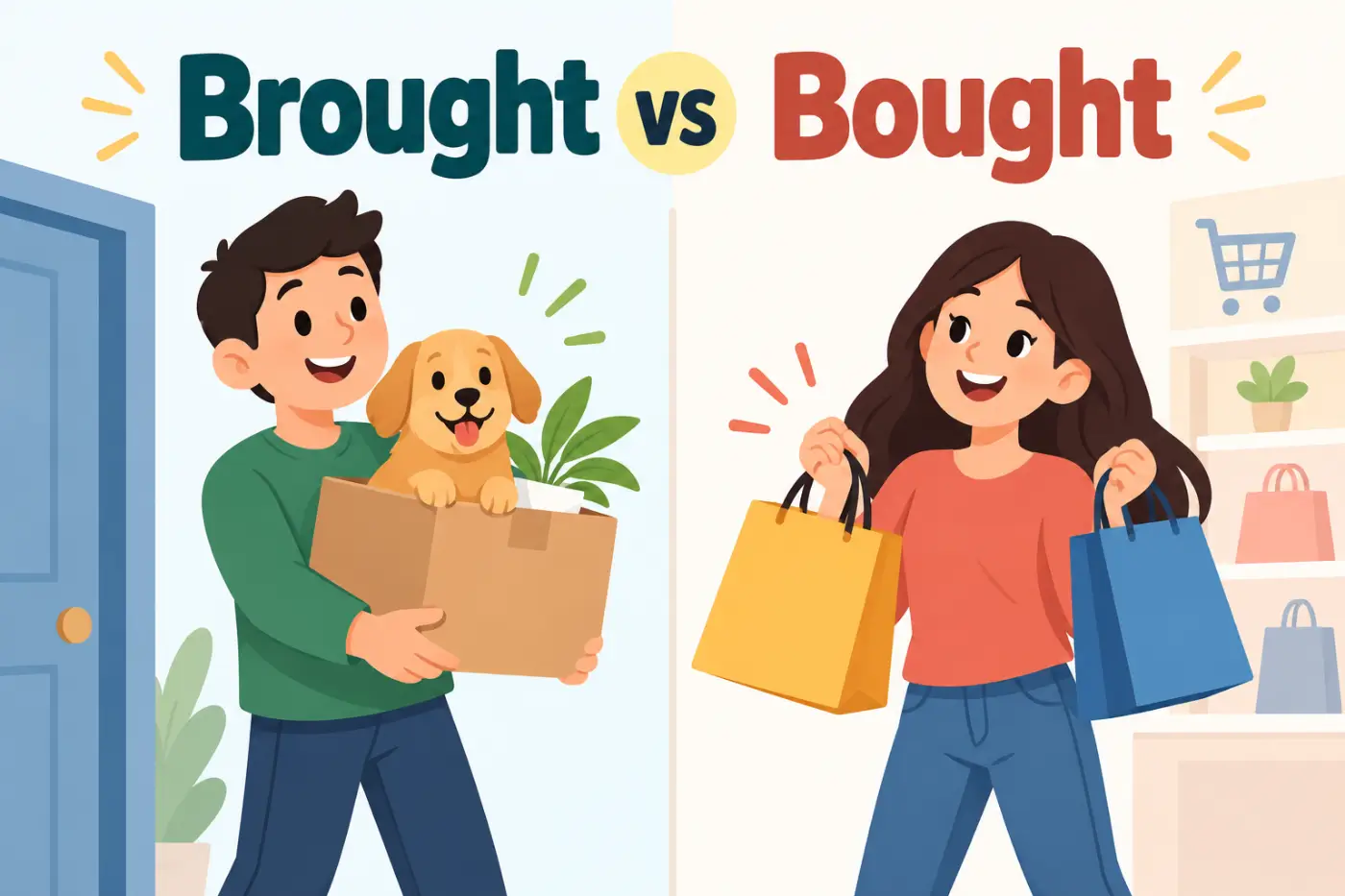
If you’re confused about brought vs bought you’re dealing with two real English words that sound very similar. They also have very different meanings. One means carrying something to a person or place. The other means paying for something and getting it in return.
The easiest way to remember them is this. Brought comes from bring. Bought comes from buy. If you can connect each word to its base verb you can usually choose the right one without guessing.
This small difference matters because using the wrong word can change the meaning of an entire sentence. If you write that you bought dinner when you mean you carried dinner to your friend you are saying something completely different.
This guide explains the meaning of both words their pronunciation their grammar and their most common uses. You’ll also see simple examples memory tricks and common mistakes so you can use both words naturally.
Quick Definition
Brought is the past tense and past participle of bring. It means someone carried moved or caused something to come to a particular person place or situation.
Bought is the past tense and past participle of buy. It means someone paid money to get something.
Direct Answer
Brought means carried or took something to a person or place. Bought means purchased something by paying for it.
Comparison Table
| Word | Meaning | Example Sentence | When to Use It |
|---|---|---|---|
| Brought | Past tense of bring. | She brought some cookies to the party. | Use it when someone carried or moved something to a place or person. |
| Bought | Past tense of buy. | She bought some cookies at the store. | Use it when someone purchased something. |
Why Brought And Bought Get Confused
These words cause trouble because they look almost identical. They both have the same number of letters and both contain the letters b o and t. The main difference is the middle sound and the meaning behind each word.
Their pronunciation can also make things harder. In many varieties of American English the words sound very similar when spoken quickly. Brought has a sound closer to brawt while bought is closer to bawt. The difference can be small depending on the speaker and accent.
That means you cannot always rely on sound alone. Context usually gives you the answer.
- Consider these two sentences.
- I brought a sandwich to work.
- I bought a sandwich at the store.
In the first sentence the person already had the sandwich and carried it to work. In the second sentence the person paid for the sandwich. The action is different even though the two words sound alike to many listeners.
What Brought Means
Brought is the past tense of bring. The basic idea is movement toward a person place or situation.
If you bring something you move it from one location to another. The destination matters. You can bring something to a friend a meeting a party your home or any other place. For example.
- I brought my laptop to the office.
- She brought flowers to her mother.
- They brought extra chairs for the guests.
- He brought his dog to the park.
In each sentence something moves toward a destination.
- The word can also describe bringing a person.
- My brother brought his friend to dinner.
- She brought her children to the museum.
The meaning does not always involve physically carrying something. Bring can also describe causing something to happen or helping something come about.
- The new policy brought major changes to the company.
- Her speech brought tears to my eyes.
- The decision brought relief to the family.
So the central idea is movement or a result that comes to someone or something.
What Bought Means
Bought is the past tense and past participle of buy. It means that someone purchased something. The person gives money or another form of payment in exchange for a product service or item. For example.
- I bought a new phone yesterday.
- She bought groceries after work.
- We bought tickets for the concert.
- He bought a birthday gift for his sister.
The key idea is purchase. If money was paid to get something the word you probably need is bought. You can buy physical things such as clothes food furniture and electronics. You can also buy services experiences and digital products.
- They bought a house last year.
- I bought a subscription online.
- She bought a ticket for the flight.
- He bought lunch for everyone.
In each example the person paid to get something.
Brought Comes From Bring
One of the easiest ways to remember the difference is to connect brought with its base verb bring.
- The verb changes form in the past tense.
- Bring becomes brought.
This is an irregular verb. That means you cannot simply add ed to create the past tense. The word changes from bring to brought. Here are a few examples.
- I bring my lunch to work every day.
- Yesterday I brought my lunch to work.
- She brings her notebook to class.
- Yesterday she brought her notebook to class.
- They bring extra blankets when they travel.
- They brought extra blankets last night.
- The present form is bring. The past form is brought.
That connection is worth memorizing because it gives you a quick test whenever you are unsure. If you could replace the word with bring in the present tense then brought is probably the form you need for the past.
Bought Comes From Buy
- The same trick works with bought.
- Bought is the past form of buy.
- Buy becomes bought.
Again this is an irregular verb. You cannot form the past tense by adding ed. The word changes completely. Here are some examples.
- I buy coffee every morning.
- I bought coffee this morning.
- She buys clothes online.
- She bought a new jacket yesterday.
- They buy fresh fruit every week.
- They bought fresh fruit on Saturday.
- The present form is buy. The past form is bought.
- This gives you a simple mental shortcut.
- Bring becomes brought.
- Buy becomes bought.
Once you remember those two pairs the spelling becomes much easier.
Brought In Real Sentences
The best way to understand this word is to see how people use it in normal conversation.
Bringing Food
Food is one of the most common things people bring.
- I brought pizza to the party.
- She brought cookies for the children.
- He brought lunch from home.
- They brought snacks for the road trip.
In each sentence the food moved from one place to another. The person had it and took it to a destination.
Bringing Objects
- You can bring almost any object.
- I brought my umbrella because it looked like rain.
- She brought her notebook to the meeting.
- He brought an extra charger for his phone.
- We brought some blankets for the guests.
- The word focuses on movement rather than payment.
Bringing People
The word also works when someone takes another person to a place.
- She brought her daughter to the doctor.
- He brought his friend to the party.
- My parents brought me to the restaurant.
- They brought their children to the beach.
Here the person is the thing being moved toward a destination.
Bringing Results
- The meaning can become more abstract.
- The change brought better results.
- The news brought hope to the community.
- His apology brought peace to the family.
- The rain brought relief after several hot days.
Nobody physically carried hope peace or relief. Instead something caused those results to come about.
Bought In Real Sentences
Bought is just as common in everyday English.
The Food Buying’s
- I bought some apples at the grocery store.
- She bought a sandwich for lunch.
- We bought fresh bread this morning.
- He bought coffee on his way to work.
- The word tells us that someone paid for the food.
Buying Clothes
- She bought a new dress for the wedding.
- I bought two shirts during the sale.
- He bought a winter coat last week.
- They bought matching shoes for the trip.
Buying Larger Items
- You can also use bought for expensive purchases.
- We bought a new car last month.
- They bought their first house in 2024.
- She bought a new computer for work.
- He bought a used bicycle from a local seller.
The price does not matter. The important point is that someone purchased the item.
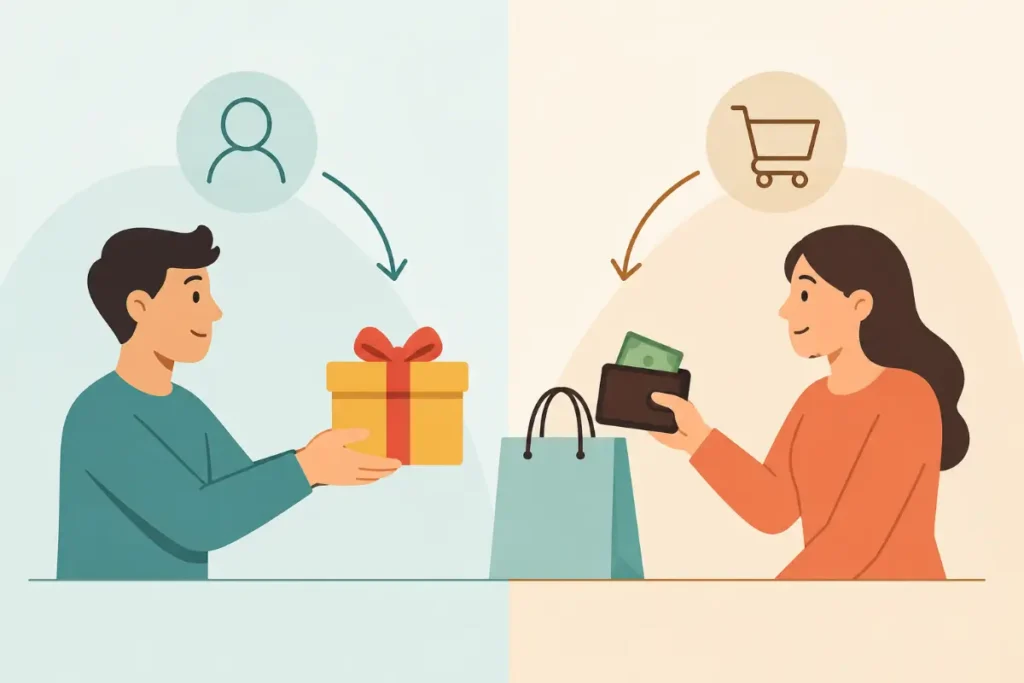
Brought vs Bought In One Situation
A single situation can contain both words. This is one of the best ways to understand the difference.
- Imagine that you go to a grocery store.
- You bought a cake at the store.
- Then you brought the cake to your friend’s house.
The first action involved purchasing the cake. The second involved carrying or moving it to a new place. You could also say this.
- I bought flowers at the market and brought them home.
- The flowers were purchased at the market. Then they were moved to your home.
That simple sequence shows the difference clearly.
- Buy means purchase.
- Bring means move something toward a person or place.
- Their past forms are bought and brought.
Common Mistakes With These Words
People often use the wrong word because they focus on sound instead of meaning. The easiest way to avoid the mistake is to identify the action first.
Ask yourself one simple question. Did someone pay for it?
If the answer is yes use bought. If the action involves carrying or moving something to a destination use brought. Look at these examples.
- Incorrect: I brought a new laptop yesterday.
- Correct: I bought a new laptop yesterday.
The second sentence is correct if you mean you purchased the laptop.
- Now consider this example.
- Incorrect: I bought my lunch from home.
- Correct: I brought my lunch from home.
The second sentence is correct if you prepared or had the lunch already and carried it from home.
- Context can change the answer.
- I bought lunch at the restaurant.
- I brought lunch to the restaurant.
Both sentences are correct. The first says you purchased lunch there. The second says you carried lunch there.
Brought And Bought Are Both Past Tense Words
Another source of confusion is that both words describe actions that happened in the past. That can make them seem like two forms of the same verb. They are not.
- Brought belongs to bring.
- Bought belongs to buy.
- Compare the pairs.
- Bring becomes brought.
- Buy becomes bought.
Take a look at how they work in sentences.
I bring my lunch to work most days. Yesterday I brought a sandwich and some fruit from home. I usually buy lunch on Fridays when I’m busy. Last Friday I bought a salad from the café near my office. The time is similar but the action is different.
This distinction matters in writing because the wrong word can change the entire message.
The Difference Between Bring And Take
Understanding bring also means understanding take because these verbs describe movement in opposite directions in many situations. Bring usually describes movement toward the speaker or another destination being discussed.
Take usually describes movement away from the speaker or toward another destination. For example.
- Bring your books to my office.
- Take these books to your teacher.
In the first sentence the books are moving toward the speaker’s location. In the second sentence they are moving away from the speaker toward the teacher.
This distinction can be flexible in real conversation because the speaker’s point of view matters. Still the basic idea is useful.
- The past form of bring is brought.
- The past form of take is took.
That gives you another useful word family to remember.
- Bring becomes brought.
- Take becomes took.
- Buy becomes bought.
Brought And Bought In Questions
Both words work naturally in questions.
- Did you bring your jacket?
- Did you buy your jacket?
These questions ask for completely different information.
- The first asks if you carried the jacket with you.
- The second asks if you purchased it.
You can also use them in longer questions.
- Who brought the food to the party?
- Where did you buy those shoes?
- Did Sarah bring enough chairs?
- When did you buy your new laptop?
The question itself often gives you a clue about which action is being discussed.
Brought And Bought In Negative Sentences
These words also appear in negative sentences. One grammar point matters here. After did not or didn’t you normally use the base verb rather than the past form. So you say.
I didn’t bring my wallet.
Not.
I didn’t brought my wallet.
You also say.
I didn’t buy anything.
Not.
I didn’t bought anything.
This happens because did already shows the past tense. The main verb returns to its base form. Compare these sentences.
- I didn’t bI brought my wallet with me yesterday.
- I didn’t bring it with me today.
She bought a jacket last weekend but decided not to buy another one this week.ring my wallet. This rule is useful because learners sometimes know the correct past forms but accidentally use them after did.
Brought And Bought In Questions With Did
The same rule applies to questions with did.
You say.
- Did you bring your passport?
- Did you buy the tickets?
You do not say.
- Did you brought your passport?
- Did you bought the tickets?
The word did already marks the past. That is why the main verb stays in its base form. This is a small grammar rule but it makes a big difference in everyday English.
How To Remember The Difference
You do not need a complicated spelling trick. The strongest memory aid is to connect each past tense word with its base verb.
Remember Brought With Bring
Think of these as one pair.
Bring → Brought.
If someone carried something to you or to a destination they brought it.
- She brought flowers to the hospital.
- He brought his laptop to class.
- They brought extra chairs to the event.
Remember Bought With Buy
Think of these as another pair.
Buy → Bought.
- If someone paid for something they bought it.
- She bought flowers at the store.
- He bought a laptop last week.
- They bought extra chairs for the event.
Use The Money Test
When you are unsure ask yourself if money changed hands.
- If you paid for the item the answer is bought.
- If you carried or moved the item to another place the answer is brought. For example.
- I bought a cake.
- Then I brought the cake to the party.
- That two step example is easy to remember because it shows both words doing different jobs.
A Simple Memory Trick
Think of the letter b at the start of both words as a reminder that they belong to different families.
- Brought has bring behind it.
- Bought has buy behind it.
You can also connect the vowel sound with the base words.
- Bring has an i sound and becomes brought.
- Buy has the long i sound and becomes bought.
The spelling still needs to be learned but the verb connection is much more reliable than trying to memorize the two past forms separately.
When Brought Means Caused
There is one useful meaning of brought that goes beyond physical movement. The word can mean caused something to happen. For example.
- The storm brought heavy rain.
- Her decision brought new opportunities.
- The medicine brought quick relief.
- The announcement brought excitement to the crowd.
- In these sentences nobody carried anything. The word describes a result.
- The storm caused heavy rain. The decision caused new opportunities. The medicine caused relief.
- This use is common in everyday English and formal writing.
Common Expressions With Brought
Some phrases with brought are especially common.
Brought Back
- Brought back can mean returned something or caused a memory or feeling to return.
- She brought the book back to the library.
- That song brought back memories of high school.
Up The Brought
- Brought up can mean raised a child or introduced a subject for discussion.
- Her parents brought her up in a small town.
- He brought up an interesting question during the meeting.
Brought In
Brought in can mean carried something inside or introduced something that produces money or results. She brought in some extra chairs.
The new product brought in more customers.
Brought Along
- Brought along means took someone or something with you.
- I brought my sister along to the concert.
- She brought along some snacks for the trip.
- These phrases show how flexible the word can be.
Common Expressions With Bought
The past form of buy also appears in several familiar expressions.
Bought It
In informal English bought it can have more than one meaning depending on context. It can simply mean purchased something.
I liked the jacket so much that I bought it. In some informal contexts it can also mean someone died or was killed. That meaning is much more specific and depends heavily on the situation.
Bought Out
Bought out means one company or person purchased another company or a person’s share of a business. The larger company bought out its competitor.
Bought Into
Bought into can mean purchased a share in something. It can also mean accepted or believed an idea.
- She bought into the business with two partners.
- He bought into the idea after hearing the full plan.
These expressions are useful because they show that bought can appear in phrases with meanings beyond a simple purchase.
Brought And Bought In Everyday Conversation
Native speakers use these words constantly. You might hear them at home work school restaurants stores and social events.
A friend might ask. Did you bring anything to eat?
You might answer.
Yes. I brought some sandwiches.
Someone else might ask. Where did you buy them?
You could say.
I bought them at the bakery.
Notice how naturally the two words work together. The food was purchased at the bakery and then carried to the place where the speakers are talking. That is the central difference in everyday English.
Examples That Show The Difference Clearly
Here are several pairs that make the distinction easy to see.
- I bought a book.
- I brought a book to class.
The first sentence focuses on the purchase. The second focuses on moving the book to class.
- She bought flowers.
- She brought flowers to her mother.
Again the first sentence tells us where the flowers came from financially. The second tells us where she took them.
- We bought some food.
- We brought the food home.
The food was purchased first. Then it was moved home.
- He bought a gift.
- He brought the gift to the party.
The gift was purchased at some point and later carried to the party. Once you see the pattern this way the difference becomes much easier to remember.
A Quick Grammar Test
When writing a sentence choose the base verb first. Ask yourself which action you mean.
- If the action is bring then its past form is brought.
- If the action is buy then its past form is bought.
For example.
- I need to bring my documents.
- Yesterday I brought my documents.
- I need to buy some paper.
- Yesterday I bought some paper.
This method works better than trying to remember which spelling looks right. Meaning gives you the answer first. Grammar gives you the correct past form second.
Why Context Matters
Sometimes a sentence can contain both words and the surrounding details make the meaning clear.
- Consider this sentence.
- I bought a cake and brought it to my friend’s house.
- There is no confusion because the sentence describes two separate actions.
- First the speaker purchased the cake.
- Then the speaker carried it to another place.
- Now compare this sentence.
- I bought a cake for my friend.
This only tells us that the speaker purchased the cake. It does not say that the speaker personally delivered it.
If you write I brought a cake for my friend the focus changes. It suggests that the speaker carried the cake to the friend or to a place where the friend would be. Small word choices can add useful details to a sentence.
How To Use These Words In School Writing
Students often confuse these words in essays assignments and short answers. The easiest solution is to slow down when writing about past events.
- If you mean purchased use bought.
- If you mean carried or took to a place use brought.
- For example.
- I bought a new book for my history class.
- I brought the book to school every day.
The first sentence tells the reader how you got the book. The second tells the reader what you did with it afterward. This distinction also helps make your writing more precise. Instead of choosing a word because it sounds right you choose it because it expresses the exact action.
How To Use These Words At Work
These words are common in professional communication too.
- We bought new equipment for the office.
- She brought the documents to the meeting.
- The company bought new software.
- The manager brought the issue to the team’s attention.
The last example uses brought in an abstract sense. The manager did not physically carry the issue. Instead the manager introduced it for discussion.
Using the right word keeps business messages clear and prevents simple mistakes from distracting the reader.
A Useful Way To Proofread
When you see brought or bought in your writing ask yourself what happened.
Did someone purchase something?
Use bought.
Did someone carry or move something to a person or place?
Use brought.
Did the word follow did?
Use the base verb instead.
- I didn’t buy it.
- I didn’t bring it.
- Did you buy it?
- Did you bring it?
This three step check catches most mistakes involving these words.
FAQs
What is the difference between brought and bought?
Brought is the past form of bring. Bought is the past form of buy. Brought usually means carried or moved something to a person or place while bought means purchased something.
Is brought the past tense of bring?
Yes. Brought is both the past tense and past participle of bring. For example you can say I brought my bag yesterday or I have brought my bag with me.
Is bought the past tense of buy?
Yes. Bought is the past tense and past participle of buy. For example you can say I bought a new phone yesterday or I have bought everything we need.
How can I remember brought vs bought?
Connect each word to its base verb. Bring becomes brought while buy becomes bought. You can also use the money test because buying involves paying for something.
Can brought and bought be used in the same sentence?
Yes. They can describe two different actions involving the same item. For example you can buy a cake at a store and then bring the cake to a party.
Which is correct brought or bought a gift?
Both can be correct because they describe different actions. You bought a gift if you purchased it. You brought a gift if you carried or took it to someone or somewhere.
Do brought and bought sound the same?
They can sound very similar in American English especially in fast speech. Their meanings are different so context often helps listeners understand which word someone means. Their spellings also come from different verbs.
Should I say I bought it or I brought it?
Use I bought it when you mean you purchased it. Use I brought it when you mean you carried or moved it to a person or place.
Conclusion
The easiest way to remember brought vs bought is to go back to the base verbs. Brought comes from bring and describes something being carried or moved toward a person place or situation. Bought comes from buy and describes something being purchased.
Think about a simple trip to a store. You might buy a sandwich there. Later you might bring that sandwich to work. The purchase gives you bought while the movement gives you brought.
When you are unsure pause and ask what action the sentence describes. If money was paid for something use bought. If something was carried or moved to a destination use brought. After did or didn’t use the base verbs buy and bring instead.
That small test will solve most problems. Remember the two pairs as bring and brought and buy and bought. Once those connections become automatic you won’t need to stop and guess.

Dr. Elena Vance holds a Ph.D. in Linguistics from Columbia University and has spent over 15 years analyzing the evolution of the English language. A former university professor turned full-time writer and editor, Elena specializes in breaking down high-level grammatical concepts, punctuation nuances, and style guides (APA, Chicago, MLA) into clear, actionable advice. When she isn’t hunting down dangling modifiers, she can be found collecting vintage dictionaries and reading classic literature.