

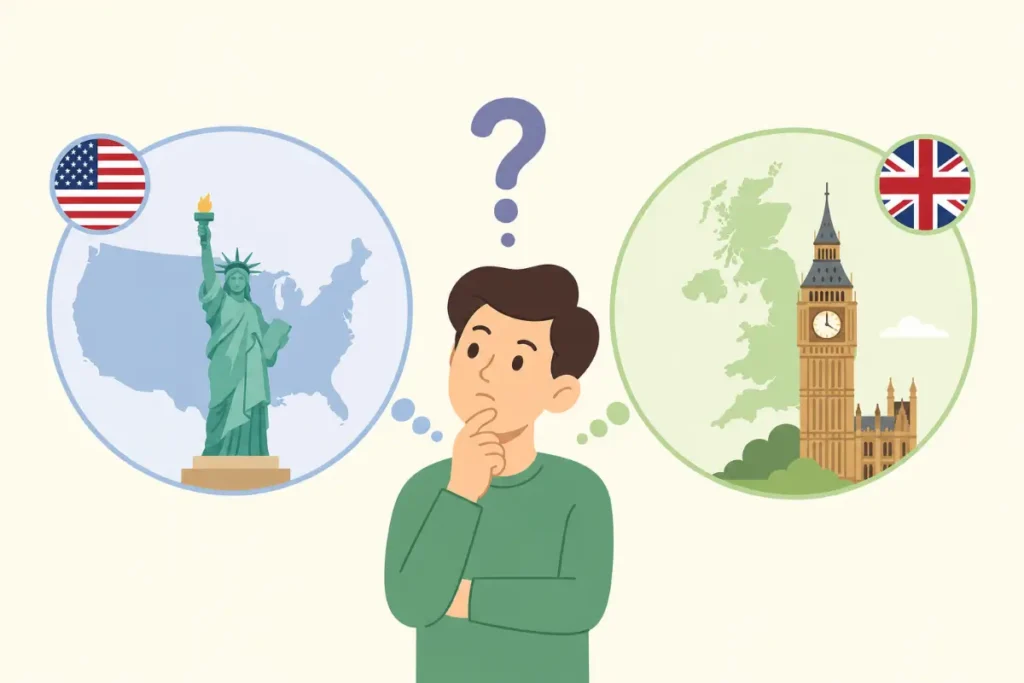
If you’ve searched for skeptical vs sceptical you’re probably wondering which spelling you should use. The answer is simple. Skeptical is the standard spelling in American English. Sceptical is the standard spelling in British English and several other varieties of English.
Both words have the same meaning. They describe someone who isn’t ready to believe a claim without enough proof or evidence. The difference comes down to regional spelling rather than meaning.
That small spelling difference matters when you’re writing for a particular audience. An American reader will normally expect skeptical while a British reader may expect sceptical. This guide explains the difference clearly and shows you how to choose the right form without second guessing yourself.
Quick Definition
Skeptical and sceptical are two spellings of the same adjective. Both describe a person who doubts a claim or wants evidence before accepting it as true.
American English normally uses skeptical. British English normally uses sceptical.
Direct Answer
Skeptical is correct in American English. Sceptical is correct in British English. Neither spelling is wrong when it matches the English variety you’re using.
Comparison Table
| Word | Meaning | Example Sentence | When to Use It |
|---|---|---|---|
| Skeptical | Doubting something or needing proof before believing it. | I’m skeptical about that claim. | Use it in American English. |
| Sceptical | The same meaning as skeptical. | I’m sceptical about that claim. | Use it in British English. |
Why The Two Spellings Exist
The difference between these spellings comes from the way English developed in different regions. English speakers in the United States gradually developed spelling preferences that differ from common British usage.
The word comes from the Greek word skeptikos which is linked to the idea of examining or considering something carefully. It entered English through Latin and French forms before developing into the modern word we use today.
The spelling with k became standard in American English. British English generally kept the spelling with c.
This isn’t a case where one country changed a correct word into an incorrect one. Both forms became established in their own varieties of English.
You can think of it like color and colour. American English uses color while British English uses colour. The meaning stays exactly the same. Only the accepted spelling changes.
The same idea applies here.
Skeptical In American English
If you’re writing for readers in the United States, skeptical is the spelling you should normally choose.
American dictionaries and style guides use the spelling with k. You’ll see it in newspapers, books, academic writing, business documents, and everyday communication across the United States.
Here are some natural examples.
- I’m skeptical about his explanation.
- She was skeptical when she heard the news.
- The doctor remained skeptical about the new treatment.
- Investors are skeptical about the company’s claims.
- He sounded skeptical when I told him what happened.
In each sentence, the word describes doubt or a need for stronger evidence.
The person doesn’t necessarily think the claim is false. A skeptical person simply isn’t convinced yet.
That distinction matters. Being skeptical doesn’t always mean being negative.
Sceptical In British English
British English normally uses sceptical with a c.
You’ll commonly see this spelling in the United Kingdom. It also appears in other places where British English has had a strong influence.
For example.
- I’m sceptical about his explanation.
- She was sceptical when she heard the news.
- The doctor remained sceptical about the new treatment.
- Investors are sceptical about the company’s claims.
- He sounded sceptical when I told him what happened.
Notice that the sentences haven’t changed in meaning. Only the spelling has changed.
This is why treating one form as simply wrong can cause confusion. The correct choice depends on the English variety you’re writing in.
What Does Skeptical Mean
The adjective skeptical describes a person who has doubts about something.
Imagine someone tells you that a new product can make you rich in a week. You don’t immediately believe the claim. Instead, you ask how it works, look for evidence, and check the source.
You’re being skeptical.
A skeptical person doesn’t automatically reject every claim. They want a good reason to believe it.
For example, someone might say:
I’m skeptical because we haven’t seen any evidence yet.
That person isn’t saying the claim is definitely false. They’re saying the available information isn’t strong enough to convince them.
This is an important part of the word’s meaning. Skepticism is often connected with careful thinking and questioning.
Skeptical Does Not Mean Negative
People sometimes use skeptical as if it means negative, cynical, or completely opposed to an idea. That’s not quite right.
A skeptical person may simply want more information.
Suppose your friend tells you that a restaurant has the best pizza in town. You might say:
- I’m skeptical. I’ve heard that before.
You aren’t necessarily saying the restaurant is bad. You’re saying you aren’t ready to accept the claim without seeing for yourself.
That difference becomes even clearer in professional settings.
A scientist may be skeptical about a new theory. That doesn’t mean the scientist refuses to consider it. The scientist may simply want more data before accepting the theory.
A journalist may be skeptical about a source’s claim. That can lead the journalist to check documents and speak with other sources.
A customer may be skeptical about a product advertisement. They may read reviews before buying.
In all three cases, doubt leads to investigation.
The Difference Between Skeptical And Cynical
Skeptical and cynical can look similar because both can involve doubt. Their meanings aren’t identical.
A skeptical person asks for evidence before believing something.
A cynical person often expects people to act for selfish or dishonest reasons.
Consider these two statements.
- I’m skeptical that the product works as advertised.
- I’m cynical about the company’s motives.
The first statement focuses on evidence. The second focuses on the company’s intentions.
You can be skeptical without being cynical.
In fact, healthy skepticism can help you make better decisions. It encourages you to pause before accepting a claim simply because someone says it confidently.
The Difference Between Skeptical And Doubtful
Doubtful is another close synonym. The two words overlap but can carry slightly different shades of meaning.
If you say you’re doubtful about something, you’re expressing uncertainty about it.
If you say you’re skeptical, you’re often suggesting that you need evidence or a convincing reason before accepting it.
Compare these examples.
- I’m doubtful that the meeting will happen today.
- I’m skeptical about the company’s promise.
The first sentence expresses uncertainty. The second suggests that the speaker wants proof.
In everyday conversation, the two words can sometimes be used in similar ways. The difference becomes clearer in formal writing and careful discussion.
Skepticism Can Be A Good Thing
Skepticism often gets a bad reputation because people associate it with negativity. In many situations, though, asking questions is useful.
Imagine you’re about to buy an expensive item online. The seller claims that the product is brand new and guaranteed to last for twenty years.
A skeptical buyer won’t simply trust the advertisement. They may check the warranty, read customer reviews, compare prices, and look at the seller’s reputation.
That doesn’t make the buyer difficult. It makes the buyer careful.
The same habit can help with news and information online. A surprising claim can spread quickly even when the evidence behind it is weak.
A skeptical reader might ask:
- Who made this claim.
- What evidence supports it.
- Is the source reliable.
- Can another source confirm it.
- Is important information missing.
Those questions can prevent simple mistakes.
Common Examples Of Skeptical In Real Life
The word appears in many situations because people question claims all the time.
In Everyday Conversation
- My brother was skeptical when I said I could fix the sink myself.
- She looked skeptical when he promised to arrive early.
- I’m skeptical about that story.
These sentences describe ordinary doubt.
In Business
Businesses often use the word when discussing customers, investors, forecasts, and claims.
- Investors remain skeptical about the company’s growth forecast.
- Customers were skeptical about the new pricing plan.
- The manager was skeptical about the projected sales figures.
Here the word often suggests that people want evidence before making a decision.
In Science
Skepticism plays an important role in scientific work.
Scientists test ideas instead of accepting them simply because they sound convincing. They examine evidence and look for results that can support or challenge a claim.
For example.
- Researchers were skeptical of the early results.
- The scientific community remained skeptical until more data became available.
This doesn’t mean scientists refuse to accept new ideas. Good scientific thinking allows ideas to be tested.
In News Reporting
Journalists may describe a source or claim as skeptical.
- Analysts remain skeptical about the proposed deal.
- Experts are skeptical that the plan will produce quick results.
The word can help show that a claim has not been fully accepted.
In Advertising
Consumers often become skeptical when an advertisement makes an unusually strong promise.
- Shoppers were skeptical about the product’s dramatic claims.
- Many customers remain skeptical of advertisements promising instant results.
Again, the idea is doubt rather than automatic rejection.
How To Choose The Right Spelling
The easiest rule is based on your audience.
- If you’re writing for an American audience, use skeptical.
- If you’re writing for a British audience, use sceptical.
This rule also helps when you’re writing for schools, companies, websites, or publications that follow a particular style guide.
For a US grammar website, for example, skeptical is the natural choice. A British newspaper would normally use sceptical.
The same principle applies to related words.
- American English uses skeptic.
- British English uses sceptic.
- American English uses skepticism.
- British English uses scepticism.
The spelling change stays connected to the same letter pattern.
Skeptic And Sceptic
The noun forms follow the same regional pattern.
- A skeptic is a person who questions a claim or isn’t easily convinced.
- A sceptic has the same meaning in British English.
For example.
- The skeptic asked for more evidence.
- The sceptic asked for more evidence.
Both sentences mean the same thing.
If your article follows American English, use skeptic. If it follows British English, use sceptic.
This consistency matters more than choosing one spelling as universally correct.
Skepticism And Scepticism
The noun follows the same spelling difference.
- American English uses skepticism.
- British English uses scepticism.
Both refer to an attitude of doubt or a habit of questioning claims.
Here are two examples.
- Healthy skepticism can help people make better decisions.
- Healthy scepticism can help people make better decisions.
The meaning remains unchanged.
If you’re writing for US readers, the version with k is the better choice.
Common Mistakes With These Spellings
One common mistake is assuming that sceptical is simply a misspelling. That isn’t true. It is the standard British spelling.
Another mistake is switching between the two forms in the same article. If you start with American English and use skeptical throughout, suddenly using sceptical can make the article look inconsistent.
The reverse is also true.
A British publication should normally stick with sceptical instead of changing back and forth between regional forms.
Consistency gives your writing a cleaner appearance.
Mistake One
- Incorrect for standard American English: The reporter was sceptical of the claim.
- Better for American English: The reporter was skeptical of the claim.
Mistake Two
Incorrect for standard British English: The reporter was skeptical of the claim.
Better for British English: The reporter was sceptical of the claim.
The word itself isn’t the problem. The regional spelling is what matters.
Why The K Spelling Is Used In American English
American spelling has several patterns that differ from British spelling. The difference isn’t limited to this word.
You can see similar changes in words such as organize and organise. American English commonly uses z while British English commonly uses s.
You can also see differences in words like color and colour.
The spelling of skeptical follows this broader pattern of regional variation. American English favors the form with k while British English favors the form with c.
This is one reason it’s useful to think about the audience before you choose a spelling.
Is One Spelling More Correct
- No. Both are correct within the English variety that uses them.
- Calling one spelling universally correct misses the main point. English exists in several established varieties and each has its own spelling conventions.
- American readers are accustomed to skeptical.
- British readers are accustomed to sceptical.
- Neither group needs to change its spelling simply because another variety uses a different form.
- The key is consistency.
How Dictionaries Treat The Two Forms
Major English dictionaries generally recognize both forms. They identify the spelling used in different English speaking regions.
This is useful because dictionaries don’t simply tell you if a word exists. They can also show pronunciation, meaning, word class, examples, and regional usage.
When you’re unsure about a spelling difference, check a dictionary that matches your target audience. An American dictionary is especially useful for US writing. A British dictionary is useful when following UK conventions.
This is a better approach than assuming that the spelling you’ve seen most often is the only correct one.
How To Use Skeptical Naturally
The word usually appears before a noun or after a linking verb.
Here are some common patterns.
Skeptical About Something
This is one of the most common structures.
- I’m skeptical about the results.
- She was skeptical about his promise.
- They remain skeptical about the plan.
The phrase skeptical about means you have doubts about something.
Skeptical Of Something
You can also use skeptical of.
- The committee was skeptical of the proposal.
- Many experts are skeptical of the claim.
- He remained skeptical of their explanation.
Both skeptical about and skeptical of are natural.
Skeptical That Something Will Happen
You can use the word before a clause that expresses a doubtful expectation.
- I’m skeptical that the project will finish on time.
- She was skeptical that the plan would work.
- They are skeptical that sales will improve quickly.
This structure is common in conversation and professional writing.
How To Use The Word In A Strong Sentence
Good writing doesn’t require complicated sentences. The word works best when the reason for the doubt is clear.
Compare these examples.
- I’m skeptical.
That sentence is grammatically correct but gives little information.
Now consider this.
- I’m skeptical because the company hasn’t provided any evidence.
The second sentence tells the reader why the speaker has doubts.
You can make the idea even more useful by explaining what evidence would change your mind.
- I’m skeptical about the claim because the study involved only twenty people.
That sentence gives the reader a reason for the doubt. It sounds measured rather than dismissive.
When Skepticism Becomes Cynicism
There is a point where healthy doubt can become something less useful.
A skeptical person is open to evidence. If strong evidence supports a claim, they can change their mind.
A cynical person may reject a claim even after strong evidence appears because they assume bad motives or expect disappointment.
That distinction is useful in writing because the word skeptical often carries a more neutral tone.
For example.
- The editor was skeptical about the results.
This simply tells us that the editor wanted stronger proof.
Compare that with:
- The editor was cynical about the researchers.
Now the sentence suggests a deeper distrust of the people involved.
Choosing the right word helps readers understand the exact attitude you’re describing.
A Simple Memory Trick
If you’re writing for Americans, remember skeptical has a k.
You can connect the k with K for American spelling as a quick memory aid. It isn’t a formal spelling rule. It’s simply a handy trick.
For British English, remember sceptical has a c.
You don’t need a complicated rhyme. Just connect each spelling with its English variety.
Another useful trick is to learn the entire word family together.
American English.
- Skeptical.
- Skeptic.
- Skepticism.
British English.
- Sceptical.
- Sceptic.
- Scepticism.
Once you know one form, the others become much easier.
Related Spelling Differences
If you’re learning American English, this word belongs to a much larger group of regional spelling differences.
Color And Colour
- American English uses color.
- British English uses colour.
Center And Centre
- American English uses center.
- British English uses centre.
Theater And Theatre
- American English commonly uses theater.
- British English commonly uses theatre.
Favorite And Favourite
- American English uses favorite.
- British English uses favourite.
Organize And Organise
- American English commonly uses organize.
- British English commonly uses organise.
These differences show why spelling should be considered alongside audience and publication style. English isn’t a single fixed system used in exactly the same way everywhere.
Is Skeptical A Formal Word
Yes. Skeptical is suitable for both everyday and formal writing.
You can use it in a casual conversation.
- I’m skeptical about that.
You can also use it in an academic or professional sentence.
- The researchers remained skeptical of the findings until additional evidence was available.
The word doesn’t sound overly formal. It fits naturally into many types of writing.
Is Skeptical A Negative Word
Not necessarily.
The tone depends on the context.
- If you say someone is skeptical because they refuse to believe anything anyone tells them, the word may sound critical.
- If you say a scientist is skeptical until more evidence becomes available, the word can sound thoughtful and careful.
The surrounding words usually tell readers how to understand the attitude.
For example.
- She was skeptical but willing to listen.
This sentence clearly presents skepticism as an open minded position.
Can You Say Very Skeptical
Yes. Very skeptical is grammatically correct and common.
For example.
- I’m very skeptical about that explanation.
- The public remains very skeptical of the proposal.
You can also use words such as deeply, highly, or extremely depending on the context.
- The committee was highly skeptical of the figures.
- He was extremely skeptical about the promise.
These phrases make the level of doubt stronger.
Can Skeptical Be Used As A Noun
No. Skeptical is an adjective.
You need a noun form when you want to name the person or the attitude.
Use skeptic for a person.
- She is a skeptic.
Use skepticism for the attitude.
- His skepticism was understandable.
The same pattern applies to the British forms sceptic and scepticism.
Knowing the word family can help you avoid awkward sentences and choose the correct form quickly.

A Quick Editing Check
- If you’re proofreading your own work, ask two questions.
- First, who is your audience.
- If you’re writing for Americans, use the spelling with k.
- Second, have you used the same regional spelling throughout the piece.
- Consistency is the key. A US article should not randomly switch to British spelling halfway through the page unless you’re discussing the difference itself.
- This small check can catch many errors before publication.
FAQs
Which spelling is correct in American English?
Skeptical is the standard American English spelling. It uses k after the s. Use this form for US readers and US focused publications.
Which spelling is correct in British English?
Sceptical is the standard British English spelling. It uses c in the same position. The meaning is exactly the same as the American form.
Is skeptical vs sceptical a difference in meaning?
No. The two spellings have the same meaning. They both describe doubt or a need for evidence before accepting a claim.
Is sceptical wrong in the United States?
It isn’t an invalid English word. However, skeptical is the normal spelling in American English. Using the British form in US writing can look inconsistent with the rest of your spelling.
Is skeptical more common than sceptical?
The answer depends on the English variety and the audience. Skeptical is standard in American English while sceptical is standard in British English. Neither spelling should be treated as universally better.
What is the noun form of skeptical?
The American noun is skeptic. The related noun for the attitude is skepticism. British English uses sceptic and scepticism.
Is skeptical the same as doubtful?
The meanings overlap but they aren’t always identical. Doubtful mainly expresses uncertainty while skeptical often suggests that someone wants evidence before accepting a claim.
Is skeptical the same as cynical?
No. A skeptical person questions a claim and may change their mind after seeing strong evidence. A cynical person often assumes that people have selfish or dishonest motives.
Conclusion
The answer to skeptical vs sceptical depends on the kind of English you’re writing. American English uses skeptical while British English uses sceptical. Both forms are correct in their own regional systems and both have the same meaning.
The word describes doubt. A skeptical person doesn’t accept a claim automatically and may ask for evidence before believing it. That kind of doubt can be useful because it encourages people to check facts and think carefully.
For American readers, choose the spelling with k. If you’re following British English, choose the spelling with c. The same pattern continues with related words such as skeptic and skepticism in American English and sceptic and scepticism in British English.
The practical rule is simple. Know your audience and stay consistent. If your writing is aimed at the United States, write skeptical and use the matching American forms throughout your article.

Dr. Elena Vance holds a Ph.D. in Linguistics from Columbia University and has spent over 15 years analyzing the evolution of the English language. A former university professor turned full-time writer and editor, Elena specializes in breaking down high-level grammatical concepts, punctuation nuances, and style guides (APA, Chicago, MLA) into clear, actionable advice. When she isn’t hunting down dangling modifiers, she can be found collecting vintage dictionaries and reading classic literature.