
If you’ve ever wondered about wack vs whack you’re dealing with two words that look and sound almost the same but don’t always mean the same thing. One spelling is common in informal American English. The other has several established meanings connected to hitting or striking.
The confusion gets worse because wack and whack can sound identical in casual speech. You may hear someone say that a movie is wack or that a person gave something a whack. Both words are real in modern English but they have different histories and uses.
The easiest way to remember the difference is simple. Wack is usually an informal word for something bad strange or uncool. Whack is usually a verb or noun connected to hitting striking or cutting. This article explains the difference with clear examples so you can choose the right word without guessing.
Quick Definition
Wack is an informal word that usually means bad strange silly or uncool. It became especially common in American slang and hip hop culture.
Whack usually means to hit strike or cut something with force. It can also describe a sharp blow or an unusual situation in informal speech.
Direct Answer
Wack is the better choice when you mean bad strange or uncool in informal speech. Whack is the standard spelling when you mean to hit strike cut or give something a sharp blow.
Comparison Table
| Word | Meaning | Example Sentence | When to Use It |
|---|---|---|---|
| Wack | Bad strange silly or uncool. | That movie was wack. | Use it in informal speech and casual writing. |
| Whack | To hit strike or cut something. | He gave the ball a hard whack. | Use it for hitting striking cutting and related meanings. |
| Whack | An informal way to describe something unusual or unfair. | That price is totally whack. | Use it only in casual contexts when the meaning is clear. |
Why These Words Cause Confusion
The biggest problem is pronunciation. In many accents wack and whack sound the same or almost the same. When two words share a sound but have different spellings it is easy to mix them up when writing.
There is also a second problem. Both words can appear in informal expressions that describe something as strange or bad. That overlap makes the distinction less obvious than it seems at first.
For example you might hear someone say that a situation is whack. You might also hear someone call a song wack. The meanings can overlap in casual speech but the words developed along different paths.
- Context usually gives you the answer.
- If someone whacks a table they hit it.
- If someone says a table is wack they are saying the table is bad strange or uncool.
- That one distinction will solve most spelling questions.
What Wack Means
Wack is an informal slang word. It can mean bad poor quality strange ridiculous or uncool. The exact meaning depends on the sentence and the speaker.
You might hear it when someone gives an opinion about music fashion food movies or behavior.
For example:
- That new restaurant is wack.
- His excuse was wack.
- I thought the ending was wack.
- Those rules are wack.
- That song sounds wack to me.
In each sentence the speaker is expressing a negative opinion. The word doesn’t usually describe a physical action.
Because wack is slang it works best in casual situations. You might use it when talking with friends or writing dialogue that sounds natural. You probably wouldn’t use it in a formal report or a professional letter.
Wack Can Mean Bad
This is one of the most common uses.
If someone says a movie is wack they usually mean the movie isn’t good. They may dislike the acting story music or overall quality.
For example:
- I watched that movie last night and it was wack.
The sentence sounds casual and strongly opinionated. In formal writing you could replace the slang with words such as poor disappointing weak or low quality.
Wack Can Mean Uncool
The word can also describe something that feels unfashionable boring or out of touch.
For example:
- Those old rules are wack.
- He thinks wearing that outfit is wack.
- The new design looks wack.
Here the speaker isn’t always saying something is objectively bad. The word can simply express personal dislike.
That is typical of slang. The meaning often depends on tone and social context.
Wack Can Mean Strange
In some conversations wack can suggest that something is weird or unreasonable.
For example:
- That’s a wack way to solve the problem.
- The whole situation was wack.
The speaker may be saying the situation was strange rather than simply terrible.
This flexible meaning is one reason slang can be hard to define with one exact synonym. The word carries an attitude as much as a dictionary meaning.
What Whack Means
Whack has a much older and broader history than the slang word wack. Its most common meaning is connected to hitting something with force.
As a verb it means to hit or strike.
For example:
- He whacked the ball with a baseball bat.
- She whacked the table with her hand.
- The branch whacked me in the face.
- He whacked the box against the wall.
As a noun it can describe one hard hit or blow.
For example:
- He gave the ball a whack.
- Take another whack at it.
- The hammer landed with a loud whack.
The word can also describe cutting something with a strong movement.
For example:
- She whacked the weeds with a garden tool.
- He whacked the branch off with a saw.
The physical meaning is the key idea to remember.
Whack As A Verb
When whack acts as a verb someone or something performs an action.
- The player whacked the ball.
- The child whacked the drum.
- The branch whacked him on the shoulder.
The word often suggests a quick forceful movement. It can sound more informal and vivid than simply saying hit.
Compare these sentences:
- He hit the ball.
- He whacked the ball.
The first sentence is neutral. The second gives you a stronger sense of force and energy.
Whack As A Noun
As a noun whack can mean a hit or blow.
- He gave the door a whack.
- The ball took a hard whack from the bat.
- Give it one more whack.
It can also appear in the phrase a whack at something. That means an attempt to do something.
For example:
- I’ll take a whack at fixing the computer.
- She wants to have a whack at the puzzle.
This use is informal. It does not mean someone is physically hitting the task.
When Wack And Whack Overlap
Things get interesting when whack is used in informal speech to mean strange bad unfair or unreasonable. This use creates some overlap with wack.
For example:
- That price is whack.
- The whole deal sounds whack.
- This system is whack.
In these sentences whack is not about physically hitting anything. It is being used as an informal adjective to describe something as strange bad or unfair.
Some dictionaries and style references recognize this informal use. Still spelling can vary in slang because slang changes quickly across regions communities and generations.
That means you may see wack and whack used differently online. The spelling can depend on the writer’s intended meaning and the variety of slang they use.
For clear writing it helps to keep the main distinction in mind. Use wack for the slang meaning of bad or uncool. Use whack for hitting and for established expressions built around that word.
The Difference Between Wack And Whack
The simplest distinction is based on meaning rather than sound.
Wack is mainly an informal adjective.
Whack is mainly a verb or noun.
Consider these examples.
- That game was wack.
- He whacked the ball.
- The joke was wack.
- She gave the table a whack.
The first and third examples describe something. The second and fourth describe hitting.
This isn’t an absolute rule because slang can change the role of a word. Still it is a useful guide for most everyday writing.
Common Mistakes With These Words
Many mistakes happen because writers remember the sound but forget the meaning. If you only hear the word spoken you have no reliable way to know which spelling the speaker intends.
Using Wack For A Physical Hit
This is usually the wrong choice.
Incorrect:
- He wacked the ball with a bat.
Correct:
- He whacked the ball with a bat.
The second sentence uses the standard spelling for the action of hitting.
Using Whack In Formal Writing To Mean Bad
The word whack can work as slang but formal writing needs clearer language.
Instead of writing:
- The company’s new policy is whack.
A formal report could say:
- The company’s new policy is unreasonable.
In casual conversation the slang version may sound natural. In professional writing a more precise word is usually better.
Assuming Wack Is Always Wrong
This is another common mistake.
Wack is a real informal word. It has been used in American slang for decades and remains familiar to many speakers.
The key is context. It isn’t a misspelling when someone intentionally uses it to mean bad strange or uncool.
Assuming Whack Only Means Hit
The physical meaning is the most common one but it isn’t the only use. Whack appears in several idioms and informal expressions.
For example:
- He took a whack at the problem.
- The price is way out of whack.
- The schedule is out of whack.
These expressions have meanings that go beyond simply hitting something.
What Does Out Of Whack Mean
Out of whack is a common informal expression meaning out of order unbalanced or not working correctly.
For example:
- My sleep schedule is out of whack.
- The printer is out of whack again.
- The numbers seem to be out of whack.
- His routine got out of whack after the trip.
The phrase can describe a physical object a system a schedule or a situation.
It often suggests that something has moved away from its normal or expected condition.
If your computer is out of whack it isn’t working properly. If your sleep schedule is out of whack your sleeping pattern has become irregular.
This expression is common enough that many speakers use it without thinking about the original sense of whack.
What Does Take A Whack At Mean
Take a whack at something means to try something.
For example:
- I’ll take a whack at fixing the sink.
- She took a whack at the crossword puzzle.
- Let me take a whack at the report before you send it.
The phrase is informal and often suggests that someone is making an attempt without claiming to be an expert.
You could replace it with try in most situations.
- I’ll try to fix the sink.
- She’ll try the crossword puzzle.
- Let me try the report.
The phrase take a whack at adds a more casual and playful tone.
What Does Whack Mean In Slang
In slang whack can have several meanings depending on context. It can describe something strange unfair bad or out of order. It can also appear in phrases that have developed their own meanings.
For example:
- That price is whack.
- The schedule is out of whack.
- I’ll take a whack at it.
These examples show why context matters. The first sentence uses whack as an informal description. The second uses an idiom. The third uses a phrase meaning to try.
If you’re writing for a broad audience you should choose a clearer word when the meaning could be misunderstood.
Wack In American Slang
The spelling wack became strongly associated with American slang and hip hop culture. It has been used to describe something considered poor quality fake weak strange or uncool.
Its use has changed over time. Some speakers use it often while others consider it dated slang. Younger speakers may prefer words such as boring weak bad or cringe depending on the situation.
That doesn’t make wack incorrect. It simply means the word belongs to a casual style of language.
Language changes like fashion. A word can be common in one generation and less common in another.
Is Wack Formal English
No. Wack is best treated as informal slang.
That doesn’t mean you can never use it in writing. Writers often use slang in dialogue personal essays reviews social posts and other casual formats.
The key is audience.
If you’re writing a text to a friend you might say:
- That movie was wack.
If you’re writing a college paper you could say:
- The movie had several serious weaknesses.
The second version communicates the same basic idea in a more formal way.
Is Whack Formal English
Whack is more established in standard English than wack. The verb and noun forms are recognized in ordinary dictionaries and can appear in many types of writing.
Still the tone depends on the use.
A sentence such as:
- The branch whacked him in the face.
is perfectly normal.
A sentence such as:
- The entire system is totally whack.
is clearly more informal.
The word itself isn’t automatically informal. Its role and meaning determine the tone.
How To Choose The Right Word
When you’re unsure which spelling to use stop focusing on the sound. Ask what the word means in your sentence.
If you mean bad strange or uncool then wack may be the word you’re looking for in casual writing.
If you mean hit strike blow or attempt then whack is the standard choice.
This simple meaning check is more reliable than trying to remember how the word sounds.
A Simple Memory Trick
- Think of the h in whack as standing for a hard hit.
- The word whack often describes force. Someone whacks a ball. Someone gives a door a whack. A branch whacks someone in the face.
- You can connect the extra letter to the physical action.
- Then save wack for the slang idea of something being bad or uncool.
- It isn’t a perfect spelling rule. It is simply a useful memory hook.
Examples To Make The Difference Clear
Here are some examples that put both spellings side by side.
- That restaurant was wack.
- He whacked the ball over the fence.
The first sentence gives an opinion. The second describes an action.
- Your excuse sounds wack.
- She gave the old chair a whack.
Again the meanings are completely different.
- The movie was wack.
- He whacked the drum with a stick.
The spelling becomes much easier when you focus on what the word is doing in the sentence.
Wack And Whack In Modern Writing
Online writing has made slang much more visible. People write the way they speak in comments social posts messages and forums. As a result informal spellings can spread quickly.
You may see wack used for something bad. You may also see whack used for the same general idea. That doesn’t mean the spellings have become fully interchangeable in every context.
When you’re writing for a website or a general audience clarity should come first. If you use slang make sure the reader can understand the intended meaning from the sentence.
For formal content it is usually better to replace slang with a precise word. Instead of wack you might use poor strange unfair weak or unreasonable.
That small change can make your writing clearer without changing the message.
Related Words That Sound Similar
English has many pairs of words that sound alike or nearly alike but have different spellings and meanings. These are often called homophones or near homophones.
Examples include:
- Right and write.
- Break and brake.
- Peace and piece.
- Sight and site.
- Allowed and aloud.
The same basic lesson applies here. Sound alone isn’t enough. Meaning and context help you choose the correct spelling.
This is especially useful for people learning English. When two words sound alike it helps to learn them through sentences instead of memorizing their sounds alone.
Is Wack The Same As Whack
Not exactly.
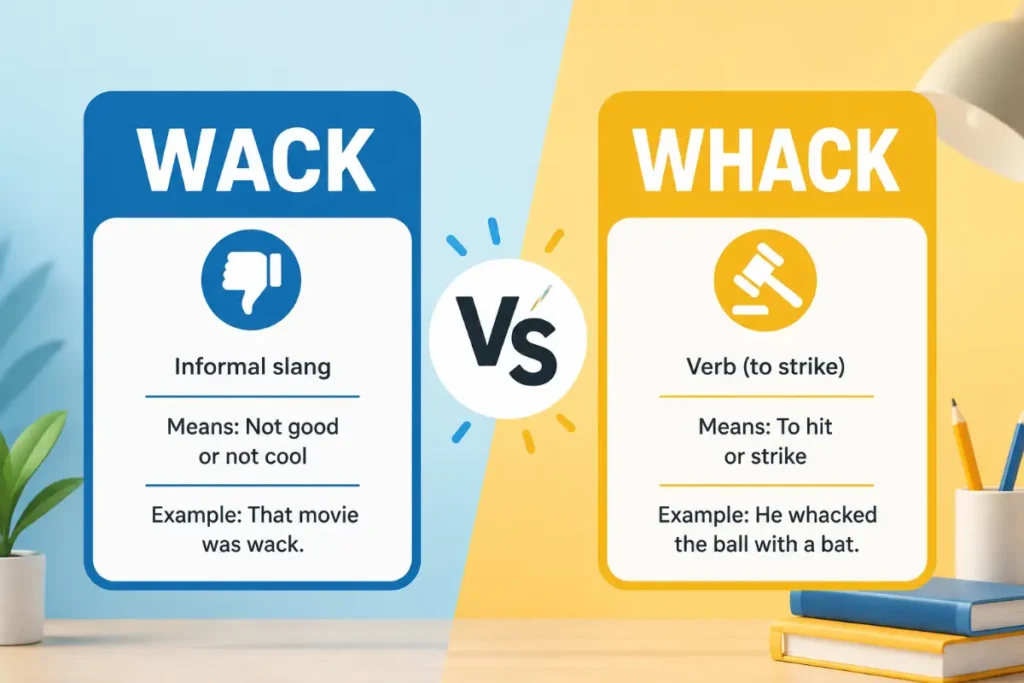
The two words can overlap in some informal uses but they have different primary meanings. Wack is mainly slang for something bad strange or uncool. Whack has a standard meaning connected to hitting and appears in established phrases.
Some speakers may use whack as an informal adjective meaning strange or bad. That usage can make the boundary less clear.
For everyday writing the safest approach is still simple. Think about the meaning first and choose the spelling that matches it.
FAQs
Is wack or whack correct?
Both spellings are valid words but they don’t have the same main meaning. Wack is informal slang for something bad strange or uncool. Whack is the standard spelling for a hit or the action of hitting.
Is wack a real word?
Yes. Wack is a real informal slang word used mainly in American English. It can describe something as bad weak strange or uncool.
Does whack mean bad?
It can mean bad strange unfair or unreasonable in some informal uses. The phrase out of whack is also common and means something is not working or balanced properly.
Why does whack have an H?
The spelling whack developed as part of the established English word for a sharp blow or hit. The wh spelling distinguishes it from the slang word wack in many modern uses.
Can I use wack in formal writing?
You can but it usually isn’t the best choice. Wack is slang so words such as poor strange weak or unreasonable will usually work better in formal writing.
What does take a whack at mean?
Take a whack at means to try something. For example you can take a whack at fixing a computer or solving a difficult problem.
What does out of whack mean?
Out of whack means out of order unbalanced or not working properly. You can use it for things such as schedules machines systems or routines.
Is wack short for whack?
Not in every case. The slang word wack developed its own usage and meaning. It is better to treat the two spellings as related but distinct words rather than assuming one is simply a shortened form of the other.
Conclusion
The choice between wack vs whack becomes much easier once you focus on meaning instead of sound. Wack is informal slang that usually means bad strange weak or uncool. Whack is the established spelling for hitting striking or giving something a blow.
Remember the basic distinction. If someone whacks a ball they hit it. If someone calls the ball game wack they think the game is bad or uncool. That small difference covers most everyday situations.
Also remember that whack has several common expressions. Something can be out of whack when it isn’t working properly. You can take a whack at a task when you want to give it a try. These expressions always use the spelling with wh.
When you’re unsure which word belongs in your sentence ask yourself what you mean. Are you talking about a hit or an attempt. Use whack. Are you using casual slang to say something is bad or uncool. Wack may be the better choice. That quick meaning check will keep your spelling clear and your writing natural.

Sienna Watson is a veteran copywriter and communications coach who has helped startup founders, marketers, and professionals polish their writing for over a decade. Realizing that most people don’t need a degree in linguistics—just clear, impactful communication—Sienna focuses on practical grammar, business writing etiquette, and eliminating wordiness. She advocates for plain language, strong verbs, and persuasive prose that gets results.