

If you’ve ever stopped while writing because you weren’t sure about busyness vs business you’re not alone. These two words look almost identical but they don’t mean the same thing. One describes being occupied or having a lot to do. The other can describe a company or commercial activity.
The confusion often comes from the extra letters in busyness. At first glance it can look like a spelling mistake. It isn’t. Busyness is a real English word and it has a clear meaning. Business is also correct but it belongs in different sentences.
The key is simple. Busyness describes a state of being busy. Business usually refers to work commercial activity a company or a matter that needs attention. Once you see that difference the two words become much easier to use.
This guide explains the meaning of each word how they are formed why people confuse them and how to use them naturally. You’ll also see examples from work daily conversation emails and other common situations.
Quick Definition
Busyness is the state of being busy or having a lot of activity and things to do. Business usually means a company commercial activity work or a matter that someone needs to deal with.
Direct Answer
Busyness is correct when you mean the state of being busy. Business is correct when you mean a company commercial activity work or a particular matter.
Comparison Table
| Word | Meaning | Example Sentence | When to Use It |
|---|---|---|---|
| Busyness | The state of being busy or full of activity. | The busyness of the office made it hard to focus. | Use it when talking about a busy state or condition. |
| Business | A company commercial activity work or a matter. | She runs a small business. | Use it for companies work commerce or matters that need attention. |

What Busyness Means
Busyness is a noun that describes the condition of being busy. It focuses on the amount of activity around a person place or situation.
For example you might talk about the busyness of a shopping mall during the holidays. You could also mention the busyness of a restaurant during dinner or the busyness of your schedule during a stressful week.
Consider this sentence.
The busyness of the office made it difficult to concentrate.
Here busyness doesn’t mean a company. It describes how active and crowded the office felt.
You could also say:
The busyness of the city surprised me.
The busyness of the airport increased before the holiday weekend.
I’m tired of the busyness of my schedule.
In each example the word describes a state or condition. Something is full of activity and that activity is being treated as a thing that can be discussed.
Busyness Describes A Condition
One useful way to remember this word is to connect it with the adjective busy.
- Busy is an adjective.
- Busyness is a noun.
- The relationship is similar to other adjective and noun pairs.
- Happy becomes happiness.
- Kind becomes kindness.
- Dark becomes darkness.
- Busy becomes busyness.
The spelling changes slightly but the basic idea remains the same. The noun names the condition described by the adjective.
If you say that a person is busy you’re describing that person. If you talk about their busyness you’re talking about the condition of having many things to do.
For example:
- I’m busy this afternoon.
- My busyness this afternoon is unusual.
The first sentence describes your current situation. The second treats that situation as a thing that can be discussed.
The second sentence sounds more formal and is less common in everyday conversation. Still it is grammatically correct.
What Business Means
Business has several related meanings. This is one reason it appears so often in English.
The most common meaning refers to a company or organization that sells products or services.
For example:
- My sister owns a small business.
- The business opened a new location.
- He wants to start his own business.
- In these sentences business refers to a commercial organization or company.
- The word can also refer to commercial activity in general.
For example:
- Business has been slow this month.
- The store gets most of its business on weekends.
- The company is trying to attract more business.
Here the word doesn’t necessarily refer to one specific company. It can describe buying selling or commercial activity.
Business Can Mean Work
You may also hear business used to talk about someone’s work or professional affairs.
For example:
- I have some business to finish before lunch.
- She traveled to Chicago on business.
- He’s away on business this week.
In these sentences the word relates to work or professional matters. It doesn’t necessarily mean that someone owns a company.
This use is common in everyday English and especially in workplace communication.
Business Can Mean A Matter
There is another common meaning that has nothing directly to do with money.
If something is your business it is your responsibility or concern.
For example:
- That’s none of your business.
- It’s my business to know what happens here.
- I have some personal business to take care of.
The word can also appear in the phrase mind your own business. That phrase means someone should stop asking about something that doesn’t concern them.
So business has a much wider range of meanings than many learners realize.
Why These Words Get Confused
The confusion becomes easier to understand when you look at the words closely. Both contain the letters bus and both relate to the adjective busy in some way.
The problem is that business doesn’t follow the spelling you might expect from busy.
You might think that adding a noun ending to busy should produce something like busyness. In fact that form does exist. But English also has business which comes from a different historical development.
That means the two words cannot simply be treated as spelling variations of the same noun.
They have different meanings and different uses.
The easiest mistake is to use busyness when you actually mean business. This often happens in phrases related to work or companies.
For example:
- I own a small busyness.
- That sentence is incorrect if you mean that you own a company.
- The correct version is:
- I own a small business.
- On the other hand you could say:
- The busyness of the store made it difficult to move around.
Here busyness is appropriate because you mean the store was full of activity.
The Difference Between Busy And Busyness
Understanding the adjective and noun forms can make the distinction much clearer.
- Busy describes someone or something.
- Busyness names the condition of being busy.
For example:
- The restaurant is busy.
- The restaurant’s busyness surprised us.
- The first sentence is much more natural in everyday conversation. The second is correct but more formal.
You could also say:
- My schedule is busy this week.
- The busyness of my schedule is exhausting.
Again the first version sounds more natural for casual speech. The second puts more attention on the state of having many commitments.
This is useful because you don’t always need to use busyness simply because you are talking about being busy. In many everyday sentences the adjective busy sounds cleaner and more natural.
Instead of saying:
- The busyness of my day is stressful.
- You might simply say:
- My day is so busy that I’m stressed.
That version is shorter and sounds more like normal conversation.
When To Use Busyness
Use busyness when you need a noun that refers specifically to the state or quality of being busy.
It works well when you are describing the amount of activity in a place schedule period or situation.
For example:
- The busyness of the downtown area was surprising.
- The busyness of the restaurant increased after six.
- She enjoys the energy and busyness of city life.
- The busyness of his schedule left little time for rest.
These sentences all focus on activity rather than a company or commercial matter.
Busyness In Descriptive Writing
The word can be useful when you want to describe an atmosphere.
For example:
- The quiet neighborhood changed completely during the festival. The usual calm was replaced by the busyness of food trucks music and large crowds.
- Here busyness helps describe the overall feeling of the place. It turns the idea of being busy into something that can be observed and described.
- You might also see the word in writing about cities travel workplaces and daily life.
For example:
- Visitors often enjoy the busyness of New York City.
- The busyness of the market gave the town a lively feel.
- The morning busyness of the train station lasted for several hours.
These uses are natural because the writer is describing a high level of activity.
When To Use Business
Use business when you mean a company commercial activity work or a matter that concerns someone.
For example:
- She started a business after college.
- Our business has grown steadily.
- He works in the insurance business.
- I need to take care of some personal business.
The word fits many situations because it has several established meanings.
Business As A Company
This is probably the meaning you see most often.
A business can be a small local shop a large corporation a family owned company or a person working for themselves.
For example:
- My uncle owns a construction business.
- They built a successful online business.
- The business employs twenty people.
- She wants to open a bakery business.
In each sentence the word refers to commercial work or an organization involved in selling goods or services.
Business As Commercial Activity
The word can also describe the activity of buying and selling.
For example:
- Business is slow during the winter.
- The store gets a lot of business from tourists.
- The company hopes to bring in more business this year.
Here business means customers sales or commercial activity. It doesn’t point to one physical company in the same way.
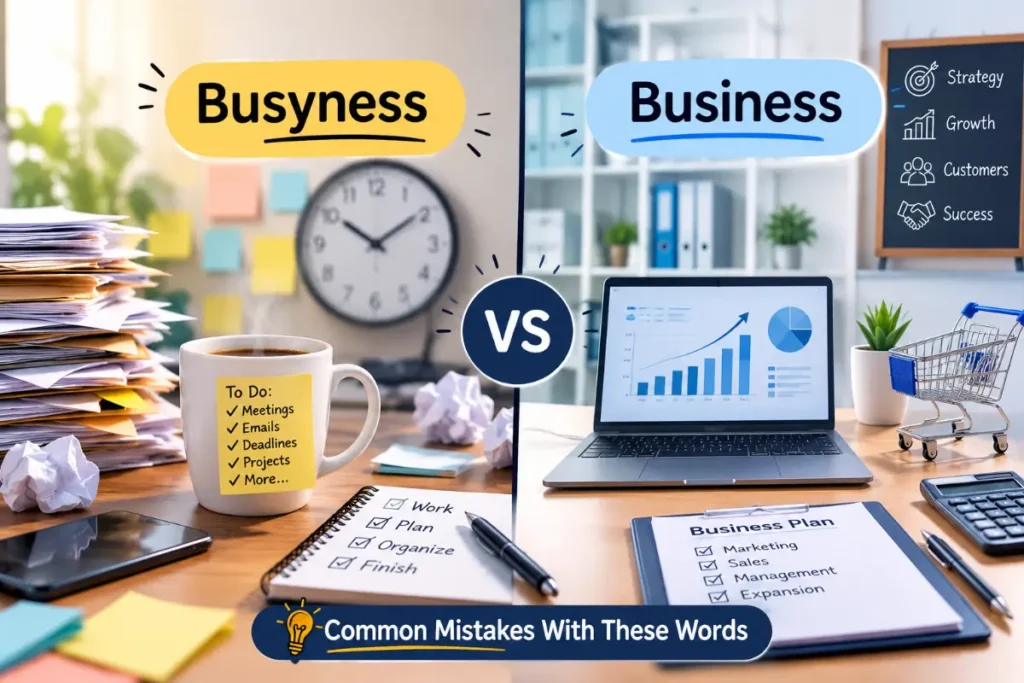
Common Mistakes With These Words
The biggest mistake is treating busyness as an alternative spelling of business. It isn’t.
Consider this sentence:
She runs a successful busyness.
If the writer means that she runs a company this is incorrect. The correct word is business.
Now look at this sentence:
The busyness of the office made everyone tired.
This sentence is correct because the writer is talking about the state of being busy.
Another common mistake is assuming that business always refers to money. It doesn’t.
For example:
That’s none of your business.
This sentence has nothing to do with buying or selling. It means that the matter does not concern the person being addressed.
You might also hear:
Mind your own business.
Again the word refers to someone’s personal affairs rather than a company.
Examples In Real Sentences
Seeing the words in different settings makes the difference easier to remember.
At Work
- The business has grown quickly over the past two years.
- The busyness of the office made it hard to hear the phone.
- I have some business to finish before I leave.
- The business received several new orders this morning.
The first and third examples involve work or professional matters. The second describes the level of activity in the office.
In Daily Conversation
- I love the busyness of the farmers market on Saturday mornings.
- My brother is in the restaurant business.
- That’s personal business and I don’t want to discuss it.
- The business closed early because of the storm.
These examples show why context matters. The two words may look alike but the meaning changes when you change the word.
In Formal Writing
- The report examined the growing busyness of major transportation hubs.
- The company expanded its business operations into three new states.
- The study looked at how workplace busyness affects employee focus.
- The firm reported strong business growth during the second quarter.
In formal writing busyness can be useful when the writer needs to discuss workload activity or crowded conditions. Business works better for companies markets commercial activity and professional matters.
How To Remember The Difference
- A simple memory trick can save you from second guessing yourself.
- Think of busy when you see busyness.
- The word describes the state of being busy.
- Think of company when you see business.
If you can replace the word with company or commercial activity then business is probably the word you need.
For example:
She owns a successful business.
You could say:
She owns a successful company.
That confirms the meaning.
Now consider:
The busyness of the airport was overwhelming.
You cannot replace busyness with company. The sentence is talking about activity and crowds. That points you toward the correct word.
Another useful trick is to ask one simple question.
Am I talking about being busy or am I talking about a company or matter.
If the answer is being busy then choose busyness.
If the answer is a company work commercial activity or personal matter then choose business.
Is Busyness A Real Word
Yes. Busyness is a real English word.
Some readers hesitate when they see it because business is much more common. The unusual appearance of busyness can make it look like a typo. It isn’t.
The word appears in dictionaries and standard English writing. It is especially useful when a writer needs a noun for the state of being busy.
That said it is less common in everyday conversation than simply using busy.
For example:
The busyness of the store was overwhelming.
is correct.
But in casual conversation many people would naturally say:
The store was so busy that it was overwhelming.
Both versions communicate the same basic idea. The second sounds more direct and conversational.
This distinction matters for good writing. A word can be correct without being the most natural choice for every sentence.
Is Business The Same As Being Busy
No. Business and busy are related in appearance but they don’t have the same meaning.
Busy means occupied or full of activity.
Business can mean a company commercial activity work or a matter that concerns someone.
For example:
- I’m busy today.
- This means you have a lot to do.
- I have some business to handle today.
This means you have a matter or task to take care of. It doesn’t simply mean that your schedule is full.
You could also say:
She is busy running her business.
Here both words appear together but they perform different jobs. Busy describes her condition. Business refers to the company she runs.
Business And Busyness In Workplace Writing
Workplace writing is one area where the distinction matters most.
A business email might contain either word depending on the message.
For example:
- The busyness of the office has increased since the new project began.
- This sentence describes activity levels.
Now compare it with:
- The business has hired five new employees.
- This sentence refers to the company.
A small change in spelling changes the meaning. That’s why proofreading matters when you’re writing a report email proposal or professional document.
Choose Clearer Language When Possible
Although busyness is correct some sentences can sound heavy if you use the noun unnecessarily.
For example:
The busyness of the team caused delays.
A simpler option might be:
The team was so busy that it caused delays.
The second sentence uses fewer words and sounds more natural. Good writing isn’t about choosing the more advanced word. It’s about choosing the word that communicates your meaning clearly.
Use busyness when you specifically want to name the condition or quality of being busy. Use busy when a simple description works better.
Related Words That Can Cause Confusion
English contains many words that look similar but have different meanings. Learning how they work can improve your spelling and word choice.
Busy And Business
- Busy is an adjective. Business is a noun.
- She is busy today.
- Her business is growing.
The first describes her. The second names her company.
Busy And Busyness
- Busy describes a person place or schedule.
- Busyness names the condition of having a lot of activity.
- The restaurant is busy.
- The busyness of the restaurant surprised me.
Business And Company
These words overlap but aren’t always identical.
A company usually means an organization that provides goods or services. Business can refer to that organization but can also describe commercial activity or a personal matter.
For example:
- The company hired ten workers.
- The business has been slow this month.
- The two sentences could refer to the same organization but the focus is different.
Business And Work
Work is a broad term for tasks or effort. Business can refer to professional activity or a specific matter.
- I have a lot of work to finish.
- I have some business to take care of.
The first sentence focuses on tasks. The second can mean professional affairs or another matter that needs attention.
Which Word Sounds More Natural
The answer depends on what you want to say.
- If you’re talking about a company use business.
- If you’re talking about commercial activity use business.
- If you’re talking about someone’s professional affairs use business.
- If you’re talking about a personal matter use business.
- If you’re describing the condition of being busy use busyness.
Still remember that busy will often sound more natural than busyness in casual writing.
For example:
The busyness of the city was exciting.
This is correct.
The city was busy and exciting.
This is simpler and more conversational.
Neither sentence is wrong. The better choice depends on the tone and purpose of your writing.

A Simple Test You Can Use
When you’re unsure which spelling to choose take a second and replace the word with a simpler phrase.
- If you mean being busy then busyness is likely correct.
- If you mean a company then use business.
- If you mean commercial activity then use business.
- If you mean a matter or concern then use business.
Try the test with these examples.
The ___ of the airport was exhausting.
Replace the blank with being busy.
The being busy of the airport sounds awkward but the meaning clearly points to the condition of being busy. Busyness works.
Now try:
She owns a small ___.
Replace the blank with company.
The answer is clearly business.
One more:
I have some personal ___ to handle.
Replace the blank with matters.
Again the answer is business.
This little test can help you choose the right word without memorizing a complicated grammar rule.
FAQs
What is the difference between busyness vs business?
Busyness means the state of being busy or having a lot of activity. Business usually means a company commercial activity work or a matter that needs attention.
Is busyness a correct English word?
Yes. Busyness is a standard English noun that means the state or quality of being busy. It is less common than the adjective busy but it is not a spelling error.
Is busyness the same as business?
No. They have different meanings. Busyness describes activity or a busy condition while business can refer to a company commercial activity professional work or a personal matter.
Can I use busyness in a sentence?
Yes. For example you could write The busyness of the airport made it difficult to find a quiet place. The word is correct when you are talking about a high level of activity.
Which word should I use for a company?
Use business. For example you could say My parents own a small business or She started a new business last year.
Is business related to the word busy?
The words are related in modern English but they don’t work as simple spelling forms of one another. Busy is an adjective while business is a noun with several meanings.
Why does busyness look wrong?
It looks unusual because business is much more common. The spelling of busyness follows the noun form of busy and is a legitimate English word.
Can business mean something other than a company?
Yes. Business can refer to commercial activity professional affairs or a personal matter. In a phrase such as none of your business it means something that does not concern you.
Conclusion
The difference between busyness vs business becomes much clearer once you focus on meaning instead of spelling. Busyness describes the state of being busy. Business usually refers to a company commercial activity work or a matter that concerns someone.
If you are talking about a store company or commercial activity use business. If you’re describing how active crowded or full of tasks something is use busyness. In many casual sentences you can also use busy because it sounds simpler and more natural.
Remember one easy connection. Busy leads you to busyness when you need a noun for the state of being busy. Company leads you to business when you’re talking about an organization or commercial activity.
The next time you hesitate over these two words ask yourself what you actually mean. Are you describing a busy condition or talking about a company work or matter. That quick check will usually give you the answer before you put the word on the page.

Sienna Watson is a veteran copywriter and communications coach who has helped startup founders, marketers, and professionals polish their writing for over a decade. Realizing that most people don’t need a degree in linguistics—just clear, impactful communication—Sienna focuses on practical grammar, business writing etiquette, and eliminating wordiness. She advocates for plain language, strong verbs, and persuasive prose that gets results.