
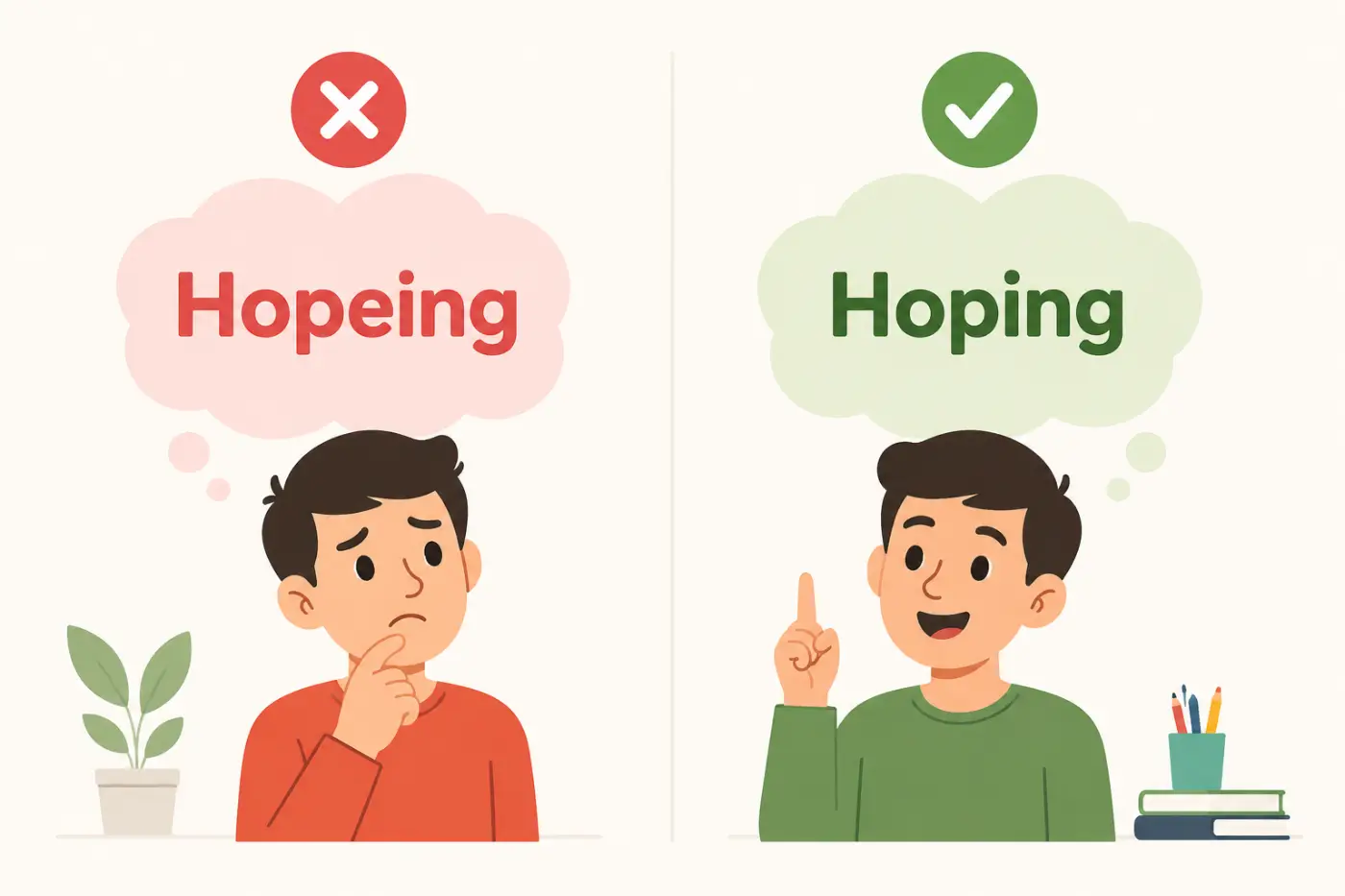
If you’ve ever paused over hopeing or hoping you’ve probably wondered which spelling is right. The correct spelling is hoping. The word hopeing is incorrect.
This mistake happens because the word hope ends with a silent e. When you add ing to many English verbs you keep the final e. That makes it tempting to write the word as hopeing. However the spelling rule changes when a verb ends in a silent e and you add a suffix that begins with a vowel.
The good news is that the rule is simple once you see it in action. This guide explains why the final e disappears how the rule works with other words and when the rule does not apply. You’ll also see plenty of natural examples so the correct spelling becomes easy to remember.
Quick Definition
Hoping is the present participle of hope. It means expecting or wishing for something good to happen. Hopeing is not a correct spelling in standard English.
Direct Answer
Hoping is the correct spelling. When you add ing to the verb hope you drop the final silent e before adding the suffix.
Comparison Table
| Word or spelling | Meaning | Example sentence | When to use it |
|---|---|---|---|
| Hope | To want or expect something good to happen. | I hope you feel better soon. | Use as the base verb. |
| Hoping | The ing form of hope. | I’m hoping for good news. | Use for an action in progress or a continuing wish. |
| Hopeing | Incorrect spelling. | This spelling is incorrect. | Do not use it. |
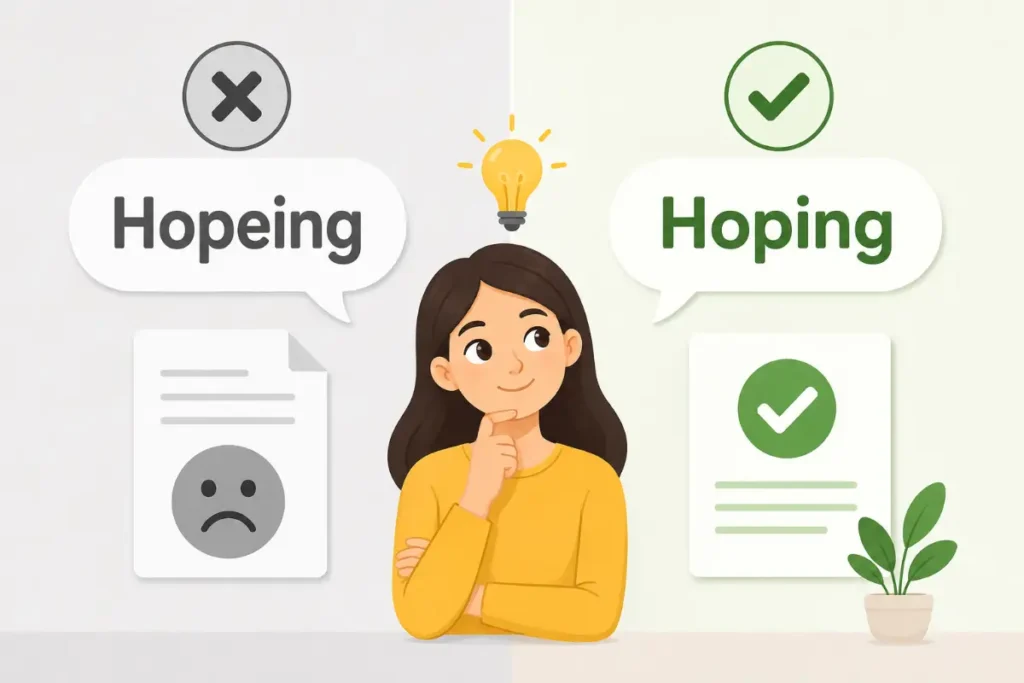
Why The Correct Spelling Is Hoping
The key is the final e in the base word hope. The e is silent. When you add ing the final e is removed before the suffix is added.
So the word changes like this.
hope + ing = hoping
It does not become hopeing.
This same spelling change happens with many common verbs. For example make becomes making. Take becomes taking. write becomes writing. use becomes using.
The pattern is easy to spot once you know what to look for. A verb ending in a silent e often drops that e before ing is added.
That small change can save you from a very common spelling mistake.
The Rule For Silent E Words
English has a useful spelling rule for verbs that end in a silent e. When you add a suffix that starts with a vowel the final silent e is often dropped.
The suffix ing begins with a vowel. Because of that the final e in hope disappears.
You can see the pattern in these examples.
- Hope becomes hoping.
- Bake becomes baking.
- Dance becomes dancing.
- Drive becomes driving.
- Move becomes moving.
- Smile becomes smiling.
- Close becomes closing.
- Save becomes saving.
The rule does not mean every word ending in e behaves in exactly the same way. English spelling has exceptions and special cases. Still this pattern covers a large group of common verbs.
For hope the rule is straightforward. Drop the final e and add ing.
Why Hopeing Looks Like It Should Be Correct
The incorrect spelling feels natural because we often add ing directly to a word.
For example read becomes reading. jump becomes jumping. work becomes working. In these cases there is no final silent e to remove.
That can make it easy to assume that hope should work the same way.
If you simply attach the letters ing to the end of hope you get hopeing. It looks logical at first glance. English spelling does not always work by simply adding letters to the base word.
The silent e changes the process.
Think of the final e as a letter that has a job in the base word. It helps create the long vowel sound in hope. Once ing is added the e is no longer needed for that purpose. It is dropped before the new ending is attached.
That gives us hoping.
How Hope Changes When You Add Endings
Understanding the different forms of hope makes the spelling rule easier to remember.
The base form is hope.
- I hope you have a great day.
The third person singular form is hopes.
- She hopes to visit California next year.
The past tense and past participle are hoped.
- We hoped the weather would improve.
The present participle is hoping.
- They are hoping for better results.
Notice something useful here. The silent e stays in hopes and hoped but disappears in hoping.
That difference is worth remembering.
When you add s the e stays.
When you add ing the e is dropped.
This is why hopes and hoped look different from hoping.
Examples Of Hoping In Everyday Writing
The word hoping is common in everyday English. You can use it in casual conversation professional emails personal messages and formal writing.
Talking About Future Plans
You can use hoping when you want something to happen in the future.
- I’m hoping to visit New York this summer.
- She’s hoping to start college next year.
- We’re hoping to finish the project by Friday.
These sentences describe plans or wishes that have not happened yet.
Talking About Good News
People often use hoping when they expect positive news.
- I’m hoping for good news from the doctor.
- We’re hoping for a positive response.
- She called the office hoping for an update.
The word does not guarantee that the desired result will happen. It simply shows that the person wants or expects a good result.
Talking About Relationships
Hoping also appears often when people talk about personal situations.
- I’m hoping we can work things out.
- He is hoping to hear from his brother soon.
- They are hoping to spend more time together.
The word gives these sentences a sense of expectation and desire.
Talking About Work
You will also see it frequently in professional communication.
- We’re hoping to resolve the issue today.
- I’m hoping you can review the document.
- The company is hoping to expand next year.
The meaning stays simple. Someone wants or expects something to happen.
Hoping Versus Hope
The words hope and hoping are related but they do not always appear in the same sentence structure.
Hope is the base form of the verb.
- I hope you get the job.
Hoping is the ing form.
- I’m hoping you get the job.
Both sentences express a wish or expectation. The second one can sound a little more focused on the current feeling or expectation.
You can also use hope to talk about a general belief or wish.
- I hope everything goes well.
With hoping you often use a form of be.
- I’m hoping everything goes well.
The choice depends on the sentence and the meaning you want to express.
Hoping Versus Hoped
Another useful comparison is hoping and hoped.
Hoping refers to an ongoing thought or expectation.
- We are hoping for better weather.
Hoped refers to a hope that existed in the past.
- We hoped for better weather.
The spelling difference also shows why you should not apply the same rule to every ending. The e disappears before ing but stays before d.
That gives us a useful pattern.
hope + ing = hoping
hope + d = hoped
Once you see the difference it becomes much easier to avoid adding an extra e.
More Words That Drop The Final E
The spelling change in hope is part of a much bigger pattern. Many everyday verbs lose their final silent e before ing.
Make Becomes Making
The verb make loses its final e.
- She is making dinner.
- I’m making a list.
- They are making plans for the weekend.
The incorrect form would be makeing.
Take Becomes Taking
The same rule applies to take.
- I’m taking the bus today.
- She is taking a short break.
- We’re taking the kids to the park.
The spelling is taking rather than takeing.
Write Becomes Writing
The verb write also loses its final e.
- I’m writing an email.
- She is writing a novel.
- He was writing notes during the meeting.
The correct form is writing.
Drive Becomes Driving
The word drive follows the same pattern.
- I’m driving home now.
- She is driving to work.
- They are driving across the country.
The final e disappears before ing.
Smile Becomes Smiling
The verb smile also follows the rule.
- She was smiling at the baby.
- He kept smiling during the photo.
- I’m smiling because you made my day.
Again the e is dropped.
When The Final E Stays
This is where English spelling gets a little more interesting. You should not assume that every word ending in e drops that letter before every suffix.
The rule depends on the suffix and the word.
With ing the final silent e is commonly dropped.
But there are words where the e stays for a special reason. Some verbs also change differently because of pronunciation or spelling conventions.
For example see becomes seeing. You do not remove both e letters. The spelling remains seeing.
The word agree becomes agreeing. Again the e remains.
These words already contain a vowel pattern that needs to stay intact.
That is why it helps to learn the general rule along with common examples. Spelling rules are useful guides but English has a few patterns that need to be learned separately.
The Special Case Of Dye
The word dye provides a useful example of why spelling can depend on meaning.
When dye becomes dyeing the e stays.
- She is dyeing the fabric blue.
This spelling is different from dying.
Dying comes from the verb die.
- The plant is dying.
The two words sound very similar but they have completely different meanings.
This is a good reminder that spelling is not just about adding letters. Sometimes a letter needs to stay so readers can tell one word from another.
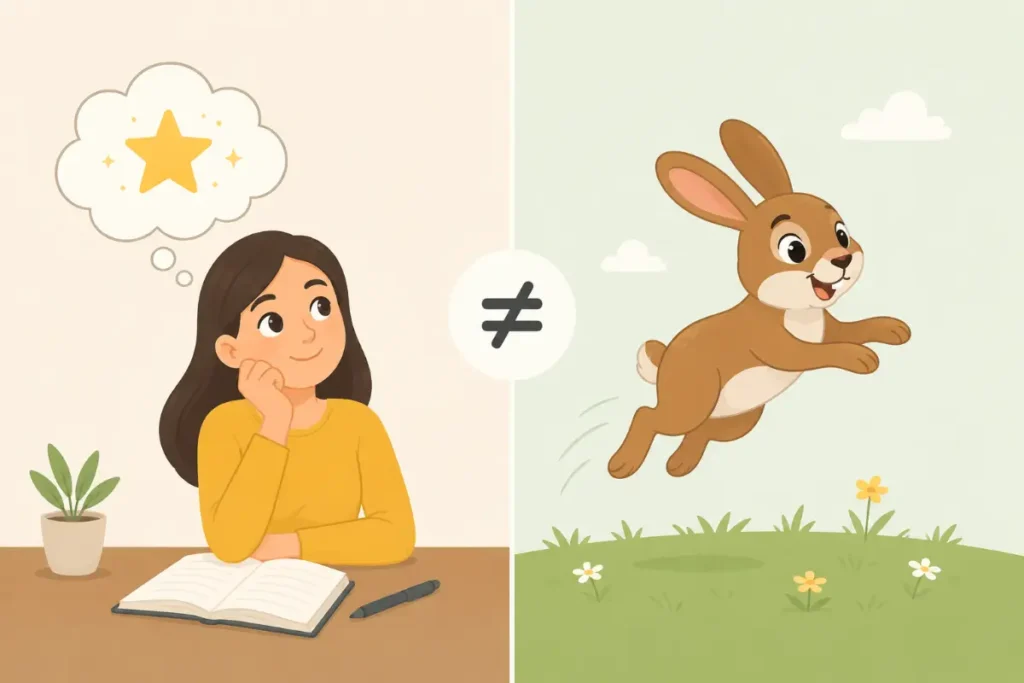
The Difference Between Hoping And Hopping
This is another spelling pair worth learning because the two words look similar but mean very different things.
Hoping comes from hope. It means wishing or expecting something good.
- I’m hoping for good weather.
Hopping comes from hop. It means making small jumps.
- The rabbit is hopping across the yard.
Notice what happens when hop becomes hopping. The final consonant is doubled.
The base word hop has one vowel followed by one consonant. Before ing is added the final consonant is doubled.
So we get hop + ing = hopping.
But hope has a silent e. The e is removed instead.
hope + ing = hoping
This difference is one of the best ways to remember the spelling.
If you mean wishing for something use hoping.
If you mean jumping use hopping.
Why Hoping And Hopping Are Easy To Mix Up
The two words differ by only one letter. That makes them easy to confuse when typing quickly.
Consider these sentences.
- I’m hoping you can come.
- The rabbit is hopping toward the fence.
The first sentence is about a wish. The second describes movement.
The spelling tells you which meaning the writer intends.
This pair also shows why careful spelling matters. A single letter can change the meaning of a word completely.
Common Mistakes With Hoping
Most mistakes involving this word fall into a few simple patterns. Once you know them you can catch them quickly during proofreading.
Adding The E
The most common mistake is writing hopeing.
The problem comes from attaching ing directly to the base word. Remember to remove the final silent e first.
Correct.
- I’m hoping for good news.
Incorrect.
- I’m hopeing for good news.
Confusing Hoping With Hopping
Some writers add an extra p because they remember that some verbs double their final consonant before ing.
That rule applies to hop but not hope.
Correct.
- She is hoping to win.
Correct.
- She is hopping across the room.
The meanings are completely different.
Using Hope When Hoping Fits Better
Sometimes the spelling is correct but the form of the verb is not.
For example the sentence I am hope for good news is incorrect. After am you need the ing form.
The correct sentence is I am hoping for good news.
This is a grammar issue rather than a spelling issue. Knowing both forms helps you choose the right word in context.
How To Remember The Spelling
A simple memory trick can make this word much easier.
Think of hope as losing its final e when ing arrives.
Hope sees ing coming and drops e.
That gives you hoping.
You can also connect the word with other familiar examples such as make and making or write and writing. Once you notice the pattern across several words the rule becomes easier to recall.
Another useful trick is to remember the difference between hoping and hopping.
One p means wishing.
Two p’s means jumping.
That short contrast can help you remember both words at once.
A Simple Spelling Test
If you’re unsure about the spelling while writing ask yourself one question.
Does the base verb end with a silent e?
If the answer is yes and you’re adding ing then check the final e. In many common verbs the e should disappear.
For hope that gives you hoping.
For drive it gives you driving. This quick check takes only a second. It can prevent a mistake before you finish the sentence.
How To Use Hoping Naturally
The word often appears with for when someone wants a particular result.
- I’m hoping for a promotion.
- She’s hoping for good weather.
- We’re hoping for an answer soon.
It can also appear before to when someone wants to perform an action.
- I’m hoping to visit soon.
- He is hoping to find a new job.
- They are hoping to move next year.
You can also follow it with a clause.
- I’m hoping that everything works out.
- She is hoping that her parents can come.
- We’re hoping that the plan succeeds.
These patterns are common in natural English. Learning them can help you use the word with confidence instead of only remembering its spelling.
Is Hoping Formal Or Informal
Hoping works in both casual and formal English.
You can use it in a text.
- I’m hoping we can schedule a meeting next week.
You can also use it in formal writing.
- The researchers are hoping to identify the cause of the problem.
The tone depends more on the rest of the sentence than on the word itself.
Hoping In Email Writing
The word is especially common in emails because it lets you express a request or expectation in a friendly way.
For example.
- I’m hoping you can help me with this issue.
- I’m hoping to hear from you soon.
- We’re hoping to finalize the agreement this week.
These sentences can sound polite without being overly formal.
Still you should choose your wording based on the situation. In some professional emails a direct sentence may be clearer.
Instead of I’m hoping you can send the file today you might write Could you send the file today.
Both can work. The second version makes the request more direct.
Hoping In Friendly Messages
In casual writing the word can sound warm and natural.
- Hoping everything goes well.
- Hoping you feel better soon.
- I’m hoping we can catch up this weekend.
People often use the word at the start of short messages too.
- Hoping you’re having a good day.
This is common in friendly communication. The full sentence would be I am hoping you’re having a good day but English speakers often shorten messages in casual settings.
A Closer Look At The Spelling Pattern
The reason hoping looks shorter than hope plus ing is tied to the role of the silent e.
In the base word hope the final e helps signal the long vowel sound. You hear the long o sound in hope.
When the ending ing is added the spelling no longer needs that final e. The word can represent the intended sound without it.
So English removes the e rather than keeping it.
This is not just a random spelling choice. It is part of a broader spelling system that helps words keep recognizable pronunciation patterns.
You do not need to memorize the technical details to write the word correctly. The practical rule is enough.
Hope becomes hoping.
Other Useful Examples
Here are more examples that follow the same general pattern.
Care becomes caring.
- She is caring for her younger brother.
Share becomes sharing.
- We are sharing the news with our friends.
Prepare becomes preparing.
- He is preparing for the interview.
Change becomes changing.
- The weather is changing quickly.
Imagine becomes imagining.
- She is imagining what life might be like in another city.
Believe becomes believing.
- I’m believing less of what I read online.
Some examples may sound more natural in certain contexts than others but the spelling pattern remains clear.
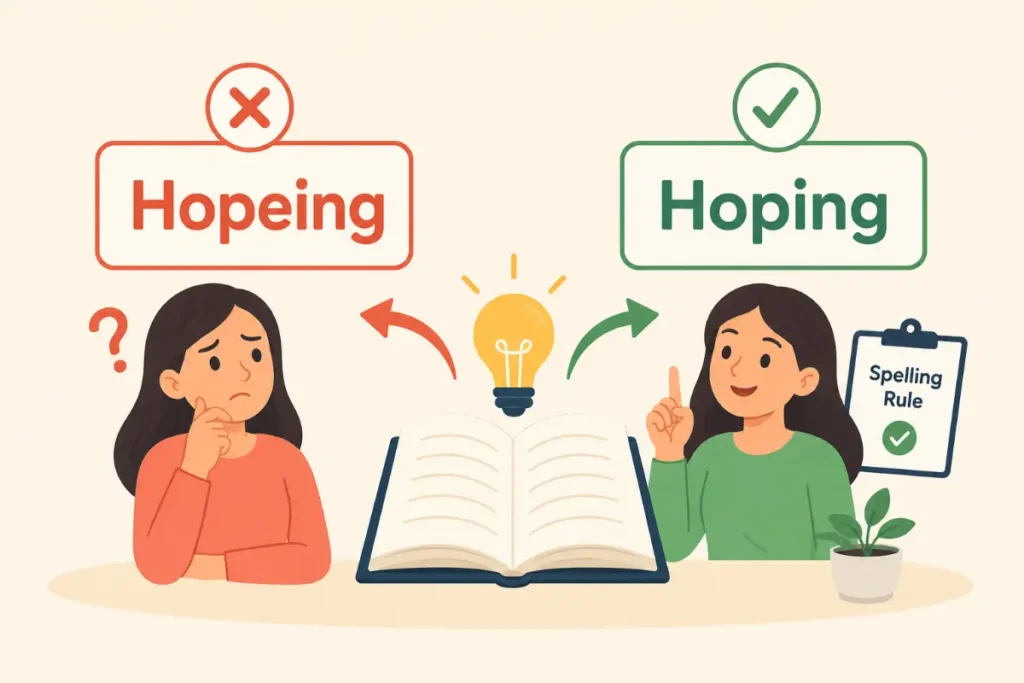
When Spelling Rules Can Change
English spelling has many rules but very few are completely universal. That is why you may find examples that do not fit the simple pattern.
The best approach is to learn the main rule first. Then learn common exceptions as you meet them.
For hope there is no need to overthink the spelling. When you add ing the final e drops.
That gives you hoping.
The same idea applies to many other everyday verbs. Once the pattern becomes familiar you will start seeing it automatically while reading.
Why Reading Helps With Spelling
Reading exposes you to correct spelling without making you study every word directly. When you see a word repeatedly your brain stores its visual pattern.
This is one reason frequent readers often develop stronger spelling instincts. They have seen thousands of words in context.
If you want to improve your spelling try paying attention to words that often cause mistakes. When you see hoping in an article or book take a moment to notice the spelling.
You do not need to stop and study every time. A quick glance is enough.
Over time the correct version becomes familiar.
A Quick Proofreading Trick
When proofreading your own writing look closely at verbs that end in ing. If the base word ends in a silent e check to see if you removed the e.
For example.
- hope → hoping
- make → making
- take → taking
- drive → driving
- move → moving
This is especially useful when writing quickly. Your first draft does not need to be perfect. A short final check can catch small spelling mistakes before you publish or send your work.
FAQs
Is hoping the correct spelling?
Yes. Hoping is the correct spelling. The final silent e in hope is removed before ing is added.
Why is hopeing wrong?
Hopeing is wrong because the final silent e is normally dropped before the ing ending is added. The correct form is hoping.
What is the difference between hoping and hopping?
Hoping means wishing or expecting something to happen. Hopping means making small jumps. For example I am hoping for good news and The rabbit is hopping across the yard have completely different meanings.
Is hoping a verb?
Yes. Hoping is the present participle form of the verb hope. It can also appear as part of a progressive verb phrase such as I am hoping for good news.
What is the past tense of hope?
The past tense is hoped. For example She hoped the weather would improve is correct.
Does hope lose the e before ing?
Yes. The final silent e is removed when hope becomes hoping. This follows a common English spelling pattern for verbs ending in silent e.
Can I use hoping in a formal email?
Yes. Hoping is suitable for formal and informal writing. For example I’m hoping we can resolve this issue soon is natural in a professional email.
How can I remember how to spell hoping?
Remember that hope drops its final e before ing. You can also compare hoping with hopping. One p means wishing while two p’s means jumping.
Conclusion
If you’ve been stuck between hopeing or hoping the answer is simple. Hoping is the correct spelling and hopeing is incorrect. The final silent e in hope disappears before the ing ending is added.
The same pattern appears in many common verbs. Make becomes making. Take becomes taking. Write becomes writing. Seeing these examples together makes the rule much easier to remember.
Also keep hoping and hopping separate in your mind. Hoping is about a wish or expectation. Hopping is about jumping. That small spelling difference changes the meaning completely.
When you’re writing and the spelling suddenly looks uncertain remember one simple pattern. Hope drops the e before ing. Write hoping and move on with confidence.

Dr. Elena Vance holds a Ph.D. in Linguistics from Columbia University and has spent over 15 years analyzing the evolution of the English language. A former university professor turned full-time writer and editor, Elena specializes in breaking down high-level grammatical concepts, punctuation nuances, and style guides (APA, Chicago, MLA) into clear, actionable advice. When she isn’t hunting down dangling modifiers, she can be found collecting vintage dictionaries and reading classic literature.