
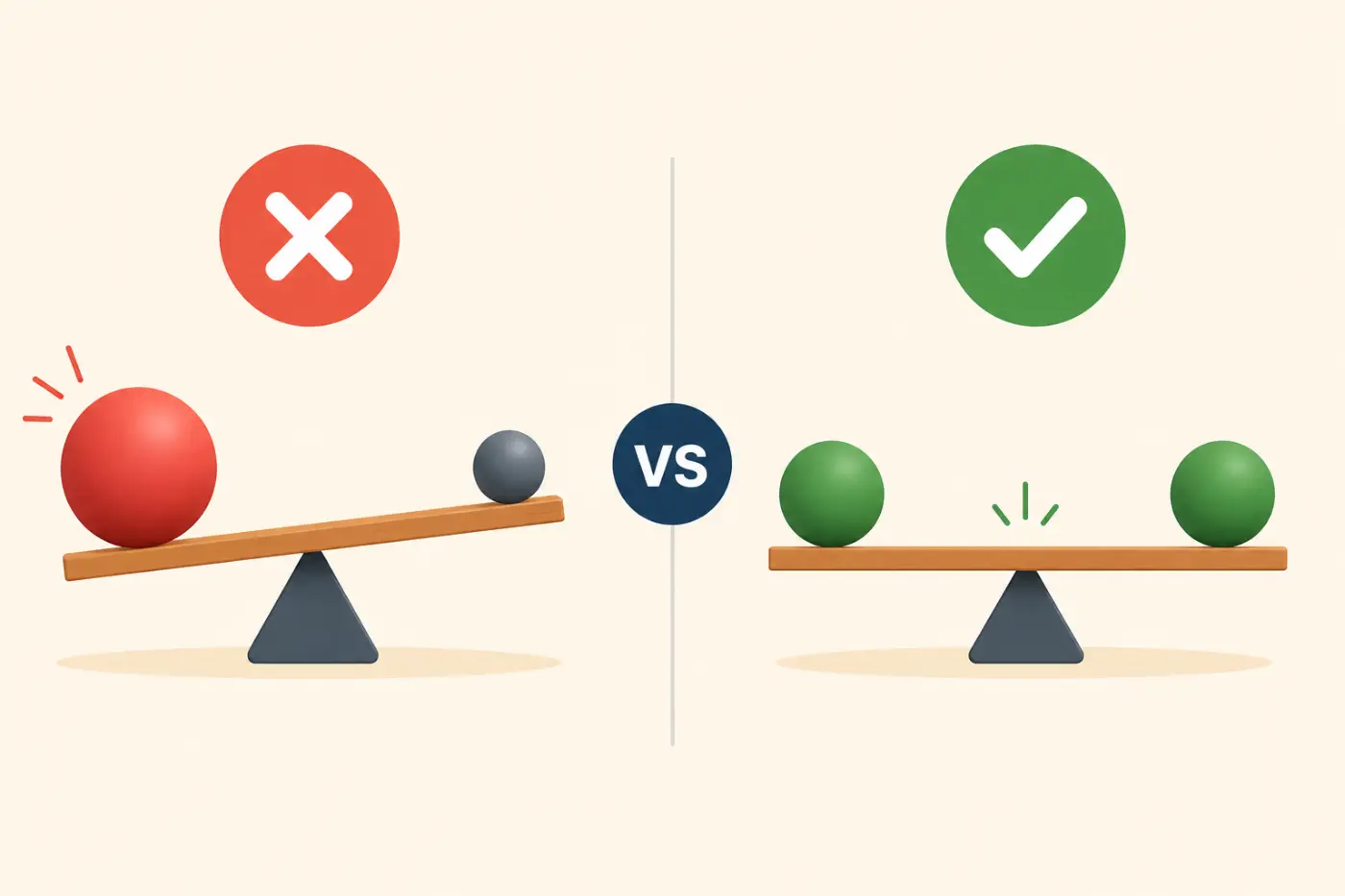
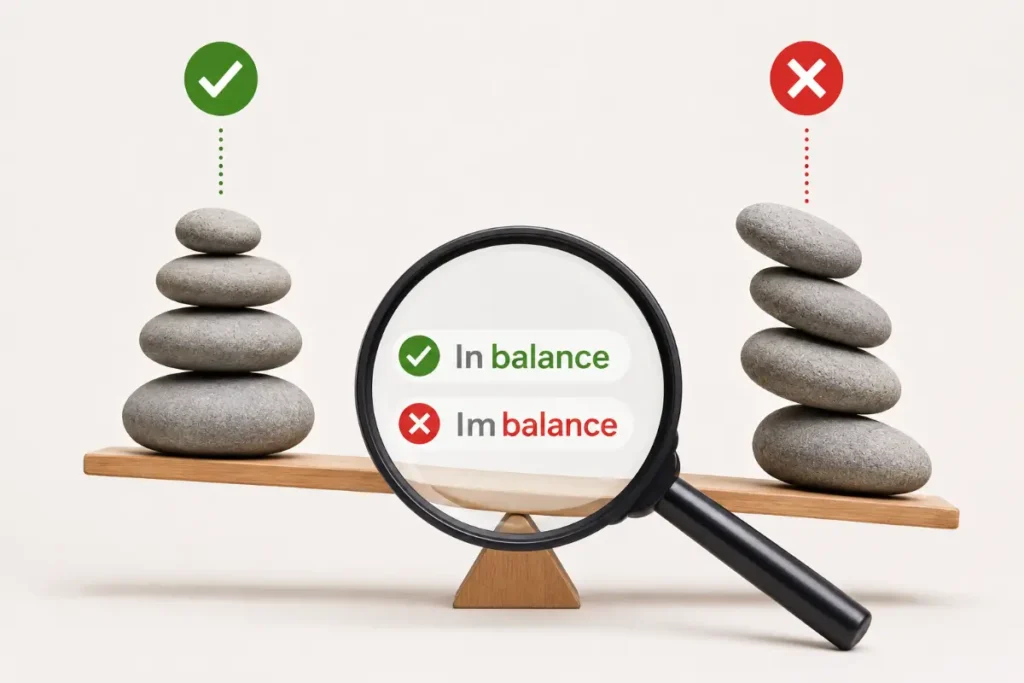
If you’re unsure about inbalance or imbalance the correct spelling is imbalance. The word starts with im rather than in. This small spelling difference is easy to miss because both versions look like they could work at first glance.
Imbalance means a lack of balance between two or more things. You might use it when talking about money income and expenses physical conditions power relationships or differences between groups. The incorrect form inbalance isn’t standard English.
This guide explains why imbalance is correct and where the confusion comes from. You’ll also see clear examples common mistakes related words and simple ways to remember the spelling.
Quick Definition
Imbalance is a noun that means a lack of balance or an uneven relationship between things. If one side has too much or too little compared with another side there may be an imbalance.
For example you can have an imbalance between work and free time. A company can have an imbalance between income and spending. The word can describe many kinds of uneven conditions.
Direct Answer
Imbalance is the correct spelling. Inbalance is not the standard English spelling and should be avoided in your writing.
Comparison Table
| Word or Phrase | Meaning | Example Sentence | When to Use It |
|---|---|---|---|
| Imbalance | A lack of balance or an uneven condition. | There is an imbalance between supply and demand. | Use this spelling in standard English. |
| Inbalance | Incorrect spelling of imbalance. | This spelling is incorrect. | Do not use it. |

Why The Confusion Happens
The confusion comes from the beginning of the word. Many English words use in as a prefix to express a negative or opposite meaning. That can make inbalance look reasonable.
For example we have words such as incomplete incorrect inaccurate and invisible. In each case the prefix in changes or reverses the meaning of the base word.
It makes sense that someone might look at balance and think the opposite should be inbalance. English has another spelling pattern at work here. The prefix changes from in to im before certain sounds.
That change is called assimilation. In simple terms the spelling shifts to make the word easier to say. The same pattern appears in several familiar words such as impossible impatient and immature.
So the correct form isn’t based on a random spelling choice. It comes from a common pattern in English word formation.
The Spelling Rule Behind Imbalance
The word imbalance is formed from im plus balance. The prefix im is a form of the negative prefix in.
The prefix in can mean not. Before words beginning with certain consonant sounds it often changes form. When the following word begins with b m or p the prefix commonly becomes im.
That gives us familiar words such as these.
- Imbalance.
- Impossible.
- Impatient.
- Immature.
- Immoral.
- Imperfect.
The spelling change helps the sounds fit together more naturally. Try saying inbalance out loud. The transition from the n sound to the b sound feels less natural than the m sound in imbalance.
English has kept this pattern in many words. Once you recognize it the spelling becomes much easier to remember.
Why Imbalance Uses Im
The key is the first letter of the base word.
Balance begins with b. When the negative prefix is added before a word beginning with b the form often changes from in to im.
So we get:
im + balance = imbalance.
You can see the same idea in possible.
im + possible = impossible.
You can also see it in patient.
im + patient = impatient.
The spelling isn’t something you need to memorize as a completely separate fact. It connects to a larger pattern that appears throughout English.
What Does Imbalance Mean
Imbalance means that two or more things aren’t equal balanced or properly matched. The difference can be small or large depending on the situation.
Imagine a scale with equal weight on both sides. The scale stays level because the two sides are balanced. Add more weight to one side and the scale tips. You now have an imbalance.
The same basic idea works in less literal situations.
If you spend much more money than you earn you have an imbalance between income and expenses. If one team has far more power than another you might describe the relationship as an imbalance of power.
The word always points to some kind of unevenness.
Common Uses Of Imbalance
The word appears in many areas of everyday English. You don’t need a technical subject to use it correctly.
Financial Imbalance
An imbalance can describe a difference between money coming in and money going out.
For example:
- The family is trying to fix an imbalance between income and expenses.
- The company faced a serious imbalance in its budget.
- Rising costs created an imbalance in the business.
In these sentences the word points to a gap between two financial factors.
Work Life Imbalance
People often use the word when talking about how they divide their time.
For example:
- His long work hours created an imbalance in his personal life.
- She noticed an imbalance between work and rest.
- The new schedule helped reduce the imbalance.
The word doesn’t mean that work is always bad or that free time is always better. It simply describes a situation where the two parts aren’t balanced in a healthy or useful way.
Power Imbalance
You may also see imbalance of power or power imbalance.
This describes a situation where one person group or organization has much more power than another.
For example:
- The agreement created a serious imbalance of power.
- The two sides tried to reduce the power imbalance.
- A large difference in resources can create an imbalance between the groups.
This use appears often in discussions about workplaces relationships politics business and social issues.
Physical Imbalance
The word can describe a lack of physical balance too.
For example:
- The injury caused an imbalance while he was walking.
- Poor posture can contribute to muscle imbalance.
- She felt an imbalance when she stood up.
Here the meaning is closer to physical stability or an uneven condition in the body.
Supply And Demand Imbalance
Businesses and economists often use the word when discussing supply and demand.
If there are far more buyers than available products there may be an imbalance between supply and demand. If stores have too many products and not enough buyers the situation is reversed.
For example:
- The shortage created an imbalance between supply and demand.
- The company reduced production to correct the imbalance.
- A sudden change in demand can create an imbalance in the market.
The word works naturally in each example because the two sides aren’t matching properly.
Examples In Real Sentences
Learning a spelling is easier when you see the word working naturally in different situations. The following examples show how people use imbalance in everyday writing.
- There is an imbalance between the two accounts.
- The report found an imbalance in spending.
- Too much screen time can create an imbalance in your daily routine.
- The team struggled because of an imbalance in experience.
- The company wants to correct the imbalance between costs and revenue.
- A large imbalance of power can make negotiations difficult.
- The coach noticed a muscle imbalance during training.
- The new policy was designed to reduce the imbalance.
- The study examined the imbalance between urban and rural areas.
- An imbalance between supply and demand pushed prices higher.
Each sentence describes some form of unevenness. That central meaning is the easiest way to understand the word and remember it.
A Simple Memory Trick
If you keep writing inbalance by mistake try connecting the word to impossible.
Both words use im at the beginning.
Imbalance.
Impossible.
The reason is simple. Both begin with a base word that starts with a sound where the prefix changes to im.
You can also remember this short pattern.
B P M → IM.
Words beginning with b p or m often take im instead of in when the negative prefix is added.
For example:
- Balance becomes imbalance.
- Possible becomes impossible.
- Patient becomes impatient.
- Mature becomes immature.
This isn’t a trick that explains every word in English. It is a useful pattern that helps with many common words.
More Examples Of Imbalance In Everyday Writing
The word imbalance can describe many kinds of unevenness. You might see it in a school essay one day and in a business report the next. The meaning stays connected to the same basic idea. Two or more things aren’t in the right balance.
That makes the word useful because you don’t need a special subject to use it. You can talk about an imbalance in time money power attention resources or physical strength.
Imbalance Between Two Things
One common structure is an imbalance between A and B. This form makes the comparison clear because it tells the reader exactly which two things aren’t balanced.
For example:
- There is an imbalance between spending and saving.
- The manager noticed an imbalance between work and rest.
- The study found an imbalance between supply and demand.
- The agreement created an imbalance between the two groups.
This structure works well when you want to show a difference between two sides.
Imbalance In Something
You can also use an imbalance in when the uneven condition exists within a system or situation.
For example:
- The company found an imbalance in its budget.
- The coach noticed an imbalance in the team’s defense.
- The report showed an imbalance in the distribution of resources.
- The teacher noticed an imbalance in student participation.
The choice between between and in depends on what you want to describe. Use between when you’re comparing two sides or factors. Use in when you’re pointing to an uneven condition within something.
Imbalance Of Something
Another useful pattern is an imbalance of.
For example:
- The discussion focused on an imbalance of power.
- The region experienced an imbalance of resources.
- The agreement resulted in an imbalance of responsibility.
This form often appears with abstract ideas such as power responsibility control or resources.
Imbalance In Business And Finance
Business writing uses this word often because companies constantly compare income expenses supply demand resources and other factors.
A business can have an imbalance between what it earns and what it spends. It can also have too many employees in one department and too few in another. A store might have more products than customers want to buy.
Consider these examples.
- The company is working to correct the imbalance between revenue and expenses.
- The sudden increase in costs created a financial imbalance.
- The business faced an imbalance between available workers and open positions.
- Managers noticed an imbalance in the distribution of resources.
The word doesn’t automatically mean something is terrible. It simply identifies a condition where things aren’t balanced. The surrounding sentence tells the reader if the situation is minor serious temporary or harmful.
Imbalance In Health And Fitness
You may also come across the word in health and fitness writing. It can describe an uneven condition in the body or in physical performance.
For example a person might have stronger muscles on one side of the body than the other. Someone recovering from an injury might also develop an uneven movement pattern.
You might read sentences like these.
- The trainer noticed an imbalance between the left and right sides of the body.
- The exercise program aims to reduce muscle imbalance.
- Poor posture can contribute to an imbalance in muscle strength.
When the word appears in health related writing the exact meaning depends on the context. It can refer to physical strength movement or another measurable difference. You should not assume that every use of the word points to a medical problem.
Imbalance In Relationships
The word can also describe relationships. This usually happens when one person gives receives controls or contributes much more than the other.
For example:
- There was an imbalance in the amount of work each person did.
- The relationship developed an unhealthy imbalance of control.
- They tried to correct the imbalance by sharing responsibilities.
This use gives the word a more personal meaning. Instead of comparing numbers on a balance sheet you’re comparing effort attention responsibility or power.
Imbalance In Society
Writers often use imbalance when discussing differences between groups or communities.
For example:
- The report examined the imbalance in access to education.
- The city is trying to address an imbalance in public resources.
- The policy aims to reduce the imbalance between rural and urban communities.
The word works well here because it describes a gap without always saying that the two sides must be exactly equal. In many cases the goal is simply to create a fairer or more reasonable distribution.

Common Mistakes With Imbalance
Spelling isn’t the only place people can make mistakes. The word can also cause confusion because writers sometimes use it in places where another word would be clearer.
Using Inbalance
The biggest spelling mistake is adding in to the beginning of balance.
The incorrect form looks logical at first because in is a common English prefix. However standard English uses imbalance.
So write:
- The report found an imbalance in spending.
Not:
- The report found an inbalance in spending.
The same rule applies to related forms.
- Imbalanced.
- Imbalance.
- Imbalances.
Confusing Imbalance With Unbalance
These words are related but they don’t always work in the same sentence.
Imbalance is usually a noun. It describes a condition where things aren’t balanced.
- The company has an imbalance between costs and income.
Unbalance can be a verb. It means to make something lose its balance.
- The sudden movement unbalanced the chair.
You may also see unbalanced used as an adjective.
- The machine became unbalanced after one part broke.
If you’re naming the uneven condition itself use imbalance. If you’re describing the act of causing something to lose balance unbalance may fit better.
Confusing Imbalance With Difference
A difference isn’t always an imbalance.
Two things can be different without one side being out of balance.
For example a red shirt and a blue shirt have a difference in color. That doesn’t create an imbalance.
An imbalance suggests that the difference affects how two or more parts work together or are distributed.
Compare these sentences.
- There is a difference in the prices.
- There is an imbalance between the prices paid by the two groups.
The second sentence suggests that the price gap creates an uneven situation that matters.
Imbalance And Imbalanced
These two forms are closely related but they serve different grammatical roles.
Imbalance is usually a noun.
- The imbalance affected the team’s performance.
Here imbalance names the condition.
Imbalanced is an adjective.
- The team’s workload was imbalanced.
Here imbalanced describes the workload.
You can remember the difference by asking a simple question. Are you naming the uneven condition or describing something as uneven?
If you’re naming it use imbalance. If you’re describing something use imbalanced.
More Examples
- The imbalance was difficult to ignore.
- The budget is imbalanced.
- An imbalance developed between the two departments.
- The workload became imbalanced after two employees left.
- The study measured the imbalance in resource use.
- The system became imbalanced after the change.
The spelling stays connected across these forms. Only the ending changes to fit the grammar of the sentence.
Is Imbalance Always A Bad Thing
Not necessarily.
An imbalance can be harmless temporary or useful depending on the situation. The word itself doesn’t always carry a strong negative meaning.
For example a company might intentionally spend more money on advertising during a product launch. For a short time there could be an imbalance between advertising costs and other expenses.
A sports team might also have more offensive players than defensive players because of a specific strategy. Someone could describe that as an imbalance but the situation isn’t automatically a mistake.
The surrounding context matters. If a writer says serious imbalance or dangerous imbalance the added words make the negative meaning clear.
Without those extra words the term simply tells you that the parts aren’t evenly matched.
When To Use Imbalance In A Sentence
Use imbalance when you need a noun that describes an uneven condition.
A useful sentence pattern is:
There is an imbalance between A and B.
For example:
- There is an imbalance between work and rest.
- There is an imbalance between supply and demand.
- There is an imbalance between income and spending.
Another useful pattern is:
There is an imbalance in something.
For example:
- There is an imbalance in the budget.
- There is an imbalance in the workload.
- There is an imbalance in resource distribution.
You can also place the word after verbs such as create cause reduce correct address and restore.
For example:
- The change created an imbalance.
- The shortage caused an imbalance.
- The company reduced the imbalance.
- The team is trying to correct the imbalance.
- The new plan aims to address the imbalance.
- The coach changed the lineup to restore balance.
These patterns give you plenty of natural ways to use the word without forcing it into a sentence.
How To Remember The Spelling
The easiest way to remember imbalance is to look at the beginning of the word instead of trying to memorize the whole thing at once.
The base word is balance. When the negative prefix is added before a word that begins with b the prefix changes from in to im. That gives you im + balance = imbalance.
This same pattern appears in many familiar words. You already know impossible impatient and imperfect. Seeing these words as part of the same pattern makes the spelling much easier to recall.
Use The B P M Pattern
A useful memory trick is to remember B P M. The negative prefix often becomes im before words that begin with b p or m.
Here are a few examples.
- Balance becomes imbalance.
- Possible becomes impossible.
- Patient becomes impatient.
- Mature becomes immature.
- Moral becomes immoral.
- Perfect becomes imperfect.
You don’t need to memorize a complicated grammar rule. Just remember that in can change to im before certain sounds.
Think About The Sound
Say imbalance slowly. The m sound flows naturally into the b sound that follows it.
Now say inbalance. It sounds awkward because the n and b sounds meet together.
English has developed many spelling patterns that make words easier to pronounce. This is one of them. Your ear can help you remember the correct form even though pronunciation alone doesn’t always reveal spelling.
The Prefix In And Its Different Forms
The beginning of this word can be confusing because in is a common prefix. It often means not or shows an opposite condition.
For example:
- Complete becomes incomplete.
- Correct becomes incorrect.
- Visible becomes invisible.
- Direct becomes indirect.
But the prefix can change its form when it joins certain words. Im is one of those forms.
You can see this change in several everyday words.
- Impossible means not possible.
- Impatient means not patient.
- Immature means not mature.
- Imbalance means a lack of balance.
The meaning stays connected to the idea of negation or opposition. Only the form of the prefix changes to fit the word that follows.
When To Use Imbalance
Use the noun imbalance when you want to name a condition where two or more things aren’t properly balanced.
For example:
- The budget has an imbalance between income and expenses.
- The teacher noticed an imbalance in student participation.
- The team has an imbalance between offense and defense.
- The report points to an imbalance in available resources.
The word can work with both concrete and abstract ideas. You can describe an imbalance in weight or an imbalance in power. You can talk about an imbalance in money or an imbalance in attention.
That flexibility makes it a useful word in everyday writing.
When To Use Imbalanced
Imbalanced is the adjective form. Use it when you want to describe something as uneven or lacking balance.
For example:
- The workload is imbalanced.
- The system became imbalanced after the change.
- His training routine was imbalanced.
- The two sides had an imbalanced distribution of resources.
The difference is simple.
Imbalance names the condition.
Imbalanced describes something that has that condition.
Compare these two sentences.
- The imbalance caused problems.
- The workload was imbalanced.
In the first sentence the word names the problem. In the second sentence it describes the workload.
Imbalance And Unbalanced
These words are related but they aren’t exact substitutes.
Imbalance is a noun. It names an uneven condition.
- The imbalance became difficult to ignore.
Unbalanced is an adjective. It describes something that isn’t balanced.
- The table feels unbalanced.
You can also use unbalance as a verb when something causes another thing to lose its balance.
- The heavy box unbalanced the cart.
The distinction becomes easier if you pay attention to the job each word performs in the sentence. If you’re naming the condition use the noun. If you’re describing something use the adjective.
Imbalance And Inequality
These words can overlap but they aren’t identical.
Inequality usually refers to an uneven difference between people or groups. It often appears when discussing income education rights treatment or opportunities.
Imbalance has a broader meaning. It can describe almost any situation where parts aren’t properly matched or distributed.
For example:
- There is an imbalance between supply and demand.
- There is an imbalance between work and rest.
You wouldn’t normally replace imbalance with inequality in those sentences. The two words have different uses even though both can describe an uneven situation.
Imbalance And Difference
A difference simply means that two things aren’t the same. An imbalance suggests that the difference creates an uneven condition.
For example a blue car and a red car have a difference in color. Nothing is necessarily out of balance.
Now imagine two departments doing the same amount of work but one has ten employees while the other has two. That could create an imbalance in staffing.
This distinction is useful because it prevents you from using the word too broadly. Not every difference is an imbalance.
Common Search Questions About The Spelling
People often search this word because they remember the base word balance but aren’t sure how the prefix should change. The answer comes down to the spelling pattern discussed above.
Is Inbalance A Real Word
In standard modern English inbalance isn’t the accepted spelling. You should use imbalance instead.
If you see the incorrect form in a text message or online post the writer most likely intended the standard word. It isn’t a separate word with a different meaning.
What Is The Plural Form
The plural is imbalances.
For example:
- The report identified several imbalances in the system.
- Financial imbalances can affect the entire organization.
- The coach worked to correct several physical imbalances.
Simply add s to the singular noun.
What Is The Adjective Form
The adjective is imbalanced.
For example:
- The schedule is imbalanced.
- The distribution appears imbalanced.
- The team has an imbalanced lineup.
The noun names the condition while the adjective describes it.
A Quick Proofreading Trick
If you’re proofreading your own work and see inbalance stop and look at the next letter. The base word starts with b.
That should remind you to use im rather than in.
You can also search your document for inbalance if you’re editing a long piece. Replace it with imbalance when you find it. This takes only a few seconds and can prevent a simple spelling mistake from appearing in a finished article report or email.
For important writing don’t rely on memory alone. A final spelling check is always worth the small amount of time it takes.
FAQs
Is imbalance the correct spelling?
Yes. Imbalance is the standard English spelling for a lack of balance or an uneven condition. The form inbalance is a common spelling error and shouldn’t be used in standard writing.
Why is imbalance spelled with im instead of in?
The prefix in changes to im before words that begin with certain sounds. Since balance starts with b the correct form is im + balance, giving us imbalance.
Is inbalance ever correct?
No. Inbalance isn’t the standard spelling of the word. Use imbalance in school work professional writing emails articles and everyday communication.
What does imbalance mean?
Imbalance means that two or more things aren’t equal or properly balanced. It can describe differences in money power time resources physical strength or many other areas.
What is the difference between imbalance and unbalanced?
Imbalance is a noun that names an uneven condition. Unbalanced is an adjective that describes something that isn’t balanced. For example you can say The imbalance caused a problem or The table is unbalanced.
What is the adjective form of imbalance?
The adjective form is imbalanced. You can use it to describe something that lacks balance such as an imbalanced schedule or an imbalanced workload.
What is the plural of imbalance?
The plural form is imbalances. For example you could say The report identified several imbalances in the budget.
How can I remember the spelling of imbalance?
Remember that balance begins with b and the prefix changes from in to im before certain sounds. Connecting imbalance with familiar words such as impossible and impatient can also help you remember the pattern.
Conclusion
When you’re deciding between inbalance or imbalance choose imbalance. It is the correct standard English spelling. The word means a lack of balance or an uneven condition between two or more things.
The spelling becomes easier once you understand the prefix. Balance begins with b so the negative prefix takes the form im. That gives us im + balance = imbalance. The same pattern appears in words such as impossible impatient and imperfect.
You can use imbalance in many settings. It can describe an imbalance between income and expenses an imbalance in workload a power imbalance or an uneven physical condition. The word is flexible but its central idea stays the same. Something isn’t properly balanced.
If you catch yourself typing inbalance pause and look at the first few letters. Think im before balance. That quick memory check is enough to help you choose the correct spelling every time.

Dr. Elena Vance holds a Ph.D. in Linguistics from Columbia University and has spent over 15 years analyzing the evolution of the English language. A former university professor turned full-time writer and editor, Elena specializes in breaking down high-level grammatical concepts, punctuation nuances, and style guides (APA, Chicago, MLA) into clear, actionable advice. When she isn’t hunting down dangling modifiers, she can be found collecting vintage dictionaries and reading classic literature.