
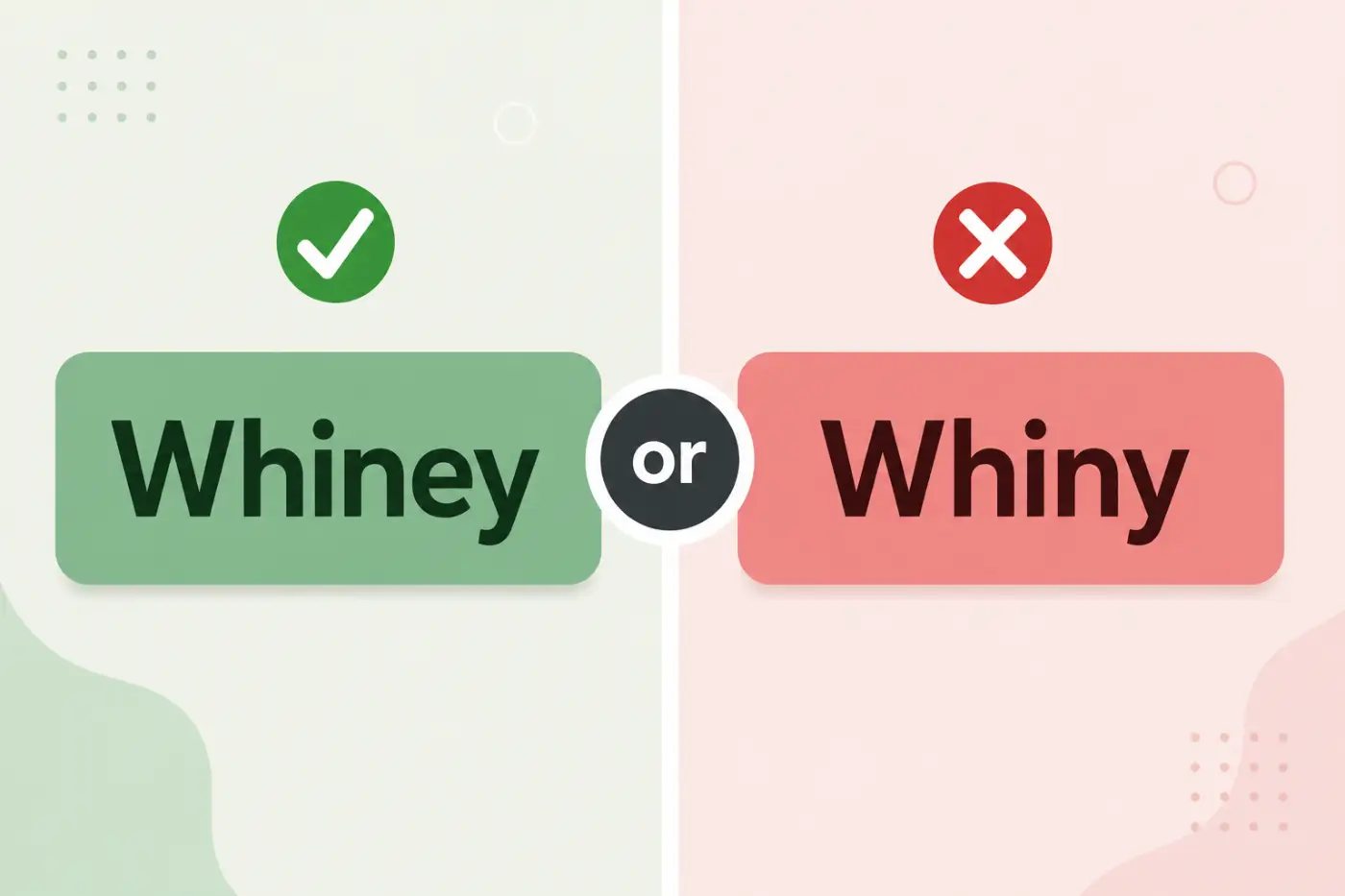
If you’re trying to decide between whiney or whiny you’re dealing with a small spelling question that causes a surprising amount of confusion. Both forms look natural at first glance. Only one is the standard spelling used in American English.
The correct spelling is whiny. It describes someone who complains in an annoying or childish way or a voice that sounds like repeated complaining. The spelling whiney does appear sometimes but it isn’t the preferred standard form.
The reason this word causes trouble is easy to understand. English spelling often changes when we add a suffix to a word. In this case the base word is whine. When the ending is added the final silent e drops before y. That gives us whiny.
This guide explains the spelling rule in plain English. You’ll also see how to use the word in real sentences how it differs from related words and how to remember the correct form without having to stop and think every time.
Quick Definition
Whiny is an adjective that describes a person voice or sound that complains in an irritating way. It can describe someone who keeps asking for things or someone whose voice has a high complaining tone.
The standard spelling in American English is whiny. The form whiney is sometimes seen but whiny is the spelling you should choose in careful writing.
Direct Answer
Whiny is the standard spelling. Whiney is a less common variant and is generally not the preferred choice in standard American English.
Comparison Table
| Word or Phrase | Meaning | Example Sentence | When to Use It |
|---|---|---|---|
| Whiny | Complaining in an annoying or childish way. | The child became whiny after missing his nap. | Use this spelling in standard writing. |
| Whiney | A less common spelling variant of the same adjective. | The dog sounded whiney at the door. | You may see it but whiny is the safer standard choice. |
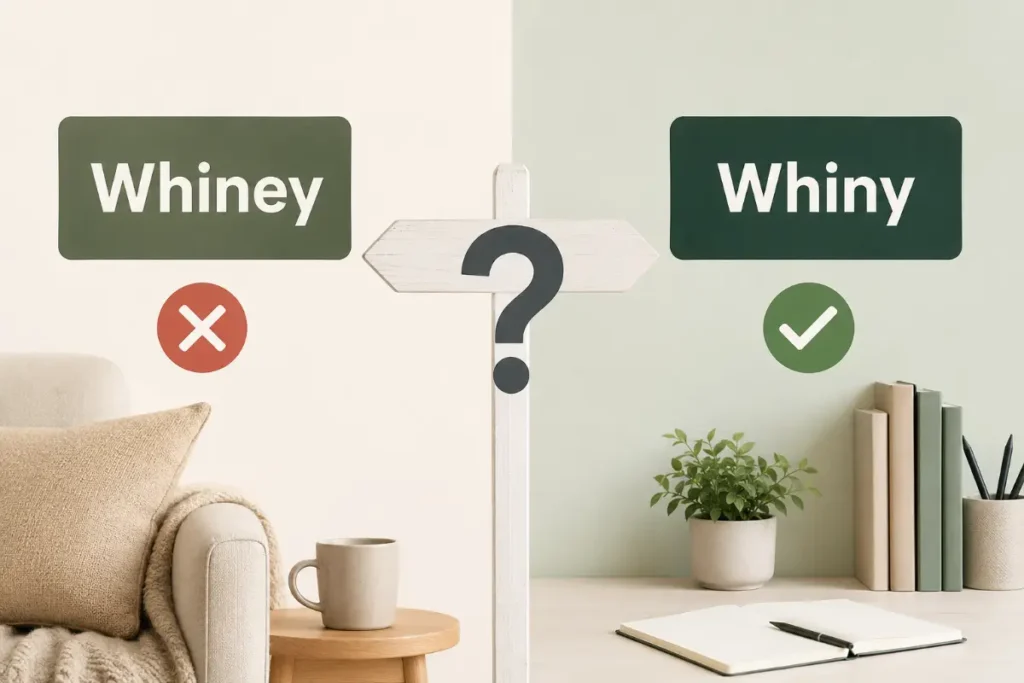
Why The Spelling Causes Confusion
The confusion starts with the base word whine. The word ends with a silent e. When you hear it spoken you can’t hear that final letter at all. That means pronunciation gives you no clue about how the adjective should be spelled.
The problem becomes clearer when you compare the two forms. Whiney looks like someone simply added y to whine. At first glance that seems reasonable. After all many English words keep their final letters when an ending is added.
English has another common pattern that applies here. When a word ends in a silent e and we add an ending that begins with a vowel sound or letter the final e often disappears. This keeps the spelling cleaner and avoids unnecessary letters.
That is what happens with whine. Remove the final e and add y. You get whiny.
The same basic idea appears in many familiar words. For example noise becomes noisy. The final e disappears before y is added. Spice becomes spicy. Again the final e drops away.
Once you see that pattern whiny stops looking strange. It follows a spelling pattern that appears in many everyday words.
The Spelling Rule Behind Whiny
The easiest way to understand the spelling is to start with the base word whine.
The base word is spelled.
W H I N E
When we form the adjective we remove the final e and add y.
That gives us.
W H I N Y
So the spelling changes from whine to whiny.
This is not a random change. English commonly drops a final silent e before adding certain endings. You can see the same pattern in words such as shine and shiny or noise and noisy.
Whine Becomes Whiny
The word whine is a verb and sometimes a noun. It refers to complaining in a high or irritating voice.
For example.
- Stop whining about the weather.
- The puppy began to whine when the door closed.
- I could hear a strange whine coming from the machine.
When you need an adjective to describe that kind of behavior or sound you use whiny.
For example.
- The puppy had a whiny bark.
- His voice sounded whiny after several hours of complaining.
- The child became whiny when she got tired.
The spelling change is small but the grammar changes too. Whine names an action or sound. Whiny describes the person voice or behavior connected with that action.
What Does Whiny Mean
The word whiny usually describes repeated complaining. It often suggests that the complaint sounds irritating childish or overly demanding.
Imagine a child asking for a cookie. The child asks once in a calm voice. That’s not necessarily whiny.
Now imagine the child keeps saying they want a cookie. Their voice gets higher and more drawn out. They complain after being told no. That behavior can be described as whiny.
The word can also describe adults. It isn’t limited to children.
For example.
- My coworker sounded whiny during the meeting.
- He gets whiny whenever the restaurant is crowded.
- She wasn’t upset at first but became whiny after waiting for an hour.
The word often carries a negative tone. Calling someone whiny can sound critical or insulting. For that reason you should think about the situation before using it to describe another person.
Whiny Does Not Always Mean Childish
Although people often associate the word with children the meaning is broader than that.
A child can be whiny because they are tired hungry or frustrated. An adult can also sound whiny when they complain constantly about minor problems.
For example.
- The toddler became whiny after missing her nap.
- The customer sounded whiny when he complained about the wait.
- I don’t want to sound whiny but we’ve been waiting for two hours.
The last example is especially common in everyday speech. A speaker may use whiny about themselves to soften a complaint. They recognize that they might sound overly negative and make that clear to the listener.
Whiny Can Describe A Voice
The word doesn’t always describe a person’s behavior. It can describe the quality of a voice or sound.
A whiny voice has a high complaining tone. It may sound nasal drawn out or irritating.
For example.
- He answered in a whiny voice.
- Her whiny tone made the conversation harder.
- The child used a whiny voice to ask for another toy.
You can also use the word for certain sounds made by animals or machines when those sounds resemble a human complaint.
For example.
- The dog made a whiny sound near the door.
- The puppy gave a whiny little cry.
- The old motor made a whiny noise as it sped up.
In these cases the word describes the sound rather than a person’s attitude.
Real Examples Of Whiny In Everyday Writing
A good way to learn a spelling is to see it used naturally. The following examples show how the adjective works in different situations.
Talking About Children
- The baby became whiny after a long day.
- My son gets whiny when he’s hungry.
- The kids were tired and a little whiny after the trip.
These examples describe behavior rather than simply saying that the children complained. The adjective gives the reader a sense of how the complaints sounded.
Talking About Adults
- He sounded whiny when he talked about his schedule.
- I don’t want to sound whiny but this room is freezing.
- She became whiny after the plans changed.
Using whiny for adults can make the description more pointed. It suggests that the person is complaining in a way the writer finds annoying.
Talking About Animals
- The puppy made a whiny noise from the kitchen.
- Our dog gets whiny when we leave the house.
- The kitten gave a whiny little cry.
Animals cannot explain their feelings with words so people often use this adjective to describe sounds that resemble human complaining.
Talking About Machines
The word can also describe a high pitched mechanical sound.
- The fan makes a whiny noise when it runs at full speed.
- I heard a whiny sound coming from the engine.
- The computer produced a faint whiny noise.
Here the word has nothing to do with complaining. It describes the quality of the sound.
Whiny And Whining Are Not The Same
These words come from the same base word but they have different jobs in a sentence.
Whiny is an adjective. It describes something.
Whining is usually a verb form or a noun. It describes the act of complaining in a drawn out or irritating way.
Compare these sentences.
- The child is whiny.
- The child is whining.
In the first sentence whiny describes the child. In the second sentence whining describes what the child is doing.
You can also use whining as a noun.
- I couldn’t listen to his constant whining.
- Her whining about the food became annoying.
Knowing this difference can help you choose the right form when you’re writing.
Whiny And Whine
The base word whine has several uses.
As a verb it means to complain in an irritating voice.
- Don’t whine about the rules.
- The child began to whine when we left.
It can also describe a high unpleasant sound.
- The brakes started to whine.
- I heard the machine whine in the background.
As a noun whine refers to the sound itself.
- The dog let out a soft whine.
- There was a strange whine coming from the engine.
The adjective whiny describes something that has the quality of a whine.
- She used a whiny voice.
- The puppy had a whiny cry.
Seeing the entire word family makes the meaning much easier to understand.
Whiny And Whiney In American English
The form whiny is the standard choice for American English. It is the spelling most readers will recognize as the normal adjective formed from whine.
You may still encounter whiney in online posts casual writing or user generated content. People sometimes spell the word that way because they add y directly to the base word. Others may have learned the variant from seeing it used by other writers.
That doesn’t mean you need to avoid the word. Simply use the standard spelling.
If you’re writing an email a school assignment article report resume or professional message choose whiny.
Why Whiney Looks Reasonable
There is a simple reason the less common form can look correct.
The base word is whine. If you add y without changing anything else you get whiney. That process feels logical because we often form new words by adding letters to an existing word.
English spelling doesn’t always work that way. Some endings cause changes to the base word. The final silent e is one of the letters that often disappears.
You can see this in other words.
Noise becomes noisy.
Spice becomes spicy.
Ice becomes icy.
Grease becomes greasy.
These examples give you a useful pattern. When a word ends with a silent e and you need an adjective ending in y the final e often drops.
That pattern gives you whiny instead of whiney.
Other Words That Follow The Same Pattern
Learning related examples can make the rule easier to remember.
Noise And Noisy
The noun noise refers to a sound. The adjective noisy describes something that makes a lot of sound.
- The street was full of noise.
- The street was noisy.
Notice that the final e disappears.
Spice And Spicy
The noun spice refers to a substance used to add flavor. The adjective spicy describes food with a strong hot flavor.
- This dish has a lot of spice.
- This dish is spicy.
Again the final e disappears before y.
Ice And Icy
The noun ice refers to frozen water. The adjective icy describes something covered with ice or very cold.
- The road has ice on it.
- The road is icy.
The spelling pattern is the same.
Shine And Shiny
The verb shine means to give off light or reflect light. The adjective shiny describes something that has a bright polished surface.
- The sun began to shine.
- Her shoes looked shiny.
These examples give you a useful mental pattern for remembering the spelling of the adjective.
Common Mistakes With Whiny
The most obvious mistake is keeping the final e from the base word. That produces the less common form whiney.
Another mistake is adding extra letters because the word feels unusual. Some writers may type whinny or whiney when they mean whiny. These spellings can look similar but they don’t have the same meaning.
The word whinny is especially worth remembering because it is a completely different word.
A horse whinnies. A person can be whiny.
For example.
- The horse began to whinny.
- The child became whiny.
Those two words sound somewhat alike but refer to very different things.
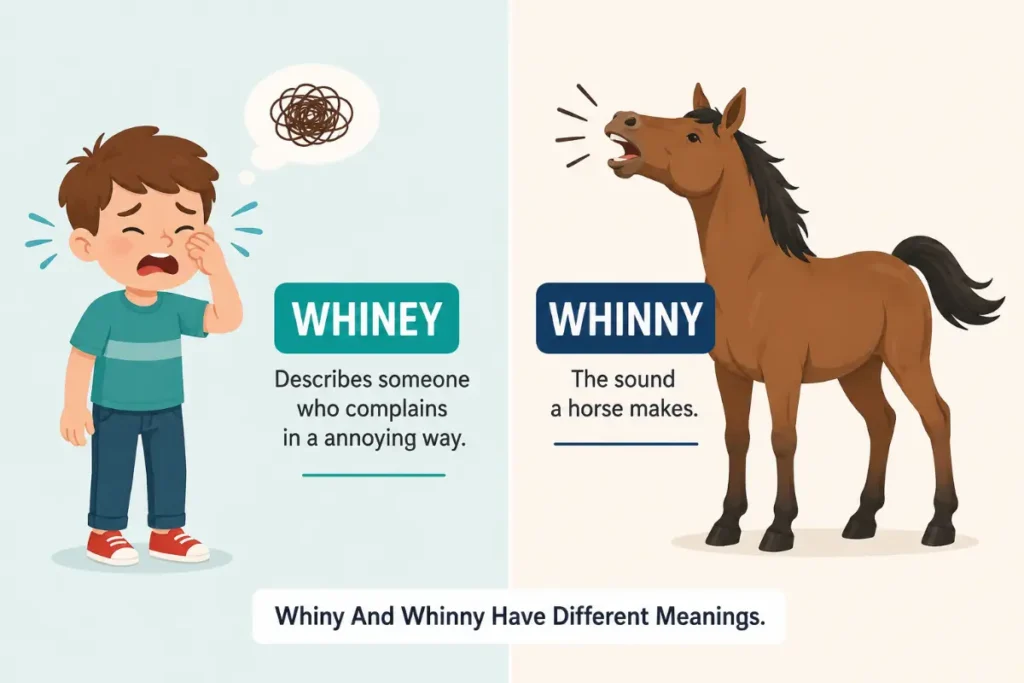
Whiny And Whinny Have Different Meanings
This is one of the most useful distinctions to learn.
Whiny describes complaining behavior or a complaining sound.
Whinny is the sound a horse makes.
You might write.
- The child gave a whiny response.
- The horse let out a loud whinny.
The noun whinny refers to the horse sound. The verb whinny means to make that sound.
For example.
- The horse whinnied when it saw the rider.
- We heard a whinny from the stable.
The spelling difference is only one letter but the meanings are completely different. If you’re writing about a horse use whinny. If you’re describing someone who complains in an irritating voice use whiny.
How To Remember The Correct Spelling
A good memory trick should be simple enough to use when you’re writing quickly. You don’t need a complicated rule.
Start with the base word whine. Then remove the silent e before adding y.
Think.
Whine becomes whiny.
You can also connect it with noise and noisy. Both words show the same kind of spelling change.
Another useful trick is to remember the phrase silent e goes away. The final e in whine is silent. When the adjective ending is added that letter disappears.
If you use the word often the spelling will soon become automatic.
Is Whiny A Negative Word
Usually yes. The word often carries a negative judgment.
Calling someone whiny suggests that their complaints are excessive annoying childish or difficult to listen to. It is stronger than simply saying someone is upset or unhappy.
Compare these sentences.
- She was upset about the delay.
- She was whiny about the delay.
The first sentence simply describes an emotion. The second gives an opinion about how she expressed that emotion.
That difference matters in careful writing. If you want to describe a situation neutrally you may prefer words such as upset frustrated concerned or disappointed.
If you want to show that someone complained in an irritating way whiny may be the right word.
Better Alternatives To Whiny
Sometimes you want to describe a person’s tone without sounding harsh. In that case another adjective may work better.
Complaining
Complaining is more neutral.
- He sounded complaining during the meeting.
This is not always the most natural phrase but it clearly focuses on the act of making complaints.
Fussy
Fussy often describes someone who is hard to please or easily bothered.
- The baby was fussy all afternoon.
Irritable
Irritable describes someone who becomes annoyed easily.
- She was tired and irritable after the long flight.
Petulant
Petulant is a stronger and more formal word. It describes someone who reacts in an annoyed childish way.
- His petulant response surprised everyone.
For everyday American English whiny is usually more natural than petulant. The best choice depends on the exact meaning you want.
When Whiny Is The Right Word
Use whiny when the sound or behavior of complaining is the main point.
For example.
- The child had a whiny tone.
- He sounded whiny after losing the game.
- The dog became whiny when everyone left.
- The old fan made a whiny sound.
In each sentence the word gives the reader more than the simple idea that someone or something made a sound. It suggests a particular quality. The sound is often high pitched drawn out or irritating.
When You Should Choose Another Word
Don’t use whiny simply because someone is unhappy.
A person can be sad without being whiny. Someone can be angry without being whiny. A customer can have a valid complaint without sounding whiny.
For example.
- She was upset because her flight was canceled.
This sentence does not tell us that she complained in an annoying way. It simply tells us how she felt.
If you write.
- She was whiny because her flight was canceled.
You are making a judgment about her behavior.
That distinction is useful in professional writing. If you’re describing a real person in a report or workplace message you may want a more neutral word.
Whiny In Formal Writing
The word is perfectly valid English but it is informal in tone. It works well in conversations personal writing reviews dialogue and casual articles.
It may be less suitable in a formal report where an objective tone matters.
Instead of writing.
- The employee was whiny about the new schedule.
A formal report might say.
- The employee repeatedly expressed frustration about the new schedule.
The second sentence gives a clearer description without making a direct judgment about the employee’s personality.
That doesn’t make whiny a bad word. It simply means the tone should match the situation.
How Native Speakers Use Whiny
In casual American English the word often appears when someone talks about a person’s tone.
For example.
- Don’t get whiny about it.
- I know I sound whiny but I’m exhausted.
- He was getting really whiny.
- The kids were tired and whiny after the long drive.
It can also be playful.
A friend might complain about having to wake up early and another friend could jokingly say.
- You’re getting whiny.
In that situation the word may not be a serious insult. Tone and context do a lot of work.
The Difference Between Whiny And Annoying
These words overlap but they aren’t identical.
Annoying is a broad word. Something annoying causes irritation for any number of reasons.
Whiny is more specific. It suggests a complaining voice behavior or tone.
For example.
- The alarm was annoying.
The alarm isn’t necessarily whiny. It could simply be loud.
But you could say.
- The puppy had an annoying whiny bark.
Now annoying tells us the sound bothers you while whiny explains the kind of sound it is.
Using specific words makes your writing more precise.
The Difference Between Whiny And Crying
A person can cry without being whiny.
Crying describes shedding tears or making sounds because of sadness pain fear or another strong emotion.
Whiny describes a particular complaining tone or manner.
A tired child might cry because they are hurt. A child might become whiny because they don’t want to go to bed.
The two words can overlap in some situations but they are not synonyms.
The Difference Between Whiny And Complaining
Complaining is broader.
Someone who complains says they are unhappy about something or believes something is wrong. The complaint may be reasonable.
Someone described as whiny is usually seen as complaining in an irritating or childish way.
For example.
- She complained about the broken heater.
This tells us that she raised a problem.
- She was whiny about the broken heater.
This tells us that the speaker disliked the way she complained.
That extra judgment is why these words should not be treated as exact substitutes.
How To Use Whiny In A Sentence
The adjective usually comes before a noun or after a linking verb.
Before a noun.
- He used a whiny voice.
- The dog made a whiny sound.
- She gave a whiny response.
After a linking verb.
- He sounded whiny.
- The child became whiny.
- The puppy was whiny all evening.
You can also use it with words that describe degree.
- He sounded very whiny.
- She became a little whiny.
- The puppy was unusually whiny today.
These patterns are natural in everyday American English.
Is Whiny Only Used For People
No. You can use it for people animals and sounds.
With people it often describes complaining behavior or tone.
- He became whiny after the decision.
With animals it can describe a sound or behavior that resembles complaining.
- The puppy was whiny all morning.
With objects it can describe a high pitched sound.
- The motor has a whiny sound.
This broader use comes from the connection between the adjective and the sound of a whine.
The History Behind The Word
The word comes from the older English verb whine, which has long been associated with making a high complaining or mournful sound. Over time the word developed both literal and figurative uses.
A person can whine. An animal can whine. A machine can whine. The sound does not have to come from a human voice.
The adjective whiny developed naturally from that base word. It describes something that has the quality of a whine.
You don’t need to know this history to spell the word correctly but it helps explain why the meanings connect so closely.
A Simple Proofreading Trick
If you’re unsure about the spelling while editing your work start with the base word.
- Ask yourself what the adjective comes from.
- If the base is whine then remove the final e before adding y.
- That gives you whiny.
This trick works for many similar words too. If you learn to look at the base word first you can often solve spelling questions without memorizing every word separately.
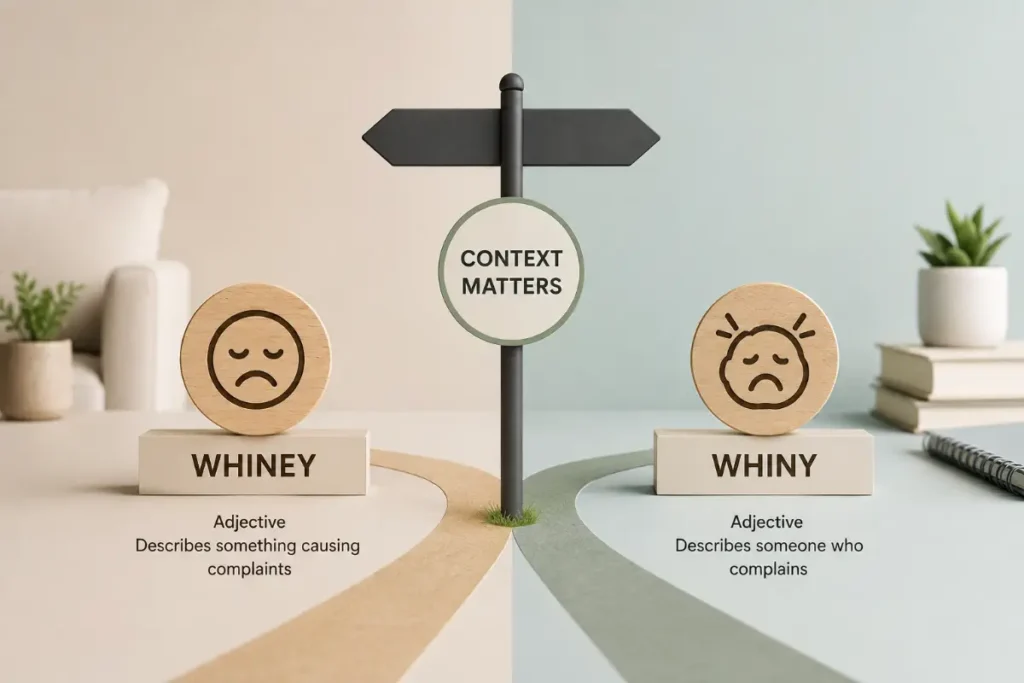
Why Context Matters More Than Spelling Alone
Spelling is only one part of good writing. Choosing the right word matters just as much.
Suppose you’re describing a child who keeps asking for a toy.
- The child was whiny about the toy.
That tells the reader the child complained in an irritating way.
Now suppose the child is crying because they are hurt.
- The child was upset about the injury.
That sentence is more accurate because it describes the emotion without judging the child’s behavior.
Strong writing does not simply use correct words. It uses the most accurate word for the situation.
FAQs
Is whiney or whiny correct?
Whiny is the standard spelling in American English. Whiney is sometimes used as a variant but whiny is the safer and more widely accepted choice for standard writing.
Why is whiny spelled without the e?
The base word is whine. When the adjective ending y is added the final silent e drops. That gives us whiny.
Is whiny a real word?
Yes. Whiny is a standard English adjective. It describes a person voice sound or behavior that has the quality of a whine.
What is the difference between whiny and whining?
Whiny is an adjective that describes someone or something. Whining usually describes the action of complaining in a drawn out or irritating way.
For example you can say The child is whiny or The child is whining. The first describes the child while the second describes what the child is doing.
Is whiney accepted in English?
You may find whiney in dictionaries or informal writing as a variant. Still whiny is the standard form most writers should choose especially in American English.
Is whiny an insult?
It can be. The word often suggests that someone complains in an annoying childish or excessive way. Still people sometimes use it playfully when talking with friends or family.
What is the difference between whiny and whinny?
Whiny describes a complaining tone or sound. Whinny refers to the sound a horse makes. For example a child can be whiny while a horse can whinny.
How can I remember the spelling of whiny?
Start with whine and remove the final silent e before adding y. You can also connect it with words such as noisy spicy and shiny because they follow a similar spelling pattern.
Conclusion
If you’ve been stuck on whiney or whiny the answer is simple. Whiny is the standard spelling you should use in American English. It describes a person voice animal or sound that has a complaining high pitched or irritating quality.
The spelling makes more sense once you look at the base word whine. Drop the final silent e and add y. The result is whiny. This same spelling pattern appears in familiar words such as noisy spicy and shiny.
It also helps to keep the meaning in mind. Whiny is not simply another word for sad upset or unhappy. It usually adds the idea of an irritating complaining tone. If you only want to describe someone’s emotion a word such as upset or frustrated may be more accurate.
When you’re writing and the spelling slips your mind start with whine. Remove the silent e and add y. That quick check gives you whiny and keeps the less common spelling out of your writing.

Sienna Watson is a veteran copywriter and communications coach who has helped startup founders, marketers, and professionals polish their writing for over a decade. Realizing that most people don’t need a degree in linguistics—just clear, impactful communication—Sienna focuses on practical grammar, business writing etiquette, and eliminating wordiness. She advocates for plain language, strong verbs, and persuasive prose that gets results.