
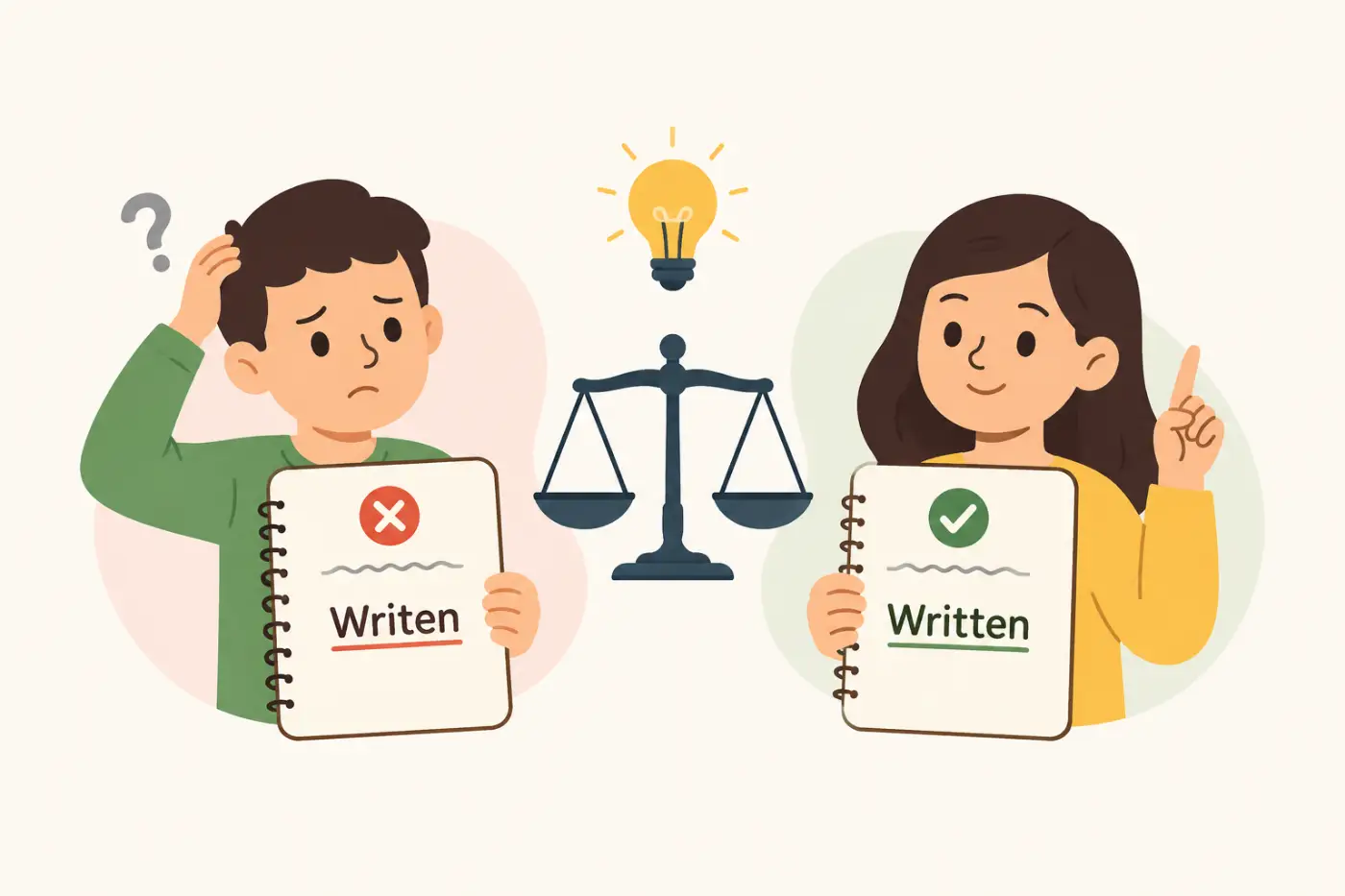
If you’re unsure about writen or written you only need to remember one spelling. The correct word is written with two t letters. Writen is a common spelling mistake and isn’t accepted as a standard English word.
The confusion makes sense because written doesn’t sound like it has two t letters when you say it aloud. English also has several verb forms that change in ways that aren’t always easy to predict. Once you understand where written comes from and how it works in a sentence the spelling becomes much easier to remember.
This guide explains the correct spelling the meaning of the word its connection to write and wrote and the most common mistakes people make. You’ll also see plenty of everyday examples so you can use the word naturally in emails schoolwork conversations and professional writing.
Quick Definition
Written is the past participle of the verb write. It means that someone has put words letters or other information into written form. You normally use written with a helping verb such as has have had or was.
Direct Answer
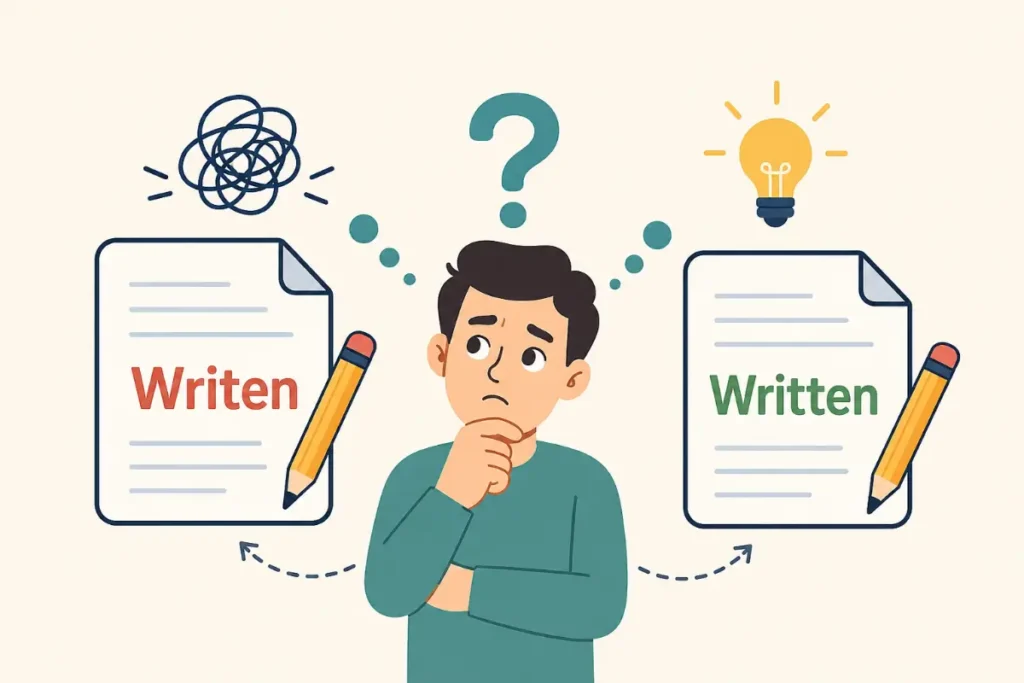
Written is the correct spelling. Writen is incorrect because the past participle of write has two t letters.
Comparison Table
| Word | Meaning | Example Sentence | When to Use It |
|---|---|---|---|
| Written | Past participle of write. | She has written a letter. | Use it with helping verbs or in passive sentences. |
| Writen | Incorrect spelling. | This spelling is incorrect. | Never use it in standard English. |
Why The Spelling Causes Confusion
The biggest reason people make this mistake is pronunciation. When you say written the two t letters aren’t clearly separated. The word sounds closer to rit en than the spelling might lead you to expect. That can make it tempting to leave out one of the letters when you’re typing.
There is another reason for the confusion. The verb write changes form as it moves through different tenses. You have write in the present tense wrote in the simple past and written as the past participle. Those forms don’t look as closely related as many regular verbs do.
Consider a regular verb such as walk. You can say walk walked and walked. The basic form stays easy to recognize. With write the vowel changes and the final form gains an extra t sound in its spelling pattern.
That change comes from the history of English. Write is an irregular verb so you can’t create its past forms simply by adding ed. You have to learn the forms as a group.
A useful group to remember is this.
Write. Wrote. Written.
Once those three forms are familiar you won’t need to guess at the spelling each time you use the word.
The Correct Forms Of Write
Understanding the whole verb family is more useful than memorizing one spelling. Each form has its own job in a sentence.
Write
Write is the base form of the verb. You use it for the present tense and after certain helping verbs.
- I write in my journal every morning.
- Please write your name at the top of the page.
- She wants to write a novel someday.
The spelling is simple because it follows the basic form of the verb.
Wrote
Wrote is the simple past form. Use it when an action happened in the past.
- I wrote an email yesterday.
- She wrote three pages before lunch.
- They wrote a short report for the meeting.
You don’t normally use wrote with has have or had. That’s where many learners get confused.
You would say:
- I wrote the letter yesterday.
But you would say:
- I have written the letter.
You wouldn’t say I have wrote the letter in standard English.
Written
Written is the past participle. It normally appears with a helping verb such as has have or had.
- I have written the report.
- She has written several books.
- They had written the instructions before the event began.
It can also appear in passive constructions.
- The letter was written by Maria.
- The report was written last week.
- These instructions were written for new employees.
The key point is simple. Written doesn’t usually stand alone as the simple past tense. It works as part of a larger verb phrase.
How To Use Written Correctly
The word appears in many kinds of sentences. You can use it when talking about letters books reports messages notes applications stories and almost anything else that contains words.
Talking About Something You Finished
Use have written or has written when the writing is complete and connected to the present.
- I have written the email.
- She has written her application.
- We have written everything down.
These sentences focus on the completed result.
Compare that with the simple past.
- I wrote the email yesterday.
- She wrote her application last night.
- We wrote everything down during the meeting.
The difference is mainly about the tense and how the action relates to the time being discussed.
Talking About Something Completed Before Another Past Event
Use had written when one writing action happened before another past event.
- I had written the report before my manager called.
- She had written the note before she left the office.
- They had written the instructions before the students arrived.
The word had helps show that the writing happened first.
Using Written In Passive Sentences
You can also use written when the focus is on the thing that was written rather than the person who wrote it.
- The book was written by a former teacher.
- The letter was written in 1998.
- The instructions were written in simple English.
This structure is common in news articles academic writing workplace documents and everyday speech.
Written In Real Life
You probably see this word often without thinking about its grammar. It appears in ordinary phrases that people use every day.
You might say that something is written clearly when the words are easy to understand. You might describe an agreement as written down when its details have been recorded. A teacher might ask if you’ve written your answer. A manager might ask if you’ve written the report.
Here are some natural examples.
- Have you written your address on the form.
- I’ve written down the phone number.
- She has written a detailed explanation.
- Someone had written a message on the board.
- The rules are written in plain English.
- He has written several articles about the subject.
The word fits naturally into casual and formal English. You don’t need a special style to use it.
A Simple Way To Remember The Spelling
Think of written as the form that connects write and wrote.
Write. Wrote. Written.
The final form has tt.
A helpful memory trick is to think of the word as having a small extra step.
wri + tt + en
You don’t need to pronounce each part separately. Just use the visual pattern to remind yourself that the middle contains two t letters.
Another useful trick is to connect written with familiar words that also contain tt. For example written and bitten both have the same tt pattern near the middle.
- The letter was written yesterday.
- The dog had bitten the toy.
You don’t need to memorize a complicated spelling rule. Remembering the verb family and the double t is enough.
Where The Double T Comes From
The two t letters in written aren’t random. They come from the way English formed the past participle of this old irregular verb. Unlike a regular verb such as talk which becomes talked write changes its form instead of simply adding ed.
The older forms of the verb developed into the forms we use today. The modern pattern is write wrote and written. The final form kept the tt spelling that we now recognize as part of the word.
You don’t need to study the history of English to spell the word correctly. Still understanding that written is its own established verb form can help. It isn’t made by taking write and guessing what letters should be added.
Written Is An Irregular Verb Form
The verb write is called an irregular verb because its past forms don’t follow the usual ed pattern.
Consider these common verbs.
- Walk becomes walked.
- Talk becomes talked.
- Clean becomes cleaned.
- Open becomes opened.
The past tense and past participle are easy to predict with these verbs.
Write works differently.
- Write becomes wrote.
- Write becomes written.
The vowel changes and the past participle has a different ending. That’s why trying to spell the word by sound often leads to trouble.
The best approach is to learn the three forms together rather than trying to invent the last form each time.
Write Wrote And Written
These three forms have different roles in English.
Use Write For The Base Form
Use write for present actions or after words such as to can will and should.
- I write every day.
- I want to write a book.
- You should write your answer here.
- She will write to you tomorrow.
The word can also describe a regular habit.
- He writes in his notebook every night.
Notice that the third person singular form is writes. It still comes from the same base verb.
Use Wrote For The Simple Past
Use wrote when the action happened in the past.
- I wrote the letter yesterday.
- She wrote a short story last weekend.
- We wrote our answers before the bell rang.
The time is often clear from words such as yesterday last week this morning or two days ago.
You don’t need a helping verb such as have or has with this form.
For example.
- I wrote the report yesterday.
That sentence is complete on its own.
Use Written With A Helping Verb
Use written as the past participle. It normally needs a helping verb when it forms a perfect tense.
- I have written the report.
- She has written three pages.
- They had written the instructions before the meeting.
The helping verb changes the tense while written stays the same.
This distinction is one of the most useful things to understand about the word. If you can identify the helping verb you can often choose the correct form without hesitation.
Common Grammar Mistakes With Written
Spelling is only part of the problem. People sometimes spell the word correctly but use the wrong verb form in a sentence.
I Have Wrote
This is incorrect in standard English.
The correct sentence is:
- I have written the email.
After have or has you need the past participle written.
I Had Wrote
This is also incorrect.
The correct version is:
- I had written the email before the meeting started.
After had you need the past participle.
I Written The Letter
This sentence is incomplete because written needs a helping verb in this type of sentence.
Say:
- I wrote the letter.
Or:
- I have written the letter.
The first sentence uses the simple past. The second uses the present perfect.
She Has Writen The Report
The grammar is fine but the spelling is wrong. The correct form is:
- She has written the report.
The double t belongs in the past participle.
Written Vs Wrote
This is one of the most common grammar questions connected with this word. Both forms describe past writing but they work differently.
Wrote is the simple past form.
Written is the past participle and needs a helping verb in perfect constructions.
Compare these sentences.
- I wrote the article yesterday.
- I have written the article already.
The first sentence places the action clearly in the past. The second focuses on the completed action and its connection to the present.
Here is another pair.
- She wrote five pages last night.
- She has written five pages so far.
The phrase last night points to a finished past time so wrote works naturally. The phrase so far connects the action to the present so has written fits better.
You don’t need to memorize a long grammar formula. Just remember that wrote can stand as the main past verb while written normally works with a helping verb.
Written Vs Write
These forms can also be easy to mix up.
Use write for the base form.
- I need to write a letter.
- Please write your name here.
- She likes to write stories.
Use written when the grammar calls for the past participle.
- I have written a letter.
- She has written several stories.
- The instructions were written by the teacher.
A quick test can help. If the sentence contains have has or had before the verb then written is usually the form you need.
Written Vs Writing
Written and writing both come from write but they serve different purposes.
Writing is the present participle. It can describe an action that is happening or act as a noun.
- I am writing an email.
- She is writing a novel.
- Writing helps me relax.
Written is the past participle.
- I have written an email.
- She has written a novel.
- The novel was written in 2024.
The ending gives you a useful clue. Writing ends in ing while written ends in en.
Examples From School And College
Students use this word constantly. Teachers may ask them to explain ideas summarize readings or complete written assignments.
Here are some natural examples.
- Have you written your essay yet.
- I have written my answer in the space provided.
- The student had written several notes in the margin.
- Our teacher said the instructions were clearly written.
- She has written a strong introduction for her paper.
The word also appears in academic phrases such as written assignment written response written exam and written instructions.
A written exam is an exam where students give answers in writing. A written response is an answer expressed through written words rather than speech.
Examples At Work
Professional writing uses the word just as often.
You might write an email to a coworker and say:
- I’ve written a summary of the meeting.
A manager might tell an employee:
- Please make sure you’ve written down the client’s requirements.
A company may publish:
- The policy is written for all employees.
The word is especially useful when discussing records and documents because writing creates a lasting record of information.

Examples In Everyday Conversation
You don’t have to be in school or at work to use this word. It fits naturally into ordinary speech.
- Have you written to your sister yet.
- I’ve written down the address for you.
- He has written a note on the fridge.
- Someone had written my name on the list.
- I’ve never written a letter by hand.
These sentences sound normal because the word is part of everyday English. You may hear it in conversations even when the topic has nothing to do with formal writing.
Why Writen Looks Almost Right
The incorrect spelling can fool your eyes because writen still resembles the correct word. You can identify the intended meaning immediately. That makes the missing t easy to overlook.
This happens with many common spelling errors. When we read familiar words our brains don’t always process every letter separately. We often recognize the overall shape and meaning first.
That is why proofreading can help. If you’re checking an important document don’t only read for meaning. Slow down and look at words that commonly cause trouble.
For this word pay special attention to the middle.
written
Two t letters.
That small visual check can prevent a surprisingly common mistake.
More Examples Of Written In Natural English
The best way to make a spelling stick is to see it doing real work in sentences. Written appears in many settings and its meaning can change slightly depending on the sentence. The core idea stays simple though. Something has been put into written form.
You might talk about a note someone left on a desk. You might describe a novel created by an author.
Here are several situations where you’ll commonly see it.
Talking About Letters
Letters are one of the clearest examples.
- I have written a letter to my grandmother.
- She had written several letters before moving away.
- The letter was written by hand.
- He has written to the company about the problem.
Notice that written often appears with have or has. In passive sentences it can appear with was or were.
Talking About Books
Authors write books but readers often talk about the finished work using written.
- The book was written by a former journalist.
- She has written five novels.
- The story was written for young readers.
- He had written the first chapter before the publisher contacted him.
The word doesn’t mean that the book itself is doing anything. It describes the act of putting the story into written form.
Talking About Notes And Messages
Short messages use the word too.
- I’ve written a note for you on the kitchen table.
- She has written down the address.
- Someone had written a message on the whiteboard.
- The instructions were written on a small card.
The phrase written down is especially common. It means that information has been recorded so someone can read it later.
Talking About Rules And Instructions
Rules often exist in written form.
- The rules are written in simple language.
- The instructions were written for new employees.
- The policy has been written to protect customers.
- Everything is clearly written on the form.
This use is common in workplaces schools government documents and many other settings.
The Phrase Written Down
Written down deserves special attention because it’s an everyday expression. It means that someone has recorded information using words rather than simply remembering or saying it.
For example:
- I’ve written down your address.
- Please write down your phone number.
- She had written down the meeting time.
- I wrote down the recipe so I wouldn’t forget it.
Notice the difference between write down and written down.
Write down is the base form.
- Please write down this number.
Written down is the past participle.
- I’ve written down this number.
The same basic rule applies to other uses of the verb. Grammar determines which form belongs in the sentence.
Written As An Adjective
Although written comes from a verb it can also describe a noun. In this role it tells you that something exists in written form.
Consider these phrases.
- Written agreement.
- Written instructions.
- Written permission.
- Written notice.
- Written record.
- Written statement.
- Written exam.
- Written response.
In written permission the word tells you that the permission has been given in writing. In written notice it tells you that the notice has been provided through a written document or message.
This use is especially common in professional and legal settings. You don’t need to treat it as a completely different word. It still comes from the verb write and keeps its connection to the idea of putting information into words.
Written And Spoken
A useful comparison is written and spoken. Both can describe forms of communication.
Written refers to information expressed through writing.
Spoken refers to information expressed through speech.
For example:
- The agreement was written in clear language.
- The instructions were spoken during the meeting.
You might also hear someone say:
- Please give me written confirmation.
That means they want the information recorded in writing instead of receiving it only through a conversation.
This distinction matters in workplaces and formal situations because spoken information can be forgotten or misunderstood. A written record gives people something they can review later.
Written And Recorded
These words are related but they aren’t identical.
Written usually means information has been put into words on paper or in digital form.
Recorded has a broader meaning. It can refer to written information but it can also refer to audio video or other stored information.
For example:
- The instructions were written in the handbook.
- The meeting was recorded on video.
A meeting can be recorded without anyone writing anything. A written report is recorded information but it isn’t necessarily a recording in the usual sense.
Understanding this difference helps you choose the right word instead of treating similar words as exact substitutes.
Common Spelling Mistakes Related To Written
Once you’ve learned the correct form it’s useful to recognize other errors that often appear alongside it.
Writen
This version is missing one t. It should always be written.
Writting
This mistake adds an extra t in the wrong place. The correct present participle is writing.
- I am writing an email.
Not:
- I am writting an email.
Writed
Some learners assume that write becomes writed in the past because many English verbs take ed. That doesn’t work here because write is irregular.
The correct form is wrote.
- I wrote the report yesterday.
For the past participle use written.
- I have written the report.
Writtened
This form isn’t used in standard English. The correct past participle is simply written.
Learning the complete verb family helps prevent all of these mistakes.
Write. Wrote. Written. Writing.
A Quick Grammar Test
If you’re unsure which form to use take a moment to look at the words around the verb.
- I have written the letter.
- She has written the report.
- They had written the instructions.
If you see am is or are and you’re describing an action in progress use writing.
- I am writing the letter.
- She is writing the report.
- They are writing their answers.
This simple test won’t solve every grammar question but it handles the most common situations.
How To Proofread For This Mistake
A good proofreading habit can catch this error quickly. Don’t rely only on spell check. Read the word carefully and check the middle letters.
Look for:
written
Then ask yourself if you see two t letters.
If you often type the wrong version add the correct word to a personal spelling list. You can also type the correct form several times in a sentence. The goal isn’t to memorize it through endless repetition. The goal is to make the correct pattern familiar.
For important writing read the document once for meaning and then read it again for spelling and grammar. Looking for everything at once can make small errors harder to notice.
A Memory Trick That Actually Works
Think of written as the word that carries two t letters between wri and en.
You can picture it like this.
wri TT en
The double t acts like a small signpost in the middle of the word. When you’re unsure of the spelling pause at that point and check the two letters.
Another useful connection is bitten. Both words contain tt before en.
- written.
- bitten.
You don’t need to force this trick every time you write. After seeing the correct spelling enough times your brain will begin to recognize it automatically.
Why The Correct Spelling Matters
A single missing letter may seem minor but repeated spelling mistakes can affect how readers view a piece of writing. Teachers may mark it as an error. Employers may notice it in an application. Readers may lose confidence if a document contains many basic mistakes.
That doesn’t mean you need perfect spelling every second. Nobody writes perfectly all the time. Good writing comes from knowing the common trouble spots and checking them when the stakes are high.
Written is worth learning because it appears so often. Once you know the double t and understand the connection between write wrote and written you have most of what you need.
Common Questions
Is writen or written correct?
Written is the correct spelling. Writen is missing one t and isn’t a standard English spelling. If you’re referring to the past participle of write always use written.
Why does written have two t letters?
The double t is part of the standard spelling of the past participle of write. English doesn’t form this verb like a regular verb because write is irregular. The three main forms are write wrote and written.
Is written the past tense of write?
Not exactly. Wrote is the simple past form while written is the past participle. You can say I wrote the letter yesterday but you say I have written the letter.
What is the difference between wrote and written?
Use wrote as the simple past form when you describe something that happened in the past. Use written with helping verbs such as has have and had or in passive sentences. For example She wrote the report yesterday and She has written the report are both correct.
Can I say I have wrote?
No. In standard English the correct form is I have written. The word have requires the past participle in this sentence.
What is the past participle of write?
The past participle is written. You use it in forms such as have written has written and had written. It also appears in passive sentences such as The book was written by an experienced author.
Is written an adjective?
Yes. Written can function as an adjective when it describes something that is expressed or provided in writing. Common examples include written instructions written permission written notice and written agreement.
How can I remember the spelling?
Remember the three forms together as write wrote and written. Then focus on the two t letters in the middle of the last form. A simple visual trick is to picture the word as wri TT en.
A Final Look At The Verb Family
Learning one spelling is useful. Learning the whole word family is even better because it helps you choose the right form when you’re writing a sentence.
The base form is write.
- I write in my journal every night.
- Please write your answer clearly.
- They want to write a new book.
The simple past form is wrote.
- I wrote the email yesterday.
- She wrote the story last month.
- We wrote our names on the list.
The past participle is written.
- I have written the email.
- She has written the story.
- We had written our names before the teacher arrived.
The present participle is writing.
- I am writing an email.
- She is writing a story.
- They are writing their answers.
Seeing all four forms together makes the differences much easier to understand. Instead of guessing from pronunciation you can look at the grammar of the sentence and choose the form that fits.
When To Use Each Form
A quick grammar check can save you from most mistakes.
Use write for the basic form of the verb.
- I need to write a report.
Use wrote for a completed action in the simple past.
- I am writing the report.
This pattern covers a huge number of everyday sentences. Once you understand it you don’t need to memorize dozens of separate examples.
A Simple Editing Check
If you’re proofreading your own writing and you see writen stop for a moment. Check the middle of the word. The correct form has two t letters.
You can also check the words before it. If you see have has or had the past participle is likely needed.
For example:
- I have written the message.
- She has written the instructions.
- They had written the report.
If you’re talking about a completed action at a specific past time use wrote instead.
- I wrote the message this morning.
- She wrote the instructions yesterday.
- They wrote the report last Friday.
That small grammar check can help you avoid both spelling and verb form mistakes.
Why Learning Word Families Helps
English spelling becomes easier when you stop treating every word as a completely separate item. Words often belong to families that share a common root or pattern.
Write gives us wrote written and writing. Once you learn those forms together you have a stronger mental picture of the whole verb.
The same idea works with many other irregular verbs.
- Begin becomes began and begun.
- Speak becomes spoke and spoken.
- Break becomes broke and broken.
- Drive becomes drove and driven.
- Choose becomes chose and chosen.
These verbs don’t follow the simple ed pattern. Their forms need to be learned and recognized. Grouping them by their forms makes that task less difficult.
Don’t Let Pronunciation Decide The Spelling
One of the biggest lessons from this word is that English spelling can’t always be predicted from sound. The pronunciation of written doesn’t clearly announce that the word contains two t letters.
That’s normal in English. Many common words contain letters that aren’t strongly heard in speech or spelling patterns that aren’t obvious from pronunciation.
When sound and spelling seem to disagree use the written form you know is correct. For this word the visual pattern is more useful than trying to spell it phonetically.
Conclusion
If you’ve been stuck on writen or written the answer is simple. Written is the correct spelling and it always has two t letters. Writen is a misspelling and should be corrected.
The word is the past participle of write. The easiest way to remember it is to learn the verb forms together: write wrote and written. Remember that wrote works as the simple past while written usually appears with have has or had or in passive sentences.
When you’re proofreading don’t rely only on how the word sounds. Look at the middle and check for the double t. If you remember wri TT en and connect the word with write and wrote you’ll have a simple way to get the spelling right every time.

Sienna Watson is a veteran copywriter and communications coach who has helped startup founders, marketers, and professionals polish their writing for over a decade. Realizing that most people don’t need a degree in linguistics—just clear, impactful communication—Sienna focuses on practical grammar, business writing etiquette, and eliminating wordiness. She advocates for plain language, strong verbs, and persuasive prose that gets results.