

If you’ve ever paused while writing and wondered about indexes or indices you’re not alone. Both words are correct. Still they are not always the best choice for the same situation. The right option depends on the context and the audience.
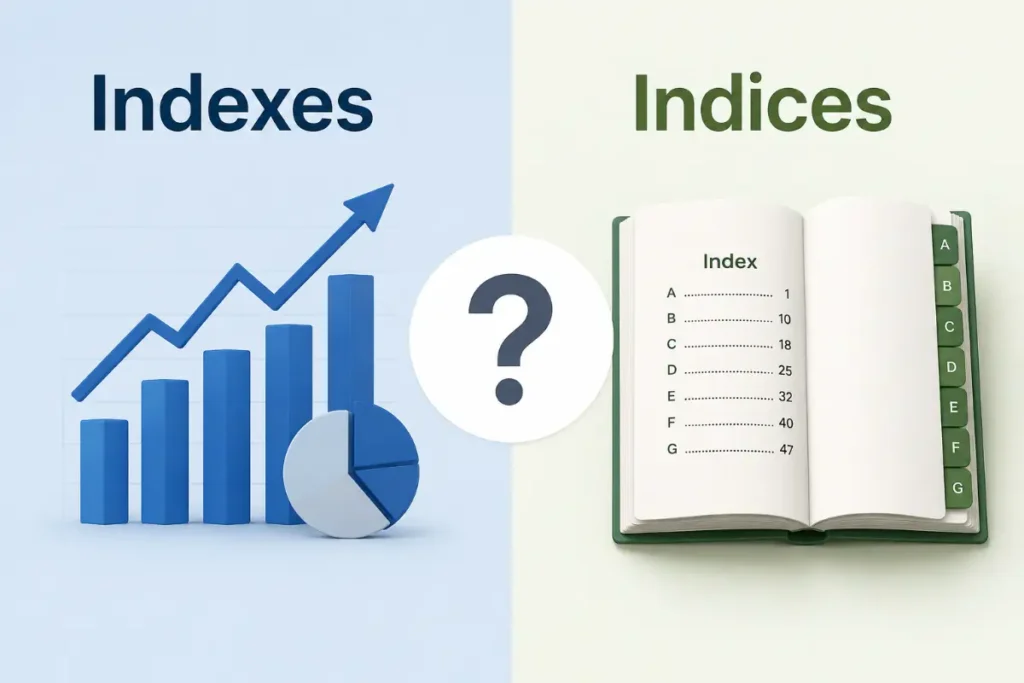
The confusion comes from the fact that both words are accepted plural forms of index. You will see indexes in books databases and everyday writing. On the other hand indices appears more often in mathematics science finance and technical fields.
This difference makes many writers stop and second guess themselves. The good news is that the rule is much simpler than it seems once you know where each word fits.
This guide explains the difference in plain English. You’ll learn when to use each plural form why both exist where they commonly appear and how to choose the one that sounds natural every time.
Quick Definition
An index is a list that helps people find information quickly. It can also refer to a measurement a sign or a numerical value in subjects like math economics and science.
The two accepted plural forms are indexes and indices. Both are correct but each is more common in different situations.
Direct Answer
Both indexes and indices are correct plural forms of index. Use indexes in general English and publishing. Use indices in technical academic mathematical and scientific writing.
Comparison Table
| Word | Meaning | Example Sentence | Best Time To Use |
|---|---|---|---|
| Indexes | Plural of index in general English. | The book includes helpful indexes at the back. | Books databases libraries websites and everyday writing. |
| Indices | Plural of index in technical fields. | Stock market indices fell today. | Mathematics science economics finance and research. |
Why Do Both Words Exist
English has borrowed words from many languages over hundreds of years. Some words keep their older plural forms while others adopt the standard English ending with s. The word index ended up with both forms and each became common in different settings. Indexes follows the regular English pattern. Most nouns simply add s to become plural so this version feels familiar to many readers.
Indices comes from the word’s Latin background. Many academic and scientific fields continue using the Latin plural because it has been part of professional writing for a long time.
That does not mean one word is smarter or more correct than the other. They simply serve different audiences. Knowing your readers makes the choice much easier.
What Does Index Mean
Before choosing the right plural it helps to understand what an index actually is. The word has several meanings and each one can influence the plural you choose.
An index is often a list of topics with page numbers at the end of a book. It helps readers find information without reading every page. For example,
- I found the recipe by checking the index.
- The textbook has a detailed index for every chapter.
The word can also describe a number that measures change or performance. For example,
- The price index increased this month.
- The air quality index reached unhealthy levels.
In mathematics an index may describe an exponent or another mathematical value. For example,
- The index tells you how many times the number is multiplied by itself.
Computers also use the word. A database index helps software find information more quickly. As you can see the meaning changes with the subject. That is one reason both plural forms continue to exist.
When To Use Indexes
In everyday English indexes is usually the safer and more natural choice. Most readers expect it because it follows the standard English plural pattern.
You will commonly see this form in publishing education libraries websites and technology. It also appears in many style guides when the discussion is about books records or searchable information. Here are a few natural examples,
- The library created new indexes for its historical newspapers.
- Our website uses indexes to organize thousands of articles.
- The textbook includes separate indexes for names and subjects.
- The database builds indexes to speed up searches.
Notice that each example focuses on organizing or locating information. In these situations indexes sounds natural to most English speakers.
Why Many People Get Confused
The confusion usually starts when people notice both words in different places. Someone may read indexes in a publishing guide but see indices in a financial news article later that same day. That can make it seem like one source is wrong. In reality both are correct. They simply belong to different writing styles and subject areas.
Another reason is that search engines display both versions. Students writers and English learners often find mixed answers online because many websites explain only part of the story. Once you understand that context matters more than memorizing one single rule the choice becomes much easier.
When To Use Indices
While indexes sounds more natural in everyday English indices is the preferred choice in many technical and academic fields. You will often see it in textbooks research papers financial reports and scientific articles.
Professionals use this form because it has been part of these subjects for a long time. If you read material written by economists mathematicians scientists or analysts you will notice indices appears far more often than indexes.
Here are some common situations where this plural fits naturally.
In Finance
Financial experts often talk about stock market indices. These numbers track the performance of groups of stocks and help investors understand how the market is moving. Examples,
- Major stock indices closed higher today.
- Global market indices reacted to the latest economic news.
- Investors watched several indices before making decisions.
In Mathematics
In mathematics an index can describe an exponent or another numerical value. Many math books use the Latin plural because it matches long standing academic tradition. Examples,
- The teacher explained how indices work in algebra.
- Students practiced solving problems with fractional indices.
- Negative indices can be confusing at first.
In Science
Scientists also prefer this plural in many fields. Examples,
- Researchers compared several climate indices.
- Health indices improved during the study.
- Environmental indices help measure pollution levels.
In Economics
Economists rely on many different measurements to study trends and compare data. Examples,
- Consumer price indices showed steady growth.
- Economic indices pointed to slower spending.
- Analysts reviewed several leading indices before publishing the report.
If your writing is aimed at a technical audience indices will usually sound more natural than indexes.
Side By Side Examples
Looking at both plural forms together makes the difference much easier to understand.
| Situation | Better Choice | Example |
|---|---|---|
| Book reference | Indexes | The book includes detailed indexes for every topic. |
| Library catalog | Indexes | The librarian updated several indexes this week. |
| Website search | Indexes | Search indexes help users find information faster. |
| Database | Indexes | Database indexes improve search performance. |
| Stock market | Indices | Asian stock indices finished higher today. |
| Mathematics | Indices | Students learned about positive and negative indices. |
| Scientific research | Indices | Scientists compared multiple climate indices. |
| Economics | Indices | Inflation indices rose again this month. |
The meaning does not change. Only the preferred style changes with the subject.
Can You Use Either Word
- Sometimes yes.
- Many dictionaries accept both plurals in general English. That means readers will usually understand your meaning no matter which form you choose.
- Still choosing the form your audience expects makes your writing smoother and more professional.
- Imagine reading a math textbook that talks about indexes throughout the chapter. Most teachers and students would probably notice because indices is the standard term in that subject.
- Now imagine a cookbook ending with indices instead of indexes. It would sound more formal than most readers expect.
- That is why context matters much more than strict grammar.

Common Mistakes Writers Make
Even experienced writers mix these words up from time to time. Most mistakes happen because people focus only on grammar instead of the type of writing they are creating.
Assuming One Form Is Wrong
This is the biggest misunderstanding. Some people believe only indexes is correct because it follows normal English rules. Others believe only indices is correct because it comes from Latin.
Neither idea is true. Both plurals are accepted. The difference is simply where each one is commonly used.
Using Indices In Everyday Writing
Technical language can make simple writing feel less natural. For example,
- The cookbook has useful indices.
Most readers would expect indexes instead because the topic is a book.
Using Indexes In Technical Papers
The opposite mistake also happens. For example,
- The report compared several economic indexes.
Many editors would change indexes to indices because it matches the style used in economics and finance.
Ignoring Your Audience
The best writers always think about who will read their work.
A research journal and a children’s book follow different writing styles. Choosing the familiar plural helps readers focus on your message instead of the wording.
Examples In Everyday Conversations
Real conversations show how naturally these words fit into different situations.
Talking About Books
- I checked the indexes before reading the whole book.
- These indexes make it easy to find every recipe.
For About Technology
- Search indexes help websites load results faster.
- The software rebuilt its indexes after the update.
Talking About Finance
- Investors watched the major indices all afternoon.
- Global indices gained value after the announcement.
Talking About School
- Our math teacher spent the week explaining indices.
- The librarian showed us how book indexes work.
Notice how each sentence matches the subject. That is exactly how native speakers and professional writers use these plurals.
How Style Guides Treat These Words
One reason people get mixed answers online is that different dictionaries and style guides explain the two plural forms in slightly different ways. They all agree that indexes and indices are correct. The difference is the context where each one sounds most natural. Most general writing guides lean toward indexes for everyday English because it follows the standard plural pattern that readers know well.
Academic writing often favors indices in subjects like mathematics economics finance and science. That preference has been around for many years and is still common today. If you are writing for a specific company school or publisher check its style guide first. Some organizations prefer one form to keep all of their documents consistent.
Which Form Sounds More Natural
- If you asked a group of native English speakers to talk about the back of a book most would probably say indexes without giving it much thought.
- Now picture a room full of economists discussing market trends. You would almost certainly hear indices instead.
- Neither group is trying to sound smarter. They are simply using the word that feels normal in their field.
- This is a good reminder that language changes with the situation. The best choice is usually the one your readers expect to see.
Easy Trick To Remember The Difference
- You do not need to memorize long grammar rules. A simple connection can help.
- Think about the place where you see the word.
- If it helps people find information use indexes.
- Examples include books libraries websites databases and catalogs.
- If it helps people measure or calculate something use indices.
- Examples include mathematics finance economics engineering and science.
- This trick will not cover every situation but it works well most of the time.
Related Words That People Confuse
People searching for this topic often have questions about similar words. Understanding these pairs makes English easier to use with confidence.
Index And Table Of Contents
- These terms are not the same.
- A table of contents appears near the beginning of a book. It lists chapters or major sections in order.
- An index appears near the end. It lists important topics in alphabetical order with page numbers.
- For example imagine looking for information about volcanoes in a science book.
- The table of contents helps you find the chapter.
- The index helps you find every page that mentions volcanoes.
Index And Indicator
- These words are related but not identical.
- An index is often a list or a numerical measure.
- An indicator is something that points to a condition or change.
- For example the unemployment rate can be an economic indicator. A stock market index measures the performance of selected companies.
Index And Indexing
- An index is the finished list or measurement.
- Indexing is the process of creating or organizing that list.
For example.
- The librarian spent the afternoon indexing old newspapers.
- The finished indexes were added to the archive.
The same idea appears in technology. Search engines index web pages so people can find them more easily.
Examples From Different Fields
Looking at real examples makes the difference easier to remember.
Publishing
- The encyclopedia has separate indexes for people places and events.
- Good indexes save readers a lot of time.
Libraries
- Digital indexes help visitors locate rare books.
- Librarians update indexes as new materials arrive.
Databases
- Database indexes improve search speed.
- Large systems use multiple indexes to organize information.
Finance
- Market indices climbed after the latest report.
- Investors compared international indices before buying shares.
Mathematics
- Students learned how indices affect exponential equations.
- Fractional indices become easier with practice.
Science
- Researchers examined climate indices from the past fifty years.
- Several health indices improved during the study.
These examples show that the subject usually tells you which plural sounds most natural.
Does It Matter In Casual Writing
Not very much.
Most readers will understand your meaning no matter which plural you choose. If you accidentally use indices in a blog post or indexes in an email people will still know what you mean.
Still using the expected form makes your writing feel smoother. It also shows that you understand the topic and your audience. That extra attention to detail helps build trust with readers. It is a small change that makes your writing look more polished without adding extra effort.

Final Tips Before You Choose
- Ask yourself a simple question before writing.
- Am I talking about finding information or measuring something.
- If the answer is finding information indexes will usually be the better choice.
- If the answer is measuring values or discussing technical subjects indices is usually the better fit.
- After a little practice this decision becomes automatic. You will stop second guessing yourself and start choosing the right plural with confidence.
FAQs
Is indexes or indices correct?
Yes. Indexes or indices are both correct plural forms of index. The best choice depends on the context. Indexes is more common in everyday English while indices is preferred in mathematics finance economics and many scientific fields.
Why are there two plural forms of index?
The word index comes from Latin but has been part of English for centuries. Over time English accepted both the regular plural indexes and the traditional Latin plural indices. Each became common in different types of writing.
Do dictionaries accept both indexes and indices?
Yes. Major English dictionaries list both as correct plurals. They also explain that usage depends on the subject instead of one form being more correct than the other.
Should I use indexes or indices in a book?
For books manuals guides and most general publications use indexes. Readers expect this form because it is the standard choice in publishing and everyday English.
Why do financial reports use indices?
Finance economics and science have traditionally used indices. It has become the accepted style in these fields and appears in research papers market reports and academic journals.
Is indexes wrong in mathematics?
It is not technically wrong because it is a valid English plural. Still indices is the form most teachers professors and textbooks use. Choosing it makes your writing sound more natural in mathematical contexts.
Which plural should students use?
Students should match the subject they are writing about. Use indexes for general English essays books libraries and databases. Use indices for math science economics and finance assignments unless your teacher gives different instructions.
How can I remember the difference?
Think about the purpose of the word. If it helps people find information use indexes. If it refers to measurements formulas or technical data use indices.
Conclusion
If you’ve been wondering about indexes or indices the answer is simpler than it first appears. Both are correct. The key is choosing the form that matches your subject and your readers.
Use indexes for books websites libraries databases and most everyday writing. It follows the standard English plural pattern and feels natural in general communication.
Use indices when writing about mathematics finance economics science or other technical subjects. It is the preferred form in these fields and is the one readers expect to see.

Dr. Elena Vance holds a Ph.D. in Linguistics from Columbia University and has spent over 15 years analyzing the evolution of the English language. A former university professor turned full-time writer and editor, Elena specializes in breaking down high-level grammatical concepts, punctuation nuances, and style guides (APA, Chicago, MLA) into clear, actionable advice. When she isn’t hunting down dangling modifiers, she can be found collecting vintage dictionaries and reading classic literature.