

If you’re wondering about analyzing or analysing the short answer is simple. Both spellings are correct. The right choice depends on the type of English you use.
In American English the correct spelling is analyzing with a z. In British English the preferred spelling is analysing with an s. The meaning stays exactly the same. Only the spelling changes.
This difference can seem small but it matters in school papers business writing books and online content. Using one spelling consistently makes your writing look polished and helps you meet your audience’s expectations.
This guide explains the difference between the two spellings. You’ll also learn why they exist where each one is used common mistakes to avoid and simple tips to help you choose the right form every time.
Quick Definition
Analyzing and analysing are present participle forms of the verb analyze or analyse. They both mean examining something carefully to understand it better or learn what it means.
The spelling changes based on the variety of English. The meaning pronunciation and usage stay the same.
Direct Answer
Analyzing is the correct spelling in American English. Analysing is the preferred spelling in British English. Neither spelling is wrong as long as it matches the style of English you are using.
Comparison Table
| Word | Meaning | Example Sentence | When to Use It |
|---|---|---|---|
| Analyzing | Examining something carefully. | She is analyzing the survey results. | American English. |
| Analysing | Examining something carefully. | She is analysing the survey results. | British English. |
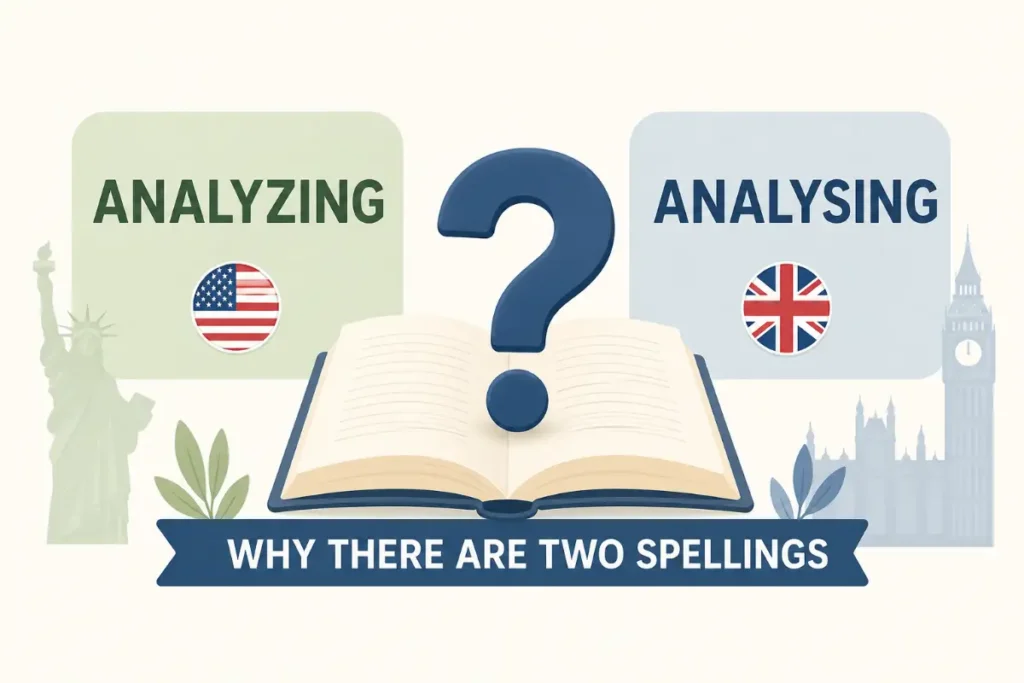
Why There Are Two Spellings
English is spoken in many parts of the world. Over time different countries developed their own spelling standards. That is why you see some words written in more than one way even though they have the same meaning.
American English often prefers the letter z in words that end with ize. British English usually prefers the letter s in many of those same words. As a result people in different countries naturally learn different spellings at school.
Neither version is newer or more correct than the other. They simply belong to different writing traditions. The important thing is staying consistent throughout your writing.
For example if you are writing for readers in the United States you should use American spelling from beginning to end. If your audience is mainly in the United Kingdom then British spelling is usually the better choice.
What Does Analyzing Mean
The verb means to study something carefully so you can understand it explain it or make a decision based on it.
People analyze all kinds of things every day. A teacher analyzes test scores to see how students are doing. A doctor analyzes medical reports before making a diagnosis. A business owner analyzes sales numbers to understand what customers are buying.
The word is also common outside work and school. You might analyze a movie after watching it. You could analyze a football game with friends. Parents often analyze their child’s progress during the school year.
In every situation the basic idea stays the same. You look closely at something so you can understand it better.
Common Situations Where People Use This Word
You may not notice it but this verb appears in many everyday situations. It is one of the most useful words for talking about careful thinking and problem solving.
At School
Students often analyze stories poems research papers and historical events.
Examples include.
- The class analyzed the novel before writing an essay.
- We analyzed the science experiment together.
- She analyzed the author’s main argument.
At Work
Many jobs involve studying information before making decisions.
For example.
- The marketing team analyzed customer feedback.
- Our manager analyzed last month’s sales report.
- The accountant analyzed the company’s expenses.
In Science
Scientists spend much of their time collecting information and studying results.
For example.
- Researchers analyzed water samples from the river.
- The lab analyzed the blood test results.
- Experts analyzed the data before publishing the report.
In Everyday Life
You do not need to work in a laboratory or office to use this word.
People analyze family budgets travel plans sports games recipes and even weather forecasts. Anytime you examine something carefully before reaching a conclusion you are analyzing it.
Why People Get Confused
The confusion usually starts because both spellings appear online. Someone reading American websites will mostly see analyzing while someone reading British newspapers will often see analysing.
Search engines books and social media mix content from many countries. That means readers see both spellings every day. Without knowing the difference it is easy to think one of them must be wrong.
Another reason is that many spelling checkers follow the language setting on your device. If your computer is set to American English it will suggest analyzing. If it uses British English it will suggest analysing instead.
Once you know that both spellings are accepted in different varieties of English the confusion disappears. The real goal is choosing the spelling that fits your audience and using it consistently throughout your writing.
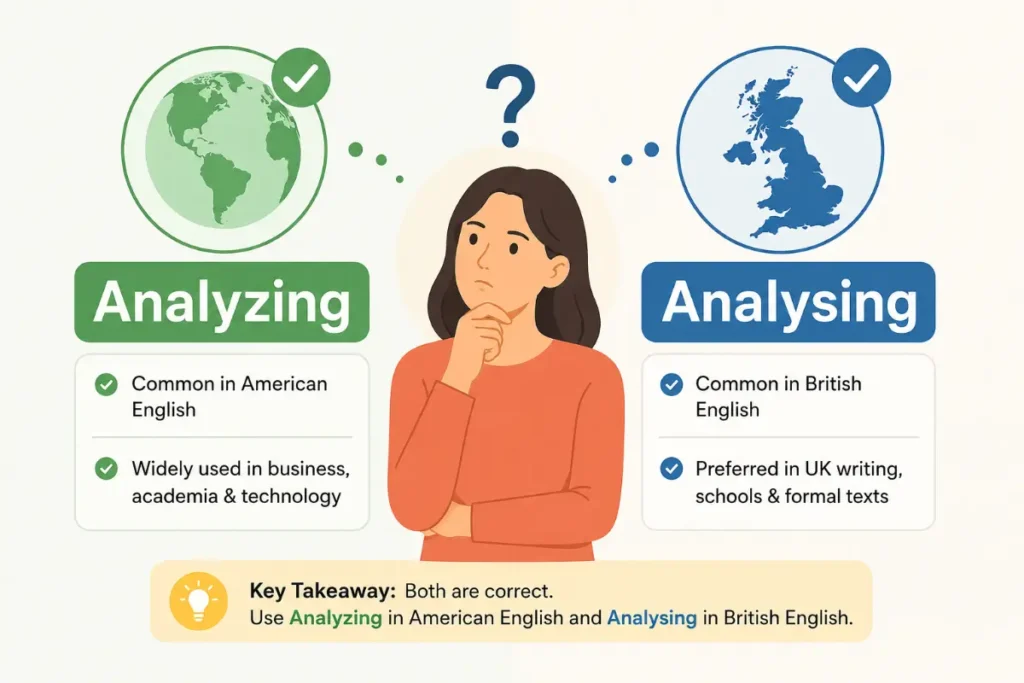
Analyzing Or Analysing Which Should You Use
- Choosing between analyzing or analysing depends on the audience you are writing for. The meaning never changes. Only the spelling does.
- If your readers are in the United States use analyzing. This is the standard American English spelling. It appears in schools newspapers businesses government documents and most US websites.
- If your readers are in the United Kingdom use analysing. This spelling follows British English conventions and is commonly seen in British books newspapers universities and official publications.
- If your audience includes readers from several countries pick one style and use it throughout the entire piece. Switching between American and British spellings can make your writing look inconsistent.
American English Vs British English
The difference between these spellings is part of a much larger pattern. American and British English share the same language but they spell some words differently.
Here are a few familiar examples.
| American English | British English |
|---|---|
| Analyze | Analyse |
| Analyzing | Analysing |
| Organize | Organise |
| Organizing | Organising |
| Realize | Realise |
| Realizing | Realising |
Notice that American English usually prefers z while British English often uses s in these words.
That does not mean every word follows this pattern. English has many exceptions. Still recognizing this common spelling difference makes it easier to choose the correct form.
Real World Examples
Looking at complete sentences helps the difference become much clearer.
American English Examples
- Our team is analyzing customer feedback before launching the new product.
- Scientists are analyzing the results of the latest experiment.
- She spent the evening analyzing the financial report.
- The software keeps analyzing incoming data in real time.
- We are analyzing traffic patterns to improve safety.
These examples all follow American spelling because they use z.
British English Examples
- The researchers are analysing the survey results.
- She enjoys analysing classic novels.
- The police are analysing the evidence.
- Doctors are analysing the patient’s test results.
- Students are analysing historical documents.
The meaning is exactly the same. Only the spelling changes.
Common Mistakes To Avoid
Most writers do not struggle with the meaning of this word. The real problem comes from mixing spelling styles.
One common mistake is starting an article with American spelling and ending it with British spelling. Readers may not always notice the change but editors almost certainly will.
Another mistake is letting your spell checker make the decision for you. If your document is set to British English it may automatically replace American spellings. The opposite can also happen.
Some people also assume that one version is more formal than the other. That is not true. Both spellings are correct in their own language variety. Professional writing depends on consistency not on choosing one spelling over the other.
How To Pick The Right Spelling
The easiest way to choose is by thinking about your readers.
If you write for people in the United States use American English throughout the document. That includes words like analyze color and organization.
If your readers are mainly in the United Kingdom follow British spelling from beginning to end. That means using forms like analyse colour and organisation.
For international websites many companies choose one style and use it everywhere. Others create separate versions for different countries. Both approaches work well as long as the spelling stays consistent.
Does It Matter For SEO
Yes but probably not in the way many people think.
Search engines understand that American and British spellings can describe the same topic. A page written in American English can still appear for someone searching with British spelling and the opposite is also true.
At the same time matching your audience’s language helps create a better experience. Readers are more likely to trust content that uses the spelling they expect. That can improve engagement and encourage them to stay on the page longer.
The best approach is simple. Write naturally for your audience instead of trying to include every possible spelling in the same article. Good content always matters more than forcing extra keywords.
Related Words That Follow The Same Pattern
Once you understand this spelling difference you will start noticing it in many other English words. The pattern is not limited to analyze and analyse. It appears in dozens of commonly used verbs.
Learning these words together makes it much easier to remember the spelling style you want to use.
| American English | British English | Meaning |
|---|---|---|
| Organize | Organise | Arrange something in order. |
| Recognize | Recognise | Identify someone or something. |
| Realize | Realise | Understand or become aware of something. |
| Apologize | Apologise | Say you are sorry. |
| Emphasize | Emphasise | Give special importance to something. |
If you normally write in American English these words will almost always end in ize. If you write in British English you will usually see ise instead.
Why American And British English Spell Words Differently
The two versions of English have shared roots but developed in different directions over time. As dictionaries became more common each country adopted its own spelling standards.
American English often favors shorter or more direct spellings. British English tends to keep spellings that reflect older traditions. Neither style is better than the other. They simply follow different conventions.
This difference goes beyond verbs ending in ize and ise.
For example American English uses color while British English uses colour. Americans write center while the British write centre. Americans write traveled while the British often write travelled.
Once you recognize these patterns it becomes easier to switch between the two writing styles when needed.
Can You Mix American And British Spelling
It is possible but it is not a good idea.
Imagine reading an article that uses color in one paragraph and colour in the next. Most readers will notice that something feels off even if they cannot explain why.
The same thing happens with analyze and analyse. Mixing spelling styles makes writing look less polished and can distract your audience from your message.
If you begin with American English stay with it until the end. If you choose British English do the same. Consistency always creates a stronger impression than switching back and forth.
Examples In Different Types Of Writing
This word appears in many kinds of writing. Looking at real examples makes it easier to see how naturally it fits into everyday communication.
Academic Writing
Teachers and researchers often use this verb when discussing evidence and ideas.
Examples.
- Students analyzed the poem before writing their essays.
- The researchers analyzed the collected data.
- Historians analyzed old records to learn more about the event.
Business Writing
Companies often use this word in reports presentations and meetings.
Examples.
- We analyzed customer feedback before changing the product.
- The finance team analyzed last quarter’s expenses.
- Our manager analyzed the market before making a decision.
Everyday Conversation
You do not have to be writing a report to use this word.
Examples.
- We analyzed the game after it ended.
- She analyzed every detail before buying the car.
- My friends analyzed the movie for almost an hour after we left the theater.
The meaning stays the same in every example. Someone studies something carefully to understand it better.
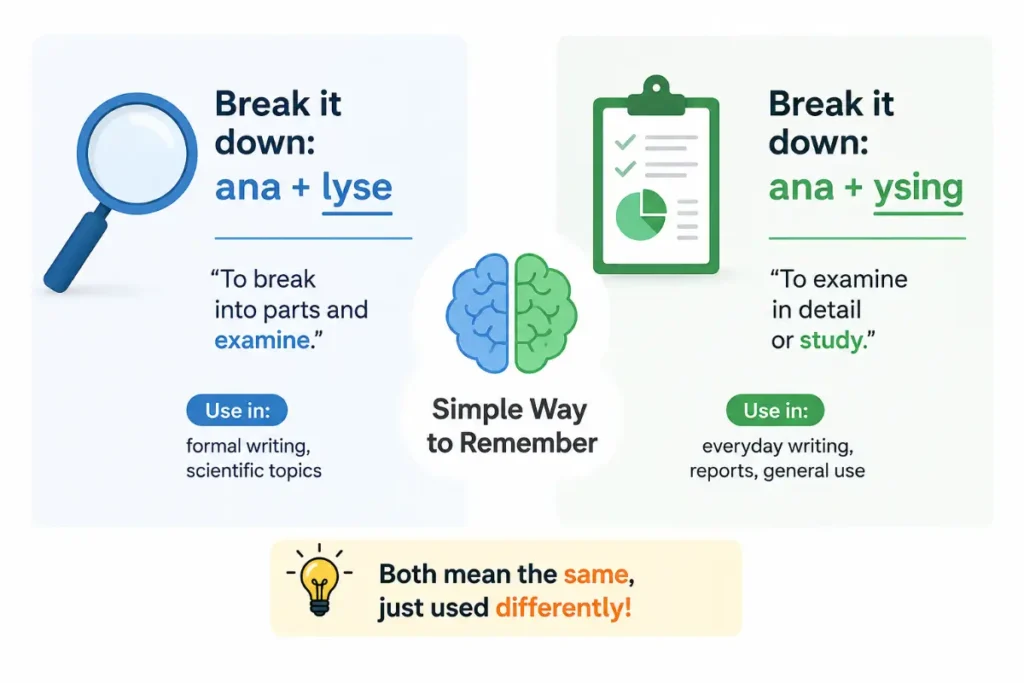
Simple Ways To Remember The Difference
Most people do not need a complicated memory trick. A few simple habits are enough.
Think about your audience before you start writing. If your readers are American choose American spelling. If your readers are British choose British spelling.
Set your computer or phone to the same variety of English that you use most often. Your spelling checker will then support your writing instead of working against it.
Read articles from trusted publications in your preferred style. The more often you see the correct spelling the more natural it becomes.
Finally proofread your work before publishing it. A quick review can catch mixed spellings that slipped in while you were writing.
Why Consistent Spelling Builds Trust
Readers expect writing to follow a clear style. Consistent spelling helps your work look professional and carefully edited.
This matters in school assignments business emails blog posts and published articles. Small details shape the way people judge your writing. A consistent style shows that you pay attention to accuracy.
The goal is not to memorize every spelling difference in English. Instead focus on using one style from beginning to end. That simple habit will improve the quality of almost everything you write.
FAQs
Is analyzing or analysing correct?
Yes. Analyzing or analysing are both correct. Analyzing is the standard spelling in American English while analysing is the preferred spelling in British English.
Which spelling should I use in the United States?
If you are writing for an American audience use analyzing. It is the accepted spelling in US schools businesses newspapers and most websites.
Is analysing wrong in American English?
Not exactly. American readers will understand it but it looks out of place because it follows British spelling rules. If you are writing in American English it is better to use analyzing consistently.
Why do American and British English spell this word differently?
The difference comes from the way English developed over time. American and British English adopted different spelling conventions for many words. The meaning and pronunciation stayed the same but the spelling changed.
Do analyzing and analysing have different meanings?
No. Both words mean to study or examine something carefully. The only difference is the variety of English you are using.
Which spelling is better for SEO?
The best choice depends on your audience. If your website targets readers in the United States use American spelling. If it targets readers in the United Kingdom use British spelling. Search engines understand both versions but matching your audience creates a better user experience.
Can I use both spellings in the same article?
It is best not to. Mixing American and British spellings makes your writing look inconsistent. Pick one style before you start writing and use it throughout the entire article.
Conclusion
If you have ever paused over analyzing or analysing the answer is simpler than it first appears. Both spellings are correct. The only difference is the variety of English you choose to follow. American English uses analyzing with the letter z. British English prefers analysing with the letter s. The pronunciation meaning and grammar stay exactly the same.
The most important rule is consistency. Once you choose American or British spelling stick with that style from beginning to end. Your writing will feel more polished and your readers will know exactly what to expect.
The next time you see analyzing or analysing you will not need to second guess yourself. Think about your audience choose the spelling that matches their expectations and write with confidence.

Sienna Watson is a veteran copywriter and communications coach who has helped startup founders, marketers, and professionals polish their writing for over a decade. Realizing that most people don’t need a degree in linguistics—just clear, impactful communication—Sienna focuses on practical grammar, business writing etiquette, and eliminating wordiness. She advocates for plain language, strong verbs, and persuasive prose that gets results.