
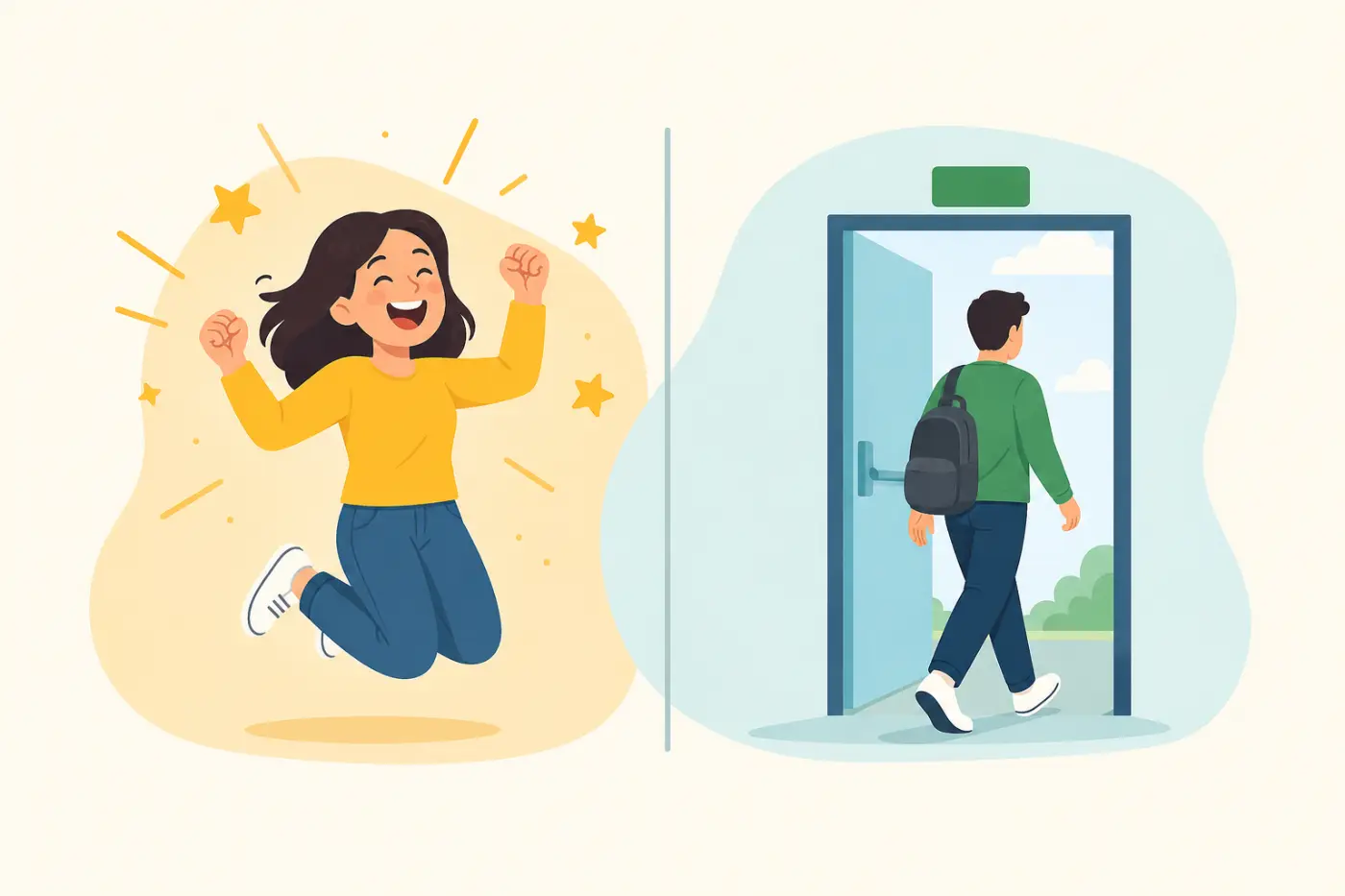
If you’re wondering about excited or exited the answer depends on what you mean. These two words are spelled differently and have completely different meanings. Excited describes a strong feeling of happiness or enthusiasm. Exited means left a place.
That one letter makes a big difference. You might say that you’re excited about a vacation because you can’t wait for it to happen. You might say that you exited the building after the meeting ended. The words sound different too, but they can still cause confusion when you’re writing quickly.
This guide explains the difference in plain English. You’ll see how each word works in real sentences, why people mix them up, how to remember the spelling, and which related words can cause similar problems. By the end, choosing the right word should feel easy.
Quick Definition
Excited is an adjective that describes someone who feels happy, eager, or enthusiastic about something. Exited is the past tense of the verb exit, which means to leave a place or situation.
Direct Answer
Use excited when you mean feeling happy or enthusiastic about something. Use exited when you mean someone left a place or went out.
Comparison Table
| Word | Meaning | Example Sentence | When to Use It |
|---|---|---|---|
| Excited | Feeling happy, eager, or enthusiastic. | I’m excited about the concert. | Use it to describe a feeling or emotional state. |
| Exited | Left a place or went out. | She exited the room quietly. | Use it to describe the action of leaving. |
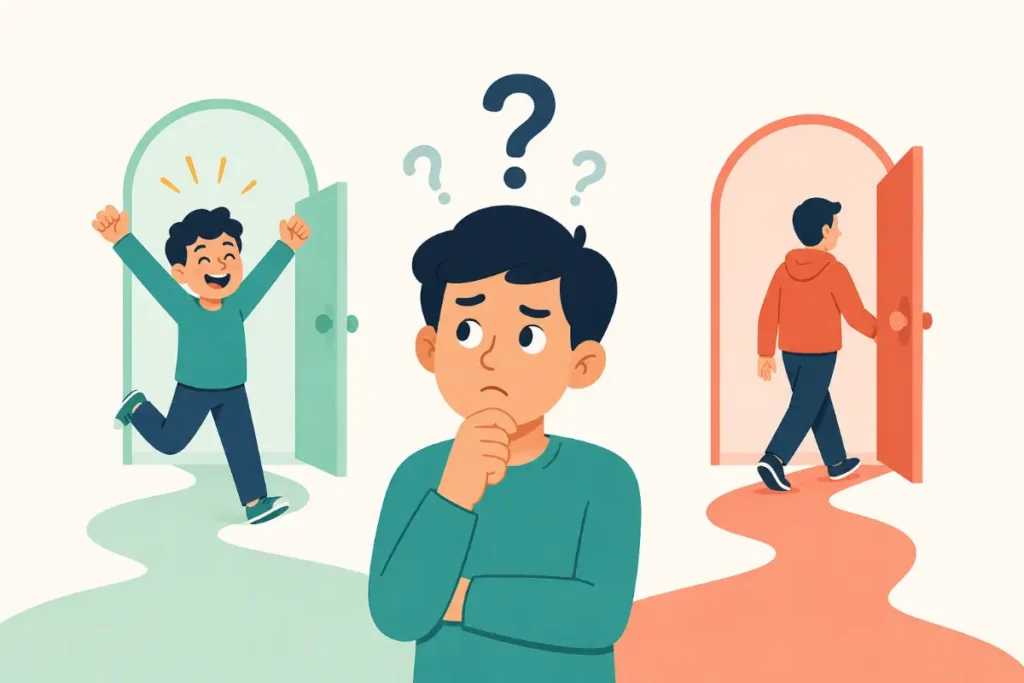
Why These Words Cause Confusion
The confusion usually starts with the shared letters exci and exi. Both words begin with ex, and both relate to common English words that can look similar when you read them quickly. Their meanings are completely different, though.
There is also a pronunciation difference. Excited is pronounced with a sound like ik SIGH tid. Exited is usually pronounced like EG zit id. The first vowel sound changes because the words come from different word families.
Another source of confusion is the word exit. When you add the ending ed to exit, you get exited. That makes the spelling fairly predictable. Excited, on the other hand, comes from excite, so its spelling follows that word family.
A quick comparison makes the difference clear. If you say, I’m excited about my trip, you’re talking about your feelings. If you say, I exited the airport, you’re talking about leaving the airport. One word describes emotion. The other describes movement.
What Excited Means
Excited describes a strong feeling of happiness, interest, eagerness, or anticipation. You usually feel excited because something enjoyable or important is going to happen.
For example, a child might be excited about a birthday party. A student might be excited about starting college. A sports fan might be excited about an upcoming game. Someone who just got a new job might be excited about their first day.
The word can describe a person’s feelings toward an event, activity, idea, or opportunity.
You might say:
- I’m excited about our vacation.
- She’s excited to start her new job.
- The kids are excited about the school trip.
- We’re excited to see the new movie.
- He was excited when he heard the news.
In each sentence, the person has a positive feeling about something.
Excited As A Feeling
The most common use of excited describes a person’s emotional state. It tells the reader that someone feels eager or enthusiastic.
For example:
Maria is excited about her birthday.
This tells us how Maria feels. It doesn’t tell us that she moved somewhere or left a place.
You can also use the word with to followed by a verb.
- I’m excited to meet your family.
- They’re excited to visit California.
- She’s excited to begin her new class.
This structure is very common in everyday American English.
Excited About Something
Use excited about when you want to name the thing that causes the feeling.
- I’m excited about the weekend.
- He’s excited about his new apartment.
- They’re excited about the concert.
The word after about is often a noun or noun phrase.
You can also use excited about with an activity expressed as an ing form.
- She’s excited about starting college.
- We’re excited about moving into our new home.
The meaning remains the same. The person feels eager or happy about something.
Excited To Do Something
Use excited to when the next word is an action.
- I’m excited to see you.
- She’s excited to start her new position.
- We’re excited to announce the winner.
This form appears often in everyday conversation and professional writing.
A company might write:
We’re excited to welcome our newest team member.
A friend might say:
I’m excited to see what happens next.
Both uses are natural.
What Exited Means
Exited is the past tense of exit. It means someone left a place or went out of an area.
For example:
She exited the building at noon.
The sentence tells us that she left the building. It says nothing about how she felt.
You can use exited with places such as rooms, buildings, cars, stores, highways, elevators, and airports.
Here are some examples:
- The passengers exited the plane.
- We exited the theater after the movie.
- He exited the building through the back door.
- She exited the car and walked toward the house.
- The driver exited the highway at the next ramp.
The action in every sentence is physical or situational departure. Someone was inside or part of something and then left it.
Exited As An Action
The word exited tells us what someone did. It is an action word because it comes from the verb exit.
Consider this sentence:
James exited the office.
James performed an action. He left the office.
Now compare it with:
James was excited about the meeting.
This sentence describes James’s feeling.
The difference becomes much easier to see when you focus on the role of the word. Exited tells you about leaving. Excited tells you about emotion.
Excited Or Exited In Real Sentences
Looking at both words side by side can make the difference stick.
I’m excited about my new job.
The person feels happy and eager about the job.
I exited the office after my shift.
The person left the office.
Here is another pair.
The children were excited about the trip.
They felt happy and eager about going on the trip.
The children exited the bus.
They got off the bus.
The words can even appear in the same sentence.
The excited fans exited the stadium after the game.
In this sentence, excited describes the fans. Exited tells us what the fans did.
That example is worth remembering because it shows that both words can be correct in the same sentence. Their meanings remain separate.
The Word Family Behind Excited
Understanding the word family makes the spelling easier to remember. Excited comes from the verb excite.
The basic family includes words such as:
- Excite.
- Excited.
- Exciting.
- Excitement.
All of these words connect to the idea of creating or experiencing strong interest or enthusiasm.
For example:
- The movie excited the audience.
- The audience was excited.
- The movie was exciting.
- There was a lot of excitement in the theater.
These words are connected. Once you recognize excite as the base word, the spelling of excited becomes much easier.
Excite
Excite is a verb. It means to make someone feel eager or enthusiastic.
The announcement excited the students.
The announcement caused the students to feel excited.
Excited
Excited usually describes the person who has the feeling.
The students were excited about the announcement.
Exciting
Exciting describes something that creates the feeling.
The announcement was exciting.
This difference between excited and exciting is another common English question. A simple rule helps. People are excited. Things are often exciting.
You can say:
I’m excited about the trip.
You can say:
The trip is exciting.
You would not normally say I’m exciting about the trip if you mean that you feel eager about it.
The Word Family Behind Exited
The spelling of exited becomes much clearer when you look at its base word.
The base word is exit.
When you use it in the past tense, you add ed.
Exit becomes exited.
This is similar to many other regular verbs.
- Visit becomes visited.
- Wait becomes waited.
- Open becomes opened.
- Exit becomes exited.
The meaning stays connected to the original verb. If exit means to leave, then exited means left.
Exit As A Verb
You can use exit as a verb in several ways.
- Please exit through the rear door.
- The passengers exited the train.
- We need to exit the building immediately.
- In each case, exit means leave or go out.
- The past tense changes it to exited.
- The passengers exited the train.
- We exited the building at five.
- She exited the store without buying anything.
The spelling follows directly from the base verb.
A Simple Memory Trick
One of the easiest ways to remember these words is to connect each one to a different idea.
- Think of excited as connected to excitement.
- If you feel excited, you feel excitement.
- Think of exited as connected to exit.
- If you exited, you left.
That gives you two simple mental links.
- Excited means feeling.
- Exited means leaving.
You can also remember the letter c in excited. The word excite has a c, and that letter stays when you form excited.
Excite → excited
The word exit has no c.
Exit → exited
That small visual clue can help when you’re typing quickly.
Common Mistakes With These Words
People often make mistakes when writing quickly because the two words look similar at first glance. The best way to avoid them is to stop and ask what you actually mean.
- If you’re describing a feeling, you need the form connected to excite.
- If you’re describing someone leaving, you need the form connected to exit.
Consider these mistakes.
- Incorrect: I’m exited about my vacation.
- Correct: I’m excited about my vacation.
The person is describing a feeling of eagerness. They aren’t saying that they left their vacation.
Now look at this one.
- Incorrect: We excited the building after lunch.
- Correct: We exited the building after lunch.
The sentence describes people leaving a building. The verb exit is the correct choice.
Another common mistake appears in messages such as:
I’m so exited to see you.
The intended meaning is almost always that the person feels happy and eager. The correct sentence is:
I’m so excited to see you.
This mistake is especially common in casual online writing. People may understand the intended meaning from context, but the spelling is still incorrect.
How To Choose The Right Word
When you’re unsure, don’t focus on the spelling first. Focus on the meaning.
Ask yourself one simple question.
- Am I talking about a feeling or leaving?
- If you’re talking about a feeling, use excited.
- I’m excited about the concert.
- If you’re talking about leaving, use exited.
- We exited the concert hall at midnight.
This approach works because meaning comes before spelling. Once you know which word you need, the spelling becomes much easier.
You can also replace the word with a simpler word in your head.
- If happy, eager, or enthusiastic makes sense, you probably need excited.
- If left or went out makes sense, you probably need exited.
For example:
- I’m excited about the trip.
- Try replacing excited with eager.
- I’m eager about the trip.
That exact sentence sounds less natural, but the idea is clearly about a feeling.
Now consider:
- She exited the room.
- Replace exited with left.
- She left the room.
The meaning stays clear. That tells you the correct word is related to leaving.
When Excited Describes People
Excited is commonly used to describe people and sometimes animals. It tells us that someone has strong positive energy or anticipation.
- The students were excited about the field trip.
- My dog gets excited when I come home.
- The crowd was excited before the game.
- I’m excited to start my new class.
The word can also describe a person’s reaction to news or an opportunity.
- She was excited when she heard that she got the job.
- He’s excited about the chance to travel.
The feeling can be mild or intense. Context tells us how strong it is.
When Excited Describes Things
You can also use excited in certain contexts to describe something that has been stimulated or made active. This use appears more often in science than in everyday conversation.
For example, science may describe an excited atom as an atom that has gained energy and moved into a higher energy state.
That technical meaning is different from the everyday meaning of feeling happy or eager. Most people using excited in ordinary conversation are talking about emotions.
You don’t need the scientific meaning to understand the common spelling question. Still, knowing that the word has more than one use can help explain why dictionaries give several definitions.
When Exited Describes People Or Objects
Exited can describe a person leaving a place.
The guests exited the restaurant.
It can also describe an object moving out of a place or system.
- The water exited through the pipe.
- The air exited through a small opening.
It can also appear in instructions.
After the alarm sounds, everyone should exit the building.
The past tense would be:
Everyone exited the building after the alarm sounded.
The basic idea remains the same. Something or someone moves out.
Formal And Informal Usage
Both words are standard English and can appear in formal or informal writing. The choice depends on meaning rather than level of formality.
Excited is extremely common in everyday speech.
- I’m excited for the weekend.
- She’s excited about the concert.
- We’re excited to see you.
Exited is also correct but can sound more formal than left in some situations.
For example:
The customer exited the store.
This is grammatically correct. In casual conversation, many people would simply say:
The customer left the store.
Both are correct. Exited can sound more precise in instructions reports and descriptions of movement.
Excited For Or Excited About
American English commonly uses excited about and excited to.
- I’m excited about the trip.
- I’m excited to visit New York.
You may also hear excited for in American English.
- I’m excited for the weekend.
- We’re excited for the game.
This form is common in casual speech and everyday writing in the United States. Some style guides and speakers prefer excited about in certain contexts, but excited for is widely used and easily understood in American English.
The important point is that none of these forms changes the spelling of excited.
Excited And Thrilled
Excited and thrilled are close in meaning but they don’t always carry the same strength.
I’m excited about dinner tonight.
Thrilled often suggests a stronger feeling of happiness or delight.
I’m thrilled that you got the job.
You can use either word depending on the strength of the emotion you want to express.
Excited And Nervous
Excitement and nervousness can happen at the same time. That may sound strange at first, but it’s common before important events.
Someone might say:
I’m excited and nervous about my first day at college.
The person looks forward to the experience but also feels uncertain about what will happen.
You can also say:
She was excited but nervous before the interview.
The word excited still describes positive anticipation. The word nervous adds another feeling.
Exited And Left
Exited and left can have similar meanings, but left is usually more natural in everyday conversation.
- She left the room.
- She exited the room.
Both sentences mean that she went out of the room. The second can sound more formal or deliberate.
You might see exit and exited in signs instructions reports and formal descriptions.
- Please exit through the front door.
- The passengers exited the aircraft.
In casual conversation, people often choose leave instead.
We left the restaurant at nine.
That doesn’t make exited wrong. It simply means that the word has a different style in some situations.
A Quick Test You Can Use
If you’re writing a sentence and can’t decide between the two words, use this test.
Replace the word with happy or eager.
If the sentence still makes sense, you probably need excited.
I’m excited about the vacation.
The idea of being happy or eager fits.
Now replace the word with left.
We exited the theater.
The word left fits perfectly.
We left the theater.
That tells you the sentence needs exited.
This simple replacement test works well because the two words describe completely different ideas. You don’t have to remember a complicated grammar rule. You only need to identify the meaning.
More Examples To Build Confidence
Here are several examples that show the difference in natural situations.
- I’m excited about my birthday next week.
- The speaker feels happy and eager.
- We exited the restaurant after dinner.
- The group left the restaurant.
- The children were excited when they saw the presents.
- The children exited the classroom when the bell rang.
- She’s excited to start her new job.
- She feels eager about starting work.
- She left the office.
- The fans were excited before the concert.
These examples show why context matters. The spelling isn’t a minor detail. It changes the meaning of the sentence.
A Few Sentences With Both Words
Using both words in one sentence is a useful way to see the contrast.
- The excited students exited the classroom after the test.
- Here excited describes the students. Exited describes what they did.
- The excited crowd exited the stadium after the game.
- Again, one word describes emotion while the other describes movement.
- I was excited to leave the party, so I exited the building early.
The first word describes the person’s feeling. The second describes the person’s action.
These sentences are useful because they make the distinction hard to miss. If you can understand both words in the same sentence, you can usually tell them apart in other situations too.
Why Context Matters More Than Spelling
When two words look similar, writers often focus too much on the letters. Meaning should come first.
Suppose you write:
I’m ___ to see my family.
The sentence describes a feeling. You aren’t saying that you left your family. So the correct word is excited.
Now consider:
The guests ___ the room after dinner.
The sentence describes an action. The guests left the room. So the correct word is exited.
The surrounding words give you a strong clue. Learning to use context this way will help with many English word choices beyond these two.
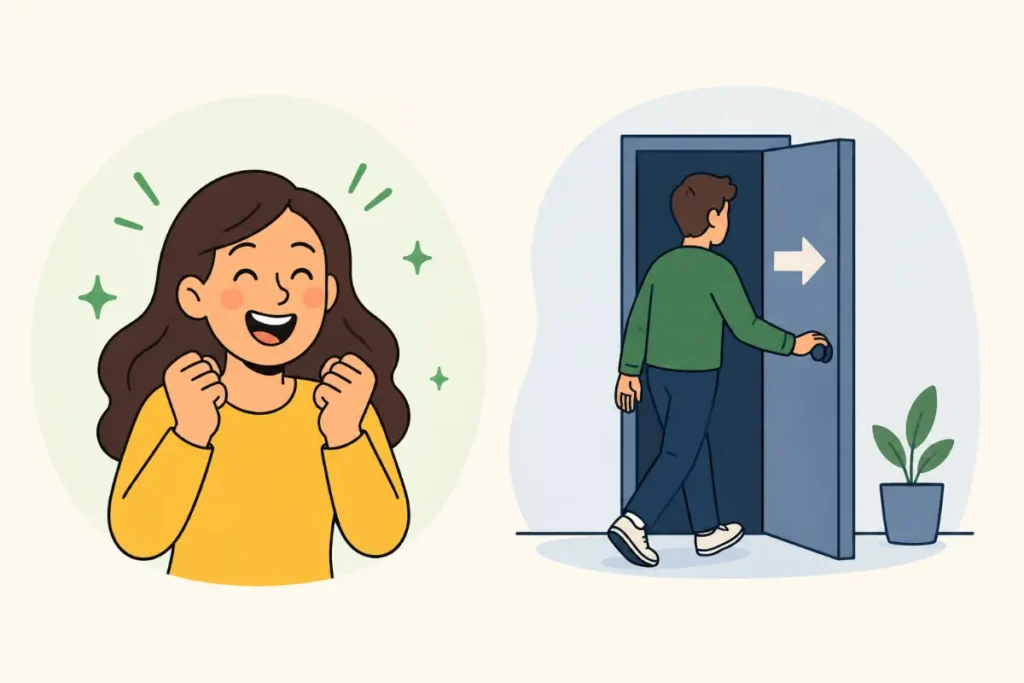
A Useful Way To Remember The Difference
Picture two scenes in your head.
- In the first scene, someone is smiling because they just got great news. That person is excited.
- In the second scene, someone walks through a door and leaves a building. That person exited.
Now connect each scene to its base word.
- Excited comes from excite.
- Exited comes from exit.
That is all you need to remember.
If you see the letter c, think about excite and emotion. If you see exit, think about leaving.

Common Search Questions About These Words
People often search for this pair because the words look almost alike. The most useful answer is always the meaning.
- If you mean happy and eager, choose excited.
- If you mean left or went out, choose exited.
You can apply that distinction to almost every sentence you write.
FAQs
Is excited or exited correct?
Both words are correct, but they have different meanings. Excited describes a feeling of happiness or eagerness. Exited means someone or something left a place.
Is it excited to see you or exited to see you?
The correct phrase is excited to see you when you mean that you’re happy or eager to meet someone. Exited to see you would suggest leaving in a way that doesn’t fit the intended meaning.
What is the difference between excited and exited?
Excited describes an emotional state. Exited is the past tense of exit and describes leaving a place or situation.
Is exited a real word?
Yes. Exited is a standard English word. It is the past tense of exit, as in She exited the building after the meeting.
Why do people confuse these two words?
They look and sound somewhat similar and share several letters. They also appear often in quick informal writing. Remembering that excited connects to excitement and exited connects to exit makes the difference easier to remember.
Can excited and exited appear in the same sentence?
Yes. For example, The excited passengers exited the plane uses both words correctly. Excited describes the passengers’ feelings while exited describes their action.
What is the past tense of excite?
The past tense is excited. For example, The news excited everyone in the room. The past tense of exit is exited.
Can I use excited for an event?
Yes. You can say I’m excited about the event or I’m excited to attend the event. The word expresses eagerness or positive anticipation.
Conclusion
The difference between excited or exited comes down to one simple idea. Excited describes a feeling while exited describes the act of leaving. Once you connect each word to its base word, the distinction becomes much easier.
Think of excited as part of the excite word family. It connects with excitement, enthusiasm, eagerness, and anticipation. Think of exited as the past tense of exit. It connects with leaving or going out.
When you aren’t sure which spelling to use, focus on the meaning before you focus on the letters. If you could replace the word with happy or eager, choose excited. If you could replace it with left, choose exited.
That quick test can save you from the mistake in seconds. Excited means you feel eager about something. Exited means you left something behind. Keep those two ideas separate and you’ll have the right word every time.

Dr. Elena Vance holds a Ph.D. in Linguistics from Columbia University and has spent over 15 years analyzing the evolution of the English language. A former university professor turned full-time writer and editor, Elena specializes in breaking down high-level grammatical concepts, punctuation nuances, and style guides (APA, Chicago, MLA) into clear, actionable advice. When she isn’t hunting down dangling modifiers, she can be found collecting vintage dictionaries and reading classic literature.