
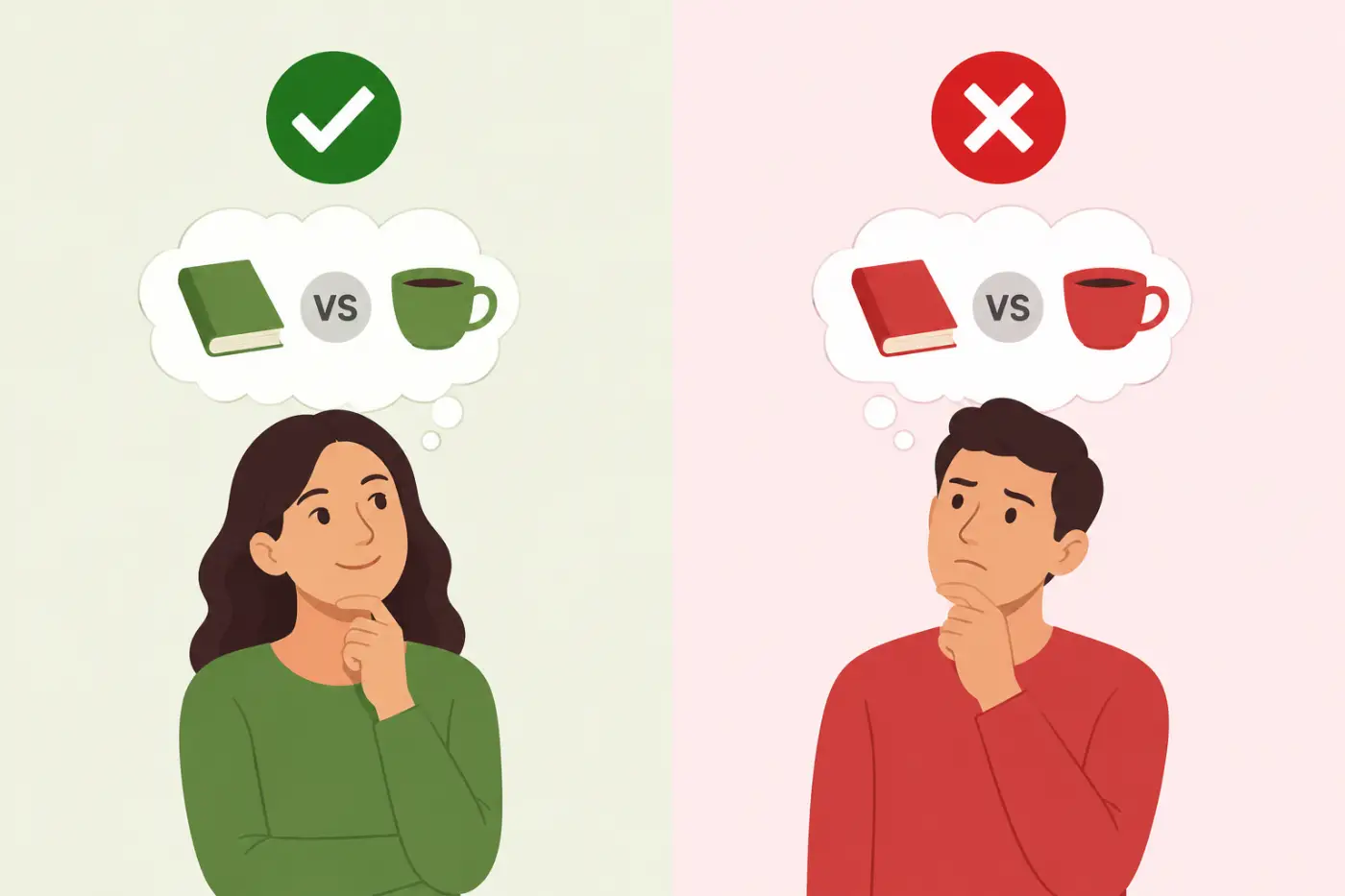
If you’re wondering about prefer or perfer you’re dealing with a very common spelling mistake. The correct spelling is prefer. The spelling perfer is incorrect and should not be used in standard English.
The confusion usually comes from pronunciation. When people say the word quickly the first vowel can be easy to miss. That makes perfer look and sound believable even though it isn’t the standard spelling.
Once you know the correct spelling and understand how the word works you’ll have much less trouble with it. This guide explains the spelling rule the meaning of prefer its different forms and the common mistakes people make when using it.
Quick Definition
Prefer is a verb that means to like one person thing or choice more than another. For example you might prefer tea to coffee or prefer working in the morning instead of at night.
Perfer is not the correct spelling. It is a common misspelling of prefer.
Direct Answer
Prefer is the correct spelling. Perfer is incorrect.
Comparison Table
| Word or Phrase | Meaning | Example Sentence | When to Use It |
|---|---|---|---|
| Prefer | To like one option more than another. | I prefer tea to coffee. | Use this spelling in all standard writing. |
| Perfer | Incorrect spelling of prefer. | This spelling is incorrect. | Do not use it. |
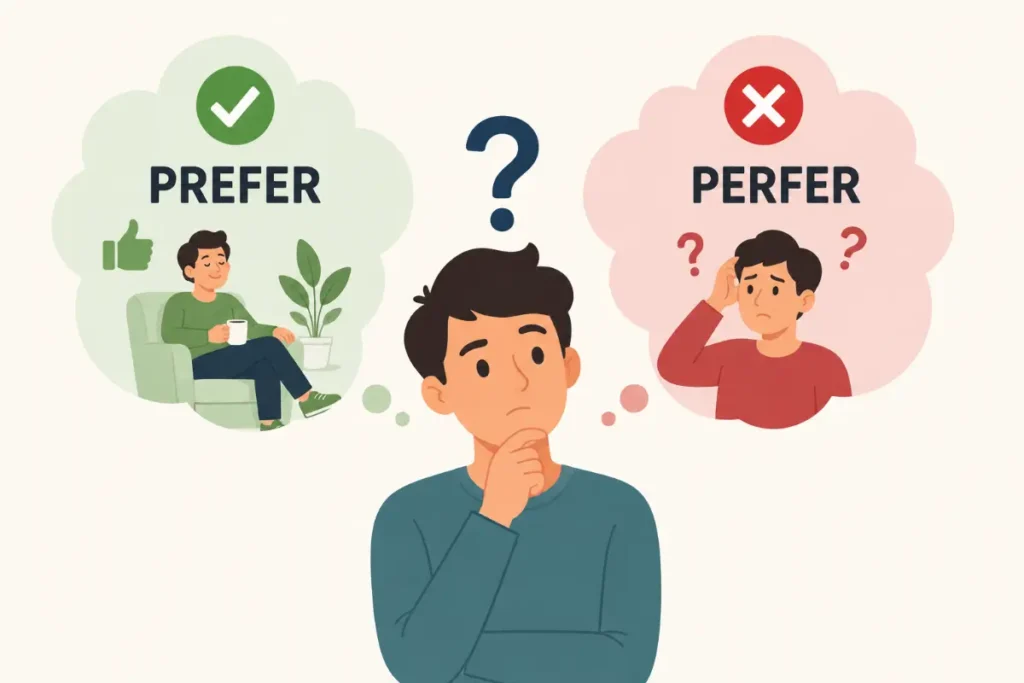
Why People Confuse Prefer And Perfer
The main reason for this mistake is simple. The first vowel in prefer can be hard to hear when the word is spoken quickly.
Say the word naturally and you may notice that the first syllable is light. The stronger sound comes later in the word. Because of that many people remember the sound rather than the spelling.
English has plenty of words where pronunciation does not give you a perfect guide to spelling. Prefer is one of them. If you rely only on how the word sounds you can easily leave out the first e.
There is another reason for the confusion. English speakers often shorten or soften sounds in normal conversation. We don’t always pronounce every part of a word with equal force. That can make a correctly spelled word look unfamiliar when you try to write it from memory.
The best solution is to remember the complete word rather than trying to spell it from its sound.
Think of prefer as having two clear parts.
pre plus fer equals prefer.
The first part starts with pre. Once you remember that opening it becomes much harder to accidentally write perfer.
What Does Prefer Mean
Prefer means to like or choose one thing more than another. It shows a personal choice or stronger liking.
For example you could say:
- I prefer tea to coffee.
- She prefers summer to winter.
- We prefer the blue design.
- He prefers to work alone.
- They prefer eating at home.
In each sentence someone has a stronger choice. The person isn’t simply saying that something is good. They are saying that one option appeals to them more than another.
That small difference matters.
If you say I like coffee you are simply telling someone that coffee is something you enjoy. If you say I prefer coffee to tea you are comparing two choices and saying coffee is the one you like more.
How To Use Prefer In A Sentence
The verb can appear in several useful sentence patterns. Learning these patterns is more helpful than memorizing a single definition.
Prefer One Thing To Another
The most common pattern is:
prefer A to B
For example:
- I prefer tea to coffee.
- Maria prefers cats to dogs.
- We prefer the original plan to the new one.
- He prefers winter to summer.
Notice the word to in these sentences. Many learners try to use than because they are making a comparison. With prefer the standard pattern is prefer A to B.
So this is correct:
- I prefer tea to coffee.
This is not the standard form:
- I prefer tea than coffee.
The second sentence may be understood but it doesn’t follow the usual grammar pattern.
Prefer To Do Something
You can also use prefer before an infinitive.
For example:
- I prefer to walk to work.
- She prefers to cook at home.
- We prefer to leave early.
- He prefers to study in the library.
Here the word describes a person’s favored action.
The structure is:
prefer to plus verb
This form is especially common when you’re talking about habits choices or plans.
For example:
- I prefer to read before bed.
- She prefers to shop in the morning.
- They prefer to travel by train.
These sentences all describe choices someone tends to make.
Prefer Doing Something
You can also use prefer with a verb ending in ing.
For example:
- I prefer reading at night.
- She prefers walking to work.
- He prefers cooking at home.
- We prefer staying indoors when it rains.
This structure is natural when you’re talking about an activity as a general preference.
You can often use both forms without changing the basic meaning.
- I prefer to read at night.
- I prefer reading at night.
Both sentences tell the reader that reading at night is your favored choice.
Prefer To Or Prefer Over
This is another point that can confuse writers.
The standard comparison pattern is prefer A to B.
For example:
- I prefer apples to oranges.
- She prefers working from home to working in an office.
- They prefer small towns to large cities.
You will also see prefer over in everyday English. It can sound natural in some sentences especially when the focus is on choosing one option instead of another.
For example:
- I prefer this model over the older one.
Still prefer A to B is the clearest traditional pattern and a strong choice for formal writing.
If you’re writing an essay school assignment professional email or other careful prose use the familiar prefer A to B structure. It keeps the sentence clear and avoids any doubt about the grammar.
Prefer And Preference
The noun form of prefer is preference.
A preference is a choice or liking for one thing over another.
For example:
- My preference is tea without sugar.
- She has a strong preference for quiet places.
- Everyone has different food preferences.
- His preference is to work in the morning.
The two words are closely related.
Prefer describes the act of liking one option more.
Preference names the choice or liking itself.
Compare these sentences:
- I prefer coffee.
- My preference is coffee.
Both express a similar idea but they use different parts of speech. The first uses a verb. The second uses a noun.
Knowing this word family can also help you remember the spelling. Both prefer and preference begin with pre. That opening gives you a useful spelling clue.
The Word Family Around Prefer
English often becomes easier when you learn related words together. Instead of treating every form as a completely separate word you can connect them through the same root.
Here are some common forms.
Prefer is the verb.
- I prefer tea.
Prefers is the third person singular form.
- She prefers tea.
Preferred is the past tense and past participle.
- We preferred the smaller room.
Preferring is the present participle.
- He is preferring the quieter option.
Preference is the noun.
- Her preference is for quiet restaurants.
These forms share the same basic spelling. Learning them as a family gives you more chances to recognize the correct pattern.
Why The Spelling Starts With Pre
The easiest spelling clue is the beginning of the word.
The correct spelling is prefer. It starts with pre.
That same beginning appears in related words such as preference and preferred. If you train yourself to see the first three letters as pre you are less likely to drop the second e.
A useful mental picture is simple.
PRE + FER
When you’re typing quickly don’t think about the pronunciation. Picture those first three letters instead.
That small habit can prevent the most common spelling mistake with this word.
Real Examples With Prefer
The word appears in everyday writing far more often than you may realize. It can describe food choices travel habits work styles entertainment and personal tastes.
Here are some natural examples.
- I prefer cold weather.
- She prefers tea without milk.
- My brother prefers action movies.
- We prefer to arrive early.
- They prefer living near the city.
- I prefer this chair to that one.
- He prefers working in the morning.
- Our customers prefer the larger size.
The meaning is easy to spot in each sentence. Someone has a choice and one option has a stronger appeal.
You can also use the word in questions.
- Which one do you prefer.
- Do you prefer tea or coffee.
- Would you prefer to sit inside.
- Which color do you prefer.
- Do you prefer working alone or with a team.
These questions are common in everyday conversation. They ask someone to choose the option they like more.
Prefer In Everyday Conversation
Native speakers use this verb naturally when talking about personal choices. It can sound polite and clear without being overly formal.
Imagine a friend asks where you want to eat.
You might say:
- I prefer the Italian place.
Someone asks how you’d like your coffee.
You could say:
- I prefer it without sugar.
A coworker asks when you’d like to meet.
You might answer:
- I prefer the morning if that’s possible.
In each case the word helps you express a choice without sounding forceful. You’re simply explaining what you would like more.
That’s one reason this verb is so useful. It works in casual conversation as well as formal writing.
Common Grammar Patterns With Prefer
Knowing how to spell a word is only half the job. You also need to know how to use it naturally. Prefer follows a few common sentence patterns that are easy to learn once you see them in real examples.
The most useful pattern is prefer A to B. You can also use prefer to plus a verb or prefer plus an ing form when talking about activities. Each structure has a slightly different purpose but they all express a favored choice.
Prefer One Thing To Another
Use prefer A to B when you compare two things.
For example:
- I prefer tea to coffee.
- She prefers dogs to cats.
- We prefer the old design to the new one.
- He prefers summer to winter.
- They prefer books to movies.
The word to matters here. A common mistake is to use than because the sentence compares two things. With this verb the standard structure is prefer A to B.
So write:
- I prefer driving to taking the bus.
Avoid:
- I prefer driving than taking the bus.
The first sentence is the natural standard form.
Prefer To Plus A Verb
Use prefer to when you want to talk about an action you would rather choose.
For example:
- I prefer to walk.
- She prefers to cook at home.
- We prefer to leave early.
- He prefers to work alone.
- They prefer to stay inside.
You can also compare two actions with this structure.
- I prefer to walk rather than drive.
- She prefers to read rather than watch television.
- We prefer to eat at home rather than go out.
The phrase rather than helps make the comparison clear. It tells the reader that the first action is the one you favor.
Prefer Doing Something
You can also follow the verb with an ing form.
For example:
- I prefer reading at night.
- She prefers cooking at home.
- He prefers walking to work.
- We prefer staying in on weekends.
- They prefer traveling by train.
This structure is especially useful when you are talking about general habits or activities.
Compare these two sentences:
- I prefer to read at night.
- I prefer reading at night.
Both are natural. The first focuses a little more on the action you choose. The second treats reading as an activity you enjoy more.
In everyday English the difference is usually small. You don’t need to worry about it too much.
Prefer Compared With Would Prefer
Prefer and would prefer are related but they don’t always serve the same purpose.
Use prefer when talking about a general taste or regular choice.
- I prefer tea to coffee.
- She prefers quiet restaurants.
- He prefers working in the morning.
Use would prefer when talking about a particular choice at a specific time.
- I’d prefer tea please.
- She’d prefer to sit outside.
- We’d prefer to leave after lunch.
Think of prefer as a general preference and would prefer as a choice for a particular situation.
For example a person might generally prefer coffee but say:
- I’d prefer tea today.
There is no contradiction. Their usual taste is coffee but their choice at that moment is tea.
Prefer Compared With Rather
Rather can also express a choice but it works differently from prefer.
For example:
- I prefer tea to coffee.
- I’d rather drink tea than coffee.
Both sentences communicate a similar choice. The grammar is different.
With prefer use to when comparing two things.
prefer A to B
With would rather use than when comparing actions.
would rather do A than do B
For example:
- I prefer walking to driving.
- I’d rather walk than drive.
These patterns are worth learning because they appear often in natural English.
Prefer Compared With Choose
Prefer and choose can seem similar but they describe different ideas.
Prefer describes what you like more.
Choose describes the decision you make.
Consider this example:
- I prefer chocolate ice cream but I chose vanilla today.
The person likes chocolate more but decided to eat vanilla. That makes perfect sense because a preference and a choice are not always the same thing.
Another example is:
- She prefers working from home but chose to go into the office today.
Her general preference is clear. Her decision for that particular day is also clear.
This difference can help you use both words accurately.
Prefer Compared With Like
Like is broader than prefer.
If you say:
- I like coffee.
You’re saying coffee is something you enjoy.
If you say:
- I prefer coffee to tea.
You’re comparing coffee with tea and saying coffee is the stronger choice for you.
You can like both things and still prefer one.
For example:
- I like both beaches and mountains but I prefer the mountains.
That sentence sounds completely natural. It shows that preference does not mean dislike.
This is a useful point because some learners think saying they prefer one thing means they dislike the other. It doesn’t. You can enjoy two options and still favor one.
Common Mistakes With Prefer
Spelling errors aren’t the only problem. This word also appears in sentences with incorrect grammar. The mistakes are usually easy to fix once you know the standard patterns.
Using Perfer
The most basic error is leaving out the first e.
Incorrect:
- I perfer tea to coffee.
Correct:
- I prefer tea to coffee.
Remember the opening pre. The word begins with three letters rather than two.
Using Prefer Than
Another common error is using than after prefer.
Incorrect:
- I prefer coffee than tea.
Correct:
- I prefer coffee to tea.
The standard comparison pattern uses to.
Using Prefer More
You may sometimes hear people say:
- I prefer coffee more than tea.
People understand the meaning but the sentence is not the cleanest form. Prefer already expresses the idea of liking one option more. Adding more can make the sentence feel repetitive.
A cleaner choice is:
- I prefer coffee to tea.
You can also say:
- I like coffee more than tea.
Both sentences are clear but they use different structures.
Using Prefer Over In Every Sentence
The phrase prefer over appears in real English and isn’t always wrong. Still, prefer A to B is the safest standard structure when you’re writing carefully.
For example:
- I prefer tea to coffee.
This is simple and widely accepted.
You may also hear:
- I prefer tea over coffee.
That form is common in American English. It can sound natural in conversation. For formal writing the prefer A to B structure remains a reliable choice.
How Prefer Changes With The Subject
The verb changes slightly when the subject is he, she, or it.
With I, you, we, and they, use prefer.
- I prefer tea.
- You prefer tea.
- We prefer tea.
- They prefer tea.
With he, she, or it, add s.
- He prefers tea.
- She prefers tea.
- The customer prefers tea.
This is the normal third person singular pattern in the present tense.
The spelling changes from prefer to prefers. The root remains easy to recognize because the first part stays pre.
The Past Tense Of Prefer
The past tense is preferred.
For example:
- I preferred the first option.
- She preferred the quieter room.
- We preferred the original plan.
- They preferred the older version.
Notice something interesting about the spelling. The final consonant is doubled before the ending ed.
Prefer becomes preferred.
The same spelling pattern appears in preferring.
Prefer becomes preferring.
This happens because the word follows a common English spelling pattern for short stressed verbs ending in a consonant and vowel pattern. The final consonant is doubled before certain endings.
You don’t need to memorize a complicated rule to use it correctly. The safest approach is to remember these common forms together.
- Prefer.
- Prefers.
- Preferred.
- Preferring.
- Preference.
How To Spell Preferred
The word preferred causes another common spelling problem.
People sometimes write:
- prefered.
That spelling is incorrect.
The correct form is:
- preferred.
There are two r letters before ed.
You can think of the change this way:
prefer → preferred
The same idea applies when adding ing.
prefer → preferring
For example:
- She preferred the blue dress.
- He is preferring the quieter option.
The first sentence is much more common because prefer is usually used as a simple verb rather than in the continuous form.
How To Spell Preferring
The correct spelling is preferring with two r letters.
For example:
- She is preferring the smaller room.
However, native speakers often choose a simpler structure instead.
- She prefers the smaller room.
The second sentence usually sounds more natural when you’re describing a general preference. The continuous form can be used in certain contexts when the preference is developing or being observed at a particular time.
For most everyday writing prefers is the better choice when you simply mean someone likes one option more.
Prefer In Questions
You can use this verb to ask someone about their choices.
Common questions include:
- Which do you prefer.
- Do you prefer coffee or tea.
- What kind of music do you prefer.
- Do you prefer to work alone.
- Would you prefer to sit inside.
- Which color do you prefer.
These questions are useful because they invite a clear answer without sounding demanding.
If you’re asking about a general taste use prefer.
- Do you prefer coffee or tea.
If you’re offering a choice for a specific moment would prefer often sounds more natural.
- Would you prefer coffee or tea.
The difference is small but useful. The first question asks about someone’s general taste. The second asks what they want right now.
Prefer In Polite Requests
Would prefer can also make a request sound softer.
Compare:
- I want a window seat.
- I’d prefer a window seat.
The second sentence sounds less direct. It clearly states your choice without sounding demanding.
You might say:
- I’d prefer an earlier appointment if one is available.
- We’d prefer a table near the window.
- I’d prefer to pay by card.
- She’d prefer to receive the documents by email.
This makes the expression useful in restaurants stores hotels offices and customer service conversations.
A Simple Memory Trick
If you often forget the spelling try this little trick.
Think of the word as PRE + FER.
The first part is pre just like the beginning of prepare present and prevent.
That gives you a quick visual reminder that there are two e letters in the first part of the word.
When you’re writing quickly don’t try to build the spelling from the sound. Picture the word in your mind as prefer. The correct version should become familiar with practice.
You can also connect it with preference. Both words begin with pre.
- I prefer the blue one.
- My preference is the blue one.
Seeing the related words together reinforces the spelling and meaning at the same time.
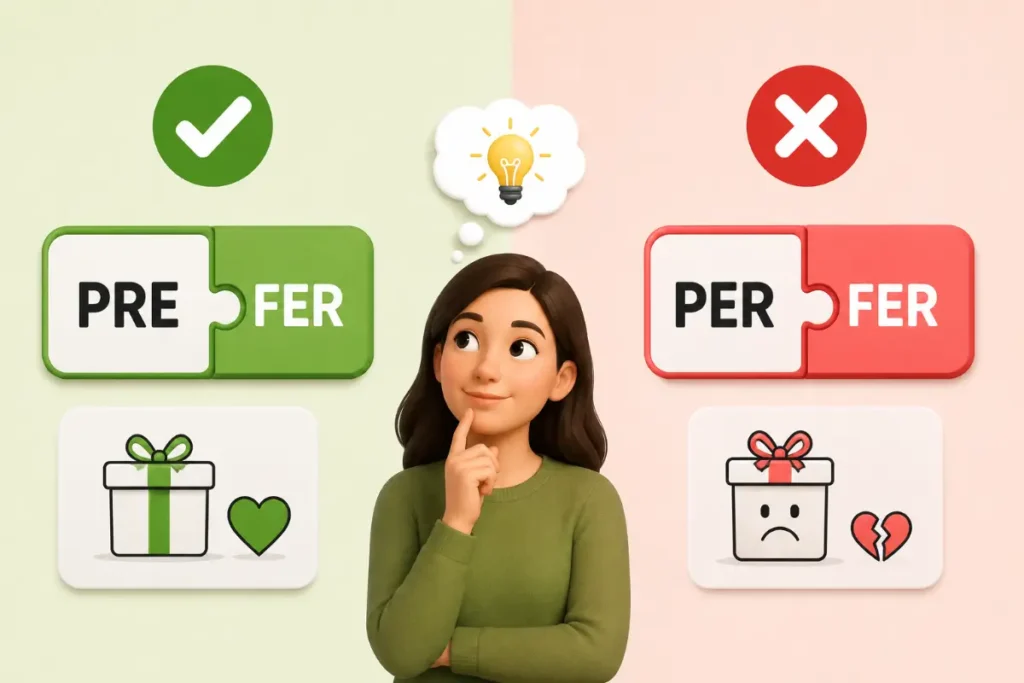
How To Remember Prefer Or Perfer
If the spelling still feels slippery you only need one small memory trick. The correct word begins with pre. Think of prefer as pre plus fer. The extra e belongs in the first part of the word and shouldn’t be dropped.
Another useful trick is to connect the verb with preference. Both words begin with pre. If you can remember preference you can use that same opening when spelling the verb.
It also helps to stop relying on pronunciation. The first vowel can sound weak when people speak quickly. Instead of spelling the word from what you hear say the word and picture its written form. With enough exposure the correct spelling will start to look right immediately.
How Prefer Works In Different Situations
The meaning stays fairly simple but the word can appear in many settings. Understanding those settings helps you recognize natural usage and avoid awkward sentences.
Talking About Food
Food is one of the easiest places to see this verb in action.
- I prefer pizza to burgers.
- She prefers fresh fruit to candy.
- My kids prefer homemade meals.
- We prefer to eat breakfast at home.
You don’t need to dislike the second food. You are simply saying the first choice is stronger for you.
For example you could enjoy both tea and coffee while still saying:
- I prefer tea to coffee.
That sentence doesn’t mean you hate coffee. It only tells the listener which drink you’d choose first.
Talking About Travel
Travel choices also create natural opportunities to use the word.
- I prefer flying to driving.
- She prefers trains to buses.
- We prefer to travel in the morning.
- They prefer smaller hotels.
The word works well when you compare ways to travel or describe your usual habits.
Talking About Work
You can use it to describe your preferred work style.
- I prefer working in a quiet room.
- He prefers to work alone.
- She prefers flexible hours.
- Our team prefers email communication.
These sentences describe choices rather than strict rules. A person may prefer one work style while still being comfortable with another.
Talking About Entertainment
Movies books games and music can all be described with this word.
- I prefer comedies to horror movies.
- She prefers reading to watching television.
- He prefers live music.
- They prefer to watch movies at home.
Again the word creates a comparison or shows a favored choice.
When Prefer Does Not Mean Choose
A preference and a decision are not always the same thing. This distinction becomes clear when circumstances force someone to pick an option they don’t like as much.
Imagine you prefer driving but your car is being repaired. You might choose the bus.
You could say:
- I prefer driving but I took the bus today.
The sentence makes perfect sense. Your preference stayed the same but your actual choice changed because of the situation.
The same thing can happen at work.
- I prefer working from home but I went to the office today.
Your general preference is working from home. Your decision for that day was different.
This distinction is useful because prefer describes a favored option while choose describes the action of making a decision.
Prefer And Favorite Are Not The Same
These words are related but they work differently in a sentence.
Prefer is a verb.
- I prefer chocolate ice cream.
Favorite is usually an adjective or noun.
- Chocolate is my favorite ice cream flavor.
The meaning is close but the grammar changes.
You can also compare the ideas directly.
- I prefer chocolate to vanilla.
- Chocolate is my favorite flavor.
The first sentence compares two choices. The second identifies the one you like best.
In casual American English people sometimes use favorite for a single top choice and prefer when comparing options.
Can Prefer Be Used Without A Comparison
Yes. You don’t always need to name the second option.
For example:
- I prefer tea.
- She prefers quiet places.
- He prefers working at night.
The listener can understand that the person has a stronger liking for the named option even though the alternative isn’t stated.
Sometimes the comparison is obvious from the context.
Imagine a server asks:
- Coffee or tea.
You can answer:
- I prefer tea.
You don’t need to add to coffee because the two choices have already been mentioned.
Still if there is a risk of confusion you can make the comparison clear.
- I prefer tea to coffee.
Can You Say Prefer It
Yes. The object can be a pronoun.
For example:
- I prefer it this way.
- She prefers it without sugar.
- We prefer it when the room is quiet.
Here it refers to something already known from the conversation.
For example:
- Do you want the report printed in color.
- No thanks. I prefer it in black and white.
The meaning is clear because the listener knows what it refers to.
Prefer In Formal Writing
The word works well in formal writing because it is clear and precise. You can use it in school essays reports workplace emails instructions and professional documents.
For example:
- The company prefers digital applications.
- Customers may prefer the updated payment option.
- The committee prefers to meet on Friday.
- Most participants preferred the original schedule.
There is no need to replace prefer with a complicated synonym. Simple words often make professional writing clearer.
Prefer In Casual Writing
The word is just as natural in everyday conversation.
- I prefer this one.
- I’d prefer to stay home.
- Which one do you prefer.
- I prefer the blue shirt.
- We prefer eating outside.
These sentences sound normal because the word is part of everyday English. It isn’t a formal term that belongs only in essays or business documents.
Common Spelling Errors Beyond Perfer
Once you’ve learned the main spelling mistake it helps to know the other forms that can cause trouble.
Prefered
The correct spelling is preferred.
The word takes two r letters before the ending.
- She preferred the first option.
Prefering
The correct spelling is preferring.
Again the final r is doubled.
- He is preferring the quieter room.
As mentioned earlier the continuous form isn’t always the most natural choice. In many situations prefers works better.
Preffer
Some people add an extra f or move the letters around because the word is easy to misremember. The correct form has one f.
- prefer.
The important spelling features are simple. Start with pre and finish with fer.
Words That Look Similar
Some English words can create confusion because they resemble one another even though their meanings differ.
- Prefer means to like one option more.
- Prepare means to get something ready.
- Present can mean to give something or to be in a particular place or time.
- Prevent means to stop something from happening.
These words are not related in meaning but their shared pre beginning can help reinforce the spelling pattern.
The point isn’t to memorize a giant list. It’s simply useful to notice that pre is a common beginning in English. When you see prefer think of that familiar opening instead of the way the word sounds.
The Difference Between Prefer And Preferred
The difference is mainly about time and grammar.
Prefer is the present form.
- I prefer tea.
Preferred is the past form.
- I preferred tea when I was younger.
You can also use preferred as an adjective.
- This is my preferred method.
In that sentence preferred describes the method that someone favors.
For example:
- Online payment is my preferred method.
The word tells us that online payment is the option the speaker likes or wants most.
The Difference Between Prefer And Preference
A quick grammar check can help here.
Use prefer as a verb.
- I prefer this option.
Use preference as a noun.
- This is my preference.
You can also use preference for to describe a favored choice.
- She has a preference for quiet rooms.
- He has a strong preference for fresh food.
These forms are closely connected. Learning them together gives you a better understanding of the word family and makes the spelling easier to remember.
How Native Speakers Naturally Use Prefer
Native speakers don’t usually stop to think about the spelling rule while talking. They use the word as part of familiar sentence patterns.
Common patterns include:
- I prefer A to B.
- I prefer to do something.
- I prefer doing something.
- I’d prefer to do something.
- Which do you prefer.
- What would you prefer.
- My preference is for something.
Learning these patterns can help you sound more natural than memorizing the definition alone.
For example instead of trying to build a sentence word by word you can remember a complete pattern.
I prefer A to B.
Then fill in the choices.
- I prefer tea to coffee.
- I prefer summer to winter.
- I prefer walking to driving.
- I prefer books to movies.
This approach makes speaking and writing much easier.
A Quick Practice Test
Try choosing the correct form in each sentence.
- I ___ tea to coffee.
- She ___ to work from home.
- We ___ the smaller table.
- He ___ reading before bed.
- They ___ the original plan.
The correct answer is prefer or prefers depending on the subject.
- The first sentence uses prefer because the subject is I.
- The second uses prefers because the subject is she.
- The third uses prefer because the subject is we.
- The fourth uses prefers because the subject is he.
- The fifth uses prefer because the subject is they.
This small exercise shows why learning the basic verb pattern matters. Spelling and grammar work together.
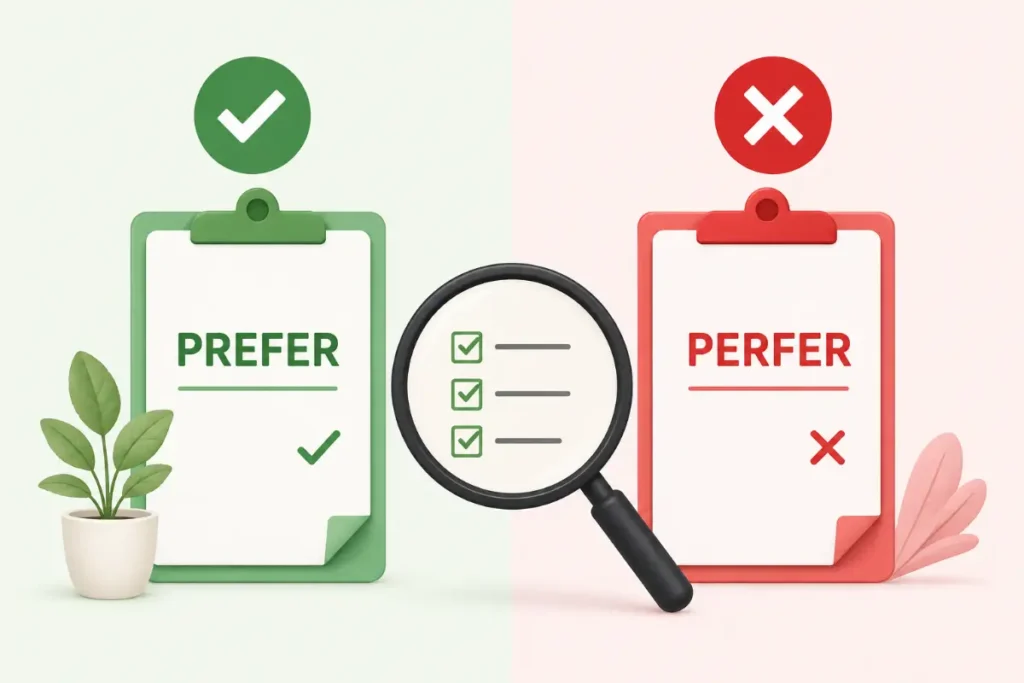
A Better Way To Proofread This Word
If you often type the wrong spelling you can build a simple proofreading habit. When you see this word in your writing pause for a moment and check the beginning.
Does it start with pre.
If yes you’re on the right track.
Then check the rest of the word.
prefer
You don’t need to reread an entire page just because of one commonly confused word. A quick visual check is enough.
For important writing such as an application essay or professional email you can also search the document for the incorrect spelling. If it appears replace it with the correct form and then read the surrounding sentence to make sure the grammar works.
Small checks like this take seconds and can prevent an avoidable mistake from reaching your reader.
FAQs
Is prefer or perfer correct?
Prefer is the correct spelling. Perfer is a common misspelling and isn’t accepted as the standard spelling in English. Remember that the word starts with pre which can help you avoid dropping the first e.
Why is prefer often misspelled?
The mistake usually comes from pronunciation and fast speech. The first vowel can sound weak so people sometimes leave out the e when writing the word. The correct spelling is easier to remember when you picture the word as pre plus fer.
How do you use prefer in a sentence?
Use prefer to show that you like one option more than another. A common pattern is prefer A to B, as in I prefer tea to coffee. You can also use it before an infinitive or an ing form.
Do you say prefer to or prefer than?
The standard comparison is prefer A to B. For example you should write I prefer walking to driving rather than I prefer walking than driving. The word than commonly appears with other comparison structures but not with the standard prefer pattern.
Can I say prefer over?
Yes. Prefer over appears in everyday American English and readers will understand it. For careful formal writing prefer A to B is a simple and reliable choice.
What is the past tense of prefer?
The past tense is preferred. The final r is doubled before ed, so prefered is incorrect.
What is the noun form of prefer?
The noun is preference. It refers to a choice or liking for one thing over another. For example you can say My preference is tea or She has a preference for quiet places.
Is prefer a formal word?
No. Prefer works in both casual and formal English. You can use it in everyday conversation emails school assignments workplace documents and professional writing.
Conclusion
If you’ve been stuck between prefer or perfer the answer is simple. Prefer is the correct spelling and perfer is incorrect. The easiest way to remember it is to focus on the first three letters. The word begins with pre.
The word also has a few useful grammar patterns worth remembering. You can say prefer A to B when comparing two choices. You can say prefer to do something when talking about an action. You can also use prefer doing something to describe an activity you favor.
Don’t let the pronunciation fool you. The first vowel can sound light in normal speech but it still belongs in the spelling. Think of prefer as pre plus fer and connect it with preference to reinforce the pattern.
The next time you type prefer or perfer stop for one second and check the opening letters. If you’ve written pre you’re starting correctly. That tiny habit is enough to keep this common spelling mistake out of your writing.

Sienna Watson is a veteran copywriter and communications coach who has helped startup founders, marketers, and professionals polish their writing for over a decade. Realizing that most people don’t need a degree in linguistics—just clear, impactful communication—Sienna focuses on practical grammar, business writing etiquette, and eliminating wordiness. She advocates for plain language, strong verbs, and persuasive prose that gets results.