
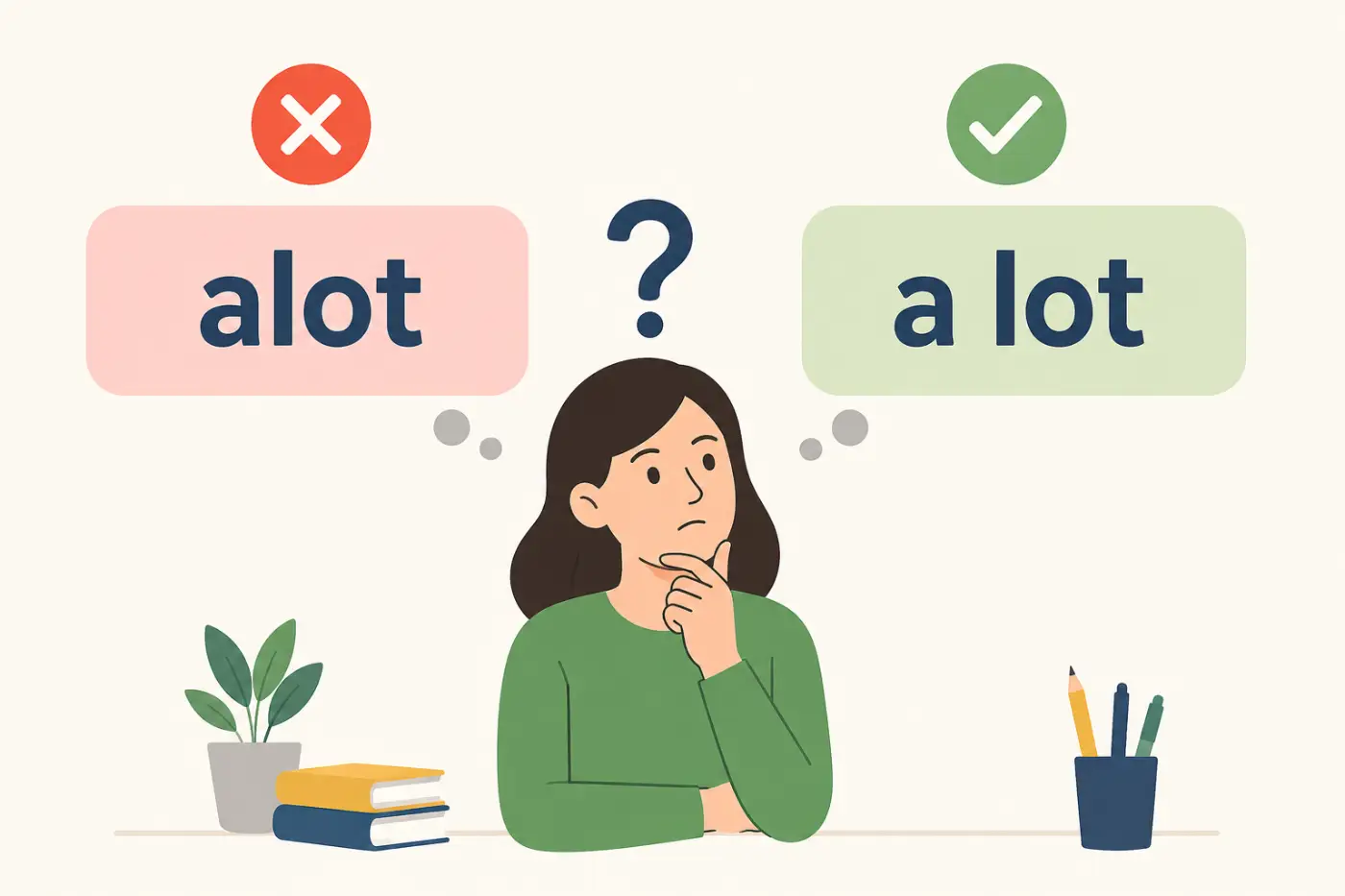
If you’re wondering about alot or a lot you’re dealing with one of the most common spacing mistakes in English. The correct form is a lot. It has two separate words and it means a large amount or a large number.
The incorrect form alot appears often in casual writing because the two words are usually pronounced together. That can make them feel like one word. However standard English does not recognize alot as a correct spelling.
The good news is that this mistake is easy to fix once you understand how the phrase works. You’ll learn what a lot means how to use it with countable and uncountable nouns why alot is incorrect and which similar expressions can replace it. You’ll also see plenty of everyday examples so the correct form becomes second nature.
Quick Definition
A lot is a two word phrase that means a large amount or a large number. It can describe things you can count and things you cannot count.
Alot is not the standard spelling of this phrase. When you mean a large amount or large number you should write a lot as two separate words.
Direct Answer
The correct spelling is a lot. Alot is not accepted as the standard English spelling when you mean a large amount or large number.
Comparison Table
| Word or Phrase | Meaning | Example Sentence | When to Use It |
|---|---|---|---|
| A lot | A large amount or number | I have a lot of work today. | Use this in everyday and formal writing. |
| Alot | Incorrect spelling in standard English | I have alot of work today. | Do not use it. |
| Lots of | A large amount or number | We have lots of time. | Use it in natural informal and everyday writing. |
| A great deal of | A large amount | She has a great deal of patience. | Useful in more formal writing. |
| Many | A large number of countable things | Many people attended. | Use it with countable nouns. |
| Much | A large amount of something uncountable | We don’t have much time. | Use it mainly with uncountable nouns. |

Why The Confusion Happens
The confusion comes from the way people speak. When you say a lot aloud the words flow together. There is almost no pause between them. After hearing the phrase many times your brain can start treating it like one unit.
English has many words that started as separate words and later became single words. That makes this mistake understandable. People may assume that alot works in the same way.
It doesn’t.
Standard English still treats a lot as two words. The article a and the noun lot have separate roles. The phrase has developed a special meaning but its spelling has not changed into one word.
Typing habits can make the problem worse. People often write quickly in texts and online comments. If they type alot several times without seeing a correction they may begin to think the spelling is normal.
Another reason for the confusion is that English has several similar expressions. We use lots of as one phrase and a lot as another. Since lots is written as one word people sometimes assume that a lot should work the same way.
That small difference is worth remembering.
- A lot has two words.
- Lots of has one word for lots.
What A Lot Means
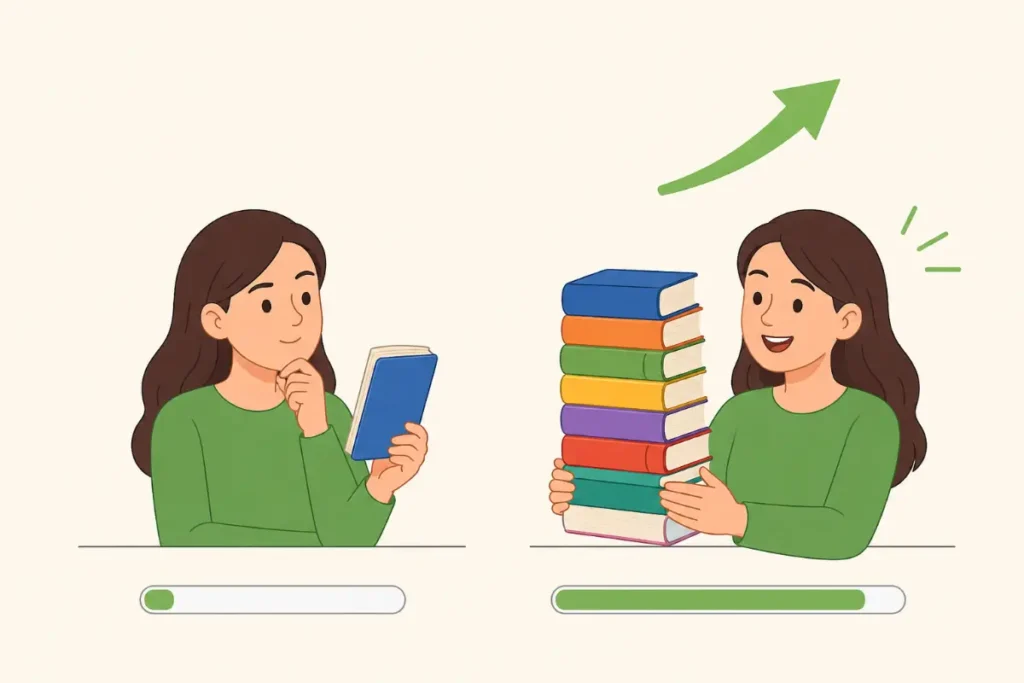
The phrase a lot has a simple meaning. It refers to a large amount or a large number. The exact meaning depends on what comes after it.
If the noun can be counted one by one then the phrase can refer to a large number.
- A lot of students joined the club.
- We saw a lot of cars on the road.
- She has a lot of books at home.
If the noun cannot normally be counted as separate individual units then the phrase can refer to a large amount.
- I need a lot of water.
- He has a lot of patience.
- We spent a lot of money on the trip.
The phrase works in both situations. That makes it one of the most useful expressions for talking about quantity.
How To Use A Lot With Countable Nouns
A countable noun is something you can count as individual items. You can have one book two books or twenty books. You can also have one person two people or many people. When you use the phrase with a countable noun you normally use a lot of followed by the plural noun. For example:
- A lot of people came to the party.
- She owns a lot of shoes.
- We have a lot of meetings this week.
- He made a lot of mistakes on the test.
- There are a lot of restaurants near the hotel.
Notice that the noun is plural in each example. You are talking about more than one person thing or item.
You would not normally say:
- I have a lot of book.
The natural form is:
- I have a lot of books.
The phrase itself does not make the noun plural. The noun still needs the correct form.
How To Use A Lot With Uncountable Nouns
Some nouns describe things that we don’t normally count as separate units. These are called uncountable nouns. Common examples include water money information advice time furniture and traffic.
You can use a lot of with these nouns too.
- We need a lot of water.
- She gave me a lot of advice.
- I don’t have a lot of time.
- They spent a lot of money.
- There is a lot of traffic today.
- He has a lot of experience.
You don’t normally make these nouns plural when you use them this way.
For example advices is not standard English when you mean pieces of advice. You would say:
- She gave me a lot of advice.
If you want to count individual pieces you can say:
- She gave me several pieces of advice.
This distinction helps you use the phrase naturally instead of simply memorizing a spelling rule.
A Lot Of Works Before Nouns
One of the most common uses is a lot of followed by a noun.
This structure is simple.
A lot of + noun
Here are some natural examples:
- We have a lot of work to finish.
- There were a lot of people at the store.
- She drinks a lot of coffee.
- They bought a lot of food for the party.
- I learned a lot of useful information.
- He has a lot of friends in Chicago.
The phrase tells the reader that the amount or number is large. It does not give an exact figure.
For example if someone says I have a lot of books they may have fifty books or five hundred. The speaker is making a general point about quantity rather than giving an exact number.
A Lot Can Also Stand Alone
You don’t always need of after the phrase.
When the meaning is already clear from the conversation you can use a lot by itself. In this form it often works as an adverb and means very much or frequently.
Consider this example:
- I like this restaurant a lot.
Here a lot describes how much the speaker likes the restaurant. There is no noun after it.
You can use the same pattern in many everyday sentences.
- She talks a lot.
- He travels a lot.
- We laugh a lot.
- They exercise a lot.
- I miss my family a lot.
This use is extremely common in spoken English.
The phrase can also appear after a verb.
- I think about that day a lot.
- She worries a lot.
- He reads a lot.
- We talk a lot.
The meaning is usually clear from the verb.
A Lot As A Noun
There is another use that can confuse learners. The word lot can also be a noun by itself.
A lot can mean a piece of land. For example:
- They bought a lot near the lake.
- The house sits on a large lot.
In this case a lot does not mean a large amount. It means a parcel of land.
The meaning comes from context.
Compare these two sentences:
- We have a lot of homework tonight.
- They bought a lot behind the house.
In the first sentence the phrase means a large amount. In the second sentence it means a piece of land.
This is one reason the spelling should remain separate. The word lot already has several meanings in English and the phrase a lot developed from one of them.
Why Alot Is Incorrect
The spelling alot looks believable because English contains many words that began as two separate words. However that does not make every commonly typed form a standard word.
When you mean a large amount or a large number the standard spelling remains a lot.
Think of it like this. The phrase is made from two separate words that work together.
- A is an article.
- Lot is a noun.
Together they form the phrase a lot.
The space matters because it separates those two words.
This is similar to other common phrases that contain an article and a noun.
- A little.
- A few.
- A number.
- A great deal.
You wouldn’t normally combine those into single words. The same idea applies here.
Is A Lot Formal Or Informal
A lot is common and natural in everyday English. It works well in conversations emails school writing and many other forms of communication.
Still there are situations where a more precise word may sound better.
For example a research report might benefit from a specific number instead of a vague quantity.
Instead of:
- A lot of customers preferred the new design.
You could write:
- Sixty eight percent of customers preferred the new design.
The second sentence gives the reader useful data. The first simply tells the reader that the number was large.
That doesn’t make a lot incorrect or unprofessional. It simply means that word choice should match the purpose of the writing.
In casual writing a lot is often exactly what you need. In formal or technical writing you may sometimes want a more exact expression.
A Lot And Lots Of
A lot and lots of have almost the same meaning when they come before a noun.
Compare these sentences:
- We have a lot of time.
- We have lots of time.
Both mean that there is plenty of time.
You can also use both with countable nouns.
- A lot of people came.
- Lots of people came.
The difference is mostly about tone. Lots of can sound a little more casual and conversational. A lot of is also very common and works in a wider range of writing.
Both forms are correct.
The key spelling difference is easy to remember. A lot has two words while lots is one word.
A Lot And Much
Learners often ask about a lot and much because both can describe a large amount. The main difference comes from how the words are used.
We commonly use much with uncountable nouns.
- I don’t have much time.
- There isn’t much water left.
- She doesn’t need much money.
We can also use a lot of with those same nouns.
- I have a lot of time.
- There is a lot of water left.
- She has a lot of money.
In positive statements a lot of often sounds more natural in everyday American English.
For example:
- I have a lot of work today.
This sounds very natural.
You could also say:
- I have much work today.
That sentence is grammatical in some contexts but it sounds unusual in normal conversation. A speaker might use much in a question or negative sentence instead.
- How much work do you have?
- I don’t have much work today.
Knowing these patterns will help your writing sound natural rather than translated or overly formal.
A Lot And Many
Many usually goes with plural countable nouns.
- Many students passed the test.
- Many people enjoy hiking.
- Many houses in the area are old.
A lot of can also go with those nouns.
- A lot of students passed the test.
- A lot of people enjoy hiking.
- A lot of houses in the area are old.
Both are correct. The choice depends on tone and context.
Many can sound slightly more formal or direct. A lot of often sounds more conversational.
For example:
- Many people believe the plan will work.
This sounds natural in an article.
- A lot of people think the plan will work.
This sounds more like everyday speech.
Neither is wrong. The important part is using the correct noun form after the expression.
A Lot And Very
These expressions are sometimes confused because they can both add emphasis. However they do different jobs.
Very usually modifies an adjective or adverb.
- She is very tired.
- He runs very quickly.
- The movie was very good.
A lot can describe the amount of something or the degree of an action.
- She works a lot.
- He travels a lot.
- I enjoyed the movie a lot.
You would not normally replace very with a lot in the same position.
For example:
- She is very happy.
This is natural.
- She is a lot happy.
This is incorrect.
However you can say:
- She is a lot happier now.
Here a lot modifies the comparative adjective happier. It tells us that the difference is large.
That gives the phrase another useful role in English.
A Lot With Comparative Adjectives
English speakers often use a lot before comparative adjectives to show a large difference.
For example:
- This car is a lot faster than my old one.
- The new phone is a lot cheaper.
- She feels a lot better today.
- The second test was a lot easier.
- This apartment is a lot bigger than our last one.
In these examples the phrase does not mean a large number or amount. Instead it strengthens the comparison.
- The sentence This car is faster gives a basic comparison.
- The sentence This car is a lot faster tells us the difference is much greater.
- This is a very common pattern in spoken American English.
Common Mistakes To Avoid
The biggest mistake is combining the two words into one.
Incorrect:
- I have alot of homework.
Correct:
- I have a lot of homework.
Another mistake is using a lot without of before a noun.
Incorrect:
- I have a lot homework.
Correct:
- I have a lot of homework.
The word of connects the quantity phrase to the noun. When you use the phrase directly before a noun you normally need of.
There is one important difference when a lot comes after a verb. In that situation you don’t need of.
Correct:
- I study a lot.
Not:
- I study a lot of.
The second sentence feels unfinished because of normally needs something after it.
A Lot Of And A Lot
A simple way to choose between these forms is to look at what comes next.
If a noun follows use a lot of.
- She has a lot of books.
- We need a lot of patience.
If you are describing an action use a lot.
- She reads a lot.
- We travel a lot.
This small distinction covers a huge number of everyday examples.
Consider the difference between these sentences:
- I eat a lot of food.
- I eat a lot.
The first sentence tells us about the amount of food. The second tells us that the person eats frequently or in large amounts without naming the food.
Both are correct because the structure changes with the meaning.
How To Remember The Spelling
The easiest memory trick is also the most practical one. Think of a lot as a phrase made from two ordinary words. Don’t try to memorize alot as a possible spelling because it isn’t the standard form.
You can also connect it with a little and a few. These expressions use a separate article and noun or quantity word.
- A lot of people.
- A little water.
- A few friends.
The visual pattern can help. Once you’ve seen a lot correctly many times the version without the space begins to look strange.
Another useful trick is to remember lots of. The word lots is one word because it has a plural ending. But when you use the singular form with the article a you write a lot as two words.
This gives you a quick mental check.
- A lot means a large amount or number.
- Lots of means the same basic thing.
- Alot is not the standard spelling.
When To Use A More Precise Expression
There are times when a lot is too general.
Imagine you’re writing a report about customer feedback. Saying a lot of customers liked the product gives a broad idea but not much detail.
A stronger sentence might say:
- Eighty two percent of customers rated the product positively.
Now the reader knows exactly what a lot meant.
The same idea applies to school essays and professional writing. If you have a specific number use it when that number matters.
Still don’t avoid the phrase just because it is general. Natural writing needs general expressions too. If the exact amount doesn’t matter the phrase can be the clearest choice.
For example:
- We spent a lot of time talking about the problem.
There is no reason to give an exact number if the point is simply that the discussion lasted a long time.
Good writing isn’t about replacing simple words with fancy ones. It is about choosing the word that communicates your meaning clearly.
FAQs
Is alot or a lot correct?
The correct form is a lot. It should be written as two separate words when it means a large amount or a large number. Alot is not the standard spelling.
Is a lot one word or two words?
It is two words. The correct spelling has a space between a and lot. This stays true when the phrase means a large amount or number.
Why is alot not a word?
The form became common because people often pronounce the phrase together and type quickly. However common use does not automatically make a spelling standard. Standard English uses the two word form.
Can I use a lot in formal writing?
Yes. A lot is grammatically correct and widely understood. In formal writing you may sometimes want a more exact phrase or a specific number when precision matters.
What is the difference between a lot and lots of?
Both expressions can mean a large amount or number. Lots of is often a little more casual while a lot of is very common in both conversation and writing. Both are correct.
What is the difference between a lot and much?
Both can describe large amounts of uncountable things. Much is especially common in questions and negative sentences while a lot of sounds very natural in positive everyday statements.
Can a lot be used without of?
Yes. You can use a lot after a verb to mean very much or frequently.
For example:
- I like this song a lot.
- She travels a lot.
When a noun follows the quantity phrase you normally use a lot of.
Can a lot be used with countable nouns?
Yes. Use a lot of with plural countable nouns.
For example:
- A lot of students joined the class.
- A lot of books were missing from the shelf.
The noun should normally be plural because you are talking about a large number of individual things.
Conclusion
The answer to alot or a lot is simple. Write a lot as two separate words when you mean a large amount or a large number. The spelling alot is not the standard form. You can use a lot of with both countable and uncountable nouns. You can say a lot of people when talking about a large number and a lot of time when talking about a large amount.
The phrase is common in everyday American English and there is nothing wrong with using it. Just remember that the space matters. If you see alot in your draft use your editing pass to change it to a lot.
A quick memory trick can save you from the mistake. Think of a lot as two words just like a few and a little. Once that pattern becomes familiar you’ll spot the correct form without having to stop and think.
The practical rule is simple. Use a lot for a large amount or number. Use a lot after a verb when you mean very much or frequently. Keep the space and your spelling will be right.

Dr. Elena Vance holds a Ph.D. in Linguistics from Columbia University and has spent over 15 years analyzing the evolution of the English language. A former university professor turned full-time writer and editor, Elena specializes in breaking down high-level grammatical concepts, punctuation nuances, and style guides (APA, Chicago, MLA) into clear, actionable advice. When she isn’t hunting down dangling modifiers, she can be found collecting vintage dictionaries and reading classic literature.