
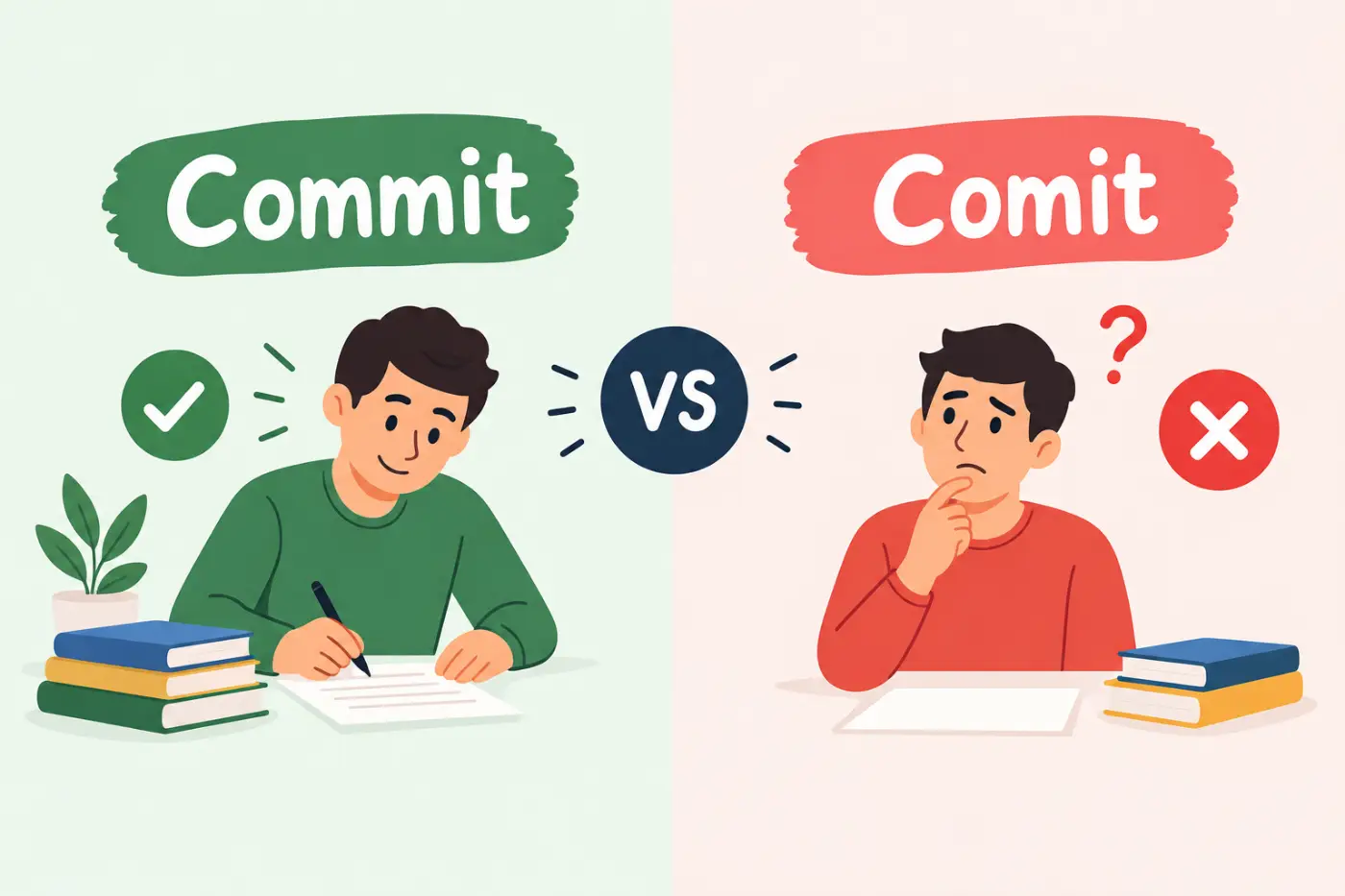
If you’re stuck on commit vs comit the correct spelling is commit. The word comit is a common spelling mistake. It doesn’t belong in standard English writing.
The confusion usually comes from the middle of the word. You can hear the same sound in both spellings so pronunciation doesn’t help much. The key is remembering that commit has two m letters.
This small spelling detail matters because commit is a very common word. You may use it when talking about making a promise making a serious decision doing something wrong or giving yourself fully to a goal. You’ll also see it often in phrases such as commit to a plan and commit a crime.
This guide explains the correct spelling and meaning of the word. You’ll also learn why the double m appears how to remember it and how to use commit naturally in everyday writing.
Quick Definition
Commit is a verb that can mean to carry out an action or to give yourself firmly to a person plan or goal. It can also mean to do something wrong such as a crime or offense.
Comit is an incorrect spelling. The correct form always has two m letters.
Direct Answer
Commit is the correct spelling. Comit is a misspelling and should not be used in standard English.
Comparison Table
| Word | Meaning | Example Sentence | When to Use It |
|---|---|---|---|
| Commit | To do something or give yourself firmly to something. | She decided to commit to the new training plan. | Use this spelling in all standard English writing. |
| Comit | No standard English meaning. | This spelling is incorrect. | Do not use it. |
Why People Confuse Commit And Comit
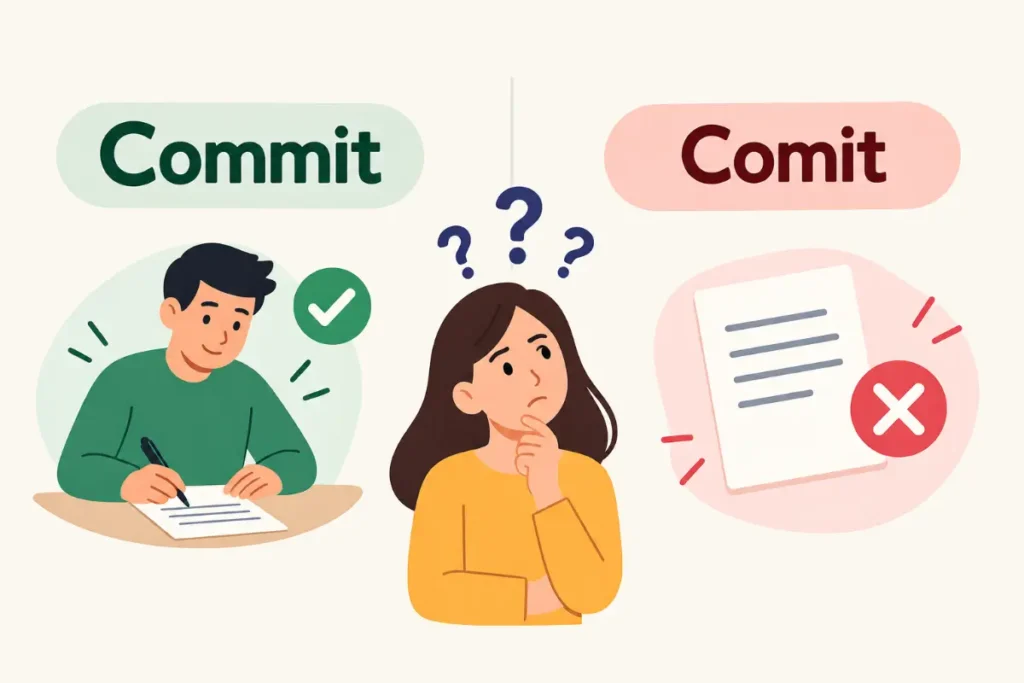
The main problem is the double m. When you say the word aloud the two letters sound like one strong m sound. That makes it easy to forget that the written word needs both letters.
Typing quickly can make the mistake even more likely. Your fingers may skip one of the repeated letters without you noticing. Since comit still looks close to the correct word your eyes may not catch the error during a quick read.
There is also a useful spelling pattern behind the word. When a short stressed word ends in a consonant and takes certain endings the final consonant may be doubled. The spelling of commit follows this pattern.
You don’t need to memorize a long grammar rule to get this word right. Remembering the double m is usually enough.
The Correct Spelling Of Commit
The correct spelling contains two m letters.
C O M M I T
The incorrect version leaves out one of them.
C O M I T
That missing m changes the spelling even though it doesn’t change the way the word sounds.
A useful way to remember the word is to picture the two m letters sitting together in the middle. You can think of them as a pair that shouldn’t be separated.
The word also keeps the double m when you add common endings.
- Commit.
- Commits.
- Committed.
- Committing.
Notice that the spelling changes slightly when an ending is added but the double m remains.
Why Does Commit Have Two Ms
The spelling comes from the way the word developed through earlier forms of English and French. Modern English kept the double consonant in commit.
There is also a spelling pattern that helps explain what happens when the word changes form. The final t is not doubled because the word already ends in a consonant after a short stressed vowel sound. When you add ed or ing the spelling keeps the double m.
For example.
- Commit becomes committed.
- Commit becomes committing.
The repeated m helps preserve the structure of the original word as its ending changes.
You don’t need to know the history of the word to spell it correctly. Still understanding the pattern can make the spelling easier to remember.
What Does Commit Mean
The word commit has several related meanings. The exact meaning depends on the sentence.
One common meaning is to decide firmly to do something or support something.
- I committed to exercising three times a week.
- She committed to finishing the project by Friday.
- They committed to helping the local community.
In these examples the word suggests a serious promise or strong decision. It carries more weight than simply saying that you might do something.
Another meaning is to perform an action. This use often appears when talking about crimes or serious mistakes.
- The suspect was accused of committing a crime.
- He admitted that he had committed an offense.
The word can also describe giving your full attention or effort to something.
- If you want to improve your writing you need to commit to regular practice.
- She committed herself to learning Spanish.
So while the meanings vary the central idea often involves taking a firm action or making a serious choice.
Commit As A Verb
Commit is a verb. A verb tells us about an action state or event.
When you say I commit to this plan you describe a decision.
When you say she committed herself to the project you describe a strong personal decision.
The word can take different forms depending on the tense.
| Form | Example |
|---|---|
| Commit | I will commit to the plan. |
| Commits | She commits to her goals. |
| Committed | They committed to the schedule. |
| Committing | He is committing to regular practice. |
These forms all come from the same verb. The spelling stays connected through the double m.
How To Use Commit In Everyday Writing
You may hear commit in many ordinary situations. It isn’t limited to formal writing or serious discussions.
Commit To A Goal
This is one of the most common uses.
When you commit to a goal you make a serious decision to work toward it.
For example.
- I committed to reading one book each month.
- She committed to saving money for a new car.
- We need to commit to a realistic schedule.
The phrase suggests effort and consistency. It tells the reader that the person isn’t simply considering the goal.
Commit To A Plan
You can also commit to a plan after deciding that you’ll follow it.
- Our team committed to the new work schedule.
- He committed to the training plan for six months.
- They committed to the changes after the meeting.
This use appears often in work conversations but it also works in everyday speech.
Commit To A Relationship
The word can describe a serious relationship or a decision to stay loyal to someone.
- She wasn’t ready to commit to marriage.
- He wants to commit to the relationship.
- They decided to commit to building a life together.
Here the word suggests a strong long term decision rather than a casual choice.
Commit A Crime
This use has a very different meaning.
When someone commits a crime they carry out an illegal act.
- The police believe someone committed the crime late at night.
- He was charged with committing fraud.
- No one should commit a crime to solve a personal problem.
This is a common fixed phrase in English. You will often see commit followed by words such as crime fraud murder or theft.
The meaning comes from the action itself rather than a promise or personal dedication.
The Spelling Rule For Commit
The easiest way to remember the spelling is to focus on the double m. The word has a short vowel sound followed by a consonant. In this pattern the final consonant of the base word can double when an ending is added. The spelling of commit already contains the double m in its base form.
Think of the word as com plus mit. The two m letters belong together in the middle. If you remove one of them you get comit which is not the standard English spelling.
The double m also stays in related forms such as committed and committing. That gives you a useful visual clue when you write the word.
Commit And Its Different Forms
English verbs often change their endings to show tense or grammar. Commit follows a spelling pattern that can look confusing at first. Once you see the forms together the pattern becomes much easier to remember.
Present Form
Use commit for the basic form of the verb.
- I plan to commit to the project.
- We need to commit to this decision.
- They want to commit more time to practice.
With he she or it the verb becomes commits.
- She commits to her goals.
- He commits to every appointment.
- The company commits to better service.
The double m stays in both forms.
Past Form
The past tense is committed.
The final t does not simply take ed. The word changes to committed with a double t at the end.
- She committed to the plan last week.
- He committed a serious offense.
- They committed themselves to the new project.
This spelling can look strange because the word has two m letters and two t letters. Still the pattern is consistent.
Present Participle
The form used with is am or are is committing.
- I am committing more time to my studies.
- She is committing to a healthier routine.
- They are committing resources to the project.
Again the double m stays in place. The final t is also doubled before ing.
Commit To Something
One of the most useful phrases to learn is commit to. It means to make a firm decision to do something or support something.
You can commit to a goal a plan a schedule a habit or an idea.
- I committed to waking up early.
- She committed to saving $100 each month.
- Our team committed to meeting the deadline.
- He committed to improving his writing skills.
The word to is important in this structure. You don’t normally say commit a goal when you mean that you promise to work toward it. You say commit to a goal.
This phrase also suggests more than a casual intention. If someone says they intend to exercise they are expressing a plan. If they say they committed to exercising they are showing a stronger decision.
Commit To A Person
The same structure works with people and relationships.
- She decided to commit to her partner.
- He isn’t ready to commit to a serious relationship.
- They committed to supporting each other.
In this context the word often suggests loyalty or a long term decision. It can appear in conversations about dating marriage friendship or family.
Commit To A Decision
You can also commit to a choice after considering different options.
- We’ve made our decision and we’re ready to commit to it.
- The company committed to the new policy.
- She committed to the change after discussing it with her team.
This use shows that the decision is no longer just an idea. The person has chosen a course of action and plans to follow it.
Commit A Crime
Another common structure is commit a crime. Here commit means to carry out an illegal act.
You might see phrases such as:
- Commit a crime.
- Commit fraud.
- Commit theft.
- Commit murder.
- Commit an offense.
For example:
- The suspect was arrested for committing fraud.
- Someone committed the theft during the night.
- He was accused of committing a serious offense.
This meaning is different from commit to. The preposition changes the structure and helps show the intended meaning.
Compare these two sentences.
- She committed to helping the team.
- She committed a serious offense.
The first sentence describes a firm decision. The second describes an action that someone carried out.
Commit Something To Memory
Another useful expression is commit something to memory. This means to learn something so well that you can remember it without looking at it.
- I committed the phone number to memory.
- She committed the poem to memory before the contest.
- He practiced the names until he had committed them to memory.
This phrase often appears in school writing but it can also work in everyday conversation.
You can think of your memory like a mental storage box. When you commit something to memory you put it there so you can find it later.
Commit Yourself To Something
The phrase commit yourself to means to give serious time effort or attention to something.
- She committed herself to learning English.
- He committed himself to the training program.
- They committed themselves to helping local families.
This construction can sound stronger than simply saying work on or try. It suggests dedication and a clear decision.
You can also use it in a negative form.
- I don’t want to commit myself to a schedule I can’t follow.
- She wasn’t ready to commit herself to the project.
This is useful when someone wants to show that they need more time before making a firm promise.
Common Mistakes With Commit
Knowing the correct spelling isn’t always enough. Writers sometimes use the right word in the wrong form or choose an awkward structure. A few common mistakes are worth knowing.
Using One M
The most obvious mistake is leaving out one m.
Incorrect:
- I will comit to the plan.
Correct:
- I will commit to the plan.
The missing letter is easy to overlook because the two spellings sound the same. Make a habit of checking the middle of the word when you’re proofreading.
Using Commit Without To
When you mean to make a firm decision or promise you normally need to before the thing you are agreeing to.
Incorrect:
- She committed the new plan.
Better:
- She committed to the new plan.
The first sentence doesn’t express the intended meaning clearly. The second one uses the standard structure.
Confusing Committed And Commiting
The correct forms are committed and committing. Both keep the double m and double the final t before the ending.
Incorrect:
- He is commiting to the program.
Correct:
- He is committing to the program.
Incorrect:
- She commited to the agreement.
Correct:
- She committed to the agreement.
These errors often happen because writers know the base word but aren’t sure how it changes when an ending is added.
Commit Versus Promise
The words commit and promise can have similar meanings but they aren’t always interchangeable.
A promise usually means that you tell someone you will do something.
- I promise I’ll call tomorrow.
A commitment suggests a firm decision or obligation. It often carries a stronger sense of responsibility.
- I committed to calling every week.
You can use both words in many situations. The best choice depends on the meaning and tone you want.
Commit Versus Dedicate
Dedicate can also be close in meaning to commit. Both words can describe giving time effort or attention to something.
- She dedicated herself to teaching.
- She committed herself to teaching.
The two sentences are similar but not identical. Dedicate often highlights giving effort or purpose to something. Commit often highlights a firm decision or obligation.
That difference becomes clearer in other contexts.
- He committed a crime.
You can’t normally replace committed with dedicated in that sentence. The two words may overlap in some situations but they don’t have the same full range of meanings.
How To Remember The Spelling
If you keep typing the wrong version stop trying to remember the whole word at once. Focus on the part that causes trouble.
Remember Two Ms
The simplest memory trick is this:
Commit has two Ms.
You can say the phrase silently in your head when you write it. The repetition creates a small mental cue that can prevent the most common spelling mistake.
Connect It With Committed
Another useful trick is to remember committed. Seeing the two m letters in the longer form can help you remember the base word.
- Commit.
- Committed.
- Committing.
The middle stays mm in every form.
Picture The Middle
If visual memory works well for you imagine the word with the two m letters highlighted in your mind.
CO MM IT
The two m letters are the part you need to protect. Once you remember that small detail the rest of the spelling is straightforward.
When To Use Commit In Professional Writing
The verb appears frequently in workplace communication. It can help describe deadlines plans responsibilities and decisions.
For example:
- We are committed to meeting the deadline.
- The company committed to improving customer support.
- Our team is committing additional resources to the project.
- The manager asked everyone to commit to the new schedule.
The related adjective committed is especially common in professional writing. It describes someone who gives strong effort or support to a goal.
- She is a committed employee.
- He is committed to providing quality service.
- They have a committed team of volunteers.
These examples show why spelling the word correctly matters. A simple error in a work email can make an otherwise clear message look careless.
When To Use Commit In Academic Writing
Students may encounter the word in essays research papers and assignments. It can describe actions decisions mistakes or dedication.
For example:
- The study examines how people commit to long term goals.
- Students who commit to regular practice often build stronger skills.
- The character committed a serious mistake.
- The author committed the details to memory.
Academic writing often requires precise word choice. Using commit correctly helps you communicate the exact action you mean.
Commit Vs Comit In Real Sentences
The easiest way to understand the spelling is to see the correct form in sentences. Once you notice commit in different situations the double m starts to look natural. You also get a better sense of how the word works beyond its spelling.
The word can describe a promise a serious choice an action or an offense. The sentence around it usually makes the meaning clear.
Talking About Goals
Use commit when someone decides to give time and effort to a goal.
- I need to commit to my fitness plan.
- She committed to studying for one hour each night.
- They are committed to improving their customer service.
- He wants to commit more time to his business.
In each sentence the person has made a firm choice. The word suggests more than simply thinking about doing something.
Talking About Plans
You can commit to a plan after you’ve decided to follow it.
- We committed to the new schedule.
- The team committed to finishing the project by Friday.
- She hasn’t committed to a final plan yet.
- They committed to making the repairs this month.
This use is common at work but it also fits personal situations. You might commit to a travel plan a study schedule or a family event.
Talking About Relationships
The word often appears when people talk about serious relationships.
- He isn’t ready to commit to marriage.
- She wants someone who is willing to commit.
- They decided to commit to each other.
- I don’t want to commit to a relationship before I’m ready.
Here the word refers to a serious personal decision. It often suggests loyalty and a long term promise.
Talking About Crimes
The meaning changes when commit appears with a crime or offense.
- The police believe he committed the crime.
- She was charged with committing fraud.
- The suspect allegedly committed theft.
- No one should commit an act of violence.
In this structure commit means to carry out an illegal or harmful act. This meaning has nothing to do with making a promise or dedicating yourself to a goal.
Commit And Committed
The past tense of commit is committed. This form is especially useful because it shows two spelling changes that writers sometimes miss.
The double m stays in the middle. The final t also doubles before ed.
So the correct spelling is:
Committed
Not:
Commited
For example:
- She committed to the project last month.
- He committed a serious offense.
- We committed ourselves to the new schedule.
- They committed to helping the community.
The same idea applies when you add ing. The correct form is committing.
- She is committing more time to her studies.
- We are committing extra resources to the project.
- He is committing himself to regular practice.
A useful pattern to remember is commit, committed, committing. The double m stays in all three forms.
Commit And Commitment
Commitment is the noun form of the verb. It refers to a promise decision responsibility or strong dedication to something.
For example:
- Learning a language takes commitment.
- She made a commitment to exercise regularly.
- His commitment to the team was clear.
- The company showed its commitment to customer service.
The spelling changes slightly when the noun ending is added but the double m remains.
This word also appears in everyday phrases such as long term commitment financial commitment and personal commitment.
What Is A Commitment
A commitment is something you agree or decide to do. It can involve your time money effort or loyalty.
For example a doctor may have a commitment to patient care. A student may make a commitment to studying. A person may have a financial commitment such as a monthly payment.
The word doesn’t always describe something formal. You can make a personal commitment to call your parents every Sunday or exercise three times a week.
Commit And Committed To
The phrase committed to is especially common in English. It means strongly dedicated to a person goal plan or cause.
- She is committed to her family.
- He is committed to improving his skills.
- The organization is committed to helping local residents.
- We are committed to finishing the work on time.
Notice that to is followed by a noun or an ing form when you describe an action.
Correct:
- She is committed to learning French.
Incorrect:
- She is committed to learn French.
After committed to you can use a noun.
- He is committed to the project.
Or you can use an ing form.
- He is committed to completing the project.
This small grammar point can help your writing sound much more natural.

Commit To Doing Something
When you want to say that someone has firmly decided to do an action use commit to followed by an ing form.
- I committed to waking up early.
- She committed to saving money.
- They committed to working together.
- He committed to practicing every day.
This structure is common because to is acting as a preposition here. That means the next verb takes the ing form.
Compare these examples.
- I decided to study every night.
- I committed to studying every night.
Both sentences are correct. The first uses to study after the verb decided. The second uses to studying because to belongs to the phrase commit to.
A Simple Spelling Trick
If you often type comit by accident try saying the word in two parts as you write it.
Think:
com plus mit
The middle contains two m letters. You can also connect the word with committed and commitment. Seeing the same double letter across the word family makes the spelling easier to remember.
Another useful trick is to write a short sentence instead of memorizing the word alone.
- I commit to my goal.
That sentence gives you both the spelling and the meaning. Repeat it a few times and then create your own sentence.
Words Related To Commit
Learning related words can strengthen your spelling because you see the same root in different forms.
Commitment
Commitment is a noun that describes a firm promise or dedication.
- Her commitment to the project impressed her manager.
Committed
Committed is the past tense and past participle of the verb. It can also describe someone who is dedicated to something.
- She committed to the plan yesterday.
- He is a committed volunteer.
Committing
Committing is the form used with helping verbs such as is are and was.
- They are committing more time to the project.
These forms are connected. If you can spell one correctly you have a useful clue for the others.
Other Common Spelling Mistakes With Double Letters
The problem with commit isn’t unusual. English has many words where repeated letters cause trouble.
Consider these examples.
- Accommodate.
- Address.
- Necessary.
- Occurred.
- Beginning.
- Successful.
Writers often leave out one repeated letter because the word still looks familiar. The same thing happens with commit.
A good proofreading habit is to look carefully at repeated letters in words that you know you often misspell. Don’t rely only on how the word sounds.
Why Committing Has Two Ms And Two Ts
The spelling of committing can look intimidating because it contains four repeated consonant letters.
C O M M I T T I N G
The word starts with the double m from the base form. The final t doubles before the ing ending.
The same process appears in committed.
C O M M I T T E D
You don’t need to treat these as random spellings. Learn the base form first. Then remember that the final consonant doubles when these endings are added.
This gives you a simple set to memorize.
- Commit.
- Committed.
- Committing.
How Spell Check Can Help
Spell check is useful when you aren’t sure about a word. If you type the incorrect form your device may suggest the correct spelling. You can then add the correct version to your memory.
Still don’t depend on spell check alone. You may write by hand or use a platform that doesn’t flag every mistake. A person may also read your writing before the software catches the problem.
A stronger habit is to know the spelling yourself and use spell check as a second layer of protection.
Commit Vs Comit In Formal Writing
When comparing commit vs comit in formal writing there is no choice between two accepted spellings. Only one form belongs in standard English.
Use commit in:
- School assignments.
- College papers.
- Resumes.
- Cover letters.
- Business emails.
- Reports.
- Websites.
- Social media posts.
- Personal messages.
The incorrect form should be corrected wherever it appears.
This is a simple mistake to fix. Once you remember the double m you can avoid it in almost every situation.
When Commit Is The Right Word
Spelling is only one part of using a word well. You also need to choose commit when its meaning fits the sentence.
Use it for a firm decision.
- I committed to finishing the course.
Use it for dedication.
These meanings may seem different but they share an idea of taking a definite action or making a serious choice.
FAQs
Is commit or comit correct?
Commit is the correct spelling. Comit is a misspelling and isn’t accepted as a standard English word. Remember the two m letters in the middle whenever you write this verb.
Why does commit have two Ms?
The spelling of commit follows an established English spelling pattern and comes from an older word form that kept the double consonant. The double m is part of the base word. It also remains in forms such as committed and committing.
Is comit a real word?
No. Comit isn’t the standard spelling of the English verb. If you mean to describe making a firm decision or carrying out an action you should use commit.
What is the past tense of commit?
The past tense is committed. The final t doubles before the ed ending.
For example:
- She committed to the plan last week.
- He committed a serious offense.
Is it commit to or commit with?
The usual phrase is commit to when you mean to give yourself firmly to a person plan goal or activity. For example you can say I committed to exercising every morning. The phrase commit with doesn’t normally express this meaning.
What is the difference between commit and commitment?
Commit is a verb that describes an action or decision. Commitment is a noun that describes a promise responsibility or strong dedication.
For example:
- I commit to the plan.
- My commitment to the plan is strong.
The two words belong to the same word family but they have different jobs in a sentence.
Is committed spelled with one M?
No. The correct spelling is committed with two m letters and two t letters. The same double m from the base word stays when you add the ending.
How can I remember the spelling of commit?
The easiest trick is to remember two Ms. Think of the word as com plus mit and picture the two m letters together in the middle. You can also connect it with committed and commitment to reinforce the spelling.
Conclusion
The correct spelling is commit. Comit is a spelling mistake. If you remember only one thing from this guide remember the two m letters in the middle.
The word is commonly used to describe a firm decision or dedication. You can commit to a goal or commit to a plan. It can also describe carrying out an action such as a crime. Related forms include committed committing and commitment.
The spelling becomes easier once you connect these words. They all keep the double m. When you proofread your writing simply check the middle of the word and make sure both m letters are there.
So when you’re choosing commit vs comit use commit. Keep the two Ms together and you’ll have the correct spelling every time.

Dr. Elena Vance holds a Ph.D. in Linguistics from Columbia University and has spent over 15 years analyzing the evolution of the English language. A former university professor turned full-time writer and editor, Elena specializes in breaking down high-level grammatical concepts, punctuation nuances, and style guides (APA, Chicago, MLA) into clear, actionable advice. When she isn’t hunting down dangling modifiers, she can be found collecting vintage dictionaries and reading classic literature.