
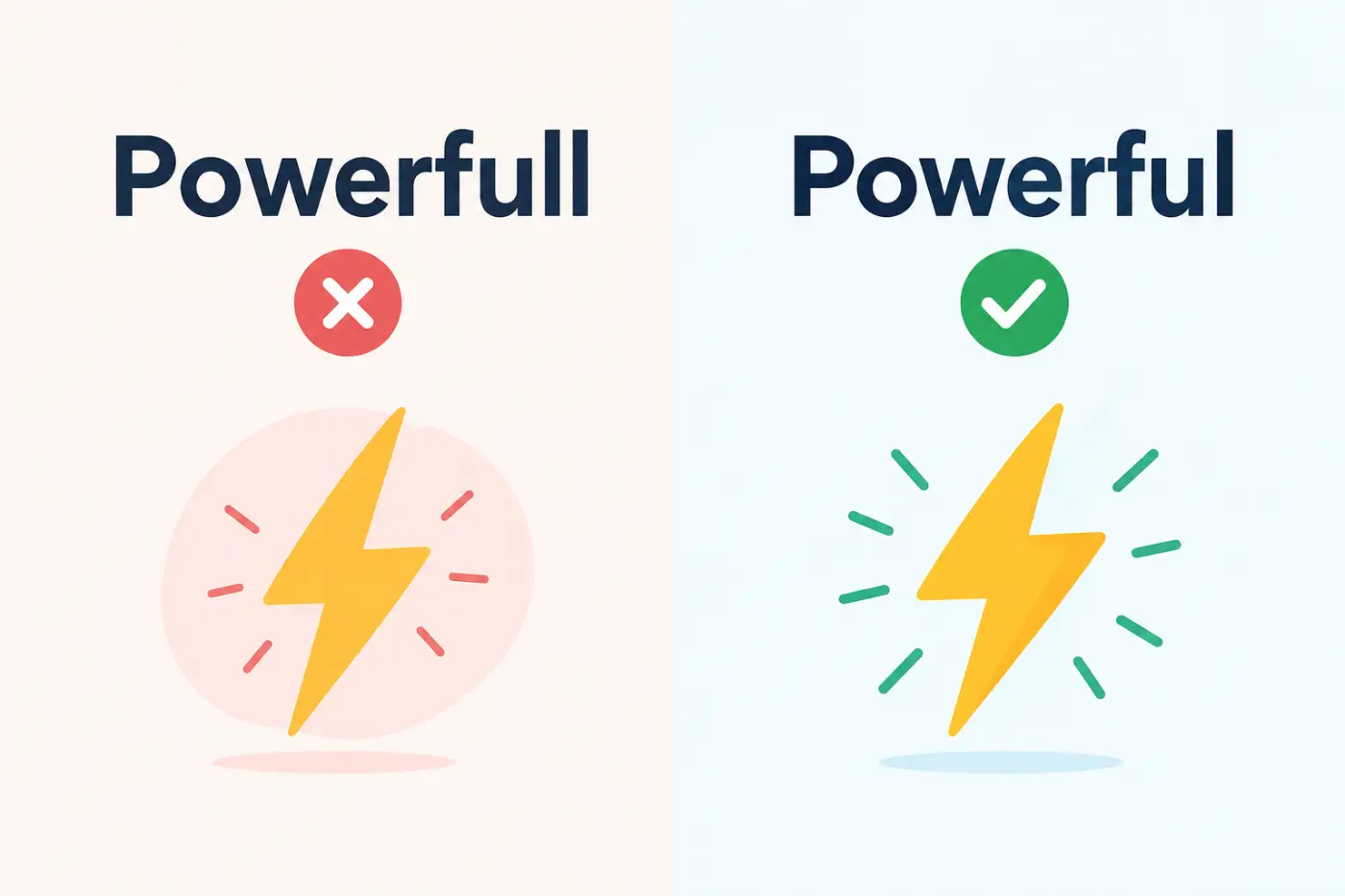
If you are unsure about powerfull vs powerful you only need to remember one spelling. The correct word is powerful. It has only one l at the end.
The incorrect spelling often happens because the word comes from power plus the suffix ful. Since many English words end with a doubled consonant in other situations it can feel natural to write two l’s here. However the suffix ful keeps only one l when it forms the word powerful.
This guide explains the correct spelling and meaning of the word. You’ll also see why the extra l causes confusion how the word is formed and how to use it naturally in everyday sentences.
Quick Definition
Powerful is an adjective that describes someone or something with a lot of power strength force or influence. It can describe a person a machine an argument an emotion or even an image.
The spelling powerfull is incorrect in standard English. The correct form is powerful with one l at the end.
Direct Answer
Powerful is the correct spelling. Powerfull is a misspelling and should not be used in standard English writing.
Comparison Table
| Word | Meaning | Example Sentence | When to Use It |
|---|---|---|---|
| Powerful | Having great power strength force or influence. | She gave a powerful speech. | Use this spelling in all standard writing. |
| Powerfull | Incorrect spelling of powerful. | The spelling is incorrect. | Do not use this form. |
Why People Spell Powerful With Two Ls
The extra l can seem logical at first glance. The word powerful comes from power and the suffix ful. When people say the word aloud the ending can sound like it deserves two l’s when written down.
English spelling does not always work by simply adding letters based on pronunciation. In this case the suffix ful is spelled with one l. When you attach it to power the result is powerful.
Think of the word as two parts.
Power + ful = powerful.
The ending ful means full of or having a lot of something. For example hopeful means full of hope. Helpful describes something that provides help. Careful describes someone who takes care.
The same idea applies to powerful. It describes something that has a great deal of power.
Once you see the word this way the spelling becomes much easier to remember.
The Correct Spelling Rule
The main spelling point is simple. The suffix ful is normally written with one l.
You can see this in many common words.
- Helpful.
- Hopeful.
- Careful.
- Useful.
- Peaceful.
- Beautiful.
- Colorful.
- Skillful.
- Powerful.
Notice that each word ends in ful rather than full.
This can feel strange because the word full by itself has two l’s. That difference causes many spelling mistakes. When ful works as a suffix it does not keep the second l.
For example full is a complete word.
- The glass is full.
But when it becomes part of another word it usually appears as ful.
- The glass is useful.
- She is careful with the dishes.
- He is hopeful about the future.
The same pattern gives us powerful.
What Does Powerful Mean
The adjective powerful has several related meanings. The exact meaning depends on the sentence.
Most often it describes something that has a lot of physical strength or force.
For example a powerful engine can produce a great deal of force. A powerful storm can bring strong winds and heavy rain. A powerful computer can process demanding tasks quickly.
The word can also describe influence. A powerful leader may have a strong effect on people or decisions. A powerful organization may have significant control or influence in a particular area.
The word can describe ideas and communication too. A powerful argument can make people rethink their views. A powerful speech can leave a strong impression on an audience.
Emotions can also be powerful. Love grief fear anger and joy can all affect people deeply.
So the word does not always mean physical strength. It can describe anything that has a strong effect.
Powerful In Everyday Sentences
The easiest way to understand a word is to see how people actually use it. The following examples show several common meanings.
Physical Strength
A powerful animal can have great physical strength.
- The horse has powerful legs.
- The lion has a powerful bite.
- The athlete has a powerful upper body.
Machines can also be powerful.
- This car has a powerful engine.
- The new vacuum has a powerful motor.
- The computer is powerful enough to run the software.
In these examples the word refers to physical force or ability.
Strong Influence
Powerful can also describe someone or something that has a strong influence.
- She is a powerful voice in the community.
- The company became a powerful force in the industry.
- His advice had a powerful effect on my decision.
Here the word does not mean physical strength. It refers to influence and impact.
Strong Emotions
People often use powerful to describe feelings that are intense or deeply felt.
- She had a powerful emotional reaction to the news.
- The movie brought back powerful memories.
- He felt a powerful sense of relief after the exam.
These sentences show how the word can describe the effect an emotion has on someone.
Strong Ideas And Messages
A message can be powerful if it makes people think or feel strongly.
- The book delivers a powerful message about friendship.
- Her story was simple but powerful.
- The speaker made a powerful argument for change.
The idea does not need to be complicated to be powerful. Sometimes a short and simple message can have the strongest effect.
Powerful And Powerfully
Another common point of confusion is the difference between powerful and powerfully.
Powerful is an adjective. It describes a person thing idea or experience.
- She has a powerful voice.
- That was a powerful speech.
Powerfully is an adverb. It describes how someone does something.
- She spoke powerfully about her experience.
- The story was written powerfully.
A simple test can help. If the word describes a noun use powerful. If it describes an action use powerfully.
Compare these two sentences.
- He gave a powerful speech.
- He spoke powerfully during the meeting.
In the first sentence powerful describes the speech. In the second sentence powerfully describes how he spoke.
This small difference matters because using the wrong form can make a sentence grammatically incorrect even when the spelling itself looks right.
The Difference Between Full And Ful
The spelling confusion becomes easier to understand when you compare full with the suffix ful.
The word full means containing as much as possible.
- The cup is full.
- My schedule is full today.
- The theater was full of people.
The suffix ful has a related idea. It helps create an adjective that means full of or having a certain quality.
- Hopeful means full of hope.
- Helpful means providing help.
- Peaceful means full of peace.
- Powerful means having great power.
The spelling changes from full to ful when the ending becomes a suffix. That is why powerful has one l even though full has two.
This is one of those small spelling details that becomes much easier once you understand how the word is built.
More Words Ending In Ful
Learning a group of related words can help reinforce the pattern. If you remember that the suffix is ful then many common words become easier to spell.
Consider these examples.
Hopeful means feeling or showing hope.
- I am hopeful that everything will work out.
Helpful means giving help.
- Your advice was very helpful.
Careful means taking care to avoid mistakes or danger.
- Be careful when you cross the street.
Useful means helpful or practical.
- This guide is useful for new students.
Peaceful means calm and free from conflict or disturbance.
- We spent a peaceful afternoon by the lake.
Beautiful means pleasing to look at or experience.
- The garden looks beautiful in spring.
Powerful means having great power strength force or influence.
- The speaker gave a powerful presentation.
Seeing these words together makes the spelling pattern easier to recognize. You do not need to memorize a complicated rule. Just remember that the suffix is ful with one l.
Why The Extra L Looks Tempting
The incorrect form feels natural because English has plenty of words with double letters. Words such as really still and little contain repeated letters. The word full also has two l’s.
That can lead writers to think that adding full to another word should produce a double l.
But English does not work that way here. The suffix is ful rather than full. The spelling stays consistent in words such as helpful hopeful and powerful.
A useful mental picture is to imagine that the second l in full gets left behind when the word becomes a suffix. You do not need to use this trick forever. Once you have seen the correct spelling enough times it should become automatic.
How To Use Powerful Correctly
The word powerful can describe much more than physical strength. In everyday English it often describes something that has a strong effect on people. The effect can come from a person a feeling an idea a speech or an event.
For example a powerful story can make you think about something long after you finish reading it. A powerful photograph can bring out strong emotions without using any words. A powerful argument can change how someone sees an issue.
The key idea is strong effect. If something has a lot of force influence or impact you can often describe it as powerful.
Powerful For Physical Force
Use the word when something has great physical strength or force.
- The truck has a powerful engine.
- The waves were powerful enough to damage the pier.
- He has a powerful swing.
- The machine uses a powerful motor.
- The flashlight has a powerful beam.
These examples describe force that you can often see or measure. A powerful engine can produce more force. A powerful storm can bring strong winds.
Powerful For Influence
The word can also describe a person group or organization with a strong ability to affect events or people.
- She became a powerful figure in the company.
- The organization has a powerful influence on local businesses.
- He is a powerful speaker who connects with his audience.
- The coach has a powerful influence on the team.
Here the word doesn’t describe muscle or physical force. It describes influence. Someone can be powerful because other people listen to them respect their ideas or follow their decisions.
Powerful For Emotions
Powerful is also common when talking about strong feelings.
- She felt a powerful sense of relief.
- The song brought back powerful memories.
- He experienced a powerful wave of sadness.
- The reunion created a powerful emotional moment.
These feelings don’t need to last for a long time. An emotion can be powerful because it affects someone deeply at a particular moment.
Powerful For Ideas
An idea can be powerful when it has a strong effect on the way people think.
- The book presents a powerful idea about kindness.
- Her message was simple but powerful.
- The teacher shared a powerful lesson with the class.
- His argument made a powerful impression on the audience.
Notice that powerful doesn’t always mean complicated. A short idea can have a lasting effect. Sometimes one clear sentence can stay with a reader longer than a page of explanation.
Powerful As A Positive Description
In many sentences powerful has a positive meaning. People often use it to praise strength confidence influence or effectiveness.
A powerful speech may inspire an audience. A powerful performance may leave people impressed.
For example.
- The singer gave a powerful performance.
- She delivered a powerful speech about kindness.
- The film tells a powerful story about family.
However the word doesn’t always mean something good. It can describe something harmful or frightening too.
- The hurricane was extremely powerful.
- The drug has a powerful effect.
- He felt a powerful urge to leave.
The sentence gives you the clue. The word itself mainly tells you that the force or effect is strong.
Powerful Compared With Strong
Powerful and strong are close in meaning but they don’t always sound the same.
Strong is one of the most common words in English. It can describe physical strength emotions arguments smells flavors relationships and many other things.
Powerful often suggests a greater effect or influence. It can sound more intense than strong in some situations.
Compare these examples.
- She has a strong voice.
- She has a powerful voice.
Both sentences are correct. The first could simply describe the volume or quality of her voice. The second may suggest that her voice has a deep emotional effect on listeners.
Another example is an argument.
- He made a strong argument.
- He made a powerful argument.
A strong argument is convincing and well supported. A powerful argument can also suggest that it had a major effect on the people who heard it.
The two words overlap often. Your choice depends on the exact meaning and tone you want.
Powerful Compared With Effective
These words are also related but they focus on different ideas.
Effective means something works well and produces the result you want. Powerful focuses more on the strength of the effect.
For example a medicine can be effective because it treats a problem successfully. You might call it powerful if it produces a very strong effect.
The same difference appears in communication.
- The advertisement was effective.
- The advertisement was powerful.
The first sentence says the advertisement achieved its goal. The second suggests that the advertisement made a strong impression.
An effective solution doesn’t always need to feel powerful. It simply needs to work.
Powerful Compared With Forceful
Forceful usually describes strong action speech or behavior. It can suggest firmness and determination.
- She gave a forceful response.
- He made a forceful argument.
- The manager spoke in a forceful tone.
Powerful has a wider range. It can describe physical force emotional impact influence ideas performances and many other things.
A person can be forceful in a conversation because they speak firmly. A person can be powerful because they have influence. The two words can overlap but they aren’t exact substitutes in every sentence.
Common Spelling Mistakes With The Word
The most common mistake is adding an extra l at the end. This happens because writers see the word full and assume the ending should keep both letters.
Another mistake is changing the spelling based on pronunciation. The ending sounds the same in many words so listening doesn’t always help you choose the letters.
Some writers may also accidentally add an extra vowel when typing quickly. These errors usually come from rushing rather than misunderstanding the meaning.
The safest habit is to remember the word as power plus ful. That gives you the correct spelling without requiring a complicated spelling rule.
How The Suffix Ful Works
The ending ful is called a suffix. A suffix is a group of letters added to the end of a word to create another word or change its meaning.
The suffix ful often gives the idea of full of or having a particular quality.
Consider these examples.
- Hope becomes hopeful.
- Help becomes helpful.
- Care becomes careful.
- Beauty becomes beautiful.
- Peace becomes peaceful.
- Power becomes powerful.
The base word stays recognizable. The suffix adds the idea connected to that word.
Powerful therefore means having power or showing a great deal of power.
The spelling point is simple. The suffix is ful with one l. It isn’t spelled full when used in these adjectives.
Does Full Always Become Ful
No. The word full itself still has two l’s.
For example.
- The box is full.
- My glass is full.
- The room is full of people.
When ful appears as a suffix the spelling is different.
- helpful.
- useful.
- hopeful.
- powerful.
This distinction is worth remembering because it explains many common spelling errors. You don’t need to change the spelling of the word full itself. You only need to remember that the suffix has one l.
A Simple Memory Trick
Try this sentence in your head.
Power plus ful makes powerful.
The trick works because it separates the word into its two useful parts. You start with power and add ful. Since ful has one l the finished word also ends with one l.
You can use the same method with other words.
- Help plus ful makes helpful.
- Hope plus ful makes hopeful.
- Care plus ful makes careful.
Once you see the pattern across several words the spelling becomes much easier to recall.
When To Use Powerful In Formal Writing
The word works well in both casual and formal writing. You can use it in essays reports articles presentations emails and everyday messages.
Still you should make sure the word says exactly what you mean. Strong adjectives can lose their impact when writers use them too often.
For example saying every idea is powerful makes the word less meaningful. Save it for ideas experiences or actions that truly have a strong effect.
Compare these sentences.
- The report contains a powerful argument supported by several years of research.
- The report contains many powerful facts powerful ideas and powerful examples.
The first sentence gives the adjective a clear purpose. The second uses it so often that the description becomes less precise.
Good writing isn’t about using the strongest word in every sentence. It’s about choosing the word that fits the idea.
Examples From Common Writing Situations
You may see this adjective in many types of writing. Knowing these patterns can help you use it naturally.
In School Writing
- The novel gives readers a powerful message about courage.
- The experiment showed the powerful effect of heat on the material.
- Her essay makes a powerful point about education.
In Business Writing
- The new software is a powerful tool for data analysis.
- The company has a powerful presence in the market.
- This feature gives users a powerful way to manage their files.
These examples show why the word is so useful. It can fit many situations without sounding unusual or overly formal.
What Makes Something Powerful
Context determines the exact meaning but several ideas appear again and again.
Something may be powerful because it has great physical force. An engine storm or machine can fit this meaning.
- It may be powerful because it has strong influence. A leader organization or speaker can fit this meaning.
- It may be powerful because it creates a deep emotional response. A memory song film or personal experience can fit this meaning.
- It may also be powerful because it communicates an idea in a convincing way. A speech argument photograph or story can have this quality.
In each case the central idea is the same. Something has a strong force effect or influence.
How To Avoid The Common Spelling Error
The easiest way to avoid this spelling mistake is to stop thinking of the ending as the word full. Think of it as the suffix ful. That small change in how you see the word can make the spelling much easier to remember.
When you start with power and add ful you get powerful. There is no second l at the end. The same pattern works with many familiar adjectives such as helpful hopeful careful and useful.
If you often type quickly you may still make the mistake from time to time. A quick visual check can help. Look at the final four letters. If they spell ful the word is written correctly.
Why Powerful Has One L
The spelling becomes clearer when you understand the difference between a complete word and a word ending.
Full is a complete adjective. It means containing as much as possible.
- The bottle is full.
- The parking lot is full.
- My calendar is full today.
Ful is a suffix. It becomes part of another word and often means full of or having a particular quality.
- Power becomes powerful.
- Hope becomes hopeful.
- Help becomes helpful.
- Care becomes careful.
So the two forms have related meanings but different jobs. Full stands on its own while ful attaches to another word.
That is why adding full to power would create the wrong spelling. The correct word uses the suffix ful.
Is Powerful An Adjective
Yes. Powerful is an adjective because it describes a noun.
For example.
- She has a powerful voice.
- We watched a powerful performance.
- The machine has a powerful motor.
- He shared a powerful message.
In each sentence the adjective gives more information about a person thing or idea.
You can also use the word after linking verbs.
- The engine is powerful.
- The speech was powerful.
- The storm became powerful.
- Her message remains powerful.
The grammar stays simple. If you are describing something with great strength force influence or impact powerful may be the right adjective.
What Is The Noun Form
The main noun connected to this adjective is power.
- Power refers to the ability or strength to control influence move or affect something.
- Powerful describes something that has a great amount of power or produces a strong effect.
Compare these examples.
- The machine has a lot of power.
- The machine is powerful.
The first sentence uses the noun power. The second uses the adjective powerful.
Other related words include powerfully and powerless.
Powerfully is an adverb.
- She spoke powerfully about her experience.
Powerless is an adjective with the opposite idea.
- He felt powerless to stop the decision.
Learning these related forms can help you understand the whole word family instead of memorizing one spelling in isolation.
Powerful And Powerless
These two adjectives express opposite ideas.
Powerful describes someone or something with great power influence strength or effect.
Powerless describes someone or something that lacks power or control.
For example.
- The powerful machine lifted the heavy load.
- The broken machine left the workers powerless to finish the job.
The contrast can also describe people and emotions.
- She felt powerful after completing the difficult task.
- He felt powerless during the crisis.
Knowing opposites can make vocabulary easier to remember. If you connect powerful with powerless both words become part of the same mental group.
Can Powerful Describe A Person
Yes. It can describe a person’s physical strength influence position or effect on others.
For example.
- The athlete is incredibly powerful.
- She became a powerful leader in the organization.
- He has a powerful presence on stage.
The meaning changes with the context. In the first sentence the word may refer to physical ability. In the second it refers to influence.
Be careful with the word when describing people. Powerful can sound like praise in one sentence and simply describe authority or influence in another. The surrounding words make the intended meaning clear.

Can Powerful Describe A Voice
Yes. This is a very common use.
A powerful voice may be loud strong rich or emotionally moving. It doesn’t always mean that the person is simply speaking at a high volume.
For example.
- The singer has a powerful voice.
- Her powerful voice filled the theater.
- He has a soft voice but can become very powerful when he sings.
The word often suggests impact rather than volume alone. A quiet speaker can also have a powerful voice if their words have a strong emotional effect.
Can Powerful Describe A Speech
Yes. A speech can be powerful if it strongly affects the people listening to it.
For example.
- She gave a powerful speech at the ceremony.
- His speech delivered a powerful message.
- The students found the speaker’s story powerful.
A powerful speech doesn’t have to be long. It can use simple words and still leave a lasting impression. Clear ideas personal stories strong examples and sincere emotion can all make communication more powerful.
Can Powerful Describe A Tool
Yes. Technology and tools are often described as powerful when they can perform difficult tasks or produce strong results.
For example.
- This laptop has a powerful processor.
- The camera has a powerful zoom.
- The software is a powerful tool for editing videos.
- The search feature is surprisingly powerful.
In these examples the word refers to capability. A powerful tool can do a lot or handle demanding work.
However the word isn’t limited to expensive or advanced products. A simple tool can be powerful if it performs its job very well.
Common Mistakes With Similar Adjectives
Spelling errors often happen because several words look similar. Learning a few related forms can prevent confusion.
Beautiful
Beautiful ends in ful with one l.
- The garden looks beautiful in spring.
Writing beautifull is incorrect.
Helpful
Helpful also ends with one l.
- Your advice was very helpful.
The incorrect form helpfull adds an unnecessary l.
Hopeful
Hopeful means feeling or showing hope.
- We are hopeful about the results.
The correct ending is ful.
Useful
Useful means helpful or practical.
- This information is useful for new writers.
Again the ending has one l.
Careful
Careful means taking care to avoid danger mistakes or problems.
- Be careful with that glass.
The word does not end in full.
These examples reinforce the same spelling pattern. Once you recognize ful as a common suffix the correct form becomes easier to recall.
When The Word Full Is Correct
It’s useful to know the difference because full itself is a perfectly correct word. The problem only comes when people use it as the ending of an adjective that should use ful.
Use full when it stands alone.
- The cup is full.
- The room is full.
- The box is full of books.
- My day is full of meetings.
Use ful when it forms part of another word.
- The cup is useful.
- The room looks beautiful.
- She is hopeful.
- The machine is powerful.
This simple contrast can prevent many spelling errors.
A Quick Proofreading Test
If you are unsure about the spelling, don’t stare at the whole word. Break it into parts.
- Start with power.
- Then add ful.
- You get powerful.
This method is especially useful during proofreading because it gives you a quick way to check the ending. You can use the same test with helpful hopeful careful and useful.
Another useful habit is to look for the extra l. If you see powerfull stop and remove one l. The correct form ends with ful.
With regular practice you won’t need the trick for long. The correct spelling will simply look right.
A Few Sentences To Practice
Writing the word in different contexts can help make the spelling automatic.
- The new engine is surprisingly powerful.
- She gave a powerful speech at the event.
- The medicine had a powerful effect.
- He made a powerful argument during the meeting.
- The storm produced powerful winds.
- Music can have a powerful effect on our emotions.
- This small computer is more powerful than my old one.
- The photograph tells a powerful story without using words.
- Her performance was simple but powerful.
- The team developed a powerful new tool for designers.
These examples also show how flexible the adjective is. It can describe machines people performances ideas emotions weather and many other things.
A Useful Way To Think About The Word
Instead of memorizing a long spelling rule think of powerful as a small equation.
Power + ful = powerful.
The first part gives you the main idea. The second part turns it into an adjective. Since ful has one l the finished word has one l too.
This same pattern appears across many everyday words. Once you learn the pattern you can apply it to new words instead of relying only on visual memory.
That’s a much stronger spelling habit. You understand why the letters appear in that order rather than simply hoping the word looks familiar.
FAQs
Is powerful the correct spelling?
Yes. Powerful is the correct spelling with one l at the end. Powerfull is a spelling error and isn’t used in standard English.
Why does powerful have only one l?
The word is formed from power and the suffix ful. The suffix ful has one l. That gives us powerful rather than a form ending in full.
Is powerfull ever correct?
No. Powerfull isn’t a standard English spelling. If you’re writing an email essay report or social media post use powerful instead.
What does powerful mean?
Powerful describes someone or something that has great strength force influence or effect. It can describe physical objects such as engines and storms as well as ideas emotions speeches and people.
Is powerful an adjective?
Yes. Powerful is an adjective because it describes a noun. For example you can have a powerful engine a powerful argument or a powerful emotional experience.
What is the difference between powerful and strong?
Both words can describe something with great strength or effect. Powerful often puts more focus on force influence or impact while strong has a wider range of uses. The best choice depends on the meaning you want to express.
What is the difference between powerful and powerfully?
Powerful is an adjective that describes a person thing or idea. Powerfully is an adverb that describes an action. You can say someone gave a powerful speech or spoke powerfully about an issue.
Does full have two l letters?
Yes. Full has two l letters when it stands alone. The suffix ful has one l when it forms words such as helpful hopeful careful and powerful.
Conclusion
When you’re choosing powerfull vs powerful remember that only powerful is correct. The word has one l at the end because it uses the suffix ful rather than the standalone word full.
The easiest way to remember it is to split the word into power and ful. You can use the same pattern with helpful hopeful careful useful and several other everyday adjectives. This gives you a simple rule that works far beyond this one spelling question.
Powerful can describe physical force strength influence emotion or impact. You might describe a powerful engine a powerful speech a powerful memory or a powerful argument. The exact meaning changes with the sentence but the spelling never needs two l letters.
The next time you type this word take a quick look at the ending. If you see full after power remove one l. Write powerful and move on with confidence.

Sienna Watson is a veteran copywriter and communications coach who has helped startup founders, marketers, and professionals polish their writing for over a decade. Realizing that most people don’t need a degree in linguistics—just clear, impactful communication—Sienna focuses on practical grammar, business writing etiquette, and eliminating wordiness. She advocates for plain language, strong verbs, and persuasive prose that gets results.