
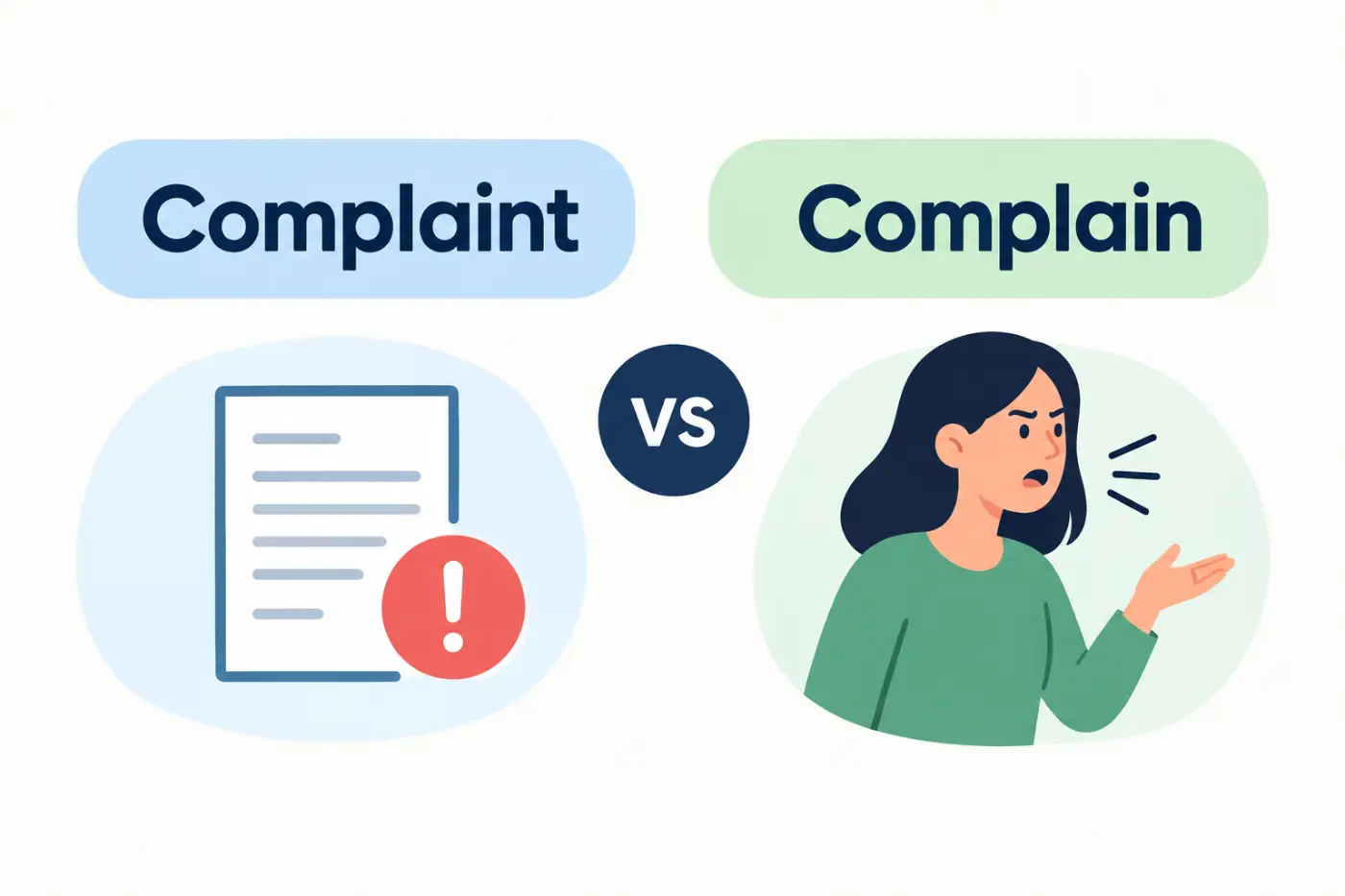
Have you ever wondered if you should write complaint vs complain in an email or a sentence? The two words look almost the same and relate to the same idea. However, they serve different purposes in English.
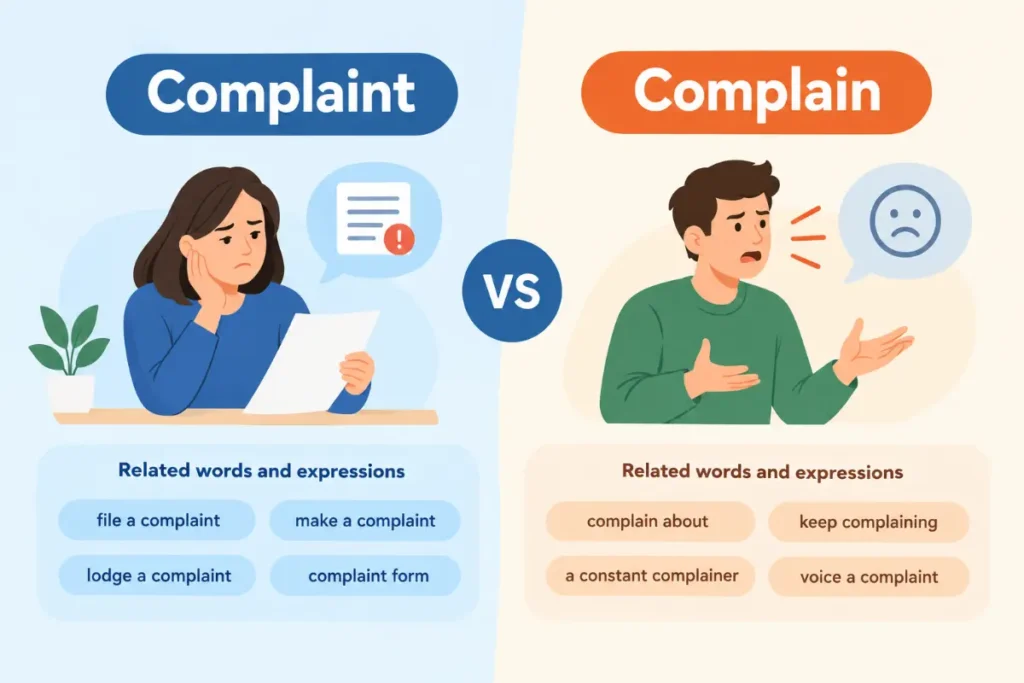
The main difference in complaint vs complain is simple. Complaint is a noun that names a problem or an expression of dissatisfaction. Complain is a verb that describes the act of expressing dissatisfaction. You make a complaint, but you complain about something.
For example, you might write, “I filed a complaint about the poor service.” You could also say, “I want to complain about the poor service.” Both sentences are correct, but each word plays a different role.
Understanding this difference can help you write clearer emails, fill out forms, contact customer service, and speak more naturally. You will also learn the correct spelling, common grammar mistakes, and practical ways to use both words in everyday American English.
Quick Definition
A complaint is a statement that expresses dissatisfaction with a person, product, service, or situation. It is a noun because it names the concern or the act of formally reporting a problem.
To complain means to express dissatisfaction about something. It is a verb because it describes an action.
Direct Answer
Use complaint when you name a concern or report a problem. Use complain when you describe the action of expressing dissatisfaction.
For example, “She made a complaint about the noise” is correct, and “She complained about the noise” is also correct. The right choice depends on how you build your sentence.
Complaint vs Complain at a Glance
| Word | Meaning | Example Sentence | When to Use It |
|---|---|---|---|
| Complaint | A concern or expression of dissatisfaction | I submitted a complaint about the damaged package. | When naming a problem or report. |
| Complain | To express dissatisfaction | I want to complain about the damaged package. | When describing an action. |
| Complains | Expresses dissatisfaction | He complains about the long wait. | With he, she, or it in the present tense. |
| Complained | Expressed dissatisfaction in the past | We complained about the cold food. | When the action happened in the past. |
| Complaining | Expressing dissatisfaction | They are complaining about the delay. | For an ongoing action or as a noun like activity. |
| Complaints | More than one concern or report | The manager received three complaints. | When referring to multiple concerns. |

Understanding the Difference Between Complaint and Complain
The easiest way to learn these words is to focus on their jobs in a sentence. One names the concern. The other describes what someone does about it.
Complaint Is a Noun
A noun names a person, place, thing, idea, or feeling. The word complaint names a concern, a report of a problem, or an expression of dissatisfaction.
You can have a complaint, make a complaint, file a complaint, or receive a complaint. These expressions all treat the word as the name of something.
Consider these examples.
- I have a complaint about my hotel room.
- The company received a complaint from a customer.
- Her complaint concerned the late delivery.
- The manager listened to every complaint.
- He filed a formal complaint against his employer.
- The restaurant handled my complaint quickly.
In each sentence, complaint names the issue or report. It does not describe the action of expressing dissatisfaction.
You will often see this word in workplaces, customer service emails, official forms, and conversations about poor service. For example, a company might ask you to submit a complaint if an order arrives damaged.
The word can also describe a less formal concern. Your friend might have a complaint about a movie, or your neighbor might have a complaint about loud music.
A complaint does not always need to be a written document. You can make a complaint in person, over the phone, through an email, or on an online form.
Complain Is a Verb
A verb describes an action or a state. Complain describes the act of expressing dissatisfaction, annoyance, or concern.
You can complain about a problem, complain to a manager, or complain that something is unfair. The word tells the reader what someone does.
Look at these examples.
- I want to complain about my hotel room.
- Customers complain when orders arrive late.
- She complained to the store manager.
- We complained that the food was cold.
- He often complains about his workload.
- They are complaining about the noise outside.
In these sentences, complain or one of its forms describes an action. Someone is expressing dissatisfaction about a situation.
Notice the words that often appear with this verb. You can complain about a problem, complain to a person, or complain that something happened.
For example, “I complained to the manager about the slow service” tells us who received the complaint and what caused it.
You can also use the verb without explaining the reason. “The customers complained” is a complete sentence because the reader knows that the customers expressed dissatisfaction. More details may help, but the sentence is grammatically complete.
Why the Two Words Are Easy to Confuse
The words share almost the same spelling and meaning. Both relate to dissatisfaction, so it is easy to assume that they can replace each other.
Their endings provide a useful clue. Complain ends in ain and functions as a verb in its basic form. Complaint ends in aint and functions as a noun.
Compare these two sentences.
- The customer made a complaint.
- The customer complained.
The first sentence names the report or concern. The second describes the customer’s action.
Both sentences communicate dissatisfaction. However, their grammar differs because one uses a noun and the other uses a verb.
This distinction matters when you write professional emails or formal reports. A small grammar mistake can make a sentence sound awkward, even when the reader understands your meaning.
The Grammar Rules for Complaint and Complain
Once you understand the difference between a noun and a verb, choosing the correct word becomes much easier. The key is to look at the sentence around the word rather than focusing only on its meaning.
Use Complaint After an Article or Determiner
Articles and determiners help identify nouns. Common examples include a, an, the, my, your, this, and that.
Because complaint is a noun, it can follow these words.
Examples.
- I have a complaint about this product.
- The complaint was sent to the wrong department.
- My complaint has not received a response.
- Her complaint was reasonable.
- That complaint needs further review.
In each example, the word names a concern. The article or determiner helps show which concern the sentence refers to.
You can also place an adjective before the noun to give more detail.
- I submitted a serious complaint.
- The customer made a formal complaint.
- We received a written complaint.
- She raised a valid complaint about the charge.
Words such as serious, formal, written, and valid describe the type of complaint. They do not change its role as a noun.
A useful rule is to check the word that comes immediately before the blank in your sentence. If you see a, the, my, or your, you may need the noun form.
For example, “I submitted a ___ about the delivery” needs complaint. The correct sentence is “I submitted a complaint about the delivery.”
Use Complain After a Subject
A subject tells the reader who or what performs the action. When a sentence describes someone expressing dissatisfaction, you usually need a form of the verb complain.
Examples.
- I complain when the service is poor.
- You complain about the same problem every week.
- We complain when the rules seem unfair.
- They complain about the rising cost of food.
The subjects I, you, we, and they use the base form complain in the simple present tense.
However, third person singular subjects need a different form.
- He complains about his noisy neighbors.
- She complains about the long commute.
- The customer complains about the extra fee.
In these sentences, the subject is he, she, or the customer. The verb takes an s at the end, becoming complains.
This is a common rule in English. In the simple present tense, most verbs take an s or es when the subject is he, she, or it.
Compare the following examples.
- I complain about the noise.
- She complains about the noise.
- We complain about the noise.
- The tenant complains about the noise.
The meaning stays the same, but the verb changes to match the subject.
Use Complain After To
The word to can introduce the base form of a verb. This pattern appears when you explain what someone wants, plans, needs, or hopes to do.
Examples.
- I want to complain about my bill.
- She decided to complain to the supervisor.
- They plan to complain about the delay.
- He needs to complain about the incorrect charge.
- We agreed to complain as a group.
In these sentences, to complain describes an action that someone wants or plans to take.
The same pattern works with many other verbs.
- I need to explain the problem.
- She wants to report the damage.
- They plan to discuss the issue.
You would not write “I want to complaint about my bill.” The phrase want to calls for a verb in its base form, so complain is correct.
This rule is particularly useful when writing customer service messages. If you want to tell a company that you intend to raise a concern, you can write, “I would like to complain about the charge on my account.”
Use Complaint After Make or File
The words make and file often appear with the noun complaint. These are common expressions in American English.
Examples.
- I made a complaint about the damaged item.
- She filed a complaint with the housing office.
- We made a formal complaint to the airline.
- The employee filed a complaint against the company.
- He plans to make a complaint about the rude service.
The noun names the concern or report. The verb make or file describes the action of creating or submitting it.
You can also use submit, register, raise, or lodge with the noun, depending on the context.
For example, you might submit a complaint through a website, raise a complaint during a meeting, or register a complaint with a government office.
In everyday American English, make a complaint and file a complaint are especially familiar. File a complaint often sounds more formal because it suggests an official process.
Remember that these expressions need the noun form. You file a complaint, not a complain.
Use Complain With About or That
The verb complain often connects to the reason for the dissatisfaction.
Use about before a noun or noun phrase.
Examples.
- She complained about the delay.
- I complained about the broken screen.
- They complained about the loud music.
- He complained about his manager’s behavior.
Use that when introducing a statement or explanation.
Examples.
- She complained that the room was dirty.
- I complained that the bill was incorrect.
- They complained that the instructions were unclear.
- He complained that no one had answered his email.
Both patterns are correct. The choice depends on what follows the word.
After about, you can use a noun such as the delay or the broken screen. After that, you can state a complete idea such as the room was dirty.
Compare these sentences.
- “I complained about the price.”
- “I complained that the price was too high.”
The first sentence uses a noun phrase after about. The second uses a clause that explains the problem in more detail.
Understand the Difference Between Complaint and Complaints
Complaint is singular. Complaints is plural.
Use the singular form when you mean one concern or report.
- The customer made a complaint.
- I have one complaint about the service.
- Her complaint was resolved yesterday.
Use the plural form when you mean two or more concerns.
- The company received several complaints.
- Customers submitted complaints about the new policy.
- The manager reviewed all the complaints.
The verb in the sentence must also agree with its subject.
For example, “The complaint is serious” uses is because the subject is singular. “The complaints are serious” uses are because the subject is plural.
This distinction matters in reports and workplace communication. If you write that a company received one complaint, you communicate something different from saying that it received several complaints.
Common Examples of Complaint and Complain
Real examples make grammar easier to remember. The following situations show how these words work in everyday conversations, emails, and formal communication.
At a Restaurant
Imagine you order a meal, but it arrives cold. You want the restaurant to fix the problem.
You could say, “I have a complaint about my meal.”
Here, complaint names the concern. You could also say, “I want to complain about my meal.” In that sentence, complain describes what you want to do.
More examples.
- The customer made a complaint about the cold food.
- I complained to the waiter about the long wait.
- She has a complaint about the service.
- Several guests complained about the noise.
- The manager handled our complaint politely.
Notice that you can use either word to discuss the same problem. The sentence structure determines which one fits.
If you are speaking directly to a waiter, you might say, “Excuse me. I’d like to complain about my order.” This sounds clear and polite.
If you are writing a review later, you could say, “My main complaint was that the food arrived cold.” That sentence names the specific issue.
When Contacting Customer Service
Customer service is another place where people often use these words. You may need to report a damaged item, an incorrect charge, a late delivery, or a poor experience.
Use complaint when you refer to the report itself.
- I submitted a complaint through the company’s website.
- The company acknowledged my complaint.
- My complaint concerns an incorrect charge.
- The support team reviewed the complaint.
Use complain when you describe the action of expressing dissatisfaction.
- I want to complain about my recent order.
- The customer complained about the missing item.
- We complained to the company about the delay.
- She called to complain about the extra fee.
Here is a practical example of an email.
“I am writing to complain about the damaged item I received yesterday. The package arrived on time, but the product was broken. Please explain how I can receive a replacement or a refund.”
The verb complain describes the purpose of the email. You could use the noun in the subject line by writing “Complaint About a Damaged Item.”
Both forms are useful, but each serves a different purpose.
At Work
Employees may raise concerns about unfair treatment, unsafe conditions, missed payments, or problems with workplace policies.
Examples with the noun.
- She filed a complaint about workplace harassment.
- The company investigated the employee’s complaint.
- His complaint involved unpaid overtime.
- The manager received a formal complaint from a staff member.
Examples with the verb.
- She complained to human resources about the unfair schedule.
- He complained that his overtime had not been paid.
- Several employees complained about the new policy.
- The worker decided to complain about the unsafe equipment.
In formal workplace settings, complaint often appears in documents and official processes. The verb complain describes what the employee does.
There is also a difference between complaining casually and making a formal complaint. Someone who says, “This schedule is terrible,” may simply be expressing frustration. An employee who submits a written report through the company’s official process may be filing a formal complaint.
The exact meaning depends on the situation, not just the word.
When Talking About Health
The word complaint has another use in medical settings. It can describe a symptom or concern that brings someone to a doctor.
For example, a doctor might ask about your main complaint. In this context, the question refers to the problem you want medical help with.
Examples.
- The patient’s main complaint was a severe headache.
- She reported a complaint of ongoing stomach pain.
- The doctor asked about his primary complaint.
- His chief complaint was pain in his lower back.
The verb complain can also describe what a patient says.
- The patient complained of chest pain.
- She complained about feeling dizzy.
- He complained that his medication caused nausea.
In medical language, the expression complain of often introduces a symptom. For example, “The patient complained of a sore throat.”
In everyday conversation, people may say, “I’ve been complaining about my back pain all week.” That sentence focuses on the repeated act of expressing discomfort.
The words still follow the same basic grammar rule. The setting simply changes the kind of concern being discussed.
When Talking About Everyday Annoyances
Not every complaint involves an official report. People complain about small frustrations all the time.
Examples.
- My brother complains about doing the dishes.
- She has a complaint about the movie’s ending.
- We complained about the traffic on the way home.
- His only complaint was the uncomfortable chair.
- The neighbors complained about the barking dog.
These sentences sound natural in casual American English.
You can also use the verb in a lighthearted way. For example, “I am not complaining about the free pizza” means you are happy with the situation rather than expressing dissatisfaction.
The phrase no complaints is another common expression. It often means that things are going well or that someone has no major problems to report.
If a friend asks, “How’s your new job?” you might answer, “No complaints. The team is great.”
Here, complaints is a plural noun. The phrase works as a casual way to say that you are satisfied.
Common Mistakes to Avoid
Even fluent English speakers can make mistakes with similar words. Most errors happen when writers focus on meaning but overlook grammar.
Mistake One Using Complaint as a Verb
Incorrect: “I want to complaint about the service.”
Correct: “I want to complain about the service.”
The phrase want to requires the base form of a verb. Since complain is the verb, it belongs in this sentence.
You could also write, “I want to make a complaint about the service.” In that version, complaint is correct because it follows a and works as a noun.
The difference lies in the structure.
Mistake Two Using Complain as a Noun
Incorrect: “I submitted a complain to the manager.”
Correct: “I submitted a complaint to the manager.”
The word after a needs to be a noun in this sentence. Complaint names the report that you submitted.
Another correct version is “I complained to the manager.” In that sentence, the verb describes the action you took.
Both sentences are correct, but they express the idea through different grammatical structures.
Mistake Three Forgetting the S in Complains
Incorrect: “She complain about everything.”
Correct: “She complains about everything.”
In the simple present tense, the verb usually takes an s when the subject is he, she, or it.
More examples.
- He complains about the weather.
- My sister complains about the bus.
- The customer complains about every charge.
However, you would say “They complain about everything” because they does not take the third person singular form.
Mistake Four Confusing Complained With Complaint
These words look similar, but their endings and functions differ.
Complained is the past tense of the verb complain. Complaint is a noun.
Compare these examples.
- She complained about the price.
- Her complaint concerned the price.
The first sentence describes an action that happened in the past. The second names the concern.
A useful way to check your sentence is to ask what role the word plays. If it tells you what someone did, use the appropriate verb form. If it names the concern, use complaint.
Mistake Five Using the Wrong Form After Did
Incorrect: “I did complained to the manager.”
Correct: “I did complain to the manager.”
When you use did to form a question or a negative statement, the main verb takes its base form.
Examples.
- Did you complain about the service?
- I did not complain about the service.
- She did complain when the order arrived late.
You should not add the past tense ending to the main verb after did.
The same rule applies to many English verbs. You say “Did you call?” rather than “Did you called?”
Mistake Six Using Complaint When You Need an Action
Incorrect: “I complaint to the supervisor yesterday.”
Correct: “I complained to the supervisor yesterday.”
The sentence describes an action that happened in the past. It therefore needs the past tense of the verb complain.
You could also write, “I made a complaint to the supervisor yesterday.” That version is correct because made is the verb and complaint is the noun.
Mistake Seven Writing a Complaint Without Explaining the Problem
This is not a grammar error, but it can make your writing less effective.
For example, “I have a complaint about your company” gives little useful information. The reader knows you are unhappy but does not know what went wrong.
A clearer version would be, “I have a complaint about the $25 fee added to my bill.”
The second sentence identifies the concern. It helps the reader understand the problem and decide what action to take.
When you write a complaint, explain the issue in plain language. Include useful details such as the date, order number, charge, or action that caused the problem when relevant.
Mistake Eight Repeating the Same Word Too Often
Repeating complaint or complain in every sentence can make an email sound awkward.
For example, “I want to complain about the service. My complaint is about the service. I am complaining because the service was poor.”
You can make the message more natural by varying the wording.
“I am writing about the poor service I received yesterday. My order arrived late, and no one explained the delay. I would appreciate a response and a suitable solution.”
The revised version communicates the concern clearly without repeating the same word in every sentence.
You do not need to avoid these words completely. Just use them when they add meaning.
How to Remember the Difference
You do not need to memorize a long grammar lesson to use these words correctly. A few simple tricks can help you choose the right form quickly.
Remember That a Complaint Is a Thing
Think of complaint as something you can make, file, submit, or receive.
You can make a complaint about a noisy neighbor. You can receive a complaint from an unhappy customer.
These expressions all use complaint as a noun.
Try this quick test. If you can naturally place a or the before the word, you probably need the noun form.
- I have a complaint.
- The complaint was reviewed.
- She submitted a complaint.
This trick works well in many everyday sentences. However, always check the full sentence to make sure the grammar fits.
Remember That Complain Is an Action
Think of complain as something a person does.
You complain about a problem. You complain that a bill is wrong.
The word describes an action, just like speak, write, ask, or explain.
Try replacing the word with another action verb. If the sentence still makes sense, you may need complain or one of its verb forms.
For example, “I want to complain about the service” follows the same basic pattern as “I want to explain the problem.”
The pattern becomes easier to recognize with practice.
Use This Simple Memory Trick
Remember this sentence.
You make a complaint when you complain.
The two words appear together, but they have different jobs.
In this sentence, make is the verb and complaint is the noun. The second part uses complain as a verb.
You can create similar sentences to test your understanding.
- I filed a complaint because I wanted to complain.
- She received a complaint from a customer who wanted to complain.
- We made a complaint after we complained several times by phone.
These examples may sound repetitive, but they help you see how the words fit into different sentence patterns.
Once you understand the pattern, you can apply it to new situations without relying on memorized examples.
Related Words and Expressions
Learning a few related forms can improve your vocabulary and help you write with more variety.
Complainant
A complainant is a person who makes a complaint, especially in a formal or legal setting.
For example, “The complainant provided a written statement to the investigator.”
This word appears in legal documents, official investigations, workplace reports, and other formal settings. In everyday conversation, person who made the complaint is often clearer.
Do not confuse the complainant with the person or organization receiving the complaint. The complainant is the person raising the concern.
Complaining
Complaining is the present participle of complain. It can describe an action that is happening now or act as a noun that names the activity.
Examples.
- She is complaining about the noise.
- They kept complaining during the meeting.
- Constant complaining can frustrate other people.
In the first two examples, the word describes an action. In the third, it names the activity of expressing dissatisfaction.
The sentence structure tells you how the word works.
Complained
Complained is the simple past form of complain. Use it when someone expressed dissatisfaction in the past.
Examples.
- I complained about the incorrect bill yesterday.
- She complained to the manager last week.
- Several customers complained after the store changed its return policy.
You can also use complained with had to form the past perfect tense.
For example, “I had complained about the problem before the company issued a refund.”
This form shows that the complaint happened before another past event.
Complaining About Something Versus Complaining To Someone
The preposition can change the information a sentence provides.
Use complain about to identify the problem.
For example, “I complained about the delayed flight.”
Use complain to to identify the person who heard the complaint.
For example, “I complained to the airline representative.”
You can use both in one sentence.
“I complained to the airline representative about the delayed flight.”
This sentence identifies both the person who received the complaint and the reason for it.
Complaint Versus Grievance
A grievance is a concern or complaint about something someone believes is unfair or wrong. The word often appears in workplaces, labor relations, and formal dispute processes.
For example, “The employee filed a grievance about the change to her work schedule.”
A complaint is a broader term. You can complain about cold food, a broken phone, rude service, or an unfair work policy.
A grievance often suggests a dispute involving a rule, right, policy, or sense of unfair treatment. The terms can overlap, but they are not always interchangeable in official procedures.
Complaint Versus Criticism
A complaint expresses dissatisfaction with a problem or situation. Criticism involves pointing out faults or weaknesses in something or someone.
For example, “My complaint was about the late delivery” identifies a service problem.
“The review offered criticism of the film’s weak ending” evaluates the quality of the film.
A complaint may include criticism, but criticism does not always express a personal grievance. Someone can criticize a book’s writing without being personally upset about it.
Complaint Versus Feedback
Feedback is information about a product, service, action, or experience. It can be positive, negative, or neutral.
A complaint usually expresses dissatisfaction or identifies a problem.
For example, “The customer gave feedback about the new website” does not tell us if the feedback was positive or negative.
“The customer made a complaint about the website’s payment error” clearly identifies a problem.
If you want a company to improve its service, you can offer feedback. If you need to report a specific problem, you can make a complaint.
How to Write a Clear Complaint
Knowing the correct word is only one part of good writing. You also need to explain the problem clearly and ask for a useful response.
Start With the Main Problem
Tell the reader why you are contacting them.
For example, “I am writing to complain about an incorrect charge on my account.”
This opening identifies the purpose of the message right away. It also uses complain correctly as a verb.
You could use a noun based version instead.
“I am writing to submit a complaint about an incorrect charge on my account.”
Both versions are grammatically correct. The first is more direct, while the second sounds a little more formal.
Include Relevant Details
Explain what happened and provide facts that help the reader understand the issue.
For example, mention the date of the purchase, the amount charged, or the item that arrived damaged.
Avoid vague statements such as “Your service was terrible.” Instead, explain the specific problem.
“My order was scheduled to arrive on Monday, but it arrived on Thursday without an update from the delivery company.”
This gives the reader something concrete to review.
Explain What You Want
A complaint becomes more useful when you explain how you would like the issue resolved.
For example, you could ask for a refund, a replacement, a correction to your bill, or an explanation of a policy.
“I would appreciate a refund for the damaged item. Please let me know what information you need to process the request.”
The message stays polite and direct. It focuses on solving the problem rather than attacking the person reading it.
Keep the Tone Calm and Respectful
You can express dissatisfaction without insulting anyone.
For example, “I was disappointed with the service because my appointment started 45 minutes late” explains the problem clearly.
By contrast, personal attacks can distract from the issue and make it harder to reach a solution.
A clear complaint should focus on facts, the effect of the problem, and the action you want the reader to take.
Check Your Grammar Before Sending
Before you send a complaint, check that you have used the noun and verb forms correctly.
- I have a complaint about the service.
- I want to complain about the service.
- I complained about the service yesterday.
- I am complaining because the service was poor.
Each sentence is correct because the word matches its grammatical role.
A quick review can make your email easier to understand and more professional.
FAQs
What Is the Difference Between Complaint and Complain?
Complaint is a noun that names a concern or report of dissatisfaction. Complain is a verb that describes the act of expressing dissatisfaction. You make a complaint, but you complain about a problem.
Is Complaint a Noun or a Verb?
Complaint is a noun. You can use it to name a problem or a formal report about an issue. For example, “The manager received a complaint about the service.”
Is Complain a Noun or a Verb?
Complain is a verb. It describes the action of expressing dissatisfaction with something. For example, “I want to complain about the late delivery.”
Should I Write I Have a Complaint or I Have a Complain?
Write “I have a complaint.” The word a calls for a noun in this sentence, and complaint is the correct noun. You can also write “I want to complain” when you want to describe the action.
What Is the Past Tense of Complain?
The past tense of complain is complained. For example, “She complained about the incorrect bill yesterday.” The word complaint is a noun and does not serve as the past tense of the verb.
Is It Correct to Say I Want to Complain?
Yes. “I want to complain” is grammatically correct because the word to introduces the base form of the verb. You can add the reason by saying, “I want to complain about the poor service.”
What Is the Plural of Complaint?
The plural of complaint is complaints. Use complaints when referring to more than one concern or report. For example, “The company received several complaints about its delivery service.”
How Do You Use Complaint and Complain in One Sentence?
You can write, “I made a complaint because I wanted to complain about the service.” In this sentence, complaint is a noun and complain is a verb. Both words are correct because they perform different grammatical roles.
Conclusion
The difference between complaint vs complain comes down to one simple grammar rule. Complaint is a noun that names a concern or report. Complain is a verb that describes the act of expressing dissatisfaction.
Use complaint in sentences such as “I filed a complaint about the damaged product.” Use complain in sentences such as “I want to complain about the damaged product.” The meaning is related, but the sentence structure determines the correct choice.
Remember that complaint can follow words such as a, the, my, and your. The verb complain can follow phrases such as want to, need to, and plan to. You can also use forms such as complains, complained, and complaining to match the subject and tense.
The next time you write an email, report a problem, or talk about poor service, check the role of the word in your sentence. If you are naming the concern, use complaint. If you are describing the action, use complain. This simple check will help you write with greater confidence.

Sienna Watson is a veteran copywriter and communications coach who has helped startup founders, marketers, and professionals polish their writing for over a decade. Realizing that most people don’t need a degree in linguistics—just clear, impactful communication—Sienna focuses on practical grammar, business writing etiquette, and eliminating wordiness. She advocates for plain language, strong verbs, and persuasive prose that gets results.