
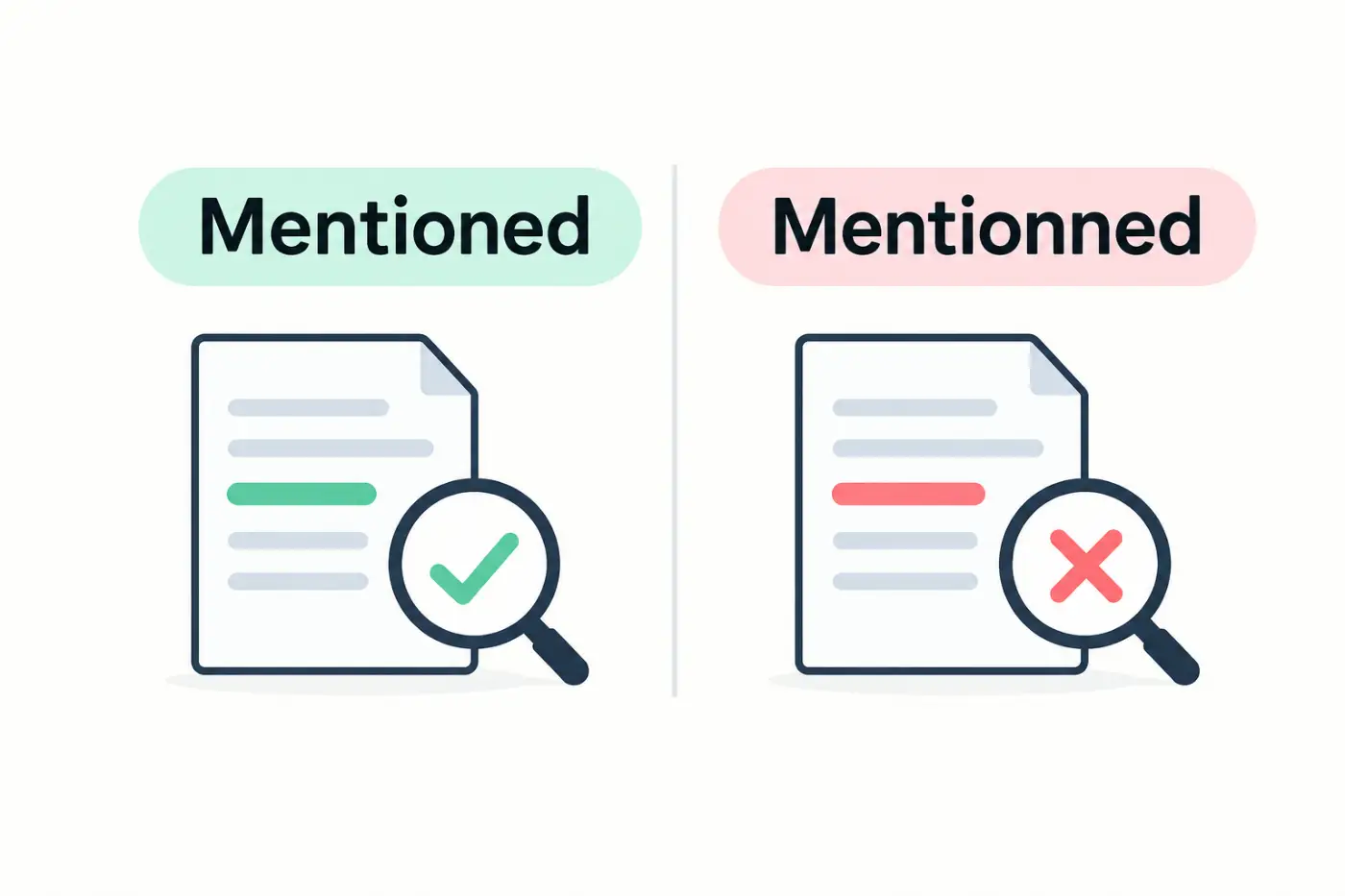
If you’ve ever paused over mentioned vs mentionned you’re dealing with a very common spelling mistake. The correct spelling is mentioned with one n before the ending. The spelling mentionned is incorrect in standard English.
The confusion usually comes from adding an extra n before the past tense ending. That mistake can feel natural because English has many words that double their final consonant before certain endings. However the word mention does not follow that pattern when you add ed.
This guide explains why mentioned is correct and why the extra n doesn’t belong there. You’ll also see how to use the word in real sentences and how its spelling changes when you add other endings. By the end you should be able to spell and use it without stopping to think.
Quick Definition
Mentioned is the past tense and past participle of the verb mention. It means that someone referred to a person idea fact place or subject in speech or writing.
Mentionned is not the standard English spelling. The correct form is mentioned.
Direct Answer
Mentioned is the correct spelling. Mentionned is incorrect because the word mention keeps one n when you add the ending ed.
Comparison Table
| Word | Meaning | Example Sentence | When to Use It |
|---|---|---|---|
| Mentioned | Past tense of mention | She mentioned your name yesterday. | Use this form for something that someone referred to in the past. |
| Mentionned | Incorrect spelling | This spelling is incorrect. | Do not use this form in standard English. |
Why The Spelling Causes Confusion
The problem comes from a spelling pattern that English speakers learn with many short verbs. When some verbs take an ending that starts with a vowel the final consonant doubles.
For example the verb stop becomes stopped. The verb plan becomes planned. The verb admit becomes admitted. Seeing these patterns can make it tempting to write mentionned.
But mention is different. The final n does not double before ed. You simply add ed to the base word.
Mention plus ed becomes mentioned.
That small difference explains the entire spelling issue. Once you understand how the base word works the extra n becomes much easier to spot as a mistake.
The Correct Spelling Rule
The base verb is mention. It has one n at the end.
When you form the past tense you add ed.
Mention becomes mentioned.
You do not change the final n. You do not add another n. The spelling stays intact and the ending attaches directly to the base word.
This gives you a simple pattern to remember.
- Mention.
- Mentioned.
- Mentioning.
- Mentioner.
The word keeps its single final n in these common forms. The spelling changes only as required by the suffix and normal English word formation.
Why Mention Does Not Double The N
English has rules for doubling a final consonant but they don’t apply to every word that ends in a consonant. The pattern often depends on the word’s structure and pronunciation.
Words such as stop and plan can double the final consonant before certain endings. Their spelling follows a different pattern from mention.
The final n in mention already belongs to the base word. Adding ed does not require another n.
Think of the process as adding a piece to the end of an existing word rather than rebuilding the word from scratch.
Mention plus ed.
Mentioned.
That is all you need.
What Mention Means
The verb mention means to refer to someone or something briefly in speech or writing. You can mention a person during a conversation. You can mention a fact in an email. You can mention a problem during a meeting.
For example you might say:
- She mentioned your name during lunch.
- Here the speaker is saying that someone referred to your name.
- You can also mention an idea.
- He mentioned a possible solution during the meeting.
- You can mention a place.
- Sarah mentioned a great restaurant near downtown.
- You can even mention something without giving many details.
- I mentioned the problem but didn’t explain everything.
The word often suggests a brief reference rather than a long discussion. If you talk about a subject for an hour you are doing much more than simply mentioning it.
How To Use Mentioned In A Sentence
The past tense mentioned tells readers that the reference happened in the past. The time can be clear from the sentence or understood from the surrounding context.
Consider these examples.
- I mentioned your idea during the meeting.
- She mentioned that she would arrive late.
- Tom mentioned your name yesterday.
- The teacher mentioned the test during class.
- We mentioned the issue in our last email.
Each sentence describes a past reference. Someone brought up a person topic fact or idea.
Mentioned With A Person
You can use the word when someone refers to another person.
- Maria mentioned David during the conversation.
- My manager mentioned you during our meeting.
- The customer mentioned her previous experience with us.
In these sentences the person is the subject that someone referred to.
Mentioned With An Idea
The word also works naturally with ideas and suggestions.
- He mentioned a different approach.
- She mentioned an interesting idea.
- The professor mentioned a useful study.
- The team mentioned several possible solutions.
The sentence doesn’t say that the speaker explained the idea in great detail. It simply tells us that the idea came up.
Mentioned With A Problem
Mentioned often appears when people refer to problems or concerns.
- I mentioned the issue to my supervisor.
- She mentioned a problem with the order.
- The report mentioned several safety concerns.
- They mentioned the delay during the call.
This use is common in workplace writing because people often need to record what was discussed.
Mentioned With That Clauses
A very common structure uses mentioned that followed by a complete idea.
- She mentioned that she was tired.
- He mentioned that the store was closed.
- They mentioned that the meeting had moved to Friday.
- I mentioned that we needed more time.
This structure is useful because it lets you report what someone said without repeating their exact words.
For example:
- John said the project was finished.
- You could report the same basic idea by writing:
- John mentioned that the project was finished.
The two sentences are not always identical in tone. Said is very general. Mentioned often suggests that the information came up briefly.
Mentioned With A Noun
You can also put a noun directly after the verb.
- She mentioned the new policy.
- He mentioned your book.
- The manager mentioned the deadline.
- I mentioned the appointment.
This structure is short and natural. It works well in both casual and formal writing.
Mentioned In Everyday Conversation
You probably hear this word often without noticing it. People use it when they refer back to something that came up earlier.
For example:
- You mentioned that you were moving. How is the new place?
- Someone might say:
- I think you mentioned her before.
- Another common sentence is:
- Didn’t you mention a trip to California?
These examples show how the word connects current conversation with information that appeared earlier.
Common Mistakes With Mentioned
The biggest spelling mistake is adding an extra n. However spelling isn’t the only thing that can cause trouble. Writers sometimes use the word in places where another verb would be clearer.
Adding An Extra N
The most common mistake is writing the word with two n letters before ed.
The incorrect form adds an extra n that does not belong to the base word. The correct spelling keeps one n.
This is easy to fix once you remember that mention does not change its final consonant when ed is added.
Confusing Mention With Say
Mention and say can overlap but they aren’t always interchangeable.
She said she was tired.
She mentioned that she was tired.
Both sentences can be correct. The first simply reports what she said. The second suggests that the information came up as a point of reference.
Consider another example.
I mentioned your new job.
This tells the reader that your new job came up in conversation.
I said your new job was interesting.
This tells the reader exactly what the speaker said about the job.
The difference is small but useful. Mention often focuses on bringing a subject into the conversation rather than giving a full statement about it.
Confusing Mention With Discuss
Mention and discuss also have different levels of detail.
- If you mention a problem you refer to it.
- If you discuss a problem you talk about it in more detail.
For example:
- We mentioned the budget during the meeting.
- We discussed the budget for an hour.
The first sentence suggests a brief reference. The second tells us that the subject received attention and conversation.
Mentioned And Mentioning
These two forms come from the same verb but describe different times or actions.
- Mentioned is the past form.
- She mentioned the problem yesterday.
- Mentioning uses the ing ending.
- She is mentioning the problem again.
- You can also use mentioning after certain verbs and phrases.
- He kept mentioning the same issue.
- She avoided mentioning his name.
- They started mentioning the new policy.
The spelling stays simple. The base word remains mention and the ending is added to it.
Mentioned And Mentions
The form mentions is used with a singular subject in the present tense.
- She mentions your name often.
- He mentions the issue in every meeting.
- The report mentions several possible causes.
- The form mention is used with I you we and they.
- I mention the problem when necessary.
They mention your work often.
The past form works with all subjects.
- I mentioned it.
- You mentioned it.
- She mentioned it.
- We mentioned it.
- They mentioned it.
That makes the past form especially easy to use once the spelling is clear.
A Simple Way To Remember The Spelling
One useful trick is to look at the base word first.
Mention.
- Then add ed.
- Mentioned.
Don’t change anything inside the base word. Just attach the ending.
You can also say the word slowly while looking at it. Focus on the single n near the end.
Mentioned.
This won’t teach you every English spelling rule but it can help this particular word stick in your memory.
Another good method is to connect the word with a familiar sentence.
- She mentioned my name.
- I mentioned the problem.
- He mentioned the meeting.
After seeing the word in real sentences several times the correct spelling becomes easier to recognize.
Related Words From The Same Family
Learning related words can strengthen your spelling because you start seeing the same base word in different forms.
Mention
This is the base verb.
I didn’t mention the mistake.
Mentioned
This is the past tense and past participle.
She mentioned the mistake yesterday.
Mentioning
This form uses the ing ending.
He kept mentioning the mistake.
Mentions
This form is used with a singular subject in the present tense.
The article mentions the mistake.
The base word remains easy to recognize in all four forms. That makes the spelling more predictable.
Mentioned In Formal Writing
The word works well in formal writing. You can use it in reports emails essays articles and professional documents.
For example:
- The report mentioned several concerns about the proposed plan.
- The researcher mentioned the need for more evidence.
- The customer mentioned a problem with the original order.
- The committee mentioned several possible changes.
These sentences sound natural because the verb is clear and precise. It tells the reader that the subject came up without suggesting that it received a long discussion.
Mentioned In Academic Writing
Students often use this word when explaining what a source says.
For example:
- The author mentioned several reasons for the change.
- The study mentioned a possible link between the two factors.
- The textbook mentioned this theory in an earlier chapter.
- The article mentioned several limitations.
In academic writing it can help you report information without copying a source word for word. Still you should make sure the sentence accurately represents the original source.
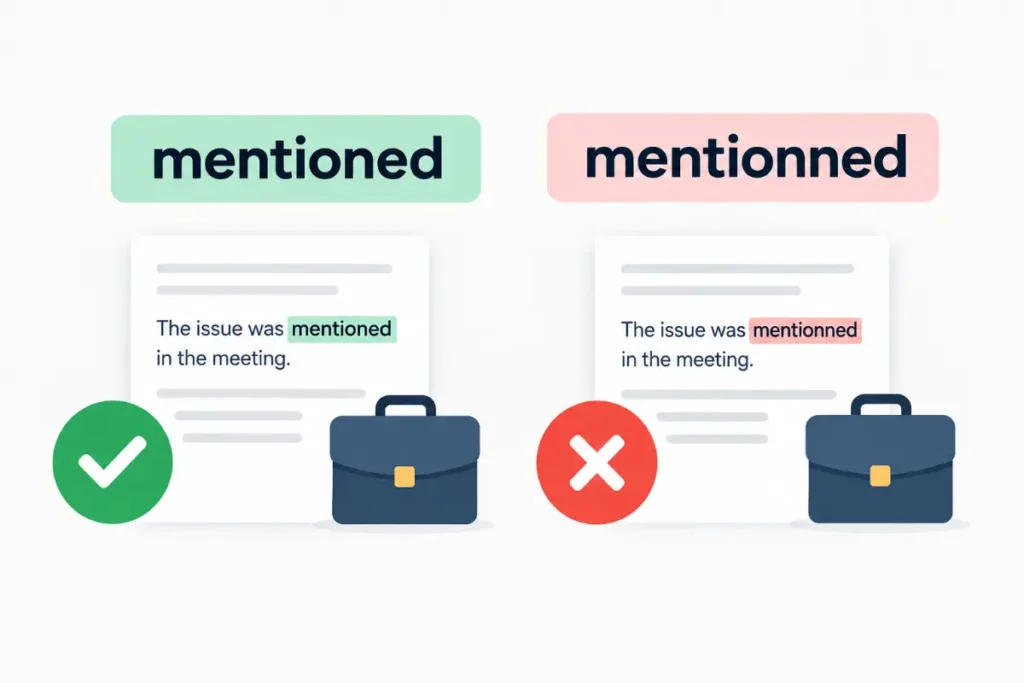
Mentioned In Business Writing
The word is also common in emails and workplace communication.
You might write:
- As mentioned during our meeting, the deadline has changed.
- As you mentioned in your email, the order was delayed.
- The client mentioned that the delivery date needed to change.
- The manager mentioned the issue during the call.
These phrases are useful because they connect the current message with an earlier conversation or document.
The phrase as mentioned is especially common in professional writing. It points back to information that appeared earlier.
When To Use Mentioned Instead Of Mentioning
The choice depends on the time and structure of the sentence.
Use mentioned when the reference happened in the past.
She mentioned the problem yesterday.
Use mentioning when the action is happening now or when the ing form fits the sentence.
- She is mentioning the problem again.
- He apologized for mentioning the issue.
The first example describes a past event. The second describes an action happening now. The third uses mentioning as part of a larger phrase.
When To Use Mentioned Instead Of Mention
Use mention for the base form and mentioned for the past.
- I usually mention this during training.
- I mentioned this during yesterday’s training.
The first sentence describes a regular action. The second describes something that happened before now.
This difference is simple but important. Verb tense tells your reader when the action happened.
Why The Extra N Looks Tempting
The incorrect spelling can look convincing because English has many words that double a consonant when an ending is added.
Consider these examples:
- Stop becomes stopped.
- Plan becomes planned.
- Run becomes running.
- Begin becomes beginning.
Those patterns are real. The problem comes when writers apply them to words that don’t follow the same structure.
Mention is one of those words.
You don’t write mentionned because the final n does not double in this form. The correct spelling simply adds ed to mention.
Knowing this can prevent a lot of guesswork. Instead of asking yourself if the consonant should double look at the base word and the spelling pattern it follows.
A Quick Proofreading Trick
If you often make this mistake use a simple two step check.
First find the base word.
Mention.
Then look at what you added.
Ed.
Put them together.
Mentioned.
This method works because it stops you from changing letters that don’t need to change. It also helps with many other spelling questions where an ending is added to a base word.
When proofreading an important piece of writing you can also search for the incorrect form. If your document contains it you can replace it with the correct spelling.
A quick search is especially useful in long reports and articles where a small spelling error can be easy to miss.
FAQs
Is mentioned or mentionned correct?
The correct spelling is mentioned. The other form adds an extra n and does not follow standard English spelling. Use mentioned in emails essays articles school work and professional writing.
Why is mentioned spelled with one n?
The base word is mention and it already has the correct final n. When you add ed you simply attach the ending without doubling that consonant. The result is mentioned.
What is the past tense of mention?
The past tense of mention is mentioned. For example you can write I mentioned the problem yesterday or She mentioned your name during the meeting.
Is mentionned a word in English?
No. Mentionned is not the standard English spelling of the past tense of mention. If you see it in English text it is normally a spelling mistake.
Is mentioned a verb?
Yes. Mentioned is a form of the verb mention. It is the simple past form and it can also work as a past participle in some sentence structures.
What is the difference between mention and say?
Mention usually means to refer to something or bring it up briefly. Say focuses more directly on the words or information someone expressed. For example I mentioned the meeting means the meeting came up in conversation while I said the meeting was canceled gives the specific information expressed.
What is the difference between mention and discuss?
Mention usually suggests a brief reference. Discuss suggests a longer or more detailed conversation about a subject. You might mention a problem during a meeting and then discuss it for thirty minutes.
How can I remember the spelling of mentioned?
Start with the base word mention and add ed. Don’t add another n. A useful sentence to remember is She mentioned my name.
Conclusion
The spelling question mentioned vs mentionned has a simple answer. Mentioned is correct and mentionned is incorrect. The word mention keeps one n when you add the past tense ending ed.
The easiest way to remember the spelling is to start with the base word. Write mention first and then add ed. You get mentioned without changing the spelling of the base word.
The word itself is useful in many settings. You can mention a person an idea a problem a fact or a source. You can also use mentioned when reporting something that someone brought up earlier.
When you’re proofreading your work look for the extra n. If you see mentionned change it to mentioned. That quick check can help you catch one of the most common spelling mistakes before you send or publish your writing.

Dr. Elena Vance holds a Ph.D. in Linguistics from Columbia University and has spent over 15 years analyzing the evolution of the English language. A former university professor turned full-time writer and editor, Elena specializes in breaking down high-level grammatical concepts, punctuation nuances, and style guides (APA, Chicago, MLA) into clear, actionable advice. When she isn’t hunting down dangling modifiers, she can be found collecting vintage dictionaries and reading classic literature.