
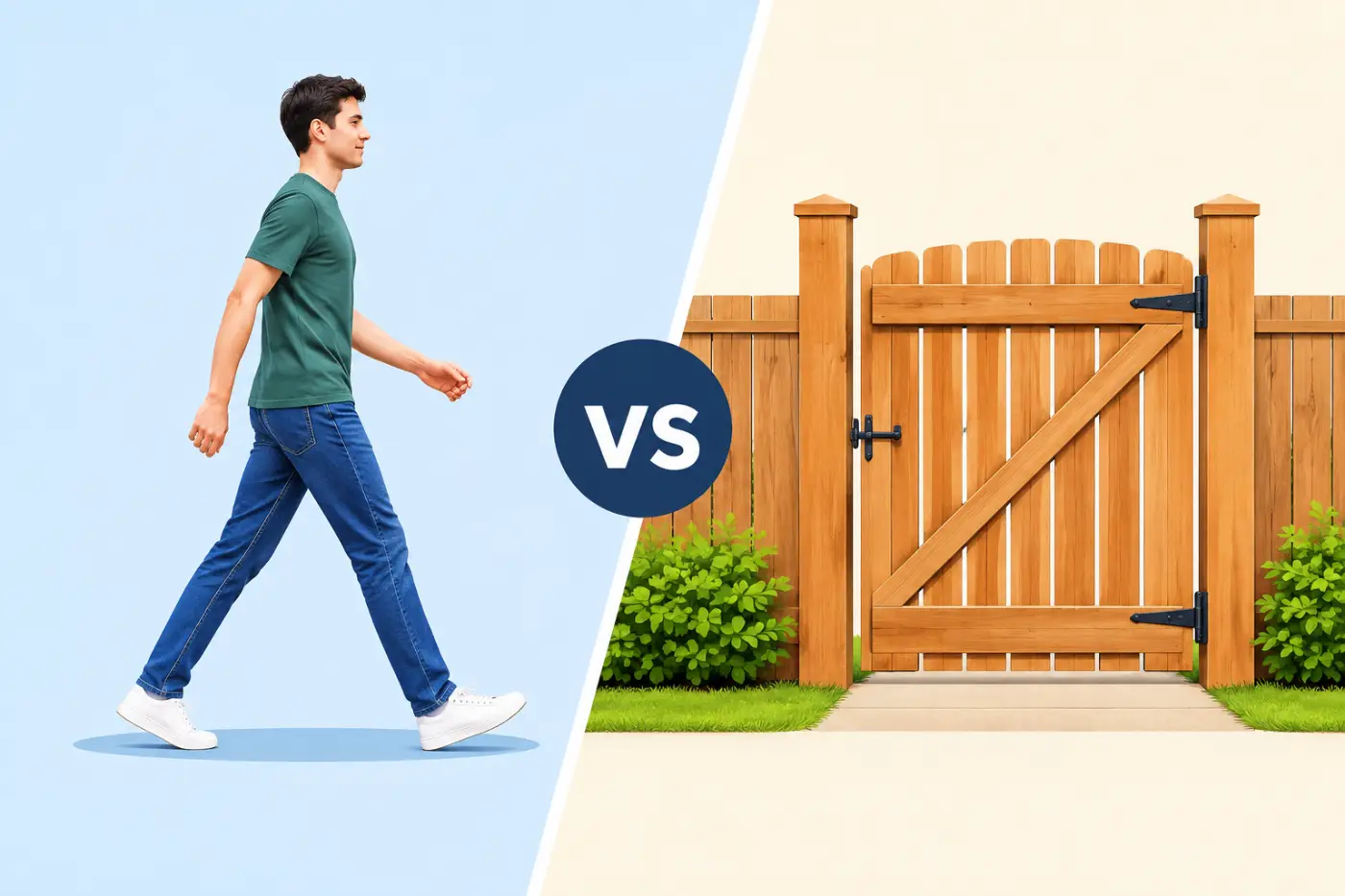
English has many words that sound the same but have completely different meanings. Gait vs gate are two good examples. They sound alike when spoken, but you can’t use one in place of the other.
The difference between gait vs gate comes down to what you’re trying to describe. Gait refers to the way a person or animal walks. Gate refers to a movable barrier that opens and closes to control access to a place.
For example, you might describe a horse’s smooth gait as it walks across a field. However, you might also talk about closing the gate before the horse leaves its stable. Both words sound the same, but they describe two very different things.
This mix-up often happens because English has many homophones. These are words that share the same pronunciation but have different meanings and spellings. Since gait and gate sound identical in everyday speech, people sometimes confuse them when writing.
The good news is that the difference is easy to remember once you understand what each word means. This guide explains their definitions, spelling, pronunciation, grammar, and everyday uses. You’ll also find plenty of examples and simple memory tricks to help you choose the right word.
Quick Definition
Gait is a noun that describes the way a person or animal walks or moves on foot. It can refer to walking speed, rhythm, posture, or movement.
Gate is a noun that describes a movable barrier used to close or control an opening. It often provides access to a yard, garden, building, or other enclosed space.
Direct Answer
Gait describes the way someone walks. Gate refers to a movable barrier that opens and closes to control entry or exit. Both words sound alike, but they have different meanings and spellings.
Gait vs Gate Comparison Table
| Word | Meaning | Example Sentence | When to Use It |
|---|---|---|---|
| Gait | A person’s or animal’s way of walking | The doctor noticed his uneven gait. | When describing walking style or movement. |
| Gate | A movable barrier or entrance | Please close the garden gate. | When talking about an entrance or barrier. |
The easiest way to tell them apart is to think about movement and access. Gait relates to how someone moves while walking. Gate relates to an opening that someone can enter or leave through.

What Does Gait Mean
Gait is a noun that describes the particular way a person or animal walks. It includes the pattern of movement, the length of each step, walking speed, balance, and the rhythm of the feet.
Think about the way different people walk. Some take long and confident steps. Others move slowly with short steps. A person might walk with a limp after an injury. Each walking pattern is an example of a different gait.
The word also applies to animals. Horses have different gaits that describe how they move. Dogs can have a steady gait when walking across a park. Birds may even show a distinctive walking pattern.
In simple terms, gait describes walking style rather than the place someone walks through.
Understanding Gait Through Everyday Examples
Imagine watching two friends walk down the street. One walks quickly with long steps. The other takes smaller steps and moves at a slower pace. You could describe their walking patterns as different gaits.
Here are a few more examples.
- The athlete has a smooth and balanced gait.
- The doctor examined the patient’s gait.
- The horse moved with a steady gait.
- His unusual gait made him easy to recognize.
- The old dog developed a slower gait.
- The child walked with a cheerful gait.
- Her graceful gait caught everyone’s attention.
- The injury changed the way he walked and affected his gait.
Notice that each sentence describes how someone or something walks. None of these examples refers to a physical barrier or entrance.
Gait in Medical and Health Settings
Doctors and other health professionals often use the word gait when examining how someone walks. A person’s walking pattern can provide useful information about balance, muscle strength, joint movement, and coordination.
For example, a doctor might ask a patient to walk across a room. The doctor may watch how the patient places each foot, keeps balance, and moves the body.
An unusual walking pattern can sometimes point to an underlying problem. Pain, muscle weakness, joint injuries, and certain nervous system conditions can affect the way someone walks.
Here are some common medical expressions that use the word.
- Abnormal gait. This describes a walking pattern that differs from the usual pattern. It may involve poor balance, unusual steps, or difficulty moving.
- Unsteady gait. This describes walking that lacks balance or control. A person with an unsteady gait may sway or struggle to walk in a straight line.
- Shuffling gait. This refers to short steps where the feet seem to drag or slide along the ground.
- Antalgic gait. This is a walking pattern that helps a person avoid pain. For example, someone with a sore ankle may put less weight on that foot.
- Limping gait. This describes walking with an uneven pattern. A person may favor one leg because of pain or an injury.
- Wide based gait. This describes walking with the feet farther apart than usual. People may use this position to improve balance.
These terms show how useful the word is in medical discussions. It helps describe movement without needing a long explanation every time.
Gait in Sports and Fitness
The word gait also appears in sports, exercise, and fitness. Coaches and trainers may study an athlete’s walking or running pattern to understand how the body moves.
For example, runners often pay attention to their running gait. They may look at stride length, foot placement, body posture, and rhythm.
A poor running pattern can sometimes increase stress on certain muscles or joints. A trainer may suggest changes to help an athlete move more comfortably.
You might come across these expressions.
- Running gait.
- Walking gait.
- Natural gait.
- Efficient gait.
- Running gait analysis.
- Gait training.
- Gait pattern.
Consider these sentences.
- The coach studied the runner’s gait during practice.
- Proper shoes can help support a comfortable walking gait.
- The trainer noticed a change in her running gait.
- The athlete worked on improving his stride and gait.
- The physical therapist suggested exercises to improve balance and gait.
Although people sometimes use gait when discussing running, the word isn’t limited to walking at a slow pace. It can describe several forms of movement on foot.
Gait in Animals
People also use gait to describe the way animals move. Horses are one of the most common examples.
A horse has several natural movement patterns. Each one has its own speed and rhythm.
The main horse gaits include the walk, trot, canter, and gallop.
Walk. This is a slow four beat movement. The horse moves each foot separately.
Trot. This is a faster two beat movement. The horse moves its legs in diagonal pairs.
Canter. This is a three beat movement. It is faster than a trot but usually slower than a gallop.
Gallop. This is a fast four beat movement that horses often use when running at high speed.
These different movements are all examples of gaits.
For example:
- The horse has a smooth walking gait.
- The trainer taught the horse a faster gait.
- The animal changed its gait as it crossed the field.
- The horse’s natural gait made the ride comfortable.
The word can also describe the movement of dogs, cats, and other animals. A veterinarian may examine a dog’s gait to check for signs of pain or movement problems.
Is Gait Always About Walking
Gait mainly refers to a person’s or animal’s pattern of movement while walking or running on foot. It doesn’t usually describe every kind of movement.
For example, swimming style isn’t normally called a gait. A person’s way of riding a bicycle also isn’t usually described as a gait.
However, the word has a wider meaning in some scientific and technical settings. Researchers may study how an animal or person moves to understand balance, coordination, and physical movement.
For everyday writing, remember this simple rule. Use gait when you describe the way someone walks.
What Does Gate Mean
Gate is a noun that refers to a movable barrier used to close an opening or control access to a place. You can find gates around homes, gardens, farms, schools, parking lots, and public buildings.
A gate often works with a fence or wall. It allows people to enter or leave an enclosed area while keeping the space closed when needed.
For example, a homeowner may install a gate at the entrance to a backyard. A farmer may use gates to keep livestock inside a field. An airport may use gates to direct passengers toward their flights.
The word can also describe an entrance at a larger place. An airport gate is the area where passengers wait to board an aircraft.
Understanding Gate Through Everyday Examples
Think about the entrance to a garden. It may have a wooden or metal barrier that swings open when someone wants to enter. That barrier is called a gate.
Here are some natural examples.
- Please close the gate behind you.
- The children played near the garden gate.
- We installed a new gate at the front of our house.
- The horse waited beside the stable gate.
- The security guard opened the main gate.
- Someone left the farm gate open.
- The delivery driver stopped outside the entrance gate.
- The dog ran through the open gate.
Each sentence refers to an entrance or barrier. That’s the main meaning of gate.
Different Types of Gates
Gates come in many shapes and sizes. Their design depends on the place where people use them and the level of security they need.
Garden gate. A garden gate provides an entrance to a garden or outdoor area. It may be made from wood, metal, or other materials.
Driveway gate. This type of gate controls access to a driveway or private property. Some driveway gates open by hand while others use an automatic system.
Farm gate. Farmers use these gates to control access to fields and livestock areas. They help keep animals in the right place.
Security gate. A security gate helps protect a building or property. It may require a key, access card, or security code.
Airport gate. This is a designated boarding area where passengers wait before getting on an aircraft.
School gate. A school gate controls access to school grounds. It can help keep students and visitors within a secure area.
Garden fence gate. This is a small entrance built into a garden fence. It gives people a way to enter without opening the entire fence.
Examples in sentences:
- The wooden garden gate needs a fresh coat of paint.
- Our driveway gate opens with a remote control.
- The farmer repaired the broken farm gate.
- Visitors must check in before entering through the security gate.
- We arrived at the airport gate before boarding began.
- The school gate closes after the morning bell.
Gate in Transportation
The word gate has several important uses in transportation. Airports are probably the best known example.
At an airport, a gate is a designated area where passengers wait to board their flights. Each gate has a number or letter that helps travelers find the correct boarding area.
For example, your boarding pass may show Gate 12. This means you should go to the area marked with that number.
Here are some common examples.
- Our flight leaves from Gate 18.
- The airline changed our departure gate.
- Passengers should arrive at the boarding gate early.
- The airport gate was crowded with travelers.
- We walked to the wrong gate by mistake.
The word also appears in other transportation settings. Some train stations and bus terminals use gates to control passenger movement.
In these cases, the word still relates to access or entry. It doesn’t describe the way someone walks.
Gate in Technology and Security
Gates aren’t always physical barriers. The word can also describe systems that control access to information, services, or equipment.
For example, a computer system may use an access gateway to control communication between networks. Some electronic systems use gates to allow or block certain actions.
In digital security, a person may need to pass through an access gate before using a service. This could involve entering a password, scanning an access card, or confirming an identity.
Consider these examples.
- The security system controls access through an electronic gate.
- Employees must scan their cards at the entrance gate.
- The software uses an access gateway to protect the network.
- Visitors cannot enter the restricted area without passing the security gate.
The word can have technical meanings in different fields. Still, its central idea remains connected to controlling access or allowing something to pass.
Gait vs Gate and the Main Differences
Now that you understand both words, it’s easier to see how they differ. The biggest difference is their meaning and the situations in which people use them.
Gait describes a walking pattern. Gate describes a physical entrance or barrier. One relates to movement, while the other relates to access.
Let’s look at their differences more closely.
Difference in Meaning
The word gait focuses on how a person or animal moves while walking. It can describe speed, rhythm, balance, and the way someone places their feet.
Gate focuses on a structure that opens and closes. It controls entry and exit from a particular area.
For example:
- The doctor noticed that the patient had an unusual gait.
- The doctor entered the building through the front gate.
The first sentence describes walking movement. The second describes an entrance.
Difference in Spelling
Although both words sound the same, their spelling is different.
Gait contains the letters G, A, I, and T. Gate contains G, A, T, and E.
The difference appears near the end of each word. Gait has the letter combination AI. Gate has the letter combination A and E.
This small spelling change creates two completely different words.
You might find this confusing when writing from memory. However, thinking about the meaning first can help you choose the correct spelling.
Difference in Pronunciation
Both words have the same pronunciation in standard American English.
They sound like the word eight with a G at the beginning.
Their pronunciation follows the same long A sound. This is why listeners usually need the surrounding sentence to understand which word someone means.
For example, consider these two sentences when spoken aloud.
- The horse has a smooth gait.
- The horse stood beside the gate.
The words sound identical. However, the meaning becomes clear from the other words in each sentence.
Difference in Grammar
Both words function mainly as nouns. A noun names a person, place, thing, or idea.
Gait is a countable noun. You can talk about one gait or several different gaits.
Examples:
- The runner has a natural gait.
- The therapist studied three different gaits.
- The horse changed its gait.
Gate is also a countable noun. You can talk about one gate or several gates.
Examples:
- The house has a wooden gate.
- The workers repaired two gates.
- The children waited beside the gates.
Both words can appear with articles such as a, an, and the when the sentence requires them.
For example:
- She has a graceful gait.
- He opened the gate.
- The horse has an unusual gait.
- The old gate needs repairs.
Remember that both words are nouns, but they don’t share the same meaning.
Difference in Context
Context means the words and details around a particular word. It helps readers understand the intended meaning.
Since these two words sound alike, context plays a big role in understanding them.
Look at these examples.
Example 1
The athlete’s gait changed after the injury.
Here, the sentence discusses the athlete’s walking pattern. Gait is the correct choice.
Example 2
The athlete opened the gate before entering the field.
This sentence describes a physical barrier. Gate is the correct choice.
Example 3
The veterinarian examined the dog’s gait.
The sentence refers to the dog’s movement while walking.
Example 4
The dog escaped through the garden gate.
The sentence describes an entrance that the dog used to leave the garden.
The surrounding details make the meaning clear. You don’t need to guess once you understand the context.
Why Do People Confuse Gait and Gate
The main reason for this confusion is pronunciation. Both words sound exactly alike in standard American English.
When people speak, they don’t see the spelling of a word. They hear its sound and understand its meaning from the sentence.
This creates a problem when someone tries to write the word without thinking about its definition.
For example, a person may hear someone say that a horse has a smooth gait. If they don’t know the word, they might write gate instead.
The opposite mistake can happen too. Someone might write gait when talking about a garden entrance.
There are several reasons behind these spelling mistakes.
They Are Homophones
Homophones are words that sound the same but have different meanings and spellings.
Gait and gate belong to this group. They share the same pronunciation, but each word serves a different purpose.
Other common homophone pairs include:
- Their and there.
- To and too.
- Right and write.
- Pair and pear.
- Break and brake.
- Flower and flour.
- Sea and see.
- Hear and here.
These pairs can confuse writers because pronunciation alone doesn’t tell you which spelling to use.
The best way to avoid mistakes is to learn the meaning of each word and pay attention to the sentence.
English Has Many Similar Sound Patterns
English spelling doesn’t always match pronunciation in a simple way. Some words have the same sounds but different letter combinations.
For example, the words rain, reign, and rein sound alike. However, they have different meanings.
Rain refers to water falling from clouds. Reign describes a period during which a king or queen rules. Rein refers to a strap used to control a horse.
Gait and gate follow the same pattern. Their spelling changes, but their pronunciation stays the same.
This is one reason English spelling can feel tricky. You can’t always rely on sound alone.
People May Not Know the Word Gait
Gate is a familiar word. Most people use it when talking about homes, gardens, schools, airports, and other places.
Gait is less common in everyday conversation. People may know its meaning without using it often.
Some people first encounter gait in a medical report, a sports article, or a discussion about horses.
Since gate is more familiar, they may automatically choose that spelling when they hear the word.
Learning the definition of gait can prevent this mistake. Once you connect it with walking and movement, the spelling becomes easier to remember.
Fast Speech Makes the Confusion Worse
People often speak quickly. They may also pronounce words differently because of their regional accent or speaking style.
Even though gait and gate have the same standard American pronunciation, fast speech can make it harder to understand a sentence.
For example, someone might say:
The horse has a strange gait.
A listener who doesn’t know the word may hear it as gate.
However, the sentence gives you a clue. A horse can have a strange walking pattern. It doesn’t normally have a strange entrance.
Understanding the meaning of the whole sentence helps you identify the correct word.
How to Remember the Difference Between Gait and Gate
You don’t need to memorize complicated spelling rules to tell these words apart. A simple memory trick can help you choose the right one.
The key is to connect each word with something familiar.
Remember Gait With Walk
Think of the word gait whenever you talk about walking.
You can connect the letters AI in gait with the idea of an athlete in motion. Picture a runner moving along a track. The runner’s gait describes the way they move.
Another easy trick is to remember the phrase walking gait. You may have heard this phrase in medical or fitness discussions.
Whenever your sentence describes steps, walking rhythm, balance, or movement, gait is probably the word you need.
Examples:
- His gait became slower as he grew older.
- The doctor watched her gait carefully.
- The horse has a natural gait.
Remember Gate With Entrance
Think of a gate as a barrier that controls entry and exit.
You can picture the gate outside your home. It opens when someone wants to enter and closes when they leave.
The word gate also appears in familiar phrases such as garden gate, airport gate, and front gate.
Whenever your sentence describes an entrance, barrier, or access point, use gate.
Examples:
- The children left the gate open.
- We waited near the airport gate.
- The farmer locked the gate.
Use a Simple Question
Before choosing either spelling, ask yourself one question.
Am I describing how someone walks or a place someone enters?
If you’re describing walking movement, choose gait.
If you’re describing a barrier or entrance, choose gate.
This small check can prevent most spelling mistakes.
Picture the Meaning in Your Mind
Visual memory can make confusing words easier to learn.
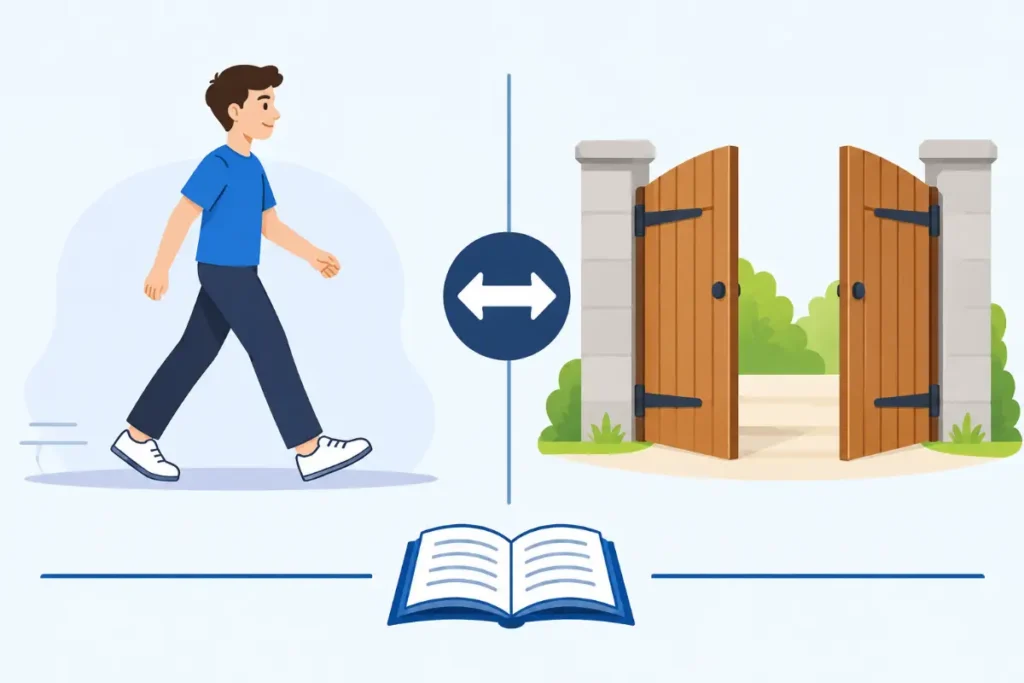
When you see gait, picture a person walking across a room. Notice their steps and body movement.
When you see gate, picture a wooden entrance opening into a garden.
These two mental pictures are very different. Connecting each word with an image makes it easier to remember the correct spelling.
Learn the Words in Pairs
Another useful trick is to study both words together instead of learning them separately.
For example:
- Walking pattern means gait.
- Garden entrance means gate.
- Horse movement means gait.
- Airport entrance means gate.
This method helps you compare the words and remember their different uses.
You can also write your own sentences using both words. The more you practice, the easier it becomes to choose the right spelling.
Common Mistakes to Avoid
Even though these words have simple definitions, writers sometimes use them incorrectly. Most mistakes happen when someone focuses on pronunciation instead of meaning.
Here are some common errors and their corrections.
Using Gate When You Mean Walking Pattern
Incorrect: The doctor examined the patient’s gate.
Correct: The doctor examined the patient’s gait.
The doctor is checking how the patient walks. Therefore, gait is the correct spelling.
Using Gait When You Mean an Entrance
Incorrect: Please close the garden gait.
Correct: Please close the garden gate.
The sentence refers to a movable barrier. It has nothing to do with walking.
Confusing Horse Gait With a Stable Gate
Incorrect: The horse walked through the stable gait.
Correct: The horse walked through the stable gate.
A stable gate is an entrance or barrier. However, you could say that the horse has a smooth gait when describing its walking pattern.
Using the Wrong Word in Medical Writing
Incorrect: The patient developed an unusual gate after surgery.
Correct: The patient developed an unusual gait after surgery.
Medical writing often uses gait to describe walking ability and movement. Using gate in this situation changes the meaning completely.
Using the Wrong Word in Travel Writing
Incorrect: Our plane leaves from Gait 14.
Correct: Our plane leaves from Gate 14.
Airports use gates to identify boarding areas. The correct spelling is gate.
Assuming the More Familiar Word Is Always Correct
Gate is a common word, so some writers may choose it automatically.
However, familiar spelling doesn’t always fit the sentence. If you’re discussing a person’s walking pattern, gate is incorrect even if it sounds right.
Always check the meaning before choosing the spelling.
Examples of Gait and Gate in Sentences
The best way to understand confusing words is to see how people use them in everyday situations. The following examples show how gait and gate work in different types of sentences.
Gait Examples in Everyday English
Use gait when describing the way a person or animal walks.
- The older people man has a slow but steady gait.
- Her graceful gait made her stand out in the crowd.
- The doctor noticed a change in his walking gait.
- The injured player struggled to maintain a normal gait.
- The horse moved with a smooth and comfortable gait.
- His unusual gait made it easy to recognize him from a distance.
- Regular exercise can help improve your walking ability and gait.
- The physical therapist examined the patient’s gait.
- The dog developed an uneven gait after hurting its leg.
- The athlete worked with a coach to improve his running gait.
- Her confident gait showed that she felt comfortable in the new environment.
- The horse changed its gait as it approached the finish line.
- The child’s gait became more stable as she learned to walk.
- The doctor asked him to walk across the room to observe his gait.
- The older dog had a slower gait than it did as a puppy.
Each example describes a walking pattern or style of movement. That’s why gait is the correct word.
Gate Examples in Everyday English
Use gate when talking about a physical barrier or entrance.
- Please shut the gate before leaving the yard.
- The children ran through the open gate.
- We painted the old wooden gate white.
- The dog waited patiently beside the garden gate.
- The farmer locked the gate after feeding the animals.
- Our flight departs from Gate 22.
- The security guard stood near the main gate.
- Someone left the driveway gate open overnight.
- The delivery driver waited outside the entrance gate.
- The school gate closes at the end of the day.
- A new metal gate protects the property.
- The horse pushed its head through the stable gate.
- Visitors must enter through the front gate.
- We installed an automatic gate at the entrance.
- The children decorated the garden gate with colorful flowers.
Each sentence refers to a physical entrance or barrier. Therefore, gate is the correct choice.
Examples Using Both Words in One Sentence
You can also use both words in the same sentence. This is a useful way to understand their different meanings.
- The horse had a smooth gait as it walked through the open gate.
- The doctor watched the man’s gait as he entered through the hospital gate.
- The dog changed its gait after running through the garden gate.
- The farmer opened the gate while watching the horse’s unusual gait.
- The athlete walked with a steady gait toward the stadium gate.
- The veterinarian examined the dog’s gait before closing the clinic gate.
- The horse approached the wooden gate with a slow and steady gait.
- Her graceful gait caught everyone’s attention as she walked through the main gate.
- The child ran toward the garden gate with an excited gait.
- The trainer studied the horse’s gait before opening the stable gate.
These examples show that both words can appear naturally in the same context. You just need to use each one according to its meaning.
Related Words and Homophones You Should Know
Learning similar words can improve your spelling and writing skills. English has many word pairs that sound alike but have different meanings.
Here are some useful examples.
Gate and Gait Related Words
The following words often appear in sentences about walking, movement, and entrances.
Stride. A stride is one long step or the way someone walks with long steps.
Example: The runner increased his stride as he approached the finish line.
Pace. Pace refers to the speed at which someone walks, runs, or performs an activity.
Example: She maintained a steady pace during her morning walk.
Stroll. A stroll is a slow and relaxed walk.
Example: We took a stroll through the park after dinner.
Limp. A limp is an uneven way of walking that often happens because of pain or injury.
Example: He developed a limp after twisting his ankle.
Entrance. An entrance is a place or opening through which someone enters.
Example: The main entrance is beside the parking lot.
Barrier. A barrier is something that blocks movement or separates areas.
Example: The workers installed a safety barrier near the road.
Fence. A fence is a structure that surrounds or separates an area.
Example: We built a fence around the backyard.
These words aren’t direct replacements for gait or gate. However, they can help you understand their meanings and use them in the right context.
Other Common Homophones
Here are some additional homophone pairs worth learning.
| Word Pair | Meaning | Example |
|---|---|---|
| Brake and Break | A brake slows a vehicle. A break is a pause or separation. | Press the brake before taking a break. |
| Flower and Flour | A flower is a plant. Flour is used in cooking. | She bought flour and picked a flower. |
| Right and Write | Right means correct. Write means to form words. | Write the right answer. |
| Sea and See | Sea refers to a large body of salt water. See means to look at something. | We could see the sea. |
| Pair and Pear | A pair means two matching things. A pear is a fruit. | She ate a pear and bought a pair of shoes. |
| Here and Hear | Here refers to a place. Hear means to notice sound. | Come here so you can hear me. |
| Their and There | Their shows ownership. There refers to a place. | Their bags are over there. |
| Meet and Meat | Meet means to come together. Meat refers to animal flesh used as food. | We will meet after buying meat. |
| Mail and Male | Mail refers to letters and packages. Male describes a sex category. | The male worker delivered the mail. |
| Plain and Plane | Plain means simple. Plane refers to an aircraft or a flat surface. | The plane flew over the plain. |
These examples show why spelling based only on sound can lead to mistakes. Understanding the meaning is always the safer approach.
How to Choose the Correct Word While Writing
If you often confuse words that sound alike, a few simple writing habits can help.
Read the Entire Sentence
Don’t choose a spelling based on how a word sounds. Read the complete sentence and identify the meaning you want to express.
For example:
The horse has a beautiful ___.
You need to describe the horse’s walking pattern. Therefore, the correct word is gait.
Now consider this sentence:
The horse escaped through the open ___.
Here, you’re talking about an entrance. The correct word is gate.
The surrounding words provide enough information to make the right choice.
Think About the Subject
The subject of your sentence can also help you choose the correct word.
If you’re writing about a doctor examining someone’s walking pattern, you probably need gait.
If you’re writing about a homeowner repairing a garden entrance, you probably need gate.
Of course, the subject alone doesn’t always decide the answer. A sentence about a horse can use both words. Always consider the full meaning.
Use a Dictionary When Necessary
If you’re unsure about a spelling, check a trusted dictionary.
The Merriam Webster Dictionary and the Cambridge Dictionary provide definitions, pronunciation guides, and example sentences.
These resources can help you understand unfamiliar words and see how people use them.
You can also use a spell checker. However, remember that spell checkers may not catch every homophone mistake.
For example, a spell checker may accept both gait and gate because both are correctly spelled words. It may not recognize that you’ve used the wrong one in your sentence.
That’s why checking the meaning matters just as much as checking spelling.
Practice With Your Own Sentences
Writing your own examples is one of the easiest ways to remember confusing words.
Try creating two sentences for each word.
For gait, write about a person walking, a runner moving, or a horse crossing a field.
For gate, write about a garden entrance, an airport boarding area, or a farm barrier.
After writing each sentence, check that the word matches the meaning.
A little practice can make these spelling choices feel natural.
FAQs
What Is the Difference Between Gait and Gate?
Gait describes the way a person or animal walks. Gate refers to a movable barrier that controls access to an area. Both words have the same pronunciation but different meanings and spellings.
Are Gait and Gate Homophones?
Yes. Gait and gate are homophones because they sound exactly alike but have different meanings and spellings. You need to use context to understand which word someone means.
How Do You Pronounce Gait and Gate?
Both words are pronounced the same way in standard American English. They rhyme with eight and have a long A sound. Their pronunciation doesn’t change based on their different meanings.
Is Gait a Noun or a Verb?
Gait is a noun. It describes a person’s or animal’s walking pattern. For example, you can say that a runner has a smooth gait or that a doctor examined a patient’s gait.
Can You Use Gait for Animals?
Yes. Gait can describe how different animals walk or move on foot. It commonly appears in discussions about horses, dogs, and other animals. Veterinarians may examine an animal’s gait to look for movement problems.
What Does Gate Mean at an Airport?
An airport gate is a designated boarding area where passengers wait before getting on an aircraft. Each gate usually has a number or letter to help travelers find the correct location. For example, your boarding pass may show Gate 15.
What Is the Plural of Gait and Gate?
The plural of gait is gaits. The plural of gate is gates. For example, a horse can have several different gaits, while a property can have several gates.
Can Gait and Gate Be Used in the Same Sentence?
Yes. Both words can appear in the same sentence when you need to describe walking and an entrance. For example, the horse had a smooth gait as it walked through the garden gate.
Conclusion
The difference between gait vs gate is simple once you understand their meanings. Gait describes how a person or animal walks. Gate refers to a movable barrier or entrance that controls access to a place.
Remember to use gait when discussing walking patterns, movement, balance, or running style. Choose gate when talking about garden entrances, airport boarding areas, farm barriers, or security entrances.
Both words sound the same in American English. However, their meanings are completely different. Don’t rely on pronunciation alone when writing. Think about the message you want to convey and choose the spelling that fits.
A simple trick can help you remember them. Gait means walking style. Gate means an entrance. Keep that difference in mind, and you’ll have no trouble using these words correctly.

Dr. Elena Vance holds a Ph.D. in Linguistics from Columbia University and has spent over 15 years analyzing the evolution of the English language. A former university professor turned full-time writer and editor, Elena specializes in breaking down high-level grammatical concepts, punctuation nuances, and style guides (APA, Chicago, MLA) into clear, actionable advice. When she isn’t hunting down dangling modifiers, she can be found collecting vintage dictionaries and reading classic literature.