
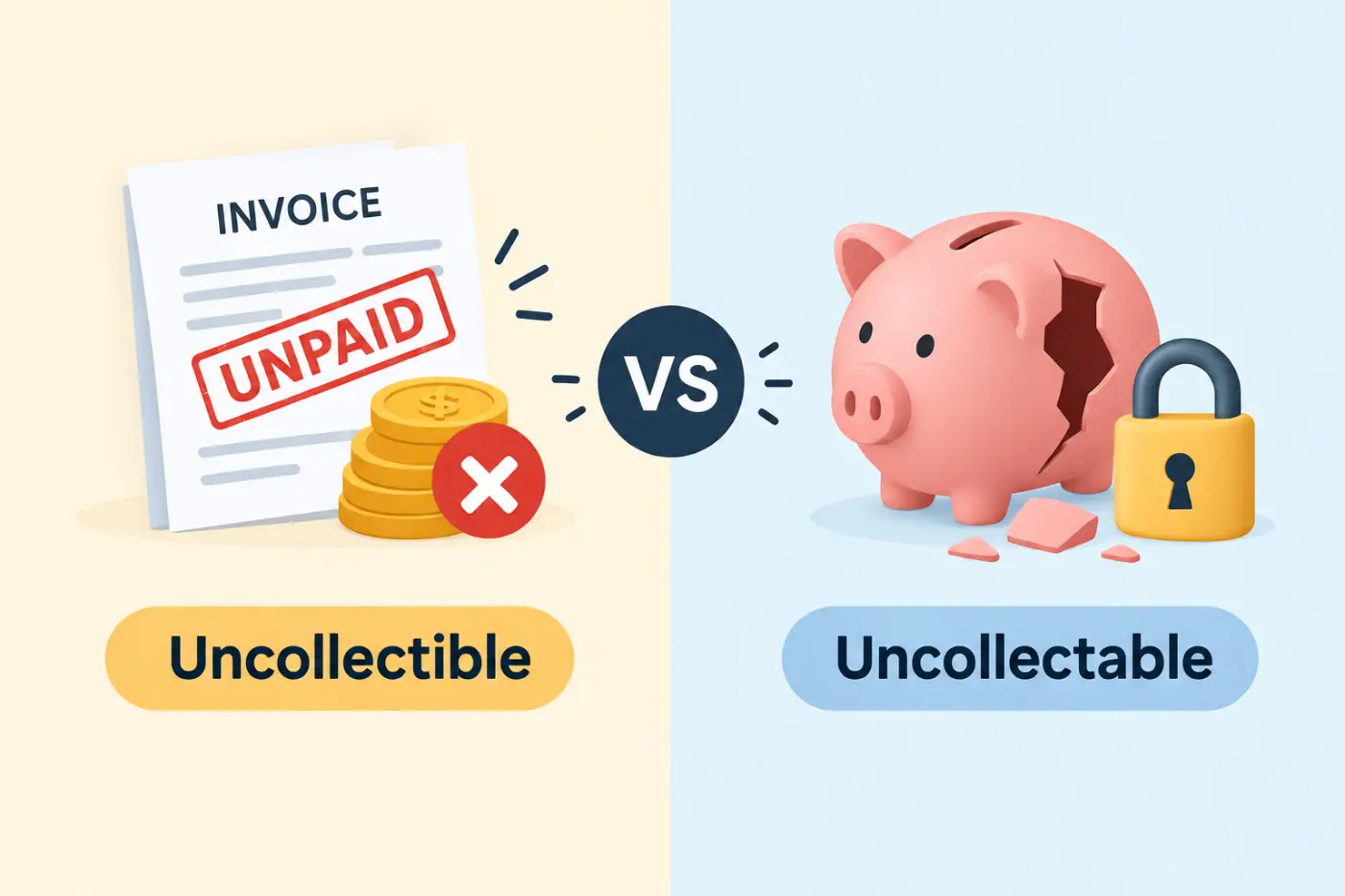
If you’ve ever wondered about uncollectible vs uncollectable you’re dealing with two real English words that have almost the same meaning. The difference isn’t as simple as right versus wrong. Both forms can describe something that can’t be collected. However one form is much more common in American English especially in accounting and business writing.
The usual US choice is uncollectible. You will often see it used for debts invoices or accounts that a person or company doesn’t expect to collect. Uncollectable also appears in English and has the same basic meaning. It just isn’t the preferred form in many American business contexts.
That small spelling difference can cause plenty of doubt. You may see one form in a financial report and another in a dictionary. You might also wonder if one refers to money while the other refers to physical things. This guide clears up those questions and shows you how to use each form naturally.
You’ll learn the meaning of both words the reason they look different the spelling pattern behind them and the situations where each one makes sense. You’ll also see plenty of examples so you can choose the right word without stopping to second guess yourself.
Quick Definition
Uncollectible and uncollectable both describe something that cannot be collected. The words often refer to money that a person or business is unlikely to recover. In US English uncollectible is the more common choice especially in accounting.
Direct Answer
Both uncollectible and uncollectable are valid words. In American English uncollectible is usually the better choice for debts and money that cannot realistically be recovered.
Comparison Table
| Word or phrase | Meaning | Example sentence | When to use it |
|---|---|---|---|
| Uncollectible | Not able to be collected or recovered. | The company wrote off the uncollectible debt. | Common in US English especially in accounting. |
| Uncollectable | Not able to be collected or recovered. | The old debt was considered uncollectable. | Correct but less common in US usage. |
Why The Two Words Cause Confusion
The confusion starts with the endings ible and able. English has many words that use both endings. Sometimes only one form is standard. Other times both forms exist and carry nearly the same meaning.
Consider words such as breakable and flexible. Both describe something that can or cannot have an action performed on it. Yet English doesn’t let us freely switch able and ible whenever we want.
That makes this pair tricky. If you already know the word collect it seems natural to add able and create collectable. From there it feels logical to add un and get uncollectable.
That form is indeed a real word.
At the same time English also has collectible. Add un and you get uncollectible. This form is also correct.
The real question isn’t simply which spelling follows a rule. It is which form fits your audience and context best.
For readers in the United States the answer is usually straightforward. Use uncollectible for financial writing. It is the standard form you’ll encounter in accounting terms such as uncollectible accounts and uncollectible debt.
Uncollectible vs Uncollectable In American English
In American English both forms can be understood and both are found in published writing. Still uncollectible has a strong advantage in financial contexts.
Accountants often talk about uncollectible accounts. These are amounts a business expects it won’t collect from customers. The business may have already sent invoices and followed up with customers but still believes the money won’t come in.
For example a company may sell $10000 worth of goods on credit. Later it discovers that a customer has closed the business and cannot pay a $2000 invoice. The company may classify that amount as an uncollectible account.
You will also see the phrase uncollectible debt. This refers to money that a creditor doesn’t expect to recover.
For example:
- The bank determined that the loan was uncollectible.
- That sentence sounds natural in American business writing.
You could replace the final word with uncollectable and the basic meaning would remain clear. The sentence would not suddenly become meaningless. However many US readers will find uncollectible more familiar in this context.
What Does Uncollectible Mean
Uncollectible is an adjective. It describes something that cannot be collected or recovered.
The word often appears in financial situations. A business may have money owed by customers. If the business has little or no realistic chance of getting that money the debt may be described as uncollectible.
For example:
- The company identified several uncollectible accounts.
- The accountant reviewed the company’s uncollectible debt.
- The business increased its allowance for uncollectible accounts.
The word can also apply outside accounting. Anything that cannot realistically be collected can potentially be called uncollectible. Still financial writing is where the word appears most often.
The key idea is not simply that something hasn’t been collected yet. The word suggests that collecting it is unlikely or impossible.
That distinction matters.
If a customer hasn’t paid an invoice that is due tomorrow you probably wouldn’t call the debt uncollectible. The customer may still pay. If the customer has disappeared and has no assets then the debt may eventually become uncollectible.
What Does Uncollectable Mean
Uncollectable is also an adjective. It means that something cannot be collected.
The meaning is nearly identical to uncollectible. The main difference comes down to usage and preference rather than a major difference in definition.
- You might see sentences such as:
- The agency marked the account as uncollectable.
- Several old debts were considered uncollectable.
- The collector removed the uncollectable accounts from the active list.
- These sentences are understandable and grammatically sound.
In American English though uncollectible tends to be the more familiar choice in accounting and finance. That makes it a safer option when you’re writing a report for a US audience.
The Difference Between Collectible And Collectable
To understand this pair you need to look at the words underneath them.
Collectible and collectable are both established English words. They can describe something that can be collected. However collectible has another very common meaning.
A collectible is an item that people collect because it has value or interest.
For example:
- She bought a rare baseball collectible.
- The store sells vintage collectibles.
That meaning is different from simply saying that something can be collected.
The word collectable can also mean capable of being collected. It is especially useful when you’re talking about something that can be gathered or recovered.
For example:
The museum displayed every collectable item from the series.
Both forms have a place in English. The difference becomes clearer when you consider context.
Collectible As A Noun
When collectible is used as a noun it usually refers to an item that people collect.
A signed card can be a collectible. So can an old toy a rare coin or a limited edition figure.
For example:
That comic book is now a valuable collectible.
Here collectible has nothing to do with unpaid debt.
Collectible As An Adjective
The same word can work as an adjective.
For example:
- The store sells collectible cards.
- The adjective tells us that the cards are items people may want to collect.
- This extra meaning makes collectible especially common in American English.
How The Prefix Un Changes The Meaning
The prefix un often creates a negative meaning. In this case it changes the idea of something being collectible into something that cannot be collected.
So you can think of the relationship like this:
- Collectible means able to be collected.
- Uncollectible means not able to be collected.
- The same basic idea applies to collectable and uncollectable.
- Collectable means able to be collected.
- Uncollectable means not able to be collected.
This makes the two pairs easy to connect.
The tricky part is choosing between collectible and collectable in the first place. Once you know the preferred form for your context the negative form becomes easier too.
When To Use Uncollectible
Use uncollectible when you want the most familiar US form especially in financial and accounting writing.
This word works well with terms such as:
- Uncollectible accounts.
- Uncollectible debt.
- Uncollectible receivables.
- Uncollectible balance.
- Uncollectible loan.
- Uncollectible amount.
These phrases are common because businesses regularly need to track money that customers owe but may never pay.
For example:
- The company reviewed its uncollectible accounts at the end of the quarter.
- The accountant estimated that $50000 in receivables could become uncollectible.
- The bank removed several uncollectible loans from its active portfolio.
- The word also works in general writing.
For example:
The donation box contained several uncollectible items.
Still the financial meaning is much more common. If you’re writing for a US business audience that is probably the form you want.
When To Use Uncollectable
You can use uncollectable when you want to describe something that cannot be collected. The word is correct and readers will understand it.
For example:
The old debt was considered uncollectable.
The records contained several uncollectable balances.
The museum removed uncollectable items from the storage list.
Even so the word may feel less familiar to many American readers than uncollectible. If you’re writing an accounting report a business article or financial document for a US audience the more familiar form will usually sound better.
This is one of those cases where two words can coexist without having a sharp difference in meaning. Language often works this way. One form becomes more popular in a certain field while another remains acceptable.
Why Accountants Prefer Uncollectible
Accounting has its own set of familiar terms. People working in the field see the same phrases repeatedly. Over time those phrases become standard parts of professional writing.
Uncollectible accounts is one of those familiar terms.
A business sells products or services and may allow customers to pay later. Those unpaid amounts appear as accounts receivable. Most customers may pay as expected. Some may pay late. A small number may never pay.
When a company believes it won’t recover a receivable it can classify that amount as uncollectible.
This matters because businesses need accurate financial records. If a company lists every unpaid invoice as money it will definitely receive the numbers can give a false picture of its financial position.
For example a company might have $100000 in accounts receivable. If $10000 of that amount probably won’t be collected the company needs to account for that risk.
That is why the term appears so often in accounting discussions.
You’ll see related phrases such as allowance for uncollectible accounts and bad debt expense. These terms help businesses estimate and record money they don’t expect to recover.
Uncollectible Accounts Explained Simply
An uncollectible account is money a customer owes a business but probably won’t pay.
Imagine that a small business sells $5000 worth of equipment to a customer. The customer agrees to pay within 30 days. The invoice becomes overdue but the customer stops responding.
The business may contact the customer several times. It might send notices or hire a collection agency. If those efforts fail and the customer has no realistic way to pay the bill the company may decide that the account is uncollectible.
The business isn’t saying that the invoice never existed. The debt is real. The problem is that the business doesn’t expect to recover the money.
That distinction helps explain why uncollectible is stronger than simply saying unpaid.
- An unpaid bill may still be collected.
- An uncollectible bill probably won’t be.
Unpaid Does Not Always Mean Uncollectible
This is an important distinction in everyday and financial writing.
Suppose your internet bill is due on Friday. You haven’t paid it yet. The bill is unpaid but nobody would normally call it uncollectible.
You may pay it later that day.
Now imagine a customer owes a company $3000. The customer has gone out of business and has no remaining assets. The company has tried several reasonable ways to recover the money but has failed.
That debt may be uncollectible.
So the two words describe different stages or conditions.
- Unpaid tells us that money has not been paid.
- Uncollectible tells us that the money is not expected to be recovered.
Using the stronger word too early can make your writing inaccurate.
Examples Of Uncollectible In Real Sentences
Natural examples make the meaning much easier to understand.
Business Writing
The company reviewed its uncollectible accounts before preparing the annual report.
The accounting team recorded an expense for several uncollectible debts.
The customer balance became uncollectible after the business closed.
Banking
The bank identified several loans that were likely to become uncollectible.
The lender took steps to recover the uncollectible balance.
Some older loans were classified as uncollectible after repeated collection attempts.
Everyday Writing
The landlord had trouble recovering several uncollectible debts from former tenants.
The charity discovered that some promised donations were uncollectible.
These examples show how the word focuses on the likelihood of recovery rather than simply the fact that something hasn’t been collected.
Examples Of Uncollectable In Real Sentences
The less common form can also appear naturally.
Financial Examples
The company listed several old balances as uncollectable.
The accountant reviewed the uncollectable debts before closing the books.
The agency removed the uncollectable accounts from its active records.
General Examples
The collector found several items that were uncollectable.
The organization decided that some outstanding amounts were uncollectable.
These sentences aren’t wrong simply because they use uncollectable. Still a US reader working in accounting may expect uncollectible instead.
A Simple Memory Trick
If you mainly write for an American audience there is an easy choice to remember.
Think of accounting.
When you see phrases such as accounts receivable bad debt or money owed by customers think uncollectible.
The ending ible appears in the form that is especially common in American financial writing.
You don’t need to memorize a complicated spelling rule. Just connect the word with the phrases you’re most likely to use.
For example:
Uncollectible accounts.
Uncollectible debt.
Once those phrases become familiar the spelling usually sticks.
Common Mistakes To Avoid
One mistake is assuming that one spelling must be completely wrong. That’s not the case here. Both forms exist and both can express the idea of something that cannot be collected.
Another mistake is treating uncollectible as a synonym for unpaid in every situation. The words have different meanings. A debt can remain unpaid while still having a good chance of being collected.
Some writers also switch between the forms within the same document without a reason. That can make the writing look inconsistent. If you’re writing a US accounting document choose the form that your audience will recognize most easily and use it consistently.
Another common error is forgetting that collectible can be a noun. If you’re talking about an item that people collect for interest or value then collectible is often the natural word.
For example:
The antique clock is a valuable collectible.
That sentence has nothing to do with debt collection.
How To Choose The Right Word
When you need to pick a form quickly ask yourself what you’re writing about.
If you’re discussing money a customer owes a company then uncollectible is usually the safest US choice.
If you’re editing someone else’s writing don’t automatically change uncollectable simply because you prefer the other form. First consider the audience the publication style and the context.
Good editing isn’t about changing every variation into your personal favorite. It is about choosing language that fits the reader and purpose.
Is There A Meaning Difference
For most practical uses there isn’t a major meaning difference between the two forms.
Both describe something that cannot be collected.
The difference is mainly about usage frequency style and context. Uncollectible is especially common in American financial language. Uncollectable is also valid but appears less often in many US contexts.
That means you shouldn’t create an artificial distinction between the words.
For example you don’t need to claim that one describes money while the other describes physical objects. English usage doesn’t support such a strict rule.
Both forms can describe things that cannot be collected. Context tells the reader what kind of collection you mean.
What About British English
English changes slightly across regions. A word that feels standard in the United States may appear less often in another variety of English.
Both uncollectible and uncollectable can be found in English outside the United States. Usage can vary by publication field and region.
Since this article focuses on US English the practical recommendation is simple. Choose uncollectible for American accounting and business writing unless a house style or source specifically calls for another form.
This keeps your writing familiar to the readers you’re trying to reach.
Related Financial Terms
Understanding a few related terms can make the word much easier to use.
Accounts Receivable
Accounts receivable refers to money customers owe a business for goods or services they already received.
For example a company may send an invoice for $2000 with payment due in 30 days. Until the customer pays that invoice the $2000 is part of accounts receivable.
Some receivables may eventually become uncollectible.
Bad Debt
Bad debt is money a business has little or no realistic chance of collecting.
For example a customer may close a business and leave a large unpaid invoice. If the company cannot recover the amount it may treat it as bad debt.
Bad debt and uncollectible debt often appear together in accounting discussions.
Allowance For Uncollectible Accounts
An allowance for uncollectible accounts is an estimate of money a business expects it won’t collect.
Companies don’t always know exactly which customers will fail to pay. Instead they use past payment patterns and other information to estimate potential losses.
The estimate helps create more realistic financial statements.
Write Off
To write off a debt means to remove it from the company’s active accounts as an amount it no longer expects to collect.
For example:
The company wrote off the uncollectible balance.
A write off doesn’t necessarily mean nobody tried to collect the money. It means the company has decided that keeping the amount as a likely asset no longer makes sense.
Why Context Matters More Than The Spelling
When two words have almost the same meaning it’s tempting to search for a strict rule that separates them. Sometimes no such rule exists.
English contains many pairs that differ mainly because of regional preference or historical usage. That doesn’t make the language broken. It simply means that good word choice depends on context.
With this pair the context is especially useful.
- If you’re writing a US accounting article then uncollectible is the natural choice.
- If you’re reading uncollectable in a published document don’t assume you’ve found a spelling error. The word is established and readers can understand it.
If you’re writing for a specific organization check its style guide. Professional publications sometimes choose one spelling and ask writers to use it consistently.
A Quick Editing Guide
- If you’re editing a sentence that contains one of these words use this simple process.
- First check the meaning. Does the word describe something that cannot realistically be collected.
- Next check the audience. If you’re writing for Americans especially in a financial setting uncollectible is usually the strongest choice.
- Then check consistency. If the document uses one form throughout there may be no reason to change it.
- Finally check the surrounding terms. Phrases such as uncollectible accounts and uncollectible debt are familiar in US accounting.
- This approach takes only a few seconds and helps you avoid unnecessary edits.
Common Questions
Is uncollectible or uncollectable correct?
Both forms are correct. They describe something that cannot be collected. In American English uncollectible is generally more common in accounting and business writing.
Is uncollectable an American spelling?
Yes. American readers can use and understand uncollectable. However uncollectible is more common in many US financial contexts.
What is the difference between uncollectible and uncollectable?
The basic meaning is the same. Both words describe something that cannot be collected. The main difference is usage and preference rather than meaning.
Is uncollectible the preferred accounting term?
Yes. Uncollectible is the more familiar form in American accounting. You’ll often see it in phrases such as uncollectible accounts and uncollectible debt.
Can I use uncollectable in a business report?
Yes. The word is valid and readers will understand it. Still uncollectible will usually sound more natural in a US accounting or finance report.
Does uncollectible mean unpaid?
Not exactly. Unpaid only means that someone hasn’t paid an amount yet. Uncollectible suggests that the money is unlikely or impossible to recover.
Is collectible related to uncollectible?
Yes. Uncollectible is formed from collectible with the prefix un. Collectible can describe something that can be collected or an item that people collect because it has value or interest.
Which spelling should I use in American English?
Use uncollectible when you want the most familiar choice for a US audience. This is especially true for accounting finance banking and business writing.
Conclusion
If you’re deciding between uncollectible vs uncollectable both forms are valid. They share the same basic meaning and both can describe something that cannot be collected. The bigger difference comes from usage and audience.
For American English uncollectible is usually the better choice. It is especially common when you’re talking about unpaid money accounts receivable bad debt and other financial matters. That’s why phrases such as uncollectible accounts and uncollectible debt sound natural to US readers.
You don’t need to treat uncollectable as a mistake. It is a legitimate word. If you see it in a document it doesn’t automatically need correction. Look at the audience and the publication style before changing it.
For everyday US business writing the practical choice is simple. If a customer owes money and you don’t expect to recover it call the debt uncollectible. Keep that form in mind and you’ll have an easy answer the next time this spelling question comes up.

Dr. Elena Vance holds a Ph.D. in Linguistics from Columbia University and has spent over 15 years analyzing the evolution of the English language. A former university professor turned full-time writer and editor, Elena specializes in breaking down high-level grammatical concepts, punctuation nuances, and style guides (APA, Chicago, MLA) into clear, actionable advice. When she isn’t hunting down dangling modifiers, she can be found collecting vintage dictionaries and reading classic literature.