
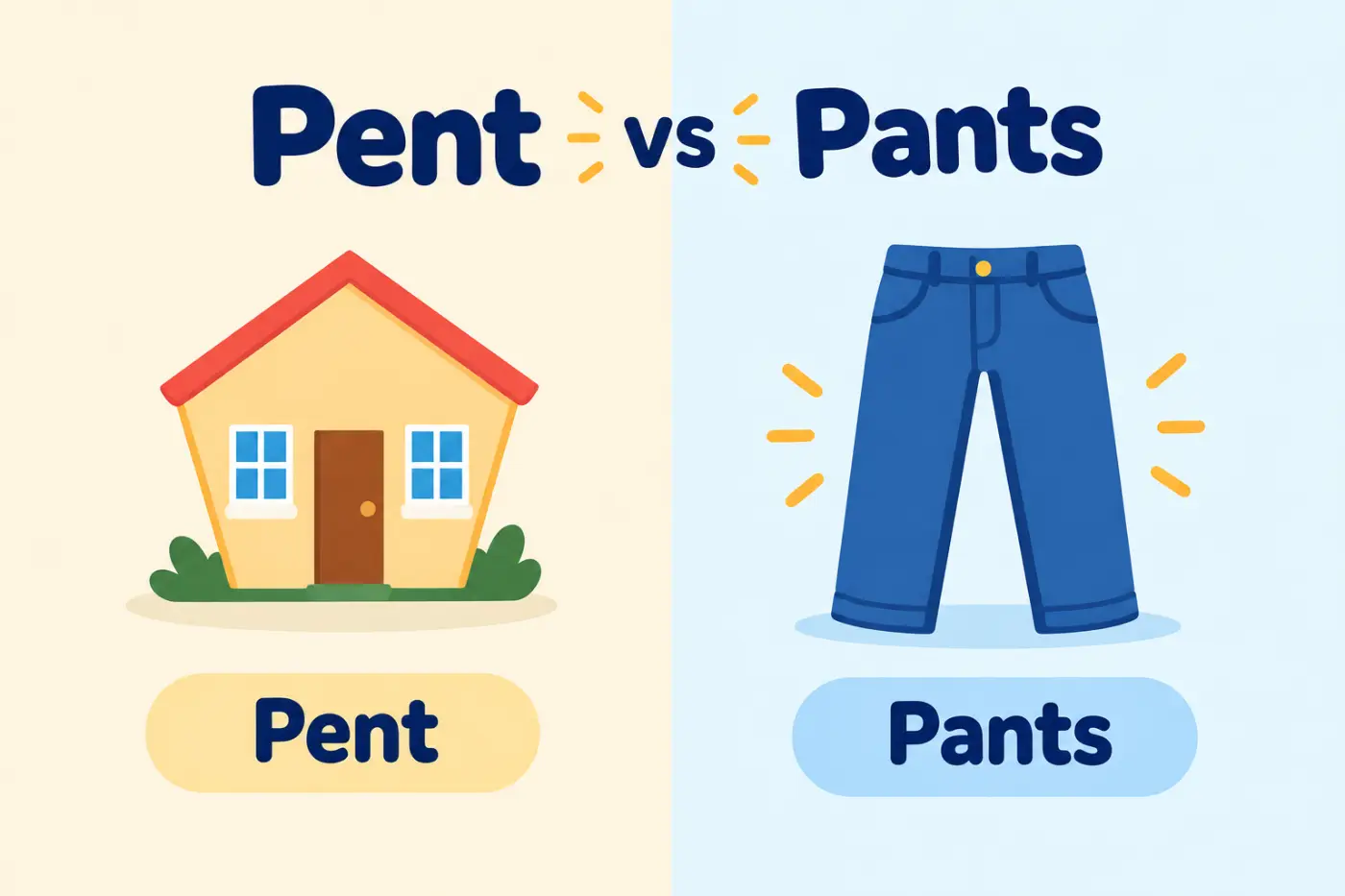
If you’re wondering about pent vs pants you may be dealing with two words that look and sound quite different but can still cause confusion. The key point is simple. Pent is a word connected with being confined or held in. Pants usually means a pair of trousers in American English. The two words have completely different meanings and uses.
The confusion often comes from seeing unfamiliar words in writing. Most people use pants every day but pent is much less common. You may know the word from the phrase pent up anger or pent up emotions without knowing exactly what pent means by itself.
This guide explains the difference in plain English. You’ll learn what each word means how to use it in a sentence why pent often appears with up and how pants can work as both a noun and a verb. You’ll also see common mistakes and simple ways to remember the difference.
Quick Definition
Pent describes something that is confined or held back. It commonly appears in the phrase pent up as in pent up anger or pent up frustration.
Pants usually refers to clothing worn on the lower part of the body. In American English pants generally means trousers. The word can also be a verb that describes breathing quickly and heavily.
Direct Answer
Pent and pants are different words with different meanings. Use pent for something that is confined or held back and use pants for trousers or for the act of breathing heavily.
Comparison Table
| Word | Meaning | Example Sentence | When to Use It |
|---|---|---|---|
| Pent | Confined or held back | He finally expressed his pent up frustration. | Use it when something has been kept inside or restrained. |
| Pants | Trousers or rapid breathing | She bought a new pair of pants. | Use it for clothing or heavy breathing. |
What Does Pent Mean
Pent is an adjective and a past participle form related to the verb pen. The verb pen can mean to confine or shut someone or something in a limited space.
Today pent is most often used to describe feelings or emotions that someone has held back. You may hear or read about pent up anger pent up frustration pent up energy or pent up emotions.
For example:
- He had years of pent up anger.
- She finally released her pent up emotions.
- The children had plenty of pent up energy after sitting indoors all afternoon.
- His pent up frustration became clear during the meeting.
In these examples pent suggests that something has been held inside instead of being released.
The word doesn’t usually appear alone in everyday conversation. Most speakers are more likely to use the familiar phrase pent up. That is why the word can seem strange when you first encounter it.
What Does Pants Mean
Pants has two common meanings.
The first meaning is clothing. In American English pants are garments that cover each leg separately and usually extend from the waist to the ankles or somewhere around that area.
For example:
- I need to buy a new pair of pants.
- His black pants match his jacket.
- She changed into comfortable pants after work.
- Those pants look great with your new shoes.
In this sense pants is a noun.
The second meaning relates to breathing. Pants can also be the present tense form of the verb pant. To pant means to breathe quickly and heavily.
For example:
- The dog pants after running across the yard.
- He pants heavily after climbing the stairs.
- The runner pants as she reaches the finish line.
The meaning becomes clear from the context. If someone says they bought pants they mean clothing. If someone says a dog pants after running they mean the dog is breathing hard.
Why Pent And Pants Get Confused
These words don’t have similar meanings so the main source of confusion is usually spelling or pronunciation.
Pent is short and uncommon. Pants is extremely common in American English. When people hear an unfamiliar word they may connect it with a familiar word that sounds close. This can create confusion when writing.
Another reason is the word pent in the common phrase pent up. People may know the phrase without realizing that pent has its own meaning.
For example someone might understand the sentence below without knowing exactly what pent means.
- She had pent up anger for years.
The sentence tells us that she had anger that she had kept inside. Once you understand that idea pent becomes easier to remember.
Pants has a much more concrete meaning. Most people picture clothing as soon as they hear the word. The difference becomes much easier to see once you connect each word with its main meaning.
The Meaning Of Pent Up
The phrase pent up is by far the most common place you’ll see pent.
When something is pent up it has been held inside or prevented from being expressed or released. The phrase often describes emotions but it can also describe energy or pressure.
Consider these examples.
- He had pent up anger after years of unfair treatment.
- She needed to talk about her pent up frustration.
- The kids had pent up energy after being stuck inside all day.
- The meeting gave everyone a chance to release some pent up tension.
The basic idea is always similar. Something has built up because it has not been released.
Think of a container with a lid on it. If pressure keeps building inside the container the pressure stays trapped until something allows it to escape. Pent up feelings work in a similar way.
This doesn’t mean people literally store emotions in a physical container. It is a figurative expression that helps describe feelings that someone has kept inside.
Is Pent A Verb
Pent comes from the verb pen when pen means to confine or enclose. In modern everyday English most people won’t use pent as an ordinary verb form.
Instead you’ll usually see it as part of the phrase pent up.
The verb pen has a separate meaning that many readers know better. It can mean to write something. For example a person can pen a letter or pen an article. That meaning is not connected to pent up.
This is a good example of how English words can have several meanings. Context tells you which meaning is intended.
When you see pent in a sentence about emotions feelings energy or frustration the writer is almost certainly using the word to mean confined or held back.
Is Pent The Past Tense Of Pant
No. The past tense of pant is panted.
For example:
- The dog panted after the long walk.
- He panted as he climbed the steep hill.
- The runner panted heavily after the race.
Pent does not mean breathed heavily. It belongs to a different word family and has a different meaning.
This distinction is worth remembering because the words may look related at first glance. They are not interchangeable.
What Is The Past Tense Of Pant
The past tense of pant is panted.
The verb pant describes quick or heavy breathing. It can describe people animals or sometimes figurative actions.
Here are some examples.
- The puppy panted after chasing the ball.
- She panted after running up the stairs.
- He was panting after the workout.
- The horse panted in the heat.
Notice the spelling. The base verb is pant and the past tense adds ed.
Pant becomes panted.
It does not become pent.
That simple rule can prevent a common spelling mistake.
How To Use Pants As A Noun
In American English pants usually refers to trousers. The word is normally plural even when you’re talking about one garment.
For example:
- I bought a pair of pants.
- These pants are too long.
- His pants are covered in paint.
- She wore black pants to the interview.
You generally don’t say one pant when referring to a complete pair of trousers. The standard expression is a pair of pants.
This works in the same way as several other clothing terms that come in pairs or have two matching parts.
For example:
- a pair of shoes
- a pair of socks
- a pair of gloves
- a pair of pants
The word pants can also refer to different styles of trousers such as jeans dress pants sweatpants and cargo pants.
How To Use Pants As A Verb
Pants can also be a verb. When someone pants they breathe quickly and heavily.
This often happens after exercise or physical effort.
For example:
- The dog pants after chasing the ball.
- I was panting after running up the hill.
- She pants when she exercises in the heat.
- The horse was panting after the race.
The verb can also appear in forms such as panting and panted.
The context makes the meaning clear. If the sentence talks about clothing the noun meaning is likely. If it talks about running exercise heat or physical effort the verb meaning is likely.
Pent Versus Penned
Another word worth knowing is penned. People sometimes confuse pent with penned because the spellings are close.
Penned is the past tense and past participle of pen when pen means to write.
For example:
- She penned a thoughtful letter to her friend.
- The author penned several popular novels.
- He penned an article about the history of the town.
Penned can also relate to confining something because the verb pen can mean to put someone or something into an enclosed space. Context tells you which meaning applies.
Pent is different. It commonly describes something that has been held back.
Compare these sentences:
- She had pent up frustration.
- She penned a letter to her manager.
The first sentence describes restrained emotion. The second describes writing.
Common Mistakes With Pent
Because pent is less common than pants many people don’t feel confident using it. Some writers avoid it completely or replace it with a phrase that is easier to understand.
That’s fine in casual writing. You don’t need to use pent just because it is technically correct. For example you could write held back anger instead of pent up anger.
However pent is useful when you want a concise phrase that describes something restrained or contained.
One common mistake is using pent when you mean panted.
Incorrect:
- The dog pent after running around the yard.
Correct:
- The dog panted after running around the yard.
Another mistake is using pants when you mean pent.
Incorrect:
- She had pants up frustration.
Correct:
- She had pent up frustration.
These mistakes change the meaning of the sentence completely.
Common Mistakes With Pants
The most common issue with pants is not spelling. It is understanding the difference between the noun and verb.
If you say I bought pants you’re talking about clothing.
If you say I panted after the run you’re talking about breathing.
The word pants can be the present tense verb for a subject such as he she it or a singular noun.
For example:
- The dog pants when it gets hot.
- The runner pants after a sprint.
But the past tense is panted.
- The dog panted after the walk.
- The runner panted after the sprint.
Keeping those forms separate makes your writing much clearer.
Examples That Show The Difference
Sometimes the easiest way to understand two words is to place them in similar contexts.
Consider these examples.
Pent
- He struggled with pent up anger.
- She released years of pent up frustration.
- The children had pent up energy after a rainy week indoors.
Pants
- I need a clean pair of pants.
- His pants were still wet from the rain.
- She bought new pants for work.
Pant
- Dogs often pant when they’re hot.
- The runner began to pant after the steep climb.
Panted
- The dog panted after playing fetch.
- He panted as he reached the top of the hill.
Seeing the words side by side makes the differences much easier to remember.
When To Use Pent
Use pent when you want to describe something that has been held back or confined. In modern writing it most often appears before or after up in the phrase pent up.
You might use it when writing about emotions.
- She finally talked about her pent up resentment.
You can also use it with energy.
- The children had pent up energy after staying indoors.
It can describe tension too.
- The long conversation helped release some pent up tension.
In each example something has been building without an outlet.
When To Use Pants
Use pants when you’re talking about trousers or similar clothing.
For example:
- I left my pants in the dryer.
- These pants are too tight.
- He wore dark pants with a white shirt.
Use pants as a verb when you mean breathes quickly and heavily.
For example:
- The dog pants after a long walk.
- The athlete pants during the final stretch.
If you’re talking about clothing think trousers. If you’re talking about breathing think pant.
A Simple Memory Trick
You don’t need a complicated rule to remember these words.
Think of pent up as something trapped inside.
Imagine anger trapped behind a closed door. The feeling is pent up because it hasn’t been released.
For pants think of clothing.
You put on your pants before leaving the house.
This gives each word a clear mental picture.
Pent means held in.
Pants means clothing or heavy breathing.
The two ideas are so different that this simple connection can make the spelling stick.
Why Pent Up Is So Common
English speakers often use short phrases that capture a larger idea. Pent up is one of those expressions.
Instead of saying someone has emotions they have kept inside for a long time you can say they have pent up emotions. The phrase is shorter and more vivid.
It can also suggest that the feeling has been building.
For example:
- She had pent up frustration after months of dealing with the problem.
This tells us more than simply saying she was frustrated. It suggests that the frustration had been held back for some time.
That’s why pent up often appears with words such as anger frustration resentment tension emotion and energy.
Related Words And Phrases
Understanding related terms can make the difference even clearer.
Held Back
Held back is a simple alternative to pent up.
- He had held back his anger for years.
This sentence communicates almost the same idea as saying he had pent up anger.
Suppressed
Suppressed means stopped or restrained. It can describe feelings thoughts actions or information.
- She suppressed her anger during the meeting.
This word is slightly more formal than held back.
Contained
Contained means kept within limits or inside something.
- He struggled to contain his frustration.
This word can work in both physical and emotional situations.
Released
Released is the opposite idea. Something that was held back is allowed to come out.
- She finally released her frustration by talking to a friend.
These related words help explain why pent up means something that has been held inside.
Does Pent Have A Plural Form
No. Pent is not normally used as a countable noun that takes a plural ending.
You don’t normally talk about pents in standard English. The word usually functions as an adjective or as a past participle in the phrase pent up.
For example:
- pent up anger
- pent up emotion
- pent up energy
- pent up tension
The noun that follows pent changes based on what you’re describing.
Can You Say Pent Up Feelings
Yes. Pent up feelings is a natural phrase.
It describes emotions that someone has kept inside instead of expressing them.
For example:
- She finally talked about her pent up feelings.
- Writing in a journal helped him deal with his pent up feelings.
- They had a long conversation about the pent up feelings they had avoided discussing.
You can use the phrase in everyday writing. It is familiar to most English speakers.
Can You Say Pent Up Anger
Yes. Pent up anger is one of the most common uses of the word.
It describes anger that has been held back for some time.
For example:
- He had years of pent up anger.
- The argument brought his pent up anger to the surface.
- She found a healthy way to deal with her pent up anger.
The phrase doesn’t tell us exactly how the anger was held back. It simply tells us that the anger was not freely expressed.
Can You Say Pent Up Energy
Yes. Pent up energy can describe energy that has built up because someone has been inactive.
This phrase is especially common when talking about children animals or people who have spent a long time indoors.
For example:
- The kids had plenty of pent up energy after the storm kept them inside.
- The dog had pent up energy after missing its usual walk.
- After sitting through a three hour meeting I had a lot of pent up energy.
Here the word doesn’t describe anger or emotion. It describes energy that needs an outlet.
How Context Helps You Choose The Right Word
When you’re unsure about a word ask yourself what the sentence is talking about.
If the sentence describes an emotion that has been held inside use pent.
- She had pent up frustration.
If the sentence describes clothing use pants.
- She bought a new pair of pants.
If the sentence describes heavy breathing use pant or pants based on the subject and tense.
- The dog pants after exercise.
- The dog panted after exercise.
If the sentence describes writing use penned.
- She penned a short note.
This quick meaning check is often more useful than trying to remember spelling alone.
A Quick Guide For Writers
If you’re editing an article email school paper or social media post these quick checks can help.
Use pent for something held back.
- pent up emotions
- pent up anger
- pent up frustration
- pent up energy
- pent up tension
Use pants for clothing.
- a pair of pants
- black pants
- dress pants
- loose pants
- comfortable pants
Use pant for heavy breathing.
- Dogs pant in hot weather.
- Runners pant after a hard sprint.
Use panted for the past tense.
- The dog panted after the walk.
Use penned for writing.
- She penned a thoughtful letter.
Once these meanings are separated in your mind the spelling becomes much easier.
FAQs
What is the difference between pent vs pants?
Pent means confined or held back and usually appears in the phrase pent up. Pants usually means trousers in American English and can also describe rapid heavy breathing when used as a verb.
Is pent a real English word?
Yes. Pent is a real English word. It is most commonly used in the phrase pent up to describe something that has been held back or confined.
Is pent the past tense of pant?
No. The past tense of pant is panted. Pent is related to the verb pen when pen means to confine or enclose.
What does pent up mean?
Pent up means held inside or kept from being expressed or released. It often describes emotions such as anger frustration resentment and tension. It can also describe energy that has built up.
Is pants a noun or a verb?
Pants can be either a noun or a verb. As a noun it usually means trousers. As a verb it means breathes quickly and heavily.
What is the past tense of pant?
The past tense of pant is panted. For example you can say the dog panted after running across the yard.
Can pent and pants be used interchangeably?
No. They have different meanings and cannot replace each other. Pent relates to something being held back while pants usually refers to clothing or heavy breathing.
Is pent up anger correct English?
Yes. Pent up anger is a standard English phrase. It describes anger that has been held back instead of being expressed.
Conclusion
The difference between pent vs pants is much easier once you connect each word with its main meaning. Pent describes something that has been confined or held back and it most often appears in the phrase pent up. Pants usually refers to trousers or can describe rapid breathing when used as a verb.
Remember the simple idea behind pent. Something is trapped or held inside. That could be anger frustration energy or tension. For pants think of clothing or the heavy breathing that happens after running or exercise.
Also keep panted and penned separate from pent. Panted is the past tense of pant. Penned usually means written. Those small differences matter because changing one letter can change the meaning of an entire sentence.
The next time you see these words pause and check the meaning first. If something is being held back use pent. If you’re talking about trousers or heavy breathing use pants. That quick check will keep the spelling and meaning clear.

Dr. Elena Vance holds a Ph.D. in Linguistics from Columbia University and has spent over 15 years analyzing the evolution of the English language. A former university professor turned full-time writer and editor, Elena specializes in breaking down high-level grammatical concepts, punctuation nuances, and style guides (APA, Chicago, MLA) into clear, actionable advice. When she isn’t hunting down dangling modifiers, she can be found collecting vintage dictionaries and reading classic literature.