
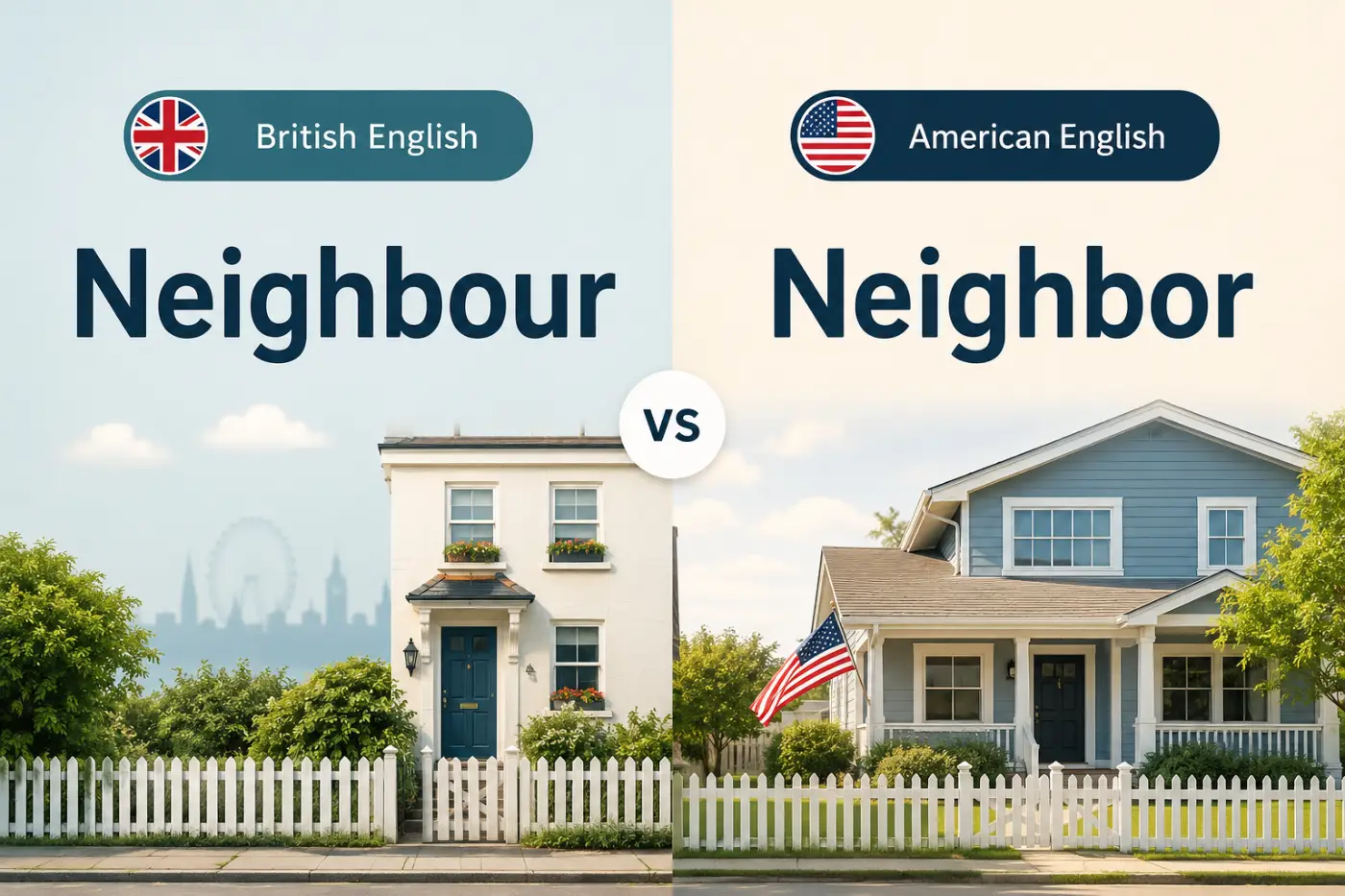
If you’re searching for neighbour or neighbor you’re looking at two spellings of the same word. The difference comes from the type of English being used. Neighbor is the standard spelling in American English, while neighbour is the standard spelling in British English and several other varieties of English.
So if you’re writing for a US audience, choose neighbor. If you’re writing for readers in the UK, Canada, Australia, or another region that follows British spelling, neighbour may be the expected form. Both spellings have the same meaning and pronunciation.
The extra u is the only spelling difference. It doesn’t change the meaning of the word. This guide explains where the two spellings come from, which one to use in American writing, how the word is used in everyday sentences, and why English has two accepted forms.
Quick Definition
A neighbor is a person who lives near you. The word can also describe something located close to another thing. Neighbour has exactly the same meaning but uses the British spelling.
Direct Answer
Neighbor is the correct spelling in American English. Neighbour is the standard British spelling and is also used in other forms of English that follow British spelling.
Comparison Table
| Word | Meaning | Example Sentence | When to Use It |
|---|---|---|---|
| Neighbor | A person who lives nearby. | My neighbor helped me carry the boxes. | Use it in American English. |
| Neighbour | A person who lives nearby. | My neighbour helped me carry the boxes. | Use it in British English and related varieties. |
Why Are There Two Spellings
The difference between these spellings comes down to regional spelling traditions. American and British English developed different spelling preferences over time. Many of those differences involve a single letter or a small group of letters.
Words ending in our are a familiar example. American English often drops the u from these words. British English usually keeps it.
You can see the same pattern in several common words. American English uses color while British English uses colour. Americans write honor while British writers use honour. The same difference appears with neighbor and neighbour.
Neither spelling is a mistake when it is used in the right variety of English. The key is consistency. If you’re writing an article for a US audience, use the American form throughout. Mixing the two styles can make your writing look careless even when both spellings are individually correct.
Why American English Uses Neighbor
American spelling was shaped by several influences. One major influence came from Noah Webster, an American writer and dictionary maker who wanted American English to have its own clear spelling conventions.
Webster favored simpler spellings in many cases. Some of his preferred forms removed letters that were common in British spelling. This helped establish forms such as color, honor, and labor in American English.
The same general preference explains neighbor. American English leaves out the u found in the British form.
This doesn’t mean Americans changed the meaning of the word. The word still refers to someone who lives nearby. Only the written form changed.
For US readers, the easiest rule is simple. If your writing follows American English, spell the word neighbor.
Why British English Uses Neighbour
British English keeps the older our spelling in words such as colour, honour, and neighbour. This spelling tradition has remained common in the UK and in several other English speaking countries.
You may see neighbour in British newspapers, books, websites, school materials, and official documents. It isn’t an unusual or old fashioned spelling in those settings. It is the normal form.
The same person could therefore write the following two sentences depending on the variety of English being used.
- My neighbor lives next door.
- My neighbour lives next door.
The meaning is identical. The spelling simply tells you something about the writer’s chosen form of English.
Which Spelling Should Americans Use
American writers should use neighbor. This is the standard form found in American dictionaries and standard US writing.
That applies to everyday writing as well as professional content. You would use neighbor in an email, school assignment, newspaper article, website, business document, or social media post written in American English.
For example:
- Our new neighbor moved in last week.
- I asked my neighbor to watch the house while I was away.
- My neighbors are having a barbecue tonight.
- The dog belongs to our next door neighbor.
The plural form is neighbors. You simply add s to the American spelling.
The adjective form also uses the same spelling pattern.
- We have a strong neighborly relationship.
- The neighbors organized a community event.
If your audience is in the United States, sticking with the American form keeps your writing natural and consistent.
Which Spelling Should British Writers Use
British writers normally use neighbour. The plural form is neighbours.
For example:
- Our new neighbour moved in last week.
- I spoke with my neighbour this morning.
- The neighbours are planning a street party.
- She has always been a friendly neighbour.
The adjective neighbourly also keeps the u.
- They showed us great neighbourly kindness.
The same rule applies to related forms built from the word. If you’re following British spelling, keeping the u throughout the word family gives your writing a consistent appearance.
Is Neighbor Or Neighbour More Correct
Neither spelling is more correct by itself. The correct choice depends on the variety of English you’re using.
For American English, neighbor is correct. For British English, neighbour is correct. Treating one as universally right and the other as wrong misses the main point about regional spelling.
This is similar to other differences between American and British English. For example, center is standard in American English while centre is common in British English. Theater is standard in American English while theatre is common in British English.
These differences don’t make one variety better than the other. They are simply established spelling conventions.
The Meaning Stays The Same
The spelling changes but the meaning doesn’t. A neighbor or neighbour is someone who lives near you.
The word usually refers to a person who lives in a nearby house or apartment. It can also describe someone who lives in the same neighborhood or nearby area.
For example:
- My neighbor lives two houses away.
- We invited our neighbors over for dinner.
- She became friends with her new neighbor.
- Several neighbors helped clean the park.
The word can also have a broader meaning. Two places can be neighbors if they are next to or close to each other.
For example:
- The two neighboring towns share a school district.
- The countries are neighboring states.
- Our office is in a neighboring building.
In these examples, the word doesn’t describe someone who lives next door. It describes something that is nearby.
Neighbor As A Noun
The most common use of neighbor is as a noun. A noun names a person, place, thing, or idea. In this case, the word names a person who lives nearby.
Imagine that you live in an apartment building. The person in the apartment next to yours can be your neighbor. Someone living across the street can also be your neighbor. The word doesn’t require the person to live directly beside you.
Here are some natural examples:
- My neighbor brought over some homemade cookies.
- I haven’t met our new neighbor yet.
- Her neighbor offered to water the plants while she was traveling.
- Our neighbors invited us to their backyard party.
The relationship can be close or casual. You don’t have to be friends with someone for that person to be your neighbor.
Neighbor As A Verb
The word can also work as a verb. This use is less common in everyday conversation but it is still correct.
As a verb, neighbor means to be located next to or near something.
For example:
- The school neighbors a large public park.
- The restaurant neighbors a busy shopping center.
This use may sound more formal than the noun. In everyday American English, people often use phrases such as next to, near, or beside instead.
For example, instead of saying:
- The school neighbors the park.
A person might naturally say:
- The school is next to the park.
Both can be correct. The second version simply sounds more conversational.
Neighbor As An Adjective
The word can also appear in adjective phrases. It describes something located nearby.
For example:
- The neighboring town has a larger hospital.
- A neighboring business reported the problem.
- We visited a neighboring state during our road trip.
The spelling here depends on the English variety too. American English uses neighboring, while British English uses neighbouring.
This is worth remembering because the regional difference doesn’t disappear when the word changes form. If you choose the American spelling, keep the American pattern in related words too.
Common Phrases With Neighbor
Some expressions appear often enough that they’re worth learning as complete phrases. Knowing these phrases can also help you use the word naturally.
Next Door Neighbor
A next door neighbor is someone who lives in the home directly beside yours.
For example:
- My next door neighbor has a very friendly dog.
The phrase can also be written as next door neighbor when next door acts as a compound modifier in American usage. In careful editing, style choices can vary based on the publication.
Good Neighbor
A good neighbor is someone who is helpful, respectful, and considerate toward people who live nearby.
For example:
- A good neighbor checks on others during a storm.
The idea goes beyond simply living nearby. It describes positive behavior within a community.
Friendly Neighbor
A friendly neighbor is someone who is pleasant and welcoming.
For example:
- Our friendly neighbor invited us over for coffee.
Neighboring Area
A neighboring area is a place that is close to another place.
For example:
- Many workers commute from neighboring areas.
This phrase shows that the word isn’t limited to people. It can describe places and things that are close to each other as well.
What About Neighboring And Neighbouring
The same spelling difference appears in the related adjective.
American English uses neighboring.
British English uses neighbouring.
For example, an American writer might say:
- We visited a neighboring town.
A British writer might write:
- We visited a neighbouring town.
Both sentences mean the same thing. The spelling follows the regional form of English used by the writer.
This pattern gives you a useful clue. If you’ve already chosen neighbor, related forms should normally keep the American spelling. If you’ve chosen neighbour, keep the British spelling in related words.
That consistency matters more than choosing one form as the supposedly better version.
Section 2 continues with the history, spelling pattern, usage, and common mistakes.
Where The Spelling Difference Comes From
The difference between neighbor and neighbour isn’t a recent change. Both forms have a long history in English. The extra u became part of the spelling tradition used in British English while American English later favored the shorter form.
The word comes from Old English nēahgebūr. It referred to someone who lived nearby. Over many centuries the word changed in sound and spelling before reaching the modern forms used today.
The British form kept the u in the middle of the word. American spelling later dropped it. This same pattern appears in several other word pairs such as colour and color and favour and favor.
That gives you a useful way to understand the difference. The two spellings aren’t competing versions where one must be wrong. They belong to different spelling systems.
The American English Spelling Pattern
American English often removes the u from words that end in our in British English. This is one of the easiest regional spelling patterns to recognize.
Consider these common pairs.
| American English | British English |
|---|---|
| Color | Colour |
| Honor | Honour |
| Favor | Favour |
| Labor | Labour |
| Humor | Humour |
| Neighbor | Neighbour |
The meaning stays the same in every pair. The main difference is the spelling convention used in each variety of English.
This pattern can help you remember the American form. If you’re writing for readers in the United States, words in this group usually appear without the u.
Why Consistency Matters In Your Writing
Using one spelling system consistently makes your writing easier to read. Readers may not consciously notice every regional spelling choice but they can notice when the style suddenly changes.
Imagine an American article that uses neighbor in one paragraph and neighbour a few lines later. Both forms are real words. Still, the switch can make the article look as if it wasn’t carefully edited.
The same problem can happen with color and colour or center and centre. A single British spelling inside an otherwise American article can look like a typo to a US reader.
That doesn’t mean you need to avoid British spelling completely. If you’re writing for a British audience, use British spelling. The goal is to match your audience and then stick with that choice.
For a US focused website, American spelling is usually the safest choice.
Common Mistakes With This Word
The most common mistake is treating the British form as an error. It isn’t. The extra u is correct in British English.
The opposite mistake is also common. Some writers assume the American form is wrong because they learned British spelling at school. It isn’t wrong in American English.
Another problem is mixing forms in the same piece of writing. A writer may use neighbor in one paragraph and neighbour in another without realizing the switch.
There are also mistakes with related forms. Someone might correctly write neighbor but then use neighbouring later in the same American article. That creates an inconsistent spelling style.
A simple editing check can catch these problems. Search your document for both forms before publishing. If you’re writing in American English, replace the British forms with their American equivalents when appropriate.
Neighbor And Neighbour In Real Sentences
The easiest way to understand the difference is to see both forms in natural sentences. The meaning stays the same while the spelling changes.
American English Examples
- My neighbor brought my packages inside.
- I met our new neighbor yesterday.
- Our neighbors are having a cookout this weekend.
- She asked her neighbor to feed the cat.
- A neighboring town has a larger hospital.
- We drove through a neighboring state on our trip.
These sentences sound natural to American readers. The spelling fits standard US English.
British English Examples
- My neighbour brought my packages inside.
- I met our new neighbour yesterday.
- Our neighbours are having a garden party this weekend.
- She asked her neighbour to feed the cat.
- A neighbouring town has a larger hospital.
- We traveled through a neighbouring county last week.
The sentences have the same basic meanings. Only the spelling and some regional vocabulary may change.
Neighbor And Neighbour In Plural Form
The plural form is easy once you know which spelling system you’re using.
American English uses neighbors.
British English uses neighbours.
For example:
- Our neighbors often walk their dogs in the evening.
- Several neighbors helped clear the fallen tree.
In British English the same ideas would appear as:
- Our neighbours often walk their dogs in the evening.
- Several neighbours helped clear the fallen tree.
The plural ending itself doesn’t change. The only difference is the spelling of the base word.
Neighboring And Neighbouring
The regional spelling difference continues when the word becomes an adjective.
American English uses neighboring.
British English uses neighbouring.
The adjective means close to or next to something.
For example:
- A neighboring city has opened a new train station.
- The neighboring house was sold last month.
- Several neighboring communities joined the project.
In British English the same sentences would use neighbouring.
This is a useful detail for editors because a spelling check shouldn’t stop at the main noun. Related forms matter too. A document can look inconsistent even when the main word appears correctly.
Is Neighbour A British Word
Yes. Neighbour is the standard British English spelling. It is also common in other varieties of English that follow British spelling traditions.
You may see it in writing from the United Kingdom as well as countries such as Australia and New Zealand. Usage can vary by country and publication style but the spelling is widely recognized.
For an American reader the extra u may look unusual. That doesn’t make it incorrect. It simply signals a different spelling convention.
The same idea applies to colour, favour, and honour. American readers may expect the shorter forms while British readers may expect the versions with u.
Is Neighbor A British Spelling
No. Neighbor is the standard American spelling. British English normally uses neighbour instead.
You may still encounter the American form in British writing. This can happen in imported books, international websites, product names, software, quoted material, or content written by an American author.
Seeing the shorter form in a British publication doesn’t change the standard spelling used in British English. It simply means the source is using another spelling convention.
Does The Pronunciation Change
No. The two spellings are normally pronounced the same.
The extra u doesn’t create a different sound. It only changes how the word is written.
That makes this spelling difference different from word pairs where spelling changes pronunciation or meaning. You don’t need to learn two pronunciations. You only need to choose the spelling that fits your audience.
When speaking, nobody will know which spelling you have in mind. The distinction matters when you’re writing.
Does The Meaning Change
No. The meaning does not change.
Both forms refer to a person who lives near you. They can also describe something located nearby when used in related forms such as neighboring or neighbouring.
For example, these sentences communicate the same idea.
- My neighbor lives across the street.
- My neighbour lives across the street.
The first follows American spelling. The second follows British spelling.
This is why the question is mainly about spelling rather than vocabulary. You aren’t choosing between two different words with different definitions. You’re choosing between two regional forms of the same word.
How To Choose The Right Form
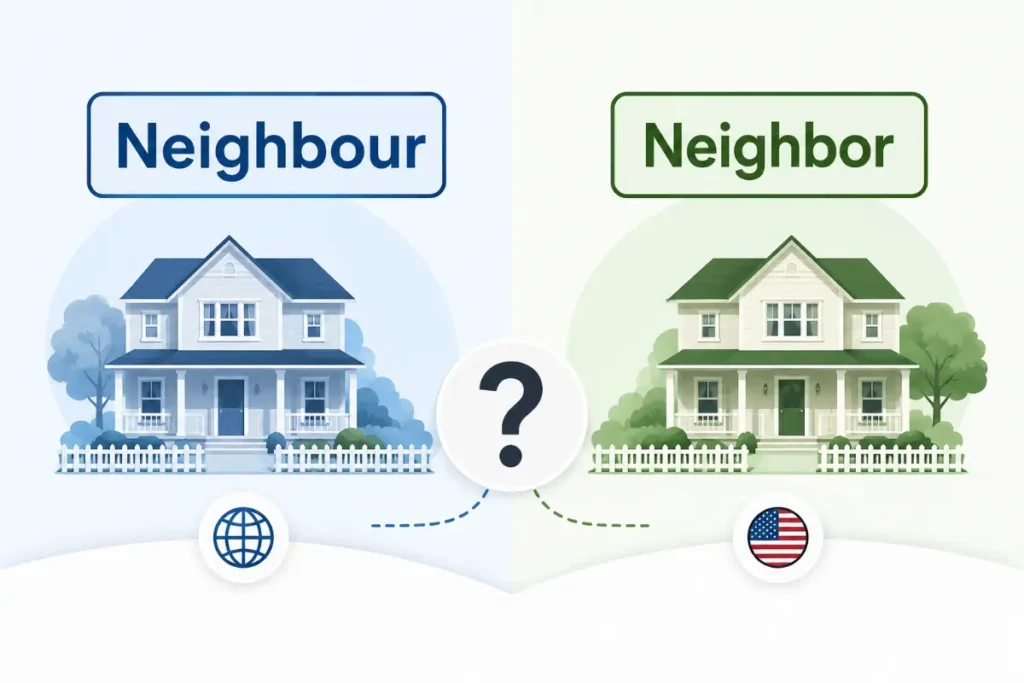
Start by identifying your audience. If you’re writing for people in the United States, use the American form.
If you’re writing for a British audience, use the British form. The same principle works for other audiences that follow one of these spelling systems.
Next, check the rest of your document. Look for related spelling choices such as color or colour, center or centre, and favorite or favourite. Your word choices should follow the same general system.
Finally, stay consistent. You don’t need to worry about which version sounds more sophisticated. Neither one is more intelligent or more formal. The best choice is the one that fits your audience.
A Simple Memory Trick For American Writers
If your main audience is in the United States, remember one small idea.
- American English drops the u.
- That gives you neighbor instead of neighbour.
- You can apply the same idea to several familiar words.
- Color instead of colour.
- Honor instead of honour.
- Favor instead of favour.
- Neighbor instead of neighbour.
This isn’t a rule that applies to every English word containing the letter u. It’s a useful pattern for this particular group of words.
Once you connect the words together, the spelling becomes easier to recall. You don’t have to memorize each one as a completely separate fact.
What Writers Should Use In US Content
For content written specifically for Americans, use neighbor. That includes most US school assignments, websites, blogs, business documents, marketing materials, emails, and general articles.
You should also use the matching American forms neighbors and neighboring.
For example:
- Our neighbors organized a block party.
- A neighboring business donated supplies.
- My neighbor recommended a great restaurant.
These forms create a consistent American English style from start to finish.
There is one practical exception. If you’re reproducing a person’s exact writing, citing a source, preserving a title, or using a proper name, don’t silently change the spelling just to match your preferred style. Keep the original form when accuracy requires it.
What Editors Should Watch For
Editors working on US content should check more than the main spelling. Regional spelling often appears across an entire article.
A writer may use American spelling in most places but accidentally keep British forms in a few sentences. This can happen after copying material from another source or editing content written by someone from another country.
Look for related forms such as neighbours, neighbouring, colour, favourite, and centre. You don’t need to change every unfamiliar spelling automatically. First decide which English variety the document is meant to use.
Then make the spelling consistent with that choice.
This small editing step can make a document feel much more polished. It also prevents readers from wondering if a spelling difference is an accidental typo.
The Best Choice For A US Audience
If you’re writing for an American audience, neighbor should be your default choice. It’s the spelling most US readers expect to see.
You don’t need to explain the spelling difference every time you use the word. Just use the American form naturally and keep related words consistent.
If you’re discussing British English or quoting a British source, neighbour may be exactly what you need. Context determines the right form.
The important point is simple. Don’t think of one spelling as correct and the other as incorrect. Think of them as regional versions that belong to different English styles.
More Examples Of Neighbor In Everyday English
The word becomes much easier to use once you see how naturally it fits into ordinary situations. You might talk about a neighbor when discussing your home your street your apartment building or your local community. The word can describe a casual relationship too. You don’t need to know someone well for that person to be your neighbor.
Here are some examples that sound natural in American English.
- My neighbor helped me carry the groceries inside.
- I ran into my neighbor at the grocery store.
- Our neighbors invited us over for dinner.
- The neighbor across the street has a new car.
- I asked my neighbor to collect my mail while I was away.
- One of our neighbors found a lost dog.
- The neighbors complained about the loud music.
- We met several new neighbors after moving into the area.
These examples also show that the word can appear in different sentence patterns. It can be the subject of a sentence. It can also appear after a possessive word such as my, our, or your.
Neighbor And Next Door Neighbor
People often use next door neighbor to talk about someone who lives immediately beside them. The phrase gives more detail than the single word neighbor.
For example:
- My neighbor lives three houses away.
- My next door neighbor lives directly beside me.
Both people are neighbors. The second sentence simply tells you exactly where that person lives.
The phrase is especially common in casual American speech. You might hear someone say that their next door neighbor borrowed a lawn mower or that their next door neighbor has a friendly dog.
The expression can also describe people who live in apartments. If two apartments share a wall you can refer to the person in the apartment beside yours as your next door neighbor.
Neighbor And Neighborhood
These two words are closely related but they don’t mean the same thing.
A neighbor is usually a person who lives nearby. A neighborhood is an area where people live.
For example:
- My neighbor lives across the street.
- My neighborhood has a small public library.
The connection is easy to remember. Your neighbors are people. Your neighborhood is the place where you and those nearby residents live.
You can also use neighborhood when talking about a general area rather than a formally defined community.
For example:
- There are several good restaurants in my neighborhood.
- She grew up in a quiet neighborhood outside Chicago.
- Our neighborhood gets busy during the summer.
The British spelling is neighbourhood. American English uses neighborhood.
Neighbor And Neighborly
The adjective neighborly describes behavior that is friendly helpful and considerate toward people who live nearby.
For example:
- It was neighborly of him to shovel the sidewalk for his elder people neighbor.
- The community showed a neighborly spirit after the storm.
- She made a neighborly gesture by bringing food to the new family.
The word doesn’t simply mean that someone lives nearby. It describes the way people treat one another.
This gives you a useful family of words.
Neighbor refers to a person.
Neighborhood refers to an area.
Neighborly describes friendly behavior between people who live near one another.
Understanding these related forms makes the main word easier to remember and use.
Neighboring Places And Things
The adjective neighboring means close to or next to something. It can describe towns cities states countries buildings or other places.
For example:
- We drove to a neighboring town for lunch.
- The neighboring state has lower gas prices.
- A neighboring country closed its border.
- The fire spread to a neighboring building.
- Students came from several neighboring schools.
The word doesn’t always mean directly beside something. It can simply mean nearby.
That distinction matters. If two houses share a wall they are next to each other. Two towns several miles apart can still be described as neighboring towns if they are close to one another.
Common Spelling Mistakes Beyond The Main Word
Once you know the main spelling difference you should also watch for related words. Regional spelling can affect an entire word family.
American English uses:
- Neighbor.
- Neighbors.
- Neighboring.
- Neighborhood.
- Neighborly.
British English uses:
- Neighbour.
- Neighbours.
- Neighbouring.
- Neighbourhood.
- Neighbourly.
The pattern is easy to spot. American forms usually remove the u while British forms keep it.
A common editing mistake is to mix the two systems. Someone might write neighbor in one paragraph and neighbourhood in another. Neither word is wrong by itself but the combination can make the article inconsistent.
Common Confusions With Neighbor
The spelling difference isn’t the only thing that can cause confusion. Some related words look or sound similar but have different meanings.
Neighbor And Nearby
Neighbor usually refers to a person. Nearby describes something that is close.
For example:
- My neighbor owns a bakery.
- There is a bakery nearby.
You wouldn’t normally replace one with the other. A person can be your neighbor while a restaurant can be nearby.
Neighbor And Next Door
Next door describes a location. It can also be used as part of the phrase next door neighbor.
For example:
- My neighbor lives next door.
- My next door neighbor has two children.
The first sentence says where the neighbor lives. The second uses a common phrase to identify the person.
Neighbor And Resident
A resident is someone who lives in a particular place. A neighbor is someone who lives near you.
The words can describe the same person but the focus is different.
For example:
- Every resident of the building received a notice.
- My neighbor received the same notice.
The first sentence focuses on the person’s status as someone who lives there. The second focuses on the person’s location relative to you.
Neighbor And Community Member
A community member belongs to a local community. A neighbor is someone who lives nearby.
Again the ideas can overlap.
Your neighbor may be part of your community but not every community member has to live right next to you.
How The Word Works In Formal Writing
You can use neighbor in formal writing without any problem. The word isn’t limited to casual conversation.
For example:
- Local neighbors expressed concern about the proposed development.
- The organization works with neighboring communities.
- Residents and neighbors attended the public meeting.
However, formal writing sometimes uses more specific terms when the exact relationship matters.
A report might use resident when discussing people who live in a particular building or area. It might use adjacent property owner when discussing property directly beside another property.
That doesn’t make neighbor informal or incorrect. It simply means that precise writing sometimes benefits from a more exact word.
For most everyday situations neighbor is clear and natural.
How The Word Works In Professional Writing
Business writers use the word too. It can describe nearby businesses properties communities or locations.
For example:
- A neighboring business reported the water leak.
- We contacted the neighbors before beginning construction.
- The new store has attracted customers from neighboring communities.
Real estate writing also uses the word often.
For example:
- The property has a friendly neighborhood atmosphere.
- Several neighboring homes have recently been renovated.
- The house is located near several popular neighborhood restaurants.
The American spelling remains the same throughout these examples.
How To Avoid Mixing American And British Spelling
The easiest approach is to choose your style before you start writing. If your audience is mainly in the United States use American spelling throughout the article.
You don’t need to memorize every regional spelling difference at once. Start with common patterns that appear often.
For this word family remember:
neighbor
neighbors
neighboring
neighborhood
neighborly
If you see the versions with u in American content check them during proofreading. They may have been copied from a British source or entered by mistake.
A style guide can also help if you’re editing large amounts of content. Many organizations choose a specific English variety and expect writers to follow it consistently.
When Neighbour Is The Better Choice
There are times when the British spelling is exactly right. If you’re writing for a British publication or audience then neighbour is usually the natural choice.
The same applies when you’re writing in a style that follows British English. Schools publishers companies and government organizations in different countries may have their own style preferences.
You may also need to preserve the spelling used in an original source. For example if you’re discussing a British newspaper article and reproducing part of its wording you shouldn’t change the spelling simply because you normally use American English.
Context matters.
The goal isn’t to erase one spelling in favor of the other. The goal is to use the form that fits the writing.
A Quick Test For Choosing The Spelling
If you still hesitate when writing this word use a simple three step check.
First ask who will read your writing. If the audience is American choose the spelling without the u.
Next check nearby words. If you’ve already written color, favorite, and center, you’re clearly following American spelling. Keep the same style here.
Finally read the whole sentence again. The correct form should fit naturally with the rest of your writing.
For American content the answer is simple.
- My neighbor lives next door.
- My neighbors are very friendly.
- We visited a neighboring town.
- Our neighborhood has a new coffee shop.
These forms all follow the same spelling system.
A Simple Memory Trick
If you’re writing American English remember that many our words lose the u.
Think of the pair as a small pattern.
Color becomes color.
Honor becomes honor.
Favor becomes favor.
Neighbor becomes neighbor.
The goal isn’t to memorize a long spelling rule. Just remember that the American form is the shorter version in this group.
If you’re writing British English keep the u.
Colour.
Honour.
Favour.
Neighbour.
This simple visual connection can make the choice much faster when you’re writing.
Does The Spelling Matter For SEO
For US focused content the American spelling is usually the natural choice. Use the spelling your readers expect rather than forcing both forms into every paragraph.
Search engines can understand that neighbor and neighbour refer to the same word. You don’t need to repeat both spellings throughout an article to prove relevance.
If people search for both versions you can explain the difference naturally in one useful section. That gives readers the answer they need without making the article sound stuffed with keywords.
Good SEO starts with useful content. Clear explanations real examples and accurate information matter more than repeating a phrase again and again.
How To Edit An Article For American English
Suppose you’re editing an article written for people in the United States. Start by looking for the main regional spelling differences.
Search for neighbour and related forms. Then check common pairs such as colour and color, favourite and favorite, and centre and center.
Don’t change every word blindly. First confirm that the article is meant to follow American English. A quoted passage or proper name may need to keep its original spelling.
Once you’ve checked the context make the spelling consistent. This small step can improve the polish of an entire article without changing its meaning or tone.
The same process works in reverse when preparing content for a British audience. Choose the British forms and keep them consistent throughout the piece.
The Main Rule To Remember
The spelling choice is regional rather than grammatical. Both forms refer to the same person and carry the same basic meaning.
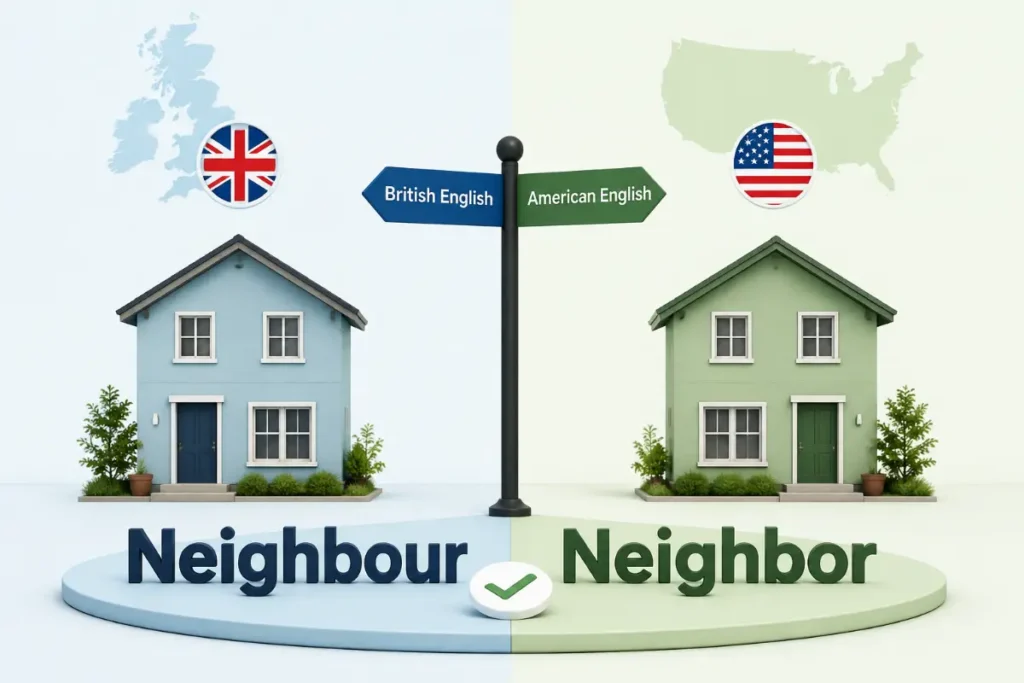
American English uses neighbor. British English uses neighbour.
The related forms follow the same pattern. American English uses neighbors, neighboring, and neighborhood. British English uses neighbours, neighbouring, and neighbourhood.
Once you know the audience you’re writing for the decision takes only a second. For US readers choose the form without the u. For British English choose the form with the u.
Section 4 completes the article with FAQs, the conclusion, and the meta description. I’ll keep the paragraphs natural and avoid one sentence paragraphs.
FAQs
Is neighbor or neighbour correct in American English?
Neighbor is the standard spelling in American English. The spelling neighbour is standard in British English and other varieties that follow British spelling. Both forms have the same meaning and pronunciation.
Is neighbour wrong in the United States?
Not exactly. Neighbour is a valid English spelling but it isn’t the standard American form. If you’re writing specifically for a US audience you should normally use neighbor for consistency with American English.
Is neighbor a British or American spelling?
Neighbor is the standard American spelling. British English normally uses neighbour with an extra u. The difference is a regional spelling choice rather than a difference in meaning.
Why does American English spell neighbor without the u?
American English developed spelling preferences that often removed the u from words ending in our. This pattern can also be seen in pairs such as color and colour, honor and honour, and favor and favour. The shorter form became standard in American English.
What is the plural of neighbor?
The American plural is neighbors. The British plural is neighbours. The meaning is the same in both forms.
What is the difference between neighbor and neighborhood?
A neighbor is a person who lives near you. A neighborhood is the area where you and other nearby residents live. For example, your neighbor may live in your neighborhood.
Is neighboring American or British English?
Neighboring is the American English spelling. British English uses neighbouring. Both forms mean close to or next to something.
Can I use neighbour in an American English article?
You can use it when the context calls for British spelling. For ordinary US content, though, neighbor is the better choice. Keeping one spelling system throughout your article makes the writing look more polished and consistent.
Conclusion
The answer to neighbour or neighbor depends on the type of English you’re using. Neighbor is the standard American spelling, while neighbour is the standard British spelling. Neither form changes the meaning of the word.
The difference comes from a broader spelling pattern. American English often drops the u from words that use our in British English. That’s why Americans write color, honor, favor, and neighbor, while British writers commonly use colour, honour, favour, and neighbour.
The same choice carries through related words. If you’re writing American English, use neighbors, neighboring, neighborhood, and neighborly. If you’re following British English, use neighbours, neighbouring, neighbourhood, and neighbourly.
For US content the practical answer is easy. Use neighbor and keep the same American spelling style throughout your writing. Once you connect this word with the larger our and or spelling pattern, you won’t have to stop and second guess yourself every time you write it.

Dr. Elena Vance holds a Ph.D. in Linguistics from Columbia University and has spent over 15 years analyzing the evolution of the English language. A former university professor turned full-time writer and editor, Elena specializes in breaking down high-level grammatical concepts, punctuation nuances, and style guides (APA, Chicago, MLA) into clear, actionable advice. When she isn’t hunting down dangling modifiers, she can be found collecting vintage dictionaries and reading classic literature.