
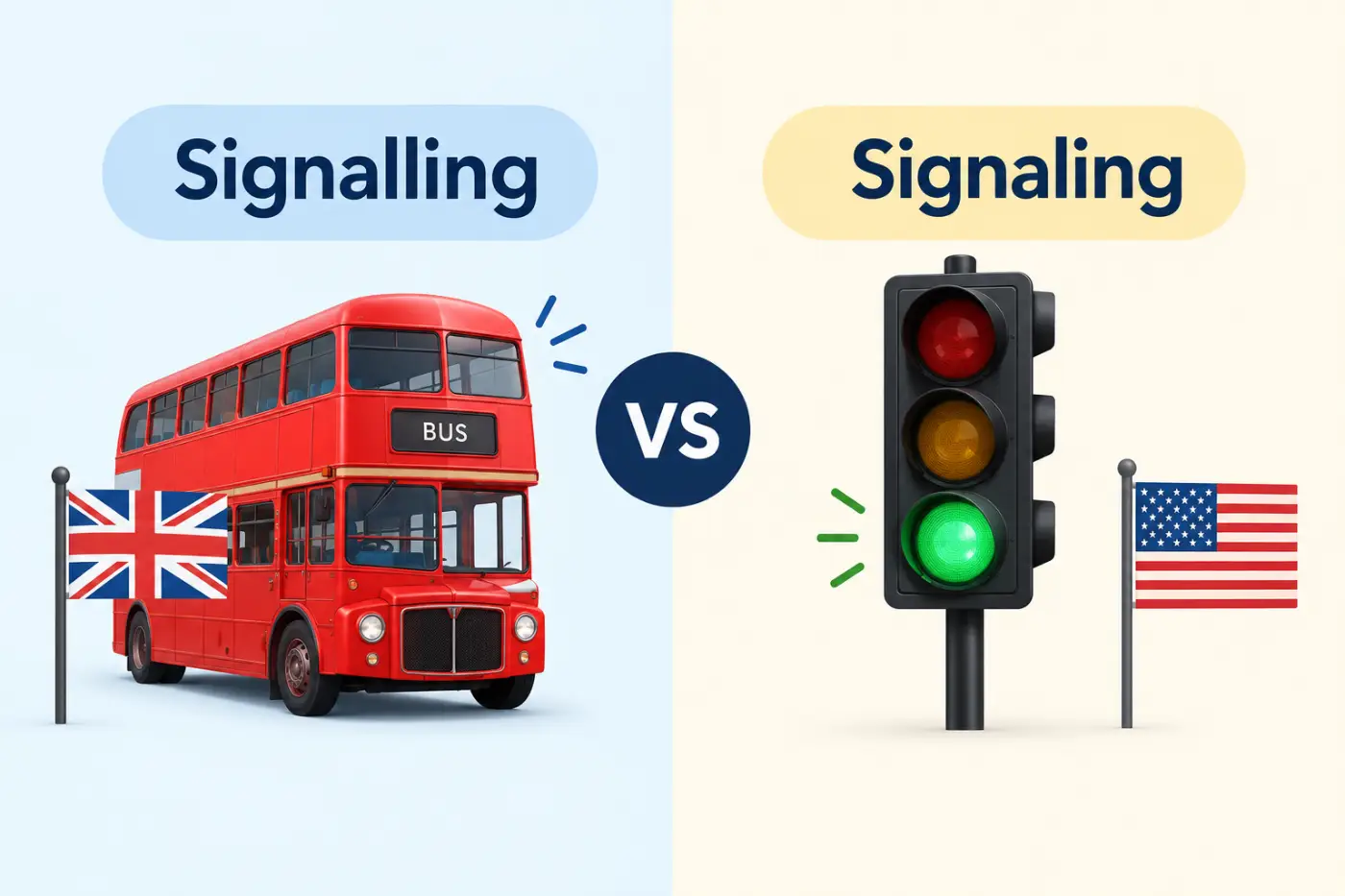
If you’re stuck between signalling or signaling you may have noticed that both spellings appear in English writing. The confusion isn’t caused by one spelling being a simple mistake. Both forms are correct. The difference comes mainly from the variety of English being used.
Signaling is the standard spelling in American English. Signalling is the standard spelling in British English and several other varieties of English. The difference comes from how American and British English handle the final consonant when adding a suffix that begins with a vowel.
This guide explains the spelling difference in plain English. You’ll see how each form works in real sentences, why American English drops one letter, which other words follow the same pattern, and how to choose the right spelling for your audience.
Quick Definition
Signaling and signalling have the same meaning. Both forms describe giving a sign or message that communicates information. American English normally uses signaling while British English normally uses signalling.
Direct Answer
Both spellings are correct. For US English use signaling. For British English use signalling.
Comparison Table
| Word | Meaning | Example Sentence | When To Use It |
|---|---|---|---|
| Signaling | Giving a sign or message | The driver was signaling before turning. | Standard in American English. |
| Signalling | Giving a sign or message | The driver was signalling before turning. | Standard in British English. |
Why Both Spellings Are Correct
The key point is that signaling isn’t an incorrect version of signalling and signalling isn’t a spelling mistake. They are regional spelling forms of the same word.
English has developed different spelling conventions in different countries. American English often favors shorter spellings in words that contain a final consonant followed by a suffix. British English often keeps the doubled consonant in these cases.
You can see the same difference in words such as traveling and travelling. American writers generally use the first form. British writers generally use the second.
The pronunciation usually stays the same. The meaning also stays the same. The spelling changes because of the writing convention used by the variety of English.
For a US audience the choice is simple. Use signaling in articles emails reports school assignments and other forms of American English writing.
Signaling In American English
American English usually uses one l when forming this word from signal.
The base word is signal. When the ending ing is added American English normally writes the result as signaling.
Here are some natural examples.
- The driver was signaling before making a left turn.
- The flashing light is signaling that the battery is low.
- She kept signaling for help from the shore.
- The warning system is signaling a possible problem.
- The coach was signaling to the players from the sidelines.
You may also see the word used in less physical ways. A person can signal an intention. A company can signal a change in direction. A study can signal a possible trend.
For example a sudden drop in sales may signal trouble for a business. A smile can signal friendliness. A change in tone can signal that someone is upset.
The basic idea remains the same. Something gives a sign that helps another person understand what is happening.
Signalling In British English
British English generally keeps the doubled l when adding ing to this word. The result is signalling.
For example a British publication might write:
- The driver was signalling before turning left.
- The warning light was signalling a fault.
- She was signalling to the boat from the beach.
- The results are signalling a possible change.
- He was signalling that the meeting was over.
The meaning is exactly the same as in American English. Only the spelling convention changes.
You’ll often see this form in writing from the United Kingdom. It is also common in other places that follow British spelling conventions.
Why Does The L Double
The spelling difference becomes easier to understand once you look at the base word.
The word signal ends in a single l. When English adds ing the treatment of that final consonant differs between American and British spelling conventions.
American English usually writes:
signal + ing = signaling
British English usually writes:
signal + ling pattern = signalling
This isn’t a difference in pronunciation. You don’t normally hear an extra sound in the British form. The second l exists in the written form.
The same basic difference appears in several other words. That makes this less about memorizing one spelling and more about recognizing a broader spelling pattern.
The Main Rule For American English
Since your content is written for a US audience the safest choice is signaling.
American English commonly uses one final consonant in words like this when the stress pattern does not require doubling. This convention affects many verbs that end in a consonant before ing or another suffix.
Consider these examples.
- Travel becomes traveling.
- Cancel becomes canceling.
- Label becomes labeling.
- Model becomes modeling.
- Signal becomes signaling.
The pattern is not limited to one word. Once you notice it you can spot the same American spelling style in many other common words.
There are exceptions and additional rules to learn. For example American English doubles the final consonant in some words when the final syllable carries the main stress.
Compare begin and open.
We write beginning because the final syllable of begin is stressed. We write opening because the final syllable of open isn’t stressed.
That rule helps explain why English spelling can feel inconsistent. Different factors can affect the spelling of a word when a suffix is added.
When To Use Signaling
Use signaling when you’re writing in American English. This is the best choice for a US focused website, American school assignment, workplace document, business email, or publication that follows US spelling.
For example you might write:
- The driver was signaling before changing lanes.
- The results are signaling a shift in customer behavior.
- The company is signaling that prices may increase.
- The warning system is signaling a serious issue.
Using the American spelling keeps your writing consistent with other common US spellings.
Consistency matters because readers quickly notice spelling differences when a document mixes American and British forms. Mixing styles doesn’t always make the writing wrong but it can make the text look less polished.
If you’re writing for American readers stick with American conventions throughout the piece.
When To Use Signalling
Use signalling when you’re following British English spelling conventions.
This form is appropriate in writing intended for readers in the United Kingdom and for publications that use British spelling.
For example:
- The driver was signalling before turning.
- The system is signalling a possible fault.
- The report is signalling a major change.
- She was signalling to her friend across the street.
The word doesn’t become more formal because it has two l letters. It is simply the spelling preferred by that variety of English.
What Does Signal Mean
To understand the spelling it helps to understand the base word signal.
As a verb signal means to communicate information through a sign action sound movement or other clear clue.
A driver can signal before turning. A person can signal for help. A traffic light can signal when drivers should stop.
The word also has a broader meaning. Something can signal a change or suggest that something is about to happen.
For example:
- Falling temperatures may signal the arrival of winter.
- Her silence signaled that something was wrong.
- The new policy signals a change in company rules.
The word can also function as a noun.
A signal is a sign or message that carries information.
- The traffic light gave us a clear signal to stop.
- I couldn’t get a phone signal inside the building.
- The radio signal became weaker as we moved away.
When you add ing to the verb you get the form used for an action happening now or as part of a longer activity.
How Signaling Works In A Sentence
The word can appear in several common sentence structures. Understanding these patterns helps you use it naturally rather than simply knowing how to spell it.
Signaling An Action
A person can signal that they intend to do something.
- The driver was signaling before turning right.
Here the action gives other drivers information about what the driver plans to do.
Signaling A Message
A person can use a movement or action to communicate a message.
- She was signaling for the children to come inside.
The person isn’t necessarily speaking. Her action communicates the message.
Signaling A Change
The word can describe evidence that something is changing.
- The latest sales figures are signaling a change in customer demand.
In this example the numbers aren’t literally sending a physical message. They provide information that suggests a change.
Signaling A Problem
Something can also signal that a problem exists.
- The unusual noise may be signaling a mechanical problem.
Again the word has a broader meaning. The noise acts as a clue.
Is Signaling A Verb
Yes. Signaling is a form of the verb signal.
It can act as the present participle in a continuous verb phrase.
- The driver is signaling before turning.
It can also work as a gerund when the action itself acts like a noun.
- Signaling before a turn helps other drivers react.
In the first sentence the word describes what the driver is doing. In the second sentence the activity itself becomes the focus of the sentence.
Both uses are common in everyday English.
Is Signalling A Different Word
- No. Signalling isn’t a different word with a different meaning. It is the British spelling of the same form.
- Think of color and colour. The spelling differs but the meaning does not.
- The same idea applies here. American writers generally use signaling while British writers generally use signalling.
- The choice depends on the spelling system you’re following.
When The Final Consonant Gets Doubled
The rule isn’t as simple as saying American English never doubles a final consonant. It does. The spelling depends partly on the word’s stress pattern.
- Look at begin.
- The stress falls on the second syllable.
- We say beGIN.
- When we add ing the final consonant doubles.
- begin + ing = beginning
- The same thing happens with prefer.
- We say preFER.
- So we write:
- preferring
- Now compare open.
- The stress falls on the first syllable.
- We say O pen.
- American English writes:
- opening
- It doesn’t become oppening.
This difference helps explain why spelling rules can seem tricky. The final consonant may double in some words but stay single in others.
Signal Compared With Begin
These two words provide a useful comparison.
- Signal has stress on the first syllable. American English normally writes signaling with one l.
- Begin has stress on the second syllable. English writes beginning with a doubled n.
The pattern isn’t based only on the final letter. Pronunciation and stress also play a role.
This is why simply memorizing a rule such as double the last consonant before ing can lead you into trouble. English spelling requires you to look at the whole word.
Why British English Doubles The L
British English has its own established spelling convention for these words. It commonly doubles a final l before endings that begin with a vowel.
That produces forms such as:
- Signalling.
- Travelling.
- Cancelling.
- Labelling.
- Modelling.
These aren’t careless spellings. They are standard British forms.
You’ll often see them in British newspapers books websites government documents and educational material. Writers who follow British English have good reason to choose the doubled form.
American readers may notice the extra l but they can still understand the word instantly. The difference is visual rather than semantic.
Signaling Or Signalling In Professional Writing
If you’re preparing professional content for a US audience use signaling. This includes business reports company websites resumes cover letters academic papers and workplace emails written in American English.
For example:
- The report is signaling a change in customer demand.
- The new policy is signaling a shift in company priorities.
- The warning system is signaling a possible equipment failure.
These sentences sound natural in American English.
If your document follows British English then use signalling instead. The most important thing is consistency.
A document that follows one spelling system from beginning to end looks more polished. You don’t need to change your spelling just because another publication uses a different style.
Common Search Questions About The Spelling
People often search for this word because they see different forms in different places. The questions below cover some of the confusion that comes up most often.
Is One Spelling More Correct
- No. Both forms are accepted in their respective varieties of English.
- American English favors signaling. British English favors signalling.
- The better choice depends on the spelling system your writing follows.
Does The Meaning Change
No. The meaning stays the same.
Both forms mean giving a sign message or indication. A driver can use a turn signal. A person can signal for help. A change in behavior can signal a problem.
The spelling doesn’t create a different definition.
Does The Pronunciation Change
Usually no. The two forms are pronounced the same way in standard speech.
The extra l in the British spelling doesn’t create an extra spoken sound. This means you can’t reliably choose the spelling by listening to the word.
The spelling difference becomes visible only when you write it.

Signaling In Technology And Science
The word also appears often in technical subjects. You may see it in writing about computers biology medicine engineering communications and data systems.
In technology signaling can describe a system sending information from one part to another.
For example:
- The device is signaling that the connection has failed.
- The system uses light for signaling between components.
In biology the word can describe communication between cells or other parts of a living system.
For example:
- The researchers studied how cells communicate through signaling pathways.
You don’t need to know the technical details to understand the basic meaning. Something is sending information or indicating that something is happening.
In American writing the form remains signaling.
Signaling In Everyday Conversation
The word isn’t limited to technical or formal writing. People use it in ordinary situations too.
A driver signals before turning. A child may signal that they need help. Someone may signal to a waiter. A person may signal that they are ready to leave.
The word can also describe body language.
A smile may signal friendliness. Crossed arms may signal discomfort. A raised hand may signal that someone wants to speak.
This broader use is useful because it shows that a signal doesn’t have to be an official message. It can be any action or sign that communicates information.
Related Forms Of The Word
Knowing the word family can make the spelling easier to remember.
The base verb is signal.
The present participle is signaling in American English and signalling in British English.
The past tense is signaled in American English and signalled in British English.
The noun signal refers to the sign or message itself.
For example:
- The driver signaled before turning.
- The driver is signaling before turning.
- The light is a signal that the road is clear.
Notice how the same regional spelling pattern appears in both signaling and signaled.
That can help you recognize the pattern when you encounter the word in different forms.
A Useful Way To Remember It
If you’re writing for a US audience remember one simple pair.
American English uses signaling.
British English uses signalling.
You can connect the American form with traveling, canceling, and labeling. These words follow the same general spelling preference.
You don’t need to memorize a long list of complicated rules. When you’re writing for Americans simply remember that the single l form is the standard choice for this word.
If you’re editing material from a British source don’t automatically change the spelling. The doubled l may be exactly what that writer needs.
The goal isn’t to make every English text use the same spelling. The goal is to use the right spelling consistently for your audience.
How To Use Signaling In Real Sentences
Knowing the spelling is only half the job. You also need to know how the word behaves in a sentence. Signaling usually describes an action that communicates information. That information can be direct such as a hand gesture or indirect such as a warning sign.
The word works naturally in casual conversation as well as professional writing. You might use it to describe a driver preparing to turn or a company showing that it plans to change its strategy. The meaning shifts slightly with the situation but the central idea stays the same.
Signaling A Turn
One of the most familiar uses involves driving. A driver signals to tell other people on the road what they plan to do.
- The driver was signaling before making a left turn.
- Always start signaling before you change lanes.
- I saw the car signaling and slowed down.
In these sentences the signal gives other drivers useful information. It lets them predict the next movement and respond safely.
Signaling For Help
A person can also signal when they need assistance. The signal might involve waving a hand raising an object flashing a light or making another clear movement.
- The hiker was signaling for help from the top of the hill.
- She kept signaling toward the boat.
- He was signaling that someone needed assistance.
This use is common in stories and everyday conversation because people often communicate without speaking.
Signaling That Something Is Wrong
The word can describe a warning or clue that points to a problem.
- The strange noise may be signaling an issue with the engine.
- A sudden drop in sales could be signaling trouble for the business.
- The warning light is signaling a serious problem.
Here the signal doesn’t need to be intentional. A person may not deliberately send the message. The event itself provides information that helps someone recognize a problem.
Signaling A Change
The word is also common when people discuss trends and changes.
- The latest numbers are signaling a change in customer behavior.
- The new policy is signaling a shift in the company’s priorities.
- Her decision to resign was signaling that something had changed.
This use is especially common in news reports business writing and analysis. The signal acts like a clue. It suggests that something else is happening beneath the surface.
Signaling And Signalling In Different Types Of Writing
The spelling you choose can depend on the audience and publication style. Since this article uses US English the preferred form here is signaling.
In School Writing
Students in the United States should normally use the American spelling in essays reports and assignments unless their teacher or school asks for another style.
For example:
- The author is signaling a change in the main character.
- The image is signaling danger to the reader.
- The final paragraph is signaling that the story is coming to an end.
Teachers generally care more about consistent correct usage than about the regional spelling itself. If you’re writing in American English use the American form throughout your assignment.
In Business Writing
The word can appear often in reports emails presentations and company documents.
For example:
- The latest survey is signaling stronger customer demand.
- The announcement is signaling a major change in company policy.
- The CEO is signaling that the company plans to expand.
These sentences show how the word can describe a message that isn’t always stated directly. A business may signal its plans through an announcement or decision without explaining every detail.
In News Writing
News writers often use this word when describing signs of a larger development.
For example:
- The latest vote is signaling growing support for the proposal.
- The market changes are signaling weaker demand.
- The announcement is signaling a new direction for the company.
This use is common because journalists often describe what an event suggests about what may happen next.
In Academic Writing
Academic writers may use the word when discussing evidence trends or findings.
For example:
- The results are signaling a need for further research.
- The data is signaling a possible change in behavior.
- The findings are signaling that the current approach may need review.
Academic writing tends to be more careful about claims. A signal suggests something. It doesn’t always prove it.
That distinction matters. If a study signals a possible trend you shouldn’t automatically say that the study proves the trend. A signal is evidence or an indication rather than absolute proof.
The Difference Between Signal And Indicate
Signal and indicate are close in meaning. Both can describe something that gives information about another thing. Still they don’t always sound the same.
Signal often suggests a clear sign or message.
- The red light signals danger.
Indicate often sounds more neutral and can simply mean show or point to something.
- The results indicate that sales have increased.
In everyday writing the words can overlap.
- The results are signaling a change.
- The results indicate a change.
Both sentences can work. The first emphasizes the idea of a sign or message. The second focuses more directly on what the evidence shows.
What About Signaled And Signalled
The same regional difference appears in the past tense.
American English uses signaled.
British English uses signalled.
For example:
- The driver signaled before turning.
- The warning light signaled a problem.
- She signaled for the waiter.
British English can use:
- The driver signalled before turning.
- The warning light signalled a problem.
- She signalled for the waiter.
The meaning remains unchanged.
This is worth remembering because you may encounter both forms in the same family of words. If you’re using American English keep the single l in both forms.
What About Signaler And Signaller
You may also encounter signaler and signaller. These forms refer to a person or thing that sends a signal.
American English tends to favor signaler.
British English may use signaller.
The difference follows the same broad spelling pattern. Again the meaning doesn’t change simply because the number of l letters changes.
These less common forms aren’t something most writers need every day. Still knowing they exist can help if you come across them while reading material from another English speaking region.
Common Errors With This Word
Some mistakes involve spelling. Others involve using the word in a way that doesn’t quite fit the intended meaning.
Using The Wrong Regional Form
A US writer may accidentally switch from signaling to signalling after reading British material. The British form isn’t wrong but it doesn’t match a consistent American style.
The same problem can happen in reverse. A British publication may use the American form even though its normal style uses British spelling.
The solution is simple. Decide which English variety you’re using before you write and stay consistent.
Treating Both Forms As Different Meanings
The two forms don’t have different definitions. They aren’t separate words with different uses.
If an American writer says something is signaling a problem and a British writer says it is signalling a problem they are communicating the same idea.
Assuming The Extra L Changes Pronunciation
It doesn’t normally create a different pronunciation.
The two spellings sound essentially the same in ordinary speech. You need to recognize the spelling convention rather than trying to hear the difference.
Using Signal When You Mean Receive
The word signal is sometimes confused with other communication words. To signal means to give information through a sign or message. It doesn’t simply mean to receive information.
For example:
- The driver was signaling before turning.
The driver is sending information to other road users.
By contrast:
- The driver received a warning.
The driver got information from another source.
Knowing the direction of the communication can help you choose the right verb.
A Quick Editing Test
When you’re proofreading your writing ask yourself one simple question.
Am I writing in American English or British English.
If you’re using American English choose the single l form. If you’re following British English use the doubled l form.
Then scan the rest of your document for similar spelling choices. Look for words such as traveling, canceling, color, and center in American writing. If your document uses British spelling in other places you may need to keep the British form consistent instead.
This quick check takes only a few seconds and can prevent a surprising number of small editing problems.
How Editors Handle Regional Spelling
Professional editors don’t usually change British spelling into American spelling simply because they personally prefer one form. They first consider the audience publication and requested style.
For a US publication the editor will normally keep American spellings. For a British publication the editor will normally preserve British conventions.
This approach matters because editing isn’t just about correcting mistakes. Good editing also keeps a document consistent with its intended audience.
If you’re editing your own work you can use the same principle. Don’t ask only if a spelling looks familiar. Ask if it fits the English variety you’re using.
A Simple Memory Trick For US Writers
If you’re writing for an American audience remember signal plus ing gives you signaling.
Then connect it with familiar American forms such as traveling, canceling, and labeling. These examples reinforce the same spelling style and make the single l easier to remember.
If you regularly read British English you may see signalling often. Don’t let that make you doubt the American form. Both belong to standard English.
For a US focused article the choice is straightforward. Write signaling and keep your other regional spellings consistent.

Why Consistency Matters More Than Preference
There isn’t much value in arguing over which national spelling is better. English has more than one accepted spelling system and readers are used to seeing these differences.
What matters in polished writing is consistency.
A US reader won’t usually struggle to understand signalling. A British reader won’t struggle to understand signaling. The problem appears when one document keeps switching between spelling systems without a reason.
Consistent spelling makes writing easier to edit and easier to trust. It also tells readers that you have paid attention to the details.
Part 4 completes the article with the most common questions and the final takeaway. I’ve kept the answers concise and natural so the section works well for voice search and featured snippets.
FAQs
Is signaling or signalling correct?
Both spellings are correct. Signaling is the standard form in American English while signalling is the standard form in British English. The meaning and pronunciation are the same.
Which spelling should I use in the US?
Use signaling in American English. This is the preferred spelling for US websites school assignments business documents emails and other writing aimed at American readers.
Is signalling wrong in American English?
Not exactly. American readers will understand it and it isn’t an invented spelling. However signalling follows the British spelling convention so signaling is the better choice when you’re writing consistently in US English.
Why does British English have two Ls in signalling?
British English commonly doubles the final l when adding endings such as ing to certain words. American English often keeps one l in the same words. That’s why British English uses signalling while American English uses signaling.
Does signaling have a different meaning from signalling?
No. The two spellings have exactly the same basic meaning. Both describe giving a sign or message that communicates information or shows that something is happening.
How do you spell signaling in American English?
American English spells the word signaling with one l before ing. You can remember it by connecting it with American spellings such as traveling, canceling, and labeling.
Is signal spelled with one L?
Yes. The base word is signal with one l. In American English the form with ing is signaling, while British English commonly uses signalling.
What is the past tense of signaling?
The past tense is signaled in American English. British English commonly uses signalled. For example, an American writer might say that the driver signaled before turning.
Conclusion
If you came here wondering about signalling or signaling the answer depends on the type of English you’re using. American English uses signaling while British English uses signalling. Neither form changes the meaning of the word.
The difference comes from regional spelling conventions. American English often uses one l in words such as signaling, traveling, canceling, and labeling. British English commonly doubles the l in those forms.
The easiest approach is to choose the spelling that matches your audience. If you’re writing for people in the United States use signaling. If you’re following British English use signalling. You don’t need to worry that one form is secretly a misspelling.
When you’re proofreading your work look at the whole spelling style rather than this word alone. Consistent American spelling will make signaling the natural choice for a US audience. Once you remember that simple distinction you can stop second guessing the spelling and focus on what you actually want to say.

Dr. Elena Vance holds a Ph.D. in Linguistics from Columbia University and has spent over 15 years analyzing the evolution of the English language. A former university professor turned full-time writer and editor, Elena specializes in breaking down high-level grammatical concepts, punctuation nuances, and style guides (APA, Chicago, MLA) into clear, actionable advice. When she isn’t hunting down dangling modifiers, she can be found collecting vintage dictionaries and reading classic literature.