
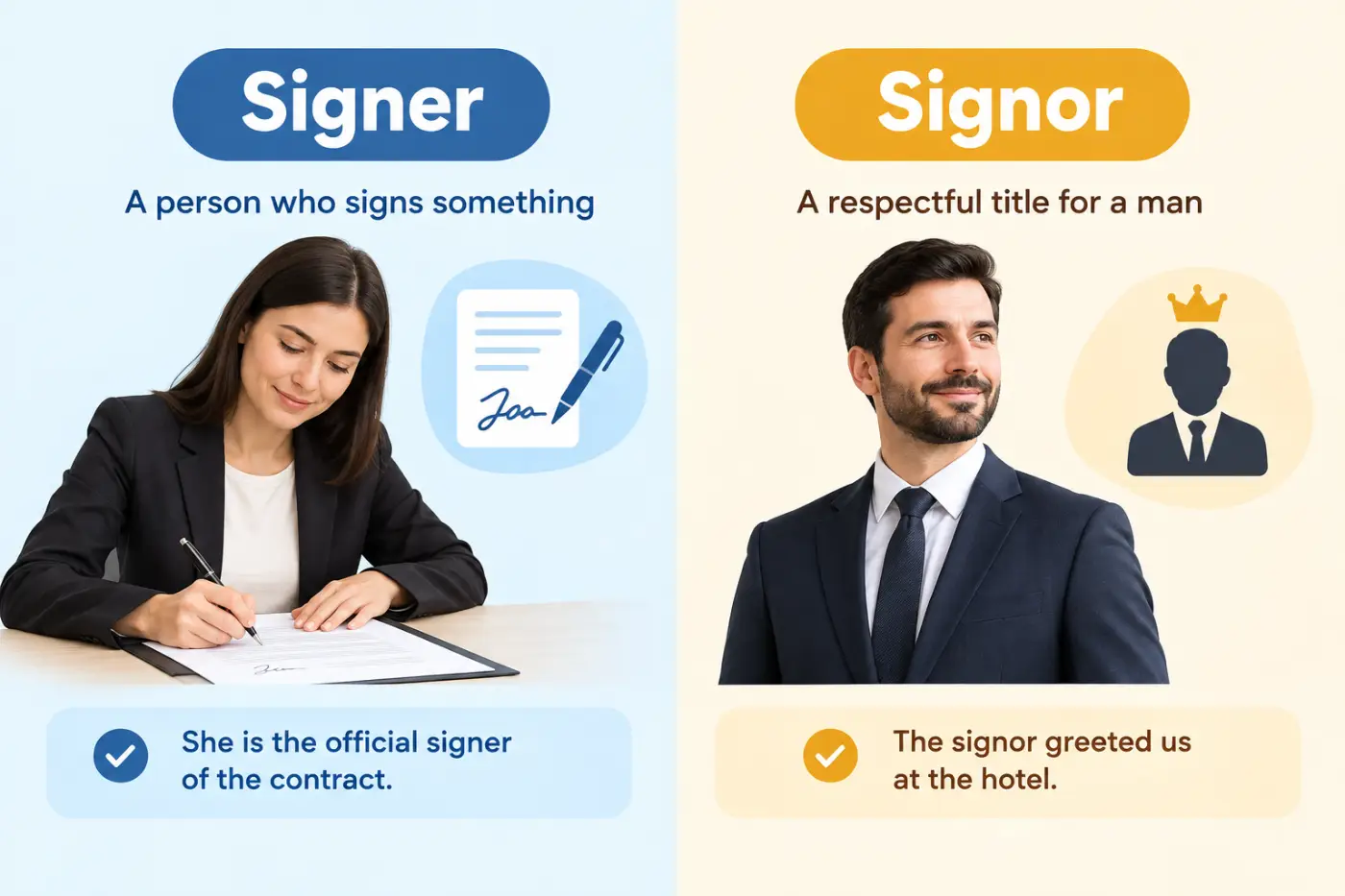
If you’re trying to decide between signer and signor, the right choice depends on what you mean. Signer is the correct word for a person who signs a document, contract, check, or other written record. Signor is an Italian title used to address or refer to a man, similar to Mr. in English.
The two words look almost the same, but they serve different purposes. Using the wrong one can make a sentence confusing, especially in business writing, legal documents, or formal communication.
For example, you might write, “The signer must date the agreement before submitting it.” Here, signer refers to the person who signs the agreement. However, in a sentence like “Signor Rossi will attend the meeting,” the word is a respectful Italian title.
This guide explains the difference between the two spellings, how to use each one, and which word fits common situations. You’ll also find practical examples, common mistakes, memory tips, and answers to frequently asked questions.
Quick Definition
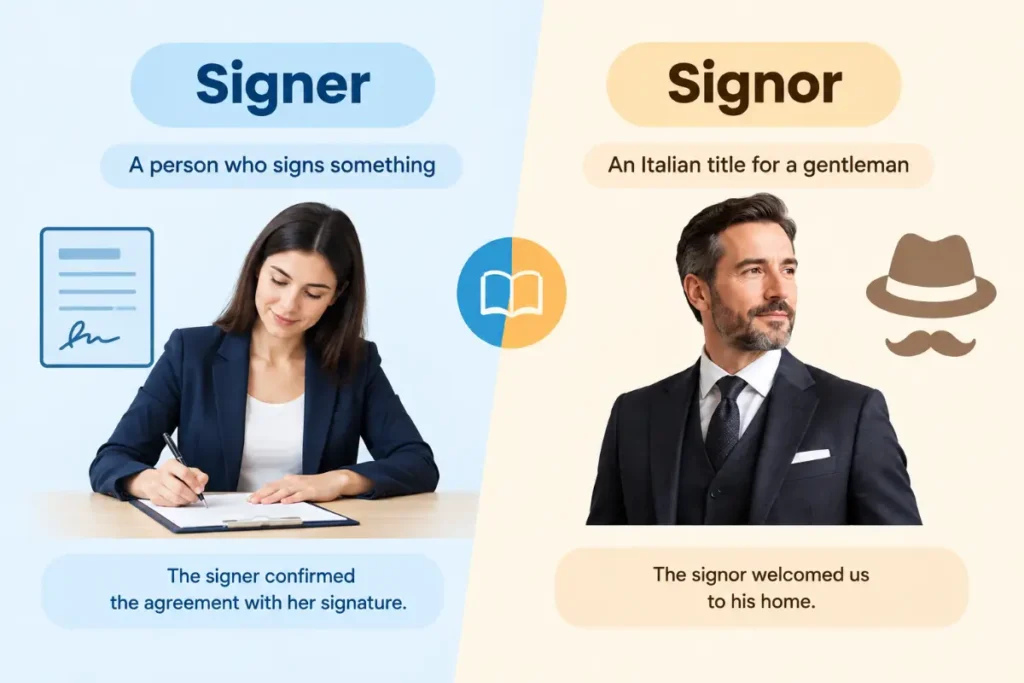
A signer is a person who signs a document or formally agrees to something by signing their name. A signor is an Italian title for a man, similar to Mr. or Sir in certain contexts. Although the words look alike, they have different meanings and aren’t interchangeable.
Direct Answer
Use signer when you mean someone who signs a document. Use signor when referring to a man with the Italian title Signor, usually before his surname.
Signer vs Signor at a Glance
| Word | Meaning | Example Sentence | When to Use It |
|---|---|---|---|
| Signer | A person who signs a document or record. | The signer approved the contract. | Legal papers, forms, checks, and agreements. |
| Signor | An Italian title for a man, similar to Mr. | Signor Bianchi welcomed the guests. | Italian names, formal address, and Italian cultural settings. |
The easiest way to choose is to look at the meaning of your sentence. If someone signs their name, use signer. If you’re addressing an Italian man by a traditional title, use signor.
What Signer Means and How to Use It
The word signer refers to a person who signs their name on a document. That document might be a contract, application, permission slip, check, or legal form.
The word comes from the verb sign. When you add the ending er to a verb, it can describe a person who performs the action. For example, a person who teaches is a teacher. A person who paints is a painter. In the same way, a person who signs is a signer.
This pattern makes the spelling easier to remember. If you need a word for someone who signs a document, signer is the natural choice.
Examples of Signer in Everyday English
Here are some natural sentences that show how to use the word.
- The signer must write their full name on the last page.
- Each signer received a copy of the agreement.
- The bank asked the signer to verify their identity.
- Both signers must approve the final contract.
- The signer forgot to add the date below their signature.
- Every signer needs to read the terms before agreeing to them.
- The final signer completed the paperwork just before noon.
- The form requires the signer’s address and phone number.
In each sentence, the word refers to someone who signs a document or record.
You can use signer in casual conversation and formal writing. It works well in business emails, banking instructions, legal paperwork, and everyday explanations.
For instance, a manager might say, “Please ask the signer to initial each page.” A bank employee might write, “The signer must provide valid identification.” Both sentences use the word correctly.
Signer in Legal Documents
Legal writing often uses signer to identify a person who signs a contract or other legal document. The term is useful because it describes the person’s action without requiring a long explanation.
Consider a rental agreement. A landlord may sign the document, and a tenant may sign it too. Both people are signers because both have signed the agreement.
However, the word signer doesn’t always tell you the person’s legal role. A signer might be a buyer, seller, tenant, landlord, witness, or company representative. The document and the surrounding facts explain that role.
For example, a contract might state, “Each signer confirms that they have read the agreement.” This wording refers to everyone who signs the contract.
In some legal settings, a signature may also show approval, consent, or acceptance of stated terms. Still, the legal effect of a signature depends on the document and the rules that apply to it. The word signer alone doesn’t prove that a person has full authority to make an agreement.
Signer in Banking and Business
Banks and businesses use the word signer when a person signs a check, approves a transaction, or signs an official record.
A business bank account may have several authorized signers. These are people the bank permits to sign certain documents or approve certain transactions under the account’s rules.
For example, a company might allow its owner and finance manager to sign checks. Both may be authorized signers, but the bank’s account terms determine what each person can do.
You might see sentences like these.
- Only an authorized signer can approve this transaction.
- The company added a new signer to its business account.
- Please ask the signer to complete the payment form.
- The bank needs the signature of every required signer.
Notice the phrase authorized signer. It doesn’t simply mean a person who can write their name. It means a person who has permission to sign for a particular account or organization.
This difference matters in business communication. A person may sign a document without having the legal power to bind a company to its terms.
Signer as a General Term
The word also appears outside contracts and banking. Anyone who signs a petition, card, statement, or public letter can be called a signer.
For example, “More than 500 signers supported the petition” means that more than 500 people signed it.
A signer might also sign a letter supporting a cause or a statement expressing a shared view. In these cases, the word identifies people who added their signatures to the same document.
The term is broad and practical. You don’t need to reserve it for legal papers or business records.
What Signor Means and How to Use It
Signor is an Italian title used before a man’s name. It is similar to Mr. in English and is often used as a respectful form of address.
For example, Signor Bianchi means Mr. Bianchi. You might see this title in Italian writing, translations, travel guides, historical stories, or conversations about Italian culture.
Unlike signer, the word doesn’t describe an action. It doesn’t mean that a person has signed anything. Instead, it serves as a title that goes with a man’s name.
This is the key difference between the two words. One identifies a person by an action. The other is a form of address.
Examples of Signor in Sentences
Here are some examples of the title in use.
- Signor Rossi greeted the visitors at the door.
- We had dinner with Signor Moretti and his family.
- Signor Bianchi will meet us at the station.
- The letter was addressed to Signor Ferrari.
- Signor Conti welcomed the guests to his home.
- The hotel manager asked Signor Romano to wait in the lobby.
- Signor Verdi was a respected member of the local community.
In these examples, Signor appears before a man’s surname. It expresses respect or follows a traditional Italian naming style.
You may also see the title in older books and formal translations. A writer might use it to preserve the setting and culture of a story.
Should You Capitalize Signor
Capitalize Signor when it appears as a title directly before a person’s name. For example, write “Signor Rossi arrived early.”
When discussing the word itself, lowercase is also appropriate. For example, “The Italian word signor is used as a title for a man.”
The same basic idea applies to many titles in English. We capitalize Mr. before a name, as in “Mr. Brown.” When discussing the general word mister, we usually write it in lowercase.
Follow the style used by the publication or document you’re writing. Consistency makes the text easier to read.
Signor and Italian Culture
The title Signor comes from Italian. It is related to the Italian word signore, which can mean a man, gentleman, or lord depending on the context.
In everyday Italian, signore is a common form of respectful address. Signor is often used before a surname or another name in certain constructions. You may see forms such as Signor Rossi in formal writing.
English readers often encounter Signor in books, travel writing, restaurant settings, and translations. It can help a writer preserve the cultural setting of a scene.
For example, a story set in Italy might say, “Signor Bellini opened the door and invited the visitors inside.” The title helps signal the setting and the respectful way the character is addressed.
In modern English writing, you usually don’t need to use Signor unless the Italian title is relevant. If you’re writing about an American man named Robert Bellini, you would normally call him Mr. Bellini in an English context unless you’re following an Italian naming convention or a specific style.
Is Signor the Same as Sir
Not exactly. Signor is an Italian title that often corresponds to Mr. in English. Sir is an English form of respectful address with its own uses.
The right translation depends on the setting. In many ordinary situations, Signor Rossi is best translated as Mr. Rossi, not Sir Rossi.
In English, sir can be used on its own when speaking politely to someone. For example, a worker might say, “Excuse me, sir.” The Italian title Signor generally appears with a name or surname.
So if you see Signor in a book or a letter, don’t assume it always translates directly to sir. In most standard English translations, Mr. is the closer match.
The Main Differences Between Signer and Signor
The easiest way to tell these words apart is to focus on what each one does in a sentence. One describes a person who signs something. The other is a title used with a man’s name.
Meaning and Grammar
Signer is a noun formed from the verb sign. It names the person who performs the action.
Signor is a title of address. It usually comes before an Italian man’s surname.
Look at these examples.
- The signer approved the form.
- Signor Ricci approved the dinner reservation.
The first sentence tells you what the person did. The second identifies a man by his title and surname.
You can also use signer in the plural. For example, “The signers completed the form.” The plural of signor is not formed by adding an s in ordinary English use. Italian has its own plural forms and usage rules, so keep the title in its proper language context.
Pronunciation Differences
The two words also sound different.
Signer is commonly pronounced SYE ner, with the first syllable sounding like the word sigh.
Signor is commonly pronounced seen YOR in English when used as the Italian title. The pronunciation may vary a little based on the speaker’s accent and language background.
The spelling gives you a useful clue. In signer, the g is silent, just as it is in the verb sign. In signor, the word follows an Italian pronunciation pattern.
If you are unsure which word you heard, consider the context. A discussion about contracts or forms probably calls for signer. A conversation about an Italian man or a traditional Italian title may call for signor.
Word Origins
Understanding the origins of these words makes their meanings easier to remember.
Signer comes from the English verb sign, which traces back through French and Latin roots connected with marks and signs. Over time, the ending er became a common way to name a person who performs an action.
Signor comes from Italian signore. The Italian word has roots in Latin senior, a term associated with an older or respected person. Its meaning developed into a title used to address or refer to a man.
Although the words have a related history through Romance language roots, modern English uses them for different purposes. Their similar appearance doesn’t make them interchangeable.
Common Mistakes to Avoid
The spelling confusion often happens because both words begin with the same letters. However, the meaning of the sentence should guide your choice.
Using Signor for Someone Who Signs a Document
This is one of the most common errors.
- Incorrect: The signor must sign the contract before Friday.
- Correct: The signer must sign the contract before Friday.
The first sentence uses an Italian title in a place where the writer needs a noun for a person performing an action. The second sentence expresses the intended meaning clearly.
Remember that a person can be a signer without having an Italian name or background. The word describes the action of signing.
Using Signer as a Title Before a Name
The opposite mistake can also happen.
- Incorrect: Signer Rossi welcomed the guests.
- Correct: Signor Rossi welcomed the guests.
If Rossi is being addressed by the traditional Italian title, use Signor. The word signer doesn’t serve as an honorific title.
An honorific is a word or title used to show respect, such as Mr., Ms., or Dr. In this case, Signor fills a similar role in an Italian context.
Confusing Signer With Signature
These two words are related, but they don’t mean the same thing.
A signer is the person who signs. A signature is the name or mark that person writes to identify themselves or show agreement.
For example, “The signer added a signature to the form” is correct. The sentence refers to a person and the mark they made.
You can remember the distinction by asking a simple question. Are you talking about the person or the mark? Use signer for the person and signature for the mark.
Assuming Every Signer Has Legal Authority
A person who signs a document isn’t always authorized to make decisions for another person or an organization.
For example, an employee might write their name on a company form. That doesn’t automatically mean they have the authority to approve a major purchase on behalf of the company.
In legal and business writing, terms such as authorized signer and authorized representative can carry more specific meanings. The relevant agreement and applicable rules determine the person’s authority.
Use signer when you mean someone who signs. Add more specific wording when the person’s role or authority matters.
Mixing Up Signor and Señor
Another source of confusion is the Spanish title señor. It is commonly used as a respectful title for a man and is similar to Mr. in English.
Signor is Italian. Señor is Spanish.
For example, Signor Bianchi follows an Italian naming convention, while Señor García follows a Spanish one.
The words look similar, but they belong to different languages. Keep the spelling that matches the language and context you’re using.
How to Remember the Correct Spelling
A simple memory trick can help you choose the right word without checking a dictionary every time.
Think of Signer as the Person Who Signs
The word signer contains the same base as sign. The ending er often names a person who performs an action.
Think of these familiar examples.
- A person who teaches is a teacher.
- A person who drives is a driver.
- A person who paints is a painter.
- A person who signs is a signer.
This pattern works well in everyday English. When your sentence refers to someone signing a form or agreement, choose signer.
Connect Signor With Italian Names
Think of Signor as the Italian equivalent of Mr. in many common situations.
If the word appears before a surname in a sentence about Italian culture, it may be the correct title.
For example, “Signor Moretti arrived at the restaurant” uses the title before a man’s surname.
This memory trick works because it links the word to a clear purpose. You don’t have to memorize a long grammar rule.
Use the Sentence Test
When you cannot decide between signer and signor, replace the word with a simple explanation.
- If you can replace it with “person who signs,” use signer.
- If you can replace it with “Mr.” before an Italian man’s name, use signor.
For example, consider the sentence, “The signer must provide identification.” Replacing signer with “person who signs” keeps the meaning intact.
Now consider, “Signor Romano will join us for dinner.” Replacing Signor with “Mr.” preserves the intended title.
This quick test works in most everyday situations.
Related Words That Are Easy to Confuse
Learning a few related terms can prevent other spelling and usage mistakes.
Signer vs Signatory
A signer is a person who signs a document. A signatory is also a person or organization that signs an agreement or becomes a party to it.
The terms overlap, especially in legal and formal writing. However, signatory often appears in discussions about treaties, contracts, and official agreements.
For example, “The signer completed the form” is a natural choice for routine paperwork. “Each signatory agreed to the terms of the treaty” is a natural choice for a formal international agreement.
In many contexts, either word may be accurate. Choose the one that best fits the document and the level of formality.
Signer vs Cosigner
A cosigner is a person who signs an agreement alongside another person and accepts certain responsibilities under its terms.
For example, a parent may cosign a loan for a child. Both people sign the relevant paperwork, but the cosigner may take on additional financial responsibilities.
A cosigner is a type of signer, but the terms aren’t identical. Use signer when you mean any person who signs. Use cosigner when the person signs alongside someone else under a specific arrangement.
Signer vs Witness
A witness is someone who observes an event or action. In document signing, a witness may observe another person’s signature and sign the document to confirm what they saw.
The witness and the person signing the main document may have different roles.
For example, “The signer completed the agreement while the witness observed” clearly separates the two people.
A witness may also sign the document, but that doesn’t automatically make the witness a party to the agreement. The role depends on the document and the rules that apply.
Signer vs Signature
A signature is the name or mark a person writes to identify themselves or show approval. A signer is the person who creates that signature.
For example, “The signer forgot to add a signature to the final page” uses both words correctly.
This distinction is useful when writing instructions for forms. If you need a person to take action, refer to the signer. If you need the written mark, refer to the signature.

How to Choose the Right Word in Different Situations
The setting often makes the answer clear. Here are a few common situations and the word that fits each one.
In Emails and Office Documents
Use signer when asking someone to complete or approve paperwork.
For example, you might write, “Please notify the signer when the document is ready.”
You could also write, “The final signer needs to date the form before sending it back.”
These sentences are clear because they identify the person responsible for signing.
In Contracts and Official Forms
Use signer when referring to a person who signs a document. If the person has a special role, such as a witness or authorized representative, name that role when it matters.
For example, “Each signer must review the terms before signing the agreement.”
For a more specific instruction, you could write, “The authorized signer must approve the purchase.”
The second sentence explains that the person needs permission to act for the organization.
In Italian Writing and Translation
Use Signor when the Italian title is appropriate.
For example, “Signor De Luca thanked the guests for attending.”
If you’re translating the sentence into everyday American English, Mr. De Luca may sound more natural. The best choice depends on the intended audience and the style of the text.
If you’re preserving an Italian setting, keeping Signor may help maintain the original tone.
In Schoolwork and Grammar Exercises
If you’re answering a spelling question, focus on the meaning of the sentence.
A sentence about signing a permission slip calls for signer. A sentence that addresses an Italian man by title calls for Signor.
For example, “The signer returned the permission slip” is correct. “Signor Bellini returned the book” is also correct if Bellini is being addressed by his Italian title.
Both spellings are valid words. The task is to select the one that matches the intended meaning.
FAQs
Is signer or signor the correct spelling?
Both spellings are correct, but they have different meanings. Use signer for a person who signs a document. Use signor as an Italian title for a man.
Does signor mean someone who signs?
No. Signor is an Italian title, not the usual word for a person who signs something. The correct word for that person is signer.
Is signor the same as Mr.?
Yes, in many common contexts. Signor is an Italian title that often translates as Mr. in English. The exact translation depends on the context.
What is the plural of signer?
The standard plural is signers. For example, “All signers must complete the form.” The word refers to two or more people who sign a document.
Can I use signer in a legal document?
Yes. Signer is commonly used in legal and business documents to refer to a person who signs. If the person’s authority or legal role matters, use a more precise term when needed.
Is signor an English word?
Yes. English uses signor as a borrowed Italian title, especially in writing about Italian people and culture. It isn’t the standard English term for someone who signs a document.
What is the difference between signer and signatory?
Both terms refer to someone who signs a document or agreement. Signer is common in everyday and business writing, while signatory often appears in formal or legal contexts. The best choice depends on the sentence.
How can I remember the difference between signer and signor?
Connect signer with the verb sign. A signer is a person who signs. Connect signor with the Italian title used before a man’s name.
Conclusion
The choice between signer or signor comes down to meaning. A signer is someone who signs a document, form, contract, or other record. A signor is an Italian title used before a man’s name.
In everyday American English, you’ll most often need signer when writing about paperwork, business agreements, bank forms, and signatures. Use signor when the Italian title fits the person and the context.
Before choosing a spelling, read the whole sentence and ask what the word needs to mean. If it refers to the person doing the signing, write signer. If it introduces an Italian man’s name as a title, write Signor.

Sienna Watson is a veteran copywriter and communications coach who has helped startup founders, marketers, and professionals polish their writing for over a decade. Realizing that most people don’t need a degree in linguistics—just clear, impactful communication—Sienna focuses on practical grammar, business writing etiquette, and eliminating wordiness. She advocates for plain language, strong verbs, and persuasive prose that gets results.