
If you’re searching stellar vs steller you probably want to know which spelling belongs in your sentence. The answer is simple in most cases. Stellar is the standard English word when you mean excellent or related to stars. Steller usually appears as a proper name or in the names of animals and other things named after the naturalist Georg Wilhelm Steller.
These two words look almost identical. Only one letter changes position. That small difference can cause a surprising amount of confusion. You might see both forms in books and online and wonder if they have different meanings or if one is simply a spelling mistake.
The good news is that the meanings are quite different. Once you know what each form refers to you can usually choose the right one without stopping to second guess yourself. This guide explains the meanings of both words and shows how to use them in natural sentences.
You will also learn why Steller appears in names such as Steller’s jay and Steller’s sea lion. Along the way we will cover common mistakes and simple ways to remember the difference.
Quick Definition
Stellar is an English adjective that means related to stars or exceptionally good. You might describe a stellar performance a stellar career or a stellar night sky.
Steller is mainly used as a proper name. It appears in names connected with Georg Wilhelm Steller and in the names of several plants and animals.
Direct Answer
Stellar is the correct word when you mean excellent or related to stars. Steller is generally used as a proper name or as part of a name such as Steller’s jay.
Comparison Table
| Word | Meaning | Example Sentence | When To Use It |
|---|---|---|---|
| Stellar | Related to stars or exceptionally good. | She gave a stellar performance. | Use it for stars or something outstanding. |
| Steller | A proper name linked to Georg Wilhelm Steller. | We saw a Steller’s jay in the yard. | Use it in established names and proper nouns. |

What Does Stellar Mean
Stellar has two closely related meanings. The first meaning is connected to stars. The second meaning describes something that is exceptionally good.
The word comes from the Latin word stella which means star. That connection explains why you may see it in astronomy and other writing about space. For example you might read about stellar objects stellar systems or stellar evolution.
In everyday English the word often has a more figurative meaning. When someone calls a performance stellar they are saying it was excellent. The same idea applies to work results service achievements or other things that stand out.
For example you might say:
- The singer gave a stellar performance.
- She has had a stellar career in medicine.
- Our sales team had a stellar month.
- He received stellar reviews for his new book.
In each sentence the word means excellent or impressive. It does not mean that the person or thing is literally connected to a star.
Stellar In Astronomy
The scientific meaning of stellar is more specific. It refers to stars or things related to stars.
For example astronomers may talk about stellar formation. This means the process through which stars form.
They may also discuss stellar evolution. This refers to the changes a star goes through during its life.
Other common terms include stellar mass stellar radiation and stellar atmosphere. These terms all relate to stars.
Consider this sentence:
- Astronomers studied the stellar activity of the distant star.
Here stellar has its literal meaning. It tells us that the activity is related to a star.
Stellar In Everyday English
You do not need to be talking about space to use stellar. In everyday American English it often works as a strong synonym for excellent outstanding or impressive.
For example:
- Your presentation was stellar.
- She did a stellar job on the project.
- The restaurant received stellar reviews.
- He has a stellar reputation in the industry.
This use is common in casual speech as well as professional writing. It adds more energy than simply saying good.
If someone tells you that you did a stellar job they are giving you strong praise. They are saying that your work was far above average.
Why Stellar Can Mean Excellent
The connection between stars and excellence is easy to understand. Stars have long been used as symbols of quality and success. A five star hotel suggests a high level of service. A star performer is someone who stands out from the group.
The figurative meaning of stellar grew from that same idea. Something stellar stands out like a bright star.
That gives the word a useful image without making the sentence complicated. Compare these two examples:
- She gave a good performance.
- She gave a stellar performance.
The first sentence gives simple praise. The second sounds stronger. It tells the reader that her performance was especially impressive.
You can use the word for people as well as things. Someone can have a stellar career. A student can have stellar grades. A company can have a stellar reputation.
The word usually works best when you have a clear reason for the praise. Instead of adding it to every positive sentence use it when something truly stands out.
What Does Steller Mean
Steller is different from stellar. It is not the normal spelling of the adjective that means excellent. Instead it is mainly found as a proper name.
One important source of this name is Georg Wilhelm Steller. He was an eighteenth century German naturalist and explorer whose work included the study of plants and animals in parts of northern Asia and the Pacific region.
Several species were named after him. That is why you may encounter Steller in names that have nothing to do with the ordinary English adjective stellar.
For example you may see:
- Steller’s jay.
- Steller’s sea eagle.
- Steller’s sea lion.
- Steller’s eider.
These names use Steller because they refer to the person after whom the species was named.
That distinction matters. If you are writing about a bird and you use its established name then Steller is correct. If you are praising the bird’s appearance then stellar may be the word you want.
Consider the difference:
- We saw a Steller’s jay near the trail.
- The bird had a stellar display of color.
The first sentence uses a proper name. The second uses an adjective that means impressive.
The Story Behind Steller
The name Steller comes from Georg Wilhelm Steller. He was born in Germany in 1709 and later became known for his work as a naturalist.
Steller joined the Second Kamchatka Expedition led by Vitus Bering. During his travels he studied and described many species. His observations became an important part of the scientific record for the region.
His name later became attached to several species. That is why Steller still appears in natural history today.
This background gives you a useful memory clue. When you see Steller in the name of an animal or another named subject it often points back to the naturalist.
You do not need to memorize his biography to spell the word. Just remember that Steller is often a name while stellar is the everyday English adjective.
Stellar And Steller In Real Sentences
Context usually makes the difference clear. Look at these examples and notice how the two forms serve different purposes.
Stellar As Praise
- The student gave a stellar presentation.
- Her performance was stellar from start to finish.
- The team received stellar feedback from its customers.
- He built a stellar reputation over many years.
In these examples stellar means excellent or impressive.
Stellar In Science
- The researchers examined stellar activity.
- The telescope captured a detailed view of stellar gas.
- Scientists are studying stellar formation.
- The paper discusses stellar evolution.
Here stellar relates directly to stars.
Steller As A Name
- We spotted a Steller’s jay in the backyard.
- The guide helped us identify a Steller’s sea lion.
- The museum displayed information about Steller’s discoveries.
- The book describes the work of Georg Wilhelm Steller.
In these sentences Steller refers to a name rather than a general adjective.
The key is context. If you mean excellent then use stellar. If you are referring to Steller or something named after him then use Steller.
Part 2 continues with the main body and keeps the same paragraph style.
When To Use Stellar
The easiest way to choose stellar is to ask what you mean by the word. If you’re describing something as excellent impressive or outstanding then stellar is the natural choice. You can also use it when you’re talking about stars or something connected to them.
For example you could tell a coworker that they did a stellar job. You could describe a student’s stellar grades or a company’s stellar record. In science writing you might use the word to describe stellar objects or stellar activity.
The word works as an adjective. That means it describes a person place thing or idea. It can appear before a noun or after a linking verb.
Stellar Before A Noun
When it comes before a noun the adjective adds information about that noun.
- She delivered a stellar performance.
- The company has a stellar reputation.
- Scientists observed unusual stellar activity.
- He received stellar reviews for his first novel.
The meaning comes from the context. In the first two examples the word means excellent. In the third example it relates to stars. The fourth example uses it as praise.
Stellar After A Linking Verb
You can also place the adjective after verbs such as is was seems and looks.
- Her performance was stellar.
- His work has been stellar this year.
- The results look stellar.
- The reviews were stellar.
This structure sounds natural in everyday American English. It also works well in professional writing when you want to give clear praise.
When To Use Steller
Use Steller when the word forms part of a proper name or refers to Georg Wilhelm Steller. The capital letter can give you an important clue.
For example Steller’s jay is the established name of a North American bird. Steller’s sea lion is the name of a large sea lion found around the North Pacific.
In these cases changing the spelling to stellar would change the name. The word is not describing something as excellent. It identifies a person or a species associated with that person.
Steller’s Jay
Steller’s jay is a striking bird found across parts of western North America. It has a dark crest and strong coloring that makes it easy to recognize.
The name contains Steller because the bird was named for Georg Wilhelm Steller.
For example:
- We saw a Steller’s jay near the campground.
- A Steller’s jay landed on the fence.
- The field guide has a page about Steller’s jays.
Notice that the spelling stays the same in each sentence.
Steller’s Sea Lion
Steller’s sea lion is another familiar scientific name that uses Steller. It is named after Georg Wilhelm Steller and is the largest member of the eared seal family.
For example:
- The researchers observed a group of Steller’s sea lions.
- Steller’s sea lions live in the North Pacific.
- The documentary showed a Steller’s sea lion resting on a rocky shore.
Again the word is part of a proper name. It does not mean excellent.
Stellar Vs Steller In Common Writing
The difference becomes much easier when you look at sentences side by side. The spelling changes because the meaning changes.
Consider these examples.
- She gave a stellar presentation.
- We saw a Steller’s jay outside the window.
The first sentence praises the presentation. The second identifies a bird.
Now look at another pair.
- He has had a stellar career.
- The guide describes Steller’s work as a naturalist.
The first sentence says his career has been highly successful. The second sentence refers to Georg Wilhelm Steller.
This distinction works across many examples. Stellar describes something or connects it with stars. Steller identifies a name.
Common Spelling Mistakes
The most common mistake is using steller when you mean excellent. Because the two forms look so similar it is easy to add the extra e without thinking.
For example this sentence is incorrect.
- She did a steller job on the report.
The correct sentence is:
- She did a stellar job on the report.
Another common mistake happens when people write the name of an animal. Someone may see Steller’s jay and assume the word should have the same spelling as stellar because the two words sound alike.
That would be incorrect. The bird’s name uses Steller.
Incorrect And Correct Examples
| Incorrect | Correct |
|---|---|
| She gave a steller performance. | She gave a stellar performance. |
| He has a steller reputation. | He has a stellar reputation. |
| We saw a stellar’s jay. | We saw a Steller’s jay. |
| The guide mentioned a stellar sea lion. | The guide mentioned a Steller’s sea lion. |
These errors are easy to fix once you connect each spelling with its meaning.
Why The Two Words Sound Confusing
In normal speech stellar and Steller are pronounced very similarly. In many accents they sound the same or nearly the same. That means you can’t always hear the spelling difference.
This is a classic example of why English spelling sometimes requires attention to context. Sound alone doesn’t always tell you which letters belong on the page.
Think about the sentence before choosing the spelling. If you’re praising someone’s work then stellar is probably what you need. If you’re naming a species or referring to Georg Wilhelm Steller then Steller is the right form.
This simple habit can prevent most mistakes.
Is Stellar Always About Stars
No. In modern English stellar has a common figurative meaning that has little to do with astronomy.
When someone says stellar performance they aren’t talking about a performance involving stars in space. They’re saying the performance was excellent.
The same thing happens with many other expressions.
- Stellar grades mean excellent grades.
- A stellar career means a highly successful career.
- Stellar service means outstanding service.
- A stellar review is a very positive review.
- A stellar result is an excellent result.
This figurative use is common in American English. It gives the sentence a stronger sense of praise than words such as good or nice.
Still you don’t need to use it every time you want to praise something. Words such as excellent outstanding impressive and exceptional can work just as well. Choose the word that fits the tone of your sentence.
Is Steller A Regular English Word
Not in the same way as stellar. Steller is mainly encountered as a proper name and in established names connected with Georg Wilhelm Steller.
You might see it in a history book a wildlife guide a scientific article or an encyclopedia. You may also encounter the surname Steller as a person’s family name.
That means you shouldn’t treat the two spellings as interchangeable forms of the same adjective. They have different roles in English.
If you’re writing a normal sentence about something being excellent use stellar. If you’re writing a proper name such as Steller’s jay keep the spelling Steller.
How Context Helps You Choose
When you’re unsure which spelling to use pause and look at the word’s job in the sentence.
If it describes quality ask yourself if you could replace it with excellent. If the answer is yes then stellar is probably correct.
For example:
- She gave a stellar performance.
You could replace stellar with excellent without changing the basic meaning.
- She gave an excellent performance.
Now try a proper name.
- We saw a Steller’s jay in the park.
You can’t replace Steller’s with excellent. The word is part of the bird’s name. That tells you you’re dealing with Steller rather than the adjective stellar.
This substitution trick works well because it focuses on meaning instead of appearance.
A Simple Memory Trick
Try connecting the word stellar with star. Both relate to the idea of stars and both can point to something that stands out.
- When you see stellar think star or excellent.
- When you see Steller think Steller the naturalist.
That small mental link can save you from mixing up the two forms.
You can also remember the extra e in Steller as part of the person’s name. The name doesn’t change just because you’re talking about an animal or another subject named after him.
The goal isn’t to memorize a complicated rule. You simply want two clear mental boxes.
- Stellar belongs with stars and strong praise.
- Steller belongs with the name Steller and things named after him.
Once those boxes are clear the spelling becomes much easier.
Part 3 continues with related usage, word history, examples, and memory tips.
Stellar Vs Steller In Different Types Of Writing
The spelling you choose can depend on the kind of writing you’re doing. Stellar appears in everyday writing as well as scientific and professional content. Steller appears much less often because it usually belongs to a name.
In a work email you might write that a coworker did a stellar job. In a science article you might read about stellar evolution.
The surrounding words usually make the meaning clear.
In School Writing
Students can use stellar when they want to describe excellent work.
- Maya earned stellar grades this semester.
- The class gave a stellar presentation.
- His essay received stellar feedback from the teacher.
In these examples the word describes quality. It has a positive meaning and works much like excellent or outstanding.
Steller can also appear in school writing if the topic involves nature or history.
- The students learned about Georg Wilhelm Steller.
- The class studied Steller’s jay during the bird unit.
The subject of the sentence tells you which spelling belongs there.
In Business Writing
Stellar is common in business writing when someone wants to praise results or performance.
- The company had a stellar year.
- She has built a stellar reputation in the industry.
- Our customer service team received stellar reviews.
The word can sound stronger than good but still feels natural. It works best when the results support the praise.
You may want to avoid using it too often in formal reports. If every result is described as stellar the word loses some of its impact. Use it when something genuinely stands out.
In Science Writing
Scientific writing often uses stellar in its literal sense.
- Scientists observed changes in stellar activity.
- The study examines stellar formation.
- The telescope captured a distant stellar system.
Here the word relates to stars. It doesn’t mean excellent.
Steller may also appear in scientific writing when researchers discuss a species named after Georg Wilhelm Steller.
- Researchers tracked Steller’s sea lions along the coast.
- The study examined the behavior of Steller’s eiders.
This difference is useful because both words can appear in the same field while serving completely different purposes.
Stellar Does Not Mean The Same Thing As Star
The words are related but they don’t have the same grammatical role.
Star can be a noun or a verb. A star is a bright object in space. As a verb it can mean to feature someone in a movie or show.
Stellar is an adjective. It describes something connected with stars or something excellent.
For example:
- The star was visible through the telescope.
- The movie stars a well known actor.
- The scientists studied stellar activity.
- She gave a stellar performance.
The first sentence uses star as a noun. The second uses it as a verb. The third uses stellar in a scientific sense. The fourth uses it as praise.
Knowing the parts of speech can make word choice much easier.
Stellar And Excellent
When stellar means excellent it can often replace words such as outstanding impressive exceptional remarkable or first rate.
Consider these examples.
- She gave an excellent performance.
- She gave a stellar performance.
Both sentences praise her performance. The second has a little more energy and often sounds more expressive.
You can also say:
- He has an outstanding record.
- He has a stellar record.
Or:
- The restaurant received excellent reviews.
- The restaurant received stellar reviews.
The meaning stays close in each pair. The choice comes down to tone and style.
When Stellar Sounds Too Strong
Although stellar is a useful word it doesn’t fit every positive situation.
Suppose someone sends you a basic message and you reply with a simple answer. Calling the message stellar would sound strange unless there is something truly impressive about it.
The word carries strong praise. Use it when you want to show that something stands above the ordinary.
For example this sounds natural:
- The team delivered a stellar performance during the final match.
This sounds less natural:
- I had a stellar glass of water with dinner.
The second sentence uses a strong word for something that doesn’t normally call for that level of praise. Good word choice depends on context as much as grammar.
Common Phrases With Stellar
Some combinations appear often enough that they are worth learning as complete phrases.
Stellar Performance
This means an excellent performance.
- The actor gave a stellar performance in the new film.
It can refer to acting music sports work presentations or almost any other kind of performance.
Stellar Career
This describes a very successful career.
- She built a stellar career in journalism.
It suggests that the person’s career includes notable success or achievement.
Stellar Reputation
This means an excellent reputation.
- The lawyer has a stellar reputation among her clients.
The phrase often appears in professional writing.
Stellar Reviews
This means very positive reviews.
- The hotel received stellar reviews from guests.
It can describe reviews for restaurants hotels products books movies and many other things.
Stellar Results
This describes results that are especially good.
- The new study produced stellar results.
The phrase works best when the results are clearly stronger than expected.
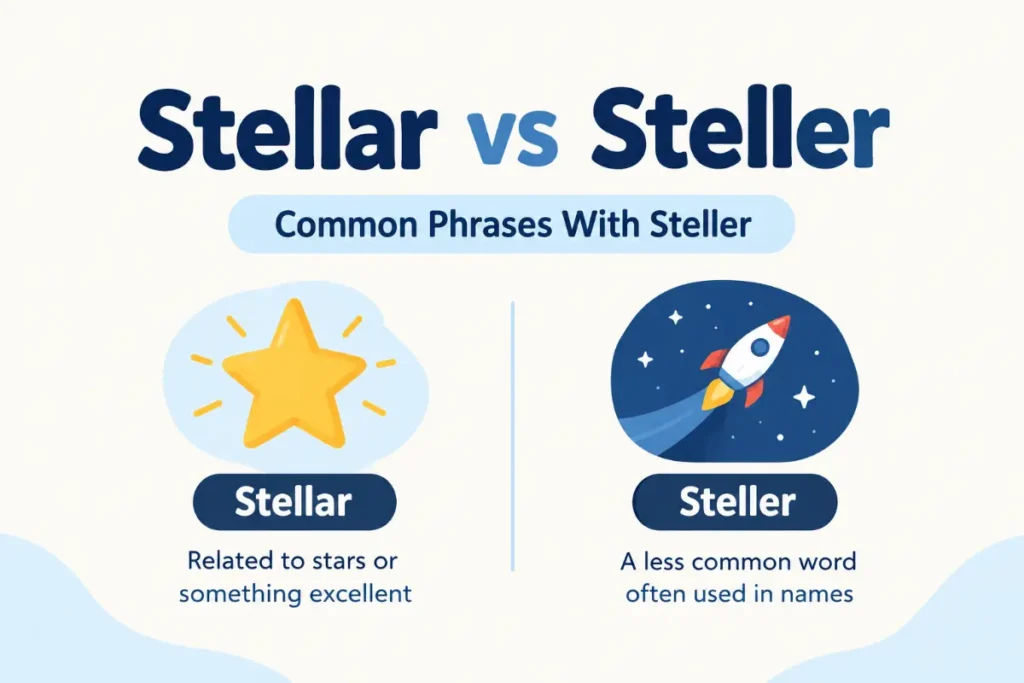
Common Phrases With Steller
Unlike stellar there aren’t many everyday phrases built around Steller. That’s because it usually appears as part of a proper name.
Some common examples include Steller’s jay and Steller’s sea lion. You may also encounter Steller’s eider and Steller’s sea eagle in wildlife and scientific writing.
The spelling stays Steller in these names. Don’t change it to stellar simply because the words sound alike.
Steller’s Jay
Steller’s jay is a bird found mainly in western North America and parts of the interior West. It is known for its dark crest and blue and black coloring.
A natural sentence would be:
- A Steller’s jay landed on the branch outside our cabin.
The name is capitalized because it contains the surname Steller.
Steller’s Sea Lion
Steller’s sea lion is a large marine mammal found in the North Pacific.
You might see it in wildlife articles documentaries and scientific studies.
- The researchers watched a group of Steller’s sea lions from the boat.
Again the spelling comes from the name of Georg Wilhelm Steller.
Does The Capital Letter Matter
Sometimes it does.
When Steller appears as part of a proper name it is normally capitalized. For example Steller’s jay and Steller’s sea lion use a capital S because Steller is a surname.
The adjective stellar is normally lowercase unless it begins a sentence.
Compare these examples:
- She gave a stellar performance.
- We saw a Steller’s jay near the lake.
The capital letter isn’t the only clue but it can help you spot the difference quickly.
You should still pay attention to meaning. A word can appear in different contexts and capitalization rules can vary in some names and titles.
Is Steller A Misspelling Of Stellar
No. The two forms are separate words with different uses.
- Stellar is an established English adjective. It has both a literal meaning connected with stars and a figurative meaning connected with excellence.
- Steller is mainly a surname and a name used in several species names. It comes from Georg Wilhelm Steller.
That means neither spelling is simply a bad version of the other. The right choice depends on what you’re trying to say.
This is similar to many English words that look almost alike but have different meanings. A small spelling change can create a completely different word.
A Quick Test For Choosing The Right Word
When you hesitate between the two forms try this simple test.
First ask if you’re describing something as excellent. If you are then use stellar.
Next ask if you’re talking about stars or something related to stars. If you are then use stellar again.
Finally ask if you’re using a person’s name or an established name connected with Georg Wilhelm Steller. If so use Steller.
For example:
- She delivered a stellar speech.
The speech was excellent. Use stellar.
- Astronomers studied stellar activity.
The activity relates to stars. Use stellar.
- We saw a Steller’s jay.
The word is part of a bird’s name. Use Steller.
This test takes only a few seconds and covers most situations you’ll encounter.
More Examples To Build Confidence
The best way to make a spelling distinction stick is to see it used in different settings. Read these examples and notice how the meaning changes.
- The restaurant provided stellar service throughout the evening.
- The astronomers observed unusual stellar activity.
- She earned stellar grades during her final year.
- A Steller’s jay appeared near the bird feeder.
- His team had a stellar season.
- The documentary featured Steller’s sea lions.
- The company has a stellar record for customer service.
- Scientists examined the stellar system with a powerful telescope.
- We watched a Steller’s sea eagle from a safe distance.
- Her stellar performance earned a long round of applause.
The pattern becomes clear when you compare the examples. The adjective stellar either relates to stars or gives strong praise. The form Steller points to a name.
A Simple Memory Trick That Actually Works
You don’t need a long spelling rule to remember these words. Give each one a clear mental image.
For stellar think of a star shining in the night sky. Then connect that image with something excellent. A star stands out from everything around it. That’s the same basic idea behind the figurative meaning of the word.
For Steller think of a person’s surname. Then connect it with Steller’s jay or Steller’s sea lion. The extra e belongs to the name.
You can make the trick even stronger by saying the two forms aloud while thinking about their meanings.
Stellar means stars or excellent.
Steller points to Steller the naturalist or something named after him.
Simple associations are often easier to remember than complicated spelling rules.
Why Context Is Your Best Clue
Sometimes spelling rules don’t give you the answer. Meaning does.
Imagine you see this sentence:
- The singer gave a ___ performance.
You know the writer wants to praise the singer. The natural word is stellar.
Now imagine this sentence:
- We photographed a ___ jay during our hike.
The phrase points to a specific bird. The established name is Steller’s jay.
The words around the blank give you the clue. This is why reading the whole sentence is often more useful than staring at the two spellings by themselves.
If you develop that habit you’ll make fewer mistakes with many other confusing word pairs too.
Related Words Worth Knowing
Understanding related vocabulary can strengthen your grasp of the difference.
For stellar the closest everyday alternatives include excellent outstanding impressive exceptional and remarkable. In astronomy it can relate to terms such as star stellar system stellar mass and stellar evolution.
For Steller the related words are mostly proper names and species names. Georg Wilhelm Steller is the key connection. Steller’s jay and Steller’s sea lion are two of the most familiar examples.
These groups should stay separate in your mind. One describes a quality or a connection to stars. The other identifies a person or something named after that person.
FAQs
Is stellar or steller correct?
Both spellings can be correct but they don’t have the same use. Stellar is the standard adjective for something related to stars or something excellent. Steller is mainly a surname or part of a name such as Steller’s jay.
Is stellar a word for excellent?
Yes. Stellar can mean excellent outstanding or very impressive. For example you can say that someone gave a stellar performance or did a stellar job.
Is Steller’s jay spelled with stellar?
No. The bird’s name is Steller’s jay. It uses Steller with an e because the name comes from Georg Wilhelm Steller.
Why is Steller’s jay spelled differently?
Steller’s jay was named after Georg Wilhelm Steller. The spelling preserves his surname. It isn’t an alternative spelling of the adjective stellar.
Can stellar describe a person?
Yes. You can use stellar to describe someone’s work career performance record or reputation. For example you could say that an employee has a stellar record.
Does stellar mean related to stars?
Yes. Its original and literal meaning is related to stars. You may see it in terms such as stellar evolution stellar mass and stellar activity.
Can I use stellar to mean very good?
Yes. This is a common figurative use of the word. If something is far above average you can describe it as stellar.
Is steller an adjective?
Usually no. Steller is mainly used as a proper name or as part of a proper name. It shouldn’t replace stellar when you want to say that something is excellent.
Conclusion
The difference between stellar vs steller becomes simple once you connect each spelling with its meaning. Use stellar when you mean excellent impressive or related to stars. Use Steller when you mean the surname or a name based on Georg Wilhelm Steller.
The adjective stellar works in many everyday sentences. You can praise a stellar performance describe a stellar career or talk about stellar results. In science it has a more direct meaning and describes something connected with stars.
The name Steller appears in subjects such as Steller’s jay and Steller’s sea lion. These names refer to the naturalist Georg Wilhelm Steller. The extra e isn’t a spelling error in these cases. It is part of the proper name.
When you’re unsure which form belongs in your sentence think about the meaning first. If you’re talking about excellence or stars choose stellar. If you’re referring to Steller or something named after him choose Steller. That simple distinction will keep your writing clear and accurate.

Dr. Elena Vance holds a Ph.D. in Linguistics from Columbia University and has spent over 15 years analyzing the evolution of the English language. A former university professor turned full-time writer and editor, Elena specializes in breaking down high-level grammatical concepts, punctuation nuances, and style guides (APA, Chicago, MLA) into clear, actionable advice. When she isn’t hunting down dangling modifiers, she can be found collecting vintage dictionaries and reading classic literature.