

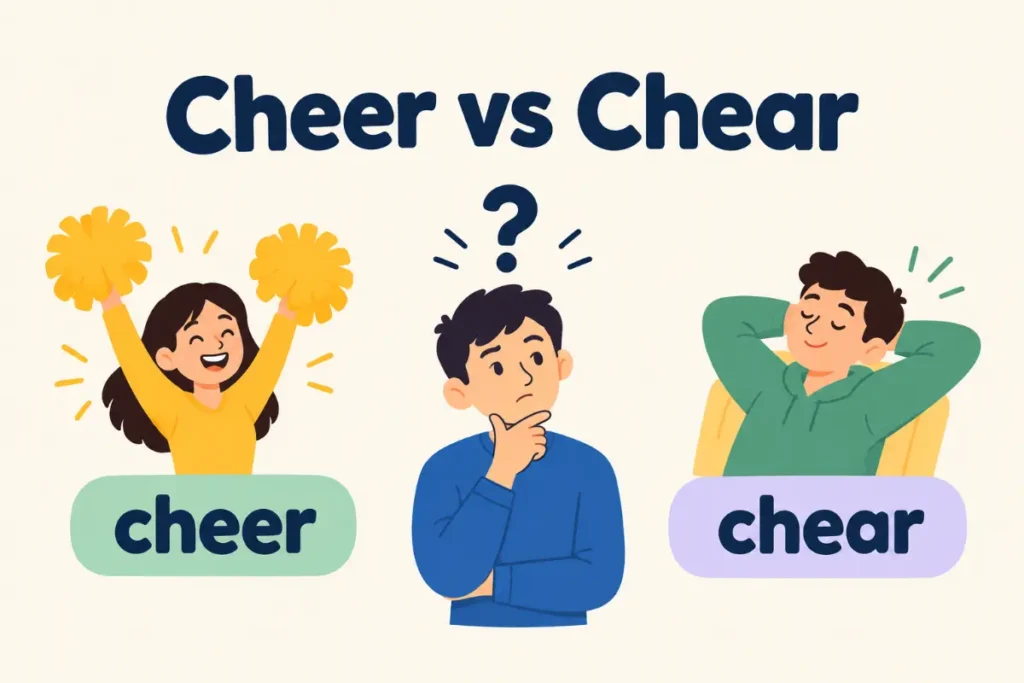
If you’re wondering about cheer vs chear the answer is simple. Cheer is the correct English spelling. Chear is an old spelling that you may see in historical texts but it isn’t the standard spelling used in modern American English.
The confusion usually comes from the sound of the word. When you hear cheer in a sentence you can’t tell which letters someone would use to spell it. That can make the word easy to mistype. The good news is that once you know the correct spelling and a few related words the choice becomes much easier.
The word cheer has several meanings. It can describe happiness or encouragement. It can also mean to shout or clap to support someone. In another use it can describe someone’s mood. This article explains all of these meanings and shows how to use the word naturally in everyday writing.
You’ll also see why the older spelling can cause confusion. Along the way we’ll look at common phrases such as cheer up and three cheers. You’ll get plenty of examples so you can recognize the word and spell it correctly without stopping to think about it.
Quick Definition
Cheer is the standard modern English spelling. It can mean happiness and good spirits or it can mean words sounds and actions used to encourage someone. Chear is an obsolete spelling and isn’t normally used in modern American English.
Direct Answer
Cheer is the correct spelling for modern English. Use chear only when you are deliberately reproducing an older historical spelling or discussing an old text.
Comparison Table
| Word | Meaning | Example Sentence | When To Use It |
|---|---|---|---|
| Cheer | Happiness encouragement or loud support. | The crowd began to cheer for the team. | Use this spelling in modern English. |
| Chear | An obsolete form of cheer. | The old text used the spelling chear. | Use only when discussing historical writing. |
Why The Spelling Causes Confusion
The main reason people hesitate over this word is pronunciation. Cheer has a long vowel sound followed by the r sound. Nothing about that sound tells you that the word should contain the letters ee.
English has many words where spelling cannot be predicted perfectly from pronunciation. Words such as deer fear near and clear have similar vowel patterns. Seeing these words together can help you recognize the spelling pattern in cheer.
There is another source of confusion too. Older English texts sometimes use spellings that look unusual to modern readers. If you’ve come across the form chear in an old book or historical document you might reasonably wonder if both forms are still accepted today.
They aren’t equal in modern usage. Cheer is the normal spelling you should use in an email school assignment article text message or professional document. The older form belongs mainly to historical writing.
What Does Cheer Mean
The word cheer has more than one common meaning. Understanding the meaning in a sentence helps you know how the word works and makes it easier to use naturally.
One meaning is a feeling of happiness or a positive mood. When someone is cheerful they seem happy friendly and full of good energy.
For example you might say that a person brought cheer to the room. This means the person’s presence made the atmosphere happier or more pleasant. You might also describe a holiday as a time of good cheer.
Another meaning involves encouragement. If you cheer for a friend you support that person with words applause or loud sounds. Sports fans cheer for their favorite teams and families often cheer for someone who is performing on stage.
The word can also refer to the sounds made by a group of supporters. A crowd may erupt into cheers after a team scores. In that sentence the word describes the excited sounds coming from the crowd.
So the basic idea changes slightly depending on the sentence. Cheer can describe happiness, encouragement, support, or a positive mood. The surrounding words usually make the intended meaning clear.
How Cheer Works As A Noun
A noun names a person place thing or idea. As a noun cheer can describe a feeling of happiness or a sound of support.
Consider this sentence.
- The news brought great cheer to the family.
Here cheer means happiness or joy. The family became happier because of the good news.
Now look at another example.
- The players heard loud cheers from the crowd.
In this sentence cheers means sounds of support. The fans are making noise because they want to encourage the players.
The word can also appear in the phrase good cheer. This phrase refers to a happy and friendly mood.
- Everyone at the party was in good cheer.
You may also hear Christmas cheer or holiday cheer. These phrases describe the happy and festive feeling linked with the holiday season.
How Cheer Works As A Verb
Cheer is also a verb. A verb shows an action. When you cheer someone you encourage or support that person.
For example:
- We cheered for our school team.
- Her friends cheered when she walked onto the stage.
- The fans cheered after the final goal.
- Everyone cheered when the winner was announced.
The verb can also mean to make someone feel happier.
- I called my sister to cheer her up.
- The funny movie cheered him up after a difficult day.
- Her friends tried to cheer her after the disappointing news.
This use is especially common in the phrase cheer up. If you tell someone to cheer up you are asking them to become happier or less sad.
Cheer Up Has A Special Meaning
Cheer up is one of the most common expressions with this word. It means to become happier or to help someone become happier.
When you say cheer up to another person you are usually trying to encourage them.
For example:
- Cheer up. Things will get better.
- I bought her some flowers to cheer her up.
- A good night’s sleep might cheer you up.
- His friends did everything they could to cheer him up.
The expression can describe a change in mood. Someone who feels sad can cheer up after hearing good news. A person can also cheer someone else up through kindness humor conversation or encouragement.
There is a small difference between cheer up and be cheerful. Cheer up usually suggests a change from a less happy mood to a better one. Be cheerful describes someone’s general manner or mood.
Compare these examples.
- She cheered up after talking with her friend.
- She is usually cheerful and friendly.
The first sentence describes a change. The second describes a person’s usual mood.
Common Phrases With Cheer
Learning common phrases is a useful way to remember spelling. Instead of treating cheer as one isolated word you can connect it with expressions you already hear in everyday English.
Cheer For Someone
To cheer for someone means to support that person. This phrase is especially common when talking about sports competitions performances and contests.
- We went to the stadium to cheer for our team.
- Her parents came to cheer for her at the competition.
- I’ll be cheering for you during your presentation.
Notice that cheer for usually means support. You aren’t simply making noise. You’re showing that you want someone to succeed.
Cheer Someone On
Cheer someone on has a similar meaning. It means to encourage someone while they are doing something difficult or challenging.
- Her family cheered her on during the race.
- The crowd cheered the runners on.
- His teammates kept cheering him on until the final minute.
The phrase often creates a strong picture. You can imagine people clapping shouting and encouraging someone to keep going.
Three Cheers
You may also hear the phrase three cheers when people want to celebrate or honor someone.
For example:
- Three cheers for the winning team.
Traditionally this is followed by three loud expressions of support. The phrase isn’t limited to sports. People can use it to celebrate a friend a group a successful event or an important achievement.
Good Cheer
Good cheer means a happy positive mood.
- The volunteers worked with good cheer.
- Her kindness brought good cheer to everyone around her.
- The room was filled with holiday cheer.
This expression has a warm friendly feel. It often appears in writing about celebrations kindness community and holidays.
Cheer In American English
In modern American English cheer is the spelling you should use. It appears in dictionaries everyday writing news articles school materials and ordinary conversation.
You’ll see it in many forms.
- Cheer.
- Cheers.
- Cheered.
- Cheering.
- Cheerful.
- Cheerfully.
These forms belong to the same word family. Once you learn the base spelling you can recognize the pattern in each form.
For example:
- The crowd cheered loudly.
- The crowd is cheering now.
- The crowd gave three cheers.
- The cheerful fans stayed until the end.
The spelling stays connected even though the grammar changes.
This is useful because spelling a word correctly isn’t only about memorizing one form. When you recognize a whole word family you have a better chance of spelling related words correctly too.
The History Behind Cheer
The spelling cheer wasn’t always the only form people used. English spelling changed over time as writers printers and readers gradually settled on forms that became standard. Older books can therefore contain spellings that look strange to modern readers.
Chear is one of those older forms. You may find it in historical dictionaries older novels religious writing or texts from earlier periods of English. Seeing it in an old source doesn’t mean it is a modern alternative that you can freely use today.
Modern English has settled on cheer. That is the form you should choose in ordinary American English.
Why Older Spellings Can Look Familiar
English has changed a great deal over the centuries. Words were sometimes spelled in several ways before one form became common. Printing helped standardize spelling but the process took time.
The older form can still appear in historical material because writers once used it as a variant of the modern spelling. If you’re reading an old document you might see several spellings that would look unusual today.
That doesn’t make those forms wrong within their historical setting. Language changes with use. A spelling that was accepted centuries ago can become rare or disappear from normal writing.
This distinction matters when you’re editing old material. You shouldn’t automatically change every unusual spelling just because it looks unfamiliar. If the goal is to preserve the original wording of a historical source then the original spelling may need to remain.
For modern writing the choice is much simpler. Use cheer.
Cheer And Chear In Modern Writing
If you’re writing an email a school paper a website article or a social media post there is no reason to choose the older form. Modern readers expect the standard spelling.
Consider these examples.
- The fans began to cheer when the players entered the field.
- Her kind words brought cheer to the group.
- I called him to cheer him up.
- Everyone was full of holiday cheer.
Each sentence uses the modern form naturally.
Now imagine replacing the spelling with the older form. The meaning would still be understandable but the word would look unusual to most readers. It could even appear to be a simple spelling error.
That is why context matters. Historical spelling has a place in historical writing. Modern communication calls for the standard modern form.
Common Spelling Mistakes With Cheer
The word itself is fairly simple but related words can still cause problems. People sometimes add or remove letters when forming different versions.
Cheered
The past tense of cheer is cheered.
- The crowd cheered when the singer appeared.
- We cheered for our team after the victory.
The spelling adds ed to the base word. It doesn’t change the main vowel pattern.
Cheering
The present participle is cheering.
- Everyone was cheering from the stands.
- She was cheering loudly for her brother.
The word keeps the same basic spelling before ing is added.
Cheers
The plural form and third person singular verb form is cheers.
- The team received loud cheers.
- He cheers for the local team every weekend.
The final s changes the grammatical form but not the spelling of the base word.
Cheerful
The adjective cheerful describes someone who is happy and positive.
- Maya has a cheerful personality.
- The bright room gave the house a cheerful feel.
The word comes from the same family but has its own ending. It doesn’t become chearful in modern English.
Cheer And Cheers
Another small point that confuses some writers is the difference between cheer and cheers.
Cheer can refer to a general feeling of happiness or an act of encouragement.
- Her words gave me some cheer.
- We went to cheer for the runners.
Cheers can refer to sounds of support made by a group.
- Loud cheers filled the stadium.
You may also hear cheers as an informal way to say thank you or goodbye in some varieties of English. This use is especially common in British English. American readers may recognize it but don’t always use it in the same way.
The meaning comes from context. The spelling stays the same.
Cheer And Cheerful
These words are closely related but they don’t have the same grammatical job.
Cheer can work as a noun or verb.
- Her smile brought cheer to the room.
- The fans cheer when their team scores.
Cheerful is an adjective. It describes a person place thing or mood that feels happy and positive.
- She has a cheerful voice.
- The children looked cheerful after the game.
A useful way to remember the difference is to ask what the word is doing in the sentence. If you’re talking about the feeling or the action use cheer. If you’re describing something as happy or positive use cheerful.
Cheer And Encourage
The words cheer and encourage are closely connected. Both can describe support but they don’t always work in the same situations.
You might cheer for a runner during a race. You might encourage that runner by telling them to keep going.
For example:
- The crowd cheered for the runner.
- Her coach encouraged her to finish the race.
Cheering is often public and energetic. Encouragement can be quiet and personal.
A parent might cheer loudly from the sidelines. The same parent might encourage a child privately after a difficult practice. Both actions show support but the setting and tone are different.
Cheer And Celebrate
Cheer can also overlap with celebrate but the two words have different meanings.
To celebrate means to mark a happy event or achievement. You might celebrate a birthday graduation victory or promotion.
To cheer means to show happiness or support through words sounds or actions.
For example:
- We celebrated her graduation with dinner.
- Her friends cheered when she received her diploma.
You can do both at the same time. A group might celebrate a victory and cheer for the person who helped make it happen.
Cheer In Sports
Sports provide some of the clearest examples of this word. Fans cheer for teams and players to show support.
You might hear phrases such as:
- Cheer for the home team.
- Cheer on your teammates.
- The fans cheered after the touchdown.
- The crowd erupted in cheers.
- Everyone was cheering from the stands.
The word can describe both the action and the sounds that come from supporters.
This is also where the word cheerleader comes from. A cheerleader performs organized chants movements and routines to support a sports team and entertain the crowd.
The related word cheerleading describes the activity itself.

Cheer In School And Community Events
The word isn’t limited to professional sports. People cheer at school events concerts races competitions and public celebrations.
Students might cheer for their classmates during a school competition. Families might cheer for children during a dance recital. Friends might cheer when someone crosses the finish line at a local race.
For example:
- Her classmates cheered after her speech.
- The audience cheered when the performers returned to the stage.
- His family cheered him on from the front row.
These examples show why the word is useful beyond sports. The basic idea is still support or encouragement.
When Cheer Means Happiness
Not every use involves shouting. Sometimes cheer refers to a happy mood or feeling.
You might say:
- The good news filled the office with cheer.
- Her visit brought some much needed cheer.
- The decorations added holiday cheer to the room.
In these examples nobody has to be yelling or clapping. The word describes a feeling of happiness or a pleasant mood.
This meaning appears often in phrases connected with holidays and celebrations. Holiday cheer refers to the happy and friendly feeling associated with the holiday season.
You may also hear good cheer when someone is described as being friendly positive and pleasant.
For example:
- The volunteers worked with good cheer despite the long day.
The sentence suggests that they stayed positive and pleasant while working.
How To Choose The Right Word
When you’re unsure about the spelling ask yourself what kind of English you’re writing.
If you’re writing for a modern American audience the answer is straightforward. Choose cheer.
If you’re quoting an old document you may need to preserve chear because the original spelling is part of the source. The same applies when you’re studying historical English or discussing how spelling has changed over time.
For everything else use the modern form.
A quick mental check can help. Picture the common word cheerful. The first part is spelled cheer. That familiar word can remind you of the correct spelling when you’re typing the shorter form.
You can also connect it with familiar words such as cheering and cheered. Seeing the same letter pattern across a word family makes the spelling easier to remember.
Common Mistakes To Avoid
Spelling mistakes become easier to avoid when you know why they happen. With this word the biggest problem is usually adding the wrong vowel order or assuming that an older spelling is still common today.
A second problem comes from confusing the noun and verb forms. The spelling stays the same but the meaning changes based on how you use it in a sentence. Understanding both uses will help you write with more confidence.
Using The Older Form In Modern Writing
One of the most important points is simple. Chear may appear in older English but it isn’t the spelling you should use in normal modern writing.
Imagine you’re writing a message to a friend.
- I hope this cheers you up.
That is the natural modern form. Writing the same sentence with the older spelling would look strange to most readers.
The same applies to professional writing.
- The announcement brought cheer to the employees.
This sentence looks normal and clear. Using the historical form could make readers wonder if you’ve made a spelling mistake.
Unless you’re working with an old source the modern spelling is the safe choice.
Confusing Cheer With Chair
Cheer and chair sound different but some people mix them up while typing. The two words have completely different meanings.
A chair is a piece of furniture that you sit on.
- Please take a chair.
Cheer refers to support happiness or encouragement.
- The crowd began to cheer.
The spelling difference is small but the meanings are far apart. A quick look at the sentence usually makes the intended word obvious.
Confusing Cheer With Chere
You may also see unusual spellings such as chere in historical material. These forms can be connected with older stages of English and should not be treated as standard modern American spelling.
If you’re writing for a modern audience stick with the familiar form. You don’t need to search through old dictionaries every time you write the word.
Real Examples With Cheer
The best way to understand a word is to see it doing real work in a sentence. These examples cover the most common meanings and settings.
Showing Support
- Thousands of fans gathered to cheer for the players.
- Her friends cheered when she walked onto the stage.
- We stood near the finish line to cheer the runners on.
- His family cheered loudly during the ceremony.
In each sentence the people are showing support. Their actions might include shouting clapping waving or simply expressing excitement.
Making Someone Feel Better
- I sent her a funny message to cheer her up.
- His friends visited him to cheer him up.
- The good news cheered everyone up.
- A short walk outside might cheer you up.
Here the word describes an improvement in someone’s mood. The person starts feeling happier or more positive.
Describing Happiness
- Her kindness brought cheer to the entire group.
- The children filled the house with holiday cheer.
- Everyone worked with good cheer.
- The decorations added a sense of cheer to the room.
In these examples the word is about happiness rather than loud support.
Describing Crowd Sounds
- A loud cheer came from the stadium.
- The players heard cheers from the stands.
- Three cheers went up after the announcement.
- The crowd broke into cheers when the winner was announced.
Here the word refers to sounds made by people who are excited or supportive.
Cheer In Common Expressions
Some expressions are so common that learning them as complete phrases can make the word easier to remember.
Cheer Up
This means to become happier or help another person become happier.
- Cheer up. You still have another chance.
- I brought some ice cream to cheer the kids up.
- Her friends helped her cheer up after a rough day.
You can use it as a direct instruction or as part of a longer sentence.
Cheer For
This means to support someone or something.
- I always cheer for the underdog.
- We went to the game to cheer for our school.
- Which team are you cheering for?
The phrase is especially common in American sports conversations.
Cheer On
This means to encourage someone while they are doing something.
- We cheered our friend on during the marathon.
- The crowd cheered the players on.
- Her parents were there to cheer her on.
The difference between cheer for and cheer on is small. Both express support. Cheer on often puts more focus on encouraging someone during an activity.
Good Cheer
This phrase describes a happy and friendly mood.
- The volunteers worked in good cheer.
- Her positive attitude brought good cheer to the office.
- Everyone joined the celebration in good cheer.
It has a warm tone and often appears in writing about kindness celebrations and community events.
Holiday Cheer
Holiday cheer refers to the happy festive mood connected with a holiday.
- The decorations brought holiday cheer to the neighborhood.
- The children were excited and full of holiday cheer.
- Music filled the store with holiday cheer.
The phrase is especially common around Christmas and other winter celebrations.
How To Remember The Spelling
You don’t need a complicated memory trick. The correct form is short and familiar once you’ve seen it enough times.
One useful trick is to connect the word with cheerful. The beginning of cheerful contains the same spelling.
Think of it this way.
Cheer becomes cheerful.
Once you remember the first word the second one is easier to spell too.
You can also connect it with cheered and cheering.
- Cheer.
- Cheered.
- Cheering.
- Cheerful.
- Cheerleader.
These words all reinforce the same cheer spelling. Instead of memorizing several unrelated words you can learn them as one word family.
Another useful method is visual memory. Look at the word cheer for a few seconds. Then close your eyes and picture the letters. This sounds simple but repeated exposure helps your brain store familiar spellings.
A Simple Spelling Test
If you aren’t sure which form looks right ask yourself which one you have seen in modern books websites newspapers and everyday messages.
The standard spelling should look familiar.
Cheer.
Now compare it with the older form.
Chear.
Most modern readers immediately recognize the first one. That familiarity comes from seeing the word used correctly over and over.
You can also put the word into a sentence before making your final choice.
- The crowd began to cheer.
The sentence makes the meaning clear. You can then focus on the spelling instead of trying to remember the word in isolation.
Why Context Helps
Context gives your brain more information than a single word does. When you read cheer in a sentence you can connect its spelling with its meaning.
For example:
- The fans began to cheer when the team scored.
You can picture the fans standing shouting and clapping. That mental image strengthens your memory of the word.
Now consider:
- The good news brought cheer to the family.
This time the word connects with happiness and relief. You understand the meaning even though the word is being used differently.
Strong readers build this kind of connection naturally. They don’t memorize every word from a spelling list. They learn words through repeated exposure in meaningful sentences.
Cheer And Encouragement
Cheer is closely linked with encouragement. Still the two ideas aren’t exactly the same.
When you cheer for someone you show support. You might clap during a race or shout a person’s name from the audience.
When you encourage someone you usually give them words or actions that help them keep going.
For example:
- Her teammates cheered for her during the race.
- Her coach encouraged her to keep running.
The first sentence focuses on public support. The second focuses on helping someone continue despite difficulty.
Sometimes both happen together. A runner may hear a crowd cheering while a coach gives direct encouragement from the side of the track.
Cheer And Joy
Cheer and joy can both describe positive feelings but they have different shades of meaning.
Joy often describes a strong feeling of happiness. Cheer can describe happiness but it can also refer to a positive mood or an expression of support.
For example:
- The birth of their child filled them with joy.
- The children brought cheer to the room.
Joy often feels more personal and emotional. Cheer can have a lighter and more social feeling.
That difference isn’t a strict rule. English speakers choose the word that best fits the situation and tone.
Cheer And Happiness
The words cheer and happiness are also related but they aren’t perfect substitutes.
Happiness is the general state of feeling happy.
Cheer can describe happiness but often has a sense of warmth energy or encouragement.
For example:
- Her happiness was clear from her smile.
- Her cheerful attitude lifted everyone’s mood.
The second sentence gives the reader a stronger sense that her mood affected the people around her.
This is one reason cheer works well in expressions such as holiday cheer and good cheer. The word often carries a social feeling that goes beyond simply being happy.
When To Use Cheer In Formal Writing
There is nothing informal about the word cheer. It works well in both casual and formal writing.
You can use it in a school essay.
- The crowd began to cheer after the speaker finished.
You can use it in a business report.
- The announcement brought considerable cheer to the staff.
You can use it in a personal message.
- I hope this message cheers you up.
The word itself doesn’t determine the level of formality. The surrounding language does.
A formal report might use support or encouragement more often because those words fit its tone. A personal story might use cheer because it sounds warmer and more natural.
What The Correct Choice Looks Like
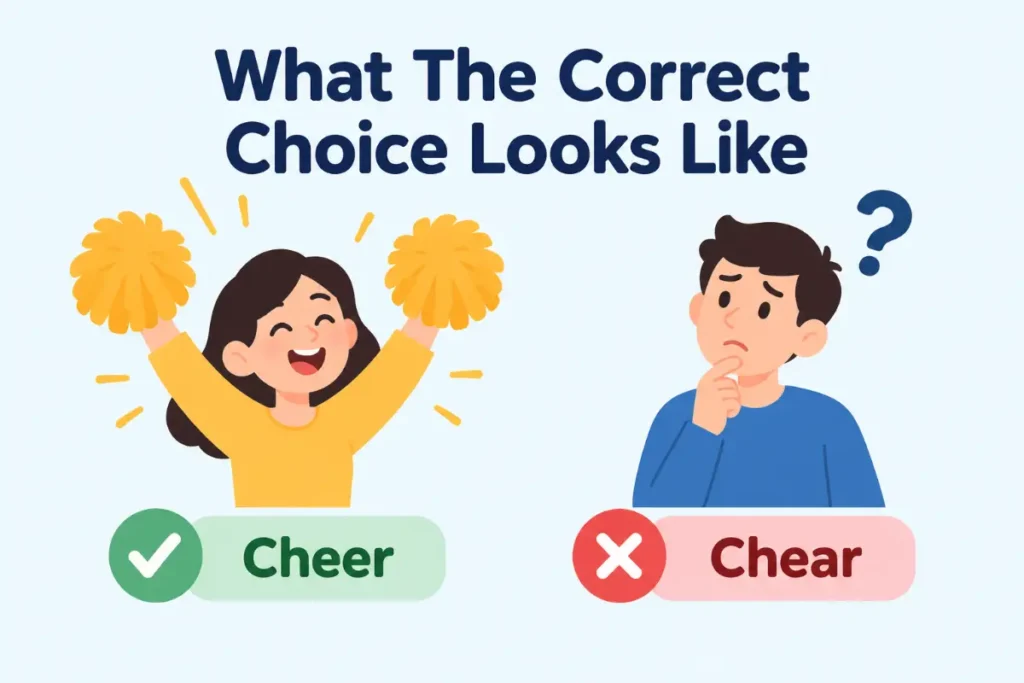
If you remember only one point from this section remember the modern spelling.
Cheer is the form you should use in regular English writing.
The older spelling may be useful when you’re studying historical texts or preserving an original source. Outside those special situations it can make modern writing look outdated or simply misspelled.
The same principle applies to many words that have changed over time. An old spelling can be historically interesting without being the right choice for modern communication.
FAQs
Is cheer the correct spelling?
Yes. Cheer is the standard spelling used in modern American English. Chear is an old spelling that may appear in historical writing but it isn’t the normal form for modern readers.
Is chear a word?
You may find chear in older English texts. It was once used as a spelling of the word we now write as cheer. In modern English it is considered an obsolete form and shouldn’t be used in regular writing.
What is the difference between cheer and chear?
The main difference is their place in English history. Cheer is the standard modern spelling while chear is an older spelling that has fallen out of normal use.
What does cheer mean?
Cheer can mean happiness or a positive mood. It can also mean to encourage or support someone by shouting clapping or showing enthusiasm. For example you can cheer for a sports team or cheer someone up when they feel sad.
Is cheer a noun or a verb?
Cheer can be both a noun and a verb. As a noun it can mean happiness or a shout of support. As a verb it can mean to encourage someone or to make someone feel happier.
What does cheer up mean?
Cheer up means to become happier or to help someone feel happier. You might tell a friend to cheer up after a difficult day or do something kind to cheer that person up.
What does cheer for mean?
Cheer for means to support someone or something. The expression is especially common when talking about sports teams and competitions. For example you might say that you cheer for your favorite team.
What does cheer on mean?
Cheer on means to encourage someone while they are doing something. Fans can cheer on athletes during a race and friends can cheer someone on while they work toward a difficult goal.
Conclusion
If you came here wondering about cheer vs chear the answer is clear. Cheer is the correct spelling for modern English. Chear is an obsolete spelling that you may find in historical sources but it isn’t the form you should use in ordinary writing.
The word cheer can work as both a noun and a verb. It can describe happiness and good spirits or it can describe the act of supporting and encouraging someone. Common expressions such as cheer up cheer for cheer on good cheer and holiday cheer all use the same modern spelling.
The easiest way to remember it is to connect the word with familiar forms such as cheerful cheering and cheered. They all begin with cheer. If you see the older form in a historical text don’t assume you’ve found a new spelling option. You’ve simply come across an older form of a word that has changed over time.
For modern writing keep it simple. Write cheer when you mean happiness support encouragement or the act of showing enthusiasm. That one choice will keep your spelling clear and correct.

Sienna Watson is a veteran copywriter and communications coach who has helped startup founders, marketers, and professionals polish their writing for over a decade. Realizing that most people don’t need a degree in linguistics—just clear, impactful communication—Sienna focuses on practical grammar, business writing etiquette, and eliminating wordiness. She advocates for plain language, strong verbs, and persuasive prose that gets results.