
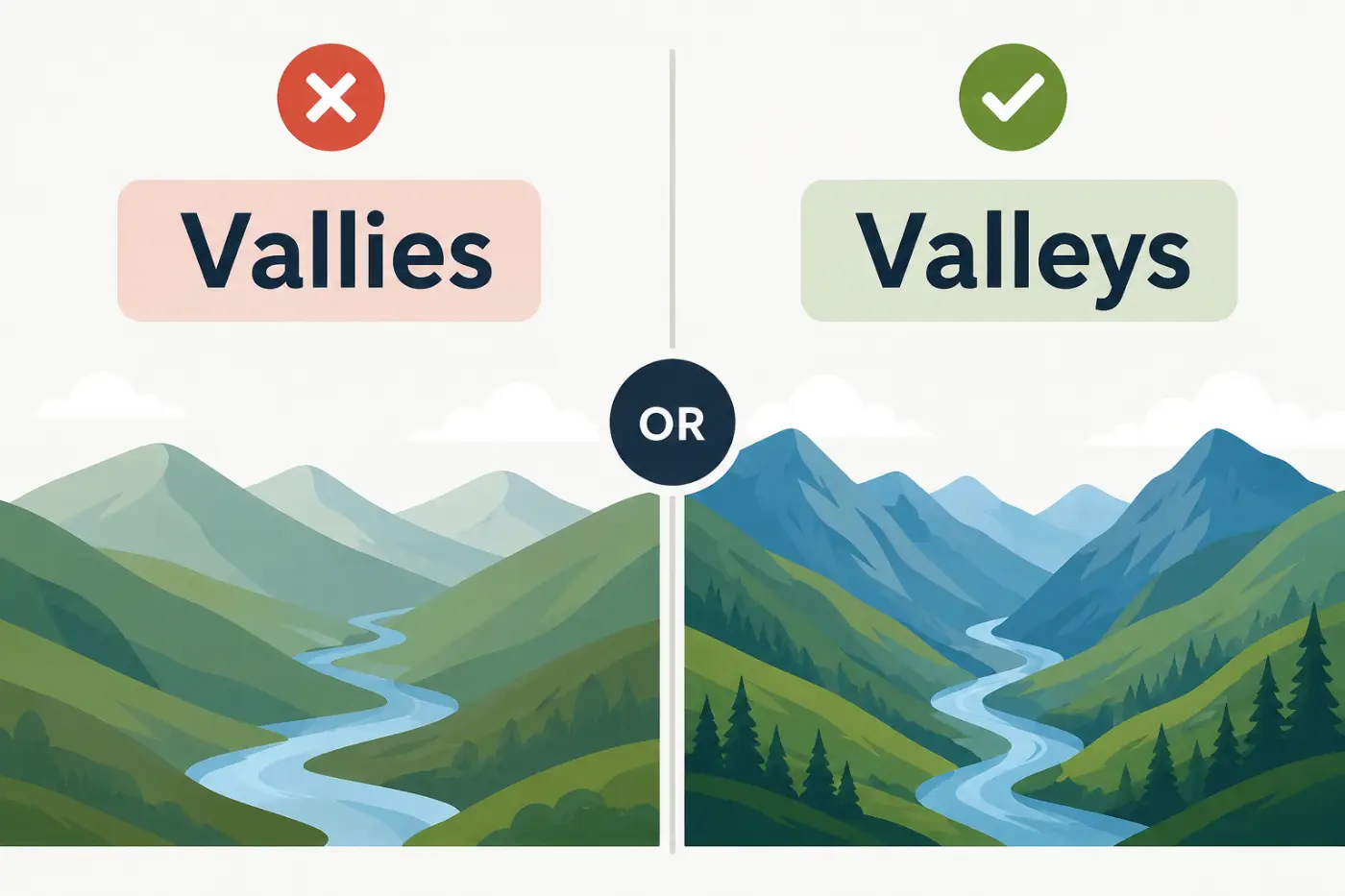
If you’re wondering about vallies or valleys the correct spelling is valleys. The word valleys is the plural form of valley and refers to low areas of land between hills or mountains. Vallies isn’t the standard spelling in English.
The confusion is easy to understand because the ending can sound like eez when people say the word. When we hear a word rather than see it written down it can be tempting to spell the sound exactly as we hear it. That doesn’t work here.
Once you know the singular form and the spelling rule behind the plural you won’t need to guess again. This guide explains the meaning of valley and valleys shows how to use the word in real sentences and covers several related spelling mistakes that can cause confusion.
Quick Definition
A valley is a low area of land that lies between hills or mountains. Valleys is the plural form when you are talking about two or more of these landforms. Vallies is not the correct plural spelling.
Direct Answer
The correct spelling is valleys. Vallies is incorrect in standard English.
Comparison Table
| Word | Meaning | Example Sentence | When to Use It |
|---|---|---|---|
| Valley | One low area of land between hills or mountains. | The valley is covered with trees. | Use it for one. |
| Valleys | Two or more low areas of land. | The region has several beautiful valleys. | Use it for more than one. |
| Vallies | Incorrect spelling. | This spelling is incorrect. | Don’t use it. |
Why The Spelling Causes Confusion
The spelling problem comes from the way the word changes from singular to plural. The singular form is valley. It ends with a consonant followed by y.
When you make it plural you don’t simply add s. Instead you change the y to ie and then add s. That gives you valleys.
This is a common pattern in English. Words that end in a consonant plus y often change in the same way when they become plural. Once you see that pattern it becomes much easier to spell the word correctly.
For example consider the word city. You don’t normally write citys when talking about more than one city. The correct plural is cities.
- The same idea applies to valley.
- Valley becomes valleys.
The spelling keeps the y because the letter before the y is a vowel. That small detail is the key to understanding the word.
The Correct Plural Rule
English has a useful rule for many nouns that end in y. If a noun ends in a consonant followed by y you usually change the y to i and add es to make the plural.
- Take baby as an example. The word ends in by. The b is a consonant. Its plural is babies.
- The same pattern appears in words such as city, family, country, and party.
- But valley is different because the letter before the y is e. The e is a vowel. Because of that you simply add s.
- So the pattern looks like this.
- valley + s = valleys
- You don’t change the y.
This is why vallies is incorrect. It applies the wrong plural rule to the word.
Look At The Letter Before Y
- If nouns ending in y confuse you, focus on the letter that comes right before the y.
- When a consonant comes before the y, you usually change y to i and add es.
- When a vowel comes before the y, keep the y as it is and simply add s.
Here are some examples.
| Singular | Letter Before Y | Plural |
|---|---|---|
| Valley | e | Valleys |
| Day | a | Days |
| Key | e | Keys |
| Boy | o | Boys |
| City | t | Cities |
| Baby | b | Babies |
| Country | r | Countries |
| Family | l | Families |
This simple check can prevent many common spelling mistakes.
What Does Valley Mean
A valley is a lower area of land surrounded by higher land. Hills or mountains often rise on both sides. Many valleys have rivers or streams running through them because water naturally flows toward lower ground.
The exact shape of a valley can vary. Some are wide and open while others are narrow with steep sides. Some stretch for many miles through mountain regions.
You might hear the word in geography class or see it in travel writing. It also appears in everyday descriptions of places.
For example you might say:
- We drove through a beautiful valley.
- A small river runs through the valley.
- The village sits in a quiet valley.
- Snow covered the mountain valley.
- The valley looked green after the rain.
In each sentence the word describes a physical area of land.
What Does Valleys Mean
Valleys simply means more than one valley. It is the plural form of the noun.
For example if you see one low area between mountains you can call it a valley. If a region contains several separate low areas you can call them valleys.
Consider these sentences.
- The valley is surrounded by tall mountains.
- The valleys are surrounded by tall mountains.
The first sentence refers to one valley. The second refers to more than one.
That difference may seem simple but it matters in clear writing. The noun must agree with the number of places you are describing.
Real Examples Of Valleys In Sentences
The word appears in many types of writing. Here are natural examples that show how it works.
Talking About Geography
- The river flows through several valleys.
- Farmers grow crops in the fertile valleys.
- The mountains divide the valleys into separate regions.
- Thick forests cover many of the valleys.
- The valley lies between two mountain ranges.
These examples describe physical geography. They use the plural because more than one area is being discussed.
Talking About Travel
Travel writers often use valleys when describing mountain regions.
- The road passes through several valleys before reaching the village.
- We spent three days exploring the valleys near the mountain.
- The train offers beautiful views of the surrounding valleys.
The word can make a description more specific. Instead of simply saying mountains and land you can identify the lower areas between the mountains.
Talking About Farming
Valleys often provide useful land for farming. Rivers may carry water through them and the surrounding terrain can offer shelter.
- Farmers have grown crops in these valleys for generations.
- The valleys provide rich soil for growing vegetables.
- Small farms are scattered across the mountain valleys.
The plural form works naturally when a region has several areas with these features.
Talking About Nature
You can also use the word when describing wildlife plants weather or scenery.
- Wildflowers cover the valleys in spring.
- Clouds settled over the valleys before the storm.
- Eagles can be seen flying above the valleys.
- The morning fog filled the valleys.
These examples show that the word isn’t limited to geography textbooks. It works naturally in everyday descriptions.
Valley And Valleys In Everyday Writing
Knowing the difference between singular and plural forms is simple once you focus on the number of things you’re describing.
- Use valley when you mean one.
- The valley was quiet at sunrise.
- Use valleys when you mean two or more.
- The valleys were covered in morning fog.
The same basic idea applies to many other nouns. Singular means one. Plural means more than one.
A useful editing habit is to look at the noun and ask how many you mean. If you’re describing one area use the singular form. If you’re describing several areas use the plural.
Common Mistakes With The Word
Spelling mistakes often happen when people apply a familiar rule in the wrong place. The most common mistake here is changing the y even though the word doesn’t require that change.
Writing Vallies
- This is the main spelling error.
- The problem is that vallies looks similar to correct plurals such as cities and babies. Those words really do change the y to ie.
- But valley belongs to a different group because the letter before y is a vowel.
- The correct form is valleys.
Writing Valleys As Valley’s
Another mistake is adding an apostrophe.
Valley’s doesn’t mean more than one valley. An apostrophe usually shows possession or a shortened form. For example:
- The valley’s river is wide.
Here valley’s means the river belongs to or is associated with the valley.
- For a simple plural use:
- The valleys are beautiful.
- No apostrophe is needed.
Writing Valleyes
Some people may also try to add es because they remember that some nouns need that ending.
- But valleyes is not correct.
- The plural is simply formed by adding s.
- Valley + s = valleys.
Valley’s And Valleys Are Different
This distinction is worth learning because apostrophes cause many common errors.
- Valleys means more than one valley.
- Valley’s can show possession.
Compare these sentences.
- The valleys are covered with snow.
- The valley’s entrance is blocked by snow.
- In the first sentence you are talking about multiple valleys.
- In the second sentence you are talking about one valley and something connected to it.
The apostrophe changes the function of the word. It doesn’t simply make a noun plural.
How To Remember The Correct Spelling
A good memory trick should make sense instead of giving you another complicated rule to memorize.
- For this word focus on the letters e and y at the end.
- The word is valley.
- The letter before y is e.
- Because e is a vowel you keep the y when making the plural.
- Then add s.
- Valley becomes valleys.
- That is all you need.
Another useful trick is to connect the word with day and key. Both end in a vowel followed by y and both keep the y when plural.
- Day becomes days.
- Key becomes keys.
- Valley becomes valleys.
Seeing these words together can make the spelling pattern easier to remember.
Words With A Similar Pattern
Several everyday words follow the same vowel plus y pattern. Their plurals keep the y and add s.
Day And Days
- We had a great day.
- We spent several days in the mountains.
Key And Keys
- I lost my key.
- She found two keys on the table.
Boy And Boys
- The boy was playing outside.
- The boys were playing outside.
Toy And Toys
- The child received a new toy.
- The children have many toys.
Journey And Journeys
- The journey took five hours.
- Their journeys took them through several countries.
These examples can help you recognize the pattern without having to stop and think about every word.
Words That Change Y To I
Now compare those words with nouns that have a consonant before y.
City And Cities
The letter before y is t. That’s a consonant. The plural changes y to i and adds es.
City becomes cities.
Baby And Babies
The letter before y is b. That’s also a consonant.
Baby becomes babies.
Country And Countries
The letter before y is r.
Country becomes countries.
Family And Families
The letter before y is l.
Family becomes families.
This comparison explains why the wrong spelling can look tempting. English has two different patterns. The key is to check the letter that comes before y.
Why The Word Sounds Different From Its Spelling
- English spelling and pronunciation don’t always line up perfectly. That’s one reason learners sometimes spell words based on how they sound.
- The ending of valleys sounds like eez. When spoken quickly the final sound can make the spelling seem less obvious.
- You might hear something close to valleez and wonder why it isn’t written that way.
- English doesn’t spell every sound exactly as it appears in speech. The written form follows established spelling patterns and word history.
- This is common across the language. Words often contain letters that don’t perfectly match the sounds we hear.
- So if you know how the word sounds but aren’t sure how to spell it don’t rely on pronunciation alone. Think about the singular form first.
- Start with valley.
- Then ask what happens when you need more than one.
- Add s.
- That gives you the correct plural.
Is Valleys A Noun
Yes. Valleys is the plural noun form of valley.
A noun names a person place thing or idea. In this case the word names physical landforms. For example:
- The valleys are green after the rainy season.
- Several valleys lie between the mountain ranges.
- The valleys attract many visitors each year.
- The singular noun is valley.
- The plural noun is valleys.
Can Valleys Be Used As An Adjective
The word itself is normally a noun. But English often lets nouns work before other nouns to describe them.
For example you might see phrases such as:
- Valley roads.
- Valley farms.
- Valley towns.
- Valley communities.
In these phrases valley helps describe another noun. It still relates to the landform.
The plural form can also appear in certain descriptive phrases when you are talking about more than one area.
For example:
- Valleys across the region have different climates.
Here valleys is still the main noun in the sentence.
Valley As A Place Name
The word Valley can also appear in the names of places. When it forms part of an official place name it may be capitalized.
For example a place might have Valley as part of its proper name.
- The capitalization depends on the specific name. If you’re talking about a general landform you use lowercase.
- The valley is surrounded by hills.
- If the word is part of an official name you follow the capitalization used for that name.
This distinction is common with geographical terms. A general feature and a proper place name don’t always use capitalization in the same way.
Valleys In Geography
A valley forms when land is worn down or shaped by natural forces. Rivers can carve valleys over long periods. Glaciers can also create large valleys as they move through mountain areas.
- The shape of a valley depends on how it formed and the land around it.
- Some valleys have broad flat floors. Others are narrow and steep. A river valley may have a stream or river running along its lowest point.
- Glacial valleys often have a broad shape with steep sides. They can look very different from narrow valleys formed mainly by flowing water.
- You don’t need to know all of these details to spell the word. Still this background helps show why valley is such a common geography term.
Valley And Canyon Are Not The Same
People sometimes use landform words loosely. A valley and a canyon can both be low areas between higher ground but they are not exactly the same thing.
A valley is a broad term for a low area between hills or mountains. A canyon usually has steep sides and is often formed by a river cutting through rock over a very long period.
A canyon can be part of a larger valley system. The terms describe different features rather than being perfect synonyms.
For example you might say:
The river runs through the valley.
Or:
The river carved a deep canyon into the rock.
The first describes a broader low area. The second emphasizes the narrow steep sided feature.
Valley And Basin Are Not The Same
A basin is another geographical term that can overlap with the idea of a low area. But a basin is generally a depression or area of land that drains into a particular point or water system.
A valley is usually longer and often lies between higher areas.
The difference matters in geography but everyday writing doesn’t always require such fine detail. If you’re simply describing a low area between hills or mountains valley is usually the natural word.
Common Phrases With Valleys
Knowing common word combinations can help you use the plural naturally.
Mountain Valleys
This phrase refers to valleys found among mountains.
The mountain valleys become cold at night.
River Valleys
This phrase describes valleys shaped by or associated with rivers.
Many towns developed along river valleys.
Fertile Valleys
This phrase often describes land that is good for farming.
Farmers grow fruit in the fertile valleys.
Deep Valleys
This phrase describes valleys that extend far below the surrounding land.
The hikers could see deep valleys from the ridge.
Green Valleys
This is common in travel and nature writing.
The green valleys looked beautiful after the rain.
These combinations sound natural because they match the way people commonly describe geographical features.
When To Use Valley Instead Of Valleys
- The choice is based on number.
- If you’re talking about one landform use valley.
- The valley is home to a small village.
- If you’re talking about more than one use valleys.
- The valleys are home to several small villages.
You can often find the answer by looking at the verb too.
- The valley is tells us the subject is singular.
- The valleys are tells us the subject is plural.
This agreement between the noun and verb is a useful clue when editing your writing.
A Simple Editing Trick
If you’re unsure about the plural form write the singular first.
- Start with:
- one valley
- Then ask:
- two what.
- The answer is two valleys.
This trick works because you don’t have to remember the spelling in isolation. You build the plural from the form you already know.
You can use the same method with other words.
- One city becomes two cities.
- One baby becomes two babies.
- One day becomes two days.
- One valley becomes two valleys.
The pattern becomes clearer when you compare the words.
Why Vallies Looks Correct At First
The incorrect form looks believable because English has many plural words ending in ies.
You may already know:
- city becomes cities.
- party becomes parties.
- story becomes stories.
- family becomes families.
Seeing these forms can make vallies look familiar. But familiarity isn’t the same as correctness.
The difference is the letter before the final y.
- In valley the letter is e.
- In city the letter is t.
- In party the letter is t.
- In story the letter is r.
That one letter determines which plural pattern applies.
A Quick Spelling Test
Try these examples without looking at the answers.
- One valley becomes two ______.
- One city becomes two ______.
- One day becomes two ______.
- One country becomes two ______.
The answers are:
- valleys
- cities
- days
- countries
Notice how the spelling changes based on the letter before the final y. Once you understand that small detail the pattern becomes much easier to use.
How To Use The Word In Professional Writing
Correct spelling matters even more in professional writing because small errors can distract from your main point.
Imagine a travel company describing a mountain destination. A sentence such as Explore the beautiful valleys of the region looks polished and natural.
A sentence using the incorrect plural spelling can make the writer appear careless even if the rest of the article is strong.
The same applies to school assignments reports websites emails and presentations. You don’t need fancy vocabulary to make writing look professional. Basic accuracy goes a long way.
A quick spelling check can catch this type of mistake before publication.
How To Teach This Spelling Rule
If you’re helping a child or English learner understand the difference teach the pattern with simple examples.
- Start with valley.
- Point out that the letter before y is e.
- Explain that e is a vowel.
- Then show that the plural simply adds s.
- Valley becomes valleys.
- After that compare it with a word such as city.
- The letter before y in city is t. Since t is a consonant the plural changes y to i and adds es.
- City becomes cities.
- This side by side comparison usually makes the rule much easier to understand.
Related Spelling Questions
People often search for several related words when they’re unsure about a plural spelling. The same basic idea can help with many of them.
Valley Or Valleys
Use valley for one. Use valleys for two or more.
Valley’s Or Valleys
Use valleys for the plural. Use valley’s to show possession or describe something connected to one valley.
Valleys Or Vallies
Use valleys. The other spelling is incorrect.
Valleyes Or Valleys
Use valleys. The plural doesn’t need es.
These differences become much easier once you understand the structure of the singular word.
FAQs
Is vallies a correct spelling?
No. The standard plural spelling is valleys. The form vallies is a spelling mistake.
What is the plural of valley?
The plural of valley is valleys. You form it by keeping the final y and adding s.
Why doesn’t valley become vallies?
The letter before the final y is e which is a vowel. Words ending in a vowel followed by y normally keep the y when they become plural.
Why does city become cities but valley become valleys?
The letter before y is different in each word. City has a consonant before y so its plural changes y to i and adds es. Valley has a vowel before y so it simply takes s.
Is valley’s the plural of valley?
No. Valley’s is not the regular plural. The correct plural is valleys. The apostrophe in valley’s usually shows possession.
What is the difference between valley and valleys?
Valley refers to one low area of land between higher areas. Valleys refers to two or more of these landforms.
How can I remember the spelling?
Look at the letter before the final y. Since valley has e before y you keep the y and add s to make valleys.
Is valley a noun?
Yes. Valley is a noun that names a type of landform. Valleys is its plural noun form.
Conclusion
If you came here wondering about vallies or valleys the answer is simple. The correct spelling is valleys. The word vallies is not the standard plural form of valley.
The reason is easy to remember once you look at the letter before the final y. In valley that letter is e which is a vowel. Because of that you keep the y and add s to form valleys.
This same idea helps you understand many other English plurals. Words such as day, key, and boy keep their final y because a vowel comes before it. Words such as city, baby, and country change the y because a consonant comes before it.
So when you’re writing about several low areas between hills or mountains don’t second guess yourself. Start with valley and add s. The result is valleys.

Dr. Elena Vance holds a Ph.D. in Linguistics from Columbia University and has spent over 15 years analyzing the evolution of the English language. A former university professor turned full-time writer and editor, Elena specializes in breaking down high-level grammatical concepts, punctuation nuances, and style guides (APA, Chicago, MLA) into clear, actionable advice. When she isn’t hunting down dangling modifiers, she can be found collecting vintage dictionaries and reading classic literature.