
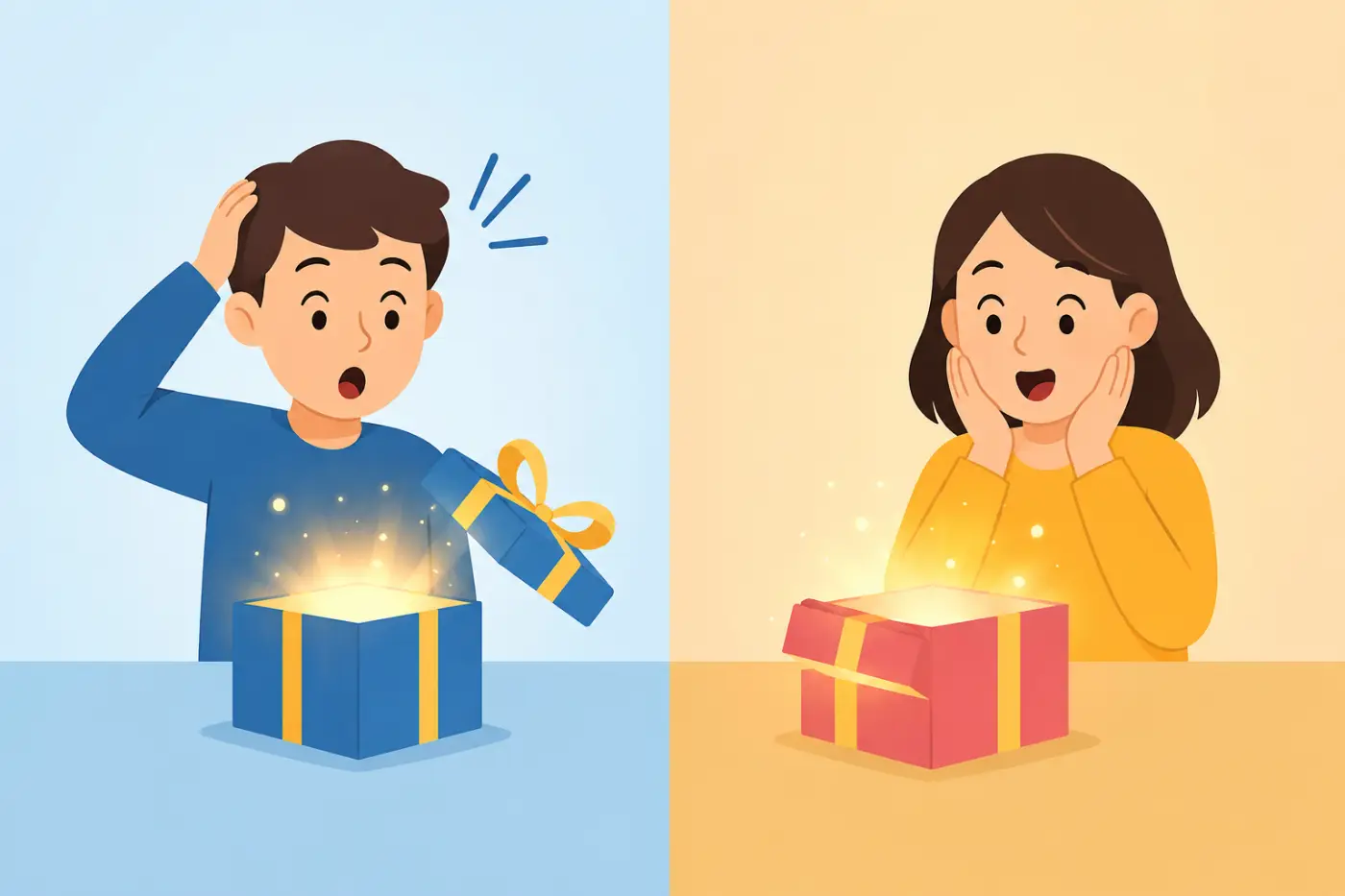
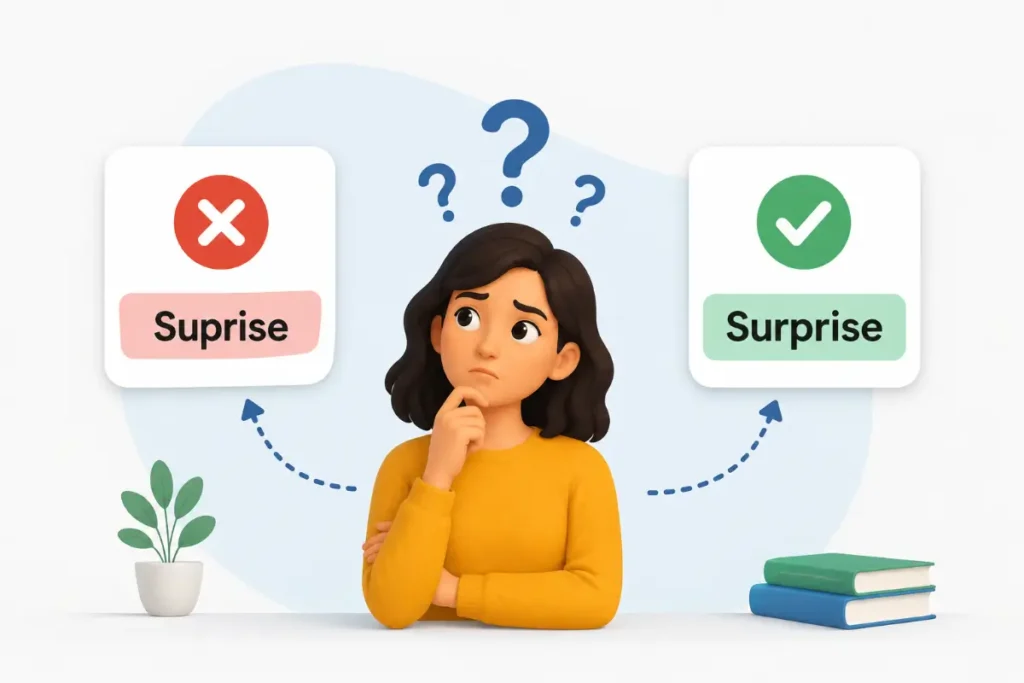
If you’re wondering about suprise or surprise the correct spelling is surprise. The word has two r letters and only one p. The spelling suprise is a common mistake because the first r can be easy to miss when you’re writing quickly.
This word causes trouble because its pronunciation doesn’t make every letter obvious. You can hear the main sounds clearly but the spelling needs a little more attention. Once you see the word broken into parts the correct version becomes much easier to remember.
In this guide you’ll learn the correct spelling and meaning of surprise. You’ll also see how to use the word as a noun verb and adjective. Along the way we’ll cover common mistakes related words real sentence examples and a few simple memory tricks that can help the spelling stick.
Quick Definition
Surprise means something unexpected that causes a person to feel amazed pleased shocked or confused. It can describe an unexpected event or the feeling caused by that event. Suprise is not the standard spelling.
Direct Answer
The correct spelling is surprise. The incorrect spelling suprise is missing the first r.
Comparison Table
| Word | Meaning | Example Sentence | When To Use It |
|---|---|---|---|
| Surprise | Something unexpected or the feeling caused by it. | The party was a complete surprise. | Use this spelling in all standard English writing. |
| Suprise | Incorrect spelling of surprise. | This spelling is incorrect. | Do not use it in standard English. |
Why This Word Is So Easy To Misspell
The spelling problem comes down to one small letter. The correct word contains sur at the beginning. When people write quickly they often remember the sound but not every letter. The first r can disappear and leave behind the incorrect form.
Pronunciation can also make the mistake harder to catch. When you say the word naturally the letters don’t sound like separate pieces. Your brain hears one complete word rather than thinking about its spelling.
This happens with many English words. A person may know the word perfectly well and still spell it incorrectly from time to time. Knowing a word and spelling a word are related skills but they aren’t exactly the same skill.
Another reason this mistake survives is that the incorrect version looks believable. It isn’t a wild spelling that immediately looks strange. It is only one letter away from the correct form.
That makes proofreading useful. When you see the word on the page take a quick look at the beginning. Check for sur before you move on.
The Correct Spelling Pattern
- The correct spelling is surprise.
- You can remember it by looking at the word in two simple parts.
sur plus prise
The first part begins with sur. The second part begins with prise. Putting those pieces together gives you the standard spelling.
surprise
- The most useful detail to remember is the first r. Many spelling mistakes happen because writers type suprise and skip that letter.
- Try saying the beginning slowly in your head.
sur
Then finish the word.
prise
You don’t need to pronounce the word unnaturally in everyday speech. This is simply a memory trick that helps you see all the letters.
What Surprise Means
The word surprise has a few connected meanings. At its heart the idea is simple. Something happens that a person didn’t expect. As a noun it can mean an unexpected event or thing.
- The birthday party was a surprise.
- Her visit was a pleasant surprise.
- I had a surprise waiting for you.
It can also describe the feeling caused by something unexpected.
- His face showed surprise.
- She stared at me in surprise.
- To my surprise the store was still open.
As a verb it means to cause someone to feel surprised.
- You surprised me with your message.
- The results surprised everyone.
- I didn’t mean to surprise you.
The word can also work as an adjective in the phrase surprise party or similar expressions. In that use it tells you that something is planned to be unexpected.
- We’re having a surprise party for Mom.
- They made a surprise visit to their old teacher.
The basic idea stays the same in all these examples. Something is outside a person’s expectations.
How To Use Surprise As A Noun
A noun names a person place thing or idea. Surprise works as a noun when you’re talking about an unexpected event or feeling.
Consider this sentence.
- The gift was a surprise.
Here surprise names the unexpected nature of the gift. The gift itself is not the word surprise. Instead surprise describes the fact that the gift was unexpected.
You can also use the word with articles such as a and the.
- It was a wonderful surprise.
- The surprise made everyone laugh.
- I have a surprise for you.
The phrase a surprise often refers to something unexpected that someone plans or discovers. For example a friend might say:
- I have a surprise for you.
That sentence tells the listener that something unexpected is coming.
The phrase to my surprise is also very common.
- To my surprise I got the job.
- To her surprise the old computer still worked.
- To our surprise the restaurant was nearly empty.
This phrase is useful when you want to explain that the result wasn’t what you expected.
How To Use Surprise As A Verb
As a verb surprise means to cause someone to feel unexpected emotion. That emotion might be happiness shock confusion or even fear. For example:
- The news surprised me.
The news caused me to feel surprised. That makes surprised the past form in this sentence. You can also use the verb in different tenses.
- The news surprises me.
- The news surprised me.
- The news will surprise me.
- The news has surprised me.
The spelling stays connected across these forms.
Present Tense
Use surprise for a present action or a general situation.
- Your kindness always surprises me.
- These results surprise the researchers.
With he she or it the verb usually takes s.
- Her honesty surprises me.
- The final result surprises everyone.
Past Tense
Use surprised for something that already happened.
- You surprised me yesterday.
- The announcement surprised the entire team.
Notice that the spelling keeps the original word intact. You simply add d because the word already ends in e.
Present Participle
The ing form is surprising.
- The result is surprising.
- It was a surprising decision.
- The ending of the movie was surprising.
The final e disappears before ing.
Surprise And Surprised Are Not The Same
- A common grammar mistake is using surprise and surprised in the wrong places.
- Surprise can name the event or describe the action that causes the feeling.
- Surprised describes how a person feels after something unexpected happens.
Compare these sentences.
- The announcement was a surprise.
- I was surprised by the announcement.
The first sentence uses surprise as a noun. The second uses surprised as an adjective that describes a person’s feeling.
This difference becomes clearer with another example.
- The party surprised Maria.
- Maria was surprised by the party.
- The party was a surprise for Maria.
All three sentences describe the same basic event but the grammar changes.
The party causes the feeling. Maria experiences the feeling. The event itself can also be described as a surprise.
Surprise And Surprising
- The difference between surprised and surprising is especially useful.
- Use surprised for the person who feels the emotion.
- Use surprising for the thing that causes the emotion.
For example:
- I was surprised by the news.
- The news was surprising.
This simple pattern works in many situations.
- She was surprised by the result.
- The result was surprising.
- We were surprised by his decision.
- His decision was surprising.
Think about it this way. A person is surprised. A thing is surprising.
That rule can prevent a common mistake in everyday writing. You wouldn’t normally say:
- The movie was surprised.
The movie can’t experience an emotion. Instead you would say:
- The movie was surprising.
You could then say:
- I was surprised by the movie.
Common Sentences With Surprise
The word appears in many everyday expressions. Learning these phrases gives you a better sense of how native speakers use it.
A Big Surprise
This phrase describes something that feels very unexpected.
- The promotion was a big surprise.
- Her visit came as a big surprise.
A Pleasant Surprise
Use this phrase when something unexpected turns out to be good.
- The free dessert was a pleasant surprise.
- Finding my old friend there was a pleasant surprise.
No Surprise
This expression means something isn’t unexpected.
- It’s no surprise that she passed the test.
- His success came as no surprise to his family.
Surprise Party
A surprise party is planned so the guest of honor doesn’t know about it in advance.
- We’re planning a surprise party for Jake.
- She thought she was going out for dinner but it was actually a surprise party.
Surprise Visit
A surprise visit happens without the person being told ahead of time.
- My brother made a surprise visit last weekend.
- The manager paid the store a surprise visit.
Surprise Attack
This phrase describes an attack that happens unexpectedly.
- The soldiers faced a surprise attack during the night.
This use is more common in news reports history books and discussions of military events.
Examples In Real Life
Understanding a word becomes easier when you see how it works in situations you already know.
Imagine a friend tells you that you’re going out for dinner. When you arrive you discover that several old friends are waiting for you.
You might say:
- What a surprise.
- I can’t believe you planned this.
- This is such a nice surprise.
Here the word describes the unexpected event or your reaction to it.
Now imagine your boss calls you into the office and tells you that you’ve been given a promotion. You might say:
- I was completely surprised.
- This promotion was a wonderful surprise.
- I didn’t expect this at all.
The same word family works in different forms depending on the sentence. Another example involves a package.
You open your front door and find a package you weren’t expecting.
You might say:
- This package was a surprise.
- I was surprised to see it.
- The unexpected delivery was surprising.
These examples show how closely the forms are related while still having different grammatical jobs.
Common Mistakes With The Spelling
The missing r is the biggest spelling problem but it isn’t the only mistake people make with this word family.
Dropping The First R
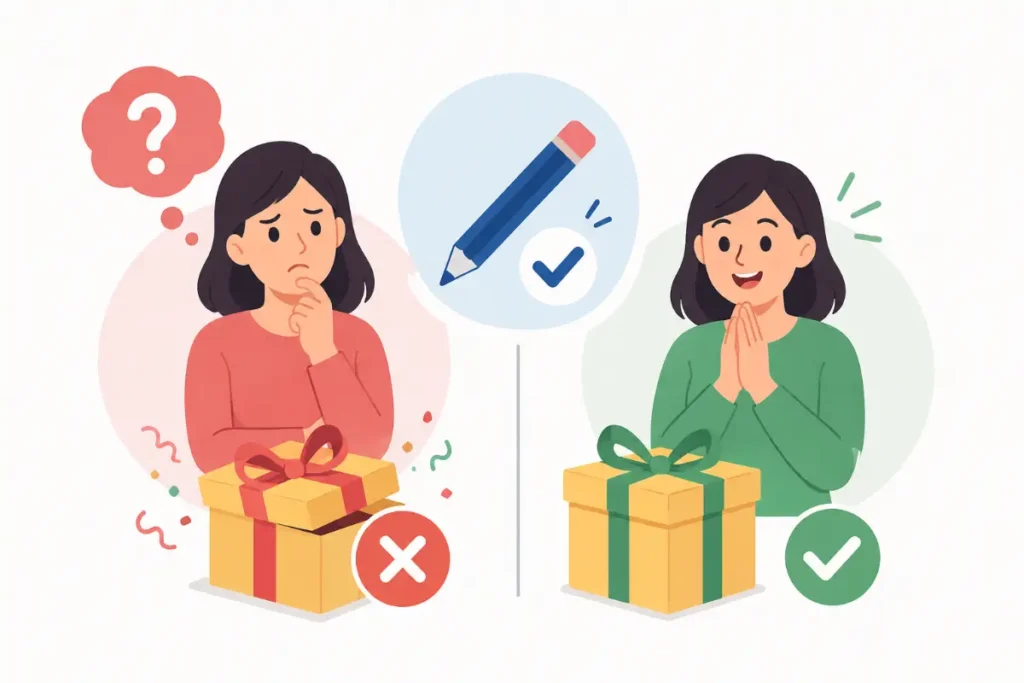
This creates the incorrect form suprise.
The fix is simple. Remember that the word begins with sur.
Adding Extra Letters
Some writers add letters because they are unsure how the word sounds.
For example they may write a form such as surprize. That spelling can appear in old texts or names but surprise is the standard spelling in modern US English.
Mixing Up The Verb Forms
- Another mistake is confusing surprise surprised and surprising.
- Remember the basic pattern.
- A person is surprised.
- A thing is surprising.
- The event can be a surprise.
- The action can surprise someone.
Once you understand that difference the forms become much easier to choose.
A Simple Memory Trick
If you keep forgetting the spelling try this short phrase.
- Surprise starts with sur.
- That is enough for most people.
You can also connect the word to surprising. When you add ing the word still shows the first r clearly.
surprising
- Seeing the longer form can make the shorter spelling easier to remember.
- Another useful trick is to picture the first four letters.
surp
If those four letters are correct the rest of the word is much easier to complete. Write it a few times in useful sentences instead of simply copying the word.
- I have a surprise for you.
- The news was a surprise.
- She surprised everyone.
- I was surprised by the result.
This gives your memory a real context to work with.
Why The Spelling Looks The Way It Does
The word surprise has a long history. English borrowed it from French. The modern English spelling developed from earlier forms of the word and retained a spelling that doesn’t always match the way an English speaker might expect it to sound.
You don’t need to know its history to spell it correctly. Still this background explains why the spelling may feel less obvious than some simpler English words.
Many English words have similar stories. English has absorbed vocabulary from French Latin Greek Germanic languages and many other sources. That history is one reason spelling doesn’t always follow a single neat system.
For everyday writing the practical lesson is more useful than the history. Remember the first r and the standard spelling becomes much easier.
When Surprise Has A Positive Meaning
Surprise isn’t always connected to something bad or shocking. In everyday English it often describes something pleasant.
You could surprise someone with a thoughtful gift. I surprised my brother with a birthday cake. You may receive some unexpected news. Getting the job offer was a pleasant surprise. You may find out that an old classmate is visiting your city. Finding her at the café was a lovely surprise.
Context tells the reader how the person feels. The word itself doesn’t automatically mean happy or unhappy.
When Surprise Has A Negative Meaning
The same word can describe something unpleasant or alarming.
- The sudden bill was an unpleasant surprise.
- The storm caught everyone by surprise.
- The news surprised the whole family.
In these examples the unexpected event causes concern or discomfort.
The phrase caught by surprise is especially common. It means someone wasn’t prepared for what happened.
- The team was caught by surprise when the weather changed.
- I was caught by surprise by the sudden question.
This phrase is useful because it describes both the unexpected event and the person’s lack of preparation.
Surprise And Shock
These words are related but they aren’t exact synonyms.
- Surprise means something unexpected happens. The reaction can be mild or strong.
- Shock usually suggests a much stronger emotional reaction. It often involves something disturbing or deeply unexpected.
Compare these examples.
- The birthday cake was a surprise.
- The accident was a shock.
A surprise can make you smile. A shock can leave you speechless.
You can also have a pleasant surprise. You normally wouldn’t describe a pleasant birthday gift as a shock.
Understanding this difference helps you choose the right word instead of treating all unexpected events as the same.
Surprise And Unexpected
Unexpected is an adjective. It describes something that wasn’t expected.
Surprise can be a noun or a verb.
Compare these examples.
- The visit was unexpected.
- The visit was a surprise.
- The visit surprised me.
All three sentences are connected but the grammar changes.
The first describes the visit. The second names the event as a surprise. The third describes the effect of the event on the speaker.
Surprise And Amazement
These words also overlap but have different meanings.
- Surprise focuses on something being unexpected.
- Amazement focuses on strong wonder or admiration.
For example:
- I was surprised to see the result.
- I was amazed by her performance.
You can feel both emotions at the same time. Still the words highlight different parts of the experience.
How To Proofread This Word
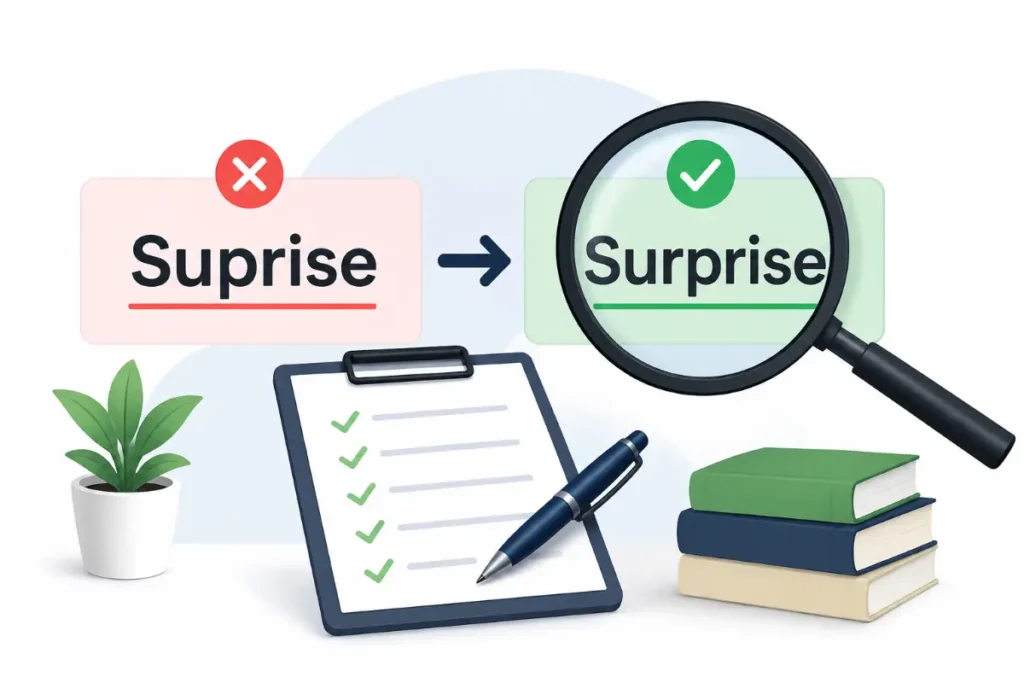
If you’re writing an email essay article or school assignment take a quick look at the beginning of the word. Check that you have sur rather than su.
Then look at the full word.
surprise
If you see the first r you’re on the right track.
It also helps to read the sentence aloud after writing it. Reading aloud won’t always reveal a spelling error because the incorrect version sounds the same. However it can slow you down enough to notice words you typed too quickly.
For important writing use a second check after you finish the whole piece. Looking at the text again after a short break often makes small mistakes easier to spot.
FAQs
Is suprise or surprise correct?
Surprise is the correct spelling. Suprise is a common spelling mistake caused by leaving out the first r. The standard word always begins with sur.
Why is surprise spelled with two Rs?
The standard spelling contains two r letters. The first appears near the beginning of the word and the second appears later in the word. Remembering the opening sur can help prevent the common mistake.
Is surprise a noun or a verb?
It can be both. As a noun it can mean an unexpected event or feeling. As a verb it means to cause someone to feel surprised.
What is the difference between surprised and surprising?
Use surprised to describe a person or other being that feels the emotion. Use surprising to describe something that causes that feeling. For example you can say I was surprised because the news was surprising.
What is the past tense of surprise?
The past tense is surprised. For example you can say She surprised me yesterday or The news surprised everyone.
How can I remember the spelling of surprise?
Remember that the word starts with sur. You can also picture the first four letters as surp before finishing the word.
What does surprise mean in a sentence?
It usually refers to something unexpected or to the feeling caused by something unexpected. For example The gift was a surprise means the gift wasn’t expected.
Is surprise the same as shock?
Not always. A surprise can be mild pleasant or funny while a shock usually suggests a much stronger reaction. The right word depends on the situation and the strength of the emotion.
Conclusion
If you’ve been unsure about suprise or surprise the answer is simple. Surprise is the correct spelling and suprise is a spelling mistake. The key detail to remember is the first r.
The word can work as a noun and a verb. It also appears in forms such as surprised and surprising. You can use it for a pleasant gift an unexpected visit surprising news or any event that catches someone off guard.
The easiest memory trick is to remember that surprise starts with sur. When you’re writing quickly take a second to check those first three letters. That tiny habit can keep this common spelling mistake out of your writing.
Next time the spelling makes you pause don’t guess. Picture surprise in your mind and check for the first r. Once that pattern becomes familiar you’ll probably stop thinking twice about it.

Sienna Watson is a veteran copywriter and communications coach who has helped startup founders, marketers, and professionals polish their writing for over a decade. Realizing that most people don’t need a degree in linguistics—just clear, impactful communication—Sienna focuses on practical grammar, business writing etiquette, and eliminating wordiness. She advocates for plain language, strong verbs, and persuasive prose that gets results.