
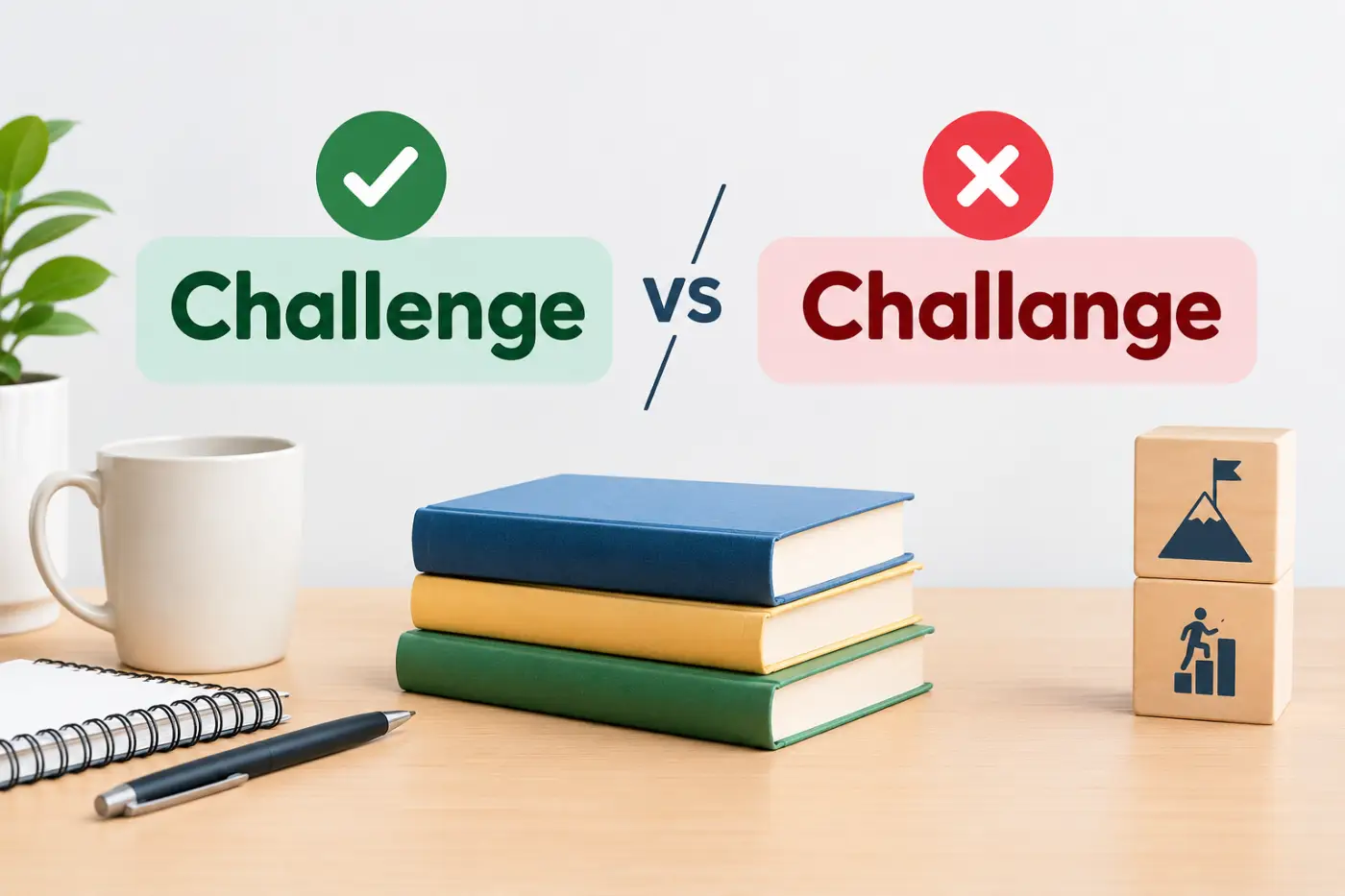
If you are unsure about challenge or challange you only need to remember one spelling. Challenge is correct. Challange is a common spelling mistake.
The confusion usually comes from the sound of the word. When people say challenge quickly the middle part can sound like it has an extra vowel. That can make the incorrect spelling look reasonable when you type it from memory.
The correct word is challenge. It can work as both a noun and a verb. As a noun it means a difficult task or problem. As a verb it means to question something or ask someone to prove or defend an idea.
This guide explains the correct spelling and meaning in simple terms. You will also see common examples real sentence patterns useful memory tricks related words and mistakes that can make this word harder to spell.
Quick Definition
Challenge is the correct spelling. It can describe something difficult that requires effort or skill. It can also mean to question someone or ask them to take part in a difficult task.
Challange is not the standard English spelling. It is a misspelling of challenge.
Direct Answer
The correct spelling is challenge. Challange is incorrect.
Comparison Table
| Word | Meaning | Example Sentence | When to Use It |
|---|---|---|---|
| Challenge | A difficult task or a request to question or test something. | The final exam was a real challenge. | Use this spelling in all standard English writing. |
| Challange | No standard English meaning. | This spelling is incorrect. | Do not use it. |
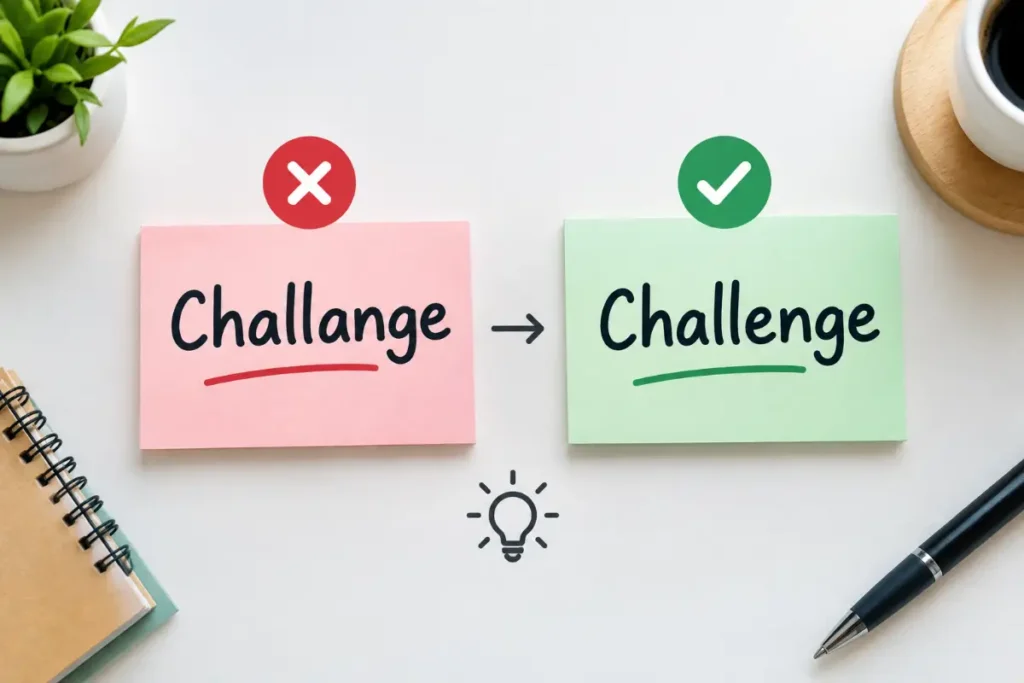
Why People Spell Challenge Wrong
The spelling mistake usually comes from the way the word sounds. When you hear challenge in normal conversation the middle sounds can blend together. Your brain may then try to match the sound with a spelling that looks familiar.
The letters a and e can cause trouble here. The incorrect form adds an a where it does not belong. Once you see that mistake several times it can start to look normal. That can make proofreading surprisingly difficult.
Typing quickly can make the problem worse. You may know the correct spelling but still type the wrong letters without noticing. This happens often with words that contain several letters in a row that do not sound exactly like they look.
The best approach is not to rely only on pronunciation. Instead focus on the visual pattern of the word. The correct form is challenge with enge near the end.
The Correct Spelling Pattern
The word challenge contains the letters chall followed by enge. The final part is what many people change when they write the word from memory.
Look at the word carefully.
Challenge
It starts with chall. After that comes enge.
The incorrect version changes this pattern to allange. That extra a creates the spelling mistake.
One useful way to remember the word is to connect it with the word challenger. Both words begin with the same spelling.
Challenge
Challenger
Once you remember the first part of the word family the correct spelling becomes easier to recognize.
What Does Challenge Mean
The word has several related meanings. The exact meaning depends on how you use it in a sentence.
As a noun it often describes something difficult. It could be a task a problem a situation or an experience that requires effort.
For example.
- Learning a new language can be a challenge.
- The long hike was a challenge for the whole group.
- Finding a new apartment was a challenge.
- The math problem looked simple but became a challenge.
In these examples the word describes difficulty. Something requires time skill patience or effort.
The word can also describe an opportunity to test yourself. A challenge does not always have to be negative. Many people enjoy challenges because they give them a chance to improve.
For example.
- Running my first marathon was a huge challenge.
- She enjoys taking on new challenges at work.
- The competition gave the students an exciting challenge.
Here the word suggests something difficult but worthwhile.
Challenge As A Verb
Challenge can also act as a verb. In this form it means to question something or someone.
For example.
- The lawyer challenged the witness.
- She challenged his explanation.
- The student challenged the teacher’s answer.
- They challenged the decision in court.
In each sentence someone questions an idea statement decision or person.
The verb can also mean asking someone to compete or prove their ability.
For example.
- He challenged his brother to a race.
- The team challenged the defending champions.
- She challenged herself to finish the book in one week.
This gives the word a wider range of uses than simply describing something difficult.
Common Uses Of Challenge
You will see this word in many areas of everyday English. It appears in school writing at work in sports and in casual conversation.
A Difficult Task
This is probably the most common use.
- The project was a challenge.
- Cooking for twenty people was quite a challenge.
- The new software created a challenge for the staff.
Here the word points to something that takes effort.
A Personal Goal
People often describe goals as challenges when they want to test themselves.
- I accepted the challenge to exercise every morning.
- She set herself a challenge to read twelve books this year.
- He took on the challenge of learning to play guitar.
This use often has a positive tone. The difficulty becomes part of the motivation.
A Problem
A challenge can also refer to a problem that needs attention.
- Rising costs are a challenge for small businesses.
- Poor weather created a major challenge for the rescue team.
- Finding enough workers remains a challenge for the company.
This meaning is common in news reports school essays and professional writing.
A Question Or Objection
As a verb the word can describe an act of questioning.
- The reporter challenged the claim.
- The employee challenged the policy.
- The scientist challenged the earlier theory.
The person does not simply disagree. They ask for evidence or offer a serious objection.
Challenge In Everyday Conversation
Native speakers use this word in many ordinary situations. You do not need formal language to use it correctly.
Someone might say that cooking a complicated meal was a challenge. A parent might tell a child to accept a new challenge. A friend might challenge you to beat their score in a video game.
For example.
- That test was a challenge.
- I like a good challenge.
- This job has been a challenge so far.
- Are you ready for the challenge.
- I challenged myself to wake up earlier.
- She challenged me to finish first.
These sentences show how flexible the word can be. It can describe a serious problem or something as simple as a friendly competition.
Challenge In School Writing
Students often use this word when discussing problems goals or difficult experiences. It works well in essays reports and personal writing.
For example.
- One major challenge was finding reliable information.
- The students faced several challenges during the project.
- Overcoming this challenge helped me become more confident.
- The experience taught me how to deal with challenges calmly.
The plural form is challenges. You simply add s to the end.
For example.
- The team faced many challenges.
- These challenges helped us improve.
- Small businesses often face financial challenges.
The spelling stays the same in the middle of the word. Only the ending changes.
Challenge In Work And Business
You will often hear this word in workplace conversations. People use it to describe difficult tasks problems or situations that need a solution.
For example.
- Meeting the deadline was our biggest challenge.
- The company faces several challenges this year.
- Finding skilled workers has become a challenge.
- The new system presents a challenge for some employees.
The word can sound neutral and professional without being overly formal. It is useful when you want to describe a problem without making it sound impossible.
Compare these two sentences.
- The project is a disaster.
- The project is a challenge.
The first sentence sounds much more negative. The second suggests that the problem can still be handled with effort and planning.
That difference makes challenge a useful word in everyday communication.
How Challenge Is Used In Different Situations
The word can describe many kinds of difficulty. You might face a challenge at school. You might take on a challenge at work.
Context gives the word its exact meaning. A student may call a hard exam a challenge. An athlete may call a strong opponent a challenge. A manager may describe a staffing shortage as a challenge. In each case the person is dealing with something that requires attention and effort.
A Challenge At School
Students face challenges all the time. A difficult subject may take extra practice. A large project may require careful planning. A presentation may test a student’s confidence.
For example.
- Math was a real challenge for me last year.
- The science project presented several challenges.
- Giving my first presentation was a big challenge.
- She took on the challenge and finished the assignment early.
The word works well in both casual and formal school writing. You can use it in a personal essay or a research paper when you need to describe something difficult.
It also works when talking about growth. A student may struggle with a subject at first but improve through practice. In that case the difficulty becomes a challenge rather than an impossible task.
A Challenge At Work
Workplaces create many situations where this word fits naturally. A tight deadline can be a challenge. A new system can create challenges for employees. Finding a good solution to a difficult problem can also be described as a challenge.
For example.
- The short deadline was our biggest challenge.
- Learning the new software was challenging at first.
- Our team faced several challenges during the project.
- She accepted the challenge and found a solution.
Notice how the word can describe a problem without making the situation sound hopeless. Saying something is a challenge often suggests that people can deal with it.
That makes the word useful in professional communication. It can sound honest without sounding overly negative.
A Challenge In Sports
Sports give us some of the clearest examples. An athlete may face a strong opponent. A runner may try to beat a personal record. A team may attempt to win after losing several games.
For example.
- The final opponent was our biggest challenge.
- Running five miles was a challenge for me.
- The team accepted the challenge and played well.
- She challenged herself to train every morning.
In this setting the word often carries a positive feeling. Athletes usually expect training and competition to be hard. The difficulty gives them something to work toward.
Challenge As A Question Or Objection
The word has another important meaning that has little to do with physical difficulty. As a verb it can mean to question something because you do not fully accept it.
For example.
- The reporter challenged the official statement.
- The lawyer challenged the witness’s account.
- She challenged the decision during the meeting.
- The student challenged the idea with a strong argument.
In these sentences nobody is necessarily facing a difficult task. Instead someone is asking another person to explain or defend a claim.
This use appears often in news writing legal writing academic work and everyday conversations. You might challenge a rule because you think it is unfair. You might challenge a claim because you want to see the evidence behind it.
Challenge A Claim
To challenge a claim means to question its truth or accuracy.
For example.
- New evidence challenged the original claim.
- The study challenges the idea that sleep has little effect on memory.
- She challenged his claim with several facts.
This does not always mean the claim is false. It simply means someone has raised a serious question about it.
Challenge A Decision
You can also challenge a decision. This means you object to the decision or ask for it to be reviewed.
For example.
- The employee challenged the decision.
- The family challenged the ruling in court.
- The organization challenged the new policy.
The exact process can depend on the situation. In casual conversation it may simply mean disagreeing with a decision. In legal or official settings it can mean taking formal steps to have a decision reviewed.
Challenge Someone To Do Something
Another common pattern is challenge someone to do something. This means you encourage or dare a person to attempt something difficult.
For example.
- I challenged my brother to run a mile with me.
- She challenged her friend to finish the puzzle first.
- The coach challenged the players to work harder.
- He challenged me to beat his score.
This construction is common in casual English. It can describe a serious competition or a friendly dare.
You can also challenge yourself.
- I challenged myself to read one book every month.
- She challenged herself to learn ten new words each day.
- He challenged himself to wake up earlier.
When you challenge yourself you set a difficult goal and try to reach it.
Take On A Challenge
The phrase take on a challenge means to accept something difficult and decide to work on it.
For example.
- She decided to take on the challenge.
- I’m ready to take on a new challenge.
- He took on the challenge of running his first race.
This phrase often shows confidence and willingness. The person knows something may be difficult but chooses to try anyway.
It also works well when talking about a new job task or responsibility.
- My new role will give me a chance to take on new challenges.
- The team took on the challenge of completing the project in two weeks.
The phrase is common in everyday speech. It does not sound overly formal.
Face A Challenge
The phrase face a challenge means to deal with something difficult.
For example.
- We faced a major challenge during the move.
- She faced many challenges while starting her business.
- The team faced a difficult challenge in the final round.
This phrase focuses more on the situation than on the person’s choice. You may face a challenge that you never expected.
That is different from take on a challenge. When you take on something you usually choose to accept it. When you face something it may simply happen to you.
Overcome A Challenge
To overcome a challenge means to successfully deal with something difficult.
For example.
- She overcame a major challenge and reached her goal.
- The team overcame several challenges during the season.
- He worked hard to overcome the challenge.
The word overcome shows that the difficulty has been handled successfully.
This phrase is common when people talk about personal growth. Someone may overcome fear. A student may overcome a learning difficulty. A business may overcome a serious setback.
For example.
- She overcame her fear of public speaking.
- The team overcame a difficult start to the season.
- He overcame many challenges before opening his business.
Rise To The Challenge
The phrase rise to the challenge means to respond well when something difficult happens.
For example.
- She rose to the challenge and led the team.
- The students rose to the challenge during the competition.
- He always rises to a difficult challenge.
This expression suggests confidence and effort. It paints a picture of someone standing up when the pressure increases.
It is often used when a person performs better than expected.
For example.
- The deadline was tight but the team rose to the challenge.
- The young player rose to the challenge during the final match.
A Challenge Can Be Positive
Many people think of a challenge as something bad. That is not always true. A challenge can be difficult while still being useful enjoyable or exciting.
Think about learning to play an instrument. The first few weeks may feel frustrating. Your fingers may hurt. You may make plenty of mistakes. Yet the difficulty can make the final result more rewarding.
That is why people often seek challenges on purpose. They want to improve. They want to test themselves.
For example.
- Learning guitar was a challenge but I loved it.
- The race was challenging but incredibly fun.
- I wanted a new challenge after finishing college.
The word does not automatically mean failure or trouble. It simply points to something that requires effort.
Challenge Compared With Opportunity
A challenge and an opportunity can sometimes describe the same situation from different angles.
An opportunity is a chance to achieve something. A challenge is something that tests your ability while you pursue it.
For example.
- Starting my own business was a huge challenge.
- Starting my own business was a great opportunity.
Both sentences can be true. The first focuses on the difficulty. The second focuses on the possible benefit.
You can even combine the two ideas.
- Starting the business was a challenging opportunity.
The choice depends on what you want the reader to notice.
Challenge Compared With Obstacle
An obstacle is something that blocks or slows progress. A challenge is broader. It can be an obstacle but it can also be a goal a test or a situation that pushes you to improve.
For example.
- A broken car became an obstacle during our trip.
- Planning the entire trip was a challenge.
The broken car gets in the way. The planning requires effort but does not necessarily block progress.
This difference can help you choose the right word in your writing.
Challenge Compared With Struggle
A struggle usually focuses on the effort or pain involved in dealing with something difficult. A challenge focuses more on the difficult situation itself.
For example.
- Learning to read was a struggle for him.
- Learning to read was a challenge for him.
The first sentence can suggest that the process was especially hard or stressful. The second sounds more neutral.
You can use both words in the same sentence when you need to show the full picture.
- Learning the new system was a challenge and the first few weeks were a struggle.
This gives the reader a clearer sense of what happened.
Challenge Compared With Test
A test is something designed to measure knowledge skill strength or ability. A challenge does not always have a formal measurement.
A school exam is a test. A difficult hike can be a challenge. A chess match can be both.
For example.
- The teacher gave us a spelling test.
- The long hike was a physical challenge.
- The competition tested our skills and gave us a serious challenge.
The words overlap but they do not mean exactly the same thing.
Challenge Compared With Task
A task is something you need or want to do. It can be easy or difficult.
A challenge usually involves some level of difficulty.
For example.
- Washing the dishes is a task.
- Washing all the dishes after a large party can be a challenge.
The first sentence simply describes something that needs to be done. The second suggests that the amount of work makes it difficult.
This is a useful distinction in everyday writing because not every task deserves to be called a challenge.
How To Use Challenge In A Sentence
The word can appear in several sentence patterns. Learning these patterns will help you use it naturally.
Challenge As A Noun
Use it to describe a difficult task situation or problem.
- The interview was a challenge.
- This assignment is a real challenge.
- We faced a serious challenge.
You can also use an article before the singular noun.
- It was a challenge.
- She accepted the challenge.
- He faced a new challenge.
Challenge As A Verb
Use it when someone questions tests or dares another person.
- I challenge your argument.
- She challenged the decision.
- They challenged us to a race.
The meaning becomes clear from the words that follow it.
Challenging As An Adjective
Use challenging to describe something that requires effort.
- The course is challenging.
- It was a challenging experience.
- The new position can be challenging.
This form is especially common when describing work school sports or personal goals.
Challenged As A Verb
Use challenged when the action happened in the past.
- She challenged the ruling yesterday.
- He challenged me to a game.
- The team was challenged by a strong opponent.
The spelling changes only at the end. The core spelling remains easy to recognize once you know the base word.
Plural Form Of Challenge
The plural form is challenges.
For example.
- Every new job brings different challenges.
- We faced several challenges during the move.
- Small businesses often deal with financial challenges.
- The students overcame many challenges.
The plural form simply adds s. There is no spelling change inside the word.
This makes it easy to use in sentences that discuss several problems tasks or tests.
Past Tense Of Challenge
The past tense is challenged.
For example.
- She challenged the decision yesterday.
- He challenged his friend to a race.
- The team challenged the defending champions.
- The lawyer challenged the evidence.
The ending changes to ed. The base spelling remains intact.
The same form can also work as a past participle.
- The decision was challenged in court.
- His claim has been challenged by new evidence.
Present Participle Form
The present participle is challenging.
For example.
- She is challenging the decision.
- The course is challenging.
- They are challenging themselves to improve.
The e at the end of the base word is dropped before ing is added. This is a common spelling pattern in English.
You can see the change clearly.
- Challenge
- Challenging
The base word remains recognizable even after the ending changes.
Common Search Questions About The Spelling
People often search for this word because they are unsure about one small part of its spelling. The most common confusion involves the extra a in the middle.
If you are typing quickly you may write the word based on its sound. That can produce the incorrect form. The safest solution is to remember the visual pattern rather than trying to spell it phonetically.
Look for the two l letters near the beginning. Then remember that the word moves directly into enge. There is no extra a in that part.
This simple check works in emails essays assignments and professional documents.
How To Check Your Spelling Quickly
If you are unsure about the word while writing pause for a moment and look at the middle.
Ask yourself three simple questions.
- Does it start with chall.
- Does it have two l letters.
Did I accidentally add another a before the n.
If the answer is yes yes and no then you have the correct spelling.
You do not need to stop writing for long. A quick visual check is enough once you know what to look for.
Why Pronunciation Can Mislead You
English spelling does not always match pronunciation perfectly. This word is a good example.
When people speak naturally they may say the word quickly. Some sounds become softer or blend into the next sound. A learner may hear something that suggests a different spelling.
That does not mean the pronunciation is wrong. It simply means sound alone is not a reliable guide for spelling this word.
This is common across English. Many familiar words have spellings that cannot be predicted perfectly from their pronunciation.
For that reason reading is valuable. Every time you see the correct written form you give your brain another chance to store its visual pattern.
A Useful Word Family
One strong way to remember spelling is to learn related words together.
The main word is challenge.
From it you get challenged challenging challenges and challenger.
For example.
- The challenge was difficult.
- She challenges herself every morning.
- He challenged the decision.
- The task is challenging.
- The challenger entered the competition.
All these forms keep the same basic spelling. Learning the family gives you repeated exposure to the correct pattern.
It also helps with vocabulary. Instead of knowing one word you begin to understand how several related words work.
Final Spelling Reminder For Part Two
The correct form starts with chall and ends with enge. It contains two l letters and only one a near the beginning.
If you keep that pattern in mind you can avoid the most common spelling mistake. You can also recognize related forms such as challenging challenged and challenger much more easily.
The word is useful far beyond spelling exercises. It can describe a difficult task. It can describe a personal goal.
That range is what makes this word so common in everyday English.
More Examples Of Challenge In Real Writing
The word challenge fits naturally into many kinds of writing. You can use it when describing a hard experience. You can use it when talking about a goal.
The meaning becomes clear from the words around it. That makes context especially useful when learning this word.
In Personal Writing
Personal stories often describe difficult moments as challenges. This can make the writing sound honest without making the situation sound hopeless.
For example.
- Moving to a new city was a challenge for me.
- My biggest challenge was getting used to the new routine.
- She faced many challenges after starting college.
- He overcame a personal challenge and became more confident.
The word works well because it focuses on the difficulty while leaving room for progress. A challenge can be hard but still manageable.
In Professional Writing
The word is common in reports emails presentations and workplace discussions. It can describe something that needs attention without sounding unnecessarily negative.
For example.
- One challenge is the limited amount of time.
- The company faces several challenges this year.
- Our biggest challenge was finding enough staff.
- The team developed a plan to address these challenges.
This type of wording can be useful when you need to explain a problem clearly and calmly.
In Academic Writing
Students and researchers also use the word when discussing difficult parts of a project or study.
For example.
- One challenge was finding reliable sources.
- The study faced several challenges during data collection.
- A major challenge was the limited sample size.
- The researchers discussed several challenges in their report.
The word works well in academic writing because it can describe a limitation without making an exaggerated claim.
Challenge In Questions
You may also see the word in questions. These questions often ask someone to explain a difficult situation or describe how they handled it.
For example.
- What was the biggest challenge you faced.
- How did you overcome that challenge.
- What challenges did you experience during the project.
- Are you ready to take on a new challenge.
These questions are common in job interviews. An interviewer may ask about a challenge to learn how you think and solve problems.
A strong answer usually explains the situation and then shows what you did about it.
Challenge In Job Interviews
Interviewers often ask candidates about difficult experiences. The goal is usually to learn how someone responds to pressure problems or setbacks.
A common question is.
Tell me about a challenge you faced at work and how you handled it.
A good answer should focus on actions and results. Avoid spending the entire answer describing the problem.
For example.
- One challenge I faced was completing a large project with a short deadline. I created a clear schedule and divided the work into smaller tasks. Our team finished the project on time.
This answer shows the challenge and explains how the person responded. It gives the listener something useful instead of simply saying the work was difficult.
Challenge In News And Public Discussion
News articles often use this word when describing social economic environmental or political problems.
For example.
- Rising costs remain a challenge for many families.
- The city faces a major housing challenge.
- Climate change creates challenges for coastal communities.
- The company is facing challenges in several markets.
This usage is common because the word can describe a serious issue without making the statement overly emotional.
It can also appear when someone questions an official claim.
- The report challenged the earlier findings.
- New evidence challenged the official explanation.
In these sentences the word has its verb meaning. Someone is questioning an idea based on evidence or disagreement.
Challenge In Technology
Technology creates many situations where the word fits naturally. A new system may be difficult to learn. A technical problem may require careful work. A company may also face challenges when adopting new tools.
For example.
- Learning the new software was a challenge.
- The update created several challenges for users.
- Keeping customer data safe is a major challenge.
- The team faced technical challenges during development.
The word does not automatically mean something went wrong. Sometimes it simply describes work that requires more skill or effort than expected.
Challenge In Health And Fitness
People often use the word when talking about exercise goals and lifestyle changes.
For example.
- I started a thirty day fitness challenge.
- Running my first five miles was a challenge.
- She challenged herself to exercise three times a week.
- The workout was challenging but enjoyable.
A fitness challenge usually gives someone a clear goal. The person may want to build strength improve endurance or create a healthier routine.
The word can also describe an obstacle.
- Staying consistent was my biggest challenge.
- Finding time to exercise was a challenge.
Both uses are natural.
Challenge In Games And Competitions
Games often involve challenges. A player may need to complete a difficult level. Someone may challenge another player to a match.
For example.
- The final level was a real challenge.
- He challenged his friend to a chess match.
- The game gives players new challenges every week.
- She completed the challenge in record time.
Here the word often has a playful tone. A challenge gives people something to attempt and a reason to keep improving.
Challenge In Relationships
The word can also describe difficulties between people. A relationship may face challenges during stressful periods.
For example.
- Long distance can be a challenge for couples.
- They faced several challenges after moving in together.
- Communication was their biggest challenge.
This does not mean the relationship is failing. It simply means the situation requires effort and communication.
The word can also describe a person questioning another person’s behavior.
- She challenged him about his decision.
- He challenged her to explain what happened.
The exact meaning depends on the sentence.
Challenge And Confrontation
These words can sometimes overlap but they do not always carry the same tone.
Challenge can mean questioning someone or asking them to defend an idea. It does not always involve anger.
Confrontation usually suggests a direct meeting or disagreement that may feel tense.
For example.
- The reporter challenged the statement.
- The two men had a confrontation.
The first sentence can describe a calm question based on evidence. The second suggests a more serious conflict.
That difference matters when you want your writing to sound precise.
Challenge And Criticism
Criticism means expressing an opinion about something that you think is wrong or could be better. A challenge can involve criticism but it does not have to.
For example.
- The editor criticized the article.
- The editor challenged the claim in the article.
The first sentence says the editor gave negative feedback. The second says the editor questioned a specific claim.
You can challenge an idea without attacking the person who made it. That distinction is useful in respectful discussions.
Challenge And Question
The verb challenge can be stronger than simply asking a question.
If you ask a question you want information.
- Why did the project fail.
If you challenge a claim you are asking someone to defend or support it.
- The researcher challenged the claim that the treatment was effective.
The second sentence suggests doubt. It asks for evidence or a stronger explanation.
That is why the word appears often in debates research reports and serious discussions.
Common Phrases With Challenge
Learning common phrases can help you use the word naturally. These expressions appear often in everyday American English.
Accept A Challenge
To accept a challenge means to agree to do something difficult or competitive.
- She accepted the challenge and started training.
Take On A Challenge
This means to choose to deal with something difficult.
- He took on the challenge of leading the new team.
Face A Challenge
This means to encounter or deal with something difficult.
- We faced several challenges during the move.
Overcome A Challenge
This means to successfully deal with a difficult situation.
- She overcame the challenge through hard work.
Meet A Challenge
This means to deal successfully with a difficult demand or task.
- The team met the challenge and finished the project early.
Rise To The Challenge
This means to respond strongly when something difficult happens.
- She rose to the challenge and delivered an excellent presentation.
A Tough Challenge
This phrase simply describes something that is very difficult.
- The final exam was a tough challenge.
A New Challenge
This phrase often refers to a fresh task or opportunity.
- He was excited to take on a new challenge at work.
Challenge And Difficult
The word difficult is an adjective. The word challenge is usually a noun or verb.
You cannot always replace one with the other.
For example.
- The exam was difficult.
- The exam was a challenge.
Both sentences are correct but they work differently. The first describes the exam. The second identifies the exam as something that tested the person.
You can also use both.
- The exam was difficult and presented a serious challenge.
This gives the reader more detail without repeating the same idea.
Challenge And Challenging
These words are closely connected but they do different jobs.
Use challenge as a noun when you name the difficult task.
- The project was a challenge.
Use challenging as an adjective when you describe the task.
- The project was challenging.
The difference is small but useful. If you can replace the word with difficult then challenging will often fit naturally.
For example.
- The course was challenging.
- The course was difficult.
Both sentences work.
Challenge And Challenged
The difference here is mainly about time and sentence structure.
Use challenge for the present or base form.
- I challenge that argument.
Use challenged for a past action.
- I challenged that argument yesterday.
The core spelling remains easy to recognize because the base word stays visible.
How To Avoid The Most Common Spelling Error
The best habit is to memorize the word as a visual pattern rather than trying to guess it from pronunciation.
- Look at the first part.
- chall
- Then look at the ending.
- enge
- Put them together.
- challenge
The incorrect version adds an a after the first part. That extra letter does not belong there.
Another useful trick is to connect the word with challenging. If you know how to spell challenging then the base word is easier to recall.
You can also connect it with challenger. These words share the same beginning.
- challenge.
- challenging.
- challenged.
- challenger.
Seeing this family often is a simple way to make the spelling stick.
Why Reading Helps With Spelling
Reading exposes you to correct spelling without making you memorize rules. Your brain sees familiar words repeatedly and starts storing their visual patterns.
This is especially helpful with words that sound different from the way they look.
When you read an article or book and notice a familiar word pause briefly and look at its spelling. You do not need to stop for long. A few seconds of attention can reinforce the correct form.
Writing also matters. Use new words in your own sentences instead of only reading definitions.
For example.
- The new assignment was a challenge.
- I accepted the challenge.
- The experience was challenging.
- She challenged the old idea.
Four simple sentences give you repeated exposure to the same word family.
How To Teach The Spelling To A Child
If you are helping a child learn the word keep the explanation simple. Avoid giving them a long list of spelling rules.
Start with the correct form. Show them the word challenge and point out the two l letters.
Then explain that there is only one a. The extra a in the common misspelling does not belong.
Next ask the child to use the word in a sentence.
- The game was a challenge.
- I like a challenge.
- She accepted the challenge.
Using the word in context makes the spelling easier to remember.
You can also introduce the related forms later.
- challenging.
- challenged.
- challenger.
This gives the child a small word family to practice.
How To Teach The Word To English Learners
English learners may need help with both spelling and meaning. Start with the basic definition. Explain that a challenge is something difficult that requires effort.
Then show the verb meaning.
- The task was a challenge.
- The teacher challenged the student.
In the first sentence the word names a difficult thing. In the second it describes an action involving questioning or testing.
Visual examples can help. A difficult puzzle can represent a challenge. Two people competing in a race can represent a challenge. Someone questioning a claim can represent the verb.
Simple context usually works better than a complicated grammar explanation.
Does Challenge Have A Silent Letter
No. The word does not contain a silent letter in the same sense as words like knock or write.
Still pronunciation does not perfectly reveal every part of the spelling. Some letters and sounds blend together in normal speech.
That is why you should not try to spell the word only by listening to it. Seeing the written form is a much safer guide.
Can Challenge Be A Noun And A Verb
Yes. It is both.
As a noun it refers to a difficult task situation or problem.
- The assignment was a challenge.
As a verb it can mean to question test or invite someone to compete.
- She challenged the decision.
This flexibility makes the word very common in everyday English.
Is Challenge A Positive Or Negative Word
It can be either.
A challenge can describe a serious problem.
- Finding affordable housing is a challenge.
It can also describe an exciting goal.
- Learning to surf was a fun challenge.
The surrounding words usually show the intended feeling. Words such as tough serious and major can make the meaning sound more difficult. Words such as fun exciting and new can make it sound more positive.
A Simple Way To Remember Everything
You do not need to memorize a complicated rule for this word. Focus on its structure.
Start with chall. Remember the two l letters. Then continue with enge. Do not insert another a in the middle.
Think of the word family too.
- challenge
- challenging
- challenged
- challenger
All four forms reinforce the same core spelling.
Once you recognize that pattern you will have a much easier time spotting the common mistake in your own writing.
Final Practice
Try reading these sentences slowly.
- This project is a challenge.
- She accepted the challenge.
- He challenged the decision.
- The task was challenging.
- They faced several challenges.
- The young athlete became a strong challenger.
Now look at the spelling of the base word again. The correct form has two l letters and only one a.
That small visual check is enough to prevent most spelling errors with this word.
FAQs
Is challenge the correct spelling?
Yes. Challenge is the correct spelling in standard English. Challange is a common spelling error and should not appear in your writing.
Why do people spell challenge incorrectly?
The mistake often comes from pronunciation and the order of the vowels. When people hear the word spoken quickly they may add an extra a after the first part. Typing quickly can also cause the same error.
Is challange a word?
No. Challange is not the standard English spelling of a word. If you mean a difficult task or if you mean to question or test something then use challenge.
How do you spell challenge correctly?
Spell it c h a l l e n g e. The word starts with chall and has two l letters. It does not contain an extra a before the n.
What does challenge mean?
As a noun challenge means a difficult task problem or situation that requires effort. As a verb it can mean to question something or someone or ask someone to compete.
What is the plural of challenge?
The plural is challenges. For example you can say that students face many challenges during a difficult course.
What is the past tense of challenge?
The past tense is challenged. For example you can say that she challenged the decision after reviewing the evidence.
What is the adjective form of challenge?
The common adjective form is challenging. It describes something that requires effort or skill such as a challenging exam or a challenging job.
Is challenge a noun or a verb?
It can be both. As a noun it describes a difficult task or situation. As a verb it can mean to question test or invite someone to compete.
What is the difference between challenge and problem?
A problem is something that needs to be solved or dealt with. A challenge can also be a problem but it often suggests something that tests your ability or gives you a chance to improve.
Can you say take on a challenge?
Yes. Take on a challenge is a common English expression. It means to accept something difficult and decide to work toward completing it.
Can you say face a challenge?
Yes. Face a challenge means to encounter or deal with something difficult. For example you might face a challenge when starting a new job or learning a new skill.
Conclusion
If you’ve been stuck on challenge or challange the answer is simple. Challenge is the correct spelling. The other form adds an extra a and does not belong in standard English.
The easiest way to remember the spelling is to focus on the structure of the word. It begins with chall and ends with enge. There are two l letters and only one a.
The word itself has several useful meanings. A challenge can be a difficult task or situation. It can also describe an opportunity to test yourself. As a verb it can mean questioning a claim decision or idea or asking someone to compete.
When you are writing quickly take a second to look at the middle of the word. Check for the two l letters and make sure you haven’t added an extra a. That quick habit can keep this common spelling mistake out of your emails essays assignments and other writing.

Dr. Elena Vance holds a Ph.D. in Linguistics from Columbia University and has spent over 15 years analyzing the evolution of the English language. A former university professor turned full-time writer and editor, Elena specializes in breaking down high-level grammatical concepts, punctuation nuances, and style guides (APA, Chicago, MLA) into clear, actionable advice. When she isn’t hunting down dangling modifiers, she can be found collecting vintage dictionaries and reading classic literature.