
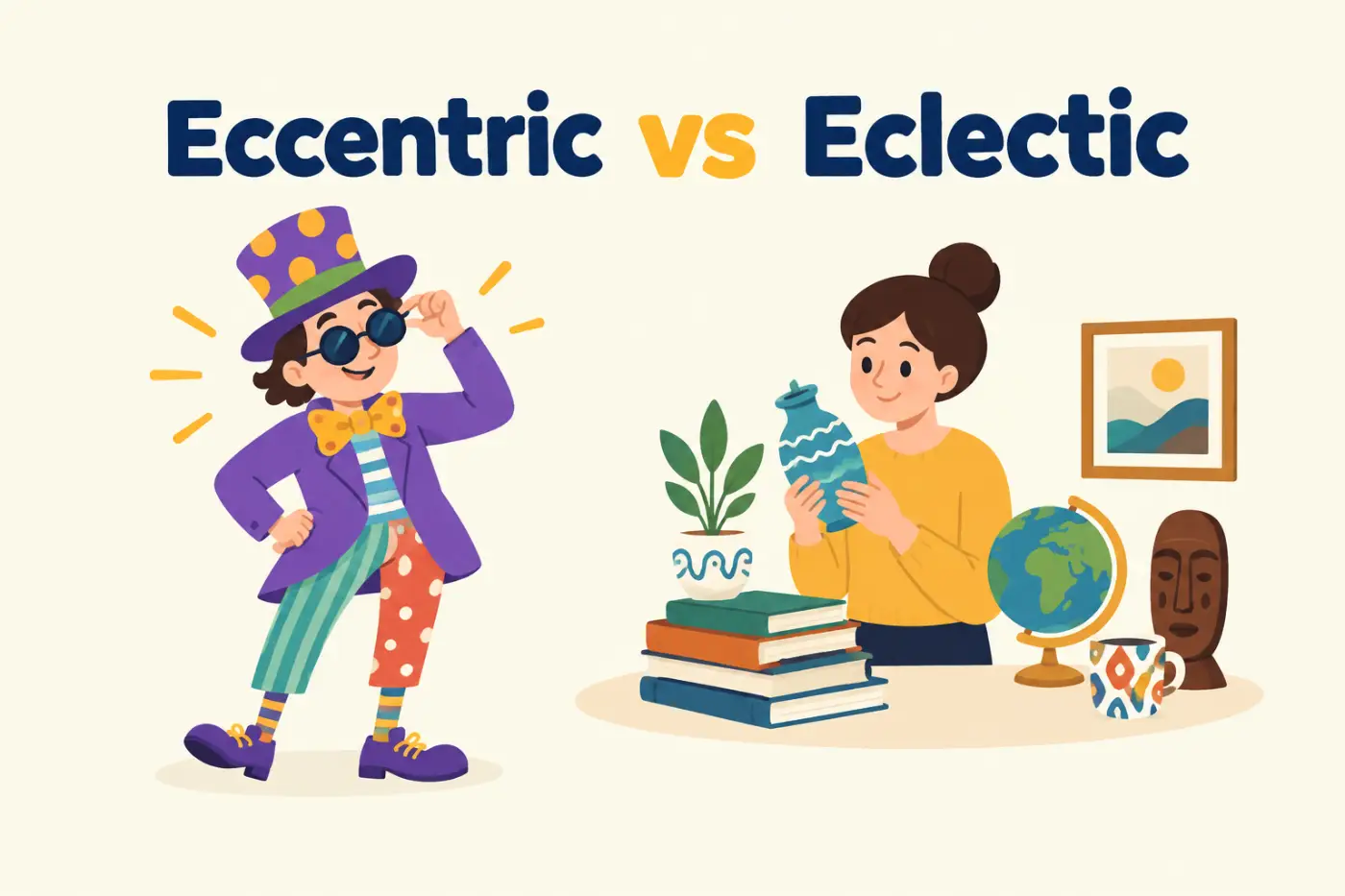
If you’re trying to understand eccentric vs eclectic you’re dealing with two words that can sound similar but mean very different things. Both can describe a person’s style or taste. That overlap is what makes them easy to mix up.
Eccentric describes someone or something that is unusual or unconventional. Eclectic describes something made from a wide and varied mix of sources or styles. An eccentric person stands out because they do things differently. An eclectic person brings different things together.
The difference becomes much clearer when you see the words in real sentences. We’ll look at their meanings pronunciation usage examples common mistakes and easy ways to remember which word fits.
Quick Definition
Eccentric means unusual or unconventional in a way that makes someone or something stand out. Eclectic means choosing or combining ideas styles or things from many different sources. A person can be both eccentric and eclectic but the two words describe different qualities.
Direct Answer
Eccentric means unusually different from what most people consider normal. Eclectic means a varied mix of things chosen from different styles sources or traditions.
Comparison Table
| Word | Meaning | Example Sentence | When to Use It |
|---|---|---|---|
| Eccentric | Unusual or unconventional. | My eccentric neighbor wears bright suits every day. | Use it for unusual behavior ideas habits or styles. |
| Eclectic | Made from many different styles or sources. | Her living room has an eclectic mix of furniture. | Use it for variety and combinations from different sources. |
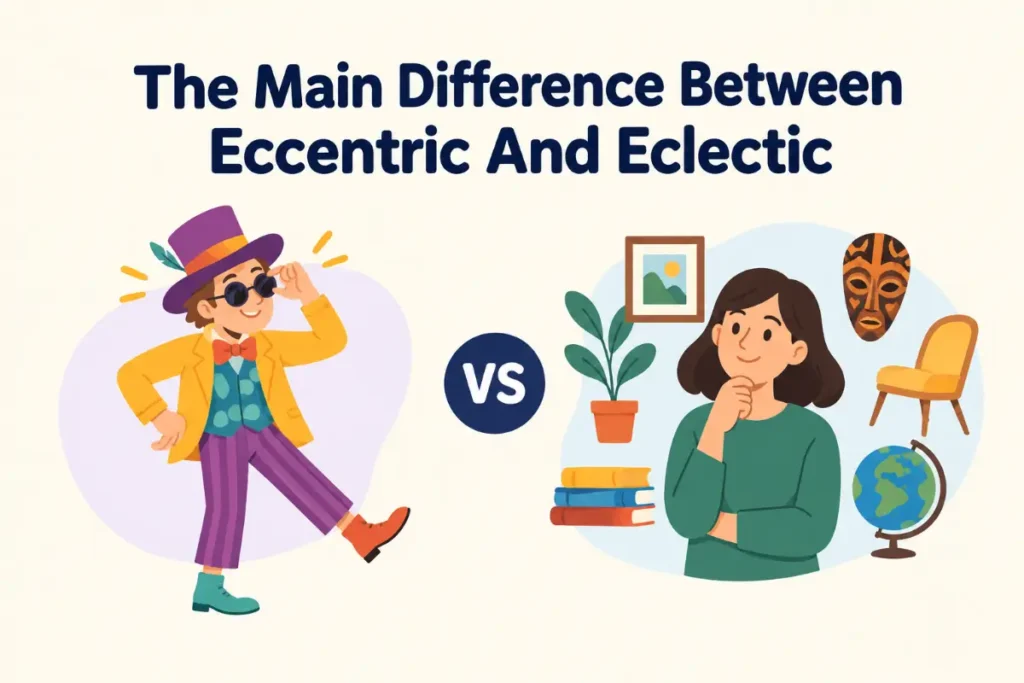
The Main Difference Between Eccentric And Eclectic
The easiest way to separate these words is to focus on unusual behavior versus variety.
An eccentric person does something in an unusual way. Their behavior may seem odd or unexpected. They might dress in a strange way collect unusual objects or follow habits that most people don’t share.
An eclectic person or collection brings together different things. An eclectic room might contain modern furniture antique lamps colorful artwork and handmade decorations from different cultures.
Think of it this way. Eccentric is about being different. Eclectic is about mixing different things.
That small distinction solves most of the confusion.
If your sentence focuses on something strange or unconventional then eccentric is usually the better choice. If it focuses on variety and a mix of influences then eclectic is the word you want.
What Eccentric Means
The word eccentric comes from a Greek based term meaning outside the center. In modern English it often describes a person whose behavior ideas appearance or habits fall outside what people normally expect.
The word doesn’t always carry a harsh meaning. It can sound playful or even positive. Calling someone eccentric may suggest that they are independent creative or wonderfully unusual.
For example you might say that an artist has an eccentric personality. You could mean that the artist dresses strangely speaks in an unusual way or has habits that make them memorable.
Consider these examples.
- My uncle is eccentric but everyone enjoys talking with him.
- The eccentric artist paints only at midnight.
- She has an eccentric sense of humor that catches people off guard.
- His eccentric habits make him easy to remember.
- The professor was known for his eccentric teaching methods.
In each sentence the focus is on something unusual about a person.
Eccentric Can Describe Things Too
Although the word often describes people it can also describe objects ideas designs and behaviors.
You might call a building eccentric if its design is highly unusual. An eccentric invention might work in a strange way. An eccentric idea might seem far outside normal thinking.
For example.
- The architect designed an eccentric house shaped like a giant shell.
- The company rejected his eccentric proposal.
- She chose an eccentric outfit for the costume party.
- The book presents an eccentric view of family life.
The common thread is always the same. Something does not follow the usual pattern.
Eccentric Does Not Always Mean Bad
This point matters because some readers assume eccentric means foolish or baffling. It doesn’t.
The word simply suggests that someone or something is unusual or unconventional. The tone depends on the situation.
If you say that a famous inventor was eccentric you may be pointing out unusual habits without insulting the person. If you call someone’s plan eccentric in a serious business meeting it could sound critical.
Context does a lot of work here.
What Eclectic Means
Eclectic describes variety. It refers to something that draws from different sources styles ideas or traditions rather than following one single style.
Imagine walking into a home and seeing a nineteenth century wooden table next to a modern sofa. On the wall you see abstract art beside a traditional landscape painting. The room doesn’t follow one strict design style. It combines several influences.
You could describe that room as eclectic.
The same idea works for music food books fashion education and many other areas.
For example.
- She has eclectic taste in music.
- His bookshelf contains an eclectic collection of novels.
- The restaurant serves an eclectic mix of dishes.
- Her wardrobe is eclectic and full of different styles.
- The museum has an eclectic collection of artwork.
The focus isn’t on something being strange. The focus is on the range of things included.
Eclectic Often Suggests Choice
There is another useful detail. Eclectic often suggests that someone deliberately selects different things because they like them.
Suppose your music playlist includes Beyoncé Taylor Swift Miles Davis Metallica and classical piano pieces. That’s an eclectic playlist because it pulls from very different musical styles.
The variety itself is not necessarily random. You may have chosen every song because you enjoy it.
That is different from being eccentric. Your music taste can be eclectic without being unusual in a negative or strange sense.
Eclectic Can Describe Ideas
The word isn’t limited to physical objects.
Someone can have an eclectic education. They might study history biology art literature and computer science. Their interests come from many areas.
A writer can have an eclectic range of influences. A chef can have an eclectic cooking style. A researcher can use ideas from several fields.
For example.
- Her teaching style is eclectic and combines several methods.
- He has an eclectic knowledge of American history.
- The designer draws from an eclectic range of cultural influences.
- Her reading habits are eclectic because she enjoys many genres.
Again the central idea is variety.
Eccentric And Eclectic In Real Life
These words become much easier when you connect them with situations you already know.
Imagine a person who wears a bright purple hat every day even though nobody else in town does. That person might be eccentric.
Now imagine someone whose clothing combines vintage jackets modern sneakers handmade jewelry and traditional scarves from different cultures. Their style might be eclectic.
The first example focuses on unusual behavior. The second focuses on a mixture of styles.
That distinction works in many areas.
Eccentric People
An eccentric person often stands apart from the crowd.
They might have unusual habits or strong personal preferences. They may reject common social expectations and do things their own way.
For example.
- The eccentric inventor refuses to use a smartphone.
- Her eccentric grandfather keeps dozens of clocks in his house.
- The actor is famous for his eccentric personality.
The word tells us that the person is unusual. It doesn’t tell us that they combine different things.
Eclectic People
An eclectic person often has broad interests.
They may enjoy many types of music read books from different fields or collect objects from different cultures.
For example.
- She has an eclectic taste in literature.
- His interests are eclectic and include cooking astronomy and jazz.
- The designer has an eclectic approach to fashion.
The word tells us that the person’s interests or choices cover many different areas.
Eccentric Style And Eclectic Style
Style is one of the areas where these words get mixed up most often.
- An eccentric style is unusual and may attract attention because it breaks common expectations.
- An eclectic style combines different styles into one overall look.
A person can have both.
Imagine someone wearing a Victorian jacket with bright sneakers a cowboy hat and futuristic sunglasses. Their outfit could be called eccentric because it is unusual. It could also be called eclectic because it combines several different fashion influences.
The words would highlight different features of the same outfit.
- If you want to emphasize how strange or unconventional it looks use eccentric.
- If you want to emphasize the mixture of styles use eclectic.
Eccentric Personality And Eclectic Taste
This is another useful distinction.
You can describe someone’s personality as eccentric when their behavior or manner seems unusual.
You can describe someone’s taste as eclectic when they enjoy a broad mix of things.
For example.
- Daniel has an eccentric personality.
- Daniel has eclectic taste in music.
The first sentence tells us something about Daniel’s behavior. The second tells us something about his preferences.
You could also combine the two ideas.
- Daniel has an eccentric personality and eclectic taste in music.
That sentence works because each adjective does a different job.
Common Mistakes With These Words
The biggest mistake is treating the two words as synonyms. They aren’t.
People sometimes use eclectic when they mean strange. That doesn’t quite work. An eclectic choice can be unusual but the main idea is variety.
Others use eccentric when they simply mean varied. That can also change the meaning.
Consider this sentence.
- She has an eccentric taste in music.
This suggests that her musical preferences are unusual or outside what most people expect.
Now compare it with this sentence.
- She has an eclectic taste in music.
This tells us that she enjoys many different kinds of music.
Maybe she listens to classical music in the morning and hip hop at night. That is eclectic. It isn’t necessarily eccentric.
Mistake One
- Incorrect idea: Eclectic means strange.
- Better understanding: Eclectic means varied or drawn from many different sources.
Error Two
- Incorrect idea: Eccentric means having many interests.
- Better understanding: Eccentric means unusual or unconventional.
Mistake Three
- Incorrect idea: The words can always replace each other.
- Better understanding: They can sometimes describe the same subject but they highlight different qualities.
How To Remember The Difference
You don’t need a complicated memory trick.
Just remember these two words with two simple ideas.
- Eccentric means unusual.
- Eclectic means varied.
You can also connect the first word with an unusual person and the second with a mixed collection.
Picture an eccentric person walking into a room wearing a bright green suit and carrying a huge umbrella on a sunny day. Something about the person immediately seems unusual.
Now picture an eclectic room. It has an old wooden desk a modern chair a colorful rug a traditional painting and a futuristic lamp. The room contains many different influences.
One person stands out. One room brings things together.
That mental picture can help the distinction stick.
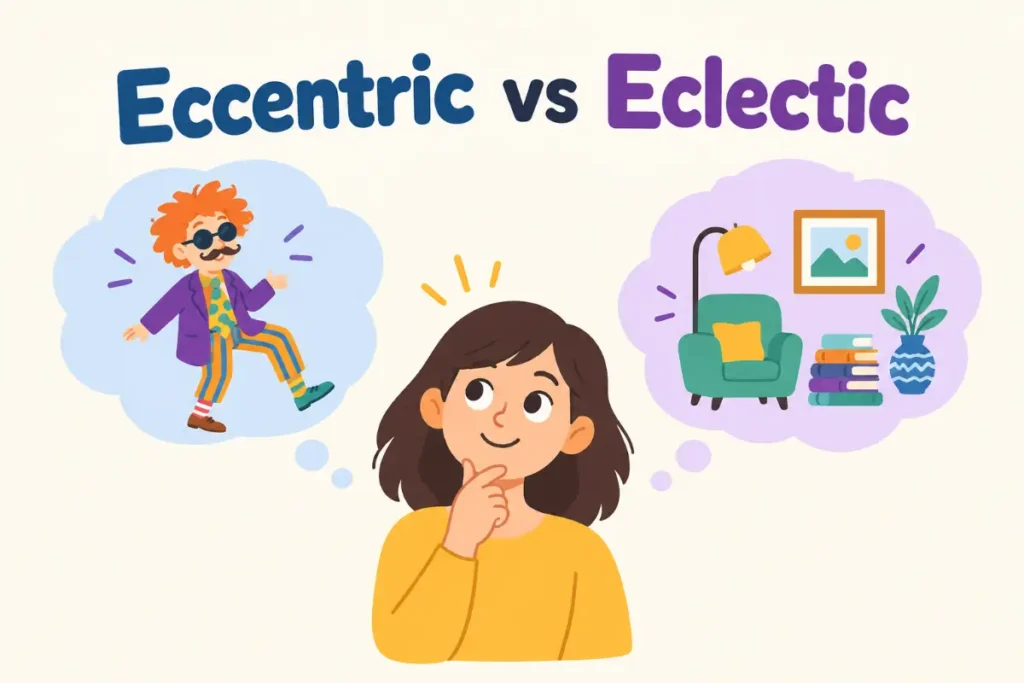
A Simple Memory Trick
Think of eccentric as the word for an exceptional individual who doesn’t quite follow the crowd.
- Think of eclectic as the word for an everything mix.
- These aren’t formal definitions. They’re just memory aids.
- When you see a sentence ask yourself one question.
Is the writer talking about something unusual or a mixture of different things?
- If the answer is unusual choose eccentric.
- If the answer is a mixture choose eclectic.
That quick test works in most everyday situations.
Pronunciation Differences
The words look somewhat similar but their pronunciation is different.
- Eccentric is commonly pronounced like ik SEN trik.
- Eclectic is commonly pronounced like ik KLEK tik.
The middle sounds are different. In eccentric the strong stress falls on the second part. In eclectic the strongest sound also comes near the middle but the word has a different rhythm.
Hearing the words aloud can help you keep them separate. Still meaning is the best guide because the two words are used in very different ways.
Related Words For Eccentric
If you understand eccentric you should also know several related words.
Unconventional
Unconventional means not following the usual way of doing something.
- Her unconventional teaching method keeps students interested.
This word is close to eccentric but usually sounds more neutral.
Unusual
Unusual simply means not common or expected.
- His unusual hobby is collecting antique maps.
This is one of the easiest synonyms for eccentric.
Quirky
Quirky describes something pleasantly unusual or odd.
- She has a quirky sense of humor.
Idiosyncratic
Idiosyncratic means distinctive to one particular person or situation. It is more formal than eccentric.
- The author has an idiosyncratic writing style.
For everyday writing you will often find unusual or quirky easier to understand.
Related Words For Eclectic
Several words can help you understand the idea behind eclectic.
Varied
Varied means containing different types of things.
- The city has a varied food scene.
Diverse
Diverse means containing many different kinds of people things or ideas.
- The class has a diverse group of students.
Mixed
Mixed is a simple everyday word for things that contain different elements.
- The album received mixed reviews.
Wide Ranging
Wide ranging describes something that covers many subjects or areas.
- She has wide ranging interests in science and art.
These words aren’t perfect replacements in every sentence. Still they all connect to the central idea of variety.
When Someone Can Be Both Eccentric And Eclectic
A person can absolutely be both.
Imagine an artist who wears unusual clothes and paints using ideas from Japanese prints African sculpture modern art and medieval European paintings.
Their personality or appearance might be eccentric because it stands outside common expectations.
Their artistic influences might be eclectic because they come from many different sources.
The two words can work together because they describe different parts of the same person.
For example.
- The eccentric artist has an eclectic approach to painting.
That sentence is clear because eccentric describes the artist while eclectic describes the approach.
This is a useful pattern to remember.
One word often tells you how unusual something is. The other tells you how varied its sources are.
How The Words Work In Writing
Choosing the right adjective can change the picture in your reader’s mind.
Suppose you write.
- The restaurant has an eccentric menu.
A reader may expect unusual food combinations. Perhaps the dishes are strange or unexpected.
Now write.
- The restaurant has an eclectic menu.
The reader expects many types of food or influences. The menu might include Italian pasta Mexican tacos Korean dishes and American desserts.
Neither sentence is automatically negative. They simply create different expectations.
Good word choice works like a camera lens. One word brings certain details into focus while another shows a different part of the scene.
Examples With Eccentric
Here are more natural examples that show how this adjective works.
- The eccentric millionaire lives in a house filled with old toys.
- Her eccentric ideas often lead to creative solutions.
- The town is known for an eccentric local artist.
- His eccentric behavior made him the most memorable person at the party.
- The author created an eccentric character who talks to birds.
- She has an eccentric fashion sense that turns heads.
- The professor’s eccentric habits became a favorite topic among students.
- The director is known for making eccentric films.
In each case the word points toward something unusual.
Examples With Eclectic
Now compare those with examples using the other adjective.
- She has eclectic taste in music.
- The hotel has an eclectic mix of old and new furniture.
- His bookshelf contains an eclectic collection of travel books.
- The artist uses an eclectic range of colors and materials.
- The festival offers an eclectic selection of food.
- Her career has taken an eclectic path through several industries.
- The living room has an eclectic feel.
- He has an eclectic group of friends from many different backgrounds.
Here the focus is variety and combination.

A Quick Test For Your Sentence
When you’re unsure which word to use pause and ask what you are trying to say.
If you mean strange, unusual, quirky, or unconventional, choose eccentric.
If you mean varied, mixed, diverse, or drawn from many sources, choose eclectic.
Try these examples.
- She has an ___ personality.
- If you mean she behaves in unusual ways then eccentric fits.
- She has an ___ taste in music.
- If you mean she enjoys many different genres then eclectic fits.
- He designed an ___ building.
- If the building looks strange or unconventional then eccentric may fit.
- He designed an ___ interior.
- If the room combines many different design styles then eclectic is likely the better choice.
The trick is to focus on meaning before spelling. Once you know what you want to say the correct word usually becomes obvious.
FAQs
What is the difference between eccentric and eclectic?
Eccentric means unusual or unconventional. Eclectic means made from a wide mix of different styles ideas or sources. The first focuses on being different while the second focuses on variety.
Is an eclectic person strange?
Not necessarily. An eclectic person usually has broad interests or enjoys many different styles. They may seem unusual but the word itself mainly points to variety.
Can a person be eccentric and eclectic?
Yes. Someone can have an unusual personality and also have varied tastes. For example an eccentric artist might have an eclectic taste in music.
Is eclectic a positive word?
Usually yes. Eclectic often has a positive or neutral tone because it suggests variety creativity and broad interests. The meaning depends on the context.
Is eccentric a negative word?
Not always. Eccentric can be neutral playful or slightly negative depending on how it is used. It often describes someone who behaves in an unusual way without saying that the person is bad.
Which word describes unusual behavior?
Eccentric is the better choice for unusual behavior. You can describe someone as eccentric when their habits actions or personality differ noticeably from what most people expect.
Which word describes a mix of styles?
Eclectic is the better choice for a mix of styles. You can have an eclectic wardrobe an eclectic home an eclectic playlist or an eclectic collection of art.
What is an easy way to remember eccentric and eclectic?
Remember eccentric means unusual and eclectic means varied. If something stands out because it is strange or unconventional choose eccentric. If something brings together different styles or sources choose eclectic.
Conclusion
Understanding eccentric vs eclectic becomes much easier once you focus on the central difference. Eccentric describes something unusual or unconventional. Eclectic describes something that combines different styles ideas sources or influences.
Use eccentric when you want to point out that a person behavior idea or design stands outside the usual pattern. Use eclectic when you want to highlight variety. An eccentric person may dress in an unusual way while an eclectic person may enjoy many different types of music.
The two words can describe the same subject but they don’t mean the same thing. An artist can be eccentric because of an unusual personality and eclectic because of the many artistic traditions that influence their work.
When you’re writing and these words start to blur together use the simple test. Ask yourself if you mean unusual or varied. Unusual points to eccentric. Varied points to eclectic. That quick distinction will help you choose the right word without second guessing yourself.

Dr. Elena Vance holds a Ph.D. in Linguistics from Columbia University and has spent over 15 years analyzing the evolution of the English language. A former university professor turned full-time writer and editor, Elena specializes in breaking down high-level grammatical concepts, punctuation nuances, and style guides (APA, Chicago, MLA) into clear, actionable advice. When she isn’t hunting down dangling modifiers, she can be found collecting vintage dictionaries and reading classic literature.