
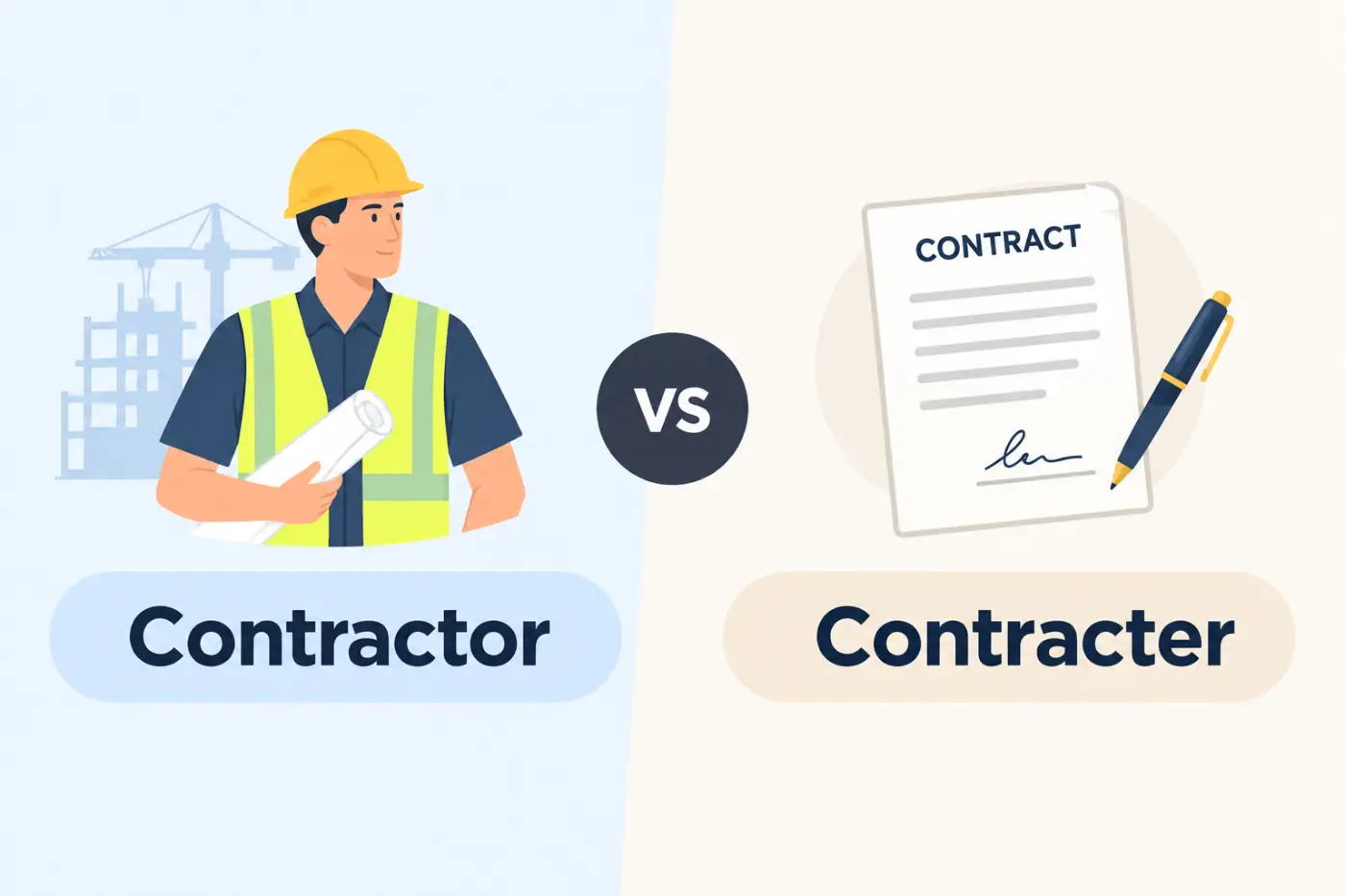
If you’re unsure about contractor vs contracter you only need to remember one spelling. The correct word is contractor. The spelling contracter is incorrect in standard English.
A contractor is a person or company hired to do a specific job under a contract. You might hire a contractor to remodel your kitchen. A business might bring in a contractor to handle a construction project. A company can also hire an independent contractor to provide services for a set period.
The confusion usually comes from the word contract. Since the person who works under a contract is called a contractor it can feel natural to add the ending er directly to contract. That would give you contracter. English doesn’t form the word that way.
The correct spelling uses or at the end. Once you see how the word is formed and learn what it means you’ll have a much easier time remembering it.
Quick Definition
A contractor is a person or business hired to perform a particular service or complete a specific project. The work is usually based on an agreement that explains the duties payment and terms.
Contracter is not the standard spelling of this word. If you’re writing about someone hired to perform work under a contract use contractor.
Direct Answer
Contractor is the correct spelling. Contracter is an incorrect spelling and should not be used in standard English.
Comparison Table
| Word | Meaning | Example Sentence | When to Use It |
|---|---|---|---|
| Contractor | A person or company hired to provide a service or complete a project. | We hired a contractor to renovate the kitchen. | Use this spelling when referring to the worker or business. |
| Contracter | Incorrect spelling of contractor. | This spelling is incorrect. | Do not use it in standard English. |
Why The Spelling Causes Confusion
The mistake makes sense when you look at how many English words work. We often create a word for a person by adding er to a verb.
For example a person who teaches is a teacher. Someone who drives is a driver. Someone who paints is a painter.
That pattern can make contracter look reasonable at first glance. The problem is that contractor doesn’t follow that exact pattern.
The ending or is used in many English words that describe a person or thing involved in an action. Contractor belongs to this group.
You can see similar endings in words such as actor operator creator and administrator. The spelling isn’t always predictable from a simple rule but familiar word patterns can help.
There’s another reason the error is easy to make. The noun contract is pronounced almost the same at the start of the longer word. When people write the word from memory they may think of contract and then attach er. That produces a spelling that looks logical but isn’t correct.
The best approach isn’t to guess from the base word. Learn contractor as its own word and connect it with its meaning.
What Does Contractor Mean
A contractor is someone hired to perform work based on an agreement. The agreement may be written or spoken depending on the situation and the type of work involved.
The word is especially common in construction. A homeowner might hire a contractor to build an addition. A contractor may then hire electricians plumbers painters or other workers to handle different parts of the project.
For example:
- We hired a contractor to repair the roof.
- The contractor gave us an estimate for the kitchen renovation.
- Our contractor expects the project to finish next month.
The word isn’t limited to construction. Businesses use contractors in many fields.
A company might hire an IT contractor to set up a computer network. A marketing agency might bring in a freelance contractor for a short project. A government agency might hire a contractor to provide specialized services.
So the basic idea is simple. A contractor provides work or services under an agreement.
Contractor In Construction
Construction is probably the setting where you’ll hear this word most often.
A general contractor manages a construction project. This person or company may coordinate workers order materials schedule tasks and communicate with the property owner.
For example a homeowner who wants to remodel a bathroom may not want to manage every part of the project. Instead the homeowner can hire a general contractor who organizes the work.
The contractor may arrange for a plumber to install pipes. An electrician may handle wiring. A tile installer may finish the walls and floor.
The general contractor acts as the person who brings these different parts together.
You might see sentences like these in everyday writing.
- The contractor started work on Monday.
- We asked three contractors for estimates.
- The contractor said the repairs would take two weeks.
- Our general contractor recommended a different type of flooring.
In all of these sentences contractor refers to the person or company performing or managing contracted work.
Independent Contractor
Another common use of the word appears in employment.
An independent contractor provides services to a business but generally works as a separate business or self employed worker rather than as a regular employee. The exact legal definition can depend on the applicable law and the specific working arrangement.
Freelancers are often described as independent contractors. A graphic designer might work with several companies on separate projects. A writer might provide articles to different clients. A consultant might advise businesses under individual service agreements.
For example:
- The company hired an independent contractor to redesign its website.
- Maria works as an independent contractor for several clients.
- The business uses contractors for short term projects.
The distinction between an employee and an independent contractor can matter for taxes benefits workplace rights and other legal issues. Those rules vary by location and by the facts of the working relationship so the label alone doesn’t always determine someone’s legal status.
For spelling purposes the key point is much simpler. The person is called a contractor. The spelling does not change because the person works independently.
Contractor Can Refer To A Company
A contractor isn’t always an individual.
A business can also act as a contractor. This is common in construction home improvement cleaning technology consulting and many other industries.
For example a homeowner might say:
- We hired a local contractor to replace the windows.
That contractor could be a company with several employees. The word still works because the company has agreed to provide a service.
This is useful to remember because people sometimes assume that contractor only means one person. In practice the term can refer to an individual or a business that takes on contracted work.
The Difference Between A Contractor And An Employee
The words contractor and employee describe different types of working relationships.
An employee normally works for an employer as part of the employer’s regular organization. The employer generally controls important parts of the person’s work and provides compensation through an employment relationship.
A contractor usually provides specific services under a contract. The contractor may have more control over how the work is performed and may work with multiple clients.
However the legal difference isn’t based on one simple factor. Government agencies often look at the actual working relationship when deciding how a worker should be classified.
For everyday writing you can keep the distinction simple. An employee works for an employer. A contractor is hired to provide a service or complete agreed work.
How The Word Contractor Is Formed
The spelling becomes easier once you stop treating contractor as contract plus er. The word comes from contract with the suffix or added to form a noun for a person or business involved in a particular activity.
English uses several endings to create nouns that describe people who perform an action. The ending or appears in many familiar words. An actor acts. An operator operates. A creator creates. A contractor works under a contract.
This doesn’t mean you can add or to every verb and get a correct word. English has many different word building patterns. The useful point is that contractor has its own established spelling. Trying to build the word as contract plus er leads to the common mistake.
The Role Of The Suffix Or
A suffix is a group of letters added to the end of a word to create a new word or change its meaning. In contractor the ending or helps form the noun that refers to the person or business carrying out contracted work.
You can see the same ending in several everyday words.
- An actor performs.
- An instructor teaches or trains.
- An operator runs or controls something.
- A supervisor oversees work.
- A contractor performs work under an agreement.
These examples don’t create one perfect spelling rule. They simply show that or is a familiar noun ending in English.
Why Contracter Looks Correct At First
The incorrect spelling can fool your eyes because it follows a pattern that works in many other words.
Consider these examples.
- Teach becomes teacher.
- Drive becomes driver.
- Paint becomes painter.
- Farm becomes farmer.
- Contract becomes contracter.
The first four examples work. The last one doesn’t.
That’s what makes this spelling mistake tricky. Your brain recognizes a familiar pattern and tries to apply it automatically. But English has many words that don’t follow the most obvious pattern.
The better habit is to remember the established word rather than trying to construct it every time you need it. If you’re writing about someone hired under a contract write contractor.
Examples Of Contractor In Real Sentences
Context makes spelling easier to remember. When you connect the word with situations you actually encounter the correct form becomes more familiar.
Home Improvement
Home renovation is one of the most common situations where you’ll see this word.
- We hired a contractor to remodel our kitchen.
- The contractor replaced the damaged flooring.
- Our contractor gave us an estimate before starting the project.
- The contractor arrived early to inspect the house.
In these sentences the contractor is the person or business hired to perform the work.
Construction Projects
Construction companies and workers use the term constantly.
- The contractor submitted a proposal for the new building.
- The city selected a contractor for the road project.
- The contractor must follow the project plans.
- We spoke with the contractor about the construction schedule.
A contractor may manage workers materials schedules and other parts of a project. The exact role depends on the contract and the type of work.
Business Services
The word also appears far beyond construction.
- The company hired a contractor to update its software.
- We brought in a contractor to review our accounting system.
- The marketing contractor created a new campaign.
- The business uses contractors for specialized projects.
This broader use is easy to overlook. You don’t have to be talking about buildings or repairs to use the word correctly.
Government Work
Government agencies also hire contractors to provide goods or services.
- The agency awarded the project to a private contractor.
- The contractor must meet the requirements in the agreement.
- Several contractors submitted proposals for the project.
Contractor And Contract Have Different Jobs
The two words are closely connected but they don’t serve the same grammatical purpose.
Contract can be a noun or a verb.
As a noun it means an agreement between people or organizations.
- We signed a contract with the company.
As a verb it can mean to enter into an agreement.
- The school contracted a company to repair the roof.
Contractor is a noun. It refers to the person or business hired to perform work under a contract.
- The contractor repaired the roof.
Keeping these roles separate can make the vocabulary easier to understand.
Think of the relationship this way.
Contract is the agreement.
Contractor is the person or company doing the contracted work.
That simple connection can help you remember the correct spelling.
Contractor And Contracting
You’ll also see the related word contracting.
Contracting refers to the process or business of making agreements to provide work or services.
For example:
- He works in the construction contracting business.
- The company specializes in government contracting.
- Contracting work has increased this year.
The word contractor refers to the person or business that takes on the work.
For example:
- The contractor won the construction project.
The words belong to the same family but they aren’t interchangeable.
General Contractor And Subcontractor
Construction writing often includes another useful term called subcontractor.
A general contractor usually manages the main construction project. A subcontractor is hired to handle a particular part of that project.
For example a general contractor might oversee the renovation of an entire house. The general contractor could then hire a plumbing company to handle the pipes and an electrical contractor to handle the wiring.
You might read sentences like these.
- The general contractor hired a subcontractor for the electrical work.
- The subcontractor finished the plumbing ahead of schedule.
- We contacted the general contractor about the project.
Both words contain contractor. The spelling stays the same.
This is another reason learning the base word is useful. Once you know the correct spelling you can recognize it inside longer words.
Common Contractor Terms
Several terms appear regularly with this word. Learning them can improve both your spelling and your understanding.
General Contractor
A general contractor manages or coordinates a construction project. The contractor may arrange workers materials permits schedules and other project details.
Independent Contractor
An independent contractor provides services independently rather than working as a regular employee. Freelancers consultants and other self employed professionals may work under this type of arrangement.
Electrical Contractor
An electrical contractor provides electrical services. This may include installing wiring lighting equipment and electrical systems.
Plumbing Contractor
A plumbing contractor handles plumbing work such as pipes fixtures drains and water systems.
Government Contractor
A government contractor provides goods or services under an agreement with a government agency.
Subcontractor
A subcontractor performs part of a larger project after being hired by a primary contractor or another business.
All of these terms use the same core spelling. The ending remains or.
Common Spelling Mistakes With Contractor
The most obvious mistake is switching or to er. But writers can make a few other errors too.
Some people leave out a letter because the word is relatively long. Others may type the letters in the wrong order. These mistakes are usually simple typing errors rather than signs that someone doesn’t understand the word.
The most useful correction is to slow down and look at the final four letters.
The word ends in tor.
That final pattern can serve as a quick visual check. If you see contracter on the screen your eye should catch the ending and remind you that the correct form is contractor.
How To Remember The Spelling
A good memory trick doesn’t need to be complicated. You can connect the word with another familiar word that uses the same ending.
Think of actor.
An actor is a person who acts. A contractor is a person or business that carries out contracted work.
Both end with or.
You can also remember the phrase contract plus or. It isn’t a complete explanation of English word formation but it gives you a useful visual cue.
Another helpful trick is to picture a construction worker standing beside a building. Imagine a small sign that says CONTRACTOR. The visual connection between the word and the job can make the spelling stick.
The key is repetition in context. Read the word. Write it in a sentence. Use it in an email. After enough exposure the correct version won’t require much thought.

When To Use Contractor In Professional Writing
Correct spelling matters more in professional documents because readers often judge a document by small details.
You might use this word in an estimate a proposal an invoice a project report or an email. You could also see it in legal documents related to construction or services.
For example:
- Please contact the contractor before making changes to the project.
- The contractor submitted the final invoice on Friday.
- We need to review the contractor’s proposal before signing the agreement.
In each case the spelling contractor keeps the writing clear and professional.
A misspelled version can distract the reader. One small error won’t ruin a document but correcting common mistakes makes your writing look more careful.
Related Words And Spelling Patterns
Once you understand contractor it helps to look at a few related words. English has several terms that describe people who perform a task or provide a service. Some use er at the end while others use or. Seeing these patterns side by side can explain why the spelling can feel confusing.
The important point is that you shouldn’t assume every person noun follows the same ending. English has developed words from different sources and patterns. Sometimes er is correct. Sometimes or is correct. The safest approach is to learn the established spelling of each common word.
Contractor And Worker
A worker is a person who does work. The word uses er because it comes from the verb work.
A contractor is a person or company hired to provide a service or complete a project under an agreement.
For example:
- The worker arrived early to start the job.
- The contractor hired several workers for the project.
These words can describe people involved in the same project but they don’t mean exactly the same thing.
Contractor And Employee
An employee is someone who works for an employer as part of an employment relationship. A contractor usually provides services under a separate agreement.
For example:
- The company has 50 full time employees.
- The company also works with several independent contractors.
The legal difference can depend on the actual working arrangement and the laws that apply. Still the basic vocabulary distinction is useful in everyday writing.
Contractor And Consultant
A consultant gives expert advice or specialized help. A contractor can also provide specialized services but the terms aren’t identical.
For example:
- The company hired a consultant to improve its business strategy.
- The company hired a contractor to install the new computer system.
The first person mainly provides advice. The second performs a specific service or project.
Contractor Versus Contracted
Another common source of confusion is the difference between contractor and contracted.
Contractor is a noun. It identifies a person or business.
- The contractor repaired the roof.
Contracted is usually a verb form or adjective. It can describe something that was agreed upon or arranged through a contract.
- The company contracted a local firm to complete the work.
The two words are related but they have different jobs in a sentence. Knowing the part of speech can help you choose the right form.
How The Word Appears In Different Forms
The noun doesn’t always appear by itself. You may see related forms when reading about jobs agreements and services.
Here are some common examples.
- Contractor.
- Contractors.
- Contracting.
- Contracted.
- Contractual.
The plural of contractor is contractors.
For example:
- Three contractors submitted bids for the project.
The spelling stays the same before the plural ending. You don’t change the or to er.
Singular And Plural Examples
Understanding the plural form is useful because the word appears often in business and construction writing.
Singular Form
Use contractor when talking about one person or one company.
- The contractor called me this morning.
- Our contractor finished the repairs.
Plural Form
Use contractors when talking about more than one.
- Several contractors submitted estimates.
- We interviewed three contractors before choosing one.
Notice that the spelling stays intact. You simply add s.
Possessive Forms
You may also need the possessive form when something belongs to or is connected with a contractor.
For one contractor use contractor’s.
- The contractor’s estimate was higher than expected.
- I reviewed the contractor’s proposal.
For more than one contractor use contractors’.
- The contractors’ proposals were reviewed by the committee.
The apostrophe changes based on singular and plural possession. The base spelling doesn’t change.
Examples From Different Fields
The meaning of contractor can shift slightly depending on the industry but the basic idea remains the same.
Technology
A technology contractor might help a company build software install equipment manage systems or provide technical support.
- We hired a contractor to update the company’s network.
Marketing
A marketing contractor may provide writing design advertising or research services.
- The marketing contractor created a campaign for the new product.
Healthcare
Some healthcare professionals work under contract arrangements rather than as regular employees.
- The hospital brought in a contractor to provide temporary medical services.
The exact legal and professional arrangement can vary. The spelling stays the same in every field.
Transportation
Transportation companies can use contractors for delivery driving maintenance and other services.
- The delivery company works with independent contractors.
Home Services
Contractors are common in home repair and improvement.
- We found a contractor to replace the damaged roof.
This wide range of uses shows why the word is worth learning properly. It’s not just a construction term.
Why The Wrong Spelling Is So Common
A misspelling can become familiar simply because you see it often. If you regularly encounter contracter online you might begin to wonder if both forms are accepted.
They aren’t.
The incorrect version may appear in user comments advertisements informal messages or poorly edited web pages. Seeing an error repeatedly doesn’t make it a standard spelling.
The same problem happens with many English words. People often write what seems logical based on pronunciation or a familiar spelling pattern. Once the incorrect version becomes familiar it can be surprisingly hard to notice.
That is why visual memory matters. When you see contractor often enough the correct form becomes much easier to recognize.
A Simple Memory Trick
Try connecting the word with actor.
An actor ends with or.
A contractor also ends with or.
You can remember the pair as:
Actor and contractor both end with or.
This isn’t a formal spelling rule. It’s simply a useful memory aid.
Another trick is to focus on the last three letters.
contractor
The ending is tor.
contracter
The ending is ter.
If you’re writing quickly you can pause and check that final sound and letter pattern. The correct word has or at the end.
A Quick Test You Can Use
When you’re unsure about the spelling ask yourself one simple question.
Are you talking about a person or company hired to perform work under a contract?
If the answer is yes use contractor.
You don’t need to create a new spelling from the word contract. You don’t need to guess based on how the ending sounds. Just use the established spelling.
Try these examples.
- We need to hire a contractor.
- The contractor sent an estimate.
- Two contractors visited the property.
- The contractors submitted their proposals.
Every sentence uses the same base spelling.
When Contracter Appears In A Sentence
If you’re proofreading someone else’s writing you may come across the incorrect form. In standard English writing you should replace it with contractor.
For example:
Incorrect.
- We contacted a contracter about the roof.
Correct.
- We contacted a contractor about the roof.
Incorrect.
- The contracter sent us an estimate.
Correct.
- The contractor sent us an estimate.
Incorrect.
- Three contracters applied for the project.
Correct.
- Three contractors applied for the project.
The correction is simple. Replace the final er with or.
Spelling Is Only Part Of Good Word Choice
Knowing the spelling is useful but understanding the meaning matters too. A strong writer doesn’t just choose a word because it looks familiar. The writer also makes sure the word fits the situation.
For example you wouldn’t normally call every person working on a construction site a contractor. Someone may be an employee of the contractor. Another person may be a subcontractor. Someone else could be a supplier who isn’t performing the contracted work at all.
That distinction becomes important in contracts proposals invoices and other professional documents. Using the right term makes the meaning clearer and prevents confusion.
The good news is that you don’t need complicated grammar knowledge to handle this word. Remember what a contractor does and remember the or ending. Those two ideas will cover most situations.
A Few Sentences To Practice
Read these examples aloud and notice how naturally the correct spelling fits into different contexts.
- The contractor gave us a detailed estimate.
- We hired a contractor after checking several references.
- The contractor completed the bathroom renovation on time.
- Our company uses an independent contractor for graphic design.
- The general contractor manages the entire construction project.
- The subcontractor handled the electrical work.
- Several contractors submitted proposals for the new building.
- We asked the contractor to explain the additional charges.
FAQs
Is contractor or contracter correct?
Contractor is the correct spelling. Contracter is an incorrect spelling and isn’t used as the standard English word for a person or company hired to perform work under a contract.
Why is contractor spelled with or?
The word contractor uses the suffix or to form a noun for someone involved in a particular activity. English uses both er and or in words that describe people but the ending isn’t always predictable from the base word.
Is contracter ever a correct spelling?
No. Contracter isn’t the standard spelling of the noun. If you’re referring to a person or business hired to provide services under an agreement use contractor.
What does contractor mean?
A contractor is a person or company hired to perform a specific service or complete a project under an agreement. The term is common in construction but also applies to technology consulting marketing home repair government work and many other fields.
Is a contractor the same as an employee?
Not necessarily. A contractor generally provides services under a separate agreement while an employee works within an employment relationship. The legal difference depends on the actual working arrangement and the laws that apply.
What is an independent contractor?
An independent contractor is a self employed person or separate business that provides services to a client under an agreement. Freelancers consultants and specialized service providers can work as independent contractors.
What is a general contractor?
A general contractor typically manages a construction project and coordinates different parts of the work. They may hire subcontractors such as electricians plumbers or other specialists to complete specific tasks.
What is the plural of contractor?
The plural is contractors. You simply add s to the correct spelling.
For example:
- Several contractors submitted bids for the project.
- We contacted three contractors for estimates.
Conclusion
If you’re deciding between contractor vs contracter the answer is straightforward. Contractor is the correct spelling. Contracter is a common mistake that comes from treating the word as contract plus er.
The easiest way to remember the correct form is to focus on the ending or. You can connect it with familiar words such as actor operator and creator. You can also remember that a contractor is the person or business carrying out work under a contract.
The word is used far beyond construction. You may see it in discussions about independent workers technology marketing consulting home repairs government projects and many other services. Knowing the meaning helps you choose the word correctly instead of relying only on its appearance.
When you write the word next time take a quick look at the final letters. If you’re talking about someone hired to perform contracted work the word you want is contractor. That small spelling check can keep your email proposal report or article clean and professional.

Sienna Watson is a veteran copywriter and communications coach who has helped startup founders, marketers, and professionals polish their writing for over a decade. Realizing that most people don’t need a degree in linguistics—just clear, impactful communication—Sienna focuses on practical grammar, business writing etiquette, and eliminating wordiness. She advocates for plain language, strong verbs, and persuasive prose that gets results.