
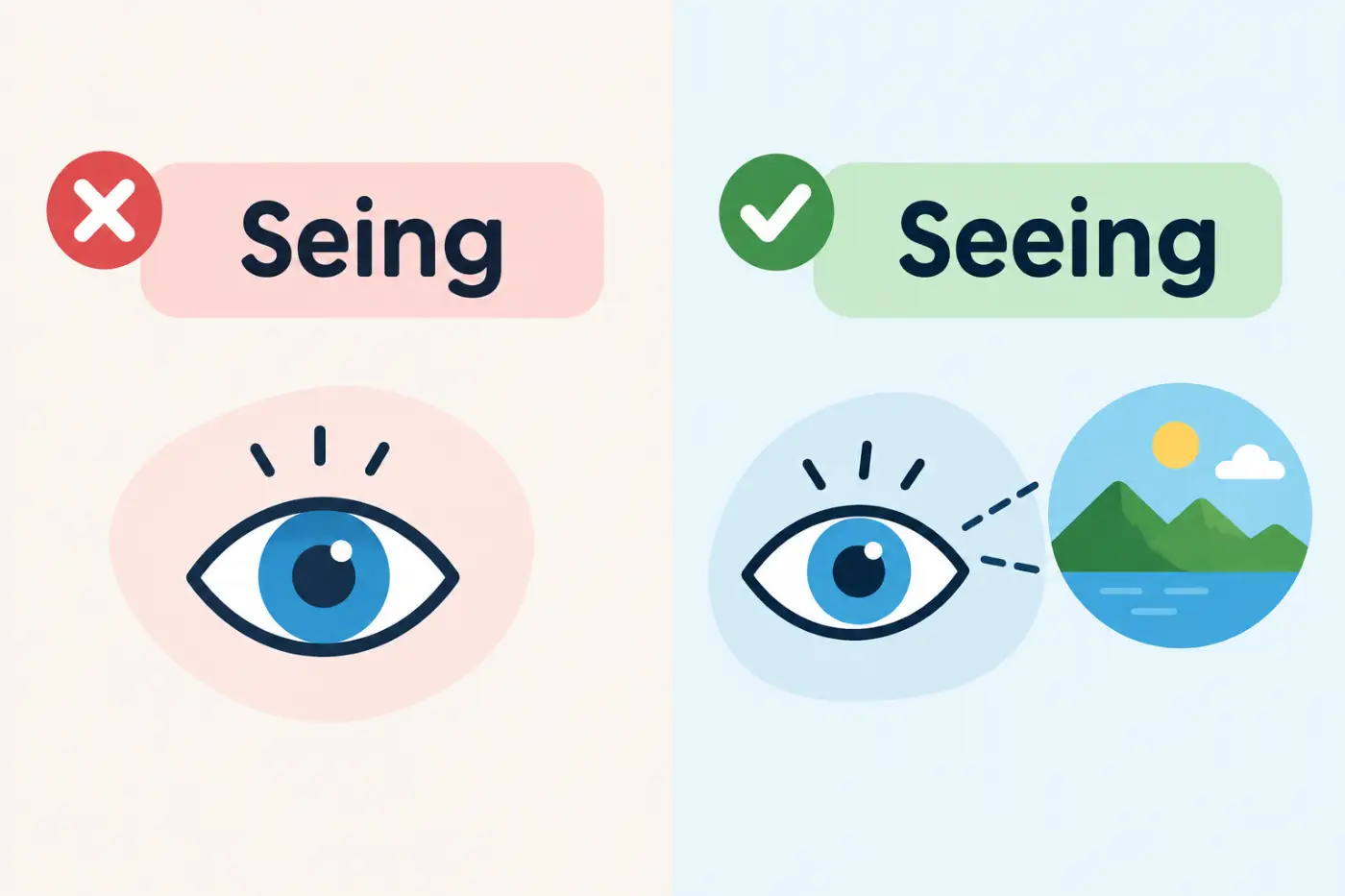
If you’re stuck on seing vs seeing the correct spelling is seeing. The word seing is a common spelling mistake and isn’t correct in standard English.
The confusion usually comes from the extra letter e. The verb see already ends in e, and adding ing can make the spelling feel awkward. Many people drop one letter without realizing that the spelling changes the word.
The good news is that the rule is simple once you see how it works. This guide explains why seeing keeps both e letters, how the word works in a sentence, and why similar words can follow different spelling patterns.
You’ll also find common mistakes, useful examples, related words, and simple ways to remember the correct form.
Quick Definition
Seeing is the present participle of the verb see. It means noticing something with your eyes or understanding or experiencing something.
Seing is not the correct spelling. The standard form is seeing.
Direct Answer
Seeing is the correct spelling. Seing is incorrect because the verb see keeps its two e letters when you add ing.
Comparison Table
| Word or Phrase | Meaning | Example Sentence | When to Use It |
|---|---|---|---|
| Seeing | The correct form of see with ing added. | I am seeing a doctor tomorrow. | Use it in standard English. |
| Seing | Incorrect spelling. | This spelling is incorrect. | Do not use it. |

Why Seeing Has Two E Letters
The spelling becomes much easier once you look at the base word. The base verb is see. It already has two e letters at the end.
When you add ing to make the present participle, you keep the spelling of the base word and add ing.
So the word develops like this.
see + ing = seeing
Nothing gets removed. The two e letters stay together.
This may look unusual at first because many English verbs change slightly when ing is added. For example, make becomes making, and write becomes writing. In those words, the final silent e disappears.
That rule does not apply to see. The spelling stays intact before ing is added.
The Spelling Rule For See
The verb see is one of the words that keeps its final letters when ing is added. The result is seeing.
Compare these forms.
- See.
- Seeing.
- Saw.
- Seen.
The forms saw and seen are different because see is an irregular verb. However, the ing form is straightforward. You simply add ing to the base form.
That gives you seeing.
This is different from verbs such as take and write.
- Take becomes taking.
- Write becomes writing.
- Make becomes making.
Those verbs drop the final e before ing. The verb see does not follow that pattern.
Why People Write Seing
The incorrect spelling usually comes from applying the wrong spelling rule. People often learn that a final e disappears before ing and then apply that rule too broadly.
That works for many common verbs.
- Hope becomes hoping.
- Love becomes loving.
- Drive becomes driving.
- Move becomes moving.
But English has exceptions and special cases. See is one of them.
Another reason for the mistake is pronunciation. When you say seeing quickly the two e letters do not sound like two separate letters. You hear one smooth sound. Because of that, the extra e can feel unnecessary when you’re writing the word.
Typing quickly can make the mistake even easier. If you’re writing a message and your fingers move faster than your attention, dropping one e is an easy error.
Once you understand the structure of the word, though, the correct spelling becomes much easier to remember.
How To Use Seeing In A Sentence
The word seeing can serve several purposes in English. Its basic meaning relates to the act of using your eyes to notice something, but the word has other common uses too.
Seeing Something With Your Eyes
The most direct meaning involves vision. You can use seeing to describe the act of looking at or noticing something.
For example:
- I am seeing a beautiful sunset from my window.
- She was seeing a bird in the garden.
- We enjoyed seeing the mountains from the hotel.
- I remember seeing that movie as a child.
In these examples, seeing refers to visual experience.
Seeing Someone
The word can also describe spending time with another person or meeting them.
For example:
- I’m seeing my parents this weekend.
- She is seeing an old friend tonight.
- We were seeing our neighbors more often during the summer.
Here, the word does not simply mean looking at someone. It can mean meeting, visiting, or spending time with someone.
Seeing A Doctor
You may also hear seeing in situations involving professional appointments.
For example:
- I’m seeing my doctor tomorrow.
- She is seeing a dentist next week.
- He needs to see a specialist about the problem.
In these sentences, seeing means meeting with a professional for an appointment or consultation.
Seeing Something Clearly
The word can also refer to understanding or recognizing something.
For example:
- I’m seeing the problem now.
- She is finally seeing why the plan failed.
- After reading the report, we started seeing the bigger picture.
Here, seeing has a figurative meaning. It does not mean looking at something with your eyes. It means understanding or recognizing an idea.
The Difference Between See And Seeing
See and seeing come from the same verb, but they don’t always fit in the same sentence.
See is the base form.
- I see the problem.
- Can you see that building?
- We see our friends every Friday.
Seeing is the form used with am, is, or are in many sentences.
- I am seeing the problem more clearly now.
- She is seeing her doctor tomorrow.
- They are seeing a movie tonight.
The choice depends on the sentence structure and the meaning you want to express.
You can also use seeing as part of a phrase.
- Seeing is believing.
- Seeing the result made me happy.
- I remember seeing that place before.
Learning the two forms together helps you understand both spelling and grammar.
Seeing In The Present Progressive
One common use of seeing is in the present progressive tense. This form describes an action that is happening now or around the present time.
The basic pattern is:
- am + seeing
- is + seeing
- are + seeing
For example:
- I am seeing a movie tonight.
- She is seeing her friends after work.
- They are seeing the same doctor.
- We are seeing better results this month.
The word remains seeing in each sentence. You don’t remove one of the e letters.
Seeing In Everyday Conversation
You may hear this word constantly in normal conversation. Native speakers use it in many simple expressions.
Someone might say:
- I’m seeing what you mean now.
- I’ll be seeing you tomorrow.
- I’m seeing someone about that issue.
- We’re seeing a lot of traffic today.
- I’m seeing things differently now.
These sentences show how flexible the word can be. Sometimes it describes vision. Sometimes it means meeting someone.
The spelling stays the same in every case.
Common Mistakes With Seeing
Spelling mistakes often happen when people remember a general rule but forget that English has exceptions. The most common error here is removing one of the two e letters.
Writing Seing
This is the main mistake.
Incorrect:
- I am seing a movie tonight.
Correct:
- I am seeing a movie tonight.
The correct form keeps both e letters from the base verb see.
Writing See Ing As Two Words
Another mistake is separating the base verb and ending.
Incorrect:
- She is see ing her doctor tomorrow.
Correct:
- She is seeing her doctor tomorrow.
The letters form one word.
Confusing Seeing With Seen
These two forms come from the same verb but serve different grammatical purposes.
Seeing is the present participle.
- I am seeing my friend tonight.
Seen is the past participle.
- I have seen that movie before.
You cannot swap them freely. The sentence structure tells you which form you need.
See Seeing And Seen
The verb see is irregular, so its forms can look quite different.
Here are the main forms.
| Form | Example |
|---|---|
| See | I see the car. |
| Sees | She sees the car. |
| Saw | I saw the car yesterday. |
| Seen | I have seen the car before. |
| Seeing | I am seeing the car now. |
This table makes one point clear. Seeing follows a simple pattern even though the other forms of the verb change.
The past tense saw does not look like see at all. The past participle seen adds another form. But the present participle simply keeps the base spelling and adds ing.
Why The Final E Rule Does Not Apply Here
A common English spelling rule says that many verbs ending in silent e drop that e before adding ing.
For example:
- Bake becomes baking.
- Dance becomes dancing.
- Smile becomes smiling.
- Use becomes using.
The reason is partly related to pronunciation and spelling conventions. Keeping the final e in those words would create a spelling that English normally does not use.
But see is different. Its final letters are not treated like the silent e in words such as make or bake.
The word already ends with ee. When ing is added, the spelling becomes seeing.
This is a useful reminder that spelling rules need to be applied to the right word. A rule that works for one group of verbs may not work for another.
Similar Words That Keep Their Double E
The spelling of seeing makes more sense when you compare it with a few related forms.
Words ending in ee often keep those letters when another ending is added.
For example:
- Agree becomes agreeing.
- Free becomes freeing.
- Flee becomes fleeing.
- Knee becomes kneeing.
- See becomes seeing.
These examples give you a useful pattern. When a word already ends in ee, adding ing can leave the two e letters in place.
That makes seeing much less strange.
Seeing And Agreeing
The word agreeing is especially useful as a memory aid.
The base word is agree. Add ing and you get agreeing.
You do not write agreing.
The same idea applies to see.
See becomes seeing.
You can remember the pair like this.
- See becomes seeing.
- Agree becomes agreeing.
Both words keep their double e before ing.
Seeing And Being
Another useful comparison is being.
The base verb is be. Its present participle is being.
This word also looks unusual because it keeps the final e before ing. You don’t write bing.
For example:
- I am being careful.
- She is being honest.
- They are being helpful.
This gives you another reminder that the simple rule about dropping final e does not apply to every verb.
A Simple Memory Trick
If you often forget the spelling, connect seeing to the phrase see it.
The word see already has two e letters. When you turn it into seeing, those two letters stay together.
Think:
see + ing = seeing
You can also picture the word as two parts.
see + ing
The base word stays whole.
Another helpful trick is to compare it with agreeing. Both see and agree end with ee, and both keep those letters when ing is added.
The more often you see this pattern, the less likely you are to drop an e.
Examples Of Correct Seeing In Real Sentences
Real examples make spelling rules easier to remember. Read these sentences naturally rather than trying to memorize them word for word.
- I am seeing my sister after work.
- We were seeing a movie when you called.
- She is seeing her doctor next week.
- I remember seeing that house before.
- Are you seeing the same problem I am seeing?
- He started seeing the value of the idea after a few weeks.
- They are seeing more customers this year.
- I can’t believe what I’m seeing.
- We kept seeing the same mistake in every report.
- She enjoys seeing her grandchildren on weekends.
Notice how the meaning changes from sentence to sentence. The spelling does not.
When Seeing Means Understanding
English often uses vision words to describe thoughts and ideas. Seeing can therefore mean understanding something rather than physically looking at it.
Consider this sentence:
- I’m seeing why you made that choice.
The speaker is not talking about eyesight. They mean that they now understand the reason.
Here are a few more examples.
- I’m starting to see your point.
- She is seeing the problem from a different angle.
- After the explanation, I was seeing things more clearly.
- He finally saw what everyone else had noticed.
This figurative use is very common in everyday English. It appears in conversations, books, articles, and workplace discussions.
When Seeing Means Dating Someone
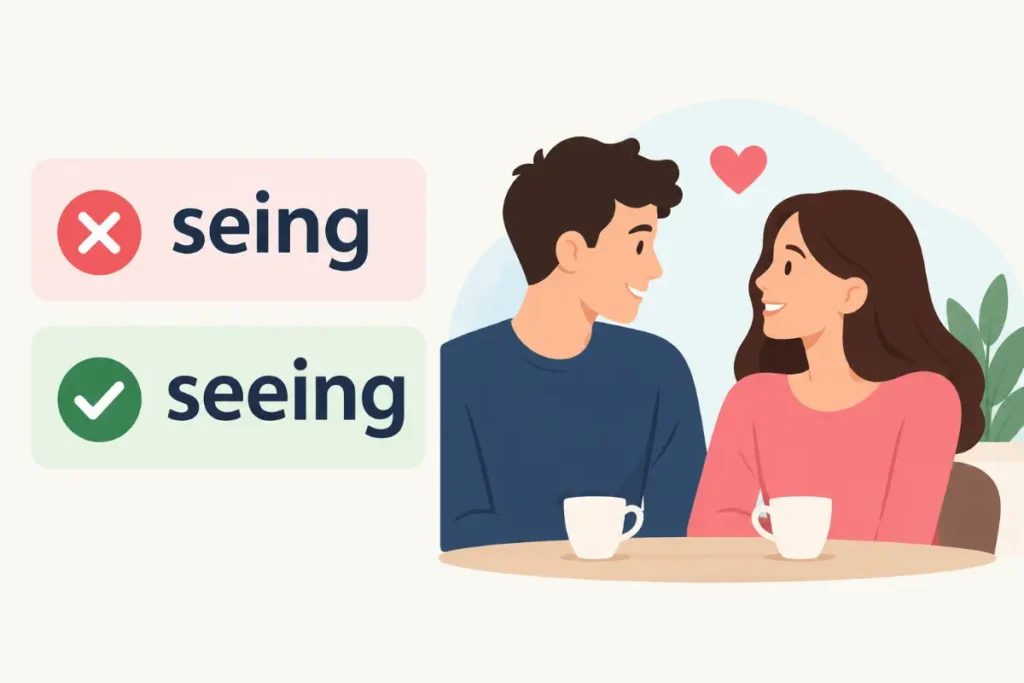
In informal American English, seeing someone can also mean dating them.
For example:
- She’s seeing someone new.
- I heard that he’s seeing someone from work.
In this context, seeing does not mean simply meeting or looking at another person. It can suggest a romantic relationship.
Context tells you which meaning the speaker intends.
For example:
- I’m seeing my dentist tomorrow.
This clearly refers to an appointment.
But:
- I’m seeing someone new.
This can suggest a romantic relationship.
The same spelling works in both cases.
Seeing As A Noun Like Form
The word can also appear in expressions where it acts as a noun like form.
A famous example is:
Seeing is believing.
This means that experiencing something yourself can make it easier to believe.
Another example is:
Seeing the damage was upsetting.
Here, the phrase seeing the damage works as the subject of the sentence.
These uses show why learning the word as more than just a spelling exercise is helpful. Understanding its grammar makes it easier to use naturally.
When To Use See Instead
Sometimes people choose seeing because they know it is the form they have been thinking about. But the sentence may actually need see.
For example:
- I can see the problem.
This is correct.
You would not say:
- I can seeing the problem.
After can, use the base form see.
The same pattern appears with other modal verbs.
- I can see it.
- You should see a doctor.
- We might see them later.
- They could see the difference.
After these helping verbs, use see, not seeing.
This is a grammar issue rather than a spelling issue. Knowing the difference helps you avoid both kinds of mistakes.
When To Use Seeing Instead
Use seeing when the sentence structure calls for the present participle.
For example:
- I am seeing the doctor tomorrow.
- She is seeing her parents tonight.
- They are seeing better results now.
You can also use it after certain verbs and expressions.
- I remember seeing that movie.
- She enjoys seeing her friends.
- We talked about seeing the new exhibit.
The grammar around the word tells you which form belongs in the sentence.
A Quick Test For Your Sentence
If you’re unsure about the spelling, first find the base verb.
Ask yourself what the word would be without ing.
If the base word is see, then the correct ing form is seeing.
For example:
- I am seeing the answer.
- Base verb: see.
- Add ing: seeing.
This simple check works better than guessing which letter to remove.
How To Avoid The Mistake While Typing
You don’t need a complicated spelling trick. Build a quick habit.
When you type the word seeing, remember that it starts with the complete word see. Then add ing.
Don’t start with se and try to rebuild the rest of the word. That approach makes it easier to lose a letter.
Instead think:
SEE + ING
This keeps the base word visible in your mind.
A second useful habit is proofreading common trouble words. If you know that seeing causes problems for you, give it a quick look before sending an important email or submitting an assignment.
FAQs
Is seeing the correct spelling?
Yes. Seeing is the correct spelling. It is the present participle of see, and it keeps both e letters before ing.
Why does seeing have two e letters?
The base verb is see, which already ends in two e letters. When you add ing, those letters remain, giving you seeing.
Is seing ever correct?
No. Seing is a misspelling in standard English. Use seeing instead.
Does see drop the final e before ing?
No. The verb see keeps its two e letters when ing is added. The correct form is seeing.
What is the past tense of see?
The simple past tense of see is saw. For example, you can say, I saw the movie yesterday.
What is the past participle of see?
The past participle is seen. It usually appears with a helping verb such as have, has, or had.
For example, I have seen that movie before.
Is seeing a verb?
Yes. Seeing is a form of the verb see. It can describe looking at something, meeting someone, understanding something, or experiencing something depending on the sentence.
What is the easiest way to remember seeing?
Remember the simple pattern see + ing = seeing. Keep the base word complete and then add ing.
Conclusion
If you’ve been wondering about seing vs seeing the answer is simple. Seeing is the correct spelling, while seing is incorrect. The key is to remember that the base verb see keeps both e letters when you add ing.
The confusion often comes from the common spelling rule that removes a final e before ing. That rule works with words such as make, write, and hope, but it doesn’t work with see. The spelling is simply see + ing = seeing.
You can use seeing in many ways. It can describe looking at something, meeting someone, understanding an idea, dating someone, or experiencing something. The meaning changes with the context, but the spelling stays the same.
When you need the word in your own writing, don’t guess. Start with the complete base verb see, then add ing. Keep both e letters and you’ll have seeing every time.

Sienna Watson is a veteran copywriter and communications coach who has helped startup founders, marketers, and professionals polish their writing for over a decade. Realizing that most people don’t need a degree in linguistics—just clear, impactful communication—Sienna focuses on practical grammar, business writing etiquette, and eliminating wordiness. She advocates for plain language, strong verbs, and persuasive prose that gets results.