
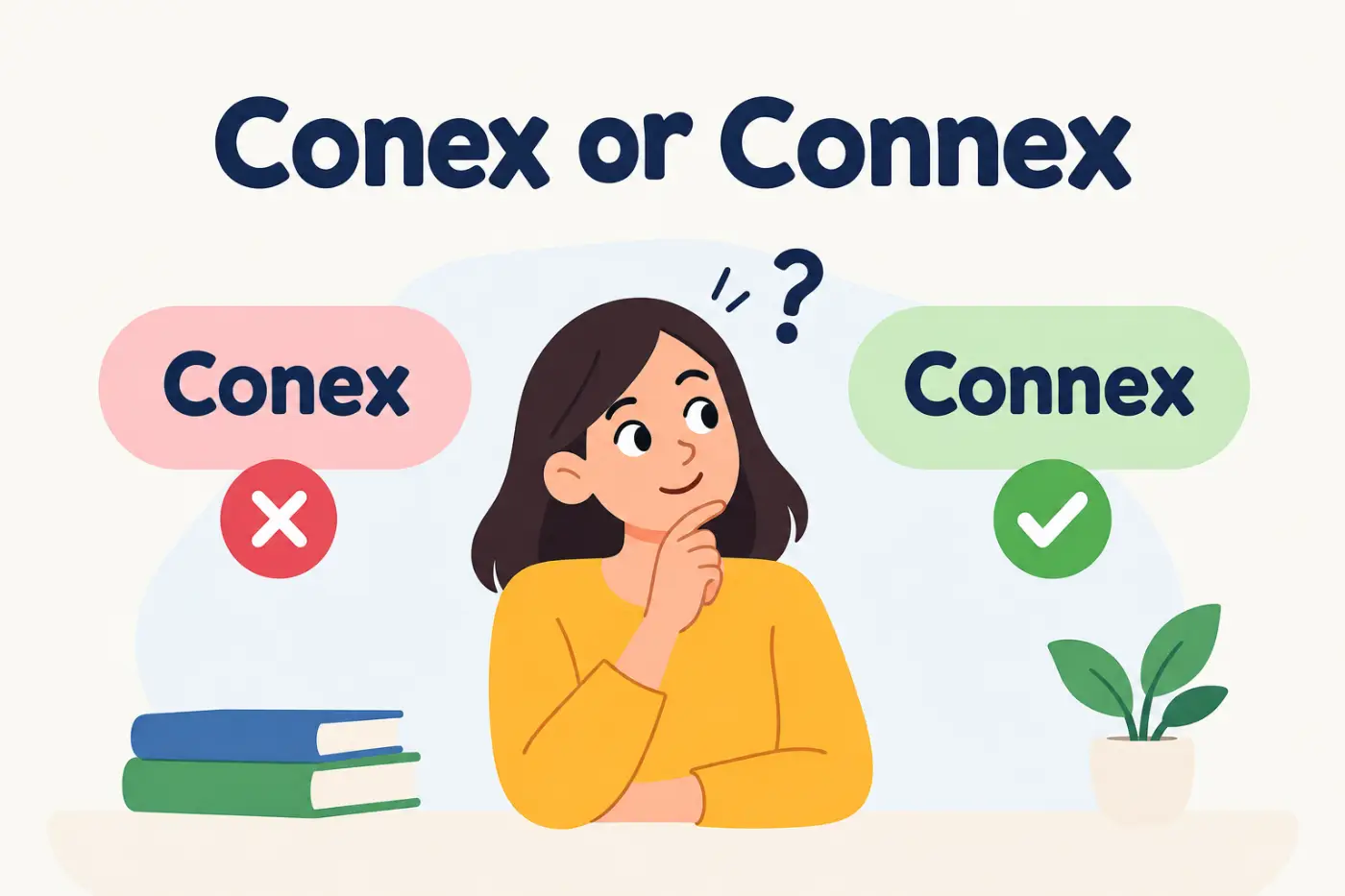
If you’re searching for conex or connex because you’ve seen both spellings online you may be surprised by the answer. Neither spelling is simply a mistake in every situation. The right choice depends on what you mean.
When you’re talking about a large steel cargo or storage container the spelling Conex is the clearest choice in American English. The term comes from the military expression Container Express. However connex is also recorded as a spelling variant for the same type of cargo container.
The confusion gets bigger because connex has other uses too. It can appear in older or specialized English with a meaning related to being connected. It can also be part of a company name product name or other proper name. So you shouldn’t automatically mark every use of the double N spelling as wrong.
This guide explains the difference in plain English. You’ll learn what each spelling means where the terms came from how people use them today and which form works best in everyday American writing.
Quick Definition
Conex is commonly used for a large steel shipping or storage container. The term is linked to the U.S. military expression Container Express.
Connex can also refer to this type of container. It is recorded by major dictionaries as a variant spelling. In other contexts it can have meanings connected to the idea of being linked or related.
Direct Answer
For a steel shipping or storage container Conex is the clearest spelling to use in most American writing. Connex is also an established variant for a military cargo container so it isn’t always an error.
Conex And Connex Comparison
| Word | Meaning | Example Sentence | Best Use |
|---|---|---|---|
| Conex | A large steel cargo or storage container | The tools are stored in the Conex. | General container writing |
| Connex | A variant spelling for a cargo container and a word with other specialized uses | The supplies were placed in a connex box. | Variant or context specific use |
| Shipping container | A standardized container used to move or store cargo | The shipping container arrived this morning. | Clear general writing |
| Storage container | A container used mainly for storing goods | We rented a storage container for the renovation. | Everyday American English |

What Does Conex Mean
A Conex is a large metal container used to transport or store goods equipment and supplies. You may see one at a construction site warehouse military facility farm or storage yard.
The term has military roots. CONEX comes from Container Express. The U.S. military used the term for a container system designed to make the movement of supplies easier. Over time the word became common in construction storage and other industries as a general name for similar steel containers.
Today someone might say Conex box Conex container or simply Conex. The meaning is usually clear from the setting.
For example:
- The contractor keeps extra lumber in the Conex.
- We need to move the equipment out of the Conex.
- The company ordered a new Conex for site storage.
In each sentence the word refers to a physical container.
What Does Connex Mean
Connex has a more complicated history because it can serve more than one purpose.
In American dictionary sources connex is listed as a noun for a large metal cargo container used by the U.S. Army. Dictionary.com describes it as an apparent respelling of conex. Collins also lists the container meaning and gives connex box as another form.
That means it would be too simple to say that connex is always wrong. If someone writes connex box when referring to a cargo container the meaning can still be clear and the spelling has dictionary support.
The word can also appear in specialized or older forms of English with a meaning related to connection. Modern American readers are much more likely to use connected linked or related instead. So a sentence such as The two ideas are connected sounds natural while The two ideas are connex sounds unusual to most people.
Context does a lot of work here.
Why The Two Spellings Cause Confusion
The two forms look almost identical. They also sound the same or very similar in ordinary speech. When someone hears the word instead of seeing it they have no reliable way to know if the writer used one N or two.
The difference becomes especially confusing in construction and storage. People in these industries may see both Conex and connex on listings advertisements messages and documents. One supplier may write Conex box while another may write connex box. Both may be talking about the same kind of steel container.
This does not mean the two spellings are equally useful in every situation. A writer needs to think about the audience and the purpose of the document.
If you’re writing a casual message to a contractor the meaning will probably be clear either way. If you’re writing an article for a general American audience the term Conex is usually the safer choice when you mean the container.
If clarity matters more than industry shorthand you can avoid the issue completely by writing shipping container or storage container.
Where The Word Conex Came From
The history helps explain the spelling.
CONEX comes from Container Express. The shortened form combines part of container with part of express. That gives you a useful memory clue.
CON plus EX gives you CONEX.
The spelling with one N therefore has a clear connection to the original expression. Dictionary.com describes connex as an apparent respelling of conex which helps explain how the double N form developed.
You don’t need to memorize military history to use the word correctly. Still the background makes the spelling easier to understand. Instead of wondering why the word has only one N you can connect it to Container Express.
That simple link can make the spelling stick.
How Americans Use Conex Today
Modern American usage is broader than the original military meaning. Construction companies may use Conex to describe a steel container for tools equipment materials or temporary storage. Businesses may rent them for job sites. Property owners may use them for extra storage.
For example a construction manager might say:
Put the extra pipes in the Conex before the storm.
A property owner might say:
We rented a Conex while we cleaned out the garage.
A contractor could write:
The new Conex will arrive at the job site Friday.
These sentences use the term naturally because the context makes the meaning obvious.
Still some readers may not know the word. If you’re writing for a broad audience it can help to define it the first time you use it.
For example:
The crew stored its tools in a steel storage container known as a Conex.
After that you can simply use Conex.
When Shipping Container Is Better
Conex is useful but it isn’t always the clearest term.
If your readers work in construction military logistics or storage they may know the word immediately. A general audience may not.
In that case shipping container is often easier to understand.
Compare these sentences:
- The company delivered a Conex to the property.
- The company delivered a steel shipping container to the property.
The first sentence is shorter and familiar to people who know the industry. The second sentence gives every reader an immediate picture of the object.
You can also use both terms together when you first introduce the subject.
The company delivered a steel shipping container known as a Conex to the property.
That sentence gives you clarity without assuming the reader knows industry vocabulary.
What A Conex Box Looks Like
A typical Conex box is a large rectangular steel container with strong walls and doors at one end. Modern containers come in different sizes and conditions. Some are used for cargo while others are used mainly for storage.
People often place them at construction sites because they provide a secure place for tools materials and equipment. They can also be modified for other purposes such as workshops offices or temporary spaces.
The word itself does not tell you the container’s size condition or exact design. A Conex might be described as a 20 foot or 40 foot unit for example. Those details should be stated separately when they matter.
This is useful when reading product listings. Don’t assume that two containers are identical just because both are called Conex boxes. Check the size condition doors flooring modifications and intended use.
Common Examples In Real Sentences
Seeing the term in normal sentences makes the distinction easier to understand.
Construction
The crew locked the Conex before leaving the job site.
The new Conex will be used to store power tools.
We need another storage container because the current Conex is full.
Storage
The homeowner keeps seasonal decorations in the Conex.
The storage company delivered a Conex to the property.
We cleaned out the old Conex before moving the equipment.
Military And Logistics
The unit loaded supplies into a CONEX container.
The historical document refers to the Container Express system.
The military used containerized cargo to make supply movement more efficient.
General Writing
The steel storage container arrived on Tuesday.
The contractor placed the equipment inside the shipping container.
These examples show an important point. You don’t always need the specialized term. Sometimes a plain phrase gives the reader a clearer picture.
Should You Use Conex Or Connex
For most American writing about a steel storage or shipping container Conex is the better default. It connects directly to the original Container Express term and is widely understood in construction storage and military contexts.
That doesn’t make connex meaningless. Major dictionary sources recognize it as a noun for a military cargo container. It may also appear as a spelling variant in industry writing.
The safest approach is simple. Use Conex when you need the common container term. Use connex when you’re preserving a recognized variant or an official name. If your audience may not know the term use shipping container or storage container instead.
That choice keeps your writing clear without turning a small spelling difference into a bigger problem than it needs to be.
Common Mistakes With Conex And Connex
The biggest mistake is assuming that one spelling must always be right and the other must always be wrong. That isn’t the case here. Conex and connex can both refer to a large cargo container, although Conex is usually the clearer choice for general American writing.
Another common mistake is using the term without considering the reader. Someone who works around construction sites or freight containers will probably know what a Conex means. A general reader may have no idea. In that situation a phrase such as steel storage container gives much more information.
Treating Connex As A Simple Spelling Error
If you see connex in a document you shouldn’t automatically assume the writer made a spelling mistake. The spelling is recognized as a variant for the military cargo container. It has also appeared in other English uses over time.
That said, connex isn’t the best default choice for every audience. If you’re writing a general American article or business document you can usually make things clearer by using Conex or the more descriptive term shipping container.
Assuming Every Conex Is A Shipping Container
A Conex can serve as a shipping container but people also use these containers mainly for storage. A unit sitting on a construction site may never transport cargo after it arrives.
For example:
The contractor uses the Conex to store tools overnight.
Calling it only a shipping container may miss the reason the unit is there. Storage container may fit the situation better.
Using Conex Without Explaining It
Specialized words can slow readers down when they don’t know the meaning. If your audience isn’t familiar with construction or military terms introduce the word before using it repeatedly.
A simple first mention works well:
The company placed a steel storage container called a Conex behind the building.
After that you can use Conex without stopping to explain it.
Conex Box And Conex Container
You may see several forms of the term in American writing. Conex box and Conex container are both common ways to describe the same general object.
A Conex box usually means the physical steel container itself. Conex container is slightly more explicit because the second word immediately tells unfamiliar readers what the object is.
For example:
- We rented a Conex box for the construction project.
- We rented a Conex container for the construction project.
Both sentences are clear. The second one may work better for a general audience because container provides immediate context.
You may also see terms such as storage Conex or Conex storage container. These phrases usually point to a container being used for storage rather than active cargo transportation.
Is Conex A Brand Name
This point causes another bit of confusion.
Conex began as a military term rather than as the name of a single private company or consumer brand. The term developed from Container Express and became associated with standardized military cargo containers.
Today people often use Conex as a general term for similar steel containers. That means a container doesn’t need to come from one specific manufacturer for someone to call it a Conex.
This is similar to how people sometimes use familiar product terms more broadly in everyday speech. The exact history and legal status of a particular name can depend on the context so writers shouldn’t assume that every use functions as a formal brand name.
Is Conex The Same As A Shipping Container
Not always.
A shipping container is designed around the movement of cargo. It is commonly used in freight transportation and can move between ships trucks and trains.
A Conex can be used for shipping but many modern units are bought or rented for storage. Once a container reaches a job site it may stay there for years and never carry cargo again.
The terms can overlap but they aren’t perfect synonyms.
Think of shipping container as the broader descriptive term. Conex is a more specialized term that people often use for a steel cargo or storage container.
Is Conex The Same As A Storage Container
It can be but the terms aren’t identical.
Storage container is a broad description. It can refer to many types of containers used to hold belongings equipment materials or supplies.
Conex usually brings a more specific image to mind. It suggests a large rugged steel container similar to the units used in military cargo operations and commercial storage.
For example:
We need a storage container for old furniture.
This sentence doesn’t tell you what kind of container the company will provide.
Now compare it with:
We need a Conex for construction equipment.
The second sentence gives you a much more specific picture.
When To Capitalize Conex
Capitalization can depend on how you’re using the term.
If you’re using Conex as the established name for the container type you may see it written with a capital C. You may also encounter CONEX in all caps when writers want to emphasize its military origin or abbreviation.
In ordinary writing consistency matters more than choosing one visual style for every situation. If you start an article with Conex then keep that form throughout the article unless you have a specific reason to change it.
Don’t switch randomly between Conex CONEX and conex. Inconsistent capitalization can make a carefully edited article look sloppy.
What Does Connex Mean Outside Container Use
The double N spelling has another history that can confuse readers.
Connex can relate to the idea of connection or something connected. This use is uncommon in everyday American English. Most readers are more familiar with connected linked or connection.
For that reason you should consider the context before changing connex to Conex during editing. If the writer is using connex in a specialized sense then changing the spelling could change the intended meaning.
This is a good example of why editing isn’t only about spotting unfamiliar words. You need to understand what the writer is trying to say before making a correction.
How To Choose The Best Term
Your choice should start with the reader rather than the spelling alone.
- If you’re writing for construction workers a storage company or people familiar with freight containers then Conex may be perfectly natural.
- If you’re writing for a general audience then steel storage container may be clearer.
- If you’re talking specifically about international freight then shipping container may be the most useful term.
- If you’re discussing the historical military system then CONEX may fit the subject better.
The best word is the one that gives your reader the right picture with the least effort.
A Simple Memory Trick
If you mainly need to remember the spelling of the container term use the original phrase as your clue.
Container Express becomes CONEX.
The word starts with con from container and ends with ex from express. That gives you the single N spelling.
If you see connex in a modern construction listing don’t assume it has no meaning. Think of it as a recognized variant and then consider the context.
This small distinction will keep you from correcting a legitimate word by mistake.
Related Terms You May See
People who search for this spelling often encounter several related terms. Knowing them can make industry articles and product listings much easier to understand.
Cargo Container
A cargo container holds goods during transportation. The phrase is broad and can describe different types of containers.
Shipping Container
A shipping container is designed for transporting cargo. These containers are commonly moved by ship truck or rail.
Storage Container
A storage container is mainly used to keep belongings equipment materials or supplies in one place.
Steel Container
This describes the material rather than the exact purpose. Many Conex units are steel but the phrase itself doesn’t tell you how the container will be used.
Conex Box
This is a common informal term for a Conex container. You’ll often see it in construction and storage conversations.
Conex Container
This phrase combines the specialized term with the plain word container. It can be useful when writing for readers who may not know the term.
Why Context Matters More Than The Spelling
Imagine that someone writes:
The crew put the generator in the connex.
A reader familiar with construction will probably understand the sentence immediately. Correcting connex to Conex may improve consistency but it doesn’t change the basic meaning.
Now imagine a sentence like:
The two systems have a connex.
That sentence needs more attention. The writer may be using an uncommon word related to connection rather than talking about a steel container.
The surrounding words give you the clue.
This is why good editing looks beyond individual words. A spelling decision should always fit the meaning of the sentence.
A Quick Guide For Writers
- Use Conex when you’re talking about the common steel cargo or storage container and want a clear choice for American readers.
- Use connex when the source or context specifically uses that recognized variant or when the word has a different intended meaning.
- Use shipping container when you’re talking about cargo transportation and want a term that most readers will understand immediately.
- Use storage container when the main purpose is storing tools belongings equipment or materials.
- Use steel container when the material matters more than the container’s specific type.
These choices make your writing easier to understand and reduce the chance of confusing readers with industry shorthand.
Why The Difference Matters In Professional Writing
A single letter rarely causes a serious problem in casual writing. Professional content is different. Small word choices can affect clarity and make readers question the quality of the information.
Suppose you’re preparing a construction proposal. The client may not know the term Conex. If you use the word without explanation they may need to search for it. A simple phrase such as steel storage container can remove that obstacle.
The same idea applies to websites. Searchers often type the word they heard without knowing how it is spelled. Clear content should answer that spelling question while also explaining the meaning.
That gives the reader something useful instead of simply telling them which version looks right.
The History Behind The Spelling
The spelling makes more sense once you know where the word came from. Conex developed from the military term Container Express. The shortened form took part of each word and became CONEX.
The U.S. military used container systems to make the movement of supplies easier. Instead of handling every item separately the system allowed large amounts of equipment and supplies to move in standardized containers.
That history explains the single N in the original form. CONEX can be understood as a shortened form of Container Express.
Over time the term moved beyond military use. Construction companies storage businesses and other industries began using similar steel containers. The word became a practical shorthand for the container itself.
The double N spelling developed as a variant. Some writers and industries use connex instead of Conex. Dictionaries recognize this form for the cargo container so calling it a simple spelling error would be misleading.
Why Connex Has Two Different Associations
The double N spelling can cause confusion because it has more than one linguistic connection.
In container use it functions as a variant spelling of Conex. You may see it in phrases such as connex box or connex container.
In older or specialized English connex can also relate to connection. This meaning is uncommon in normal American conversation but it explains why the word may appear in a context that has nothing to do with cargo containers.
That distinction matters when you’re editing someone else’s writing. Don’t change every instance of connex to Conex without checking the sentence first.
If the sentence talks about tools equipment or storage the container meaning is likely. If it talks about relationships links or connections the writer may have a different meaning in mind.
Real Examples Of Conex And Connex
Examples make the difference much easier to understand.
Construction Example
The crew keeps its power tools inside the Conex.
Here the word refers to a steel storage container at a job site.
Storage Example
We rented a Conex for six months while we renovated the house.
The container provides temporary storage during the renovation.
Transportation Example
The company loaded the equipment into a shipping container before sending it overseas.
Here shipping container is more precise because the sentence focuses on transportation.
Military Example
The unit loaded supplies into a CONEX container.
The capitalized form fits a historical or military discussion about the Container Express system.
Variant Example
The contractor ordered a connex box for the new work site.
Here connex functions as a recognized variant of the container term.
These examples show why context matters. The same basic object can have several names depending on the audience and situation.
Is Conex A Real Word
Yes. Conex is an established English term for a large cargo container. It is especially associated with military use and has also become common in construction storage and related industries.
You may see the word in job site conversations product listings rental services and articles about storage containers.
It isn’t simply a random abbreviation that people invented online. Its history goes back to the military term Container Express.
The word is less familiar to general readers than shipping container. That doesn’t make it incorrect. It simply means writers should think about their audience.
Is Connex A Real Word
Yes. Connex is also a recognized word.
When it refers to a cargo container it can serve as a variant of Conex. It appears in dictionaries and in real world industry usage.
The word can also have other specialized meanings. Because of that you should not treat connex as an automatic spelling mistake.
If your goal is to answer a spelling question for an American audience then Conex is usually the easiest form to recommend for the container meaning. If you’re quoting a source or preserving an official name then keep the original spelling.
Which Spelling Is More Common
Usage can vary by industry region source and context. Conex is a familiar form in American construction and storage settings while connex also appears in industry writing.
There isn’t a useful rule that says one form must replace the other every time. Instead think about consistency and clarity.
If you choose Conex in an article keep using Conex unless the context calls for a different form. Don’t alternate between Conex and connex simply to avoid repetition.
Consistency helps readers follow your meaning without stopping to wonder if the spelling change signals a different object.
Conex In Construction
Construction is one of the places where you’ll often encounter the term.
A job site needs secure storage for tools materials safety equipment and spare parts. A steel container can provide that space without requiring a permanent building.
A contractor may rent a container for a short project or buy one for long term use. Some units stay on the same site for years.
For example:
The crew uses the Conex to store extra drywall and power tools.
The word fits naturally because people in the industry understand the reference.
Still a customer reading the sentence may not know the term. If you’re writing a public facing page for a storage company you can introduce it clearly.
A Conex is a large steel storage container that gives construction crews a secure place for tools and materials.
That one sentence gives the reader enough context to keep reading.
Conex In Storage
The term also appears frequently in storage services.
People may use a steel container to store furniture household goods business inventory or seasonal equipment. Companies can deliver the unit to a property and pick it up later.
This makes the term useful for temporary storage.
For example:
We placed the furniture in a Conex while the house was being renovated.
The sentence tells us both what the object is used for and why the person needs it.
If you’re writing for homeowners you may get better results with storage container than Conex. Most people understand the first term immediately.
Conex In Military Writing
The military connection is where the word gets its strongest historical meaning.
Container Express was created to make cargo handling more efficient. Large standardized containers made it easier to move supplies from one location to another.
Military writing may therefore use CONEX in a more specific historical sense. A discussion about modern commercial storage may use Conex more loosely.
The distinction isn’t always strict. Language changes as people adopt technical terms and use them in everyday settings.
If you’re writing a history article about military logistics keep the historical context clear. If you’re writing about a storage unit for homeowners focus on the practical meaning.
Conex And ISO Shipping Containers
These terms are sometimes treated as interchangeable but they can carry different levels of meaning.
An ISO shipping container follows international standards for dimensions construction handling and transportation. ISO stands for the International Organization for Standardization.
Conex is a broader everyday term. It often refers to a rugged steel container used for storage or cargo.
That means you shouldn’t automatically assume that every container called a Conex is an ISO certified shipping container. If technical specifications matter you should check the actual container’s certification and dimensions.
For general writing this distinction may not matter. For freight planning engineering purchasing or compliance it can matter a great deal.
Common Questions About Size
People often assume that the word Conex tells them the size of the container. It doesn’t.
A container can come in different lengths and configurations. Common shipping container sizes include 20 feet and 40 feet but other sizes and custom units exist.
The term tells you more about the type and general use of the container than its exact dimensions.
If size matters write the measurement directly.
For example:
The company delivered a 20 foot steel storage container.
That sentence gives the reader useful information that the word Conex alone cannot provide.
Can A Conex Be Used As An Office
Yes. Some steel containers are modified into offices workshops break rooms and other work spaces.
People may add windows insulation electricity lighting flooring doors and climate control. Once modified the unit can serve a purpose far beyond basic cargo storage.
However the word Conex still describes the original container type. The modifications should be explained separately.
For example:
The company converted a steel container into a temporary site office.
That wording gives a clearer picture than simply calling it a Conex office.
Can A Conex Be Used For Homes
People have also converted shipping containers into living spaces. These projects can involve major structural and building changes.
A container alone isn’t automatically a safe or suitable home. Local building codes zoning rules insulation requirements electrical standards and structural needs can all affect a project.
For general writing it is better to describe the object as a modified shipping container or container home when that’s the actual subject.
The word Conex tells you where the container type came from. It doesn’t tell you that the finished structure meets residential standards.

How To Use The Word In A Sentence
The simplest structure is to use Conex as a noun.
The Conex is locked.
You can also describe it with another noun.
We need a larger Conex container.
Use an article when the sentence needs one.
The contractor ordered a Conex.
Or use the word in a plural form when discussing more than one unit.
The company delivered three Conex containers.
In informal industry writing you may also see Conexes as the plural. If you’re writing formal content you can avoid an awkward plural by using containers.
For example:
The site has three storage containers.
That sentence is simple and clear.
Common Search Questions Related To The Term
People who search for the spelling often have a bigger question behind it. They may want to know what the word means where it came from or how to use it.
Some common questions include:
- Is Conex a shipping container.
- Is connex a misspelling.
- What does Conex stand for.
- What is a Conex box.
- What is the difference between a Conex and a shipping container.
- Can you use a Conex for storage.
- Is Conex a military term.
- How do you spell Conex container.
- Is connex an accepted spelling.
- What size is a Conex container.
The answer depends on the exact context but the core idea stays simple. Conex is a container term with military roots while connex is a recognized variant and can have other specialized uses.
A Practical Editing Rule
If you’re editing American English and the sentence refers to a steel cargo or storage container you can use Conex as your default.
If the source uses connex you don’t need to change it automatically. First check the context and the publication’s style guide.
If the article is aimed at general readers consider replacing the specialized term with shipping container or storage container when that wording gives the reader a clearer picture.
This approach keeps the writing accurate without making it harder to read.
The Easiest Way To Remember The Difference
For the container term think about the original phrase Container Express.
Take the first part of Container and the last part of Express.
CON plus EX equals CONEX.
That gives you the single N spelling.
Then remember one extra point. Connex isn’t simply nonsense. It is a recognized variant for the container and can have other meanings in specialized English.
That small distinction is enough to prevent most mistakes.
Why Clear Word Choice Matters
A reader shouldn’t have to stop and search for a technical term if a simple alternative would work just as well.
If you’re writing for a construction audience then Conex may be the natural word. If you’re writing for homeowners then storage container may communicate the idea faster.
Good writing isn’t about choosing the most specialized word available. It’s about choosing the word that gives the reader the right meaning with the least effort.
That principle is especially useful for spelling and usage articles. Readers usually want a quick answer first. They also want enough explanation to understand why the answer works.
The Main Point To Remember
Conex and connex aren’t a simple case of right spelling versus wrong spelling.
Conex is the clearest default for the large steel cargo or storage container in American writing. Connex is also a recognized variant for that container and has additional specialized uses.
If you need maximum clarity for a broad audience use a plain term such as shipping container or storage container. If your readers know the industry Conex can be a natural and useful choice.
The spelling matters but the meaning comes first. Always look at the sentence before deciding that one form needs correction.
FAQs
Is Conex or Connex the correct spelling?
Both forms can be found in English when referring to a large cargo container. Conex is the clearer default for American writing while connex is recognized as a variant. The choice can also depend on the context and the style used by a particular organization.
What does Conex stand for?
Conex comes from the military term Container Express. The name was used for a system of standardized containers designed to make the movement of supplies easier. The term later became common in construction storage and other industries.
Is connex a misspelling of Conex?
Not necessarily. Connex is recognized as a variant spelling for a military cargo container. It can also have other specialized meanings so you should look at the context before changing it during editing.
Is a Conex the same as a shipping container?
A Conex can be used as a shipping container but the terms aren’t exactly the same. Shipping container is a broader term that describes containers designed to transport cargo. Conex is a more specialized term that is also commonly used for steel storage containers.
What is a Conex box?
A Conex box is a large steel container used to store or transport goods equipment and supplies. Construction crews often use these containers to protect tools and materials at job sites. Businesses and homeowners also use them for temporary or long term storage.
Can I use Conex in formal writing?
Yes. Conex can work in formal writing when the audience understands the term or when you define it first. For a general audience shipping container or steel storage container may be clearer.
How do you remember the spelling of Conex?
Connect the word to its origin in Container Express. The first part gives you CON and the second part gives you EX. Thinking of those two parts can help you remember the single N spelling.
Should Conex be capitalized?
Capitalization depends on the context and style guide. You may see Conex in general writing and CONEX in military or historical writing. The most important point is to choose one style and use it consistently within the same piece.
Conclusion
The question of conex or connex looks like a simple spelling problem but the answer has a little more nuance. Conex is the clearest default when you’re talking about a large steel cargo or storage container in American English. Connex is also a recognized variant for that container and can have other specialized uses.
The word Conex comes from Container Express and has strong military roots. Over time the term spread into construction storage and other industries. Today people may use it for a steel container that holds tools equipment materials or other goods.
If you’re writing for a general audience you don’t have to rely on industry shorthand. Shipping container and storage container are often easier for readers to understand. If your audience knows construction or logistics then Conex can be a perfectly natural choice.
When you need to choose a spelling remember Container Express. CON plus EX gives you CONEX. Then check the context before correcting connex. That simple habit will help you choose the clearest term without treating every variation as a mistake.

Sienna Watson is a veteran copywriter and communications coach who has helped startup founders, marketers, and professionals polish their writing for over a decade. Realizing that most people don’t need a degree in linguistics—just clear, impactful communication—Sienna focuses on practical grammar, business writing etiquette, and eliminating wordiness. She advocates for plain language, strong verbs, and persuasive prose that gets results.