
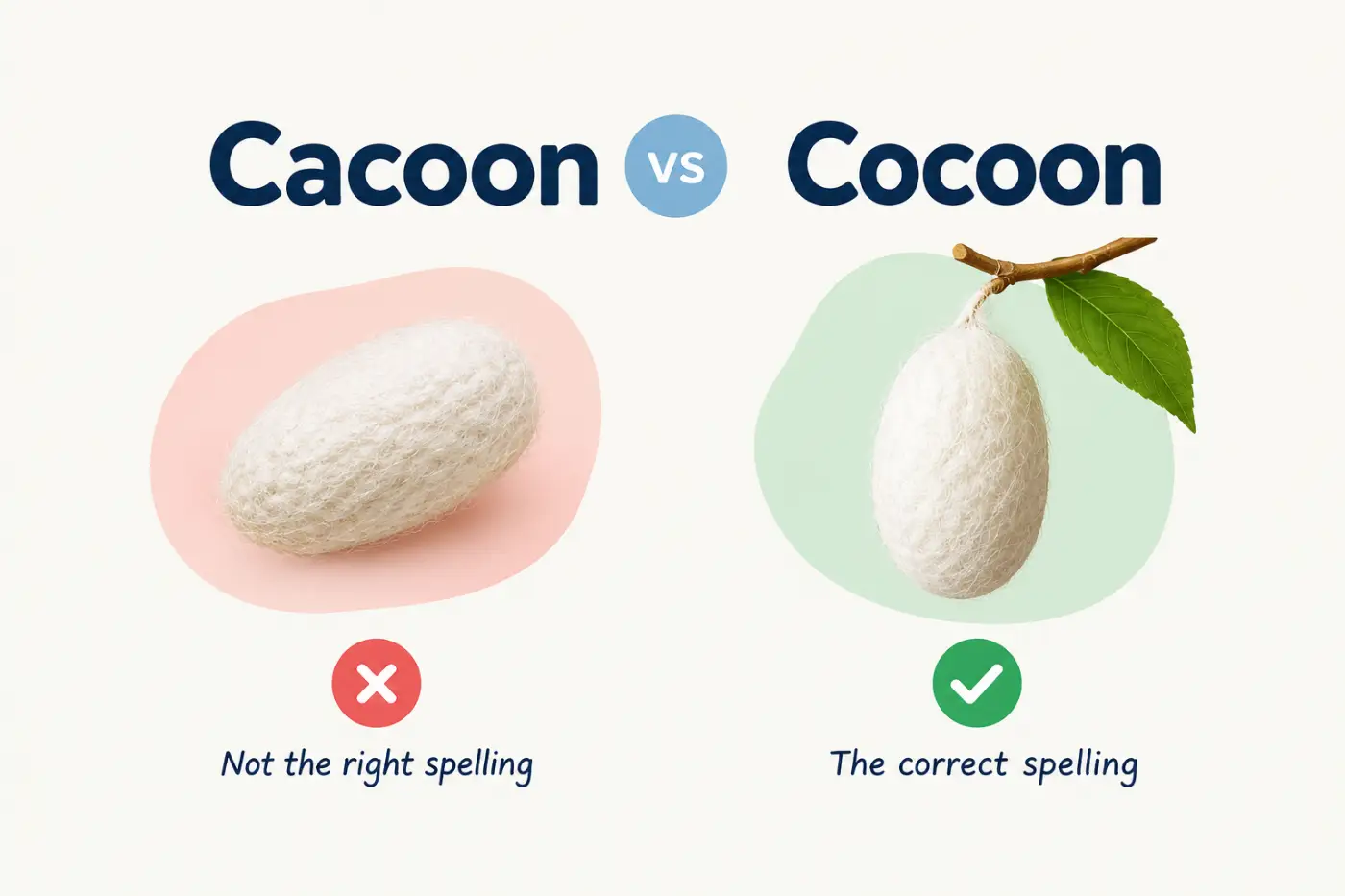
If you’ve ever wondered about cacoon or cocoon you may have paused because both spellings look believable. Only one is correct in standard English. The correct spelling is cocoon.
A cocoon is a protective covering that some insects create around themselves before they change into their adult form. The word also has a figurative meaning. Someone can describe a quiet private space as a cocoon when it feels safe and protected.
The spelling mistake usually comes from the way the word sounds. The first syllable can make the spelling feel less obvious. People may also write the word based on how they hear it instead of remembering its letters.
This guide explains the correct spelling and meaning of cocoon. You’ll also see real examples that show how the word works in everyday writing. Along the way you’ll learn where the confusion comes from and how to remember the spelling without second guessing yourself.
Quick Definition
A cocoon is a protective covering made by certain insects during a stage of their development. A moth larva is a familiar example. The word can also describe a person or place that provides a feeling of comfort and protection.
Direct Answer
Cocoon is the correct spelling. Cacoon is a misspelling and should not be used in standard English.
Comparison Table
| Word | Meaning | Example Sentence | When to Use It |
|---|---|---|---|
| Cocoon | A protective covering made by some insects or a safe private space. | The moth formed a cocoon before becoming an adult. | Use this spelling in all standard English writing. |
| Cacoon | Incorrect spelling of cocoon. | This spelling is incorrect. | Do not use it. |
Why The Spelling Causes Confusion
The word cocoon is easy to say but slightly harder to spell. When people hear it they may focus on the sound rather than the exact letters. That can lead to the incorrect spelling with ca at the beginning.
Another reason for the confusion is that English has many words where the letter c can represent different sounds. In cocoon the first c has a hard sound. The second c also has a hard sound. Once you know the spelling this pattern is simple but it may not be obvious when you first hear the word.
The pronunciation also doesn’t give you a strong clue about the first vowel. The beginning sounds like coo. That can tempt someone to spell the word from memory in a different way.
The safest approach is to remember the word as a whole rather than trying to spell it from sound alone. The correct form starts with co and ends with coon.
What Does Cocoon Mean
The main meaning of cocoon is a protective covering that an insect creates around itself during a stage of development. The covering helps protect the insect while it changes.
Moths are strongly associated with cocoons. A caterpillar may spin silk around itself and remain inside while its body changes. When the process is complete the adult insect leaves the protective covering.
For example:
- The caterpillar built a cocoon on a tree branch.
- We found an empty cocoon in the garden.
- The moth emerged from its cocoon after several days.
The word can also be used more broadly. A person may describe their home as a cocoon when it gives them a warm and protected feeling.
For example:
- After a long day at work I like to relax in my cozy cocoon at home.
- The small bedroom became a peaceful cocoon during the winter.
- She created a quiet cocoon where she could read and rest.
The literal meaning relates to an insect. The figurative meaning relates to comfort safety and privacy.
The Difference Between A Cocoon And A Chrysalis
People often use cocoon and chrysalis as if they mean exactly the same thing. They are related but they are not identical.
A cocoon is a protective silk covering that certain insects make around themselves. Moth caterpillars are well known for doing this.
A chrysalis is the hard outer form that a butterfly pupa develops into during metamorphosis. Butterflies do not usually spin silk cocoons around their pupae.
That distinction matters when you’re writing about insects. If you’re describing a butterfly hanging from a plant you may be thinking of a chrysalis rather than a cocoon.
For example:
- The butterfly remained inside its chrysalis.
- The moth caterpillar spun a cocoon around itself.
Both words describe an important stage of insect development but they refer to different structures.
How Cocoon Is Used In Nature
A cocoon plays a protective role for certain insects. Before becoming an adult insect a larva may need a protected place where its body can undergo major changes.
The silk used to make a cocoon comes from the insect itself. A caterpillar produces silk and uses it to build a covering around its body. The finished structure can vary in size shape color and texture depending on the species.
A cocoon isn’t simply a sleeping bag for an insect. Major biological changes happen inside. The insect goes through metamorphosis and develops adult features.
Moths provide one of the best known examples. After the larval stage a moth caterpillar may create a cocoon and remain inside while it develops. Once the adult moth is ready it leaves the protective covering.
This natural process explains why the word has become linked with change. A person can use cocoon as a metaphor for a protected period before moving into a new stage of life.
Examples Of Cocoon In Real Sentences
The word appears in science writing children’s books nature articles and everyday speech. The meaning becomes easier to understand when you see it in different contexts.
In Nature Writing
- The tiny cocoon was hidden beneath a leaf.
- We spotted several cocoons attached to the branches.
- The moth emerged from its cocoon during the night.
These examples use the literal meaning. The word refers to a physical structure connected with insect development.
In Everyday Writing
The figurative meaning is also common.
- Her apartment felt like a warm cocoon during the storm.
- He stayed in his quiet cocoon for most of the weekend.
- The blanket created a cozy cocoon around the sleeping child.
Here the word doesn’t refer to an actual insect covering. It describes a place or situation that feels safe comfortable and protected.
In Creative Writing
Writers often use cocoon as an image for personal growth. A character may withdraw from the outside world for a while before becoming more confident or starting a new chapter.
For example:
- During those quiet months she lived in a cocoon of books music and reflection.
- The small studio became his cocoon while he worked on his first novel.
This use gives the word a deeper meaning. It suggests protection but it can also suggest transformation.
The Correct Spelling Pattern
The easiest way to remember the spelling is to focus on the beginning of the word. Cocoon starts with co followed by coon.
Think of it as two parts.
Co + coon = cocoon.
The repeated co sound can help you remember the spelling. The word does not begin with ca. That is the key difference between the correct spelling and the common mistake.
Once you recognize the pattern you can quickly spot the incorrect form. If you write cacoon the first part doesn’t match the standard spelling of the word.
It’s also useful to remember that the word has two c letters. The first one appears at the beginning and the second one appears in the middle.
C O C O O N
Seeing the complete word several times can make the correct form much easier to recall.
Why The Incorrect Spelling Looks Familiar
A misspelling can look surprisingly natural when you’ve seen it often enough. Your brain doesn’t always inspect every letter when you read. Instead it often recognizes the general shape of a familiar word.
That is why cacoon may look acceptable at first glance. The word has the same length and a similar rhythm. The main difference is the vowel after the first c.
This happens with many commonly misspelled English words. Familiarity can make an incorrect version feel right even when it isn’t.
The solution isn’t to worry about every letter you write. Instead learn the correct form and notice the part that causes trouble. For this word that means remembering co at the beginning.
A Simple Memory Trick
Try thinking of the word as two matching parts.
Co + coon.
The first two letters are co. The next part starts with another co. That repeated pattern gives you a quick visual clue.
You can also connect the word with the phrase cozy cocoon. Both words start with co. This isn’t a spelling rule but it can make the correct form easier to remember.
For example:
- The moth rested inside its cocoon.
- My reading chair feels like a cozy cocoon.
If you remember cozy cocoon you may find it easier to recall the spelling when you need it.
Common Mistakes With Cocoon
The most common mistake is changing the first o to a. That creates the incorrect spelling cacoon.
Another mistake is leaving out one of the repeated letters. Because the word contains several vowels in a row some people may type it too quickly and drop an o.
For example the correct form has four vowels after the first consonant pattern:
c o c o o n
The two o letters in the middle are important. Writing cocon leaves one out and produces another incorrect form.
You may also see people add or remove letters because they are trying to match the pronunciation. That approach can cause trouble with English words because spelling and sound don’t always line up perfectly.
The best habit is simple. Learn the visual shape of the correct word and use it consistently.
Is Cocoon A Noun Or A Verb
Cocoon can work as both a noun and a verb.
As a noun it refers to the protective covering made by certain insects.
- The caterpillar disappeared inside its cocoon.
As a verb it means to surround or protect something with a cocoon. It can also describe a person who withdraws into a safe comfortable environment.
- The insect cocooned itself in silk.
- She cocooned herself in blankets and watched a movie.
The verb form is less common in everyday speech than the noun. Still it appears in both literal and figurative writing.
Understanding both forms gives you a better grasp of the word. You won’t just know how to spell it. You’ll also know how to use it naturally.
Cocoon As A Figurative Word
English speakers often use physical objects as metaphors for feelings and experiences. Cocoon is a good example because it naturally suggests safety and protection.
Someone might say they spent the weekend in a cocoon of comfort. They aren’t claiming they turned into an insect. They mean they stayed in a protected private space away from stress or outside pressure.
The figurative meaning can also suggest personal growth. A person may spend time alone while learning something new recovering from a difficult period or preparing for a major change.
For example:
- After moving to a new city she created a little cocoon where she could feel at home.
- He spent the winter in a quiet cocoon before returning to social life.
This metaphor works because a real insect spends time protected before emerging in a different form. The image is easy to understand and can add warmth to a piece of writing.
Where The Word Cocoon Comes From
The word cocoon has a long history. English borrowed it from French in the seventeenth century. The French word was cocon. It came from an older word connected with the idea of a shell or covering.
That history helps explain why the spelling doesn’t always feel obvious to English speakers. The word wasn’t built from a simple English spelling pattern. It entered English as a borrowed word and kept its distinctive form.
You don’t need to know its history to spell it correctly. Still, knowing where a word comes from can make an unusual spelling easier to accept. Many English words have similar stories because English has borrowed vocabulary from French, Latin, Greek, and many other languages.
The modern spelling is cocoon. It has two c letters and four o letters. Seeing the complete pattern is more useful than trying to spell the word from its sound.
How To Pronounce Cocoon
The word cocoon has two syllables. It is commonly pronounced like kuh Koon.
The first syllable is weak. The second syllable gets more stress. That pronunciation can make the spelling harder to guess because the first vowel isn’t strongly pronounced.
This is a good example of why pronunciation alone isn’t always enough to spell an English word. You may know exactly how the word sounds and still need to remember its written form.
Try saying the word slowly while looking at the spelling.
Cocoon.
The first part is co and the second part begins with coon. Repeating that pattern can help connect the sound with the correct written form.
What Is A Cocoon Made Of
A cocoon is often made from silk produced by an insect. Moth caterpillars are especially well known for producing silk cocoons.
The caterpillar has special glands that produce silk. It uses the silk to build a protective covering around its body. The exact structure depends on the species.
Some cocoons look like small white or cream colored bundles. Others can be brown gray or mixed with bits of leaves and other material. A cocoon doesn’t always look like the neat oval shape people see in pictures.
The structure provides protection while the insect develops. It can help shield the developing insect from weather predators and other threats.
Not every insect creates a cocoon. That’s an important detail when talking about insect life cycles. Some insects have a pupa that remains exposed instead of being surrounded by a silk covering.
Cocoon And Metamorphosis
The word cocoon is closely connected with metamorphosis. Metamorphosis is the process through which some animals change form as they develop.
Moths and butterflies are famous examples. Their life cycle includes several stages. It begins with an egg. The young insect then develops into a larva. Later it enters the pupa stage before becoming an adult.
For moths the pupa may be protected inside a cocoon. The insect undergoes major changes during this stage.
A caterpillar doesn’t simply grow larger inside the covering. Its body changes in significant ways as it develops into an adult moth.
This is one reason cocoon has become such a useful metaphor for human change. A person may spend time in a quiet or protected period before starting something new.
Cocoon And Chrysalis Are Not The Same
The difference between these two words causes a lot of confusion.
A cocoon is an outer covering that some insects create around their pupal stage. A chrysalis is the pupal form of a butterfly.
Butterflies generally don’t spin silk cocoons around themselves. Instead the chrysalis forms as the outer body of the pupa.
Moths are more closely associated with cocoons. Some moth species create elaborate silk coverings before entering the pupal stage.
So if you’re writing about a butterfly hanging from a branch you will usually want chrysalis rather than cocoon.
For example:
- The butterfly emerged from its chrysalis.
- The moth developed inside its cocoon.
The distinction may seem small but it matters in science writing. Using the right term makes your description more accurate.
Cocoon And Nest Are Not The Same
A cocoon is also different from a nest.
A nest is generally a structure where an animal lives rests lays eggs or raises young. Birds build nests from materials such as twigs grass feathers and mud. Some insects also build nests.
A cocoon serves a different purpose. It surrounds or protects a developing insect during a particular stage of its life cycle.
For example a bird may return to the same nest many times. A developing moth does not use its cocoon as a permanent home.
The two words can sometimes appear in the same nature article but they describe different things.
How To Use Cocoon In A Sentence
The word is easy to use once you understand its two main meanings. Use it literally when you’re talking about insects. Use it figuratively when you’re describing a place or situation that feels protective or private.
Literal Examples
The following sentences describe real insect cocoons.
- The child found a cocoon hanging from a branch.
- The moth stayed inside its cocoon during development.
- We watched the insect emerge from its cocoon.
- Several cocoons were attached to the underside of the leaves.
- The scientist examined the cocoon under a microscope.
Each sentence refers to an actual protective covering.
Figurative Examples
The following sentences use the word as a metaphor.
- Her bedroom became a cozy cocoon during the cold winter.
- He created a quiet cocoon where he could work without distractions.
- The cabin gave us a warm cocoon during the storm.
- After a busy week I like to retreat into my little cocoon.
- Music helped create a peaceful cocoon around her.
In these examples the word creates an image of comfort and protection. The reader understands that the person isn’t literally inside an insect covering.
Common Phrases With Cocoon
Some combinations sound especially natural in English. Learning them can help you use the word with confidence.
Cocoon Of Comfort
This phrase describes a place or situation that feels safe and relaxing.
- Her home became a cocoon of comfort after a stressful day.
Cocoon Of Silence
This phrase suggests a quiet place that blocks out noise and distractions.
- The library offered a cocoon of silence where he could concentrate.
Cocoon Of Warmth
This expression creates an image of being surrounded by warmth.
- The blanket wrapped her in a cocoon of warmth.
Cocoon Yourself
This phrase means to withdraw from the outside world and stay in a private comfortable space.
- I just want to cocoon myself at home this weekend.
This expression is usually figurative. It can suggest rest and self care but it can also describe someone who avoids contact with other people.
Is Cocoon Always About Insects
No. The original and most direct meaning relates to insects but the word has developed a common figurative use.
You might see cocoon in writing about homes travel personal space recovery creativity or emotional comfort. In those settings it usually describes something that surrounds a person and makes them feel protected.
For example a hotel room may feel like a cocoon after a long flight. A favorite chair may become a cocoon during a quiet evening. A small cabin in the woods may offer a cocoon from a busy city.
The metaphor works because people already understand the basic image. Something surrounds you and gives you a break from the outside world.
Is Cocoon A Positive Word
Usually yes but context matters.
When someone describes a room as a cocoon they often mean it feels warm private peaceful and comfortable. The word can create a pleasant image of safety.
However the same idea can sometimes suggest isolation. If someone spends too much time inside their cocoon they may be avoiding people or responsibilities.
Compare these examples.
- After the stressful trip the hotel room felt like a peaceful cocoon.
This sounds positive. The person needed rest.
Now consider this sentence.
- He stayed inside his cocoon and refused to talk to anyone.
Here the word suggests isolation instead of simple comfort.
The meaning comes from the context. That is common with figurative language.
Common Spelling Mistakes To Avoid
The main spelling problem is changing the first o to a. That produces the incorrect form.
Another mistake involves leaving out one of the middle vowels. The correct spelling contains two o letters together near the end.
A useful visual check is to look at the word in three parts.
Co + co + on.
You don’t need to pronounce it that way. The purpose is simply to notice the letters.
The full spelling is:
C O C O O N
If you can picture those six letters you are less likely to type the word incorrectly.
A Better Way To Remember The Spelling
Don’t try to memorize a complicated spelling rule for this word. There isn’t a special rule that makes the answer obvious.
Instead remember the repeated co pattern.
Think of these two parts:
co + coon
Both begin with co. That gives you a simple visual cue.
You can also connect the word with something familiar. Imagine a cozy cocoon. Both words begin with co. This small association can make the spelling easier to recall.
Another useful method is to write one or two natural sentences with the word. For example:
- The moth formed a cocoon on the branch.
- My favorite chair feels like a cozy cocoon.
After using the word in context a few times the spelling becomes much easier to recognize.
Why You Should Not Spell From Sound Alone
English spelling and pronunciation don’t always match perfectly. This word shows why.
When you hear cocoon you can understand the word immediately. But the sound doesn’t tell you that the written word contains two c letters and several o letters.
If you try to write every English word exactly as it sounds you will eventually run into problems. Words such as enough though and through make that clear.
The same idea applies here. Learn the written form and connect it with the sound. Don’t rely on pronunciation as your only spelling guide.
When To Use Cocoon In Formal Writing
You can safely use cocoon in formal writing when it fits the subject.
In science writing it can describe an insect structure.
- The larva remained inside the cocoon until adult development was complete.
In general writing it can describe a protected environment.
- The retreat offered guests a quiet cocoon away from the noise of the city.
In creative writing it can work as a metaphor for comfort transformation or isolation.
The key is to make sure the context makes the intended meaning clear. If you’re writing for a science audience be precise about the type of insect and its life cycle. If you’re writing creatively you have more freedom to use the word as an image.
When Cocoon Is Not The Best Word
Sometimes another word gives your reader a clearer picture.
If you mean a place where a person lives you might need home or shelter. If you mean a quiet private space you could use sanctuary or retreat. If you’re talking about a butterfly’s pupal stage chrysalis is usually more precise.
For example:
- My bedroom is my sanctuary.
This sentence directly says that the bedroom feels safe and peaceful.
You could also say:
- My bedroom feels like a cocoon.
That version is more visual and expressive. It suggests that the room surrounds you with comfort.
The best word depends on the image and tone you want. Cocoon is especially useful when you want the reader to picture protection and transformation at the same time.
When To Use Cocoon In Everyday Writing
You don’t need to write about insects to use cocoon correctly. The word works well in everyday writing when you want to describe comfort privacy or protection. It can make a simple description feel more vivid because it gives the reader a clear picture.
Imagine coming home after a long and stressful day. You close the door turn on a soft lamp and settle into your favorite chair with a blanket. You might describe that space as a cocoon because it separates you from the noise and pressure outside.
For example:
- After work I curled up on the sofa and settled into my little cocoon.
- The cabin felt like a warm cocoon during the snowstorm.
- Her reading corner became a quiet cocoon away from the rest of the house.
The word works best when the surrounding sentence supports the idea of protection. It shouldn’t feel like a random fancy word. Give the reader enough context to understand the image.
How Writers Use Cocoon As A Metaphor
A metaphor compares one thing with another to create a stronger image. Cocoon works well as a metaphor because most people already understand what a real cocoon does.
It protects an insect during a major stage of development. That idea can be transferred to human experiences. A person might spend time alone while healing learning creating or preparing for a change.
For example:
- The quiet retreat became a cocoon where she could recover from a difficult year.
- His small workshop was a cocoon for new ideas.
- The young artist worked inside a creative cocoon before sharing her paintings with the public.
These sentences don’t suggest that the person is literally inside a cocoon. Instead they compare a safe environment with the protection provided by a real insect covering.
The metaphor can also suggest transformation. A person may enter a quiet period and later emerge with a new outlook or stronger sense of self.
That makes cocoon a useful word in personal essays stories articles and reflective writing.
Cocoon And Personal Growth
The connection between a cocoon and personal growth is especially common. The insect enters one stage of life and eventually emerges in another form. Writers often use that process as a comparison for human development.
Someone might describe a period of study as a cocoon. A student spends months learning and practicing before reaching a new level. A writer may work alone on a book before finally publishing it. Someone recovering from a major life change may need quiet time before feeling ready to move forward.
For example:
- College became a cocoon where she learned to trust herself.
- His small business started in a quiet cocoon of planning and practice.
- The months she spent alone gave her the space she needed to grow.
The word doesn’t promise that change will happen. It simply creates an image of a protected period that may lead to something new.
Cocoon In Creative Writing
Writers often choose cocoon because it does more than give a basic meaning. It creates an image in the reader’s mind.
Compare these two sentences.
- She stayed home during the storm.
- She stayed home in a warm cocoon of blankets while the storm passed outside.
The first sentence gives information. The second creates a scene. You can almost picture the person wrapped in blankets while rain and wind continue outside.
This is why figurative language can make writing feel more personal. A well chosen metaphor gives readers something they can picture instead of simply telling them a fact.
Still, don’t use cocoon in every sentence about comfort. Repeating the same metaphor too often can make your writing feel forced. One strong image is usually enough.
The Difference Between Cocoon And Shell
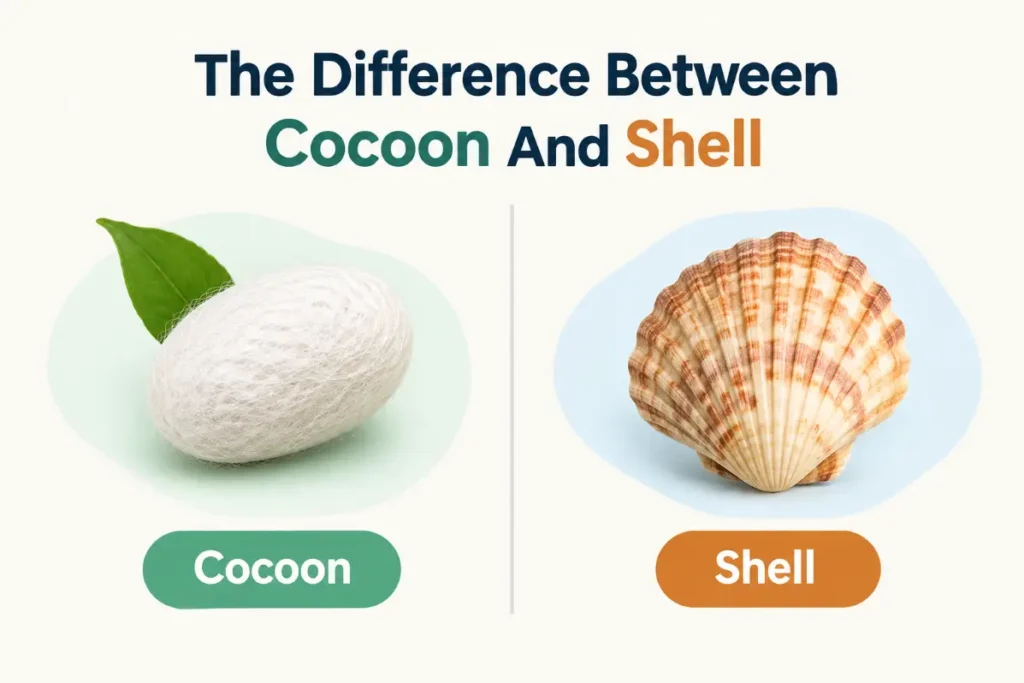
Cocoon and shell can both suggest protection but they describe different things.
A shell is a hard outer covering found on certain animals such as turtles and many mollusks. It can protect the animal throughout much or all of its life.
A cocoon is usually a temporary protective covering connected with a particular stage of insect development.
The words can also work differently as metaphors.
- She built a shell around herself.
This often suggests emotional distance. The person is protecting themselves from other people.
- She created a cocoon for herself.
This usually suggests comfort privacy or a period of personal change.
The difference is subtle but useful. Shell often suggests defense. Cocoon often suggests protection and transformation.
The Difference Between Cocoon And Shelter
A shelter is a place that protects someone from danger or difficult conditions. It can be a building a temporary structure or another safe location.
A cocoon has a more specific and often softer image. It suggests being surrounded by comfort and protection.
For example:
- The family found shelter from the storm.
This sentence focuses on safety from danger.
Now consider:
- The family turned their living room into a cozy cocoon during the storm.
This sentence focuses more on comfort and privacy.
Both words can describe protection but they create different feelings.
The Difference Between Cocoon And Sanctuary
Sanctuary is another word that can overlap with cocoon in figurative writing. A sanctuary is a safe or peaceful place where someone can find protection or rest.
For example:
- Her garden became a sanctuary after a stressful week.
You could also write:
- Her garden became a cocoon after a stressful week.
The first sentence sounds more direct. The second creates a stronger image of being surrounded and protected.
Cocoon often suggests temporary retreat and personal change. Sanctuary can suggest a lasting safe place. Context determines the best choice.
Plural Form Of Cocoon
The plural form is cocoons.
You simply add s to the end of the word.
For example:
- We found one cocoon on the branch.
- We found several cocoons on the branches.
This follows a simple plural pattern. There is no need to change the spelling of the main word.
The same rule applies when the word is used figuratively.
- The homes felt like quiet cocoons during the storm.
Learning the plural form can help you use the word naturally in longer sentences.
Past Tense Of Cocoon
When cocoon works as a verb the past tense is cocooned.
For example:
- The caterpillar cocooned itself in silk.
- She cocooned herself under a blanket with a good book.
- He cocooned himself at home for the weekend.
The spelling adds ed to the base word. The double o remains part of the word.
As a verb the word is less common than the noun but it can be useful in both scientific and casual writing.
Can Cocoon Be Used As An Adjective
Cocoon is mainly used as a noun and sometimes as a verb. Writers may also place it before another noun to describe something related to a cocoon.
For example:
- The cocoon stage lasts for several days.
- Scientists studied the cocoon structure.
- The insect remained in the cocoon chamber.
In these examples cocoon helps describe another noun. English often allows nouns to work this way.
You don’t need to change cocoon into a different spelling for these uses. The context tells the reader how the word functions.
Why Context Matters With Cocoon
A single word can carry different meanings depending on the sentence around it. Cocoon is a good example.
If you write:
- The cocoon was attached to the branch.
The reader will understand that you’re talking about an insect structure.
If you write:
- Her bedroom was a cocoon after a stressful week.
The reader will understand that you’re using the word figuratively.
The surrounding words provide the clue. This is one reason you should learn vocabulary through sentences instead of memorizing isolated definitions.
When you understand how a word behaves in real sentences you can use it with much more confidence.
Common Questions About Cacoon Or Cocoon
People often search for this spelling because the incorrect version looks close to the correct one. The best way to avoid the mistake is to focus on the visual pattern instead of trying to guess the spelling from pronunciation.
Remember that the correct word begins with co. It then repeats that pattern before ending with on.
Think of it as:
co + coon
That simple pattern is enough to help you remember the word in most situations.
How To Proofread This Word
If you’re unsure about the spelling while writing don’t stare at the word for too long. Instead compare it with the pattern you already know.
Check the first two letters. They should be co.
Then look at the middle. The word contains another c followed by oo.
Finally check the ending. It finishes with n.
The complete form is:
c o c o o n
This quick visual check takes only a moment. It can be especially helpful when you’re writing an article essay school assignment or work document.
How To Teach The Spelling
If you’re helping a child or English learner remember this word keep the lesson simple. Avoid giving them a long list of spelling rules.
Write the word clearly and say it aloud. Then break it into two memorable parts.
Co plus coon.
Next place it in a sentence.
- The caterpillar made a cocoon.
Then show the figurative use.
- My bedroom feels like a cozy cocoon.
Using the word in two different ways helps the learner understand both the spelling and the meaning. Pictures can also help because a real image of a moth cocoon creates a strong connection between the word and its meaning.
A Quick Spelling Test
Try covering the word and writing it from memory.
Start with the first part.
Co
Then add the second part.
Coon
Put them together.
Cocoon
If you remember the repeated co pattern you won’t need to guess between the two spellings. The incorrect form begins with ca and breaks the pattern.
You can also test yourself by using the word in a sentence.
- The moth emerged from its cocoon.
If the spelling looks natural to you now you’re on the right track.
Why Reading Helps With Spelling
Good spelling isn’t only about memorizing rules. Reading plays a major role too.
When you read often you see correct spellings again and again. Your brain begins to recognize familiar word shapes automatically. That makes it easier to notice a spelling that looks wrong.
For example after seeing cocoon many times the incorrect form may start to look strange. You don’t always need to explain why. Your visual memory simply recognizes the correct version.
This is one reason reading high quality books articles and other well edited material can improve spelling over time.
Final Spelling Reminder
If you’re still unsure about cacoon or cocoon don’t try to solve the word by sound. Look at its structure instead.
The correct spelling starts with co. It contains another c followed by two o letters. It ends with n.
Think co plus coon and you’ll have a simple reminder whenever the spelling slips your mind.
The word can describe a real protective covering made by certain insects. It can also describe a comfortable private space in figurative writing. Once you understand both meanings you’ll find it much easier to recognize and use the word naturally.
FAQs
Is cocoon the correct spelling?
Yes. Cocoon is the correct spelling in standard English. The spelling with a after the first c is incorrect.
Why is cocoon spelled with two c letters?
The standard spelling is cocoon. It contains a c at the beginning and another c before the final group of vowels. Thinking of the word as co plus coon can make the spelling easier to remember.
What does cocoon mean?
A cocoon is a protective covering made by certain insects during a stage of development. The word can also describe a comfortable or private place that makes someone feel safe and protected.
Is a butterfly inside a cocoon?
Usually no. A butterfly develops inside a chrysalis rather than a silk cocoon. Moths are more commonly associated with cocoons.
What is the plural of cocoon?
The plural is cocoons. You simply add s to the end of the singular form. For example you could say that several cocoons were attached to tree branches.
Can cocoon be used as a verb?
Yes. Cocoon can be used as a verb when something surrounds or protects a person or an insect. For example you could say that someone cocooned themselves in a warm blanket.
Can cocoon describe a person or place?
Yes. This is a common figurative use. A person may describe their home bedroom or another private space as a cocoon when it gives them comfort peace and protection.
Is cocoon a noun or a verb?
It can be both. As a noun it refers to the protective covering associated with certain insects. As a verb it describes the act of surrounding or protecting something or withdrawing into a comfortable private space.
Conclusion
If you’ve been stuck on cacoon or cocoon the answer is simple. Cocoon is the correct spelling. The incorrect version changes the first o to a and doesn’t belong in standard English writing.
The word has two useful meanings. Its literal meaning refers to a protective covering made by certain insects during development. Its figurative meaning describes a place or situation that feels safe private warm or comfortable.
The easiest way to remember the spelling is to see it as co plus coon. The repeated co pattern gives you a quick visual reminder and helps you avoid guessing from pronunciation.
Next time you need the word remember the six letters in order. C O C O O N. That small spelling check is all you need to write it correctly with confidence.

Dr. Elena Vance holds a Ph.D. in Linguistics from Columbia University and has spent over 15 years analyzing the evolution of the English language. A former university professor turned full-time writer and editor, Elena specializes in breaking down high-level grammatical concepts, punctuation nuances, and style guides (APA, Chicago, MLA) into clear, actionable advice. When she isn’t hunting down dangling modifiers, she can be found collecting vintage dictionaries and reading classic literature.